Introduction
Wheezing and asthma are among the most common health problems in young children and are major causes of emergency department visits and hospitalization in early childhood with significant health services costs.Reference To, Dell, Dick and Cicutto 1 , Reference Krahn, Berka, Langlois and Detsky 2 Prevalence estimates for early childhood wheezing in Ontario are 22%, and range from 10 to 19% for asthma.Reference Crighton, Feng, Gershon, Guan and To 3 , Reference Garner and Kohen 4 Established risk factors for childhood wheezing include family history of asthma, male gender and exposure to tobacco smoke and environmental allergens.Reference Sears 5 Emerging evidence suggests that vitamin D may be associated with reduced risk of childhood wheezing and asthma.Reference Ginde, Mansbach and Camargo 6 – Reference Lau 9 It is hypothesized that vitamin D may play a protective role through improved immune functions including better response to respiratory infections, decreased airway inflammation and optimal smooth muscle proliferation contributing to improved lung development.Reference Litonjua 7
A growing body of literature suggests that vitamin D exposure in utero may be important for lung development and programming the immune system.Reference Yong, Wu, Wang and Yang 10 – Reference Devereux 12 Several studies have identified an inverse association between vitamin D intake, from foods or supplements, during pregnancy and childhood wheezing and asthma in the offspring.Reference Devereux, Litonjua and Turner 13 – Reference Maslova, Hansen and Jensen 17 Some of the studies regarding the association between maternal 25-hydroxyvitamin D (25(OH)D) concentrations (the preferred vitamin D biomarker) during pregnancy and wheezing or asthma in early childhood have reported an inverse association,Reference Zosky, Hart and Whitehouse 18 but not all.Reference Gale, Robinson and Harvey 19 – Reference Magnus, Stene and Håberg 22 Two studies of cord blood 25(OH)D concentrations both found evidence of an inverse association with wheezing in young children but no association with asthma in later childhood.Reference Baïz, Dargent-Molina, Wark, Souberbielle and Annesi-Maesano 23 , Reference Camargo, Ingham and Wickens 24
The relationship between early childhood 25(OH)D concentration and wheezing or asthma is less clear. Two large studies found no association between 25(OH)D and adolescent asthmaReference Gergen, Teach and Mitchell 25 or wheezingReference Tolppanen, Sayers and Granell 26 , whereas another study found that low 25(OH)D at 6 years of age was associated with increased risk for asthma at 14 years of age.Reference Hollams, Hart and Holt 27 Other studies have suggested that lower 25(OH)D may be associated with wheezing severity, including increased medication use, hospitalization and emergency department visits, among children with asthma older than 5 years of age.Reference Brehm, Acosta-Pérez and Klei 28 , Reference Brehm, Schuemann and Fuhlbrigge 29
The primary objective of this study was to evaluate whether vitamin D exposures, including maternal vitamin D supplementation during pregnancy, child vitamin D supplementation or child 25(OH)D, were associated with the risk for wheezing in early childhood. The secondary objectives were to evaluate whether the aforementioned vitamin D exposures were associated with diagnosed asthma or wheezing severity.
Methods
Participants
Healthy children from 0 to 5 years (up to 72 months) of age attending scheduled primary-care health supervision visits through TARGet Kids! (The Applied Research Group) were recruited to the study between 2008 and 2012 and were offered annual follow-up (www.clinicaltrials.gov; NCT01869530). TARGet Kids! is a primary-care practice-based research network (www.targetkids.ca) and has been described previously.Reference Carsley, Borkhoff and Maguire 30 Children were recruited from nine paediatric or family practice primary-care clinics in Toronto, Canada. Children who had severe developmental delay or chronic illness (except for asthma) and if they were born before 32 weeks of gestational were excluded from the study.
Study design
A prospective cohort study was conducted. Baseline was defined as the first visit with questionnaire data on vitamin D supplement intake for all the children participating in TARGet Kids! and follow-up was defined as the last visit with wheezing data. Blood testing at baseline with 25(OH)D measurement was available for a subset of these children. Informed consent was obtained from parents of all participating children and ethical approval was obtained from the Research Ethics Board of The Hospital for Sick Children and St. Michael’s Hospital.
Exposure variables
Three measures of vitamin D exposure were evaluated (hereafter referred to as ‘vitamin D exposures’): (1) maternal vitamin D supplementation in pregnancy, (2) child vitamin D supplementation and (3) child serum 25(OH)D concentration. Maternal vitamin D supplementation in pregnancy was measured at baseline through a parent-completed standardized data collection from using the question ‘Did your child’s biological mother take any vitamins or supplements during her pregnancy?’. Two separate supplement variables were derived during pregnancy: single product vitamin D supplement use and multivitamin use. Data on vitamin D dose was not available for this analysis, but standard prenatal multivitamins contain 400 IU of vitamin D, whereas adult vitamin D supplements typically contain 1000 IU; thus, these two sources were evaluated separately. The Canadian Pediatric Society recommends prenatal vitamin D supplementation of 2000 IU/day.Reference Godel 31
Vitamin D supplementation during childhood was measured at baseline using the question ‘Does your child take any vitamins or supplements regularly?’. One summary variable ‘child vitamin D supplementation’ was derived that included single product vitamin D supplements, multivitamin or multivitamin with iron. In Canada, both children’s over-the-counter multivitamins and single product vitamin D supplements usually contain a vitamin D dose of 400 IU.
Child serum 25(OH)D was measured from blood samples collected at baseline by a trained phlebotomist and sent daily to the Mount Sinai Services Laboratory in Toronto (www.mountsinaservices.ca). Serum 25(OH)D was measured using a competitive two-step chemiluminescence assay (Diasorin LIAISON). This assay was regularly calibrated according to the internationally recognized Vitamin D External Quality Assessment Scheme.Reference Carter, Carter, Jones and Berry 32 Extensive testing and validation of this assay have been performed and demonstrated an intra-assay imprecision of 7.2% at a concentration of 213 nmol/l and an inter-assay imprecision of 4.9% at 32 nmol/l, 8.9% at 77 nmol/l and 17.4% at 213 nmol/l, values which are well within acceptable limits for biochemical measurements.Reference Maunsell, Wright and Rainbow 33 , Reference Singh, Taylor, Reddy and Grebe 34 For all the analyses, serum 25(OH)D was considered as both a continuous variable and categorized as <50 nmol/l v. ⩾50 nmol/l based on the Institute of Medicine’s reference cut-off point. 35
Outcome variables
Three parent-reported outcome measures were evaluated at follow-up. Our primary outcome was parent-reported wheezing. Secondary outcomes included parent-reported diagnosed asthma and wheezing severity. Wheezing was measured using the International Study for Asthma and Allergy in Childhood (ISAAC) questionnaire by response to the question ‘Has your child ever had wheezing or whistling in the chest at any time in the past?’.Reference Asher, Keil and Anderson 36 Wheezing severity was measured by response to the ISAAC questions ‘Does your child use asthma medication such as inhalers?’ and ‘During the past 12 months, how many times has your child gone to a hospital emergency room for a wheezing episode?’. Hospitalization and medication use were both categorized as yes or no. Asthma diagnosis was measured by response to the question ‘Has your child been diagnosed with asthma?’.
Other variables
Data on covariates, including potential confounding variables and predictors of the outcome measures, were collected using a parent-completed, standardized questionnaire and physical measurements. Covariates were defined a priori using a causal model, and all adjusted models were fully adjusted for all variables. Covariates included child factors such as age, sex, body mass index (BMI), outdoor play, daycare attendance, birth weight and breastfeeding duration. Additional parental or household factors included median neighbourhood household income, maternal ethnicity, family history of asthma and parental smoking. Median after tax neighbourhood household income was calculated based on the postal code using the Statistics Canada Postal Code Conversion File and data from the 2006 Canadian Census.Reference Wilkins 37 Outdoor play was defined as hours per week spent outside playing. Parental asthma was defined as the mother or father diagnosed with asthma, and parental smoking was defined as smoking by any household member. Child’s birth weight and duration of breastfeeding were based on parent recall. Trained research assistants obtained the child’s current physical measurements including each child’s weight and standing height (or length for children under 2 years old). BMI was calculated as weight in kilograms divided by the square of height in metres.Reference Mei, Grummer-Strawn and Pietrobelli 38 BMI Z-scores were calculated using WHO growth standards. 39 All covariates were measured at baseline, except family history of asthma and parental smoking, which were derived from across all visits.
Statistical analysis
Multivariable logistic regression was used to evaluate whether each baseline vitamin D exposure was associated with our primary outcome (wheezing), and both secondary outcomes, (diagnosed asthma and wheezing severity) at follow-up. Adjusted odds ratios (aOR) and 95% confidence intervals (CI) were reported for all models. Adjusted models included all of the a priori specified, clinically relevant covariates specified above. For the 25(OH)D models, we also evaluated multivariate models with the month of blood draw included. We tested for multicollinearity using the generalized variance inflation factor test. The multiplicative interactions between all vitamin D exposures and both child sex and family history of asthma were evaluated in all models and P<0.05 was considered statistically significant.
All potential confounders had <15% missing data, with the exception of outdoor free play, which had 24% missing data. To avoid bias, which can be introduced from missing data, multiple imputation was conducted using aregImpute in the R package Hmisc (http://biostat.mc.vanderbilt.edu/wiki/Main/Hmisc). Models were run on 50 imputed datasets using the lrm fitter for logistic regression, and the results of the individual analysis were combined to obtain the final estimates.Reference Little and Rubin 40 Data were only imputed for the covariates. Statistical analysis was conducted using SAS statistical software version 9.3 (SAS Institute Inc., Cary, NC, USA) and the R project for statistical computing (http://www.R-project.org).
Results
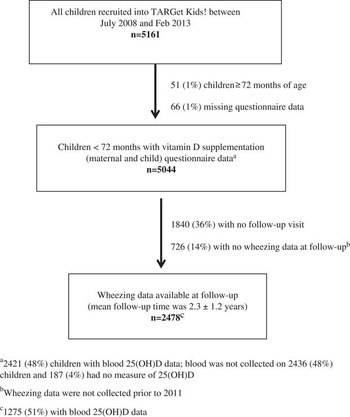
A total of 5161 eligible children were recruited into the TARGet Kids! cohort between July 2008 and February 2013. Baseline maternal and child vitamin D supplementation data were available for 5044 children aged 0–5 years (<72 months), and wheezing data were available from follow-up visits for 2478 children. Baseline 25(OH)D data were available for 2421 children and wheezing data were available at follow-up for 1275 children (Fig. 1). The mean time of follow-up for all children was 2.3±1.2years.
Identification of the study cohort.

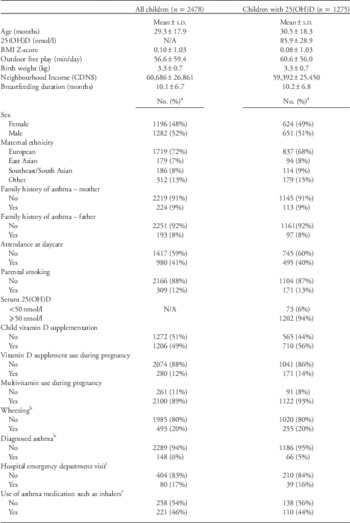
The baseline characteristics of children with serum 25(OH)D measures were similar to children without blood measures (Table 1). Among all, wheezing was reported in 20% of children and 6% were diagnosed with asthma. Among the cohort of children with blood testing, the mean 25(OH)D concentration was 85.9±28.9 nmol/l, and 6% of the children had concentrations <50 nmol/l.
TARGet Kids! baseline population characteristics

a Numbers may not add to the total due to missing values.
b Parent-reported wheezing and diagnosed asthma at follow-up.
c Severity among children with wheezing at follow-up only; n=484 for supplements and n=249 for 25(OH)D.
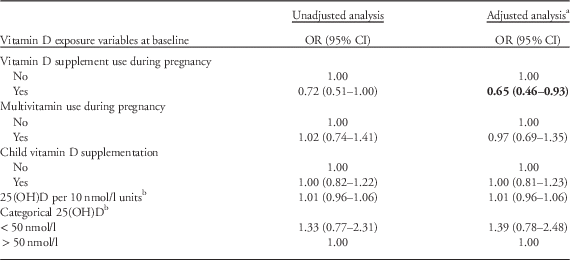
In our primary analysis, a statistically significant inverse association was observed between vitamin D supplement use by mothers during pregnancy and child wheezing (aOR=0.65; 95% CI: 0.46–0.93) (Table 2). Maternal multivitamin intake during pregnancy was not associated with wheezing (aOR=0.97; 95% CI: 0.69–1.35). Child vitamin D supplement use was also not associated with wheezing (aOR=1.00; 95% CI: 0.81–1.23). In the cohort with blood testing, neither 25(OH)D concentration (aOR per 10 nmol/l 25(OH)D=1.01; 95% CI: 0.96–1.06) nor categorized 25(OH)D <50 nmol/l v. ⩾50 nmol/l (aOR=1.39; 95% CI: 0.78–2.48) was associated with wheezing. When we added month of blood draw to the multivariate 25(OH)D models, the aOR did not change.
Logistic regression models for vitamin D exposures and wheezing at follow-up (n=2478)

Bold=statistically significant findings at P<0.05.
a Adjusted for child sex, family income, smoker in household, maternal ethnicity, child in licensed daycare, age in months, z-BMI, birth weight, hours of outdoor free play, breastfeeding duration and family history of asthma (both mother and father). All covariates were measured at baseline except family history of asthma and parental smoking, which were derived from across all visits.
b Serum measured 25(OH)D was available for 1275 children.
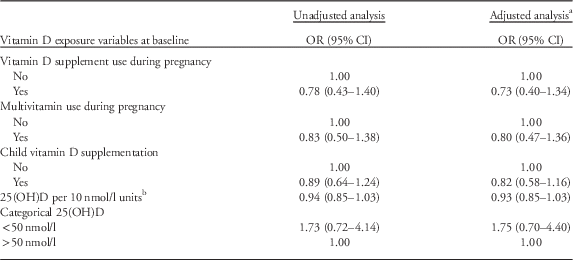
In our secondary analysis, there were no statistically significant associations between any of the vitamin D exposures and diagnosed asthma (Table 3). The effect estimates for both vitamin D supplement use by mothers during pregnancy (aOR=0.73; 95% CI 0.40–1.34) and multivitamin use during pregnancy (aOR=0.80; 95% CI: 0.47–1.36) and child asthma were <1.0, but were not statistically significant. No significant associations were observed for 25(OH)D or vitamin D supplement use in children and diagnosed asthma.
Logistic regression models for vitamin D exposures and diagnosed asthma at follow-up (n=2437)

a Adjusted for child sex, neighbourhood income, smoker in household, maternal ethnicity, child in licensed daycare, child’s age in months, z-BMI, birth weight, hours of outdoor free play, breastfeeding duration and family history of asthma. All covariates were measured at baseline, except family history of asthma and parental smoking, which were derived from across all visits.
b Serum measured 25(OH)D was available for 1252 children.
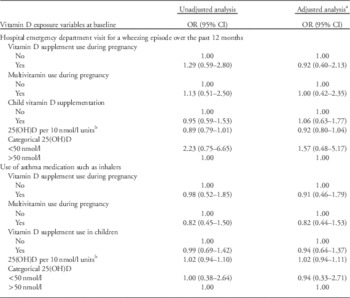
Among 484 children with parent-reported diagnosis of wheezing, no statistically significant associations were observed between any vitamin D exposures and hospital emergency room visits or asthma medication use (Table 4). Only 249 of the children with measured 25(OH)D concentrations had wheezing, and 25(OH)D was also not associated with hospitalization (aOR per 10 nmol/l increase=0.92; 95%CI: 0.80–1.04) or asthma medication use (aOR per 10 nmol/l increase=1.02; 95% CI: 0.94–1.11).
Logistic regression models for vitamin D exposures and wheezing severity among children with wheezing (n=484)

a Adjusted for child sex, neighbourhood income, smoker in household, maternal ethnicity, child in licensed daycare, age in months, z-BMI, birth weight, hours of outdoor free play and breastfeeding duration. All covariates were measured at baseline, except family history of asthma and parental smoking, which were derived from across all visits.
b Serum measured 25(OH)D was available for 249 children.
No statistically significant interactions (P<0.05) were observed between any of the vitamin D exposures and either child sex or family history of asthma in relation to wheezing or diagnosed asthma.
Discussion
We have used prospectively collected data from a cohort of healthy urban pre-school children to evaluate whether vitamin D supplement use, during pregnancy or childhood, or child 25(OH)D concentrations were associated with wheezing, wheezing severity and asthma diagnosis. Use of vitamin D supplements, but not multivitamins, during pregnancy was associated with a 35% reduced risk of wheezing in early childhood. We found no significant associations between child vitamin D supplementation or 25(OH)D concentrations and wheezing. Further, none of the vitamin D exposures were significantly associated with either diagnosed asthma or wheezing severity.
Our study is consistent with other studies that have identified that vitamin D intake during pregnancy was associated with decreased risk of wheezing in the offspring.Reference Devereux, Litonjua and Turner 13 – Reference Maslova, Hansen and Jensen 17 In addition, supporting the hypothesis that vitamin D in early life may be important, two studies on cord blood 25(OH)D concentrations have found evidence of decreased wheezing in young children but not asthma in later childhood.Reference Baïz, Dargent-Molina, Wark, Souberbielle and Annesi-Maesano 23 , Reference Camargo, Ingham and Wickens 24 One large prospective cohort study found that maternal 25(OH)D concentrations <50 nmol/l at 16–20 weeks of gestation were significantly associated with increased risk of both wheezing and asthma at 6 years of age.Reference Zosky, Hart and Whitehouse 18 In contrast, other studies on maternal 25(OH)D concentrations during late or mid-pregnancy have not identified an association with wheezing or asthma at age 6 or youngerReference Pike, Inskip and Robinson 20 , Reference Morales, Romieu and Guerra 21 , and, elsewhere, high 25(OH)D concentrations (>75 nmol/l) during late pregnancy were associated with increased risk of asthma at age 9.Reference Gale, Robinson and Harvey 19 One small randomized controlled trial (n=180), with limited statistical power, randomized mothers to prenatal vitamin D supplementation at 27 weeks of gestation and found no association with child wheezing at 3 years of age.Reference Goldring, Griffiths and Martineau 41 The ‘relatively deficient’ women in this trial were randomized to 800 IU/day or a single bolus of 200,000 IU, and both doses were only modestly associated with cord blood 25(OH)D.Reference Goldring, Griffiths and Martineau 41
Few studies have evaluated the association between early childhood 25(OH)D and wheezing outcomes in children <6 years of age.Reference Demirel, Guner, Celiksoy and Sancak 42 – Reference Stenberg Hammar, Hedlin and Konradsen 44 One small study of 70 children aged between 1 and 3 years in Turkey found that 25(OH)D levels were significantly lower in children with wheezing but did not adjust for possible confounders.Reference Demirel, Guner, Celiksoy and Sancak 42 Another small study of 30 infants with wheezing and 45 controls in Turkey found no association between 25(OH)D and recurrent wheezing at a mean age of 12 months.Reference Ozaydin, Butun, Cakir and Kose 43 A case–control study of 103 children with acute wheezing and 101 controls <4 years of age in Sweden did report a positive association between 25(OH)D <75 nmol/l and acute wheezing.Reference Stenberg Hammar, Hedlin and Konradsen 44 None of these studies used a prospective cohort study design and all of them recruited cases from emergency departmentsReference Stenberg Hammar, Hedlin and Konradsen 44 or hospital outpatient clinics,Reference Demirel, Guner, Celiksoy and Sancak 42 , Reference Ozaydin, Butun, Cakir and Kose 43 which may limit comparison with our prospective cohort study of children recruited from primary-care well-child visits.
In older children and adolescents, some cross-sectional studies have reported that low 25(OH)D concentrations are associated with increased wheezing.Reference Niruban, Alagiakrishnan, Beach and Senthilselvan 45 – Reference Uysalol, Uysalol and Yilmaz 47 However, our findings of a null association are consistent with previous large prospective studies.Reference Gergen, Teach and Mitchell 25 – Reference Hollams, Hart and Holt 27 One of these studies reported a statistically significant association between 25(OH)D at 6 years of age and asthma at 14 years of age among males only,Reference Hollams, Hart and Holt 27 but we did not find a sex difference in our population of young children. It is possible that a sex difference may emerge post-puberty. It is also possible that 25(OH)D levels in our cohort may have been sufficiently high to negate the effect of 25-hydroxyvitamin D on wheezing; only 6% of children had 25(OH)D concentrations <50 nmol/l. This is lower than estimates from the Canadian Health Measures Survey (CHMS), which found that 15.6% of children had 25(OH)D concentrations <50 nmol/l; however, the CHMS included only older children (6–12 years of age) and was conducted from 2007 to 2009.Reference Niruban, Alagiakrishnan, Beach and Senthilselvan 45 There are no national data on young children limiting direct comparison.
The timing of exposure may be important and it is biologically plausible that vitamin D exposure during pregnancy but not early childhood may protect against wheezing. Studies have suggested that vitamin D exposure during pregnancy may be important for lung development or programming of the immune system.Reference Yong, Wu, Wang and Yang 10 – Reference Devereux 12 Animal studies have found that the offspring of vitamin D-deficient mice have impaired lung function and reduced lung volume.Reference Zosky, Berry and Elliot 48 Vitamin D has also been associated with lung cell differentiation and airway branching in vitro.Reference Nguyen, Trubert and Rizk-Rabin 49 , Reference Nguyen, Guillozo and Marin 50 We would expect, however, that the inverse association would be observed for diagnosed asthma as well as wheezing, although only 25% of children with wheezing were diagnosed with asthma. We may have had limited power to detect an association with asthma, given the relatively low prevalence of exposure (6%); however, established risk factors for asthma, including family history, were associated with both wheezing and asthma in the expected direction (data not shown). Further, we do not know the reason for maternal vitamin D supplementation during pregnancy.
A strength of our study was the use of a standardized questionnaire for the measurement of wheezing.Reference Asher, Keil and Anderson 36 A ‘gold standard’ test for the diagnosis of asthma in early childhood remains elusive, as spirometry is inaccessible to young children.Reference Becker, Berube and Chad 51 Additional strengths included a relatively large sample size, measured 25(OH)D in young children and prospective data for the majority of children. Furthermore, detailed questionnaire data were available on vitamin D supplement use and multiple other potential confounders, including established risk factors for childhood wheezing or asthma, allowing us to adjust our models for the major established risk factors for wheezing and asthma.
It is a limitation of our study that we were not able to evaluate incident wheezing, as our questionnaire queried ‘wheezing or whistling in the chest at any time in the past’. Maternal report of supplement intake during pregnancy required recall, which may be subject to measurement error and recall bias, although it would not be expected that recall would be differential based on the outcome, as wheezing was measured at a subsequent visit. We did not have access to maternal 25(OH)D during pregnancy and cannot rule out the possibility that the inverse association between maternal vitamin D supplementation during pregnancy and wheezing in early childhood may be due to residual confounding. We did, however, adjust for numerous potential confounders and our fully adjusted models were very similar to the unadjusted results. Further, we did not observe a similar association with prenatal multivitamin use, which generally contains less vitamin D, but may be expected to be associated with wheezing if the observed association was due to confounding by some unmeasured characteristic associated with supplement use.
Despite the increasing incidence of asthma and the burden on the healthcare system, there are relatively few modifiable risk factors for childhood wheezing. Although we did not find an association between 25(OH)D in early childhood and wheezing risk or severity, our results do support the hypothesis that vitamin D exposure in utero may protect against early childhood wheezing. Given that only 12% of mothers reported taking a vitamin D supplement during pregnancy, this may be a modifiable factor to reduce childhood wheezing. A well-designed randomized controlled trial of vitamin D supplementation during pregnancy and wheezing outcomes in childhood would be helpful to confirm or refute our findings.
Acknowledgements
The authors thank all participating families for their time and involvement in TARGet Kids! and are grateful to all the practitioners who are involved in the TARGet Kids! research network at present. Steering Committee: Tony Barozzino, Brian Chisamore, Mark Feldman, Moshe Ipp. Research Team: Charmaine Camacho, Diviya Elango, Julie DeGroot, Shanique Edwards, Nadia Kabir, Marina Khovratovich, Tarandeep Malhi, Juela Sejdo, Laurie Thompson and Mandy Tran. Applied Health Research Centre: Gerald Lebovic, Magda Melo and Patricia Nguyen. Mount Sinai Services Laboratory: Azar Azad.
Financial Support
This work was supported by the Canadian Institutes of Health Research. Funding agencies had no role in the design and conduct of the study, collection, management, analyses or interpretation of the results of this study or in the preparation, review or approval of the manuscript.
Conflicts of Interest
None.
Ethical Standards
The authors assert that all procedures contributing to this work comply with the ethical standards of the relevant national guidelines on human experimentation (Canadian Tri-Council Policy Statement: Ethical Conduct for Research Involving Humans) and with the Helsinki Declaration of 1975, as revised in 2008, and has been approved by the institutional committees (The Research Ethics Board at The Hospital for Sick Children and St. Michael’s Hospital, Toronto, Ontario).