1. Introduction
The Eodiscina comprise small, isopygous trilobites possessing only two or three thoracic segments and a generally fully segmented pygidial axis. Eyes and proparian facial sutures may be present. Eodiscoids are characteristic elements of many Cambrian faunas, with several geographically widespread genera and species that provide a basis for long-distance correlations of upper lower Cambrian and lower middle Cambrian strata (e.g. Robison et al. Reference Robison, Rosova, Rowell and Fletcher1977; Ahlberg & Bergström, Reference Ahlberg and Bergström1993; Geyer & Shergold, Reference Geyer and Shergold2000; Geyer, Reference Geyer2005). In the lower Cambrian of Scandinavia they are generally rare, and hitherto only two species have been described: Calodiscus lobatus (Hall, Reference Hall1847) and Runcinodiscus cf. index Rushton in Bassett, Owens & Rushton, Reference Bassett, Owens and Rushton1976 (e.g. Ahlberg, Reference Ahlberg1983, Reference Ahlberg1984**). The former species is common in the Holmia kjerulfi Assemblage Zone and has been recorded from the Gärdsjön Formation of Jämtland, central Sweden, and from the Gislöv Formation of Scania, southern Sweden (Ahlberg, Reference Ahlberg1984; Ahlberg & Bergström, Reference Ahlberg and Bergström1993; Cederström, Ahlberg & Clarkson, Reference Cederström, Ahlberg and Clarkson2005). Recently, it was also recorded from the Evjevik Limestone (Ornamentaspis? linnarssoni Assemblage Zone) at Skyberg in the Mjøsa district, southeastern Norway (J. Ahlgren, Mariestad, pers. comm. 2006). The presence of R. cf. index (Weymouthia nobilis Ford of Kiær, Reference Kiær1917) in the lower Cambrian of Scandinavia is based on a single pygidium from the Holmia Shale (H. kjerulfi Assemblage Zone) at Tømten in the Mjøsa district (Ahlberg, Reference Ahlberg1984). Furthermore, a yet unpublished find of Luvsanodiscus cf. gammatus Korobov, Reference Korobov1980, from the Gärdsjön Formation of Jämtland has been noted by one of the authors (PC).
This paper reports the first occurrence in Baltica of two additional eodiscoids, Chelediscus acifer Rushton, Reference Rushton1966, and Neocobboldia aff. dentata (Lermontova, Reference Lermontova and Vologdin1940), recovered from the upper lower Cambrian in the Torneträsk area of northern Swedish Lapland. Their potential for long-distance correlations is discussed herein.
2. Geological setting
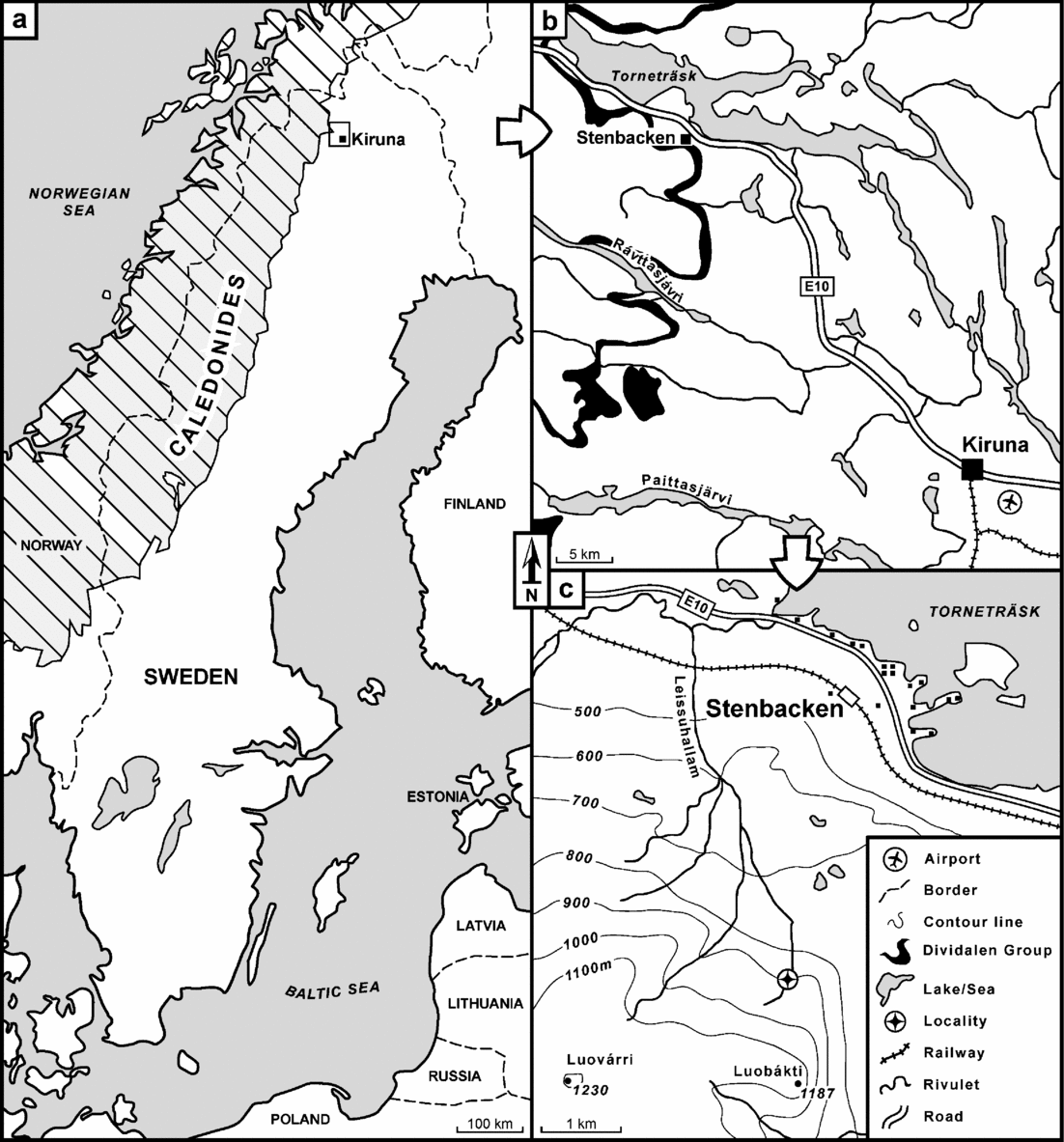
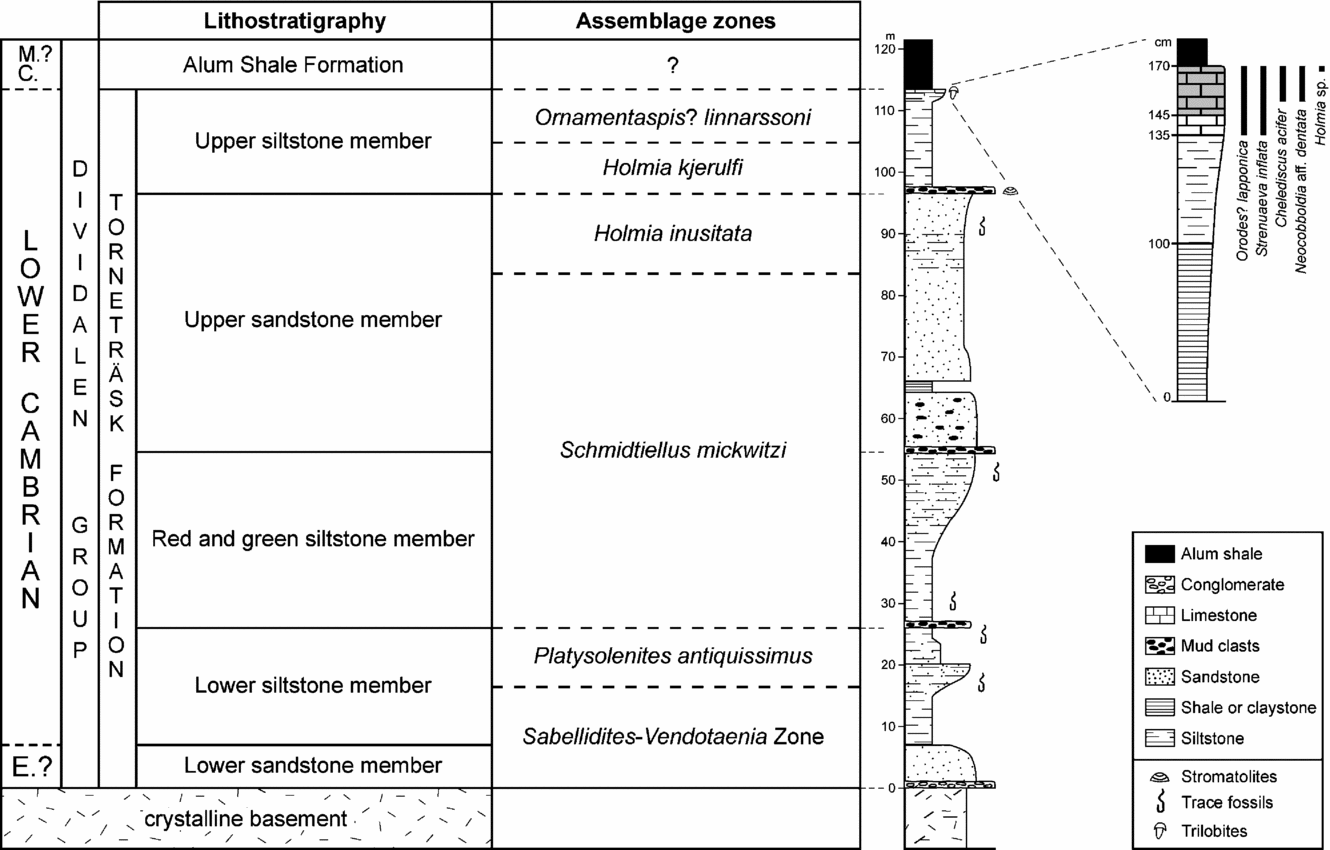
In Scandinavia, lower Cambrian deposits crop out in a narrow sinuous belt along the eastern front of the Caledonides (Fig. 1). West and northwest of the Caledonian Front, the autochthonous sedimentary rocks are generally superimposed by allochthonous units, thrusted onto the Baltoscandian Platform during the Caledonian Orogeny (Roberts & Gee, Reference Roberts, Gee, Gee and Sturt1985). The autochthonous sedimentary succession along the Caledonian Front of northern Scandinavia consists predominantly of siliciclastic rocks and is referred to as the Dividalen Group. It has a thickness of 100–200 m and rests with a profound unconformity on a Proterozoic or Archaean crystalline basement. The general succession has been worked out mainly by Moberg (Reference Moberg1908), Vogt (Reference Vogt1918, Reference Vogt1967), Kulling (Reference Kulling1964) and Føyn (Reference Føyn1967). The lithostratigraphy was subsequently revised by Thelander (Reference Thelander1982), who distinguished two major units within the Dividalen Group: the Torneträsk Formation and the overlying Alum Shale Formation. He further subdivided the Torneträsk Formation into five members, in descending order: the Upper siltstone, Upper sandstone, Red and green siltstone, Lower siltstone and the Lower sandstone members. The Torneträsk Formation is generally poorly fossiliferous and the precise age of the included members is not known. Trilobites from the top of the formation indicate a late early Cambrian age (Moberg, Reference Moberg1908; Ahlberg, Reference Ahlberg1980a, Reference Ahlberg1980b, Reference Ahlberg, Gee and Sturt1985), and the presence of Sabellidites sp. (a problematic tubular organic fossil) and trace fossils, such as Treptichnus pedum (Banks, Reference Banks, Crimes and Harper1970) and Kullingia concentrica Glaessner in Føyn & Glaessner, Reference Føyn and Glaessner1979, in the Lower siltstone member suggest a position near the base of the Cambrian (Jensen & Grant, Reference Jensen and Grant1998; Jensen et al. Reference Jensen, Gehling, Droser and Grant2002; cf. Vidal & Moczydłowska, Reference Vidal and Moczydłowska1996). Recent sequence stratigraphical studies indicate that the Red and green siltstone and at least the lower to middle part of the Upper sandstone member can be assigned to the Schmidtiellus mickwitzi Assemblage Zone (Fig. 2; A. T. Nielsen, Copenhagen, pers. comm. 2006).
(a) Map of Sweden and surrounding areas showing the extent of the Caledonides. (b) Map of the Torneträsk area, northern Swedish Lapland, showing outcrop areas of the terminal Proterozoic?–Cambrian Dividalen Group. (c) Location of the Luobákti section south of Lake Torneträsk.

Lithological succession, stratigraphy and occurrences of fossils in the Luobákti section. Compiled mainly from Moberg (Reference Moberg1908), Ahlberg (Reference Ahlberg, Gee and Sturt1985), Jensen & Grant (Reference Jensen and Grant1998) and A. T. Nielsen, Copenhagen, pers. comm. 2006. M. C. – middle Cambrian; E. – Ediacaran.

The Dividalen Group is well exposed south of Lake Torneträsk, for instance, along the northern slope of Mount Luobákti (also known as Luopahta or Luopakte), c. 4 km south of Stenbacken railway station (Fig. 1). At Luobákti, the lower c. 112 m comprise the Torneträsk Formation and consist of sandstones alternating with siltstone- and shale-dominated units, and subordinate limestone and conglomerate beds (Fig. 2), representing fluvial and shallow marine tidal and storm-influenced environments (Kulling, Reference Kulling1964; Thelander, Reference Thelander1982). The succeeding Alum Shale Formation is unfossiliferous and possibly of middle Cambrian age. The material described herein was collected by PC from a bioclastic limestone forming the top of the Torneträsk Formation in a ravine at the northern flank of Luobákti (layer 23 in profile II of Moberg, Reference Moberg1908).
3. Faunal composition and preservation
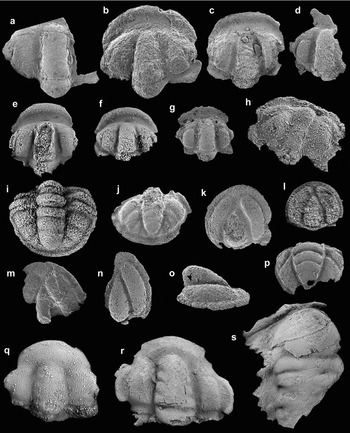
All fossils were collected from the uppermost limestone in the Luobákti section (Fig. 2). The limestone is dense and dark grey to black in colour (for details, see Hadding, Reference Hadding1958). It contains a fauna dominated by trilobites, followed by phosphatic-shelled brachiopods, for instance, Glyptias cf. favosa (Linnarsson, Reference Linnarsson1869) and Lingulella? sp. Other faunal elements include rare helcionellid molluscs and the bradoriid Indiana sp. Five trilobite taxa (Fig. 4), Chelediscus acifer, Holmia sp., Neocobboldia aff. dentata, Orodes? lapponica (Ahlberg, Reference Ahlberg1980a) and Strenuaeva inflata Ahlberg & Bergström, Reference Ahlberg and Bergström1978, were collected from the upper, darker, part of the limestone. Orodes? lapponica and S. inflata were also found in the lower part of the limestone. The trilobites are disarticulated and generally fragmentary, which may indicate that they have been subjected to post-mortem transport. The sclerites vary greatly in size, however, suggesting poor sorting and that the fauna represents an autochthonous fossil assemblage of moulted exuviae. Identification of fossils in the field was difficult and much of what is illustrated herein is the result of extensive preparation of bulk samples in the laboratory.
4. Biostratigraphy and correlation
The fossil record in the lower Cambrian of the Scandinavian Caledonides is scarce and the biostratigraphical resolution is inadequate. Five faunal zones are generally recognized, of which the upper four are defined by the occurrence of polymerid trilobites, in descending order, the Ornamentaspis? linnarssoni, Holmia kjerulfi, H. inusitata and the Schmidtiellus mickwitzi assemblage zones (e.g. Moczydłowska, Reference Moczydłowska1991; Ebbestad, Ahlberg & Høyberget, Reference Ebbestad, Ahlberg and Høyberget2003). The conventionally lowermost biostratigraphical unit, the Platysolenites antiquissimus Zone, is characterized by the occurrence of non-trilobite fossils, such as the enigmatic nominal species (see Føyn & Glaessner, Reference Føyn and Glaessner1979).
In contrast to the underlying zones, the two uppermost zones in the lower Cambrian of Scandinavia (the H. kjerulfi and O.? linnarssoni assemblage zones) contain diverse faunas, including, amongst others, a variety of olenellid and ellipsocephalid trilobites, eodiscoids, lingulate and other inarticulated brachiopods, molluscs, hyoliths and a few bradoriids (e.g. Kiær, Reference Kiær1917; Bergström & Ahlberg, Reference Bergström and Ahlberg1981). The generic composition of the Luobákti trilobite fauna indicates a late early Cambrian age. The presence of a species of Holmia (fig. 4s) at first sight might suggest that the fauna comes from the H. kjerulfi Assemblage Zone, but that genus ranges upwards into the O.? linnarssoni Assemblage Zone (Nikolaisen, Reference Nikolaisen1986). The stratigraphical position of the fauna, at the top of the lower Cambrian and just below the Alum Shale Formation, indicates that it belongs to the O.? linnarssoni Assemblage Zone. This is supported by the common occurrence of shallow-water limestones in this zone (Kiær, Reference Kiær1917; Bergström & Ahlberg, Reference Bergström and Ahlberg1981).
Intercontinental correlation within the lower Cambrian is hampered by the strongly provincial character of the trilobite faunas (e.g. Palmer, Reference Palmer1998). However, several genera and species of eodiscoids seem to have a wider geographical distribution than polymerid trilobites, and hence are important for long-distance correlations in the upper lower Cambrian (e.g. Robison et al. Reference Robison, Rosova, Rowell and Fletcher1977; Fletcher, Reference Fletcher, Lane, Siveter and Fortey2003; Geyer, Reference Geyer2005). The new collection of trilobites from Luobákti includes two eodiscoids previously unknown from Baltica, Neocobboldia aff. dentata and Chelediscus acifer, of which the latter provides a novel tie-line between lower Cambrian successions in Baltica and Avalonia.
Neocobboldia is relatively common in strata of Botomian age in Siberia and Mongolia, and has also been recorded from coeval successions in South China and Antarctica (e.g. Korobov, Reference Korobov1980; Repina, Reference Repina and Taylor1981; Palmer & Rowell, Reference Palmer and Rowell1995; Korovnikov et al. Reference Korovnikov, Rowland, Luchinina, Shabanov and Fedoseev2002). Because the Neocobboldia species recovered from the Luobákti section cannot be adequately identified (see below), it is of little use for high-resolution correlation.
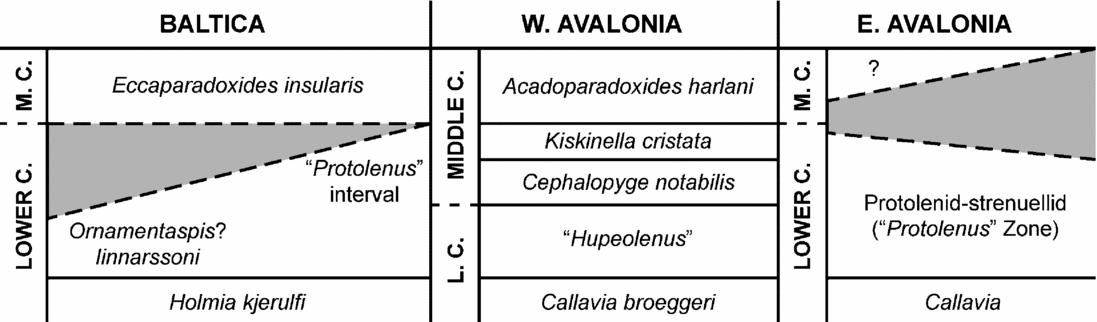
Chelediscus acifer is known from the middle Purley Shales (‘Protolenus’ Zone) of Warwickshire, England, where it is associated with, for example, Serrodiscus ctenoa Rushton, Reference Rushton1966, Acidiscus theristes Rushton, Reference Rushton1966, Tannudiscus balanus Rushton, Reference Rushton1966, and Condylopyge amitina Rushton, Reference Rushton1966. A similar Condylopyge–Chelediscus–Tannudiscus assemblage, including C. acifer and T. balanus, has been recorded from the upper Redland Cove Limestone Member of the lower to middle Brigus Formation (Hupeolenus Zone) in southeastern Newfoundland (Fletcher, Reference Fletcher, Lane, Siveter and Fortey2003). The record of C. acifer from the Torneträsk area, northern Swedish Lapland, indicates that the O.? linnarssoni Assemblage Zone of Scandinavia can be correlated with the Protolenid–strenuellid Zone (‘Protolenus’ Zone) of eastern Avalonia (England) and the middle Hupeolenus Zone (Tannudiscus balanus Subzone of Fletcher, Reference Fletcher, Lane, Siveter and Fortey2003) of western Avalonia (southeastern Newfoundland) (Fig. 3). Thus, the O.? linnarssoni Assemblage Zone is younger than strata yielding eodiscoid trilobites of the Serrodiscus bellimarginatus–Triangulaspis annio–Hebediscus attleborensis assemblage in Avalonia, Morocco, Taconic Laurentia and Siberia (see, e.g. Geyer & Palmer, Reference Geyer and Palmer1995; Geyer, Reference Geyer2005), and older than the Acidiscus–Cephalopyge Assemblage ‘Zone’ (Cephalopyge notabilis Zone) of Avalonia and Morocco. This is in accordance with the recent correlation scheme of Geyer (Reference Geyer2005, fig. 8).
Correlation chart of the upper lower Cambrian and basal middle Cambrian for Baltica and western and eastern Avalonia. Modified after Geyer & Shergold (Reference Geyer and Shergold2000), Fletcher (Reference Fletcher, Lane, Siveter and Fortey2003), Fletcher et al. (Reference Fletcher, Theokritoff, Lord and Zeoli2005) and Geyer (Reference Geyer2005).

Trilobites from the top of the Torneträsk Formation in the Luobákti section, northern Sweden. All specimens except (e, f, i, l, q–s) are SEM-photographs of epoxy casts. (a–j) Neocobboldia aff. dentata (Lermontova, Reference Lermontova and Vologdin1940). (a) Cranidium, ×15, LO9763t. (b) Cranidium, ×15, LO9764t. (c) Cranidium with a meraspid cranidium (see h) inside the broken part of the glabella, ×15, LO9765t. (d) Cranidium, ×15, LO9766t. (e) Cranidium, ×15, LO9767t. (f) Cranidium, ×15, LO9768t. (g) Cranidium, ×20, LO9769t. (h) Meraspid cranidium, oblique dorsal view, see also (c), ×85, LO9770t. (i) Pygidium, ×15, LO9771t. (j) Pygidium, ×20, LO9772t. (k–p) Chelediscus acifer Rushton, Reference Rushton1966. (k) Cephalon, ×20, LO9773t. (l) Cephalon, ×15, LO9774t. (m) Small cephalon, ×40, LO9775t. (n) Small cephalon, ×40, LO9776t. (o) Small cephalon, lateral view of (n), ×40, LO9776t. (p) Pygidium, ×20, LO9777t. (q) Strenuaeva inflata Ahlberg & Bergström, Reference Ahlberg and Bergström1978, cranidium, ×11, LO9778t. (r) Orodes? lapponica (Ahlberg, Reference Ahlberg1980a), cranidium, ×6, LO9779t. (s) Holmia sp., incomplete cephalon, ×4, LO9780t.

5. Selected systematic palaeontology
All described and illustrated (LO) specimens are housed at the Department of Geology, Lund University, Sweden.
Suborder EODISCINA Kobayashi, Reference Kobayashi1939 Superfamily eodiscoidea Raymond, Reference Raymond1913 Family pagetiidae Kobayashi, Reference Kobayashi1935 Genus Neocobboldia Rasetti, Reference Rasetti1952
Type species. Cobboldia dentata Lermontova, Reference Lermontova and Vologdin1940 (p. 120, plate 35, fig. 3a–e) from the lower Cambrian Botomian Stage (Bergeroniellus micmacciformis/Erbiella Zone) at the Lena River in Yakutia, Siberia.
Remarks. Species of Neocobboldia are characterized by an unfurrowed and nearly parallel-sided glabella, a wide (sag.), flat or concave preglabellar field, a usually narrow (sag. and exsag.) anterior border, a distinct palpebral furrow and a pygidium with prominent pleural furrows and a denticulate border (e.g. Palmer, Reference Palmer1968; Jell in Kaesler, Reference Kaesler1997).
The genus is known from Siberia, Mongolia, China and possibly Antarctica. In Siberia and Mongolia, it appears near the base of the Botomian Stage and ranges upwards into the lower Toyonian Stage (e.g. Korobov, Reference Korobov1980; Repina, Reference Repina and Taylor1981; Korovnikov et al. Reference Korovnikov, Rowland, Luchinina, Shabanov and Fedoseev2002). In China, it is known from the upper Nangaoan Stage of western Hunei and from coeval strata in southwestern Henan (Zhang et al. Reference Zhang, Lu, Zhu, Qian, Lin, Zhou, Zhang and Yuan1980; S. Peng, Nanjing, pers. comm. 2006). It is also known from Yichun in Heilongjiang (Duan & An, Reference Duan and An2001). In Antarctica, only two incomplete pygidia of an indeterminate species are known from the Central Transantarctic Mountains (Palmer & Rowell, Reference Palmer and Rowell1995).
Neocobboldia aff. dentata (Lermontova, Reference Lermontova and Vologdin1940) Figure 4a–j
Material. Sixty-seven cranidia, 59 pygidia, three thoracic tergites and two poorly preserved enrolled specimens. The cranidia range in length from 0.4 to 3.1 mm and the pygidia from 0.7 to 2.8 mm. The majority of the specimens are fragmentary.
Description of the adult. Cephalon semicircular, c. 1.1 times wider than long. Preglabellar field wide (sag.), depressed, separating anterior part of genae. Glabella tapering slightly forward, strongly convex (tr.), rounded in front, delimited laterally by wide and deep axial furrows. Occipital furrow distinct and curved backward medially. Occipital ring long (sag.) with rounded posterior margin. Genae inflated, tapering towards tip of glabella. Palpebral lobe long, defined adaxially by deep, narrow palpebral furrow. Slightly curved eye ridge extends from palpebral lobe inward across cheek towards anterolateral part of glabella.
Number of thoracic segments unknown. Pleural furrows broad, deep. Distal tips of pleura blunt.
Pygidium semicircular, smaller than cephalon, c. 1.5 times wider than long. Three pleural furrows, curved backwards, reaching border furrow. Pleural furrows wide, dividing pleural field into four pleural bands. Pygidial axis tapered backward, nearly reaching border furrow. Axis divided into three or four rings and a small terminal piece. Border wide, slightly expanding posteriorly, with denticulate margin.
Remarks. Several ontogenetic stages are represented. The smallest cranidium (0.4 mm long; fig. 4c, h) is about 1.4 times wider than it is long and provided with a long, subcylindrical and ‘hourglass-shaped’ glabella, that is, constricted and slightly depressed in the middle. The preglabellar area is short (sag.) and largely occupied by the anterior border and border furrow. As size increases, the cranidium becomes proportionately narrower and the preglabellar field becomes longer (sag.). During growth there is also a change from an ‘hourglass-shaped’ glabella to a nearly parallel-sided glabella, tapering slightly forward.
The overall cephalic and pygidial features of this form most closely resemble those of N. dentata, except that it has a longer (sag.) occipital ring, a wider (sag.) anterior border and more pronounced eye ridges. The specific characteristics, however, cannot be adequately determined without knowledge of more and better preserved specimens.
Occurrence. Limestone at the top of the Torneträsk Formation (layer 23 in profile II of Moberg, Reference Moberg1908; probably Ornamentaspis? linnarssoni Assemblage Zone) in the Luobákti section, south of Lake Torneträsk, northern Swedish Lapland.
Family eodiscoidae Raymond, Reference Raymond1913 Genus Chelediscus Rushton, Reference Rushton1966
Type species. Cheledicus acifer Rushton, Reference Rushton1966 (pp. 19–21, text-figs 2b, 6, 7, pl. 2, figs 13–26) from the lower Cambrian Purley Shales (‘Protolenus’ Zone) of Warwickshire, England.
Remarks. Chelediscus is a distinctive genus that is known from upper lower Cambrian strata in England, Newfoundland, New York State and Russia (Rushton, Reference Rushton1966; Rasetti, Reference Rasetti1967; Jell in Kaesler, Reference Kaesler1997; Fletcher, Reference Fletcher, Lane, Siveter and Fortey2003). It is characterized by, for example, a conical and bilobed glabella, a median preglabellar furrow, a pitted cephalic border furrow and two pairs of cephalic spines (one pair of genal spines and one pair of lateral spines; Rushton, Reference Rushton1966; Jell in Kaesler, Reference Kaesler1997).
Chelediscus acifer Rushton, Reference Rushton1966 Figure 4k–p
1966 Chelediscus acifer sp. nov.; Rushton, pp. 19–21, pl. 2, figs 13–26, text-figs 2b, 6, 7 (described).
1992 Chelediscus acifer; Whittington, pl. 56, figs C–G (illustrated).
2003 Chelediscus acifer Rushton, Reference Rushton1966; Fletcher, pl. 1, figs 25, 26 (illustrated).
2005 Chelediscus acifer Rushton, Reference Rushton1966; Cotton & Fortey, p. 100, fig. 2A, B (discussed and illustrated).
Material. Sixteen cephala and 13 pygidia. The cephala range in length from 0.9 to 1.8 mm and the pygidia from 1.1 to 1.8 mm.
Remarks. The available material is disarticulated and generally fragmentary, but agrees in all essential features with Rushton's (1966) diagnosis and detailed description of the species. The lateral spines are generally not preserved in the cephala from Luobákti. The right lateral spine is, however, partially preserved in one cephalon (fig. 4l). It is situated opposite the anterior glabellar lobe. The border furrow is provided with at least 20 pits. The pygidia have a wide and posteriorly tapered axis and a pair of distinct pleural furrows opposite the second axial ring.
The juvenile cephala shown in Figure 4m–o have a highly convex glabella lacking a distinct transglabellar furrow.
Occurrence. Limestone at the top of the Torneträsk Formation (layer 23 in profile II of Moberg, Reference Moberg1908; probably Ornamentaspis? linnarssoni Assemblage Zone) in the Luobákti section, south of Lake Torneträsk, northern Swedish Lapland. The species has also been reported from England (see above) and the lower to middle Brigus Formation (Hupeolenus Zone; Tannudiscus balanus Subzone) at Cape St Mary's, Newfoundland (Fletcher, Reference Fletcher, Lane, Siveter and Fortey2003).
Suborder OLENELLINA Walcott, Reference Walcott1890 Superfamily olenelloidea Walcott, Reference Walcott1890 Family holmiidae Hupé, Reference Hupé1953 Genus Holmia Matthew, Reference Matthew1890 Holmia sp. Figure 4s
Type species. Paradoxides kjerulfi Linnarsson, Reference Linnarsson1871 (pp. 790–1, pl. 16, figs 1–3) from the lower Cambrian Holmia Shale (Holmia kjerulfi Assemblage Zone) at Tømten in the Ringsaker district, Norway.
Remarks. The concept of Holmia adopted here is that of Palmer & Repina (Reference Palmer and Repina1993), with slight modifications introduced by Ebbestad, Ahlberg & Høyberget (Reference Ebbestad, Ahlberg and Høyberget2003). As noted by, for example, Ahlberg & Bergström (Reference Ahlberg and Bergström1983), Ahlberg, Bergström & Johansson (Reference Ahlberg, Bergström and Johansson1986) and Ebbestad, Ahlberg & Høyberget (Reference Ebbestad, Ahlberg and Høyberget2003), species of Holmia appear to be endemic to the Baltic Faunal Province, though, tentatively, a few species have been reported from Laurentia, Morocco and Siberia (see Palmer & Repina, Reference Palmer and Repina1993; Geyer & Palmer, Reference Geyer and Palmer1995; but see also Hollingsworth, Reference Hollingsworth2006).
Material. One slightly distorted but nearly complete glabella with an incomplete occipital ring and a partially preserved anterior cephalic border.
Description. Glabella (incl. occipital ring) nearly twice as long as wide, extending to anterior border. It is widest anteriorly across frontal lobe and slightly constricted at preoccipital furrow (S1). Frontal lobe 1.2 times wider than long, highly convex, steeply sloping anteriorly and laterally. Occipital ring (L0) and glabellar lobe L1 of equal length (exsag.) and slightly longer (exsag.) than L2 and L3. Occipital furrow (S0) and glabellar furrows S1 and S2 deepest adjacent to dorsal furrows, shallow or barely apparent across top of glabella. S0 almost transverse. S1 slightly longer (tr.) than S0, curved backward adaxially. S2 directed inward and slightly forward from dorsal furrow, then curved slightly backward adaxially. S3 transglabellar directed inward and forward from dorsal furrow, then curved abruptly inward and backward adaxially. Anterior border poorly preserved, seen only in front of right part of frontal glabellar lobe. It appears to be narrow (sag.) and almost flat.
Remarks. The anteriorly expanded glabella, with a broadly rounded and convex frontal lobe, the arrangement of the glabellar furrows and a conjoined S3 suggest that the material belongs to a species of Holmia. With the limited and fragmentary material at hand it is left under open nomenclature.
Occurrence. Limestone at the top of the Torneträsk Formation (layer 23 in profile II of Moberg, Reference Moberg1908; probably Ornamentaspis? linnarssoni Assemblage Zone) in the Luobákti section, south of Lake Torneträsk, northern Swedish Lapland.
Acknowledgements
We appreciate helpful comments on drafts of the manuscript by Mats E. Eriksson and Sofie Lindström. Adrian W. A. Rushton and Terence P. Fletcher kindly commented upon the material, and Arne T. Nielsen provided information on the biostratigraphy of the Luobákti section. We thank the journal reviewers, Euan N. K. Clarkson and Jan Ove R. Ebbestad, for their comments on the manuscript. PA is indebted to the Swedish Research Council (VR) and the Crafoord Foundation for their financial support.