

I. Introduction
The United Nations Guiding Principles on Business and Human Rights (UNGPs) endorse operational-level grievance mechanisms (OGMs) as a means to empower rightsholders to access remedy for human rights abuses.Footnote 1 This article presents empirical research findings on Kakuzi Plc’s (Kakuzi) ‘Independent Human Rights Mechanism’ (IHRM), an OGM in Africa explicitly designed to provide remedy for human rights abuses.Footnote 2 Based on qualitative sociolegal research conducted between August 2022 and March 2023, the study draws upon semi-structured interviews with 50 participants, 11 focus groups, participant observation and internal and external documents describing the mechanism. Kakuzi is a majority UK-owned Kenyan agribusiness company in Murang’a County that instituted its OGM as part of an out-of-court settlement agreement in the UK following transnational litigation concerning allegations of a killing, rapes and assaults by Kakuzi security forces.
Case studies in Africa tend to focus on OGMs apparently designed to pursue a risk management or community relations function. These OGMs are not designed with the primary purpose of providing remedies.Footnote 3 This results in limited understanding of how explicitly remedy-oriented OGMs can function. The Kakuzi shines light on this issue by examining an OGM explicitly designed to provide a human rights remedy under the UNGPs.
Further, as Kemp and Owen highlight, discourses on grievance mechanisms often fail to differentiate between community grievances as injurious experiences held by community members and community grievances as claims made within the confines of the administrative dimensions of a mechanism.Footnote 4 A community or community member’s injurious experiences often do not give rise to legal actionsFootnote 5 and often fall outside a company’s definition of grievance.Footnote 6 Hofmeyr terms this a question of legibility, whereby communities struggle to make their injurious experiences legible to a grievance mechanism.Footnote 7 This is not only because an OGM validates only some injurious experiences whilst rejecting others but also because ‘it has the ability to decontextualise and recontextualise the basis of claims’, including insisting that community members amend their articulation of their grievances to adhere to the administrative requirements of the OGM.Footnote 8
Research has examined the role of companies in controlling the parameters of what constitutes a viable grievance and available outcomes, but it has rarely highlighted how community members exercise agency in the context of grievance mechanisms, including how they dissent from or resist these parameters.Footnote 9 This article adopts an actor-oriented approach to reveal what institutional accounts of OGMs often fail to: that an OGM, even one that presents itself as a neutral process of grievance adjudication, can be an inherently agonistic site, where multiple actors assert competing visions of the IHRM and pursue strategies in line with their objectives. It follows grievances through their entire trajectory—from community members’ injurious experience through how community members translate those experiences into claims legible to the IHRM, to how the mechanism then interprets and handles those claims and finally how the IHRM then produces its own narratives around community grievances.
In the case of Kakuzi, most community injurious experiences have some nexus to ‘historical’ land injustices and the contemporary practices of territorial and legal enclosure that sustain them in the present day. Territorial enclosure refers to actions taken to secure physical control over the land: security arrangements, including fencing and armed guards, which give rise to physical violence (e.g., assaults and rapes); and the demarcation of the land itself, which restricts community access to public utilities and water. Legal enclosure refers to the mobilisation of law against communities and civil society, including civil lawsuits, vexatious prosecution and the obstruction of the evidence, forums and collective action that redress would require.
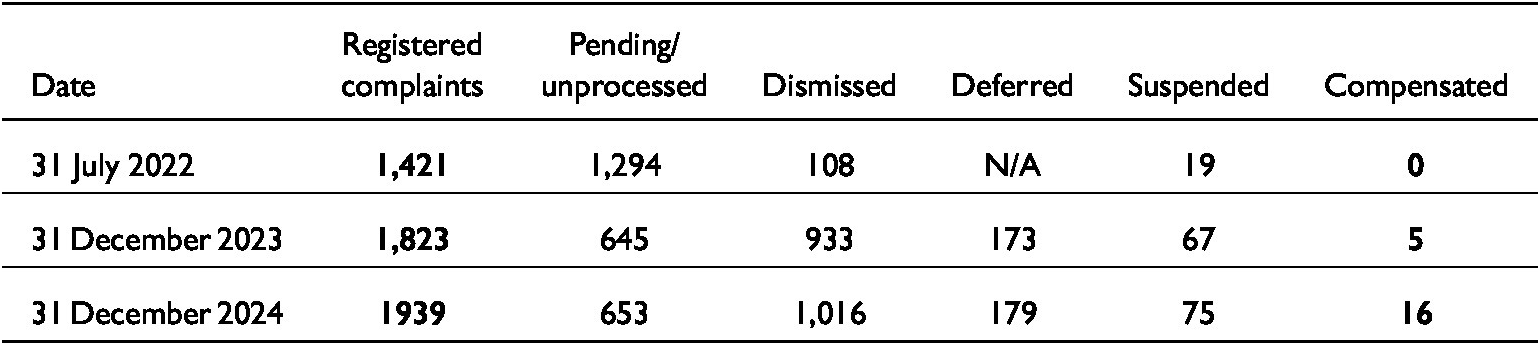
Kakuzi’s IHRM covers only a small subset of community injurious experiences and often decontextualises them from the practices of enclosure that cause them. It focuses on the same types of grievances as those in the settlement agreement: personal injury torts including killings, rapes and assaults. Kakuzi’s IHRM is an adjudicative mechanism that requires community members to submit evidence, primarily oral testimony and official documentation (hospital records) and reaches a decision on the ‘balance of probabilities’. The IHRM has received a high number of grievances (over 1,000 in its first three months). As of 31 December 2024, the IHRM reported that 16 of 1,939 (0.83 percent) of grievances had been compensated, with the majority dismissed, primarily for insufficient evidence.Footnote 10
Community members have protested the IHRM’s narrow scope and high dismissal rates and have carried out various modes of grievance submission that have upset the normative expectations of the mechanism. These have included boycotting the mechanism, over-submitting individual grievances for an act of collective violence, submitting out-of-scope grievances but reframing them as personal injury tort complaints and submitting grievances while asking no remedy be provided.
Through an actor-oriented analysis, this article highlights the strategies pursued by both the company and the community in the context of the IHRM while being cognisant of the gap between community grievances as injurious experiences and community grievances as claims within the confines of the mechanism. It discusses this gap in terms of delimitation, dissent and distortion. The mechanism delimits what counts as a viable grievance: it sets the rules by which an injurious experience must be translated into a claim the mechanism can hear, determining which types of grievance are heard and how they must be substantiated. Communities dissent from this delimitation through various strategies including boycotting the mechanism, reframing injurious experiences to fit within scope and submitting grievances that upset the normative expectations of the mechanism (e.g., submitting grievances while insisting they do not want compensation). The mechanism’s disclosure practices then distort local realities by failing to accurately describe the gap between grievances as injurious experiences and grievances as claims, instead recasting the IHRM’s narrow administrative dimensions as representative and potentially exhaustive of a community’s injurious experiences.
Following a review of scholarship on OGMs in Africa (Section II) and a description of methodology (Section III), this article presents its empirical findings: the context (Section IV), the IHRM itself (Section V) and how communities exercise agency in the context of grievance handling (Section VI). It concludes with a final discussion section (Section VII).
II. Operational-level grievance mechanisms
The UNGPs stipulate that companies should establish or participate in ‘effective operational-level grievance mechanisms for individuals and communities who may be adversely impacted’ as a means to enable ‘the remediation of any adverse human rights impacts’ that companies cause or contribute to.Footnote 11 Principle 31 sets out eight effectiveness criteria: OGMs should be legitimate, accessible, predictable, equitable, transparent, rights-compatible, a source of continuous learning and based on engagement and dialogue.Footnote 12
The UNGPs simultaneously construct stipulations on corporate remediation and grievance handling in reference to legal rationales of providing remedy as reparations for wrongful conduct resulting in human rights abuses, management rationales of continuous improvement and corrective action for impacts that were not (or could not) be prevented/mitigated and stakeholder engagement rationales of resolving minor grievances before they escalate into company–community conflict.Footnote 13 This creates interpretive ambiguities over what types of grievances OGMs should handle and how.
Legal and human rights scholarship has generally interpreted the UNGPs in line with legal rationales. OGMs are frequently described as providing remedy for human rights abuses, a stance justified more in reference to the UNGPs than real-life practice.Footnote 14 This has arguably led to a form of mission creep whereby OGMs, originally viewed only as low-level dispute resolution mechanisms, have increasingly been viewed as a means to provide remedy for human rights abuses.Footnote 15
In practice, company practitioners do not necessarily view OGMs as providing remedy or handling human rights claims, often interpreting the UNGPs in reference to established industry logics.Footnote 16 Companies rarely report providing remedy in response to human rights allegations; corporate disclosures of remedy tend to focus on means of offsetting harm (gifts and philanthropy), which Owen and Kemp call ‘disconnected remedy.’Footnote 17
Regarding OGMs in Africa, scholarship paints a bleak picture. For instance, the Chad–Cameroon oil pipeline’s OGM was found to be primarily designed to prevent community resistance and smooth the way for oil production.Footnote 18 Likewise, research on a platinum mine in South Africa found the company narrowed the scope of the grievance mechanism to exclude many grievances, prevent appropriate outcomes and disempower rightsholders.Footnote 19 An OGM in Tanzania was discovered to be unable to deal with those grievances that relate to serious acts of use of force, land access rights and environmental pollution.Footnote 20 In Ghana, an OGM placed unfair evidentiary requirements on communities, resulting in inadequate compensationFootnote 21 and, in Kenya, an OGM failed to independently address grievances.Footnote 22 Where there are relatively positive evaluations of OGMs in Africa, these articles have centred on OGMs’ roles in fostering positive company–community relationshipsFootnote 23 and improving how companies track their impacts on communities.Footnote 24
A new type of OGM has emerged that scholarship has yet to adequately capture: mechanisms established through out-of-court settlements following litigation. Where claimants and the company agree to an out-of-court settlement including compensation, they can insert a ‘no act’ clause in exchange for an ‘OGM’ clause. A ‘no act’ clause protects the interests of the company: the law firm agrees not to bring future claims of a similar nature from claimants not represented in the original action (other community members). An ‘OGM’ clause requires the company to set up a grievance mechanism to provide remedy for remaining grievances. This compromise aims to ensure closure of the litigation while not closing off remedy for those remaining victims who are not party to the settlement agreement. Leigh Day has pioneered this approach with respect to several OGMs in Africa, including Petra Diamonds in Tanzania, Gemfields in Mozambique, Eastern Produce in Malawi and Kakuzi in Kenya, the latter of which is the case study for this article.Footnote 25
There is limited scholarship on the role community members play in deciding whether and how to submit their grievances and in navigating the administrative dimensions of OGMs in practice. There is a tendency to conflate grievances as injurious experiences with grievances as claims tailored to the scope, evidentiary burdens and grievance-handling logics of an OGM.Footnote 26 Given this dissociation and the tendency for mechanisms to become disconnected from the grievances they purport to resolve, scholarship is needed which highlights the gaps between injurious experience and claims submitted to grievance mechanisms and how different actors strategise in the course of grievance handling.
III. Methodology
The article adopts an actor-oriented perspective, coined by Nyamu-Musembi.Footnote 27 In contrast to ’institutional accounts’ which focus on how empirical practices adhere to human rights principles, an actor-oriented perspective focuses on the concrete experiences of those actors involved in human rights struggles.Footnote 28 Rather than assessing the IHRM against the standards it sets for itself or those laid down in the UNGPs (an institutional perspective), this article foregrounds how community members understand, frame and claim their grievances. It directly responds to critiques of scholarship that argue the focus is on OGMs’ compliance with normative standards rather than the material outcomes for rightsholdersFootnote 29 and that such accounts exclude rightsholders’ visions of justice.Footnote 30 This article’s account renders visible the community agency and resistance which institutional accounts tend to obscure.
This sociolegal article draws on a case study conducted as part of the first author’s doctoral research into how the UNGPs effect change in OGMs.Footnote 31 It examines Kakuzi’s IHRM and follows community grievances from injurious experiences, to the claims community members translate them into, to the mechanism’s handling of those claims and finally to the narratives the IHRM produces about them. This is a critical case studyFootnote 32 for understanding how OGMs designed according to the UNGPs operate in postcolonial contexts marked by historical land injustices and (post)colonial violence.
The case study on Kakuzi’s IHRM was carried out primarily through fieldwork conducted by the authors between 21 August and 15 October 2022, with follow-up remote interviews conducted between October 2022 and March 2023. This was a multistakeholder case study with participants selected from different constituencies of practice (community members, company staff, government officials and external stakeholders) using a purposive sampling approach to account for different interests and ensure a comprehensive account of events. There were four principal methods of data collection used in this research: 50 semi-structured interviews, 11 focus groups, participant observation and document collection.
Thirty of 50 interviews were with community members/workers who had either used the grievance mechanism or were potential users of the grievance mechanism.Footnote 33 These participants were asked about their relationship with Kakuzi (where they lived and their role there), their injurious experiences,Footnote 34 whether and how their issue related to human rights, what they wanted to achieve (including remedies) and why they submitted (or did not submit) grievances to the IHRM. Participants who had submitted grievances to the IHRM were additionally asked how they lodged a claim and what follow-up steps they undertook (including timelines), who dealt with their grievances, how the IHRM communicated with them at various stages, what evidence was required and submitted, what solutions (if any) were offered and how they responded to what was offered. They were asked about their overall experience with the mechanism, what their ideal mechanism would look like and how they might change it to improve it; however, many participants rejected the framing of improvement altogether, wanting the mechanism disbanded rather than reformed.
The remaining 20 of 50 interviews were with participants knowledgeable about the mechanism’s design and the broader company–community conflict: 5 practitioners directly involved in the design and implementation of the mechanism,Footnote 35 13 practitioners with knowledge of the broader company–community conflicts and alleged human rights abuses leading to the adoption of the grievance mechanismFootnote 36 and 2 community members who did not attest to any grievances but whose standing afforded them particular insights into the IHRM. These interviews focused on the participant’s role in the mechanism: how they understood their role in relation to the mechanism, what the principal issues and decisions were, how the IHRM was designed and operated, the actors involved in the IHRM, the scope and objective of the IHRM and anticipated changes resulting from the IHRM. They were further asked about the IHRM in reference to the UNGPs, access to remedy and gender issues.
11 focus groups were conducted in English, Kiswahili, Kikuyu and Kamba, with live interpretation into English. Eight focus groups were conducted with community members (n = 75), two with workers (n = 25) and one with community activists (n = 14), totalling 114 participants. They focused on understanding participants’ lived experience, including their own injurious experiences, how these grievances were (or were not) handled, who was aware of the IHRM and how, what their engagement (if any) with the IHRM had been and what kind of remedies they wanted. The selection of focus groups was done in concert with two local partners: Ndula Resource Center (NRC) and another individual whose anonymity has been protected. Focus groups with community and civil society tended to cover similar issues as interviews with community members but were more oriented towards collective grievances and the overall approach of Kakuzi and government bodies to grievance handling and created more space for participants to ask their own questions.Footnote 37
Interviews and focus groups were transcribed verbatim, with the 29 non-English interviews translated into English. For each grievant, we wrote a short summary of their grievance and how it was handled, cross-referenced against the documentation provided. Both interviews and focus groups were then open-coded using NVivo.
Participant observation was carried out in the squatter settlements and at various sites across Kakuzi’s farm, including land access routes and roads, fencing and other security infrastructure, points of water access, the grievance mechanism’s access points and Kakuzi’s community centre and human rights office. In doing so, we observed how residents lived, how community members used the land, the operation of Kakuzi’s other initiatives and the role of wildlife in the dispute. These observations were recorded in field memos and all participant observation was overt.
Document collection enabled triangulation of participant testimonies against the IHRM’s official documentation, allowing us to identify both convergences and discrepancies. The IHRM provides each grievant with written acknowledgements and decision letters setting out the reasons for a given decision. We also drew on letter exchanges between community organisations and Kakuzi, the parts of the settlement agreement relating to the IHRM and a desk-based review of corporate disclosures to build as full a picture of the disputes as possible.
By engaging different stakeholder groups, the research aims to provide as nuanced an account as possible of the grievance mechanism. This resulting analysis seeks to provide an account based on triangulated evidence from multiple sources. The principal limitation in the case study is the eight-week period of field research with the grievance mechanism; more sustained fieldwork would have provided more robust findings. There were no remedies provided in the early implementation of the IHRM,Footnote 38 with remedies provided after the period of fieldwork.Footnote 39 This article’s account of remedies provided accordingly relies on the IHRM’s own subsequent disclosures rather than data independently gathered through fieldwork.
Finally, confidentiality requirements mean that specific statements cannot be attributed to individual practitioners and that individual grievances cannot be discussed if they would identify a grievant. Participants quoted in the text are identified by pseudonyms. The illustrative grievances discussed are typical of those widely reported during fieldwork rather than accounts of identifiable individual cases and the findings and framework are informed by the full range of grievances encountered.Footnote 40
IV. The context
While Kakuzi’s IHRM is intended to resolve complaints of personal injury—including assaults, rapes and other harms amounting to torts—for community participants, their grievances, including many of those they take to the IHRM, are rooted in the broader conflict over land. While such conflicts are often referred to by the term ‘historical land injustices’, this can be conceptually misleading, particularly where ‘historical’ is taken to mean ‘in the past’. As Manji argues, ‘there is nothing past about historical land injustice’.Footnote 41 Land injustices are not events that can be isolated to a given timeframe but structures with complex intertemporalities between past and present actively sustained by contemporary arrangements.Footnote 42
Land issues form the crux of most community grievances, whether concerning access to public utilities, capacity to sustain livelihoods, water access or ability to associate freely, protest and criticise Kakuzi. Land injustices are not limited to formal disputes over land rights but extend to a wealth of practices aimed at securing Kakuzi’s exclusive authority over the land, which implicate not only Kakuzi but the Kenyan state. Research participants routinely attested to how land disputes are core to most community grievances and regularly underlie individual cases of personal injury and human rights abuse. These include both actions taken to physically restrict community members from accessing the land (territorial enclosure) and actions to legally prevent community members from challenging company authority over the land (legal enclosure). The discussion starts with the history of the land injustice, moving to the practices of territorial enclosure, concluding with the legal enclosure that forecloses redress.Footnote 43 This section does not purport to be exhaustive: the full array of community grievances relating to Kakuzi is too extensive to detail here.
A. ‘Historical’ land injustices
Kakuzi is an agricultural company which farms avocados, macadamia nuts, livestock, forestry and blueberries in the south of Murang’a County, Kenya.Footnote 44 Camellia Plc (a UK company) has been the effective majority shareholder of Kakuzi since the 1990s.Footnote 45 Estimates vary but Kakuzi occupies around 32,900 acres (133 km²) of land in Murang’a County with thousands of squatters still living on and around Kakuzi land (see Figure 1).
Squatter community in Gachagi.

Land itself is often a measure of wealth and social status and has spiritual significance in many communities. Over 80 per cent of Kenya’s rural population relies on agriculture and related activities for their livelihood.Footnote 46 Community members and public utilities lack land title deeds, creating difficulties with demarcation, cultivation, access to lending and (for public utilities) government spending.Footnote 47
Kakuzi has its origins in colonial ventures starting in 1906.Footnote 48 In pre-colonial Kenya, land tenure was based on communal ownership.Footnote 49 Concepts of ownership based on individual ownership, title documents and exclusive control increasingly displaced communal systems.Footnote 50 Following Kenyan independence, successive governments have been reluctant to transform land regimes in a manner that would address these land injustices.Footnote 51
In the decades after independence, Kakuzi began to resettle communities to new areas at the peripheries of Kakuzi land. Many current issues of land conflict relate to the implementation of these resettlements, including forced evictions, lack of consideration of issues such as access to water, roads or public utilitiesFootnote 52 and allegations of corrupt practices in how settlement agreements were implemented.Footnote 53
Kamau: Kakuzi grabbed the land, settled on the land, and [re]located the local communities. There are very few who can recall and remember how it was. We have to rely on oral tradition and written records. The African issues are paramount.Footnote 54
At Kakuzi, squatter groups still live on the plantation, with many public utilities including schools and hospitals within the boundaries of the plantation. Civil society actors estimate at least eleven communities comprising approximately 30,000 members contest aspects of Kakuzi’s land holdings.Footnote 55 Many community members migrated or are descended from those who migrated onto the farms for work (‘squatters’)Footnote 56; some describe the land they occupy as their ancestral land.
In 2019, the National Land Commission in Kenya recommended that all public utilities be surrendered to government, that leases not be renewed until Historical Land Injustice claims are determined and that 999-year leases be converted to 99 years.Footnote 57 Kakuzi applied for judicial review of this decision.Footnote 58 In 2025, the National Land Commission recommended further ceding of land including 3,200 acres for settlements of squatters.Footnote 59 Kakuzi has reportedly sought judicial review of National Land Commission decisions based on it making recommendations outside its jurisdiction and in contravention with the 1999 Kenya-UK bilateral investment treaty.Footnote 60 On 27 April 2026, this judicial bid was rejected.Footnote 61
B. Territorial enclosure
Practices of territorial enclosure refer to those practices that physically control access to land. To police its land holdings, Kakuzi employs a significant private security force. Kakuzi security forces engaged in an alleged practice of assaulting and raping community members, including children. These acts included assaults with rungus (clubs) and, in at least one instance, a panga (machete)Footnote 62 and one alleged unlawful killing.Footnote 63 Guards ‘intentionally and systematically mistreat members of the surrounding communities to physically punish local community members for either crossing Kakuzi property or raising issues against Kakuzi’.Footnote 64 Large-scale violent incidents between guards and community members were documented in 2002, 2014 and 2016.Footnote 65
Rapes were reportedly systemic and commonplace, with some women reporting they were raped more than once.Footnote 66 These alleged rapes, often committed by security guards, could take the form of violent rapes and ‘sex for firewood’ situations where women collecting firewood on Kakuzi land were required to provide sexual favours to not be reported to the police for trespassing on Kakuzi land.Footnote 67
While access routes exist and are used, their legality is unclear, with public road designation often contested. Community members, including children, must still ‘commute’ onto Kakuzi land to use public utilities, including schools and hospitals that remain on Kakuzi’s land from the colonial period. These routes are often long and hazardous, particularly during the rains.Footnote 68 Hippopotamuses threaten community members, which has led to at least one recent death.Footnote 69 Paths covered in grass attract snakes and hyenas.Footnote 70 Baboons and monkeys take food from children and from farms.Footnote 71 Children’s food insecurity, lengthy walks and lack of personal safety adversely affect their education.Footnote 72 When people fall ill, the lack of motorable roads means they must be carried by stretcher to hospitals; women often give birth at home in non-ideal conditions, resulting in unnecessary health complications and deaths.Footnote 73
Wanjiru: Many people die because of a lack of medicine, because the hospital is here [on Kakuzi land]. They [the communities] lost access to go to the hospital, so many people died because no access.Footnote 74
C. Legal enclosure
Legal enclosure refers to the practices through which the legal and institutional avenues for challenging the company’s control of the land are foreclosed and through which the legal system is turned against community members. This operates in three registers: the criminalisation of everyday community life, the foreclosure of the evidence and forums that redress requires and the suppression of collective action.
Squatter communities live in a constant state of precarious quasi-legality and trespass; some are asked to sign lease agreements at negligible rents and to seek permission to repair their housing, in ways that recognise Kakuzi’s legal authority over the land. Where community members pass away, families are prevented from burying them on the land, with Kakuzi threatening exhumation orders should they do so.Footnote 75 Guards apprehend community members when suspected of theft or trespass—reportedly often on poor grounds—and take them to the police, where they must make bail or pay bribes; community members are sometimes charged with theft, but Kakuzi repeatedly fails to attend the resulting court sessions, leaving them in arduous proceedings until the cases are eventually dismissed.Footnote 76
The evidence and forums that redress would require are also foreclosed. In cases of violence, community members are deterred from going to the police where they may themselves be accused of trespass or theft, or where the police are alleged to be involved in the violence. This is compounded by the P3 form: in Kenya, a medical examination following an assault requires a P3 form completed by both the police and a medical examiner.Footnote 77 Documentation relating to disputes is often confiscated or ‘disappears’.Footnote 78 Where community members do attempt to pursue their rights, Kakuzi draws out proceedings and invokes pending cases to keep matters sub judice, both remaining silent itself and silencing community members.Footnote 79
Collective action is suppressed. Communities stated they were unable to mobilise their own meetings to discuss Kakuzi:Footnote 80
Muthoni: They said all future meetings, you must get permission from the police.Footnote 81
Even when government authorities grant permission, there is often no written record of such permissionFootnote 82 and officials can deny any permission was given.Footnote 83 Legal tactics are also mobilised against civil society. Kakuzi sued both Kenya Human Rights Commission (KHRC) and NRC over their press statement of 14 February 2021 announcing the UK settlement—a suit both organisations characterised as a Strategic Lawsuit Against Public Participation (SLAPP)Footnote 84 and which Kakuzi later withdrew.Footnote 85 Following the Leigh Day litigation, the Directorate of Criminal Investigations reportedly investigated Kenyan nationals involved in the case, including claimants and a member of NRC, over the alleged inducement of litigants and falsification of evidence; the investigation was later dropped.Footnote 86
Macharia: Release the community from the shackles of Kakuzi. We are like slaves right now… I want to be free from this bondage.Footnote 87
V. The independent human rights mechanism
Kakuzi’s human rights OGM is referred to as the ‘Independent Human Rights Mechanism (IHRM)’ or ‘Sikika Two’.Footnote 88 Leigh Day (a UK law firm) brought proceedings against Camellia Plc on behalf of Kenyan claimants, which resulted in an out-of-court settlement agreement with 85 claimants on 14 February 2021.Footnote 89 The claims included allegations of a killing, rapes (some of which resulted in pregnancy or contracting HIV), and assaults by security guards.Footnote 90 In addition to the payment of compensation, the agreement included a stipulation that Kakuzi establish an OGM with safeguards.Footnote 91 This section will detail how the IHRM was designed and how it was implemented.
A. The design of the IHRM
The basic parameters of the IHRM were negotiated in the settlement agreement, which requires it to have an independent adjudication process with an independent appeals process.Footnote 92 It is required to be accessible, be well publicised, account for language and literacy barriers, offer psycho-social support and provide compensation training. It is expected to recognise the principles of due process and natural justice through timely grievance handling, provide for independent pro bono legal advice for grievants, collaborate with the Kenyan legal system and provide confidentiality safeguards.
The consultancy firm Triple R Alliance (TRA) was chosen under the settlement agreement to provide assessments during the design and initial implementation of the IHRM. Through 2021 they carried out consultations across internal stakeholders (employees and workers) and external stakeholders (community members, civil society and government), conducted in smaller meetings owing to COVID-19 restrictions.Footnote 93 TRA made repeated efforts to engage the civil society organisations most involved in the litigation—the Centre for Research on Multinational Corporations (SOMO), KHRC and NRC—though KHRC and NRC refused, citing the SLAPP suit Kakuzi had lodged against them.Footnote 94
The very idea of community consultations was objected to by many community members:
Kariuki: You [Kakuzi] have no right to us! If you don’t know, you don’t have an answer.Footnote 95
They objected to a relationship in which Kakuzi extracts and depends on community knowledge to pursue its own projects, while denying the community access to the same convening power—chief barazas and police-supervised community meetings—that Kakuzi mobilised for its community consultations and awareness-raising sessions.Footnote 96
Community members and others levelled several criticisms at the consultation. TRA were widely regarded as insufficiently independent, since communities had no say in their appointment; participants were often unaware of TRA’s findings; and participants stated that the design was never returned to them for validation, as they claim was promised.Footnote 97 The selection of communities was also contested: not all squatter communities were included, while communities further from Kakuzi’s farms—with fewer grievances and less interest in a mechanism—were.
Wanjiku: No consultations or awareness meetings were conducted in [our squatter community] We don’t know why, because we are aware they went to other areas.Footnote 98
The IHRM team has reported greater efforts to reach out to squatter communities since 2023.Footnote 99
The principal requests participants from the community stated they had made in consultations were that remedies be commensurate with the harm suffered, in line with national law and that communities—or other credible parties including NRC, KHRC and Kenya National Commission on Human Rights (—be involved in the IHRM’s governance.Footnote 100 Local civil society argued that TRA did not demonstrate to the communities how they had integrated community concerns.Footnote 101
While community participation was never enshrined in the mechanism, TRA report integrating a range of stakeholder concerns: additional access points, anonymous complaints channels, psycho-social support, a retaliation-review process, an appeals mechanism and a local observer panel.Footnote 102 Some were already stipulated in the settlement agreement and some added following consultations.
The focus of the IHRM, both in the settlement agreement and in the consultation process, is on ensuring legitimacy through independence. Most community members we spoke to described the mechanism as not independent from Kakuzi.
Mwangi: [The IHRM] and Kakuzi are one and the same thing. It’s Kakuzi that funds [the IHRM]. [The IHRM] is only here to protect Kakuzi.Footnote 103
This perception that Kakuzi runs the IHRM has led to a frequent mantra amongst community members that the IHRM is ‘a lie’.
B. Procedure
The IHRM began implementation in February 2022. It handles allegations of severe human rights impacts (involving personal injury) that Kakuzi has caused, contributed to or is directly linked to through its operations or business relationships. This covers grievances associated with public or private security actors in Kakuzi’s areas of operation including physical injuries; loss of life; rape and sexual assault; forced eviction; sexual exploitation; adverse health effects stemming from pesticides; retaliatory action against Kakuzi staff for raising grievances; and other incidents that cause severe human rights impacts due to their scale, scope and irremediability of the harm.Footnote 104
The IHRM is described as engaging with all human rights impacts in some of its public-facing documentation; however, in the settlement agreement, in the operating manual and in practice it is largely limited to personal injury claims. This mirrors the matters which were subject to litigation: personal injury claims as understood in tort law.Footnote 105 This includes assaults, rapes and killings but could also potentially include workplace accidents and other injuries:
[Kimani] For example, there was a [awareness-raising] meeting [They said] to come and report your serious grievances at [the IHRM]. The community said there are serious grievances relate to land. Kakuzi said, ‘No. We’re not going to deal with that.’Footnote 106
The IHRM operates from an office in Kenol, separate from Kakuzi’s head office. A submitted grievance is registered and grievants are provided a grievance acknowledgement (see Figure 2). A Legal Administration Office (LAO), working in English, Kiswahili and Kikuyu, takes statements from the grievant and any witnesses and explains the process. Grievants must sign informed-consent and mutual-confidentiality agreements, the latter limiting how they may disclose their grievance.
Example of grievance acknowledgement.

Investigations are generally carried out through the assessment of statements and the verification of (medical) documentation. Statements are taken from the grievant and any available witness. These statements are then assessed for credibility and truthfulness. The IHRM checks for consistency between the testimony of the grievant and any witnesses. They also do follow-up interviews to check consistency over time. Medical records are required to verify the nature and extent of the alleged injuries.Footnote 107
Fact-finding could extend to interviewing neighbours and family, attending scenes and tracing the relevant doctors and institutions, and many participants described the IHRM teams as sympathetic when lodging their grievances.Footnote 108 The IHRM provides every grievant with a response which is generally between two and three pages long. There is an articulation of what the grievant stated, whether their statement was coherent with the witness and whether their documents were valid. The efforts taken by the investigation team are described in detail and the reasons for dismissal are given. These decisions are communicated in person and via decision letters. These letters are in complex English with legalese; many grievants do not speak or read in English and cannot comprehend their decision letter. This is exacerbated by the confidentiality agreement they sign which requires them not to disclose their grievance decisions to third parties.
The IHRM determines remedy with reference to civil awards available in Kenyan law. The IHRM can make binding awards without approval by the Kakuzi board or Kakuzi management and it is able to make non-binding recommendations to address underlying root causes, trends or patterns of grievances. The head of the mechanism is Justice Violet Mavisi, previously at the Kenyan National Commission on Human Rights, who signs off on final decisions. Determinations are based on the ‘balance of probabilities’ as used in civil cases and in reference to a confidential compensation matrix. The OGM relies on the national legal system for its quantum of awards, but it is not clear whether it relies on awards in health and safety cases, tort law or ‘constitutional torts’, which significantly vary in terms of the amounts paid.Footnote 109
An ad hoc Appeals Panel, drawn from a roster of independent judges, hears appeals.Footnote 110 Its scope was initially described as extending to incorrect judgementsFootnote 111 but was later limited to illogical decisions, procedural failures or genuinely new evidence.Footnote 112 Grievants have seven days to appeal, a procedure and deadline many are unaware of.Footnote 113
C. Grievance resolution
Community members and practitioners alike described the IHRM’s high load of complaints as significantly higher than anticipated. The IHRM reports indicate a total of 1,939 grievances submitted in the first three years (see Table 1).
Grievance outcomes (cumulative totals as of each date)Footnote 114

Table 1. Long description
The table consists of seven columns: Date, Registered complaints, Pending/unprocessed, Dismissed, Deferred, Suspended, and Compensated.
* Row 1: 31 July 2022. Registered complaints: 1,421. Pending/unprocessed: 1,294. Dismissed: 108. Deferred: N/A. Suspended: 19. Compensated: 0.
* Row 2: 31 December 2023. Registered complaints: 1,823. Pending/unprocessed: 645. Dismissed: 933. Deferred: 173. Suspended: 67. Compensated: 5.
* Row 3: 31 December 2024. Registered complaints: 1,939. Pending/unprocessed: 653. Dismissed: 1,016. Deferred: 179. Suspended: 75. Compensated: 16.
The mechanism is both underused and overused. Despite the high quantity of grievances overall, many communities have reportedly barely used the mechanism, including squatter communities, members of which have grievances regarding assault, rape and other harms.Footnote 115 The mechanism’s high number of registered complaints relates disproportionately to one incident in 2014 in Kangangu-Gikono, where a company–community conflict over access to a road resulted in violence by Kakuzi security forces, including police.
The most common reasons community members cited for accessing the IHRM were that it promises compensation, it is free to access and it aims to resolve grievances faster than courts.
Njeri: I had a grievance which I had not pursued due to lack of money which the lawyer needed to pursue the matter for me. So, I found the [IHRM] a good option.Footnote 116
The IHRM primarily depends upon evidence submitted by community members, both official documentation and testimony. This normally requires community members to submit medical documents, and the IHRM checks their veracity and consistency with community testimony, including the locations on their bodies where they were injured, the order of events and how they took care of themselves after the incident.
There are many reasons why those who did attend hospital often lack the official documentation the IHRM requires. Records were sometimes not processed correctly; legitimate records ‘disappeared’. Many hospitals have not retained documentation going as far back as the incidents grievants describe. Many community members who have been injured did not want to fill in a P3 form with the police to attend a public hospital. Others self-medicated.
Given the lack of access to the documentation needed and the need for documentation, community members, particularly from Kangangu-Gikono, reportedly provided documents from non-certified doctors, participated in schemes to publish false medical records or provided documents from health centres that were not registered, had shut down or may never have existed. This potentially includes producing false medical records to substantiate real injuries.
As noted in Section IV, in cases of assault community members must notify police in order to access public hospitals. Many did not do so due to fear of arrest or retaliation.
Wachira: They asked for medical report. I didn’t have because after the incident we feared going to police. When you go to hospital you will be required to get a P3 form. I thus resorted to pharmaceutical drugs treatment. I was in so much fear.Footnote 117
Another issue was self-medication or no medication where community members did not seek hospital assistance and thus had no documentation.
D. (Lack of) remedies
According to IHRM disclosures, only 16/1,939 grievances have been compensated, representing 0.83 per cent of all grievances. Payments provided are likely on the basis of the community member waiving any right to any future litigation for the same issue.Footnote 118 Corporate disclosures do not indicate which types of grievances have been compensated. Community members in receipt of remedies have reportedly expressed disappointment that payments are significantly lower than those provided to claimants that were parties to the out-of-court settlement.Footnote 119
In addition to the perceived lack of independence, the widespread dismissal of grievances is a key criticism from community members, who often describe the lack of remedies as a betrayal.
Muturi: [The IHRM] is my hope because they had promised to help me get justice. But after doing that to me [dismissing my grievances], I went back home with a heavy heart and so much pain in my heart, because everything I had told them as my grievances are true, and it’s a true account of what actually happened. I even told them, ‘You have disappointed me and betrayed my trust in you, because you have dismissed me while everything that I told you was true’.Footnote 120
Decision letters from the IHRM are generally explicit that community member complaints have been dismissed because they have not reached the evidentiary threshold rather than a determination that the underlying events did not occur. Despite this, many community members view the IHRM as castigating them as liars; they argue that the IHRM is itself ‘a lie’.
When asked how the IHRM can be improved, one common response was that it should be disbanded and that Kakuzi cannot implement an IHRM while engaging in its broader interaction with the community in bad faith. Community members considered an appropriate IHRM to be contingent on Kakuzi exercising goodwill with respect to outstanding grievances, including respecting judicial decisions and the National Land Commission awards, dropping lawsuits against the community and civil society and implementing outstanding provisions of resettlement agreements. Another common response was that a new IHRM should be set up with participation from communities. As Njoroge puts it, ‘A good Sikika [IHRM] is a Sikika [IHRM] that would come from this community’.Footnote 121
E. Reporting
There are two forms of reporting on the IHRM. The first is done by the IHRM team directly, in the form of around one report per year. The second is done by a Third Party Monitor (Jonathan Drimmer) based on interviews with various stakeholders, including community members, to evaluate the OGM and make recommendations for improvement. Both these reporting exercises are requirements of the settlement agreement.
The level of transparency around grievance handling is significantly higher than most OGMs with in-depth breakdowns of how complaints are being handled over time. While reports were provided for the years 2022, 2023 and 2024, no report has, as of 30 June 2026, been provided for the year 2025, which may be due to the fact that certain settlement agreement obligations are time-bound to three years.
The IHRM’s reports go to significant lengths to explain how evidence is handled to demonstrate how it assessed the evidence, including the lengths gone to in order to verify medical documentation, both the veracity of the documentation and whether it corroborates the community member’s grievances. The mechanism consistently finds that the majority of those documents submitted to substantiate grievances are false or not relevant to the injuried complained of. Yet, as set out above, this falsity cannot be cleanly separated from the structural foreclosure of legitimate documentation: where official documentation is unobtainable, fabrication becomes one of the few available routes for those whose injuries are real but cannot be evidenced.
The IHRM’s manual requires it to monitor grievants’ satisfaction with both process and outcome, gathered from complainants at the end of the process.Footnote 122 In the first IHRM report only satisfaction with process was disclosed: 39 per cent ‘yes’; 26 per cent ‘no’ and 35 per cent ‘no response’.Footnote 123 In subsequent reports neither satisfaction with process nor outcome has been disclosed.
The Third Party Monitor reports are based on interviews with stakeholders including TRA, Kakuzi management, grievants and community members and IHRM staff. Two of the most pertinent criticisms raised by community members in the course of the research—that the IHRM did not involve community participation and that Kakuzi continues not to exercise goodwill in its broader operations—are not included in the reports. Instead, the reports focus on community criticisms of the independence of the IHRM, critiques of the evidentiary thresholds and criticisms of compensation amounts. Community disagreements with the decisions made in the design and implementation of the OGM are consistently equated to a lack of understanding on the part of community members, with terms such as ‘perceived’, ‘misconception’, ‘rumours’ and ‘cynicism’ used to describe community ‘perceptions’ around the mechanism.Footnote 124 In this way, statements from IHRM practitioners and Kakuzi appear to be given greater authority than community statements, which are treated as subjective, ill-informed perceptions.
Kakuzi has consistently denied the security guard rapes, which has proved a very sensitive matter for it.Footnote 125 The IHRM reports utilise terms like sexual harassment and assault or ‘gender-based violence’, in one report making explicit that these terms cover acts of rape.Footnote 126 The Third Party Monitor reports, however, avoid any mention of rape, sexual assault or sexual harassment, erasing such allegations completely.
The IHRM’s reporting has navigated a careful path recognising that many collective grievances submitted are effectively land grievances but that the IHRM must delineate between land disputes and the issues of personal injury within its scope.Footnote 127 The Third Party Monitor reports, on the other hand, rarely discuss land issues extensively, often relegating such issues to community perceptions and beliefs without reference to underlying disputes:
Community members believe they are entitled to an additional access road. […] Kakuzi then constructed an all-weather road on its own land that connects the community to the main road, although individuals in the community are seeking a road in a different location, in the middle of the farm (as opposed to a closer boundary road).Footnote 128
In the above quote, the community’s demand to unblock an access road, citing the history of land access using that road and the National Land Commission’s decision, is presented as a (unjustified) sense of entitlement on the part of communities that they should have access to an additional road without reference to community justifications or the broader context of the dispute.
In this regard, we see two approaches to handling the gap between the capacities and lack of remedies provided by the IHRM and community injurious experiences. The IHRM reports operate through legal demarcation—setting out which grievances can be handled, how and which are remedied—with a level of disclosure well above most OGM reporting and some recognition of its limitations in resolving community grievances.Footnote 129 The Third Party Monitor reports operate through epistemic erasure: systematically attacking community credibility as knowledgeable actors, misrepresenting community issues and erasing the most serious allegations entirely.Footnote 130
VI. Community agency
As noted in Section II, the strategies by which communities engage with OGMs have rarely been captured in scholarship. Below we introduce three modes of community strategy to submitting grievances: boycotting and withdrawal, reframing a communitarian claim as individual injury and submitting grievances that upset the normative expectations of the IHRM.
A. Boycotting and withdrawal
While the Kangangu-Gikono community have submitted high quantities of grievances to the OGM, many communities have submitted very few. In some communities, people were generally unaware of the mechanism at the time of our research, in part because those community members who had been informed about the OGM during the awareness-raising sessions had decided not to pass this information on. In other communities, community members were more aware of the mechanism but refused to use it because they were sceptical. This scepticism appeared to be particularly pervasive in communities not represented in the consultations and awareness-raising sessions:
Githua: The reason why [the IHRM team] did not come was because [Kakuzi] were in receipt of so many formal complaints from this community and therefore, they would feel ashamed of coming to engage this community over the same complaints, and it is in the view of this community that [the IHRM] is all a waste of time.Footnote 131
Many community members perceive the IHRM as a means by which to counter community mobilisation efforts, either by utilising the IHRM as an information collection tool to collect information on grievances that can later be used against the community or by channelling community members away from alternative modes of rights mobilisation:
Ngugi: [The IHRM] is a form of suppressing the voice of human rights defenders in that now you will be told that, ‘You don’t need to shout. You don’t need to say a lot of things. We have a mechanism that is addressing this problem’.Footnote 132
Despite this concern that the IHRM could reduce activism within the community, some noted that dissatisfaction with the IHRM was encouraging community members to consider avenues of political and legal mobilisation when they had not previously. In this way, the IHRM could help bolster rights mobilisation efforts.Footnote 133
Many community members who submitted grievances began to pull out of the process or refuse to sign the relevant documents necessary to receive their grievance decision.Footnote 134 For example, Njeri initially submitted a grievance but refused to continue with the full process because they had concluded the IHRM was dismissing all the grievances it received to ‘kill any evidence that may be produced against them’.Footnote 135
B. Thousands of individual claims for one collective act of violence
The most engaged community with the OGM is Kangangu-Gikono, with the majority of complaints the OGM has received arising from a community protest on 2 September 2014.Footnote 136 The incident arose as part of a wider trend of land conflicts within Kenya following the 2013 elections. The incident, which followed extended negotiations over opening a road, remains highly contested over the numbers involved, the nature of the protest and the roles of government and Kakuzi. A number of protesters were allegedly injured through direct and indirect actions of Kakuzi employees/contractors and police. Several demonstrators were arrested. According to KHRC, Kangangu-Gikono won a case against Kakuzi with the court observing their right to assembly.Footnote 137
Nyokabi: When we went to Kakuzi, we were not going to fight. We didn’t even know that fighting would ensue. Because if we knew, an old, weak woman like me could not go.Footnote 138
Many community members view the 2014 event as a collective assault on the community in response to a community protest over a land access road. The community is locked between several farms, and they argue that this road, which used to be available to them, is essential to their freedom of movement and access to markets and public facilities. Kakuzi has failed to surrender public roads despite orders by the National Land Commission to do so.Footnote 139 While the event of 2 September 2014 is seen as a single event by the grievance mechanism,Footnote 140 the underlying structural issues—the lack of land access, security arrangements and the lack of freedom of association—predate and postdate the event.
When they came to Kangangu-Gikono, the IHRM team (according to the community) stated that anyone who had not been compensated for the 2014 demonstration could be compensated now.Footnote 141 As one practitioner put it:
When [the IHRM] came the community understand that there is someone who will listen to their grievances. [The IHRM] opened the door to the community to come and visit them. People started saying Kakuzi is giving money, because Kakuzi is compensating everybody, so people came all the way from Mombasa to get compensated by Kakuzi.Footnote 142
While this large number of claims is often understood as an opportunistic attempt on the part of the community to access undeserved compensation through false documentation, this cannot explain why only one community, Kangangu-Gikono, is responsible for submitting over a thousand claims. The language of ‘Phase One’ and ‘Phase Two’ was adopted by the Kangangu-Gikono community with ‘Phase One’ referring to those compensated in the Leigh Day settlement and ‘Phase Two’ referring to those who would be compensated now.Footnote 143 Many believe that everyone who attended the protest or who lives in Kangangu-Gikono should be compensated, sometimes citing communitarian ethics or Harambee (‘all pull together’). Therefore, while the mass submission of grievances could be seen as opportunism, it can also be seen as an attempt to have a large-scale communal grievance around a land dispute heard within the confines of a mechanism that generally focuses on individual instances of personal injury.
C. Submitting grievances that upset the normative expectations of the mechanism
Another approach community members have taken is to take grievances to the IHRM without providing the forms of justification or seeking the forms of remedy it expects. For instance, community members have used non-legal arguments, not attempted to prove personal injury or insisted they do not want remedy but a better relationship with Kakuzi. The IHRM’s decision letters often note the relevant community member’s arguments do not relate to personal injury—for example, the community arguing they still did not have the access road, that it is not fair to compensate some community members for the demonstration and not others or that the community are impoverished and would greatly benefit from financial assistance—but then dismiss the grievance as lacking evidence to substantiate personal injury. The IHRM’s reporting also notes this phenomenon, including that a community member who alleged they had been assaulted asked only ‘that Kakuzi Plc improves relationships with the community’ rather than any compensation.Footnote 144
According to its disclosures, the IHRM has begun navigating a large number of land-centric grievances despite land cases being beyond its scope.Footnote 145 The IHRM has the ability to forward grievances that are not within its mandate to Kakuzi and it has done so in relation to access roads as well as poverty remediation programmes.Footnote 146 In the IHRM’s report they stated that Kakuzi has enhanced the existing roads.Footnote 147 Kakuzi also built a (very) short road connecting two existing roads which has improved Kangangu-Gikono’s access to the highway.Footnote 148 The principal roads communities have asked for have not been provided.
Overall, community efforts to dissent from the IHRM vehicle have not achieved community objectives of widespread compensation or Kakuzi ceding the access roads and other land for community/public use. At the same time, it has greatly frustrated any intentions from Kakuzi to have the IHRM limit itself to a small, manageable number of grievances and has perforated the administrative dimensions of the IHRM.
VII. Discussion
When viewed from an actor-oriented perspective, the transition from community grievances as injurious experiences held by community members to community grievances as claims that can be resolved within the administrative dimensions of an OGM consists of three distinct steps: delimitation, dissent and distortion.
A. Delimitation
The first step is delimitation. Through its design and implementation, an OGM necessarily must determine which grievances (or aspects of grievances) can be heard (and remedied). With regard to the IHRM, the primary modes of delimitation were through a scope limited to personal injury claims and evidentiary thresholds emphasising official documentation. This meant that the vast majority of community grievances (as injurious experiences) were excluded by the mechanism, including issues related to health, education, food and water, livelihood and freedom of association which were all intrinsically linked to Kakuzi’s practices of territorial and legal enclosure. Many community members (and other stakeholders) consider this narrow scope to compromise the relevance of the IHRM to their grievances.Footnote 149 Even many grievances related to security arrangements (and consequent personal injury) cannot be easily heard by the mechanism. Three exemplars illustrate this.
First, there is reportedly a practice by Kakuzi of rebuking communities by cutting off their water access when squatter communities violate terms of memoranda by allowing their livestock to graze in the wrong areas or using particular land routes. Security guards can block access to water thereby placing the community in highly precarious situations for days at a time. Because no assault occurs, there would likely be no personal injury under the terms of the mechanism and therefore no access to remedy.
Second, many community members report injuries from environmental factors that are under the control of Kakuzi. One prominent example is kei apple thorns causing health issues. Kakuzi plants kei apple hedges to fence off and enclose squatter communities. The thorns of these plants are sharp enough to cause serious injury—including, in documented cases, penetration of joints requiring medical interventionFootnote 150—and community members reported injuries to people, children and livestock from them. Because the hedges are almost universally planted by Kakuzi and the risk they pose is evident, yet the practice continues, the resulting injuries go unremedied. Causation likely does not meet the standards required under the IHRM, despite the fact that injuries of this nature are an almost inevitable consequence of such fencing practices.
Third, many community members have suffered health complications and been unable to access healthcare sufficiently quickly due to absence of land access routes. The lack of motorable access means ambulances rarely visit many squatter communities (see Section IV). This ongoing precarity has a clear impact, including deaths—particularly in cases of childbirth—yet such issues will likely not meet the mechanism’s requirements: the harm flows from an enduring structural condition—the absence of usable roads—rather than from any discrete act by an identifiable perpetrator, and so takes no form the mechanism can recognise as a grievance.
This case study has consequences for how scholarship approaches the scope of OGMs. As noted in Section II, some scholars argue that OGMs should not handle more severe issues such as crimes, instead focusing on minor, easy-to-resolve issues resulting from everyday practices.Footnote 151 Yet this lens of severity may fail to explain the limitations of OGMs in situations of territorial and legal enclosure such as Kakuzi. Kakuzi’s IHRM is comparatively well placed to hear certain crimes, which fit its adjudicative, evidence-based design, but poorly placed to hear many everyday grievances—including ‘easy-to-fix’ human-rights-related grievances over fencing or water access—because the underlying practices of enclosure that generate them are deemed essential to maintaining the company’s authority over the land.Footnote 152
B. Dissent
If delimitation creates the gap between grievances as injurious experiences and grievances as administrative claims, dissent is the reaction of communities to that gap. While some community members accept the administrative dimensions of the mechanism and work their best within those confines, many community members dissent from various modes by which an OGM delimits grievances (see Section VI).
Where community agency is described in scholarship on OGMs, it is generally anticipated to be exercised outside of company private governance projects such as OGMs.Footnote 153 This article highlights how communities can exercise agency in relation to an OGM and further demonstrates how community modes of dissent and resistance can disrupt an OGM’s practices in pursuit of it objectives. The IHRM was intended to deal with a small, clearly demarcated cluster of grievances. Some practitioners suggested they had originally anticipated the total number of grievances could be as low as ten.Footnote 154 The figure of thousands of grievances has challenged the IHRM’s attempts to delimit community grievances to a small, manageable number.
Business and human rights scholars have critiqued this consensus-orientation of the UNGPs.Footnote 155 The UNGPs create a company-centric model which does not recognise the agency of communities in grievance handling.Footnote 156 Where any community dissent or contestation is discussed, it is often perceived as a problem to be relieved through more effective grievance handling practices, thereby building community ‘trust’ and ‘awareness’ of the mechanism.Footnote 157 Shivji has discussed how the UNGPs’ stipulations encourage consensus-seeking in the context of remedial processes, which can be problematic in practice—companies cajoling false consent through marginalising confrontational voices and co-opting agreement—and in theory—as the consensus-seeking orientation of the UNGPs and broader discourse on grievance handling restricts the analytical space for approaches that are cognisant of ongoing conflict and disagreement.Footnote 158
Whether through the lens of dialogical accountability or agonism, there has been a recent trend to advocate for non-judicial grievance mechanisms which are cognisant of conflict and dissent, affirm the perpetuity of such conflict rather than seeking its resolution and accept that consensus may be neither feasible nor desirable.Footnote 159 This requires focusing on OGMs as sites of ongoing struggle rather than viewing them as institutions that should adhere to particular normative prescriptions.Footnote 160
Agonistic or dialogical approaches to remedy are often advocated for as alternatives to top-down non-participatory remedy processes.Footnote 161 However, the Kakuzi case illustrates that even within a legalistic, adjudication-based model with fixed procedures and apparently non-negotiable remedy outcomes, communities can exercise agency and dissent that disrupt and shape its implementation. The IHRM is, in this sense, an inherently agonistic site, even as its design and reporting present it as a single, neutral adjudicator processing discrete claims.
C. Distortion
If delimitation creates the gap and dissent is the community response to the gap, distortion refers to how corporate disclosures approach that gap. Most corporate disclosures do not recognise a distinction between the administrative dimensions of the OGM and the injurious experiences of community members.Footnote 162
Kakuzi’s Third Party Monitor reporting engages with not just the company but also with grievants who have used the mechanism, an approach which could have recognised differences of perspective, legitimate contestation and the gap between the limited capacity of the IHRM and the wealth of community grievances. Instead, it largely dismissed the credibility of community accounts in favour of institutional accounts (see Section V.E.). This not only amplifies issues of epistemic injustice in the context of OGMs, where community knowledge of how their grievances are handled is systematically denied,Footnote 163 but also risks asserting the administrative logics of the IHRM as representative of community injurious experiences, thereby distorting local realities.
The Third Party Monitor reports have done this through consistently ignoring and denying the efforts undertaken to delimit the scope of the mechanism. While early communications from Kakuzi made clear the mechanism was oriented towards personal injuries (without reference to human rights)Footnote 164 and the IHRM manual makes clear the mechanism is broadly limited to any ‘allegation of a severe human rights impact (involving personal injury)’,Footnote 165 the Third Party Monitor report suggests that all human rights issues—including those relating to civil and political rights and economic, social and cultural rights—are covered by the mechanism: ‘The OGM encompasses all potential negative human rights impacts, and does not have a substantive limit or focus.’Footnote 166
By misrepresenting the IHRM’s scope as much broader than it is in practice, the Third Party Monitor Reports risk suggesting that the narrow subset of community grievances the IHRM has handled is exhaustive of all community grievances. When the majority of community grievances are dismissed as ill-founded or false, the implication is that communities cannot evidence grievances related to human rights, yet the vast majority of grievances squatter communities have as a result of Kakuzi’s practices of territorial and legal enclosure are clearly demonstrable, but do not meet the narrow confines of the mechanism. Consequently, media outlets have reported the vast majority of human rights abuse cases against Kakuzi were ‘faked’.Footnote 167
The Third Party Monitor Reports do not merely discredit community accounts but allow other actors to assert authority over the content of community members’ own injurious experience. This validates scholarship emphasising the risk of external experts conferring legitimacy on corporate practicesFootnote 168 and the potential for OGMs to dismiss community members’ credibility as knowers and privilege corporate modes of knowing over community modes of knowing.Footnote 169
However, this phenomenon goes further than accounts of epistemic injustice in the literature, which describe how OGMs dismiss community narratives but not why particular narratives are targeted for dismissal or erasure. We posit that the practice above is best explained as ‘epistemic enclosure’. Epistemic enclosure allows for (limited) recognition of those forms of community knowledge that do not challenge company authority over the land, albeit still privileging company and expert narratives. It requires erasing those forms of community testimony that could challenge company authority over the land, whether directly—community calls that insist Kakuzi comply with the National Land Commission’s decisions—or indirectly—community calls for participation in the IHRM’s own governance, which would likely open the mechanism’s scope to grievances related to Kakuzi’s practices of land enclosure. This intersects with the practices of territorial and legal enclosure described in Section IV.
VIII. Conclusion
By the standards of the field, Kakuzi’s Independent Human Rights Mechanism is arguably a relatively effective mechanism. It is explicitly committed to the UNGPs, designed to provide remedy, more transparent than any comparable mechanism the authors are aware of and staffed by a credible team of human rights experts and appraised as highly effective by its own monitoring. Yet, judged against its own commitments, it generally fails to provide remedy and apparently fails to satisfy community members regarding its processes or outcomes. It undertakes to address the community’s human rights grievances, but its scope excludes the vast majority of them. It promises remedy, but in three years has, on its own reporting, compensated only 16 of nearly 2,000 grievances. It is built to deliver a legitimate and credible process, yet many of those who use it describe it as a betrayal and, repeatedly, as ‘a lie’. Assessment against the mechanism’s own standards, or those of the UNGPs, cannot explain why the IHRM falls short of its stated objectives.
In a context of land conflict and historical land injustices, community grievances are often rooted in corporate and governmental practices of enclosure—territorial, legal and epistemic—that seek to sustain the company’s exclusive control and authority over the land. Kakuzi’s IHRM is designed to resolve grievances without attending to these broader practices of enclosure. The IHRM cannot handle grievances of territorial enclosure (violent security arrangements, fencing, prohibitive water and land access), legal enclosure (criminalisation of community conduct, the suppression of evidence and the foreclosure of access to courts) or epistemic enclosure (dismissing community credibility and erasing community calls for alternative institutional arrangements) that would challenge Kakuzi’s exclusive authority over the land.
More broadly, this article exposes the shortcomings of institutional accounts of OGMs. The actor-oriented perspective taken in this article captures how communities can exercise agency in the context of OGMs by dissenting from their requirements, reframing grievances and boycotting them. These dynamics are almost invisible to institutional accounts of grievance mechanisms, which generally locate an OGM’s difficulties in its design and adherence to principles such as effective process and access to remedy. Institutional approaches can account for the types of grievances received and how they are handled, but they cannot account for the gap between community grievances as injurious experiences and community grievances as claims acceptable to the administrative dimensions of the mechanism. They can attest to rates of successful grievances according to an evidentiary standard, but they cannot speak to the structures that often make such evidence unobtainable, nor to the broader community knowledge that has been erased in the process of grievance handling. Questions of disclosure are generally treated as matters of transparency—access to information—without attention to how disclosure can be employed to discredit community criticism and legitimate corporate authority. Overall, while institutional approaches can detail how an OGM is implemented, they are blind to the strategies companies and communities pursue within the context of an OGM. As Kampourakis and Lane argue, business and human rights scholarship must move beyond its preoccupation with internal critiques based on adherence to standards and instead attend to the collective agency of affected communities and to the political economy that grievance mechanisms and other institutional arrangements help sustain.Footnote 170
Acknowledgements
We are indebted to the hundreds of research participants who anonymously participated in this research project and to local partners who assisted in our research, including Ndula Resource Center. We are also grateful to Nicola Jägers and Phillip Paiement for their supervision of the underlying PhD research and their helpful comments. Our thanks go to the guest editors—Ibironke Odumosu-Ayanu, Michael Addo and Danwood Chirwa—for their helpful comments and stewardship of the special issue and to those scholars who gave us insights into previous drafts, including Florian Wettstein, Bonita Meyersfeld, Erika George, Anita Ramasastry and Chairman Okoloise; Tine Destrooper, Brigitte Herremans, Iuliia Anosova, Cira Palli-Aspero (and the Justice Visions team); and Jena Martin. Earlier versions of this paper were presented at ‘Global Corporations and International Law’ (Cambridge University, December 2022), ‘Business and Human Rights in Africa’ (University of Cape Town, April 2024), ‘The Research, Practice, and Lived Experience of Remedy within Business and Human Rights’ (Queen’s University Belfast, May 2024) and at the Research Day Law and Criminology (Ghent University, November 2024); we thank participants at each for their comments. Finally, we give special thanks to Tevin Gathu, our driver, who worked round the clock in difficult circumstances to get us where we needed to be.
Author contribution
Ben Grama: Conceptualization, Methodology, Investigation, Data curation, Formal analysis, Writing—original draft, Writing—review & editing, Project administration; Charles Gitonga Githu: Investigation, Data curation, Writing—review & editing.
Competing interests
Neither author has any conflict of interest.
Ethical Approvals
This research received ethical approval from the Ethics Review Board of Tilburg Law School, the Strathmore University Institutional Ethics Review Committee and the National Commission for Science, Technology and Innovation (NACOSTI). All research was conducted in accordance with strict informed consent practices.
AI use statement
We used Claude Opus 4.8 solely for proofreading and formatting.



 Open access

