Introduction
Psychopathy is a severe disorder that involves a constellation of personality and behavioral anomalies, including interpersonal and emotional dysfunctions in addition to antisocial lifestyle and behavior. According to Cleckley (Reference Cleckley1976), psychopathic individuals are charming persons with a hypertrophic self-esteem but, at the same time, they are skillful manipulators, lacking both empathy and remorse. They are further characterized by shallow affect, impulsivity, poor behavior control and parasitic lifestyle, and are prone to persistent violations of social norms and expectations. Compared with offenders suffering from pure antisocial personality disorder (APD), psychopaths' emotional coldness predisposes them to commit violent crimes repeatedly (Blair, Reference Blair1995; Lykken, Reference Lykken1995; Hare, Reference Hare1996); according to Hart & Hare (Reference Hart and Hare1996), only one-third of APD offenders fulfill psychopathy criteria. The international standard for the assessment of this disorder is the Psychopathy Checklist Revised (PCL-R; Hare, Reference Hare2003). The issue of a possible relationship between intelligence and psychopathy is still controversial among researchers in the field; according to some of them, given psychopaths' great ability to fake, manipulate and injure others for their own advantage, their intelligence should be correlated positively with their level of psychopathy. Instead, according to other scientists, because in the long run criminal psychopaths are insensitive to repeated punishment and their ability to foresee the consequences of their actions and to make successful criminal plans is pathologically impaired and frustrated, lower intelligence scores should be associated with higher levels of psychopathy.
Past studies on criminal male offenders found significant associations between psychopathy, intelligence and violence (e.g. Holland et al. Reference Holland, Beckett and Levi1981; Heilbrun, Reference Heilbrun1982; Walsh et al. Reference Walsh, Swogger and Kosson2004). In their study, DeLisi et al. (Reference DeLisi, Vaughn, Beaver and Wright2010) analysed a large sample of male and female psychiatric in-patients (n = 840) and found that participants who had higher levels of psychopathy [measured with the Psychopathy Checklist: Screening Version (PCL: SV)] had lower verbal intelligence as measured by the Wechsler Adult Intelligence Scale – Revised (WAIS-R) vocabulary subtest (r = − 0.14). Probably because of the general lower prevalence of psychopathy in female samples, very limited studies have been carried out on psychopathic women (for a review, see Nicholls et al. Reference Nicholls, Ogloff, Brink and Spidel2005) and only the study of Vitale et al. (Reference Vitale, Smith, Brinkley and Newman2002) has analyzed the relationship between intelligence and PCL-R scores in non-psychotic female offenders. The authors found a negative weak relationship between intelligence and psychopathic traits, which was significant only for African American women (r =− 0.13) and not for Caucasian women (Vitale et al. Reference Vitale, Smith, Brinkley and Newman2002).
To explain inconsistencies across studies, some authors have suggested that the total PCL score is a complex, not unitary, construct to be used in a correlational design, and instead the two- or four-factor models and their corresponding subscales should be used (Vitacco et al. Reference Vitacco, Neumann and Wodushek2008). Indeed, factorial analysis of PCL has identified two main dimensions of psychopathy: the Emotional Detachment dimension (first factor, F1) and the Antisocial Behavior domain (second factor, F2; Harpur et al. Reference Harpur, Hakstian and Hare1988). Later, the two-factor model was further refined, so that the Emotional Detachment factor was split into an Interpersonal and an Affective component and the Antisocial Behavior factor was split into Lifestyle and Antisocial facets (Hare, Reference Hare2003; Hare & Neumann, Reference Hare, Neumann and Patrick2006).
Following this approach, Vitacco et al. (Reference Vitacco, Neumann and Wodushek2008) found, in a sample of 100 incarcerated prisoners, a positive correlation between the Interpersonal and Antisocial components of psychopathy and intelligence measured with the Wechsler Abbreviated Scale of Intelligence (WASI; r = 0.70 and r = 0.29 respectively), whereas Affective and Lifestyle components were negatively associated with IQ (r = − 0.72 and r = − 0.10, respectively).
The present study aimed to investigate the association between intelligence levels and psychopathy scores in a sample of criminal, insane, Italian females. Unlike most past studies that have used crystallized intelligence scales (e.g. the WAIS-R or the WASI), in which the scores on Verbal and Performance subscales are largely affected by education level or time constraints, we chose the fluid intelligence quotient (IQ) assessed by Raven's Progressive Matrices (RPM; Raven, Reference Raven1938) to reduce interfering/confounding variables associated with possible low levels of patients' education or drug-related psychomotor slowing. On the basis of past literature on male, psychiatric, violent offenders (Walsh et al. Reference Walsh, Swogger and Kosson2004; DeLisi et al. Reference DeLisi, Vaughn, Beaver and Wright2010), and in line with the view that criminal psychopathy is related to poor planning and an inability to represent future outcomes of actions, we expected a significant, negative correlation between patients' PCL-R (and its two- and four-factor subscales) and IQ scores.
Method
Fifty-six criminal female in-patients were recruited from the Ospedale Psichiatrico Giudiziario (high-security psychiatric hospital for the criminally insane) of Castiglione delle Stiviere, Mantova, Italy, according to the following criteria: all patients had been convicted of violent criminal offenses, they were judged to be mentally insaneFootnote 1 Footnote †, and were all Caucasian. The psychiatrists who treated the patients explained the study procedure to them and ensured their mental competence in understanding and signing the informed consent to participate in the research. All patients were free from traumatic head injury or related neurological disorders, as demonstrated by their case histories and by negative magnetic resonance imaging/computed tomography (MRI/CT) scan assessment. Evaluation procedures were approved by the Ethics Committee of the Faculty of Psychology, University of Padova, and carried out in accordance with the ethical standards laid down in the Declaration of Helsinki.
The mean age of the patients was 39.0 years (s.d. = 9.8 years, range 22–77 years). Four of the 56 patients had a primary school qualification (i.e. 5 years), 26 a junior high-school qualification (i.e. 8 years), 19 a high-school qualification (i.e. five had 11 years, and 14 had 13 years), and two a university degree (i.e. 17 years). Psychiatrists were unable to determine the education level of five patients. All participants were convicted of personal offenses (20 patients for murder, nine for attempted murder, five for physical assault/personal injury, four for arson, three for domestic abuse, one for persecution, one for kidnapping, one for public damage, and one for extortion), armed threat/theft/robbery (10 patients) or drug holding/jailbreak (one patient). Psychiatric diagnoses were ascertained by the ward psychiatrists using the Structured Clinical Interview for DSM-IV (SCID). Psychiatric assessment classified 33 patients as being affected by personality disorders, 10 of whom by Borderline type (ICD-10 F60.3), nine Borderline/Antisocial type (ICD-10 F60.3/F60.2), six Antisocial type (ICD-10 F60.2), four Paranoid type (ICD-10 F60.0), two Histrionic type (ICD-10 F60.4), one Borderline/Histrionic type (ICD-10 F60.3/F60.4) and one Dependent type (ICD-10 F60.7). The other seven patients were classified as suffering from Major Depression (ICD-10 F34), of whom two had psychotic symptoms (ICD-10 F32.3), another six from Paranoid Schizophrenia (ICD-10 F20.0), three from Schizotypal Disorder (ICD-10 F21.0), three from Schizo-affective Disorder (ICD-10 F25.9), one of whom Bipolar type (ICD-10 F25.2), one from Dysthymia (ICD-10 F34.1), one Bipolar Disorder (ICD-10 F31.0), one Undifferentiated Schizophrenia (ICD-10 F20.3) and one Delusional Disorder (ICD-10 F22.0). On average, patients were mainly treated with antipsychotic and benzodiazepines, and about one-third of patients also received antidepressant and mood-stabilizing drugs. With regard to psychological treatment, all patients underwent individual and group psychotherapy, including recreational activities such as painting or playing in comedy dramas.
Patients were screened to ascertain the presence of psychopathic traits according to the Italian version of the PCL-R. The ward psychiatrists assigned the PCL-R scores on the basis of patients' clinical symptoms and their past criminal career. For statistical purposes, PCL-R total scores and the two main factors Emotional Detachment (F1) and Antisocial Behavior (F2) were computed. We also investigated the two additional dimensions proposed in the four-factor model of psychopathy (Hare, Reference Hare2003; Hare & Neumann, Reference Hare, Neumann and Patrick2006), by rating the Interpersonal and Affective facets within the Emotional Detachment F1 factor and the Lifestyle and Antisocial components within the Antisocial Behavior F2 factor. A trained psychologist (D.S.), blind to patients' PCL-R scores, administered RPM to estimate the patients' IQ, which was corrected for patients' age. According to the Italian IQ norms obtained with a representative sample of 1123 male and female subjects aged between 11 and 70 years (Raven, Reference Raven1999), the subject's age systematically affects the raw score of RPM: therefore, RPM IQ was corrected for age, in line with the Italian normative scores. The association between psychopathy and IQ was analyzed using Pearson's correlation.
Results
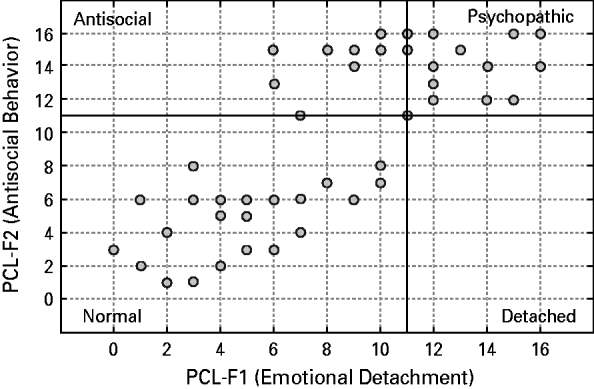
According to the PCL-R cut-off criteria (a diagnosis of psychopathy is made when the PCL-R score is ⩾30, and a non-psychopathic diagnosis when it is <20), 21 out of 56 patients (37.5%) met the cut-off score of ⩾30, and were therefore classified as psychopathic; nine patients (16.1%) had ‘borderline’ scores (between 20 and 30) and 26 women (46.4%) were classified as non-psychopathic violent patients. The distribution of patients' PCL-R scores along the two main PCL factors, Emotional Detachment (F1) and Antisocial Behavior (F2), is shown in Fig. 1.
Distribution of patients' Psychopathy Checklist Revised (PCL-R) scores along the continuum of the two main dimensions of psychopathy: Emotional Detachment (F1) and Antisocial Behavior (F2). All criminal women in the top right box fulfilled criteria for psychopathy.

Patients who fell in the top right quadrant of Fig. 1 achieved high scores (>11) in both F1 and F2 and were classified as psychopathic criminals, whereas those who fell in the top left quadrant of Fig. 1 with high scores in F2 but not in F1 were characterized by antisocial behavior without emotional detachment. There were no women showing high scores in F1 and low in F2, that is emotionally detached without antisocial behavior components (bottom right quadrant of Fig. 1), and about 45% of patients had low (⩽ 8) F1–F2 scores, a pattern that marks a lack of psychopathy traits.
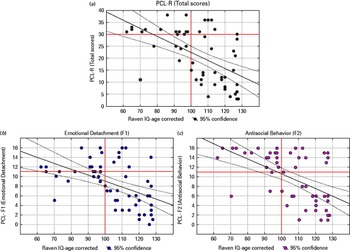
A significant negative correlation was found between PCL-R total scores and RPM IQ age corrected (r 54 = − 0.55, p < 0.001); the higher the PCL-R total score, the lower the intelligence measured with RPM (Fig. 2 a). In addition, Pearson's correlations were significant when considering separately the two main PCL factors, Emotional Detachment (F1) and Antisocial Behavior (F2) (r 54 = − 0.50, p < 0.001 and r 54 = − 0.55, p < 0.001 respectively): the higher the emotional detachment (PCL-F1) and the antisocial behavior (PCL-F2), the lower the RPM IQ (Fig. 2 b, c).
Significant negative correlation between (a) patients' Psychopathy Checklist Revised (PCL-R) scores and Raven's Progressive Matrices (RPM) IQ (r 54 = − 0.55, p < 0.001); (b) patients' PCL-F1 (Emotional Detachment) scores and RPM IQ (r 54=−0.50, p < 0.001); and (c) patients' PCL-F2 (Antisocial Behavior) scores and RPM IQ (r 54 = − 0.55, p < 0.001).

We further factorized each of the two main PCL factors into their relative two subcomponents, the Interpersonal and Affective facets for the Emotional Detachment factor (F1) and the Lifestyle and Antisocial facets for the Antisocial Behavior factor (F2). All of these components were negatively correlated with RPM IQ age corrected (r 54 = − 0.35, p < 0.01, r 54 = − 0.52, p < 0.001, r 54 = − 0.53, p < 0.001, and r 54 = − 0.49, p < 0.001 respectively), revealing that the higher the scores on Interpersonal, Affective, Lifestyle and Antisocial elements, the lower the IQ.
Discussion
In the current study we analysed the association between intelligence and psychopathy in a sample of insane, female offenders, all convicted for violent crimes, including murder or attempted murder, physical assaults or personal injuries, and arson. In line with the main hypothesis that imprisoned psychopaths (also termed unsuccessful psychopaths) exhibit a reduced planning and learning capacity leading to irreducible failure, in female psychiatric patients we found a consistent negative correlation between PCL-R total/partial scores and RPM intelligence level: criminal women with the highest psychopathic traits had lower fluid IQ scores. One important issue concerns the test used to measure intelligence; in most of the past research on psychopathy, the WAIS (or its subtests) has been used. In the present study, the RPM was administered as it is faster and less influenced by culture and education level. However, these two IQ tools have shown a relatively high correlation in past literature, with an r value >0.70 between RPM IQ and WAIS Verbal and Performance IQ scores (e.g. McLeod & Rubin, Reference McLeod and Rubin1962; Burke, Reference Burke1972). Therefore, the two IQ tests are almost equivalent and most differences among all of the studies in this field should be explained mainly by other factors. In particular, a change in the direction of the correlation between PCL and IQ (negative versus positive) cannot be definitely attributed to differences between tools.
Despite the differences between our study and that of DeLisi et al. (Reference DeLisi, Vaughn, Beaver and Wright2010) in the assessment of psychopathy (in the DeLisi study the PCL: SV was used) and IQ (RPM versus Vocabulary subtest of the WAIS-R), and in the samples of psychiatric in-patients studied, our negative correlation is in agreement with that of the DeLisi study. However, the effect size in the present study (r = − 0.51) was larger than that found (r = − 0.13) by DeLisi et al. (Reference DeLisi, Vaughn, Beaver and Wright2010). This difference can be explained not only by the differences in the psychometric tools used but also by the fact that the previous study had a larger sample size, mixed genders and an unselected psychiatric population, all spurious variables affecting the extent of the correlation. In our study, the sample was smaller but it included only criminal insane women and for this reason it was expected to include a larger proportion of fully psychopathic women (representing 37.5% of the whole sample) and a larger variance in the PCL scores. The additional negative correlations of the PCL subscales and RPM IQ confirms that the patients' intelligence was associated equally with the Emotional Detachment and the Antisocial Behavior domains of psychopathy. The analysis of the four-factor subdivision of PCL further strengthens the univocal direction of correlation in all subscales: lower IQ scores were significantly associated with high levels in all four PCL subscales (Interpersonal, Affective, Lifestyle and Antisocial), although a larger and comparable contribution was found for three facets: affective, lifestyle and antisocial. The correlation with the Interpersonal component of psychopathy was relatively weak with respect to the other three psychopathy dimensions, suggesting that the traits that defined this facet (i.e. superficial charm, grandiose sense of self-worth, pathological lying and manipulation) were less negatively associated with intelligence. In comparison with the study of Vitacco et al. (Reference Vitacco, Neumann and Wodushek2008) in male inmates (using a different assessment of psychopathy, the PCL: SV, and the intelligence test, WASI IQ), our results revealed a good agreement for the Affective and Lifestyle components, which were negatively associated with full-scale IQ. By contrast, in the male sample, significant positive correlations were found between IQ scores and Interpersonal/Antisocial dimensions of psychopathy whereas, in our female sample, the association between IQ and these two factors was negative. These aspects of psychopathy partially overlap with narcissistic traits of personality. Because the Narcissistic Personality traits affect males (75%) more frequently than females, a possible interpretation of our findings is that the dimensions that entered the Interpersonal facet of Emotional Detachment depicted typical male characteristics. Thus, the association between high levels of Interpersonal PCL-R scores and low/high levels of intelligence for females and males respectively could be the result of a gender-biased construct, positively correlated with intelligence in men (i.e. the presence of narcissistic traits) and negatively correlated in women.
From the observed negative correlation it is possible to draw some final considerations. At a biological level, criminal psychopathy has been associated with both altered structure and impaired functional activity at the level of the prefrontal regions (Gorenstein, Reference Gorenstein1982; Gordon et al. Reference Gordon, Baird and End2004; Yang et al. Reference Yang, Raine, Lencz, Bihrle, LaCasse and Colletti2005; Kiehl, Reference Kiehl2006). Indeed, the prefrontal cortex subserves executive functions, impulsivity control, planning and cognitive flexibility, is necessary for effective decision making, action and perspective taking and learning from losses and punishment. These abilities are impaired not only in criminal imprisoned unsuccessful psychopaths but also in neurological patients affected by the pseudo-psychopathy syndrome, which typically follows severe ventromedial and orbitofrontal cortex lesions (Blair & Cipolotti, Reference Blair and Cipolotti2000; Angrilli et al. Reference Angrilli, Bianchin, Radaelli, Bertagnoni and Pertile2008; Koenigs et al. Reference Koenigs, Kruepke and Newman2010). Although at first glance, in laboratory testing, intelligence is spared in frontal lobe lesion pseudo-psychopathic patients (Eslinger & Damasio, Reference Eslinger and Damasio1985; Angrilli et al. Reference Angrilli, Palomba, Cantagallo, Maietti and Stegagno1999), in real-life situations, more related to fluid intelligence, it is severely affected (Shallice & Burgess, Reference Shallice and Burgess1991). Intelligence measured by the WAIS has been found to be associated with an intact left frontoparietal network (Barbey et al. Reference Barbey, Colom, Solomon, Krueger, Forbes and Grafman2012). In accordance with this, a relationship between lower general intelligence and frontal lobe dysfunction has been reported in research on goal-directed behavior, and also healthy subjects may sometimes exhibit goal-neglect problems mainly due to novelty distraction, weak error feedback and concurrent task requirements (Duncan et al. Reference Duncan, Emslie, Williams, Johnson and Freer1996). Similar limits arise in criminal psychopaths as they are not able to remain on long-term legal goals and they tend to pursue immediate, impulsive rewards and goals without processing losses, failures and punishments (Hare, Reference Hare1999). The present investigation supports this view by showing, in a sample of Caucasian criminal females, that high psychopathy traits are associated with lower IQ scores. As we used a correlational design, the results are obviously limited in that no causality can be inferred. Although this holds true for Caucasian criminal imprisoned women, our results cannot be generalized to other populations, nor do they contradict the alternative hypothesis in samples of successful (out of jail) psychopaths, for whom higher intelligence levels might be associated with higher levels of psychopathy and intact frontal functioning (Yang et al. Reference Yang, Raine, Lencz, Bihrle, LaCasse and Colletti2005). Future research is needed to investigate the complex factors associated with successful versus unsuccessful psychopathy mediated by intelligence.
Acknowledgments
This study was supported by a grant from the Ministero Italiano dell'Università e della Ricerca Scientifica e Tecnologica (MIUR) to A.A. (PRIN 2006110284) and University of Padova project CPDA047438 to A.A.
Declaration of Interest
None.