Introduction
The unprecedented expansion of the Neo-Assyrian empire during the first millennium BCE brought diverse groups from across the Middle East under a unified political system. Through the processes of conquest, forced population movement, and trade and tribute delivery, the Assyrian empire became what is often called a “multi-ethnic” state.Footnote 1 Previous studies of cultural interaction in this highly diverse setting have tended to focus on processes of local assimilation to a dominant culture. Parpola (Reference Parpola, Dever and Gitin2003 and Reference Parpola2004) in particular has argued that conquest was accompanied by forced “Assyrianization,” in which groups were required to adopt Assyrian language and culture.Footnote 2 Other recent studies have focused instead on voluntary assimilation to an Assyro-Aramaean culture among cosmopolitan elites (e.g. Liverani Reference Liverani, Arnason and Raaflaub2011; Berlejung Reference Berlejung and Nissinen2012). Concrete examples of voluntary assimilation include the increasing use of Aramaic as a lingua franca Footnote 3 and Assyrian influence in the iconography and material culture across the Levant.Footnote 4
Assimilation is, however, only part of the story. Several recent studies have focused on the construction of difference in Assyrian propaganda as a means of managing the diverse populations brought under Assyrian rule (e.g. Zaccagnini Reference Zaccagnini, Nissen and Renger1982; Cifarelli Reference Cifarelli1998; Feldman Reference Feldman, Kelle, Ames and Wright2011; Karlssohn Reference Karlsson2017). This process is, in certain respects, the flip side of assimilation — i.e. a program of “Assyrianization,” forced or voluntary, requires that rulers and subjects distinguish between “Assyrian” and “Other.”Footnote 5 In her analysis of representations of foreigners in Assyrian palace reliefs, Cifarelli (Reference Cifarelli1998: 211) concludes:
One of the tenets of the ideology expressed and formulated through the art of Ashurnasirpal — created at a time when Assyria was engaged intensively in building an empire at the expense (literally and figuratively) of its neighbors—was a negative conception of alterity, of the otherness or cultural difference ascribed to foreigners. In this system, the features that distinguish non-Assyrians from Assyrians were understood to be inherently sinister and abnormal.
Cifarelli's approach shares with assimilationist models the idea of a binary opposition between Assyrian and other, in which the category of other constitutes a largely undifferentiated entity with deeply negative associations in Assyrian propaganda.
The twin processes of assimilation and differentiation are certainly well attested in the historical record. I argue, however, that they do not represent the full range of Assyrian approaches to managing a heterogenous empire. As Braun-Holzinger (Reference Braun-Holzinger2018) has recently observed, Assyrian art does not convey a consistently negative stance towards human difference.Footnote 6 Instead, as I will argue, Assyrian texts and iconography display diversity as a means to demonstrate the full extent of the Assyrian empire. These representations of human diversity can best be understood within the broader context of royal consumption and display of luxury goods from around the empire that has already been the subject of much study.Footnote 7 Just as the description and display of foreign objects projected Assyrian power, so too the representation of cultural difference among population groups signaled the truly universal nature of Assyrian rule. In this respect, rather than being seen as a danger to be eliminated through assimilation, representations of human diversity were employed as a strategy of empire.
This rhetorical strategy is not unique to Assyria. Recent studies of empire recognize a variety of ways in which imperial centers manage the heterogenous populations they incorporate.Footnote 8 Burbank and Cooper (Reference Burbank and Cooper2010: 11–12) term this phenomenon the “politics of difference,” noting that “distinction does not everywhere imply a binary split into colonized and colonizer. […] For many empires, loyalty, not likeness, was the goal.” This instrumentalizing approach to diversity is particularly characteristic of empires that do not share the European construct of racial difference and social evolution, including polities as varied as the Seleucid (Fischer-Bovet Reference Fischer-Bovet2015 and Haubold Reference Haubold, Lavan, Payne and Weisweiler2016), Carolingian (Moreland Reference Moreland, Alcock, D'Altroy, Morrison and Sinopoli2001), and Ottoman Empires (Barkey Reference Barkey2008). Even within Europe, the categorization and display of difference became a method of justifying and advancing imperial rule.
Building on this type of comparative approach, I consider Assyrian representations of difference alongside a distinctly European innovation: the world fairs of the 19th and early 20th centuries. Studies of these fairs show how they functioned as “symbolic universes” that legitimated colonial exploits by allowing fairgoers to view the vast extent of empire and enact the experience of conquest.Footnote 9 I argue that within the broader context of palace architecture, the careful rendering of foreigners on wall reliefs functioned to construct a symbolic universe. Individuals living in the heartland as well as dignitaries from vassal states could witness the full range of imperial territories and subjects on the walls of the Assyrian palace. Representations of diversity thus illustrated for subjects their own role in an empire that truly covered the known world, including places so distant that many encountered them only through Assyrian representation.
The differences between Assyrian and European categorization and representation of difference are as instructive as the parallels. As many scholars have noted (e.g., Fales Reference Fales, Vanderhooft and Winitzer2013; Karlsson Reference Karlsson2017: 8–9), Assyrians did not consider ethnicity a constitutive element of citizenship. Thus, while the Assyrian approach to diversity was certainly instrumentalizing, it was also inclusive in a way that differs from modern experiences of European empire. In this respect, the Assyrian understanding of human diversity shares much in common with the way the empire treated other types of difference, ranging from topographic variation to biodiversity. From the imperial vantage point, cultural difference like these other elements had the potential to be tamed rather than destroyed outright in a way that highlighted the unparalleled control of the king over the four quarters of the world.
Exoticism in Assyrian Inscriptions and Iconography
Previous studies have explored how the display of foreign goods, flora, and animals allowed Assyrian kings to vividly illustrate their military triumphs.Footnote 10 This collector's approach to foreign goods and products can be clearly seen in depictions of foreign campaigns. Royal inscriptions from the reigns of Ashurnasirpal II through Assurbanipal (883–627 BCE) highlight the Assyrian king's power specifically through the enumeration of tribute delivered (or captured) from far-off, exotic locales. Describing his successful campaign through north Syria and Phoenicia which brought the coastal cities of the Mediterranean under Assyrian control for the first time,Footnote 11 Ashurnasirpal II lists the sumptuous tribute he received (Ashurnasirpal II 2 [ = RIMA 2 A.0.101.002]: 26–30):Footnote 12
ina qibīt Aššur bēli rabê bēliya u Ninurta rā’im šangûtiya ana Labnāna lū allik. Ana tâmti rabīte lū ēli. ina tâmti kakkīya lū ullil nīqē ana ilānīya lū aṣbat. ina ūmešuma maddatu ša šarrāni ša šiddi tâmti ša Ṣurrayya Ṣidunayya Amurrayya Gubalayya Maḫlatayya Kaizayya Maizayya u Arwada ša qabalti tâmti kaspī ḫurāṣī annakī siparrī diqārī siparri lubulti birme kittê šinnī nāḫirī binût tâmti amḫur
By the command of Assur, my great lord, and Ninurta who loves my priesthood, I went to the land of Lebanon. I went up to the Great Sea. I washed my weapons in the sea and made sacrifices to my gods. At that time, I received tribute from the kings of the seacoast, from the kings of the lands of Tyre, Sidon, Amurru, Byblos, Mahallatu, Kaizu, Maizu, and the city of Arwad, which is in the midst of the sea: silver, gold, tin, bronze, bronze tureens, garments with colorful trim,Footnote 13 linen, and tusks from hippopotamuses,Footnote 14 creatures of the sea.
Following this impressive list of physical tribute, Ashurnasirpal describes the wildlife he captured and brought back for his royal zoo, including large and small monkeys and lions (ll. 30–33).
Assyrian representations of the foreign groups encountered while on campaign can be best understood in the broader context of Assyrian collection and display. In the description of his second Egyptian campaign,Footnote 15 Esarhaddon similarly illustrates his accomplishment by emphasizing exotic elements of the endeavor, ranging from the booty acquired to the appearance of the locals. Like Ashurnasirpal's Phoenician campaigns, Esarhaddon's capture of Egypt was a signi-ficant military triumph with symbolic significance for the Assyrian monarch, bringing Egypt fully under Assyrian control for the first time in the empire's history. A fragmentary inscription from Nineveh (RINAP 4 34)Footnote 16 recounts the trip to Egypt in near mythic terms, describing an arduous journey by camel across inhospitable terrain where the army encountered deadly two-headed snakes (r. 5). The Assyrian king also demonstrates his new familiarity with the region by referring to the area, commonly called Magan and Meluḫḫa in Akkadian inscriptions, by its native monikers Kush and Muṣur {kurku-u-si ù kurmu-ṣur} (8’).Footnote 17 The use of native terminology to describe Egypt allowed the Assyrian king to prove his intimate connection to the far-off region.
Another text (RINAP 4 1019)Footnote 18 contains an extensive description of the wealth obtained in Egypt, emphasizing the foreignness of both people and animals taken captive. Esarhaddon remarks on the skin color of the royal family, which he describes as “dark as pitch” {gim esir ṣal-mu uzu.meš-šú-[nu]} (23). The text likewise notes unique features of the physical tribute, which included a hoard of gold crowns bedecked with serpents {šá ba-aš-mu kug.sig17 ù muš.meš kug.sig17 ina muḫ-[ḫi šak-nu]} (r. 28). Along with the hoard, Esarhaddon brought back exotic animals, such as sheep with the tails of oxen {udu.níta.meš šá kun gu4.meš šak-[nu]} (r. 33) and a red and white beast whose appearance was altogether unparalleled in Assyria {[i]na uru u kur la in-nam-[mar-ru]} (r. 41).
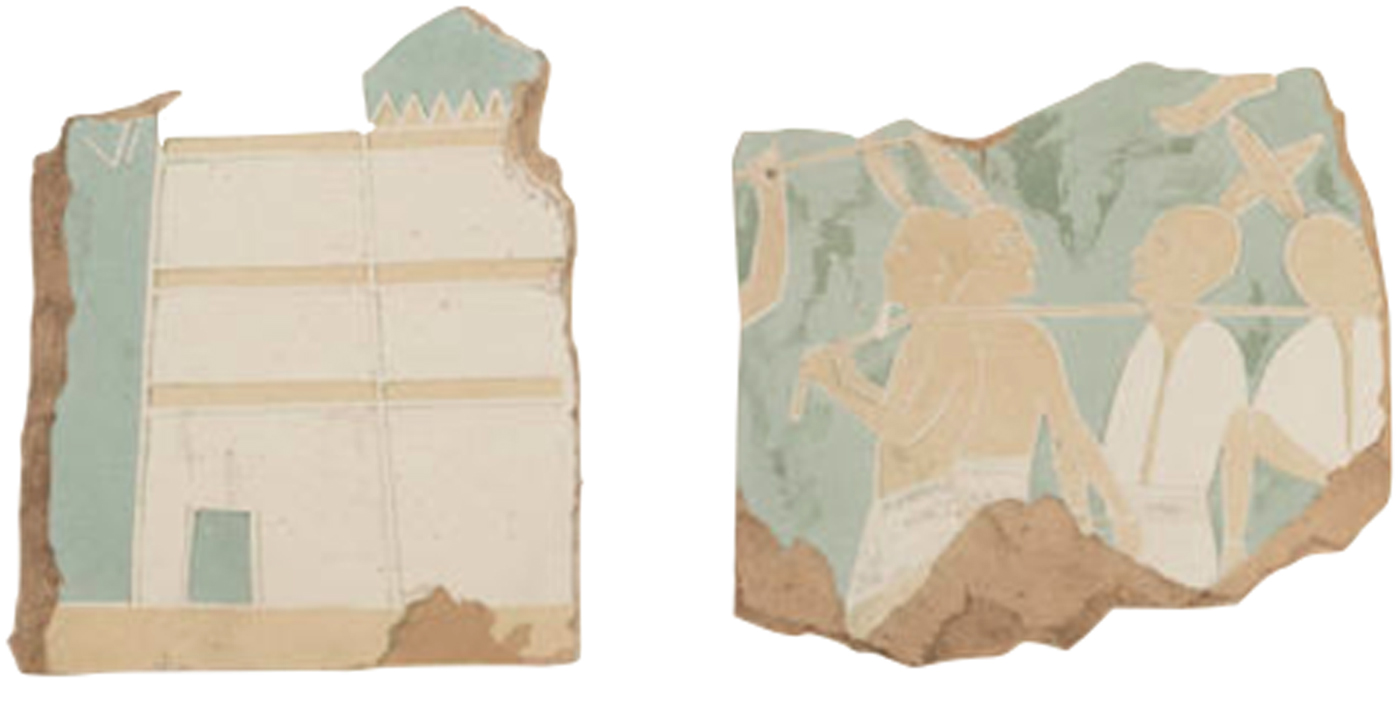
Fragments of glazed brick from Nimrud provide a visual representation of Esarhaddon's Egyptian campaign in full color (Fig. 1).Footnote 19 The fragments include images from multiple scenes that would have constituted a full composition with the siege of Memphis featured in the center. On one side, Assyrian soldiers proceed from left to right, approaching the city and then engaging in combat with Egyptian cavalry. The outcome of the battle is indicated by a change in direction, with captured soldiers, refugees, and booty-laden officials moving from right to left. Fragments from each of the scenes remain. The fortifications of the Egyptian city are depicted on N.2067 (= Layard Reference Layard1853: Pl. 53 no. 5) and replicate Egyptian architectural patterns, including a pylon-shaped tower with crenellated walls (Albenda Reference Albenda1982: 13; Nadali Reference Nadali2006: 14). In fragments of battle scenes, Egyptian warriors appear clad only in short kilts with a distinctive feather attached to their clean-shaven heads.Footnote 20 Similarly dressed soldiers, bound in neck shackles, are led off as prisoners on N. 1036 (= Layard Reference Layard1853: Pl. 54 no. 7). Although it has not been preserved, the full relief likely included images of the exotic spoils that were carted back to Assyria, such as the hoard of serpent-headed crowns described in RINAP 4 1019 (r. 28).
Glazed bricks from Nimrud depicting Esarhaddon's Egyptian campaign. Left: Layard: Pl. 53 no. 5. Right: Layard Reference Layard1853: Pl. 54 no. 7.

In Esarhaddon's iconographic and literary depiction of his Egyptian campaigns, the represen-tation of foreigners’ bodies, including hair, clothing, and skin color, can be analyzed within the broader context of practices of collection and display. Markers such as dress and language are part of a broader cultural matrix that includes consumable products like food and luxury goods. Taken together, the careful attention to geography, architecture, and dress in Assyrian depictions of foreign conquest can be understood as a rhetorical strategy designed to emphasize the full extent of Assyrian hegemony. The inclusion of exotic tribute lists in royal inscriptions does more than indicate the wealth of the monarch. It allows the Assyrian state apparatus to claim ownership of the lands conquered (or taxed) by showing mastery of the products, people, and wildlife unique to the region and its trade network. Similarly, descriptions of exotic and dangerous landscapes, such as Esarhaddon's campaign through Sinai, accomplish two rhetorical goals. On the one hand, the account is designed to show the Assyrian king's valor and cunning when, for example, he “discovered” the use of camels for transport in arid regions (RINAP 4 34: 4: r. 1–2). Simultaneously, however, the emphasis on the exotic allows the Assyrian monarch to harness zoological, cultural, and physical difference in order to colorfully illustrate his own power over distant and diverse regions.
Visualizing Empire at the World Fair
Assyrian texts, architecture, and iconography provide their audience with a highly structured experience of foreign lands, with carefully curated details ranging from the appearance of Egyptian soldiers to the smell of Lebanese Cyprus trees in royal gardens (discussed in more detail below). Each individual component participates in a broader symbolic world that can be elucidated by comparison to a distinctly modern phenomenon: European and American displays of foreign civilizations at the world fairs of the 19th and 20th centuries. At the Paris Exposition Universelle, for example, fairgoers had the opportunity to visit exhibits representing recent French conquests, including Algeria and Tunisia, as well as areas that the French government had but briefly claimed, such as Egypt.Footnote 21 These exhibits provided tangible evidence of the vast extent of colonial control: visitors could see, smell, and even touch the acquisitions of the French government.
Edmond About, a visitor to the exposition in 1867, enumerated the riches of the Egyptian exhibit in terms reminiscent of Esarhaddon's royal inscriptions:
Les armes du Soudan, les dépouilles d'animaux monstrueux, les parfums, les poisons, les plantes médicinales, nous transportaient d'emblée sous le tropique; les poteries de Siout et d'Assouan, les filigranes, les tissus de soie et d'or, nous invitaient à toucher du doigt une civilisation étrange. Toutes les race soumises au vice-roi étaient personnifiées par des individus choisis avec soin; on coudoyait le fellah, on se rangeait devant les Bédouins du désert de Libye sur leurs beaux dromadaires blancs.Footnote 22
Here, the focus on luxury items and exotic flora and fauna finds a striking antecedent in the Assyrian campaign accounts and tribute lists. The Egyptian exhibit at the Paris exposition not only highlighted the wealth of Egypt but also presented visitors with a frisson of the dangers of conquest. A similar rhetorical technique is evident in the Assyrian annals. Compare, for example, the presence of monstrous animals and deadly poisons on display in Paris with Esarhaddon's description of the two-headed snakes and the many references to the capture of wild animals in Assyrian royal inscriptions.
By constructing a model of Egypt at the Paris exhibit, the French government was able to claim mastery of an area they controlled only briefly and appropriate its wealth and intellectual heritage as their own.Footnote 23 Here we find a second parallel with Esarhaddon's descriptions of his Egyptian campaign. Like France, Assyria was unable to maintain control over Egypt and within six months of the Assyrian conquest, the Egyptian ruler appears in a list of rebellious kings.Footnote 24 Despite his tenuous grip on Egypt, Esarhaddon emphasized his conquest in text and iconography because of its symbolic value — positioning himself as both heir to and conqueror of the ancient civilization,Footnote 25 just as France would do two thousand years later. In each case, the victorious ruler capitalized on symbolic imagery to create an idealized (even fictitious) version of past conquests.
This points to a feature shared by the other world fairs that were staged across Europe and America: the curation and display of diversity to not only demonstrate but also consolidate political authority. Drawing on the work of sociologists Berger and Luckmann (Reference Berger and Luckmann1966), Rydell (Reference Rydell1987: 2) argues that world fairs created “symbolic universes,” structures of hegemonic legitim-ation that provided meaning for fairgoers’ experience of the outside world. In this respect, the Exposition Universelle not only represented French colonial acquisitions but also concretized French authority for the visitors, inflecting their future experiences by providing a blueprint for understanding social and political relations.
The world fairs in England, Germany, and America similarly allowed visitors to participate in the colonial process.Footnote 26 The colonial exhibit at the 1896 Industrial Exhibition in Berlin included a human zoo with subjects imported from German colonies who occupied model cities. In an exhibit showcasing colonial businesses and mission work, fairgoers could step inside the “Hartebeest”-style huts built by German colonists in southwest Africa (Steinmetz Reference Steinmetz2017: 54–55). The science hall contained botanical samples from across the German colonies, and a hygiene exhibit allowed visitors to visit an exact replica of a colonial hospital (ibid.: 56). Steinmetz observes the effects of circumambulating the fair: “The displays and the guidebook aligned visitors with the aims of German colonialism, urged them to reenact colonial conquest and symbolic domination, and allowed them to imagine themselves in the mundane colonial roles that were essential to the operations of the colonial state” (ibid.: 57).
The world fairs were not, however, designed only for a domestic audience viewing the full extent of empire for the first time. The fairs, designed to showcase technological advances as well as territorial conquest, attracted an international audience that included individuals from many of the regions that were themselves on exhibit. The experience of being both spectator and subject created a sort of slippage that reinforced the symbolic universe, blurring the line between the world fair and the real world. During his visit to an exhibition held in Birmingham in 1846, for example, Egyptian crown prince Ibrahim was involuntarily incorporated into the exhibit itself (Mitchell Reference Mitchell1988: 4). Two decades later, his son Ismail Pasha, then the khedive (viceroy) of Egypt, was invited to help design his country's exhibit at the 1867 Exposition Universelle. As Nour (Reference Nour2017) has shown, Khedive Ismail used the exhibit to construct and display an Egyptian cultural and political identity distinct from the Ottoman Empire. To emphasize Egypt's status as heir to ancient empire, the exhibit included a replica of an Egyptian temple, filled with antiquities and fronted by a full size pylon-gate like the one depicted on Esarhaddon's glazed bricks. At the opening ceremonies, the Egyptian contingent was invited to participate alongside sovereign nations, to the consternation of their Ottoman suzerains. In instances like these, the world fair became not only a representation of imperial might but an actual means for the negotiation of complex political relationships.
Assyria's Symbolic Universe: Gardens, Zoos, and Palace Art
Conceptualizing the European world fairs as symbolic universes provides a useful lens through which to view Assyrian representational strategies. Like later European imperial powers, Assyrian kings articulated their hold on vassal states through the careful curation of their representations within the palace architectural program. For example, kings constructed and maintained royal gardens with botanical and zoological specimens obtained on campaign. The tradition is first attested in the Middle Assyrian period under Tiglath-pileser I (r. 1114–1076), who boasts of collecting specimens of fruit trees that had never before been grown in Assyria:
erēna taskarinna allākkaniš ina mātāti ša āpelušināti iṣṣī šâtunu ša ina šarrāni abbīya maḫrûte mamma lā izqupū alqâmma ina kirâti mātiya azqup Footnote 27
I took cedars, box-trees, and Kanesh-oaks from the lands over which I had gained dominion, such trees as none of the previous kings, my forefathers, had ever planted, and I planted them in the orchards of my land.
The tradition was revived by Ashurnasirpal, the first of the great Neo-Assyrian kings, who commemorated his capture of the Levantine coast by creating a magnificent botanical garden with specimens collected from across the empire.Footnote 28
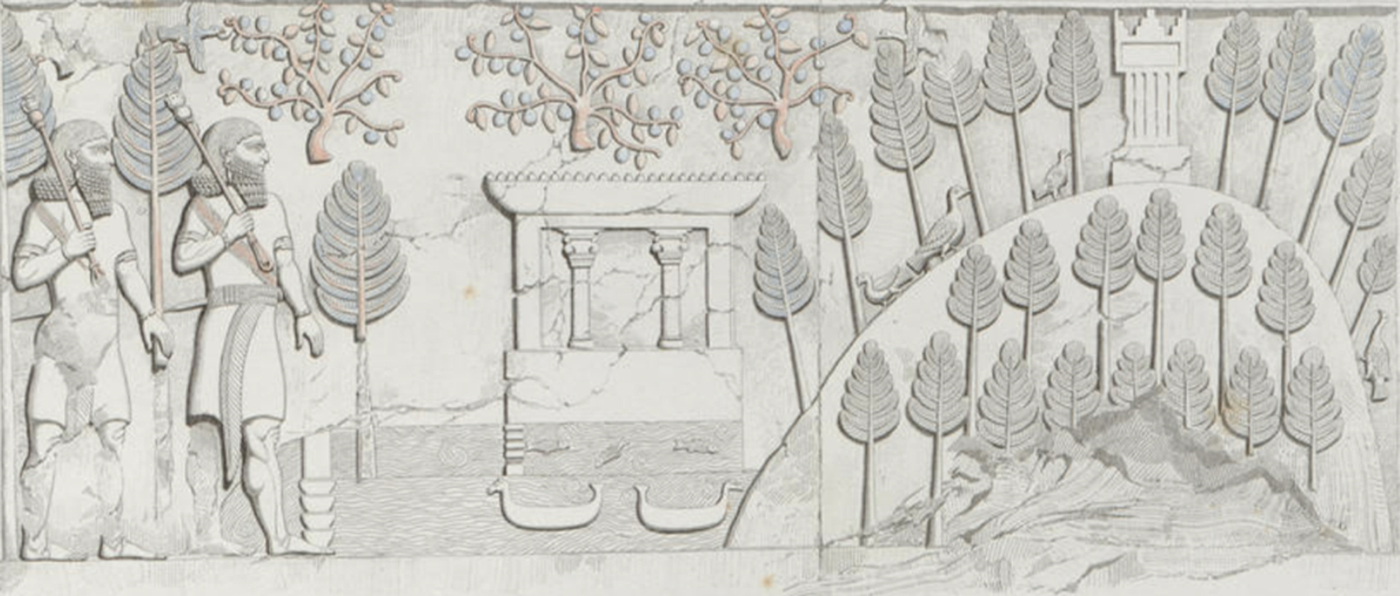
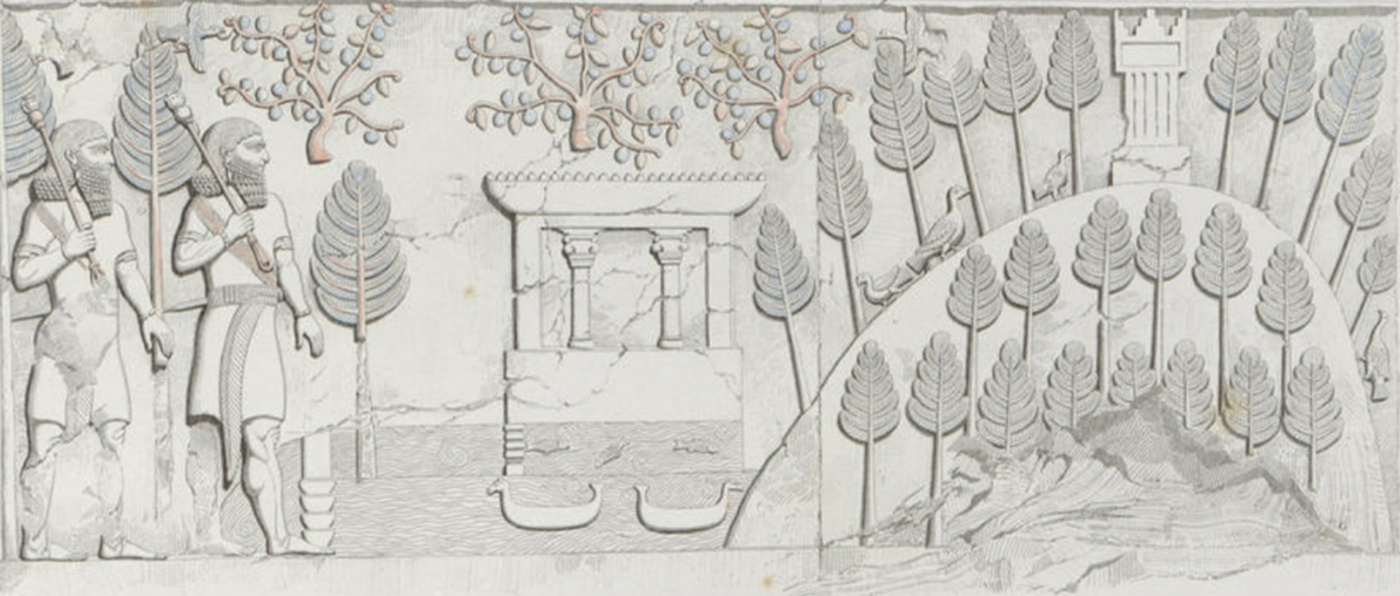
Although the gardens themselves have not survived, Sargon's Khorsabad palace includes a wall relief depicting just such a garden.Footnote 29 The scene appears in the lower register of Slab 13 in a small chamber (Room 7) that forms part of a double-sided reception suite on the upper terrace, accessible via the throne room courtyard (Fig. 2).Footnote 30 In his royal inscriptions, Sargon describes how he sculpted the terrain of the real garden to accommodate the fauna of north Syrian forests in his palace.Footnote 31 As Stronach (Reference Stronach1990: 172) notes, the artificial hills, dense planting, and Syrian-style architecture “underlin[ed] the now firm extension of Assyrian power to the west of Euphrates.” Each of these elements is visible in the wall relief, which also features a small lake in the foreground with boats with horse-headed protomes. These vessels are well known from the Phoenician region (Friedman Reference Friedman, Amedick, Froning and Held2015) and combine with the architecture and topography to recall the western extent of the empire. Sargon's son Sennacherib created a similar garden in his own “Palace without Rival” at Nineveh, where he added an artificial swamp filled with wild boar in imitation of the landscape in southern Babylonia.Footnote 32 Within the Assyrian king's palace, the visitor could thus encounter the full extent of the empire, from the towering trees in Syria (along the coast of the upper sea) to the marshes of Babylonia (at the lower sea).
Relief from room 7 of Sargon's palace at Khorsabad. Botta and Flandin Reference Botta and Flandin1849: Vol. 2, Pl. 114.
People on Display: Sargon's Seascape
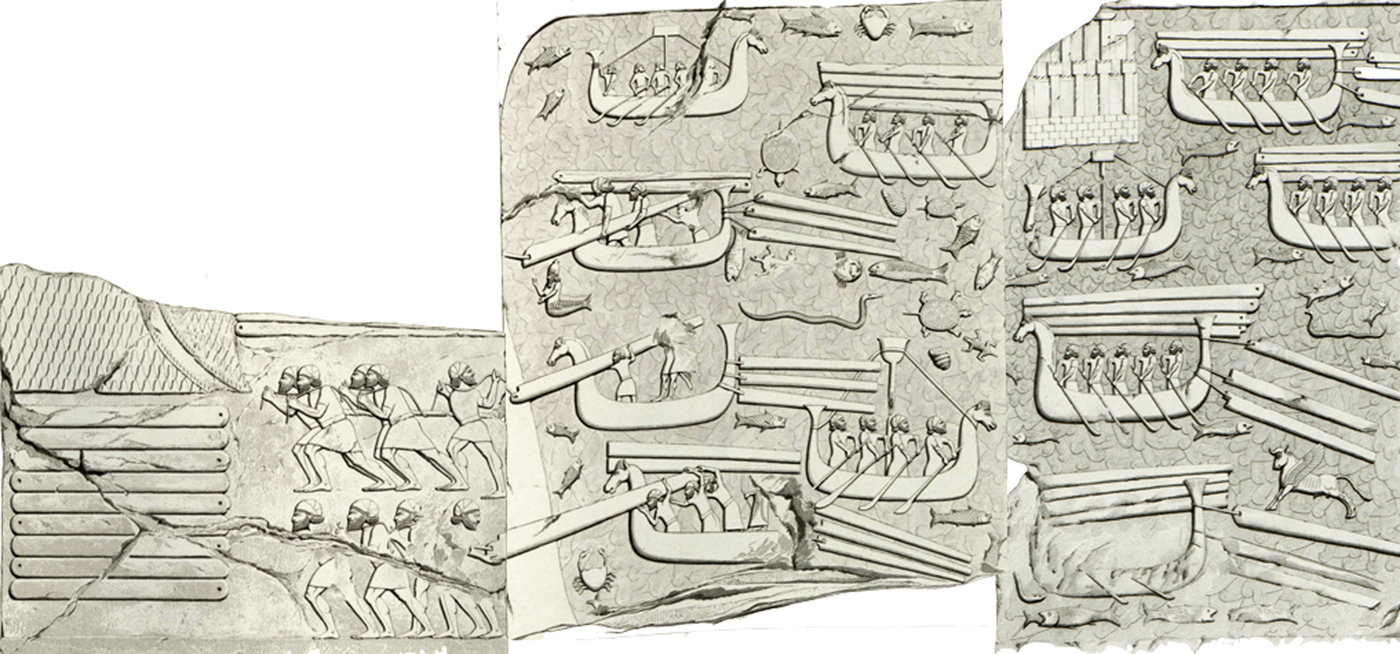
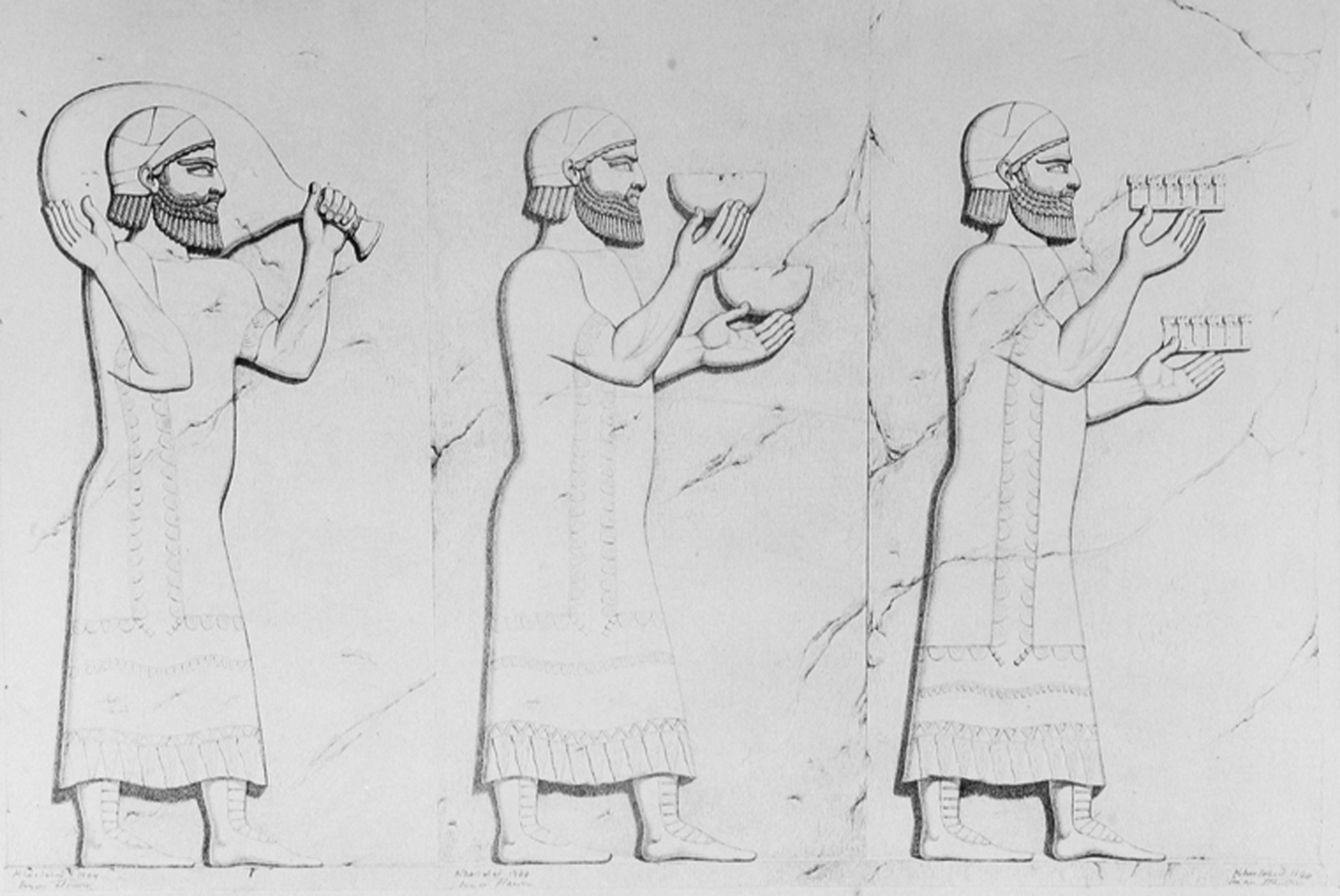
Unlike the modern builders of 19th-century world fairs, Assyrian kings did not import live actors to fill their exotic gardens. They did, however, represent the people of conquered nations in palace reliefs and other visual media, which would likely have been seen by higher status deportees from foreign territories likely encountered their own representations.Footnote 33 A remarkable example can be found in the throne room courtyard (Room VIII) of Sargon's palace at Khorsabad.Footnote 34 A series of reliefs along the southeastFootnote 35 wall affords the visitor a bird's-eye view, extending from an island city in the west (perhaps Tyre)Footnote 36 to the king's reception of tribute at the palace itself. The full extent of the southeast façade frames a door at center,Footnote 37 with an image of the Assyrian king facing outward on either side of the door. To the right of the door (slabs 0Footnote 38–9), the king's gaze reaches to the Mediterranean sea (slabs 0–3), where seafarers are depicted hauling lumber in flat-bottomed boats propelled by oars (Fig. 3). Laden vessels proceed to the shore, where barefoot workmen in short kilts drag the lumber in teams and stack the beams in orderly piles beneath an acropolis. The sea teems with life, both ordinary (fish, crabs, turtles, and snails) and mythic (a winged horse [slab 2] and a merman [slab 3]). On the left side of the façade, another likeness of the Assyrian king receives a line of foreign tributaries, depicted with caps and coiffures that match those of the Phoenician lumber workers (Fig. 4). In contrast to their working contemporaries, however, these individuals are decked in finery, including long, ornate kilts with scalloped trim and tassels, and high boots.Footnote 39 Their tribute includes bowls, burgeoning wineskins, camels, and even model cities, a representation within a representation.Footnote 40
Slabs 2–4 (3–5) of façade n in Sargon's Palace at Khorsabad. Image after Botta and Flandin Reference Botta and Flandin1849: Vol. 1, Pls. 33–35.

Facade n, slabs 22–20 (23–21) in Sargon's palace at Khorsabad. Albenda Reference Albenda1986: Pl. 34

Taken as a whole, Sargon's seascape can be seen as an attempt to delimit control over a quadrant of the known world, extending from the Assyrian heartland to the Mediterranean sea and encompassing both maritime trade and aquatic species, mythical and mundane. The scene adorned an external wall of the palace in a large courtyard. During the palace's inaugural banquets and short-lived tenure as Assyrian capital, the relief would have provided foreign dignitaries with an alternative to the gory battle scenes showing the fate of rebellious enemies.Footnote 41
Royal Audience: The Tribute Scene in Palace Art
The tribute scene and accompanying seascape of Sargon II's palace at Khorsabad is a particularly striking example of a broader phenomenon in Assyrian palace and temple art: the illustration of subjects from vassal kingdoms bringing their annual maddattu to Assyria. A similar scene is depicted in the palace of Ashurnasirpal II at Kalhu (Kertai Reference Kertai2015: 103–104). As in Sargon's palace, the outer façade (D and E) of the throne room of the Northwest Palace included a tribute scene featuring foreigners.Footnote 42 Located in the main courtyard, the friezes frame the side entrances to the throne room (entrance D-d and E-c respectively), with lines of tributaries approaching the lamassu-framed doorways on each side. The tributaries approach the throne room entrance bedecked in finery and bearing sumptuous gifts and exotic tribute, including tame monkeys. The advancing line of dignitaries sink into a deep bow as they approach the door to the throne room. The reliefs have the striking effect of conveying a constant flow of tribute into the Assyrian heartland and palace, where an image of the king stands before each door, eternally poised to receive his due.
Both Postgate (Reference Postgate1974: 126–127) and Cifarelli (Reference Cifarelli1998: 217–218) have observed that the palace reliefs provided an opportunity for real-life ambassadors to encounter their representation in annual tribute ceremonies.Footnote 43 These insights can be extended further to include the images of diverse tributaries in other media, such as the three sets of bronze gates from Balawat,Footnote 44 and throne decorations from Fort Shalmaneser in NimrudFootnote 45 and Esarhaddon's bīt akīti in the Ezida Temple.Footnote 46 The palace gates of Ashurnasirpal II and Shalmaneser III at Balawat, for example, most likely led from an outer courtyard into a reception suite (although their precise location and the layout of the palace is unknown).Footnote 47 Thus, like the wall reliefs, the images of tributaries were most probably on display to visitors as they processed from the throne room courtyard into their audience with the king. The presence of tribute scenes on the thrones themselves allowed tributaries to see their own behavior modelled at all moments of their audience, from their arrival in the grand courtyard to the moment they bowed in prostration before the king.
Palace visitors thus entered a symbolic universe that blended experience and representation in much the same way that the world fairs did. In each case, individuals participated in the experience of empire by taking on the roles prescribed within a carefully orchestrated interaction. Like the Assyrian palace, fairgrounds could also become a scene for international negotiations. In addition to participating in the opening ceremonies as a head of state, Khedive Ismail took up residence in the medieval palace of the Egyptian exhibit when on trips to London (Mitchell Reference Mitchell1988: 4; Çelik Reference Çelik1992: 111). In both European world fairs and Assyrian palaces, individuals experienced an imperial vision that displayed the entire world and dictated their place within it.
Inclusivity in Empire: Visions of Self and Other
Like European empires, Assyria managed difference by categorizing diverse groups in order to prescribe their role within the empire. There is, however, a significant difference in the ways in which the two groups went about this process of classification. European and American world fairs were heavily influenced by ideas of racial hierarchy and human progress. French and German exhibitions, for example, separated exhibits related to European progress, such as technological showrooms, from those displaying colonized areas (Çelik and Kinney Reference Çelik and Kinney1990: 36; Steinmetz Reference Steinmetz2017: 55–57). The 1893 Columbian Exhibition in Chicago went even further. The organizers of the Midway attraction initially intended to present an evolution of human culture based on the principles of Social Darwinism, arranging their model villages from the most primitive to the most evolved (Kendall Reference Kendall2017: 22).
Assyrian representations of diversity also organize and classify people but without an evolut-ionary approach to human culture. Differences of dress, language, and physiognomy are not portrayed as inherently threatening. Similarly, it cannot simply be assumed that the Assyrians had a conception of “Assyrian culture” as a coherent and closed system that must be defended against inferior outside influence. This is not to say that Assyrians consistently approached other cultures with benevolence and a presumption of equality. Brown (Reference Brown, Brown and Feldman2014: 533–535), for example, has compellingly argued that Assyrian representations of north Syrian architecture and populations convey a sense of respect and prestige that is lacking in representations of Arab groups.
It does not follow from Brown's observation, however, that the primary rhetorical purpose of Assyrian representations of alterity is the articulation of Assyrian superiority on a cultural continuum, as some have argued (e.g. Zaccagnini Reference Zaccagnini, Nissen and Renger1982; Cifarelli Reference Cifarelli1998; Feldman Reference Feldman, Kelle, Ames and Wright2011). Cifarelli is certainly correct that the slouching posture of foreigners in Assyrian art is intended to invoke submission and relative weakness in the face of the Assyrian king. Caved backs and bent knees characterize defeated enemies as portrayed on a variety of media, ranging from the battle scenes of Ashurnasirpal's throne roomFootnote 48 to the defeated Egyptian soldiers on Esarhaddon's glazed bricks (Fig. 1 above). Recalcitrant Egyptians slouch in defeat as they are led away in chains. Contrasting the representation of vanquished foreigners with those of straight-backed Assyrian officials, Cifarelli (Reference Cifarelli1998: 212) concludes that Assyrians held a deeply negative view of foreign culture as threatening and sinister.
The distinction between the posture of Assyrians and foreigners is not, however, as clear cut as Cifarelli suggests. Braun-Holzinger (Reference Braun-Holzinger2018: 24–25) observes that individuals in Assyrian garb are featured in full prostration before the Assyrian king on the reliefs of Ashurnasirpal II (B-10) and the Balawat gates of Shalmaneser III. She concludes that prostration is neither characteristic exclusively of foreigners nor an inherently sinister gesture. Instead, the posture should be primar-ily analyzed as indicating submission, a position that characterizes the relation of both foreign rulers and Assyrian officials to the king.
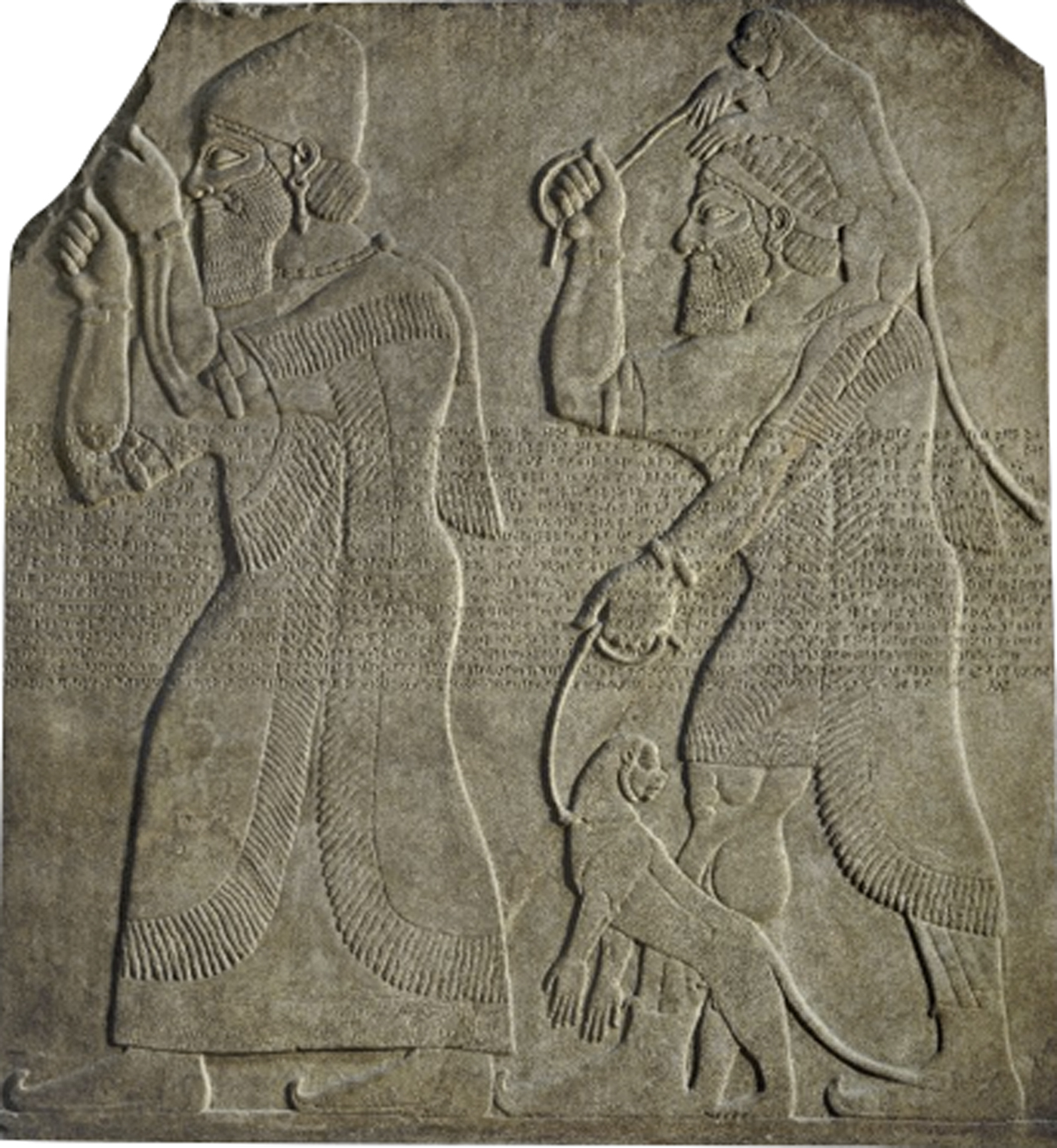
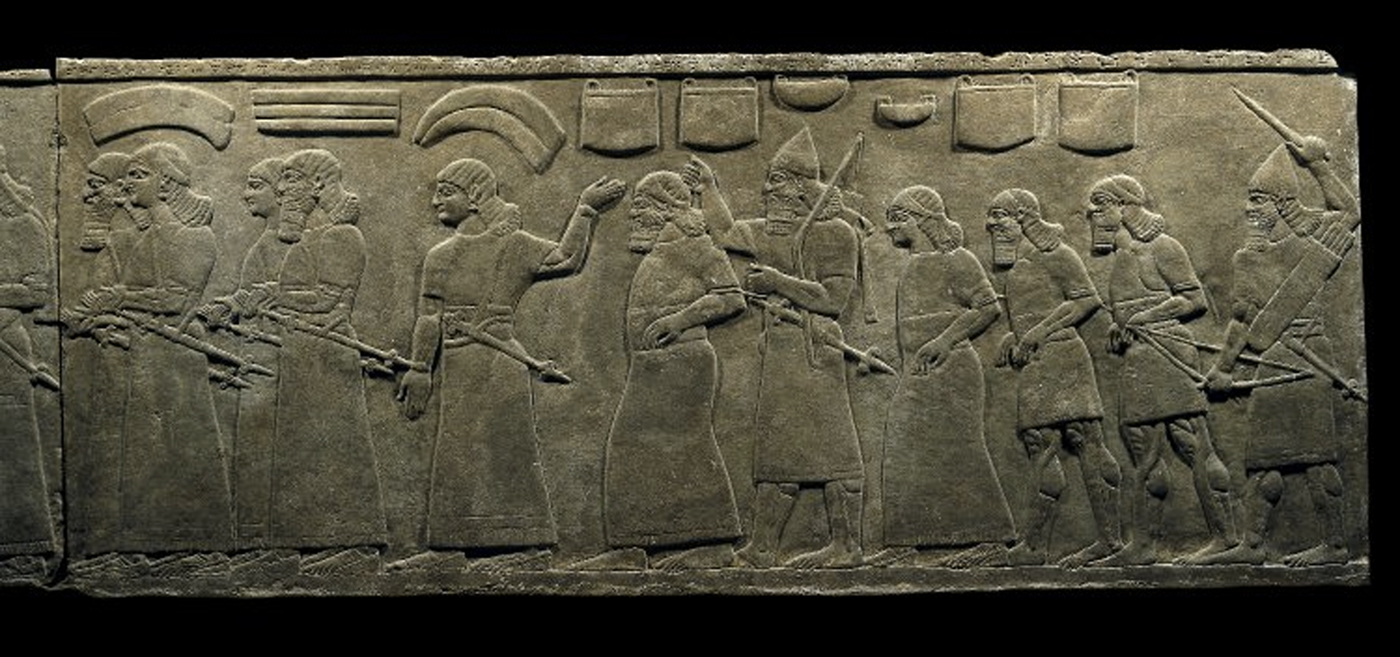
A more productive contrast can be drawn between the depiction of destitute refugees who flee vanquished cities from that of voluntary tribute bearers. To be sure, both groups adopt submissive postures. Citizens of rebellious states, however, stream from their cities in a permanent crouch, dressed simply and frequently carrying children and sacks. The dignitaries of obedient vassals, by contrast, are shown in a variety of postures, including (but not only) bowing in audience before the king. Cifarelli (Reference Cifarelli1998: 215) focuses in particular on the postures of voluntary tributaries in a frieze from the main courtyard of Ashurnasirpal's Northwest Palace.Footnote 49 The tributaries are depicted in procession on either side of the frieze, leading towards the far doors of the throne room (doors c and d).Footnote 50 As the procession advances towards door c, the tributaries crouch lower, paying obeisance to the living king who, we imagine, stands just beyond the threshold. We can, however, distinguish the respectful posture of these guests from the defeated slouch of enemies and refugees. The voluntary tributaries are arrayed in finery and carrying exotic goods and gifts, including monkeys (Fig. 5). In contrast to the simply-dressed prisoners who are forcibly marched off in nearby reliefs (Fig. 6),Footnote 51 the tributaries here arrive of their own accord. They wear slippers with curled toes, embroidered robes, and multiple pieces of jewelry each, including necklaces, armbands and earrings. The images march along the wall, converging with the scene depicted on façade n of the throne room courtyard (Figs 3 and 4 above).
BM 124562 Court D, Slab 7. Northwest Palace of Ashurnasirpal. © Trustees of the British Museum.

BM 124539. Room B, Slab 17 (lower). Northwest Palace of Ashurnasirpal. © Trustees of the British Museum.

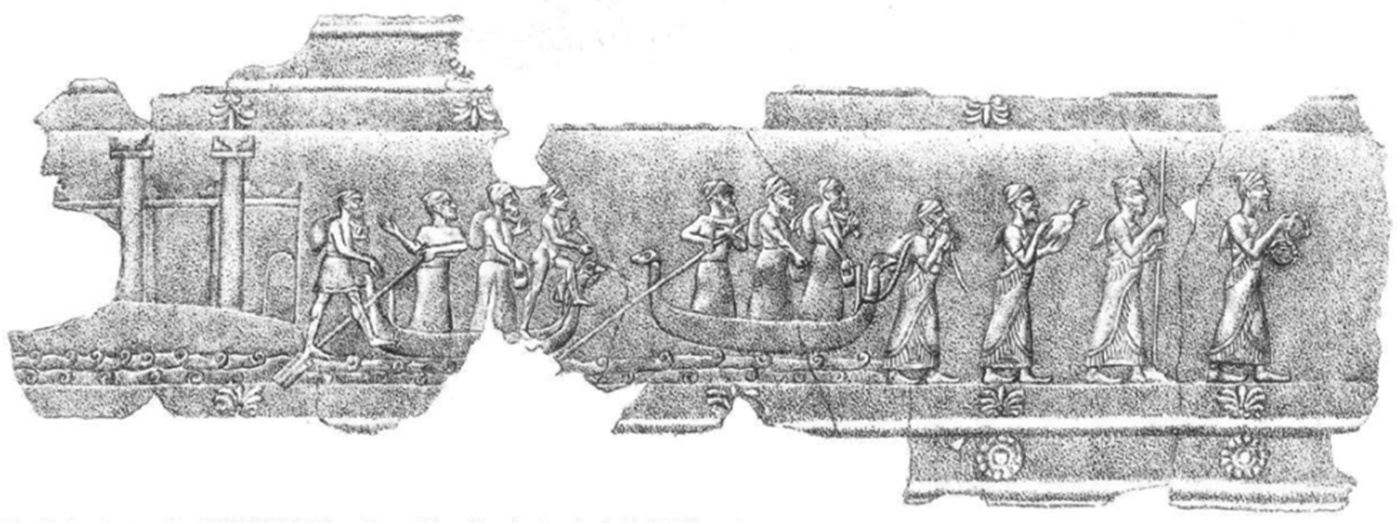
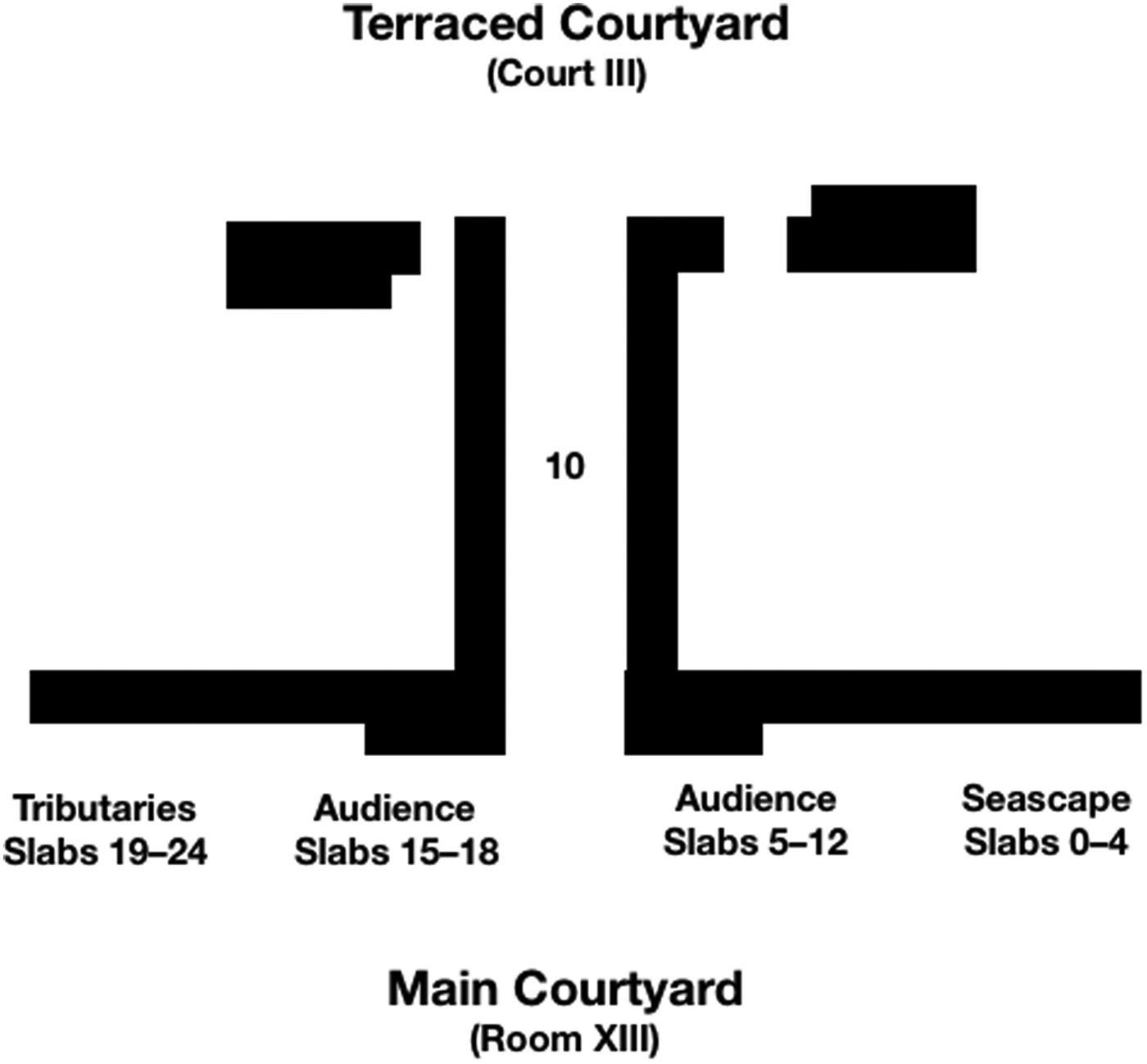
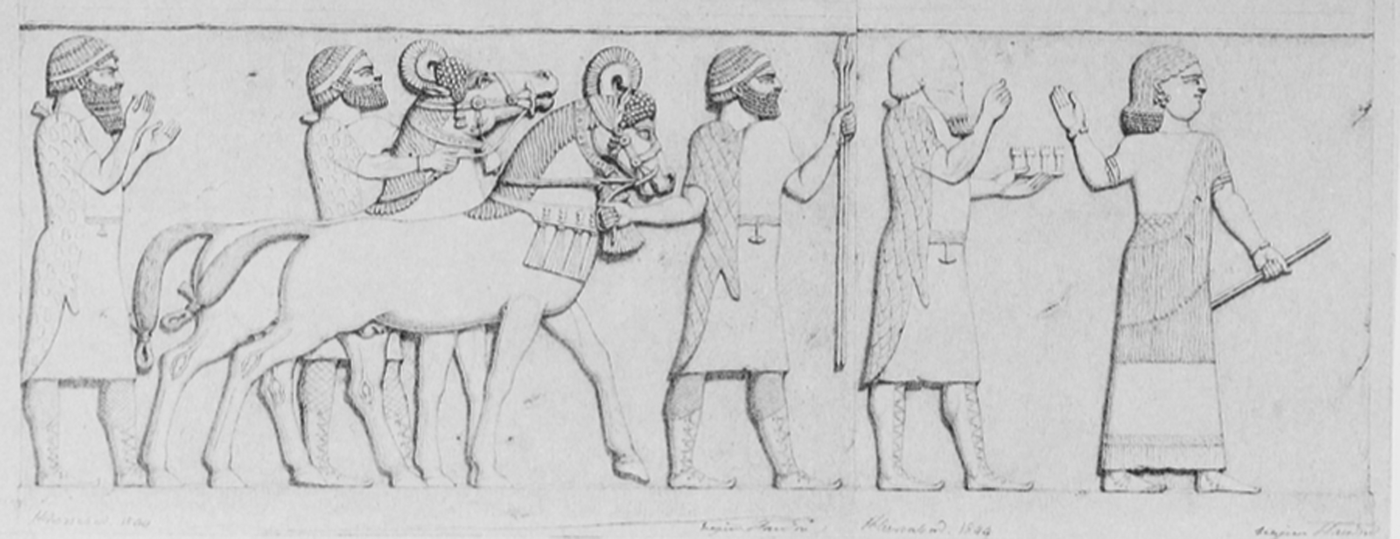
Foreigners are elsewhere depicted in less submissive postures, including in artwork dating to the reign of Ashurnasirpal himself. The tributaries in the processions preserved on the Mamu gates, for example, proceed with erect backs. On MM ASH II L5 (Fig. 7), the posture of the tributaries carrying goods can be contrasted with the forward-leaning stance of the individual who strains to pull their boat ashore. In the realm of monumental art, the tribute procession from Room 10 at Khorsabad also features representatives from across the empire in fine garb standing as erect as the Assyrian officials who lead them. The passageway designated Room 10 connects the outer courtyard to the main throne court adjacent to the throne room (Fig. 8). Tributaries process along the walls in the narrow passage, continuing the tribute scene depicted on façade n the throne room courtyard (Fig. 4 above). The lower register of slabs 7–8 shows Median tributaries leading richly caparisoned horses and dressed in leather cloaks and knee-high boots (Fig. 9). Vassals from the west appear in the upper register, wearing embroidered robes and hemmed caps. Even the tributary carrying a full wineskin stands upright. The contrast to be drawn by foreigners, then, is not the difference between Assyrians and the other but between loyal and rebellious subjects.Footnote 52
Temple gates of Ashurnasirpal at Balawat. Drawing of MM ASH II L5 by M. Howard. Barnett et al. Reference Barnett, Curtis, Davies, Howard and Walker2008: fig. 66.

Map of entry to throne room. Northwest Palace of Ashurnasirpal. Drawing by author based on Albenda Reference Albenda1986: 196.

Room 10, Slabs 7–8 (lower). Sargon's Palace at Khorsabad. Albenda Reference Albenda1986: Pl. 30.

Assyrian depictions of difference thus operate at multiple rhetorical levels. Descriptions of exotic tribute from far-off lands in Assyrian royal inscriptions highlight royal power by showing the universal extent of empire. Similarly, Assyrian artists can be said to have a collector's approach to cultural diversity, displaying human difference in the same way that they curate ivory furniture and botanical samples. The incorporation of tribute reliefs in the central courtyard and throne room in the Northwest palace at Kalḫu and at Khorsabad had, however, a second rhetorical function. The images offered foreign dignitaries a window onto the universal extent of the empire by depicting not the other but many others. In addition, they provided a mirror in which foreigners could glimpse themselves, joining other tributaries from across the empire gathering, resplendent and respectful, to gain audience with the Assyrian king. They also saw an alternative eventuality in the gruesome reliefs of war and its aftermath. The Assyrian view of difference is simultaneously inclusive and highly politicized — anyone can belong, provided they pay.
Understanding the way the Assyrian empire capitalized on diversity can complicate the modern tendency to sharply differentiate between exoticism, associated with imperialism, and diversity, a marker of multicultural humanism.Footnote 53 Instead, the Assyrian example shows how structures of hegemony can employ positive portrayals of human difference to reinforce a particular political or economic system. In this respect, one might consider how studying Assyrian propaganda can contribute to our understanding of diversity in modern advertising, such as the glossy multiculturalism of Coca-Cola commercials and the marketing of postcolonial novels.Footnote 54 In these advertisements, difference is presented in a way that is fundamentally inclusive; simultaneously, however, corporations capitalize on inclusivity by encouraging consumers to view their purchases as participation in a global community. Such discourse can be emotionally effective even when the viewer fully understands the political or economic underpinnings.
Ancient visitors to the Assyrian palaces may likewise have been struck by the vast universe depicted in the incredible reliefs. This awe was the result of a deliberate system of propaganda that treated human diversity in much the same way it used images of the empire's varied geographic and topographic terrain. In this respect, human diversity was more than an indication of the far-reaching boundaries of Assyrian sovereignty; it also had the potential to consolidate Assyrian power. The orderly world laid out in Assyrian tributary scenes and the accompanying rituals of royal audience allowed foreign vassals to participate in the experience of empire. By highlighting difference, the Assyrian king projected his power across the four quarters of the world, from sea to shining sea.
Acknowledgements
I am grateful to Simeon Chavel, Sam Lundberg, and Marian Feldman for their comments on earlier drafts of this article. I had the opportunity to present a version of the paper at the Hebrew Bible Workshop of the University of Chicago. I thank Aslan Cohen Mizrahi for facilitating the workshop, where I received valuable feedback from participants, including Walter Farber, Cathleen Chopra-McGowan, David Ridge, and Jeffrey Stackert. I also would like to thank Timothy Gutmann, Madadh Richey, and Charles Huff for discussion on numerous occasions. All errors are always my own.