Implications
A better understanding of the separate and interactive effects of the physical environment, pig traits and feeder and feed characteristics on feeding behaviour and performance in pigs may provide novel, useful insights to further improve current feeding strategies and production systems, as well as the welfare and productivity of growing-finishing pigs.
Introduction
Providing pigs with an adequate feed supply is a key aspect of pig production systems. An adequate supply is not only related to the quantitative and qualitative aspects of diet but also to the physical environment and the social context of feeding activity. Ultimately, optimal profit and improved animal welfare should be achievable by an adequate food supply.
It is widely known that, in pigs, feeding behaviour, feed intake and growth rate differ with respect to breed and sex (Bruininx et al., Reference Bruininx, van der Peet-Schwering, Schrama, Vereijken, Vesseur, Everts, den Hartog and Beynen2001; Ellis and Augspurger, Reference Ellis and Augspurger2001; Mercat and Mormède, Reference Mercat and Mormède2002). Feeding behaviour and feed intake are also largely determined by age or body weight (BW; Hsia and Wood-Gush, Reference Hsia and Wood-Gush1984; Ellis and Augspurger, Reference Ellis and Augspurger2001). The physical environment can be defined by a number of components, namely space allowance, group size, flooring conditions, temperature and presence of enrichment. Each of these has a potential effect on the feeding behaviour and performance of pigs. Both high and low temperatures have a large impact on feeding behaviour (Quiniou et al., Reference Quiniou, Dubois and Noblet2000; Collin et al., Reference Collin, van Milgen, Dubois and Noblet2001), feed intake and performance of growing-finishing pigs (Holmes and Close, Reference Holmes and Close1977; Le Dividich et al., Reference Le Dividich, Desmoulin and Dourmad1985). The effect of a reduced floor space allowance on pigs’ feed intake and growth has also been extensively studied (Manteca and Edwards, Reference Manteca and Edwards2009). Allometric measures, where floor space allowance (A) is expressed as A = k × BW0.667, and where the constant is commonly known as the k-value, have been proposed as the most suitable approach for the determination of pigs’ spatial needs (Petherick and Phillips, Reference Petherick and Phillips2009). Allometric measures have recently allowed the determination of the effect of space allowance on feeding behaviour, which also depends on the age or BW of pigs (Street and Gonyou, Reference Street and Gonyou2008). This study showed that pigs are able to adapt their feeding strategy according to the group size, although the effect of group size on pigs’ performance is rather limited (Turner et al., Reference Turner, Allcroft and Edwards2003). The flooring characteristics are also known to modulate the effect of physical space, temperature or housing enrichment on pigs’ excretory, lying and investigative behaviours (Aarnink et al., Reference Aarnink, Schrama, Heetkamp, Stefanowska and Huynh2006; Averós et al., Reference Averós, Brossard, Dourmad, de Greef, Edge, Edwards and Meunier-Salaün2010a and Reference Averós, Brossard, Dourmad, de Greef, Edge, Edwards and Meunier-Salaün2010b), as well as their performance (Gonyou et al., Reference Gonyou, Brumm, Bush, Deen, Edwards, Fangman, McGlone, Meunier-Salaün, Morrison, Spoolder, Sundberg and Johnson2006). Nevertheless, the simultaneous and interactive effects of all these influences have not been estimated.
The characteristics of the environment around the feeder also have an important role in the feeding behaviour and performance of pigs. This is composed of features such as the feeder size, the number of feeding places, the presence of a drinking-water source and the presence of individual protection within the feeder. Brumm and Gonyou (Reference Brumm and Gonyou2001) pointed out the positive impact of individual protection on the feeding behaviour patterns and productive performance because of less disturbances while eating, and consequently higher feed intake. Feed composition, characteristics and allowance (ad libitum/restricted) also play a role in the expression of the feeding behaviour and performance of pigs (Ellis and Augspurger, Reference Ellis and Augspurger2001).
Different approaches have already been used to predict the simultaneous effect of the above-mentioned aspects on feed intake and growth (e.g. Wellock et al., Reference Wellock, Emmans and Kyriazakis2003). Nevertheless, these earlier studies only took some of the relevant factors into account and many more need to be considered to produce predictive models of feeding behaviour and performance. Such new information may help improve current production systems in terms of productivity and welfare during the growing-finishing period. Meta-analysis of existing scientific literature may be an appropriate approach to achieve this objective. It has already proved to be a valid tool to extract novel information relative to the effect of group size (Turner et al., Reference Turner, Allcroft and Edwards2003) and space allowance (Gonyou et al., Reference Gonyou, Brumm, Bush, Deen, Edwards, Fangman, McGlone, Meunier-Salaün, Morrison, Spoolder, Sundberg and Johnson2006) on pig performance. Recent studies have used meta-analytical tools to determine the effect of different aspects of the physical environment on the resting behaviour (Averós et al., Reference Averós, Brossard, Dourmad, de Greef, Edge, Edwards and Meunier-Salaün2010a), and the combined effect of the physical environment and the enrichment characteristics on the behaviour and performance of pigs (Averós et al., Reference Averós, Brossard, Dourmad, de Greef, Edge, Edwards and Meunier-Salaün2010b).
Consequently, the present study aims to determine the separate and interactive effects of different factors relating to the physical environment, animal traits and the feeder and feed characteristics on the feeding behaviour and the performance of growing-finishing pigs by means of the meta-analysis of currently existing scientific knowledge.
Material and methods
Data collection
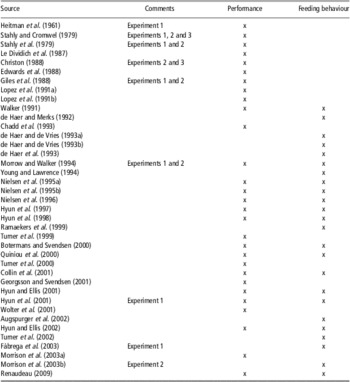
Information regarding the effect of the physical environment, animal traits, feeder and feed characteristics on the feeding behaviour and the performance of growing-finishing pigs was collected from studies published in peer-reviewed journals between 1961 and 2009. In a first step, a wide search for information was carried out using the terms ‘feeding behaviour’ and ‘pig’, and ‘performance’ and ‘pig’, on the Institute for Scientific Information Web of Knowledge online database. Only those manuscripts relating to growing and finishing pigs were retained, rejecting studies in which feed additives (apart from different energy sources and/or amino acids) were tested, as well as manuscripts, or experiments within a manuscript, in which the initial BW for the studied time interval was lower than 20 kg. The literature cited in each of the manuscripts was also checked, in order to complete the information available. Further, a second selection of manuscripts was carried out, with the candidate papers having to simultaneously fulfil the following additional requirements: for each treatment, the publication had to provide information (1) relative either to the initial and final age or initial and final BW for each studied time interval, as well as the sex and genetics of pigs; (2) about the floor space allowance, group size, average temperature, floor characteristics (non-slatted/slatted floor) and the use of a bedding substrate; (3) about the energy and protein content of the diet, the feed allowance (ad libitum v. restricted), the feeder design (individual v. collective), the presence of water supply within the feeder (with v. without water supply), the number of feeder places/pig and the use of protection within the feeder (presence v. absence); (4) the productive performance of pigs and/or their feeding behaviour as dependent variables. The list of manuscripts used in the present study is shown in Table 1, with 45 experiments from 39 publications and a total of 99 different treatments finally being included in the database. An Excel datasheet was built for each of the two groups of variables (feeding behaviour and performance) to perform further analyses.
Studies and corresponding information included in the meta-analysis of the effects of the physical environment, the animal, the feeder and the feed characteristics on the feeding behaviour and the performance of growing–finishing pigs

According to their objective, studies were identified depending on whether they were descriptive, whether they tested some aspect relative to the physical environment, content and characteristics of diet, pig characteristics or some of these aspects simultaneously. For each treatment within each experiment, information regarding pigs’ initial and final age and their initial and final BW were either collected or estimated when they were not directly reported. To perform the estimations on the age and BW, the available information from all the selected experiments was pooled and linear regressions between the initial age and the initial BW (R 2 = 0.873) and the final age and the final BW (R 2 = 0.918) were obtained. Data on pigs’ sex within the experimental unit (entire male, female, castrated male, mixed sexes) were collected for each experimental treatment. An experimental unit was considered to be composed of mixed sexes when pigs were either entire males and females or castrated males and females, but also when the results were reported without distinguishing between sexes. Data on pigs’ genetics were also collected for each experimental treatment. The Large White and Landrace breeds are known for their maternal abilities, whereas the Duroc, Pietrain and Hampshire are commonly used as terminal sire breeds (Jones, Reference Jones1998). For this reason, the Large White and Landrace pure breeds and the Large White × Landrace crosses were grouped into one category, whereas the Duroc, Pietrain, Hampshire, Duroc × Pietrain and Duroc × Hampshire crosses were identified as five other independent classes. The Meishan cross was excluded from our analysis because of the low proportion of manuscripts finally selected that used this cross.
Space allowance, expressed by means of allometric measures (k-value; m2/BW0.667) at the end of the experimental period, was either directly collected from the manuscript or estimated using the average floor surface per pig and the average BW at the end of the experimental period. The group size (number of pigs), the average temperature during the experimental period (°C), the floor characteristics (presence/absence of slats) and the use of a bedding substrate (presence/absence) were also collected.
For each experimental treatment, feed was characterized by its net energy (NE, MJ/kg) and crude protein (CP, %) content on an as-fed basis, as well as by its allowance (ad libitum/restricted). Information on NE and CP was either directly collected from the manuscript or estimated by means of different methods. Metabolizable energy (ME) was estimated from the diet's digestible energy (DE) and CP (May and Bell, Reference May and Bell1971). The NE value was estimated taking into account that, on average, the diet NE/ME ratio is 0.75 (Sauvant et al., Reference Sauvant, Perez and Tran2002; Noblet and van Milgen, Reference Noblet and van Milgen2004). When the diet's chemical composition was provided, the DE content was estimated using the formula proposed by Ewan (Reference Ewan1989). When diet ingredients were provided, NE and CP contents were estimated by means of EvaPig® (version 1.2.3.0) software.
For each experimental treatment, the feeder was characterized by the presence of water provision (dry v. wet/dry feeder; because of the low number of studies using wet feeders, experiments using wet feeders were not included in the database), the design (individual v. collective feeders), the presence v. absence of individual protection within the feeder and the number of feeder places/pig. In the case of collective feeders, the number of feeder places/pig was either directly collected from the manuscript or estimated by allometric shoulder measurements when total feeder length was provided (Petherick, Reference Petherick1983). The maximum value for this variable was one feeder place/pig, even when feeder space availability was higher.
Dependent variables were grouped into two main categories, that is, feeding behaviour and performance, and one database was built for each group. In consequence, and depending on the information contained, each of the selected manuscripts was included in either one or both databases. For each treatment within each experiment, measures of the feeding behaviour included the percentage of total time spent eating, the time spent at each visit to the feeder (min), the number of visits per day and the ingestion rate (g/pig × min). The average daily gain (ADG; g/day), average daily feed intake (ADFI; g/day) and feed conversion ratio (FCR: defined as ADFI/ADG) were collected as productive performance variables.
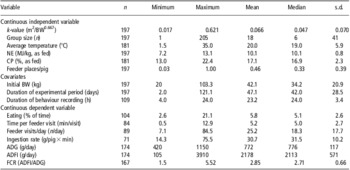
When repeated measures for the studied variables were provided at different time intervals over the whole experimental period, estimations of the values for all the studied variables were determined at the end of each time interval. When these data were not directly reported, they were estimated using the information provided in the manuscript. Therefore, each line of the Excel datasheet corresponded to an observation within an experimental treatment, with a total of 197 observations being used in the analyses. Table 2 shows descriptive statistical values on the continuous independent variables, covariates and continuous dependent variables.
Descriptive statistics for the continuous independent and dependent variables, and covariates included in the models

BW = body weight; NE = net energy; CP = crude protein; ADG = average daily gain; ADFI = average daily feed intake; FCR = feed conversion ratio.
n = total number of observations for which information was available.
Statistical analysis
Multiple regression MIXED models (MIXED procedure; Statistical Analysis Systems Institute (SAS, 2000)) were calculated in order to develop prediction equations for each variable. Because of differences in the nature and the availability of information, models were calculated differently for each group of variables.
Performance variables
For ADG, ADFI and FCR, the main fixed effects included in the initial regression models were: (1) the objective of the study (descriptive study v. physical environment source of variability v. pig characteristics source of variability v. mixed sources of variability); (2) the sex of pigs (entire male v. female v. castrated male v. mixed sexes); (3) pigs’ genetics (Large White breed/Landrace breed/Large White × Landrace cross v. Duroc cross v. Pietrain cross v. Hampshire cross v. Duroc × Pietrain cross v. Duroc×Hampshire cross); (4) the dietary NE content (MJ/kg, as-fed basis); (5) the dietary CP content (%, as-fed basis); (6) the average temperature (°C) during the experimental period; (7) the allometric space allowance (m2/BW0.667) at the end of the experimental period and its quadratic term; (8) the group size (n); (9) the presence of slatted floor (yes v. no); (10) the presence of a bedding material (yes v. no); (11) the feed allowance (ad libitum v. restricted); (12) the presence of water provision within the feeder (dry v. wet/dry feeder); and (13) the number of feeder places/pig. A nested data structure was detected between the presence of individual protection within the feeder and the feeder design, and consequently they were included in the model as a single independent factor (individual, non-protected v. individual, protected v. collective, non-protected feeder). Pigs’ initial BW at the beginning of the time interval (kg), and its quadratic and cubic terms, and the duration of the experimental period (days) were included in the models as covariates. The experiment and the time of measurement, nested within the experiment, were also included as random factors to account for the effect of the individual experiment and the moment when measures were made within each experiment (St-Pierre, Reference St-Pierre2001; Sauvant et al., Reference Sauvant, Schmidely, Daudin and St-Pierre2008).
Models testing all main factors and all possible two-way interactions failed to converge. Therefore, to obtain the definitive models, main fixed effects were included independently when statistically significant (except for BW's quadratic and cubic terms). Subsequently, relevant two-way interactions between main fixed effects were sequentially added to the model, being retained on the basis of their statistical significance (P < 0.05) and on the reduction of Akaike's Information Criterion.
Feeding behaviour variables
For the percentage of time spent eating, the duration of visits to the feeder, the number of visits/day and the ingestion rate, the fixed effects for the regression models were basically the same as for performance variables, although average temperature and CP content had to be excluded from calculations because of insufficient degrees of freedom. In addition, the class levels for the case of the ‘objective of the study’ fixed effect were descriptive study v. physical environment source of variability v. feed characteristics source of variability v. pig characteristics sources of variability. The random factors included in the regression models and the procedure to obtain the models for each of the behaviour variables were the same as described for the performance variables (see previous section).
Although it would be advisable to weight observations to account for variance heterogeneity existing between the different experiments (Sauvant et al., Reference Sauvant, Schmidely, Daudin and St-Pierre2008), observations could not be weighted because of non-identical expression of variability measures of the studied variables within the different publications, as observed in other studies (Schmidely et al., Reference Schmidely, Glasser, Doreau and Sauvant2008). Least square means were computed for fixed, discrete effects included in each of the models. In case of statistical significance (P < 0.05), pair-wise comparisons were performed using t-tests.
Results
Performance
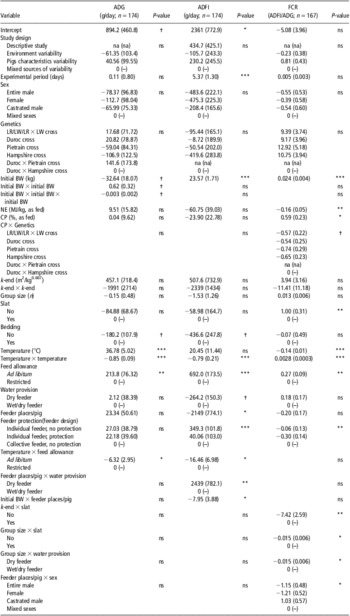
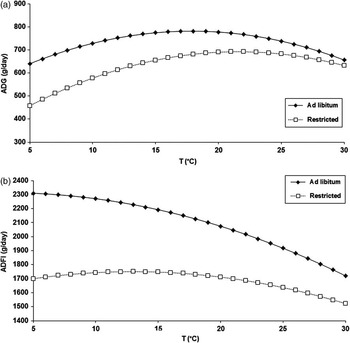
Models obtained for performance variables are shown in Table 3. Although higher ADG values were predicted for ad libitum-fed pigs, the positive response of ADG to increasing temperatures, up to 20°C, was more marked in pigs fed restricted diets (P < 0.05; Figure 1a). The ADG tended to decrease with pigs’ initial BW and its cubic term and to increase with its quadratic term (P < 0.10). A trend to higher ADG values was also predicted in the presence of a bedding substrate (P < 0.10).
Parameter estimates (s.e.) for the models quantifying the effect of the different factors on the performance variables of growing-finishing pigs

ADG = average daily gain; ADFI = average daily feed intake; FCR = feed conversion ratio; BW = body weight; NE = net energy; CP = crude protein; LR = Landrace; LW = Large White.
*P < 0.05; **P < 0.01; ***P < 0.001; †P < 0.10; ns: variable statistically non-significant, and therefore removed from the model.
na = factor level not available for the corresponding model; – = factor level not affecting the intercept value of the multiple regression models.
Predicted effect of the interaction between the average temperature and the feed allowance (predicted means) on ADG (a) and ADFI (b) of growing-finishing pigs (for the median of the other continuous independent variables and covariates). ADG = average daily gain; ADFI = average daily feed intake.

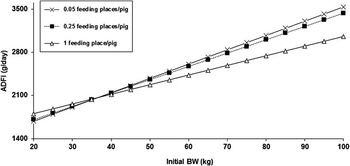
A marked decrease in the ADFI when temperatures increased was predicted in the case of ad libitum-fed pigs only, whereas ADFI in restricted-fed pigs remained practically constant (P < 0.05; Figure 1b). A decrease in ADFI with increasing number of feeding places/pig was predicted only for wet/dry feeders (P < 0.01). Similar trends in ADFI were predicted for all feeding places/pig values when initial BW was below 40 kg, whereas above 40 kg the increase in ADFI with initial BW was higher when feeding places/pig values decreased (P < 0.05; Figure 2). Higher ADFI values were predicted for pigs fed in individual, non-protected feeders with respect to other feeder types (P < 0.001). A trend to higher ADFI was predicted in the presence of a bedding substrate (P < 0.10).
Predicted effect of the interaction between the initial BW and feeder space allowance (predicted means) on ADFI of growing-finishing pigs (for the median of the other continuous independent variables and covariates). BW = body weight; ADFI = average daily feed intake.

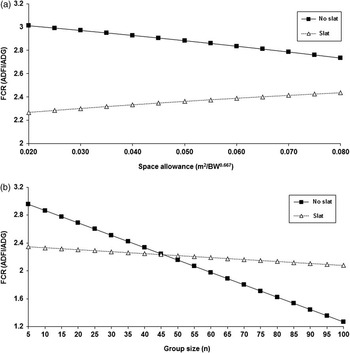
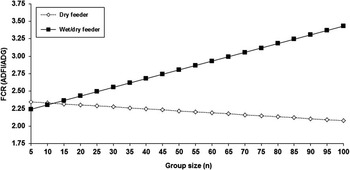
FCR was predicted to increase with pigs’ initial BW (P < 0.001) and to decrease with dietary NE content (P < 0.01), whereas a trend towards decreasing FCR values with increasing dietary CP content (P < 0.10) was particularly remarkable for the Pietrain cross. The FCR decreased with increasing average temperature (P < 0.001) but increased with its quadratic value (P < 0.001). Higher FCR values were predicted for pigs fed ad libitum (P < 0.01) and lower values were predicted for those fed in individual and protected feeders (P < 0.01). Pigs housed on non-slatted floors showed decreasing FCR values with increasing space allowance, whereas the opposite was observed for those housed on slatted floors (P < 0.01; Figure 3a). In addition, FCR values decreased with increasing group size only for pigs housed on non-slatted floors (P < 0.05; Figure 3b). In contrast, FCR values increased with increasing group size for pigs fed in wet/dry feeders, whereas a slight decrease was observed in the case of dry feeders (P < 0.05; Figure 4). FCR values decreased with increasing number of feeding places/pig for entire males and females, whereas they increased for castrated males with respect to that predicted for mixed sexes (P < 0.05).
Predicted effect of the interaction between space allowance (a) group size (b) and the presence/absence of slatted floor (predicted means) on the FCR of growing-finishing pigs (for the median of the other continuous independent variables and covariates). FCR = feed conversion ratio; ADFI = average daily feed intake; ADG = average daily gain.

Predicted effect of the interaction between group size and the water provision within the feeder (predicted means) on the FCR of growing-finishing pigs (for the median of the other continuous independent variables and covariates). FCR = feed conversion ratio; ADFI = average daily feed intake; ADG = average daily gain.

Feeding behaviour
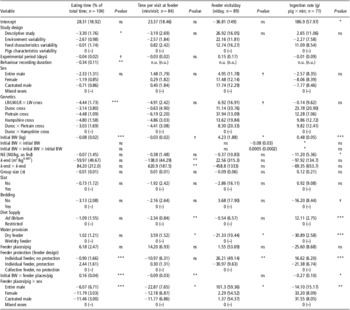
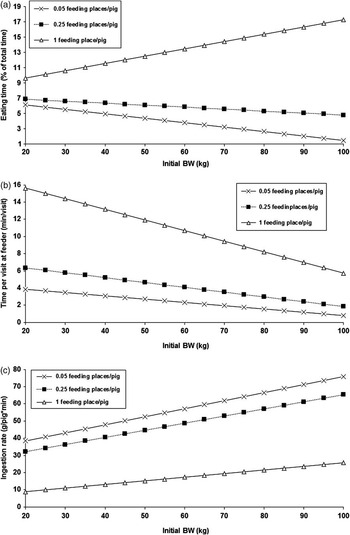
As shown in Table 4, the percentage of total time spent eating was significantly higher for the Duroc × Hampshire cross than for other genetic classes, especially in the case of crosses not containing the Duroc breed (P < 0.001). Pigs fed in individual and protected feeders were predicted to spend a higher percentage of total time eating than those fed in individual and non-protected feeders (P < 0.001). The percentage of total time spent eating increased with feeder availability. Moreover, it was predicted to decrease with increasing pigs’ initial BW for the lower feeder space availabilities, whereas it increased when one feeder/pig was available (P < 0.001; Figure 5a). The percentage of time spent eating increased when increasing the feeder places/pig in the case of mixed sexes, decreased for females and castrated males and was almost constant in the case of entire males (P < 0.001).
Parameter estimates (s.e.) for the models quantifying the effect of the different factors on the feeding behaviour of growing-finishing pigs

BW = body weight; NE = net energy; CP = crude protein; LR = Landrace; LW = Large White.
*P < 0.05; **P < 0.01; ***P < 0.001; †P < 0.10; ns: Variable statistically non-significant, and therefore removed from the model.
n.u. = variable not used in the corresponding model; – = factor level not affecting the intercept value of the multiple regression models.
Predicted effect of the interaction between the initial BW and feeder space allowance (predicted means) on the eating time (a), the time per visit at the feeder (b), and the ingestion rate (c) of growing-finishing pigs (for the median of the other continuous independent variables and covariates). BW = body weight.

The duration of individual visits to the feeder decreased when the k-value increased (P < 0.01), and increased with its quadratic term (P < 0.01). Pigs fed ad libitum were predicted to spend less time per visit at the feeder than those fed restrictively (P < 0.01), whereas pigs fed in dry feeders were predicted to perform longer visits at feeder with respect to those fed in wet/dry feeders (P < 0.05). The decrease in the average duration of visits at the feeder when pigs’ initial BW increased became gradually more marked with increasing number of feeder places/pig (P < 0.01; Figure 5b). The duration of visits at the feeder decreased when increasing the number of feeding places/pig in the case of entire males, increased in the case of mixed sexes and was almost constant in that of females and castrated males (P < 0.05).
The number of feeder visits/day increased with pigs’ initial BW and its cubic term, but decreased with its quadratic term (P < 0.05). The number of feeder visits/day was lower in the case of dry feeders than in that of wet/dry feeders (P < 0.05), and it was higher for individual, non-protected feeders with respect to individual, protected feeders (P < 0.01). The increase in the number of feeder visits/day when the number of feeder places/pig also increased was particularly evident in the case of entire male pigs (P < 0.05). The trend towards a higher number of visits/day was more marked for the Pietrain cross with respect to the other genetic classes studied (P < 0.10).
The ingestion rate decreased with increasing dietary NE content (P < 0.05) and was higher for ad libitum-fed pigs compared with those fed restrictedly (P < 0.001). Pigs fed in dry feeders showed slower ingestion rates than those in wet/dry feeders (P < 0.001). Pigs fed in individual, non-protected feeders showed the fastest ingestion rates, whereas those fed in individual, protected feeders showed the slowest rates (P < 0.001). Ingestion rates generally increased with the initial BW, but the increase became more marked as the feeder space availability decreased (P < 0.05; Figure 5c). The ingestion rate decreased drastically when the number of feeding spaces/pig increased in the case of entire males, and to a lesser extent in that of mixed sexes, but remained practically constant in the cases of females and castrated males (P < 0.01).
Discussion
Before this study, little quantitative information existed about the feeder and feed characteristics that most affect pig behaviour and performance (Manteca and Edwards, Reference Manteca and Edwards2009). In this study, we identified simultaneous effects of these different factors, as well as others relating to the physical environment and pig traits. Unfortunately, because of insufficient information, the average temperature and CP content had to be excluded from feeding behaviour models, and therefore their effects, as well as their potential interactions with the other studied factors, could not be tested.
It is widely known that both high and low temperatures affect feed intake in pigs (Le Dividich et al., Reference Le Dividich, Desmoulin and Dourmad1985; Rinaldo and Le Dividich, Reference Rinaldo and Le Dividich1991). Our results indicate that the effect of temperature on performance would additionally be modulated by feed allowance. In general, ad libitum-fed pigs showed higher ADG and ADFI values than restricted-fed pigs, which is in accordance with Leymaster and Mersmann (Reference Leymaster and Mersmann1991). The present study indicates that the detrimental effect of low temperature is particularly apparent in restricted-fed pigs, although differences disappear gradually as temperature increases, with similar performances for both types of feed allowance at temperatures around 30°C (Figure 1). Restricted-fed pigs are more active (Halter et al., Reference Halter, Wenk and Schurch1980), which might account for the non-significant increase in the number of visits/day, maybe because of pigs checking the presence of feed in the feeder. It may also account for the non-significant increase in the time spent eating, as well as for the significant increase in the duration of visits to the feeder predicted for restricted-fed pigs.
Results suggest that feeder space allowance determines feeding strategy, which depends, in addition, on BW. The model predicts that under feeder space-restricted conditions pigs increase their ingestion rate, reduce the duration of visits to the feeder and the total time spent eating as they grow, which is in agreement with Hsia and Wood-Gush (Reference Hsia and Wood-Gush1984) and Brumm and Gonyou (Reference Brumm and Gonyou2001). This adaptation of feeding behaviour to feeder space allowance results in a gradual augmentation of feed intake as feeder space allowance becomes more restricted. However, this might also be because of feeder space restriction, leading to greater feed wastage because of more often disturbed feeding bouts. The direction of the effect of feeder space allowance, although not significant, would confirm the latter hypothesis. The model further indicates that feeder space allowance does not affect growth rate and feed efficiency, in accordance with Gonyou and Lou (Reference Gonyou and Lou2000) and Spoolder et al. (Reference Spoolder, Edwards and Corning1999) who compared feeder space allowance values ranging between 0.05 and 0.33 places/pig. Gonyou and Lou (Reference Gonyou and Lou2000) proposed that the maximum number of pigs that can be fed per feeder place increases with BW, because the increase in the ingestion rate would reduce feeder occupation, although this fact could be dependent on the presence of feeder protection. No significant interaction was found between pigs’ initial BW and the feeder design or the use of feeder protection. Possibly, although feeder occupation is higher in younger pigs, their ability to access the feeder simultaneously is also higher.
Earlier studies showed that different aspects of the physical environment of pigs have different effects on behaviour. For instance, floor space allowance, in the form of allometric measures (k-value), influences the performance (Gonyou et al., Reference Gonyou, Brumm, Bush, Deen, Edwards, Fangman, McGlone, Meunier-Salaün, Morrison, Spoolder, Sundberg and Johnson2006) and the behaviour of pigs, whereas the presence of environmental enrichment influenced their activity pattern (Averós et al., Reference Averós, Brossard, Dourmad, de Greef, Edge, Edwards and Meunier-Salaün2010a and Reference Averós, Brossard, Dourmad, de Greef, Edge, Edwards and Meunier-Salaün2010b). Results of the present study are in accordance with this, with an interaction between space allowance and group size on the one hand and floor characteristics on the other hand. Specifically, increasing pen space allowance or group size predicted an improvement of feed efficiency of pigs if they were housed on solid, non-slatted floors, but not when they were housed on slatted floors. Solid flooring was previously linked to a reduction in negative social behaviours but this effect may be confounded by the fact that bedding is often provided on solid floors (Van de Weerd and Day, Reference Van de Weerd and Day2009). Our models also found some overall effects. First, there was a gradual reduction in the impact of increasing space allowance on feeding behaviour, independent of the presence of a bedding substrate. This was shown by the parameter estimates of the k-value and its quadratic term for the duration of visits to the feeder, as well as to the lack of interaction between space allowance and the presence of bedding (Table 4). Second, the use of bedding tended to influence ingestion rate, independent of other environmental aspects.
Pigs fed in wet/dry feeders usually show the highest feed intakes and growth rates (Gonyou and Lou, Reference Gonyou and Lou2000). It might be speculated that under non-stressful conditions, both hunger and thirst motivate pigs to visit this type of feeder, opposed to hunger only as in other feeders. This might account for the higher number of visits/day observed in the present study with respect to dry feeders and result, under crowded or elevated social pressure conditions, in stressful situations that may cause reduced performance, as shown in Figure 4. This hypothesis is confirmed by the prediction of the model that pigs fed in wet/dry feeders perform shorter visits and have higher ingestion rates with respect to dry feeders, and by the interaction between the presence of water provision within the feeder and the number of feeding places/pig. This suggests that under non-crowded feeding conditions, pigs may visit the feeder just to drink. Nevertheless, poorer FCR in wet/dry feeders might also reflect greater feed wastage, as a residue of food is more likely to stick to the pig's chin each time it leaves the feeder. Higher ingestion rates might be because of the fact that wet food is eaten faster than dry food (Gonyou and Lou, Reference Gonyou and Lou2000).
The presence of feeder protection is beneficial for pigs, as this drastically reduces the occurrence of feeder aggressions (Baxter, Reference Baxter1989). According to our results, this beneficial effect would also extend to feeding behaviour and performance, as pigs fed in individual, protected feeders performed the lowest number of visits/day, spent the highest proportion of their time feeding and showed the slowest ingestion rate, as well as the lowest FCR values. The use of individual, non-protected feeders was associated with the highest ADFI values, although this might be again related to feed wastage due to competition. This type of feeder also presented the lowest percentage of time spent at the feeder, the shortest visits to the feeder and the highest number of feeder visits per day, as well as ingestion rates.
Sex showed significant interactions with feeder space allowance because of a lower responsiveness of castrated males and females to changes in the feeder space allowance compared with entire males or mixed sexes. This may be due to the generally lower feed intake in entire males compared with castrated males (Kempster and Lowe, Reference Kempster and Lowe1993). The present study found no overall effect of gender on feeding behaviour in pigs, which is in contrast to earlier results (Ellis and Augspurger, Reference Ellis and Augspurger2001). Differences in BW among studies may, at least partially, account for the sex differences in the performance variables within the existing literature (Ellis and Augspurger, Reference Ellis and Augspurger2001). Although no significant effect of sex on ADG and ADFI was found in the present study, the model predicts a gradual reduction of FCR in entire males and females with increasing feeder space allowance. This indicates that sex may, to some extent, modulate the effect that some of the factors relative to the physical environment have on performance. Genotype also determines behaviour and performance of pigs, and the Duroc breed is known, amongst other things, for its elevated feed intake values (McGloughlin et al., Reference McGloughlin, Allen, Tarrant, Joseph, Lynch and Hanrahan1988; Edwards et al., Reference Edwards, Wood, Moncrieff and Porter1992). In the present study the Duroc, Duroc × Pietrain and Duroc × Hampshire crosses showed high percentages of total time spent eating, indicating that genetic differences in performance may, at least partly, be explained by behavioural differences. The Pietrain breed is known for its reduced feed intake and fat deposition (Affentranger et al., Reference Affentranger, Gerwig, Seewer, Schwörer and Künzi1996; Edwards et al., Reference Edwards, Tempelman and Bates2006), as well as for its positive response, in terms of growth rate and feed conversion, to increasing dietary protein supplies (Martin and Buysse, Reference Martin and Buysse1960). Results of the present study are in accordance with these characteristics, as the Pietrain crosses tended to show a higher reduction in FCR in response to increasing dietary CP levels. It is also known that in pigs, feed intake is regulated by feed energy content (Noblet and van Milgen, Reference Noblet and van Milgen2004), suggesting a positive effect of increasing dietary energy content on the feed efficiency. Results of the present study are coherent with this, as the model predicts that increasing dietary NE will decrease FCR values. The predicted decrease in the feed ingestion rate when increasing dietary NE suggests in addition that feed energy content may, to some extent, affect aspects of feeding behaviour.
Conclusions
In growing-finishing pigs, genetic traits, various aspects of the physical environment and characteristics of the feeder and the feed affect feeding behaviour and performance in a complex manner. Interactions between these factors show that the effect of ambient temperature is modulated by feed allowance, with the detrimental effect of lower temperatures being particularly apparent in restricted-fed pigs. The effect of feeder space allowance on feeding behaviour and on ADFI depends further on BW, although feed wastage might explain the increase of ADFI under restricted feeder space allowance conditions. In this sense, the potential effect of feed wastage on productivity suggests that this fact should be considered in future research. The models found further various interactions between other aspects relative to the physical and social environment, such as group size and the presence of slatted floor. Characteristics of the feeder are also important. For example, growing-finishing pigs adapt their feeding behaviour to the presence or absence of water provision within the feeder. From this perspective, wet/dry feeders may have beneficial effects under conditions of low density or reduced social pressure, although they may increase feed wastage due to feed remaining stuck to the pig's chin. The presence of feeder protection also has beneficial effects for growing-finishing pigs. Increasing the diet energy content may improve the performance of growing-finishing pigs and could, to some extent, modify feeding behaviour. Results showed no clear effect of sex on feeding behaviour. Genetics also had an effect on feeding behaviour and performance, in interaction with feed characteristics. Overall, the present study provides novel information that may contribute to improving the performance and the welfare of growing-finishing pigs, and may be used to optimize current feeding and housing strategies.
Acknowledgements
The authors gratefully acknowledge the European Community financial participation under the Sixth Framework Programme for Research, Technological Development and Demonstration Activities, for the Integrated Project Q-PORKCHAINS (FOOD-CT-2007-036245). The authors also thank Claudia Terlouw for her useful comments on a previous draft of the manuscript.
Disclaimer
The views expressed in this publication are the sole responsibility of the authors and do not necessarily reflect the views of the European Commission. Neither the European Commission nor any person acting on behalf of the Commission is responsible for the use that might be made of the information. The information in this document is provided as is and no guarantee or warranty is given that the information is fit for any particular purpose. The user thereof uses the information at its sole risk and liability.