





Impact statement
This study contributes to biotechnology design research by demonstrating how wet-spun chitosan fibres can be developed and explored at the intersection of materials science, process engineering and textile design. By translating laboratory-scale polymer processing into textile-scale experimentation, the work makes fibre-level material behaviour tangible within design contexts. Rather than treating mechanical limitations as deficits, the study positions them as active parameters that inform textile construction and form-finding. Derived from chitin-rich biological waste streams, chitosan is examined as a bio-based design material with relevance for sustainable and regenerative textile practices. The presented approach supports interdisciplinary research and highlights the role of design-led prototyping in evaluating emerging biomaterials beyond purely technical performance.
Introduction
Chitin is a structural polysaccharide that is often described as the second most abundant natural polymer after cellulose. Industrial chitin is mainly sourced from crustacean shell waste from shrimp and crab processing, but it is also present in insect cuticles and fungal cell walls (Kou et al. Reference Kou, Peters and Mucalo2021; Ravi Kumar Reference Ravi Kumar2000). On the molecular level, chitin is a linear β-(1→4)-linked polymer of N-acetyl-D-glucosamine; strong intermolecular hydrogen bonding leads to a highly crystalline structure that is not soluble in water or commonly used organic solvents (Rinaudo Reference Rinaudo2006; Sulthan et al. Reference Sulthan, Reghunadhan and Sambhudevan2023). This lack of solubility is a key obstacle for different applications.
To make the polymer processable, chitin is partially deacetylated, typically under alkaline conditions, to yield chitosan, which contains a higher amount of deacetylated units (usually > 80%) and thus primary amino groups. These amino groups can be protonated in dilute aqueous acids, thereby rendering the chitosan soluble. Because of this combination of solubility, cationic character, polymeric structure, biodegradability and film-forming ability, chitosan has been widely investigated for biomedical devices, as packaging material, in wastewater treatment, as controlled release system or as textile auxiliary (Thambiliyagodage et al. Reference Thambiliyagodage, Jayanetti, Mendis, Ekanayake, Liyanaarachchi and Vigneswaran2023; Tien et al. Reference Tien, Lyngstadaas, Mano, Blaker and Haugen2021).
Since chitosan exhibits biocompatibility, skin and wound healing properties, high moisture absorption, intrinsic antimicrobial and odour-controlling effects as well, it is highly attractive for next-to-skin textile applications (Costa et al. Reference Costa, Silva, Veiga, Tavaria and Pintado2018; Gupta et al. Reference Gupta, Agarwal and Alam2010). In textiles, it is already used as a finishing agent or coating to impart antimicrobial behaviour, moisture management and improved dyeability to conventional fibres (Elamri et al. Reference Elamri, Zdiri, Hamdaoui and Harzallah2023; Lixia et al. Reference Lixia, Lin and Gholamreza2018). Direct use of chitosan as a primary fibre material, however, is still limited to a few commercial examples and many experimental studies (Hahn et al. Reference Hahn, Bossog, Hager, Wunderlich, Breier, Stegmaier, Zibek, van den Broek and Boeriu2019). Given its many beneficial properties, it can be concluded that the potential of chitosan has not yet been fully realised in this instance. This is happening at a time when legislation and consumer demand are driving the search for environmentally friendly, bio-based fibres and in general textiles that provide additional beneficial (especially health-beneficial) properties. Chitosan satisfies these needs. However, there is a huge economic challenge posed by the high cost of the raw material: The price per ton varies from USD 15,000 to USD 160,000, depending on the quality of the chitosan (Weng et al. Reference Weng, Durand and Desobry2023). To advance the development of chitosan fibres and their application in the textile, design and fashion sectors, we must build the expertise needed to overcome this economic hurdle. This issue can only be overcome if further technical and scientific questions are answered simultaneously. Despite significant progress, there is still a substantial research gap between fundamental chitosan chemistry and scalable production of robust, wearable fibres. It is hence about creating prototypes that allow people to understand the material visually, demonstrate the opportunities and challenges and visualise the properties. However, this also provides an opportunity to create a case study requiring highly interdisciplinary work for successful processing.
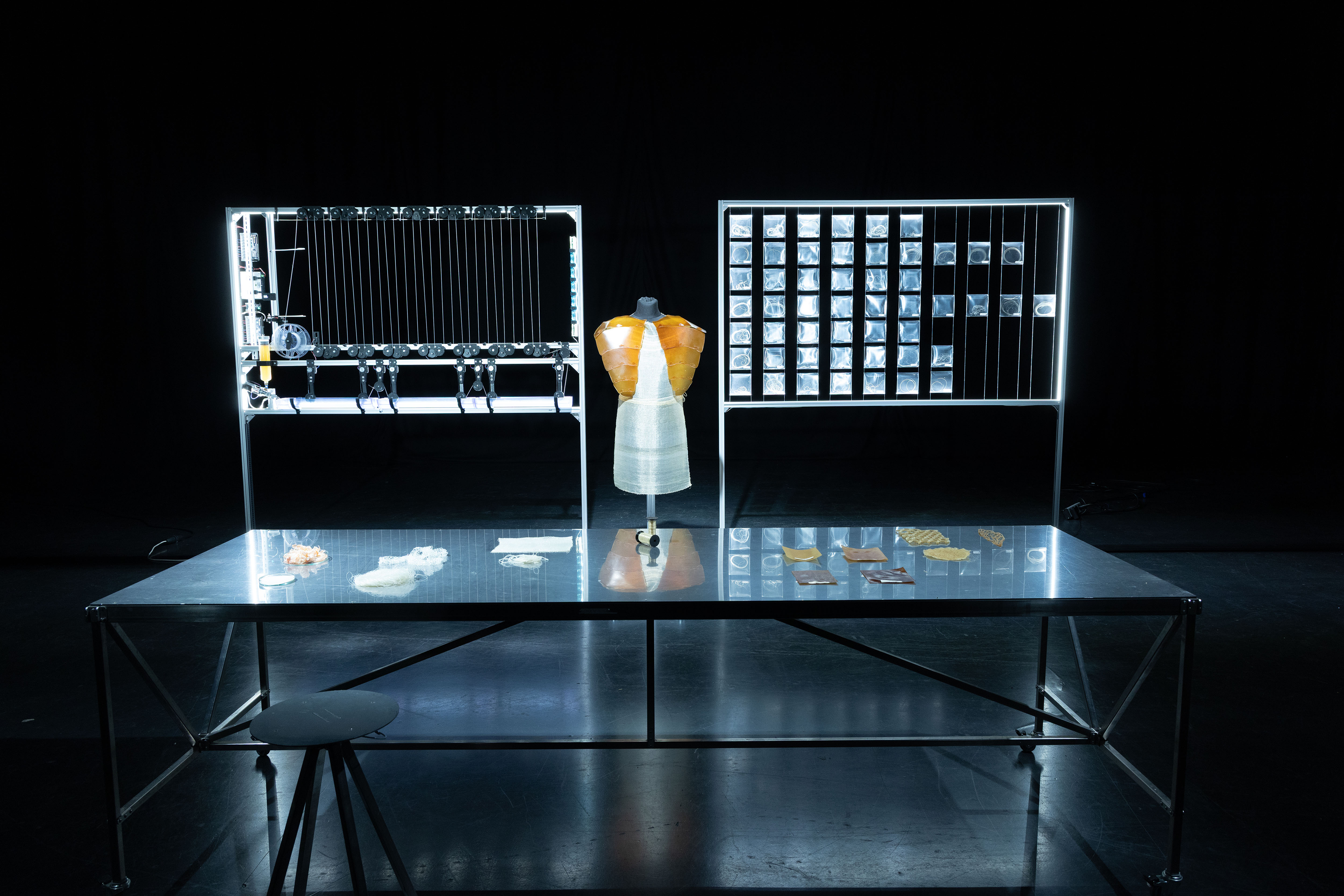
In this contribution we present a material and process prototype (Figure 1) in which chitosan, derived from chitin, is spun into continuous fibres and subsequently woven into a garment. By situating the work within a biodesign context, we aim to connect detailed knowledge about the structure, chemistry and fibre formation of chitosan with creative and experiential questions of fashion and textile design, positioning chitosan as a design material at the interface of material science, process engineering, textile technology and design. Instead of looking at chitosan fibres primarily from the perspective of performance optimisation or scalability, we adopt a material-driven biodesign perspective – guided by the research question how fibre-level material behaviour emerging from wet-spinning processes can be translated into textile structures and design outcomes, and how inherent mechanical limitations can be reframed as active parameters within textile and fashion design.
CHITIN [C8H13NO5]_shelter exhibition.
©Photo SurrealLabor/Marius Probst.

Figure 1. Long description
Panel A: A machine with multiple spools of thread, likely used in the production of chitosan fibers. Panel B: A mannequin dressed in a garment made from chitosan fibers, demonstrating their use in textiles. Panel C: A grid of small squares, possibly samples of chitosan fibers or textiles, displayed for examination. The table in front holds various objects and samples related to chitosan fibers.
Physiochemical background of chitosan processing
The following section provides the material-scientific foundation necessary for the subsequent design-oriented exploration, establishing a shared knowledge base between polymer processing, fibre formation and textile experimentation within a biodesign framework. Unlike native cellulosic fibres, such as cotton, chitosan cannot be spun directly from its natural source by purely mechanical or enzymatic means. This is because the chitin in the original biomass is converted into short, non-fibrillar particles (powders/flakes) during demineralisation, deproteinisation and conversion into chitosan. These particles lack spinnable, continuous microfibrils (Kurita Reference Kurita2006). Additionally, chitosan is not a thermoplastic; it undergoes thermal degradation before melting, precluding conventional melt-spinning processes (Agboh and Qin Reference Agboh and Qin1997). Consequently, chitosan is typically produced via solution processing to man-made fibres.
Chitosan spinning processes
There are several types of spinning processes described to produce chitosan fibres:
Electrospinning is described as a suitable method to obtain chitosan nano-und microfibres for biomedical and filtration applications (Ibrahim et al. Reference Ibrahim, Alhalafi, Emam, Ibrahim and Mosaad2023). Chitosan is dissolved in harsh solvents (e.g., concentrated organic acids or trifluoroacetic acid/dichloromethane) or in mixed aqueous systems with auxiliary polymers such as polyethylene oxide or polyvinyl alcohol (PVA) to reduce viscosity and electrostatic repulsion between protonated amino groups (Ibrahim et al. Reference Ibrahim, Alhalafi, Emam, Ibrahim and Mosaad2023; Yang et al. Reference Yang, Wang, Lou and Meng2025). Under a high voltage (typically 10–30 kV), a charged jet is drawn from a Taylor cone at the spinneret tip. The solvent evaporates during flight, and a non-woven chitosan (or chitosan blend) web is collected on a grounded target.
More recently, solution blow spinning (SBS) and microfluidic blow spinning (MBS) have been applied to chitosan-containing systems (Wang et al. Reference Wang, Shan, Huang, Penkova and Su2025). In SBS, a polymer solution is drawn into fibres by a high-velocity gas stream rather than an electric field; this avoids high voltage but gives similar non-woven structures. MBS uses microfluidic channels and gas-assisted jetting to produce finer, composition-controlled fibres. The above methods are certainly more suitable for producing nano- and microfibres. A different method, wet-spinning, is used to produce macrofibres.
For wet-spinning, chitosan is first dissolved in dilute organic acid (typically aqueous acetic acid; other acids such as dichloroacetic or urea–acetic mixtures have also been used) to form a “dope” chitosan. The dope is extruded through a spinneret into an aqueous coagulation bath. Common baths for coagulation of chitosan fibres have an alkaline pH. In the bath, protonated chitosan is neutralised and precipitates as a continuous filament, followed by washing, drawing (stretching in water or alcohol) and drying. (Agboh and Qin Reference Agboh and Qin1997; Ilyas et al. Reference Ilyas, Aisyah, Nordin, Ngadi, Zuhri, Asyraf, Sapuan, Zainudin, Sharma, Abral, Asrofi, Syafri, Sari, Rafidah, Zakaria, Razman, Abd Majid, Ramli, Azmi, Bangar and Ibrahim2022). We used the classic wet-spinning method as well to produce chitosan-based macrofibres, the conditions used for spinning are described in the following sections.
Key processing parameters for chitosan wet-spinning
Suitable chemical parameters, whether in terms of chitosan properties, spinning solution parameters or coagulation bath conditions, are fundamental to the production of chemical fibres, as is maintaining an optimal operating window.
-
• Chitosan intrinsic properties have a great impact on the overall performance of the process since these are determining the solubilisation, the coagulation and finally the fibre properties. Purity, molecular weight and degree of deacetylation (DDA) are the main factors influencing the chitosan production process and fibres: Purity determines how much of the resulting fibres consist of the chitosan; impurities disturb the spinning process at the same time interfering the fibre properties. Solid impurities could be removed by filtration beforehand (Qin, Reference Qin1990: 37). The molecular weight needs to be high enough to ensure chain entanglement and thus fibre formation. High molecular weight increases viscosity of the spinning dope and diameter of the resulting fibre (da Silva et al. Reference da Silva, Barbosa, de Souza, Lima, Duarte, Navarro, Silva and Fook2025). Lower molecular weight eases spinning but can lead to weaker fibres. For optimal production of uniform fibres without beads, chitosan with medium molecular weight is recommended (Li et al. Reference Li, Liu and Zhao2025; Qin, 1990: 37). DDA is another crucial factor that influences charge density, solubility and viscosity, as well as coagulation behaviour. Higher DDA results in higher solubility and viscosity.
-
• Extrinsic conditions such as concentration, solvent and pH are likewise decisive: In wet-spinning of chitosan, the polymer concentration critically determines the dope viscosity and spinnability, where higher concentrations generally improve filament cohesion in the resulting fibre but eventually hinder extrusion due to excessive viscosity (Maevskaia et al. Reference Maevskaia, Dresvyanina, Yudenko and Yudin2018). Moreover, optimal concentration ranges are required to achieve uniform coagulation and mechanically robust fibres, as overly dilute dopes lead to discontinuous or weak filaments, while overly concentrated systems compromise molecular orientation during solidification (Kuznik et al. Reference Kuznik, Kruppke and Cherif2022; Nechyporchuk et al. Reference Nechyporchuk, Yang Nilsson, Ulmefors and Köhnke2020; Peniche et al. Reference Peniche, Razonado, Alcouffe, Sudre, Peniche, Osorio-Madrazo and David2024).
-
• Chitosan is only soluble when amino groups are protonated (typically pH < 6), and solvent choice strongly affects surface tension. Aqueous acetic, formic, citric or lactic acid and mixed systems (e.g., acetic acid with water/ethanol) are commonly used. Mohammadkhani et al. (Reference Mohammadkhani, Kumar Ramamoorthy, Adolfsson, Mahboubi, Hakkarainen and Zamani2021) suggested to apply adipic acid to increase tensile strength of the fibres. But there are also some new concepts utilising ionic liquids for solubilisation of chitosan (Kuznik et al. Reference Kuznik, Kruppke and Cherif2022; Kuznik et al. Reference Kuznik, Kruppke, Pötzsch and Cherif2024) by the dissociation of hydrogen bonds.
-
• Wet-spinning conditions and post-treatment: Coagulation bath composition (type and concentration of base, presence of salts or organic coagulants), bath temperature and draw ratio govern filament continuity, orientation and crystallinity (Dresvyanina et al. Reference Dresvyanina, Dobrovol’skaya, Popryadukhin, Yudin, Ivan’kova, Elokhovskii and Khomenko2013). Higher bath temperature and appropriate plasticisers improve spinnability and mechanical performance (Nechyporchuk et al. Reference Nechyporchuk, Yang Nilsson, Ulmefors and Köhnke2020). In general, neutralisation is followed by washing (in water or alcohol) and drying under tension; this is essential to develop tensile strength and dimensional stability; drying conditions strongly affect extensibility and moisture sensitivity.
The role of cross-linkers, processing aids and blends
Despite the previous mentioned, it is generally known that the chitosan fibres lack superior mechanical strength (Hahn et al. Reference Hahn, Bossog, Hager, Wunderlich, Breier, Stegmaier, Zibek, van den Broek and Boeriu2019). Various methods are employed to circumvent process limitations or enhance fibre performance, including general processing aids, cross-linkers, plasticisers and other polymers.
Beyond the primary spinning route, the stability and performance of chitosan fibres are strongly governed by post-spinning cross-linking. Cross-linking strengthens wet-spun chitosan macrofibres by enhancing intermolecular network stability, improving their mechanical integrity and resistance to deformation during textile processing at the same time suppresses re-dissolution or excessive swelling in aqueous media. Common cross-linkers are sodium tripolyphosphate or glutardialdehyde (Vega-Cázarez et al. Reference Vega-Cázarez, López-Cervantes, Sánchez-Machado, Madera-Santana, Soto-Cota and Ramírez-Wong2018), whereby Chi et al. (Reference Chi, Li, Meng, Qiao, Yang, Zhou, Liu and Li2026) used citric acid to enhance fibre rigidity. As part of this project, work was carried out using various bio-based polycarboxylic acids to cross-link the chitosan fibre. However, the fibres became so brittle that they could not be used or optimised.
Polymers commonly blended with chitosan to improve wet-spinning performance and the mechanical properties of textile-grade macrofibres include PVA, which enhances filament strength, cohesion and processability (Vega-Cázarez et al. Reference Vega-Cázarez, López-Cervantes, Sánchez-Machado, Madera-Santana, Soto-Cota and Ramírez-Wong2018), and cellulose nanofibrils (CNFs), which increase tensile properties and stability during spinning. Such blends improve dope rheology, fibre homogeneity and final mechanical performance, enabling more robust and uniform chitosan-based textile fibres.
In wet-spinning, additives in the coagulation bath (Na2SO4, ethanol, sodium dodecyl sulfate) and plasticisers (urea, glycerol) have been used to adjust viscosity and filament quality (Nechyporchuk et al. Reference Nechyporchuk, Yang Nilsson, Ulmefors and Köhnke2020; Vega-Cázarez et al. Reference Vega-Cázarez, López-Cervantes, Sánchez-Machado, Madera-Santana, Soto-Cota and Ramírez-Wong2018). Glycerol is one of the most widely used low molecular weight plasticisers for chitosan-based films and membranes and was thus used in our case in the spinning dope to improve the fibres performance. In case of chitosan films, it forms hydrogen bonds with the –OH and –NH2 groups of chitosan, disrupts inter-chain associations and increases chain mobility. Thus, it could be assumed that this results in enhanced chain flexibility and extensibility, while reducing molecular orientation stability during solidification, leading to decreased tensile strength and stiffness.
Engineering framework for experimental chitosan wet-spinning
To translate laboratory-scale wet-spinning of chitosan into a textile- and design-relevant context, a modular wet-spinning system was developed. Rather than aiming for industrial throughput, the system was designed to enable continuous operation, visual accessibility and fine control over key process parameters such as extrusion rate, coagulation time and draw ratio. This engineering setup functions as an experimental interface between polymer processing and textile-scale material exploration.
The spinning dope was prepared from crab-based chitosan with an approximate DDA of 94% and a weight-average molecular weight of approximately 215 kDa. The chitosan was suspended at 3 wt% in water, followed by pH adaption to 5 with concentrated acetic acid to dissolve the chitosan. Glycerol (5 wt% relative to polymer content) was added as a plasticiser to improve filament flexibility and process stability. The solution was subsequently concentrated to 6 wt% at 60 °C under continuous stirring for 3.5 h until it turned a dark amber/light brown colour, before being transferred into pressure-resistant cartridges for extrusion.
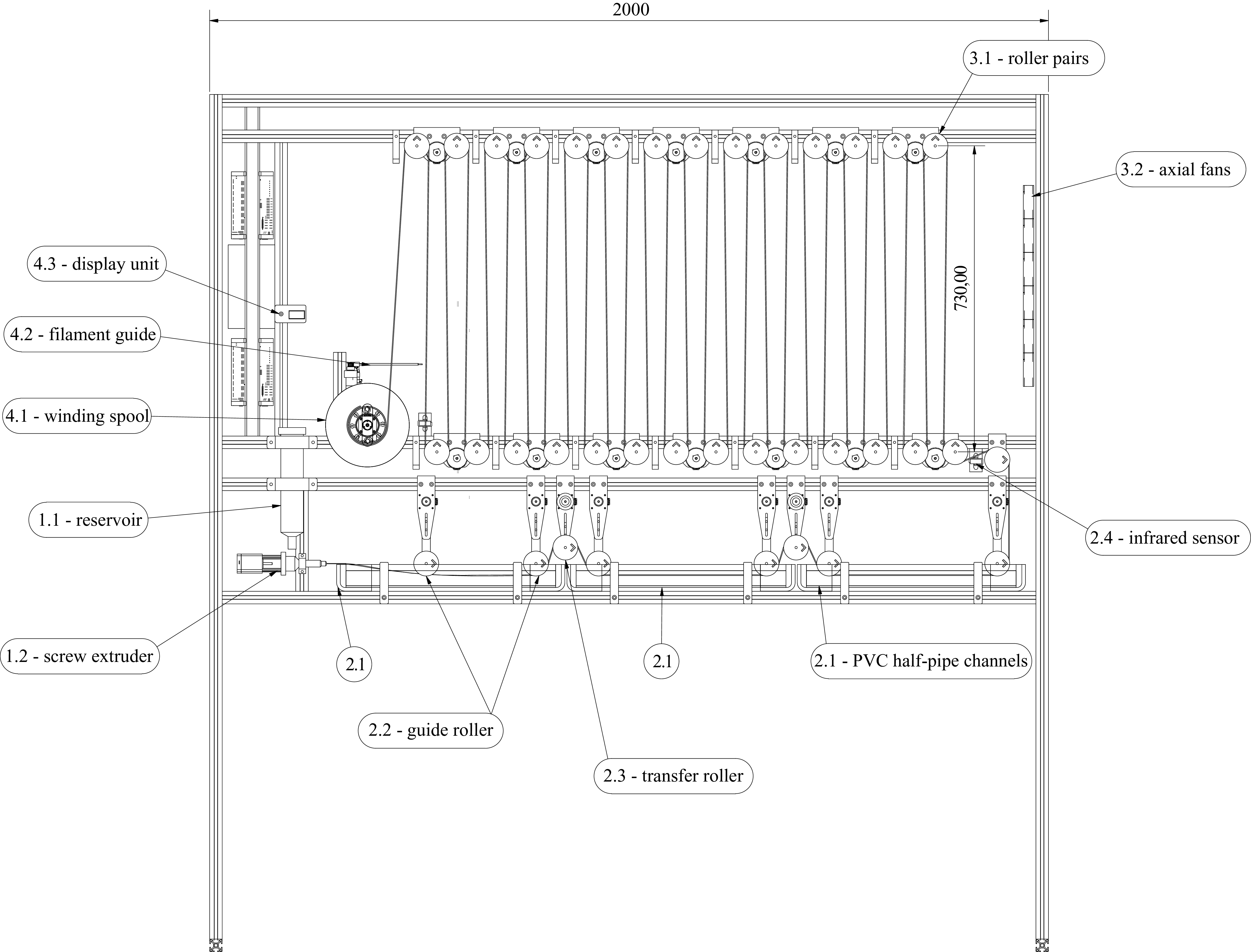
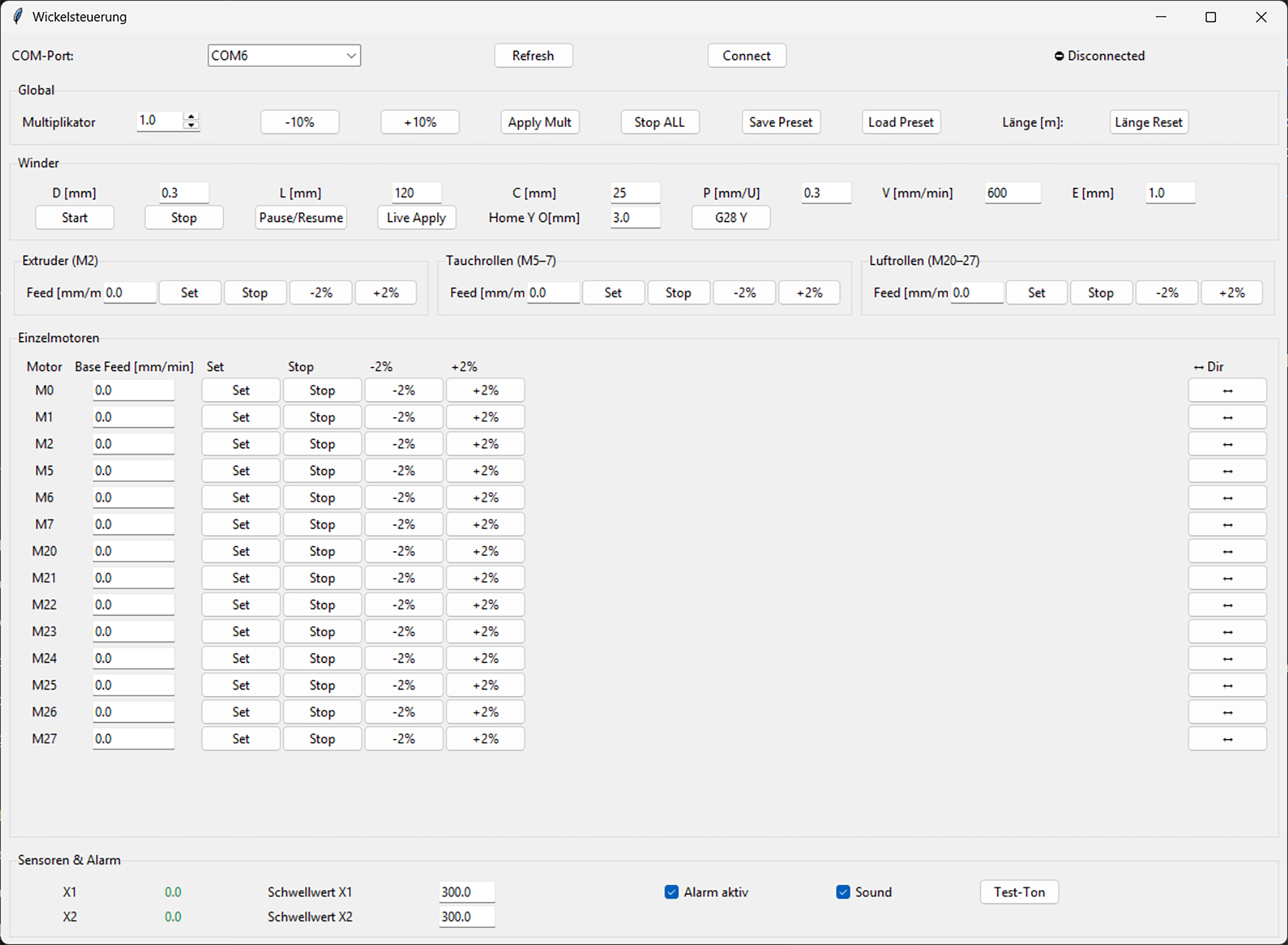
The wet-spinning apparatus (Figure 2) consists of four functional zones: (i) an extrusion unit, (ii) coagulation and washing baths, (iii) a combined drying and drawing unit and (iv) a winding unit. The modular architecture allows independent adjustment of each process stage and facilitates iterative modification in response to material behaviour. Machine control is realised using 3D printer control boards operated with custom firmware developed by the authors. High-level machine operation and parameter adjustment are performed via a PC running a Python-based control script providing a graphical user interface (GUI) (Figure 3). The system operates using a 24-volt power supply.
Drawing of the wet-spinning machine. Illustration.
©SurrealLabor/Andreas Hölldorfer.

User Interface to control the wet-spinning machine.
©SurrealLabor/Andreas Hölldorfer.

Figure 3. Long description
The user interface for controlling a wet-spinning machine includes several sections for different parameters. The top section shows the COM port selection and connection status. Below that, there are global settings including a multiplier, buttons for applying changes, stopping all processes, saving and loading presets, and resetting length measurements. The Winder section includes parameters for diameter, length, circumference, pitch, velocity, and extrusion length, with buttons for starting, stopping, pausing, resuming, and applying changes. The Extruder, Tauchrollen, and Luftrollen sections allow for setting and adjusting feed rates. The Einzelmotoren section lists individual motors with their base feed rates and buttons for setting, stopping, and adjusting feed rates. The Sensoren & Alarm section includes thresholds and alarm settings for sensors X1 and X2.
The frame is made up of aluminium extrusion profiles measuring 30 mm × 30 mm, with a standard Nut 6. All employed components are either industrial standard parts or custom elements fabricated via fused filament fabrication using PLA. PLA was found to provide sufficient chemical resistance against the applied coagulation and washing solutions under the described operating conditions.
-
(1) Extrusion Unit
The extrusion unit consists of a reservoir (1.1) containing up to 500 mL of spinning solution. The reservoir is pressurised to 4 bar using a compressor. Extrusion is carried out via a screw extruder (1.2) driven by a stepper motor and equipped with a Luer Lock connector. This configuration allows rapid adjustment of extrusion diameters by exchanging commercially available dispensing needles.
The polymer solution is extruded a few millimetres above the surface of the coagulation bath. Direct extrusion into the liquid was observed to cause frequent needle clogging and irregular agglomeration of the extrudate and was therefore avoided. All extrusion experiments were conducted at room temperature.
-
(2) Coagulation and Washing Baths
The coagulation (10% NaOH) and washing baths (10% sodium hydrogen carbonate and distilled water) are implemented as PVC half-pipe channels (2.1). Each bath contains a submerged guide roller (2.2) driven by a toothed belt, which transports the extruded filament through the bath. The filament path length within each bath is 400 mm.
An additional driven transfer roller (2.3) ensures controlled filament transfer between successive baths. After the final washing bath, an infrared sensor (2.4) is installed to detect filament breakage during continuous operation.
-
(3) Drying and Drawing Unit
For drying and drawing, the filament is guided through a sequence of seven roller pairs (3.1). Each roller pair is mechanically coupled via gears and driven by a stepper motor. The upper and lower motor pairs are electrically connected in series, enabling the implementation of seven discrete speed levels and thus controlled adjustment of filament transport and drawing conditions.
After the final roller pair, a second infrared filament-break detection sensor, identical to that described in section (2.4), is installed. Additional airflow is provided by axial fans (3.2) to support convective drying of the filament.
-
(4) Winding Unit
The final processing stage consists of a motor-driven winding spool (4.1) equipped with an active filament guide (4.2). Winding parameters including filament pitch, spool diameter, spool width and edge offset can be adjusted via the control software. Empty 3D printer filament spools are used as winding cores; these are typically designed as single-use packaging in conventional applications.
A display unit (4.3) provides a real-time estimate of the theoretical filament length based on the selected winding parameters.
-
(5) Extrusion Parameters
Based on preliminary parameter studies, all experiments were conducted at a filament transport speed of 4 m min−1.
Mechanical data of the chitosan fibre
Mechanical characterisation of the wet-spun chitosan filaments was conducted to assess their suitability for subsequent textile processing rather than to benchmark them against conventional industrial fibres. The measured parameters provide a material-specific performance envelope within which weaving and knitting experiments could be conducted under reduced tension and adapted processing conditions.
The tenacity of the fibre was determined to 0.7±0.06 cN/tex, which is low with regard to the 1-10 cN/tex described from other authors using the wet-spinning technique to achieve chitosan fibres (Costa et al. Reference Costa, Silva, Veiga, Tavaria and Pintado2018; Hahn et al. Reference Hahn, Bossog, Hager, Wunderlich, Breier, Stegmaier, Zibek, van den Broek and Boeriu2019; Nechyporchuk et al. Reference Nechyporchuk, Yang Nilsson, Ulmefors and Köhnke2020). Breakage points were observed at various locations during the measurement of the yarns. The 18% elongation indicates comparatively elastic behaviour for chitosan fibres regarding the values obtained from da Silva et al. (Reference da Silva, Barbosa, de Souza, Lima, Duarte, Navarro, Silva and Fook2025) and Mohammadkhani et al. (Reference Mohammadkhani, Kumar Ramamoorthy, Adolfsson, Mahboubi, Hakkarainen and Zamani2021) with 3–9%, revealing that our chitosan fibres have a higher amount of amorphous regions. However, the 32% variance in elongation is high but not unusual for hydrophilic biopolymers where small changes in conditioning (moisture) and structure (crystallinity/orientation) disproportionately affect strain at break.
Summarising the mechanical data provided, this indicates, that overall optimisation is required. This refers not only to improvements in chemical parameters, such as the use of additives in coagulation and washing baths, or the preparation of the spinning solution, but also, and above all, to improvements in process homogeneity and robustness.
Close-up images of the chitosan fibres
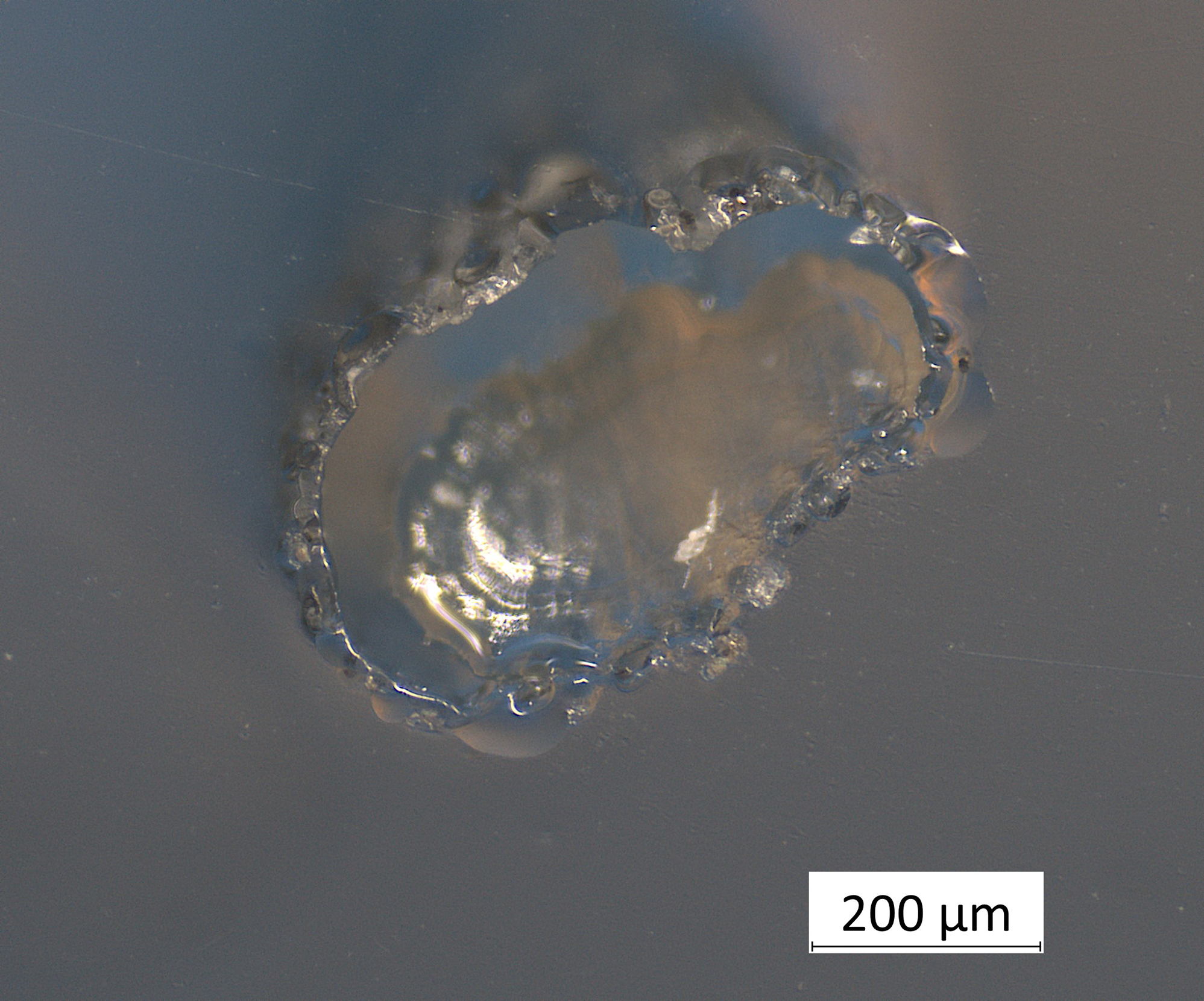
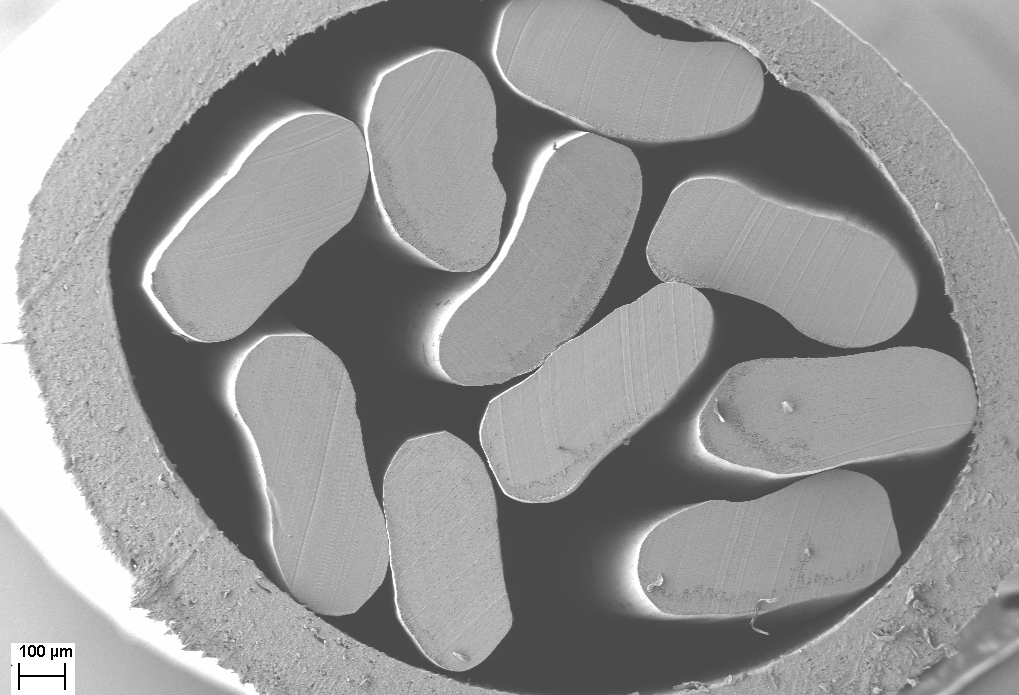
Figures 4 and 5 show close-up images in a cross-sectional view of the chitosan fibres. Due to the size, the fibres could be clearly identified as macrofibres with a diameter of hundreds of µm depending on the geometric magnitude of the cross-section. A more amorphous form on the outer side and a higher crystallinity on the inner core could be recognised indicating a skin-core-effect during coagulation. The fibres revealed a homogeneous, but a bean shape form as also described by Dresvyanina et al. (Reference Dresvyanina, Dobrovol’skaya, Popryadukhin, Yudin, Ivan’kova, Elokhovskii and Khomenko2013). According to them, this was due to the action on the moist fibre located on the uptake reel of compaction stresses.
Chitosan wet-spun fibres in different processing states. The image in Figure 4 was taken using a stereomicroscope under reflected light.

A scanning electron microscope image of a cross-section of several fibres.
Photos ©DITF.

Biodesign context and design translation
Nevertheless, the engineering system described above does not aim to produce chitosan fibres with optimal mechanical properties for commercial purposes. Instead, it establishes a controllable interface between polymer processing and textile-scale experimentation, enabling the translation of fibre-level material behaviour into design-relevant textile structures. This transition from process engineering to design exploration is addressed in the following section.
Biodesign as a framework for bio-based textile materials
As outlined in the preceding sections, the development of chitosan fibres is primarily driven by advances in polymer chemistry, solution processing and fibre engineering. However, the translation of such fibres into textile and fashion applications requires an additional perspective that extends beyond material performance alone. In this context, biodesign provides a conceptual and methodological framework that integrates scientific material development with design-led exploration and application-oriented prototyping. In recent years, biodesign has developed into a distinct field of research and practice that integrates biological knowledge, systems and materials into design processes (Broega et al. Reference Broega, Cunha, Carvalho and Providência2023). Rather than treating materials as passive inputs, biodesign understands them as active agents whose properties, origins and transformations shape both design outcomes and application scenarios (Collet Reference Collet, Karana, Giaccardi, Nimkulrat, Niedderer and Camere2017; Geaney Reference Geaney2022). Within fashion and textile design, biodesign encompasses two closely related approaches: working directly with living organisms, such as bacteria, fungi or algae, and working with bio-based or bio-fabricated materials derived from renewable biological resources (Mihaleva, Reference Mihaleva2020; Scarpitti Reference Scarpitti2022). This distinction is relevant for chitosan, which is not a living material itself but originates from biological waste streams and retains properties that are closely linked to its biological function.
The increasing interest in biodesign within the fashion industry is strongly linked to the sector’s environmental impact and the search for alternative material sources. Textiles have been identified as one of the product categories with the highest environmental burden, driven by fossil-based fibres, intensive chemical processing and limited end-of-life options (Collet Reference Collet2018; Kääriäinen and Niinimäki Reference Kääriäinen and Niinimäki2019). While efficiency improvements and recycling strategies remain important, they are widely considered insufficient to achieve a fundamental transformation of the sector. Biodesign has therefore been discussed as a means to rethink material production at a more systemic level, shifting from extractive models towards regenerative and bio-based material cultures (Balar and Kowalczyk Reference Balar and Kowalczyk2025; Muthu Reference Muthu2023; Rognoli et al. Reference Rognoli, Petreca, Pollini and Saito2022).
Within this discourse, bio-based materials play a crucial intermediary role. Unlike fully living systems, they can often be processed using existing industrial infrastructures while still offering reduced environmental impact and new functional or experiential qualities (Scarpitti Reference Scarpitti2022). Chitosan, derived from chitin, exemplifies this position. Although it is not grown as a living textile, it originates from biological waste streams and retains material properties that are closely linked to its biological function. The wet-spinning process described above does not merely produce a filament with defined mechanical properties but enables the exploration of chitosan as a textile material whose behaviour must be evaluated across multiple scales, from polymer solution to fibre, textile structure and finally garment or prototype.
Nevertheless, chitosan wet-spinning should not be understood as an impact-free material route. Although chitosan can be derived from chitin-rich waste streams, conventional chitin and chitosan production involves a chemically intensive deproteinisation, demineralisation and in particular a deacetylation step, typically relying on strong acids and bases such as HCl and NaOH – in some cases in very high concentrations and at temperatures above 100 °C. Life-cycle assessments have shown that the environmental hotspots of chitosan production vary by supply chain, with chemical inputs and energy use being key contributors (Bashiri et al. Reference Bashiri, De Aguiar Saldanha Pinheiro, Tappi, Rocculi, Kaleda and Vilu2024; Mohammadi et al. Reference Mohammadi, Khounani, Hosseinzadeh-Bandbafha, Foong, Yusoff, Shahbeik, Abdul Razak, Lam, Sheikh Ahmad Tajuddin, Aghbashlo, De Tender and Tabatabaei2025; Muñoz et al. Reference Muñoz, Rodríguez, Gillet and Moerschbacher2018; Shetranjiwalla and Ononiwu Reference Shetranjiwalla and Ononiwu2025). The wet-spinning process further requires acidic dissolution, alkaline coagulation, washing and drying. In the present study, aqueous acetic acid was used as a comparatively mild solvent system, but neutralisation, wastewater treatment and drying energy remain relevant factors for future scale-up. The key factor in improving sustainability is undoubtedly the proper treatment of the high salt load in the coagulation bath. Compared with conventional textile fibres, whose impacts include land and water use, fossil resource dependence, chemical processing and wastewater generation (Bianco et al. Reference Bianco, De Bona, Zanetti and Panepinto2023; Gonzalez et al. Reference Gonzalez, Lou and Chi2023), the advantage of chitosan does not lie in simple substitution. Rather, its relevance emerges from the combination of biological origin, potential use of waste streams, biodegradability and functional properties such as moisture uptake, skin compatibility and antimicrobial activity.
Properties of the chitosan thread for further processing
Within a material-driven design context, the relevance of a newly developed fibre material is closely tied to its behaviour during textile processing and its capacity to enter established making practices. Design research on emerging materials emphasises that fibres must be evaluated not only through isolated material parameters, but through their functional translation into yarns, textile structures and ultimately wearable or spatial applications (Karana et al. Reference Karana, Barati, Rognoli and Zeeuw van der Laan2015; Rognoli et al. Reference Rognoli, Petreca, Pollini and Saito2022).
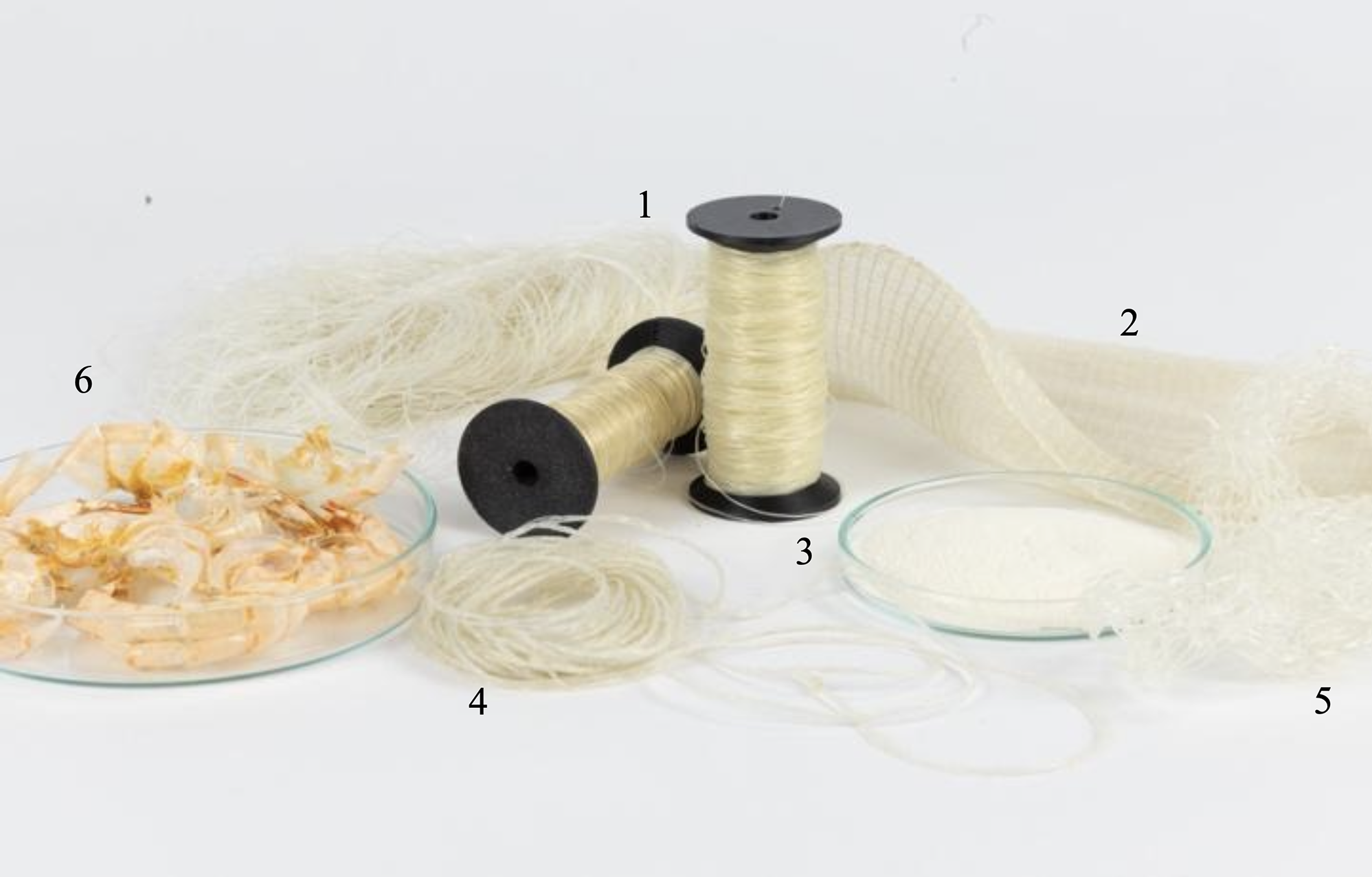
The continuous chitosan thread (Figure 6) produced via wet-spinning enables processing using conventional textile techniques such as weaving, knitting and twisting, thereby distinguishing it from chitosan nano- or microfibres obtained through electrospinning or blow-spinning, which are typically limited to nonwoven applications. At the same time, the filament exhibits properties that require careful negotiation within textile processing: Its comparatively low tensile strength, limited extensibility and pronounced moisture sensitivity directly influence yarn handling, textile density and structural design. The material’s relatively high susceptibility to tearing meant that it could not be produced on a large scale using mechanical knitting machines or weaving looms. In order to produce a textile fabric nonetheless, a mixed-material approach was chosen: The warp threads of the fabric consist of conventional silk threads, which on the one hand ensure increased tension during weaving and on the other hand create a trajectory to chitin due to the material origin of silkworms. The weft threads, in turn, were produced from the developed chitosan thread in order to enable the largest possible tactile material applications. Therefore, these characteristics were not treated as shortcomings, but as material constraints that actively informed textile construction and aesthetic outcomes (Karana et al. Reference Karana, Barati, Rognoli and Zeeuw van der Laan2015).
Chitosan wet-spun fibres in different processing states: (1) Single wet-spun chitosan thread (2) Woven chitosan-silk fabric (3) Raw chitosan powder (4) Three-ply twisted chitosan thread (5) Circular-knitted chitosan thread (6) Dried prawn shells.
©Photo SurrealLabor/Julia Ihls.

The practical handling of the chitosan filament confirmed this material-specific performance envelope. In the dry state, the filament had a smooth but slightly rigid and glassy hand, with a tactile quality closer to a fine monofilament than to a conventional soft staple yarn. During winding, twisting and weaving, the material responded sensitively to local bending, friction and sudden changes in tension. Rather than allowing continuous high-speed textile processing, it required slow handling, wide bending radii and reduced thread tension. Contact with moisture increased flexibility but also made the filament more vulnerable to deformation and local sticking, confirming that humidity and handling conditions are central parameters for textile processing. These observations became part of the design process: the material was not forced into standard textile behaviour, but was approached through techniques and structures that could accommodate its stiffness, fragility and surface friction. Several textile techniques were therefore explored in order to evaluate how the filament behaves under different structural conditions: Twisting was tested to improve handling and bundle several filaments into a more textile-like thread, but excessive twist increased local stress and could lead to breakage. Knitting was explored using a semi-automatic circular knitting machine, yet loop formation placed repeated bending stress on the filament and was therefore only possible at very open loop sizes and with careful handling. Weaving proved to be the most suitable technique for the prototype, as it allowed the chitosan filament to be inserted as a weft material while the main tensile load was carried by a stronger warp system. A plain-weave structure was therefore selected for the tunic-like textile because it provided a clear and stable construction while keeping the interlacing logic technically simple. The silk warp functioned as the load-bearing element of the textile, enabling the fabric to be held under tension during weaving without exposing the chitosan filament to continuous longitudinal stress. The chitosan filament was inserted as the weft, thereby maximising its tactile and visual presence on the fabric surface while reducing the mechanical demands placed on it. The warp density was intentionally kept relatively open. This reduced friction at the interlacing points, limited abrasion of the chitosan filament and allowed the material’s stiffness and larger filament diameter to remain visible as part of the textile’s aesthetic.
The translation of the chitosan filament into woven and knitted samples makes tangible how fibre-level properties discussed in the preceding sections manifest at the textile scale. Hygroscopic behaviour, surface friction and flexibility become perceptible through handling and wear, while the material’s intrinsic antibacterial properties and skin compatibility – well established in biomedical research – gain relevance when considered in relation to bodily proximity and next-to-skin applications (Costa et al. Reference Costa, Silva, Veiga, Tavaria and Pintado2018; Mihaleva, Reference Mihaleva2020; Scarpitti, Reference Scarpitti2022). In this sense, textile processing functions as a critical testing ground in which the suitability of chitosan fibres for fashion and design contexts can be assessed beyond purely mechanical performance.
Formfinding and design process: translating material properties into concept and form
The design process underlying this project follows a material-driven design approach in which formfinding emerges through iterative engagement with material behaviour, processing constraints and embodied experimentation (Del Gesso Reference Del Gesso2021; Karana et al. Reference Karana, Barati, Rognoli and Zeeuw van der Laan2015). Rather than starting from a predefined garment typology, the development of textile samples and prototypes evolved in close dialogue with the properties of the wet-spun chitosan filament. Within this process, textile techniques such as weaving and knitting act as mediating practices that translate polymer- and fibre-scale characteristics into human-scale experiences. They reveal how parameters such as moisture uptake, stiffness or limited elasticity influence not only structural stability but also drape, tactility and bodily interaction. This aligns with the notion of “materials biography,” which frames materials as evolving entities whose origin, transformation and potential lifecycle are embedded within the design outcome (Rognoli et al. Reference Rognoli, Petreca, Pollini and Saito2022). By foregrounding the marine origin of chitosan used in this project and its transformation through wet-spinning, the design process contributes to a narrative that connects biological resource, technical processing and speculative application.
Conceptually, the formfinding process is anchored in the double meaning of the ancient Greek term chitón (χιτών), from which the word chitin is etymologically derived. On the one hand, chitón refers to an ancient garment worn directly on the body, characterised by its proximity to the skin and its function as a basic textile interface between body and environment. On the other hand, the term denotes chitons as primitive marine molluscs, whose bodies are protected by overlapping mineralised shell plates. This semantic duality between textile intimacy and biological armour provided a conceptual framework for translating the inherent properties of chitosan into form and structure.
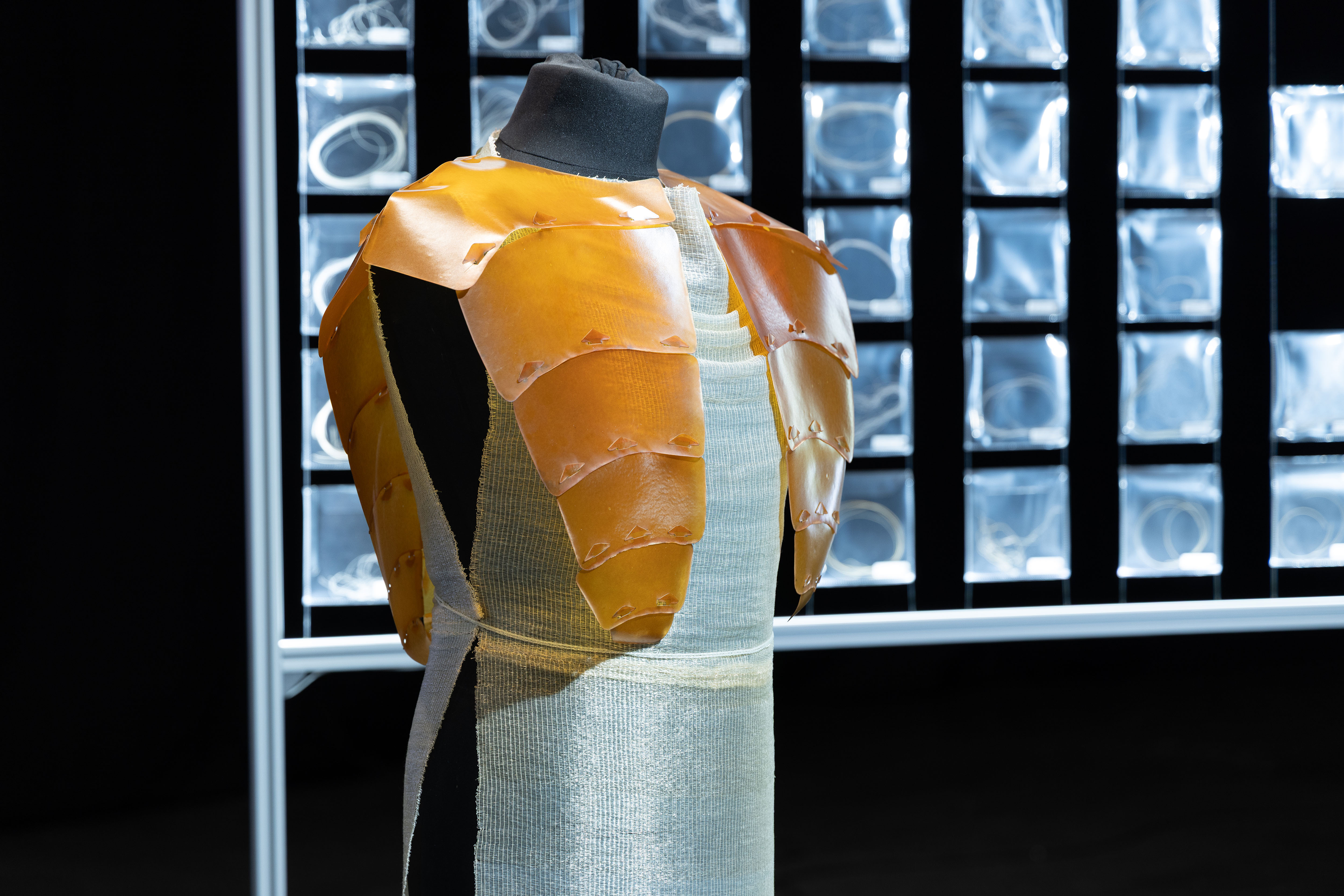
Within the design process, this duality was explored through a layered textile logic (Figure 7). A woven, tunic-like structure made from the wet-spun chitosan filament addresses the material’s suitability for next-to-skin applications, foregrounding properties such as moisture regulation, antibacterial behaviour and bodily proximity (Uslu Reference Uslu2024).
Chiton prototype consisting of a tunic-like woven textile layer and a semi-rigid chitosan-composite outer wrap. The woven textile uses silk as the load-bearing warp and wet-spun chitosan filament as the weft, while the outer layer translates the protective shell logic of biological chitin into a scale-like composite structure.
©Photo SurrealLabor/Marius Probst.

In handling and wear, however, the material did not behave like a lightweight silk fabric that visually and physically recedes on the body. The chitosan filament had a smooth, slightly elastic and nylon-like hand, with a translucent, rubber-like quality likely influenced by the glycerol plasticiser. On the skin, the woven textile initially produced a cool sensation, while its limited breathability made the wearer continuously aware of it as a distinct second layer. Rather than disappearing into comfort, the textile therefore acted as a perceptible interface between skin, material and environment.
In contrast, a second, more rigid and scale-like layer investigates chitosan-based composites as a protective outer structure, referencing the shell-like function of biological chitin. The chitosan-composite wrap differed markedly from the woven textile layer. While the woven fabric behaved as a close, skin-aware interface, the composite sheets acted more like semi-rigid bio-based plates or foils. They could bend within a limited range but did not drape or fold like fabric. On the body, this created a protective distance rather than intimate contact, translating the shell-like reference of chitin into a spatial outer layer.
Conclusion
The resulting prototypes are speculative translations rather than finalised products. They make tangible how material properties discussed in the preceding sections can inform both structural and conceptual design decisions, while simultaneously exposing the limitations of chitosan use in the context of biotextiles. Such speculative prototyping is a recurring strategy within biodesign and critical fashion research, where artefacts function as discursive tools that mediate between scientific development and potential future applications (Balar and Kowalczyk Reference Balar and Kowalczyk2025; Hansell Reference Hansell2017).
By embedding the wet-spun chitosan filament within this conceptual framework, the project positions design as an interpretative and translational practice that complements material science, process engineering, textile technology and design. The artefacts produced through this process do not aim to resolve all technical challenges associated with chitosan fibres, but to render their opportunities, constraints and cultural implications experientially accessible. In doing so, the work contributes to broader discussions on how bio-based fibres can be integrated into fashion and textile design beyond purely functional or performance-driven criteria.
Even though the project uses an initial speculative design prototype to highlight potential trajectories for the textile industry, the next step is to further optimise both the material and the processing level in order to enable scalable applications: Blending with other polymers (Yudin et al. Reference Yudin, Dobrovolskaya, Neelov, Dresvyanina, Popryadukhin, Ivan’kova, Elokhovskii, Kasatkin, Okrugin and Morganti2014) is a promising way to increase the stabilising properties of the thread. The processing of low-molecular-weight mycelial chitosans for the spinning process is also of interest in order to develop a vegan alternative to the marine seashell raw material. In a further step, the aim is to improve mechanical processing with additional heating/drying processes and semi-automated weaving machines tailored to the properties of the thread. However, future development should not be limited to adapting chitosan filaments to existing industrial weaving or knitting processes. The mechanical behaviour of the fibre itself may instead suggest alternative textile formats, including open weaves, hybrid yarn systems, nonwoven structures, laminated composites or scaffold-like constructions in which low tensile strength and moisture sensitivity are not necessarily disadvantages.
Data availability statement
Data available within the article or its supplementary materials. The authors confirm that the data supporting the findings of this study are available within the article.
Acknowledgements
We would like to acknowledge the technical team of the University of Arts and Design Karlsruhe, Alexander Knoppik, Tobias Keilbach and Sebastian Schäfer, for supporting and providing the spatial infrastructure of the project exhibition, as well as the film makers Sebastian Schönfeld and Pauline Cemeris for the accompanying documentary of the project. Further we would like to thank Dr. Petry for providing the Chitosan and the German Institute for Textile and Fibre Research Denkendorf (DITF)/Frank Gaehr for measuring the mechanical properties and analysing the chitosan fibres, as well as Ulrich Hageroth for providing the microscope images.
Author contributions
The research article was developed collaboratively by all authors. However, it is attributed to: Julia Ihls: Conceptualisation, Investigation, Methodology, Project Administration, Writing – original draft, Writing – review and editing. Andreas Hölldorfer: Conceptualisation, Investigation, Methodology, Writing – original draft, Writing – review and editing. Marius Probst: Conceptualisation, Investigation, Writing – review. Susanne Zibek: Writing – review, Supervision. Thomas Hahn: Investigation, Methodology, Project Administration, Data evaluation, Writing – original draft, Writing – review and editing, Supervision. In particular, it is attributed to: Julia Ihls: Biodesign Context and Design Translation, Conclusion. Andreas Hölldorfer: Engineering Framework for Experimental Chitosan Wet-Spinning. Thomas Hahn: Introduction, Physiochemical Background of Chitosan Processing.
All authors approved the final submitted draft.
Financial support
This work was supported by grants from the Fraunhofer Network “Wissenschaft, Kunst und Design” (grant line “Artist/Designer in Lab 2025”).
Competing Interests
The authors have no conflicts of interest to declare for this publication.
Ethical standards
Ethical approval and consent are not relevant to this article type.
AI declaration
Large language models (e.g., ChatGPT, OpenAI) were used to assist in drafting and language editing. All outputs were reviewed and verified by the authors.

 Open access

