

There is a general consensus that the LGBTI+ movement began worldwide at the end of the 1960s in the United States (Figari Reference Figari, Massetti, Villanueva and Gómez2011). However, the emergence of LGBTI+ movements in Latin America cannot be understood simply as an importation of liberal struggles from the Global North, but rather as a situated action shaped by structural inequalities, preexisting moral practices, the coloniality of power (Quijano Reference Quijano2000), and the impact of dictatorships in many countries of the region. Many of the places where LGBTI+ rights organizations emerged had been marked by military dictatorships or restricted transition processes. As a result, collective actions in Latin America have developed distinct characteristics, such as mobilizing in underground activities, confronting severe police and military repression, and collaborating with human rights movements rather than solely focusing on demands for individual freedoms as seen in developed countries (Rapisardi Reference Rapisardi2008; Green Reference Green2012; Meccia Reference Meccia2016). In Latin America, these movements have also been linked with autonomous feminist groups, student movements, and territorial organizations (Curiel Reference Curiel2013). Additionally, there was a strongly anti-neoliberal current within the LGBTI+ political movement, even in its pursuit of state recognition (Miskolci and Pelúcio Reference Miskolci and Pelúcio2012). On the other hand, Valencia (Reference Valencia2010) emphasizes that Latin American dissident struggles have confronted economies of death and material exclusion that go far beyond liberal struggles for sexual rights.
It was during the 1990s that these movements gained greater relevance as a field of political action, driven by organized demands focused on citizenship and policies for the prevention of HIV/AIDS (Iosa & Rabbia Reference Iosa and Rabbia2011). In Chile, the setting for this study, the movement also gained public visibility in the 1990s and only achieved a significant victory with the decriminalization of sodomy in 1999, a struggle that was a driving force behind its political consolidation (Sutherland Reference Sutherland2009). This need to fight is related to the persistence in Chilean society of strong pockets of resistance to the recognition of LGBTI+ people, which has acted as an obstacle to progress in these areas (Valdés and Guajardo Reference Valdés and Guajardo2007).
For the purposes of this article, it is important to bear in mind that the concept of sex-gender dissidence has emerged as a means of pushing beyond the notions of sexual diversity and the identity-based framework surrounding the LGBTI+ community.Footnote 1 This concept represents a political and epistemological stance that challenges hegemonic norms regarding sexuality and gender while critiquing the normalizing, liberal and assimilationist discourses of citizenship and liberal inclusion (Falconí Reference Falconí Trávez2021; Sabsay Reference Sabsay, Falconí Trávez, Castellanos and Viteri2014; Campuzano Reference Campuzano2008). These subjectivities connect with historical struggles that challenge the intersections of race, class, sexuality, and racialization (Curiel Reference Curiel2013). Likewise, groups identifying as dissidents confront the co-optation of rights struggles within liberal discourses that reduce the potential of critique to mere demands for recognition. They reclaim the body as part of political action, viewing it as a site of struggle and the production of meaning (Chaparro and Miranda-Mora Reference Chaparro Martínez and Mora2023).
The struggles of migrants can also be traced historically; migrants played a leading role in many defining social struggles of the nineteenth and twentieth centuries. However, migrant struggles in a narrower sense are characteristic of neoliberal globalization “because it was with neoliberalism that racist and xenophobic forms of managing contemporary external and internal borders became more acute” (Varela Huerta Reference Varela Huerta, Sánchez, Herrera and Domenech2023, 476). In South America, Domenech and Boito (Reference Domenech, Eugenia Boito, Cordero, Mezzadra and Huerta2019, 166) situate civil society organizations’ protagonism “in the disputes around the legitimate ways to regulate migration and mobility” as beginning in the mid-1990s.
This article examines the intersection of these two movements by exploring how migrants from sex-gender dissident communities interpret their involvement in LGBTI+ migrant activism in Chile. Over the past two decades, Chile has become an important recipient of intraregional—South-South—migration (IOM 2022), a shift from its previous status as a migrant-exporting country between 1970 and 1980 (Stefoni Reference Stefoni2011). According to the 2024 Census, 1,608,650 foreigners reside in Chile, which represents 8.8 percent of the national population. There are no statistics on migrants with sex-gender dissidence; however, recent research (Galaz et al. Reference Galaz, Stang and Lara2023a; Galaz et al. Reference Galaz, Stang and Lara2023b) indicates that they have also arrived in Chile. In many cases, these migrants flee situations of violence and exclusion in their home countries due to their gender orientation, identity, or expression. They also face structural economic violence, violence related to drug trafficking, and institutional violence predominantly perpetrated by security forces. This violence continues throughout their migration journey (including experiences of sexual abuse in trafficking networks or during drug smuggling) and persists in the destination country, Chile, in what Galaz et al. (Reference Galaz, Stang and Lara2023b) refer to as a continuum of intersectional violence. During their stay in Chile, the authors documented sexual harassment at borders; labor exploitation; racism; xenophobic remarks in neighborhoods, schools, and workplaces; police abuse targeting transgender migrants engaged in sex work; evictions from housing; and abuse by Chilean partners.
This article is based on research that identified two main interpretative repertoires (Wetherell and Potter Reference Wetherell, Potter, Gordo and Linaza1996) on the activist involvement of migrants in collective actions: We refer to them as political-affective and political-identitarian.Footnote 2 The first acquires a fundamental role for migrants of sex-gender dissidence, who turn to the metaphor of the family to interpret their experience of involvement within these organizational networks. These organizations are seen as family spaces that offer shelter, support, and protection from the discrimination and violence these migrants experience due to their gender identity. They also address the loneliness and lack of networks that generally characterize the early stages of the migratory process. In other words, the aspect of foreignness (Stang et al. Reference Stang, Riedemann, Soto and Abarca2022) stamps specific characteristics on the political involvement of these migrants within organizations related to sex-gender diversity and dissidence; according to the fieldwork carried out, these are the types of organizations to which they are mostly connected.Footnote 3 The second repertoire (political-identitarian) relies on the strategic use of an identity linked to sex-gender dissidence. This use makes political demands in response to the systemic undermining of equality that our interviewees have experienced due to that aspect of their subjectivity. Furthermore, it also challenges the nationalist framework upon which the nation-state is constructed, given their status as de jure noncitizens.
This study aims to contribute empirical evidence to a thematic line that has been underexplored in the Latin American context: the processes of political subjectivation among migrants (Stang et al. Reference Stang, Delgado and García del Río2026). Specifically, we explore two areas covered by this thematic umbrella: the activism of migrants who identify with sex-gender dissidence and the relationship between affect and collective action. This relationship is particularly significant in one of the repertoires identified in our study: we address the intersection of foreignness and sex-gender dissidence through a situated approach within a South-South migration context.
Migration, sex-gender dissidence, and struggles: A brief state of the art
The migration of individuals of sex-gender dissidence and diversity has been explored incipiently in various contexts. A significant line of inquiry has focused on analyzing the inequalities faced by LGBTI+ migrants in processes of inclusion and exclusion. At the same time, however, less attention has been given to the activism, resistance, and social movements of nonheterosexual migrants, which is the main focus of this article.
There has been debate on the weight of racial attributions, socioeconomic inequalities, and gender related factors in the experience of processes of inclusion and exclusion of migrants of sex-gender dissidence and diversity. In the Congo in Africa (Bhagat Reference Bhagat2018) and in China (Luo Reference Luo2020), racial and socioeconomic factors were found to carry more weight in these processes than gender identities. Both studies of those contexts posit that being perceived as white and employed takes precedence over being considered a homosexual man. On the other hand, Viteri (Reference Viteri, Trávez, Castellanos and Viteri2013) addressed the social mobility of LGBTI+ migrants from Ecuador in New York. She highlighted that discrimination varies depending on the specific groups to which LGBTI+ migrants belong. For instance, in the context of native gay groups, ethnic-racial discrimination is intensified, while in migrant groups that are ethnically and racially homogeneous, discrimination is related to their identification with sex-gender dissidence. The results of Patel’s (Reference Patel2019) study differ from those of Viteri (Reference Viteri, Trávez, Castellanos and Viteri2013). Patel found that those who identify or are recognized as Asian lesbian women in Toronto are marginalized by both local LGBTI+ communities and Asian migrant activist groups. In turn, the work by Marnell et al. (Reference Marnell, Oliveira and Hoosain Khan2020) reaches similar conclusions in the context of non-heterosexual migration on the African continent, establishing that these migrants are seen by states in various African countries as a threat to heteropatriarchy and national order.
There is a limited body of research on the social movements, resistance, and activism of migrants of sex-gender dissidence. One example is Falquet’s (Reference Falquet2019) study conducted in France, which explores the struggles and forms of organization of the lesbian-feminist movement during the first two decades of this century, focusing on the demands of lesbian migrants and racialized women. Based on this perspective, the study establishes a chronological framework that spans from the movement’s autonomous organization (excluding white lesbian women) and its focus on denouncing racism to the development of specific solidarity networks for migrant lesbians. Meanwhile, in the Spanish context, there have been efforts to bring together (heterogeneous) minority groups, such as “racialized people, migrants, Black people, and diverse refugees” (Pérez Navarro Reference Pérez Navarro2019) into a queer activism movement that unites struggles.
In the context of Latin America, some studies focus primarily on describing the life trajectories and conditions of migration for people of sex-gender dissidence and diversity, and secondarily on how they overcome obstacles to accessing their rights (Mercado Mondragón and Bollo Sánchez Reference Mercado Mondragón and Bollo Sánchez2023; Valenzuela and Anguiano-Téllez Reference Valenzuela and Anguiano-Téllez2022; Bula Beleño and Cuello Reference Bula Beleño and Santana2019). Villareal et al.’s (Reference Villarreal Villamar, Aramayo and Evelin Demarchi Viallón2023) work analyzes the solidarity and care networks among collectives made up of female and sex-gender dissident migrants in Argentina, Brazil, Chile, and Bolivia, in the context of the pandemic.
Few studies incorporate an analysis of affect within these forms of activism and social movements, a relevant topic for our study. This focus has gained traction, as noted by the pioneering work of Jasper and Owens (Reference Jasper, Owens, Jan and Jonathan2014) in the field of social movement studies. They argue that affect is seen as a central driving force and unifying element within these movements. Specifically, they highlight the role of moral anger or indignation in the discourse of feminist, LGBT, and queer movements during “Pride” protests, in response to the moral feelings of disgust and distaste directed at them, in reference to their “stigmatized identity.” Furthermore, they analyze how affect can simultaneously weaken or strengthen a movement, for example, by noting that “the pleasures of participation have their negative counterparts in frustration and fatigue” (Jasper and Owens Reference Jasper, Owens, Jan and Jonathan2014, 532).
In Latin America, Messina’s work (Reference Messina2021, Reference Messina2023) represents an emerging line of enquiry. It analyzes affect as both a unifying force and a mechanism for social and political agency for transmigrant women in Guatemala. In the analysis of their life trajectories (Messina Reference Messina2021, 120), the author highlights how collectives and communities serve as spaces of belonging and protection, where acts of care and resistance are identified that “nourish relationships with loving meaning” within that collective fabric. Furthermore, the study examines political demands that go beyond the issue of marginalization and explores the claim to happiness as a form of political self-affirmation (Messina Reference Messina2023).
In Chile, some studies explore the intersection of migration status with sexual orientation and sex-gender identity. We highlight those that have sought to characterize the multiple forms of violence to which migrants are subjected throughout their migration trajectories (Galaz and Menares Reference Galaz and Menares2021; Galaz et al. Reference Galaz, Stang and Lara2023b). In addition, we reference studies that have examined the reconfiguration processes of the sex-gender aspect in LGBTI+ migrants as a result of mobility. This latter group of studies analyzes how having agency coexists with new constraints linked to factors such as foreignness, nationality, class, ethnicity, and racialization (Stang Reference Stang2019; Galaz Reference Galaz2020).
As a direct antecedent to this current work, Fernández-Vergara and Quiñones-Campos (Reference Fernández-Vergara and Quiñones-Campos2023) drew attention to the role affect plays in the collective resistance practices employed by LGBTI+ migrants to confront the violence they experience. This article seeks to contribute along the same lines. It aims to provide empirical evidence on activists’ involvement in collective action that is produced at the intersection between foreignness and sex-gender dissidence, with an approach situated in a South-South migratory context.
Collective action and affect: A theoretical lens for interpretation
The theoretical toolbox used for analysis takes elements from the concept of collective action and some ideas developed from the sociology of emotions, particularly related to social movements and the notion of subjectivity with regard to the sex-gender dimension and politics.Footnote 4
We start by assuming that the organizational practices of the migrant activists of sex-gender dissidence we studied can be understood as collective action that, in some cases and under certain circumstances, creates processes of politicization. According to Melucci and Massolo (Reference Melucci and Massolo1991, 361–362), collective action exists if at least one of the following elements is present: solidarity, which previously implies “the capacity of the actors to recognize themselves and be recognized as part of a social unit”; conflict, understood as “a situation in which two adversaries find themselves in opposition over a common object, in a field disputed by both,” and finally, “the rupture of compatibility limits of a system to which the actors involved refer.” They explain that collective action occurs if the collective agent can define both itself and the field of its actions. This implies determining their relations with other actors, the resources at their disposal, the opportunities, and the constraints for their action: “How actors constitute their action is the concrete connection between orientations and opportunities and systemic coercions” (Melucci Reference Melucci1999, 38).
For the case that we are interested in analyzing, the role that these authors attribute to affect in the configuration of collective action is significant. From their analytical proposal, collective action is not reduced to the incidence of structural conditions or values and beliefs. Rather, it refers to the organized investments of different actors, that is, to the definition of their field of possibilities and their limitations in cognitive, affective, and relational terms. These relationships are activated “in order to give meaning to ‘being together’ and to the ends they pursue” (Melucci and Massolo Reference Melucci and Massolo1991, 358). In this regard, Mouffe (Reference Mouffe2023) emphasizes that for individuals to mobilize politically, they must connect primarily on an emotional level, because this is the basis from which people desire something together and act accordingly.
From this theoretical lens, emotions are not merely psychological states; they are cultural and social practices (Ahmed Reference Ahmed2015), and “they depend on an economic-cultural order that structures social relations, positions bodies and identities, and orients desires and the actions to satisfy them” (Messina Reference Messina2023, 166). Russell Hochschild (Reference Russell Hochschild2019) affirms: “Our social situation—our social class, race, sexual orientation, religion, and national identity—clearly shapes our emotional experience.” In short, these theoretical proposals challenge us to denaturalize affective experiences and make visible the underlying power dynamics (Messina Reference Messina2023) that shape affective economies (Ahmed Reference Ahmed2015) and the construction of emotional habitus (Messina Reference Messina2023).
Another theoretical construct relevant to the proposal of this article is the notion of subjectivation, in relation to the sex-gender dimension and politics. Following Briones (Reference Briones2007), we understand subjectivation processes as the different modes, always crossed by disputes, of inhabiting the subject positions with which the social formations of which we are or have been part challenge us. By sex-gender, we refer to the “repertoire of positions of sexed and gendered subjects with which we are challenged in a specific social formation, a position that will be inhabited, shaped, resisted, or even disrupted in what is understood as the process of subjectivation” (Stang Reference Stang2019, 19). By political subjectivation, we mean the process of inhabiting, shaping, straining, resisting, and reconfiguring the positions of political subjects in a social formation, conceiving the political as the construction of a self-in-relation-to-others in the demand for a challenge to equality (Rancière Reference Rancière2006).
Methodological notes
The research that gave rise to this article was based on the production of situated knowledge (Haraway Reference Haraway1991). This approach considers the current context of discourse on sex-gender dissidence activism in Chile, which is characterized, on the one hand, by advances in public policies in its favor and, on the other, by discriminatory reactions from conservative sectors. In addition, we adopt an interpretative, hermeneutic vision (Gadamer Reference Gadamer1994) in which we understand research as a dialogic process between researchers and participants. In line with Haraway’s (Reference Haraway1991) perspective, we consider that knowledge is produced through “partial connections” between material and semiotic positions among the various subjects involved. In this sense, this research engaged with various migrant and sex-gender dissident activist collectives and subjects to reveal their strategies of resistance in the face of the discrimination and violence they suffer. We understand “activists” as individuals who engage in collective action, not necessarily organized, in pursuit of social transformation or changes in certain social conditions (Melucci Reference Melucci1999). This situated and collaborative process involved the active participation of these individuals and took place through two steps: first, through in-depth interviews, and then through the creation of life narratives (Prieto Reference Prieto2012). Subsequently, the results were shared with participants to complement the researchers’ views on the findings.
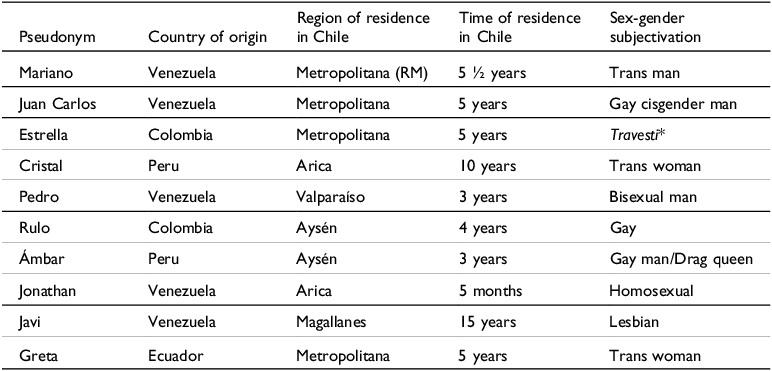
From this position, this article presents an analysis derived from a corpus of interviews with ten migrant LGBTI+ activists residing in five of the six regions that were the setting for the study, as detailed in Table 1. The fieldwork took place between 2021 and 2022.
Profile of the interviewees

Table 1. Long description
A table with ten rows and five columns detailing the profiles of migrant LGBTI activists residing in Chile. The columns are labeled Pseudonym, Country of origin, Region of residence in Chile, Time of residence in Chile, and Sex-gender subjectivation. Each row provides specific information for each interviewee. Row 1: Mariano, Venezuela, Metropolitana (RM), 5 ½ years, Trans man. Row 2: Juan Carlos, Venezuela, Metropolitana, 5 years, Gay cisgender man. Row 3: Estrella, Colombia, Metropolitana, 5 years, Travesti. Row 4: Cristal, Peru, Arica, 10 years, Trans woman. Row 5: Pedro, Venezuela, Valparaíso, 3 years, Bisexual man. Row 6: Rulo, Colombia, Aysén, 4 years, Gay. Row 7: Ámbar, Peru, Aysén, 3 years, Gay man/Drag queen. Row 8: Jonathan, Venezuela, Arica, 5 months, Homosexual. Row 9: Javi, Venezuela, Magallanes, 15 years, Lesbian. Row 10: Greta, Ecuador, Metropolitana, 5 years, Trans woman.
Source: own elaboration. *In Latin America, the term travesti does not have the same meaning as transvestite does in core countries. While in Europe and other contexts it has fallen into disuse by the LGBTI+ movements themselves, it remains relevant in Latin America, increasingly used in the context of trans struggles. Although it was once a pejorative and derogatory term, over time, transvestite activists have given the word new meaning, linking it to struggle, resistance, dignity, and empowerment. Through this reappropriation and its embodied experience, it confronts and challenges a state that has established genders in rigid categories and forms of inclusion (Pierce Reference Pierce2020). For this reason, we keep the Spanish term here.
Sixty interviews were carried out in the research that gave rise to this text. Fifty interviews were conducted with key informants from the State and civil society who work on inclusion. Additionally, ten interviewees were recognized activists from different organizations distributed throughout the three macro zones of Chile (North, Center, and South). For this article, we analyze only the interviews with sex-gender dissident activists and migrants, as our goal is to visualize organized resistance against the discrimination and violence they experience.
Aiming to get the broadest range of views on the subject, we included at least one representative for each of the different orientations and identities grouped under the LGBTI+ acronym. In addition, we sought a diversity of origin, ensuring representation of the majority groups currently residing in Chile. The activists interviewed have sought support from various organizations to meet certain initial needs upon their arrival. Over time, their intra-group relationships have evolved into various stages of organization and social advocacy. Some have joined organizations promoting sex-gender dissidence rights (civil society and trade unions). Others have formed new LGBTI+ migrant social organizations or have joined migrant organizations open to dissidence. Others, without being involved in an organization, also declare themselves activists because they “activate publicly” based on their sex-gender orientation or identity.
The analysis revealed two interpretative repertoires (Wetherell and Potter Reference Wetherell, Potter, Gordo and Linaza1996) that were constructed from these activist experiences. Following Potter and Wetherell (Reference Potter and Wetherell1987), we emphasize the performative nature of language and the fact that discourses are themselves social practices that speak to us, beyond their content, about the possibilities of expression available in the context of the subject in question. In this sense, the language has a constitutive character (Íñiguez and Antaki Reference Íñiguez and Antaki1998). The separation between saying and doing is blurred; what is said becomes partly how groups, such as those involved in LGBTI+ activism, configure their actions. Thus, discourses produce versions of the world, in this case, about collective migrant and dissident action.
In this sense, we understand interpretative repertoires as linguistic units that are consistently linked in their discursive trajectory. They constitute a “toolbox” that activists use to construct explanations about the events within their collective political action trajectories (Castillo and Reyes Reference Castillo and Isabel Reyes2013). Repertoires are the discursive elements speakers use persistently to provide versions of the social phenomena that concern them, considering the linguistic resources available to them given the historical context in which we live. For this analysis, we followed the procedure proposed by the authors: we scrutinized the discursive categories that were significant and repeated in the discourses to identify the dimensions that influence the configuration of migrant and dissident activism.
Unlike content analysis, which seeks to determine the themes and elements that emerge in the interviews (Duarte Reference Duarte2022), in the discourse analysis we developed, we sought to visualize how language produced on certain topics is constructed in this Chilean context and based on certain power relations in the prevailing gender system. In this sense, our analysis allows us to reveal underlying dynamics in language that reify dominant ways of understanding some phenomena.
This discursive approach was relevant in our case because it allowed us to explore how migrants from sex-gender dissidence negotiate their identity processes today, based on the expression of their emotional experiences, struggles, and desires in this new context. It also allowed us to see how they identify certain social relations of domination that silence these communities, and how, through their discourses, they establish a policy of affective representation for LGBTI+ migrant groups. Finally, based on the language they use, we also identified the ways in which they mobilize and how various dimensions, such as gender, class, and national origin, interact in this process.
It is important to consider that there are criticisms regarding discursive techniques to account for affects and corporeality (Blackman and Venn Reference Blackman and Venn2010; Cromby Reference Cromby2007)—central elements in one of the interpretative repertoires found—one example being that discourse can fall into treating the body as an inert or mute mass. As Wetherell (Reference Wetherell2013) argues, some discursive analyses are not suitable for investigating these fields when they become overly deterministic or fail to engage with other social dimensions or perspectives of the participating subjects. However, as the author argues, the need for new ways of analyzing affect does not rule out a productive dialogue with discursive studies. Studying “affect,” the author emphasizes, raises questions about the practices of constructing meaning and how the speaking subject communicates affect. It is within this framework that we situate the analysis of our article.
The organization as “family”: The political-affective dimension of activist involvement
The first interpretive repertoire we identified regarding the activist involvement of these sex-gender-dissident migrants (political-affective) is related to a group of statements that hold significant weight in their discourse. Along with others, these statements are repeatedly used to explain their involvement: The organizations in which they participate are metaphorically constructed as a “family.” Ámbar, a twenty-seven-year-old gay man from Peru who performs as a drag queen, has lived in Aysén, a region in southern Chile for nine years. He has been involved with a sex-gender dissident organization that has worked to defend LGBTI+ rights for more than five years. He was a founding member of the organization and the first migrant to join it. In the interview, he told us:
Little by little, I gradually introduced Ámbar [he refers to her in third person because he’s talking about his drag persona] to the NGO, and now Ámbar is part of the NGO; she helps out. I’m absolutely thrilled to help, and I’ve always said it: the doors of the NGO here in Patagonia, or anywhere in Chile or the world, are always open to everyone—whether they’re straight, gay, lesbian, or transgender, it doesn’t matter; we’ll always be here as a family, because that’s what we are: a family. (Ámbar, Aysén, own emphasis).
This metaphor carries a specific meaning for the LGBTI+ population, given that, in Latin America, it is common for families to be the first space of discrimination, violation, and violence toward people of sex-gender diversity and dissidence, especially transgender people (Galaz and Menares Reference Galaz and Menares2021). This hostile environment drives them to initiate migratory trajectories, whether from their localities to cities, within cities themselves, to other regions of their countries of origin, and then, in some cases, outside their countries (Eribon Reference Eribon2001). The migrant LGBTI+ activists we interviewed in this study have also had these experiences. Cristal, a twenty-seven-year-old Peruvian trans woman who has lived ten years in Chile and belongs to an organization in the north of Chile that aims to make visible and support trans individuals, told us:
For example, in my case, I wasn’t accepted by my family, and that hurt a lot; to this day, it weighs heavy on my heart. Maybe that’s why I’m a migrant, maybe that’s why I wanted in some unconscious way to look for what I didn’t have, for what I lacked when I was younger. (Cristal, Arica)
This narrative clearly shows the link between a lack of protective ties in the families of origin and the search for, or creation of, new family spaces within the organizations or collectives they join. This can be seen in the interview with Javi, a twenty-nine-year-old Venezuelan lesbian who has been living in Chile for fifteen years and is a member of a sex-gender dissident organization in the south of Chile:
It’s as if the community itself develops gradually the family issue, which I believe is like a recurring theme in the LGBTQ+ community. In the end, there are very few people fortunate enough to be born into a family that was more or less expecting you to be gay. (Javi, Magallanes)
The melancholy that is caused by this rupture of family ties is a theme that has been addressed both in literature on people of sex-gender dissidence and diversity (Eribon Reference Eribon2001) and literature concerning migrants (Ahmed Reference Ahmed2021). In the corpus, this emotion is brought into the discourse to interpret the connection with the organization of which one is a part: Ámbar, for example, speaks of her organization as a support group and how
that family that I have, that family that welcomes everybody that, if they feel discriminated against, if they are mistreated in the street, they tell us about it. We can go and protest, we can raise our voices as the family that we are. (Ámbar, Aysén)
The family, in the discourse of the activists interviewed, is understood as a space of affection linked to containment, protection, and safety. This metaphor allows our interviewees to collectively confront the fear involved in giving visibility to “who they are”—in relation to their sex-gender orientation and identity—due to the discrimination and violence this visibility generates.Footnote 5 In addition, they can connect with networks of support and solidarity in the face of the various forms of vulnerability and precariousness they experience in their trajectories.
The experience of family protection acquires a very relevant role for these activists, not only as agents of sex-gender diversity and dissidence but also because of their status as migrants. Being a migrant distances them physically from their family and social networks, and in some cases, these relationships may have developed hostile characteristics in their country of origin. This repertoire, which draws on a wealth of images of the protective family, is related to the Latin American social context, where the institution of the family is constantly legitimized at the political and communication levels within the general social contract as an entity that is rarely, if ever, questioned. The family is symbolically reaffirmed as the space of protection par excellence (Calquin et al. Reference Calquin, Galaz and Magaña2022).Footnote 6
For Rulo, a twenty-six-year-old Colombian gay man who is a member of the same organization as Ámbar, this search for affection and protection is a stronger reason for joining the organization than the legal demands made to the state in support of the sex-gender dissident and migrant cause that convokes it:
I want to feel that warmth of a home. Yes, what I’m most interested in is that my heart is cradled … because that way, I also feel like I’m in my homeland, that way that … if anything happens to you, they listen to you, you can let off steam … because obviously I know that somehow with my contribution to the organization … we’re gaining visibility with the laws, which is what we’re looking for, this thing to be approved, the other to be approved, of course, I completely support you in that. But really, let’s say that the main reason for me is to feel that in those spaces I am, I feel that warmth of a hearth, that’s it, that apapache. (Rulo, Aysén, own emphasis)
This excerpt from the conversation with Rulo also highlights a specific aspect implied in sex-gender dissident activism; in these cases, it is also intertwined with the experience of foreignness. Rulo speaks of feeling “like he is in his homeland” thanks to the “apapache”Footnote 7 he receives in the organization. In this way, the migratory situation intensifies the relevance the interviewees place on family (as a space of affection and belonging) in their interpretative repertoires. It is this unusual distancing brought about by migration, says Ahmed, that allows migrants to reconstruct the loss of their past as a shared experience, creating a sense of “we” that is referred to as home: “The very experience of leaving home and ‘becoming a stranger’ leads to the creation of a new ‘community of strangers,’ a common bond with those others who have ‘shared’ the experience of living overseas” (Ahmed Reference Ahmed1999, 337).
Estrella, a twenty-year-old Afro-Colombian transvestite living in the Metropolitana Region who is a sex worker and a community activist, makes the same point as Rulo when she speaks of the need for containment, care, and affection, and adds the possibility of “claiming our existences,” another idea around which this repertoire is condensed. In other words, the spaces of activist involvement as spheres in which being able to claim who you are, almost an existential demand, are associated with the ontological character conferred to sexuality and gender in the processes of subjectivation in our social formations (Stang Reference Stang2019). Cristal, from Arica, alludes to this point with a forcefulness that leaves no room for paraphrasing: “We are resisting right through to our bones until they break our bones, we are resisting to be who we are” (own emphasis). Sharing such a decisive experience in their life trajectory, having a shared memory linked to a generally painful process, is another idea that emerges from the corpus as a reason for joining these organizations and for linking this bond with the search for accompaniment and security. In the words of Pedro, a twenty-six-year-old Venezuelan community activist who is bisexual:
You’re in a space where you feel safe, where you share with people who have gone through the same thing as you … to have the courage to say, “Heh, this is me, I’m not afraid to do this in the street because even though I am afraid, I’m going to do it because I want to show who I really am.” It’s something I feel I was able to develop a little more thanks to participating in activism. (Pedro, Valparaíso)
Reactions to the social aggressions experienced profusely in these life and migratory trajectories (Galaz et al. Reference Galaz, Stang and Lara2023b) are also the basis of the activist involvement. Among the aggressions are insults and slander, traumatic experiences that become part of their emotional habitus. In the case of these LGBTI+ migrants, such experiences fuel their commitment to be involved in activism (Poma and Gravante Reference Poma and Gravante2013; Jasper and Owens Reference Jasper, Owens, Jan and Jonathan2014). This is how Pedro explains it:
Doing something productive with this anger, because deep down the anger comes from injustice, and we all know that this treatment is unjust … and personally I don’t really know how to handle anger, and so through activism I find I can release this energy and transform it into something much more positive. (Pedro, Valparaíso, own emphasis)
Discontent and indignation at injustice and violations can be powerful catalysts for collective action (Gutiérrez Vidrio Reference Gutiérrez Vidrio and Ariza2016), and for social change. These emotions are “able to transform that pain or grab it like a source of motivation to try and bring this to an end, to stop it from happening, to seek a little justice: activism gives you a space to do that” (Pedro, Valparaíso). In other words, there is a need to re-create a shared affection that opens up the possibility of an effective social transformation (Mouffe Reference Mouffe2023).
Thus, emotion connects individual experience and action with structural inequality (Gutiérrez Vidrio Reference Gutiérrez Vidrio and Ariza2016, 425). In that connection, there are signs of agency, says Messina (Reference Messina2023), insofar as that affective practice can lead to questioning the inequality and exclusion also experienced in affective terms (Poma and Gravante Reference Poma and Gravante2013).
The actions our interviewees developed within the framework of their organization are related to a wide range of experiences and practices. These range from being able to share with others who have gone through similar situations and “heal together” the wounds left by those experiences to weaving networks that make it possible to meet various subsistence needs.
Rulo and Ámbar, from Aysén, emphasize the idea of a collective reparation: “The majority of people who are a little on the margins of normality, in inverted commas, we actually have something in common, and we have things to heal, so, by being in a group like that, a collective reparation is created” (own emphasis).
To use the terms of Melucci and Massolo (Reference Melucci and Massolo1991), we could say that the actions in which our interviewees participate in their roles as activists represent a type of collective action insofar as there is a collective recognition of a “we” linked by solidarity ties. In this interpretative repertoire, this “we” plays a more important role than the instrumentality of the action itself (Sabucedo et al. Reference Sabucedo, Durán and Alzate2010). In other words, the political rationality of these collective actions carried out by the interviewees “is located beyond the consequentialist logic and … is based on the moral principles of the subject and their commitment to the group” (Sabucedo et al. Reference Sabucedo, Durán and Alzate2010, 189), which is constructed as a family linked by the shared experience of having suffered affronts.
Borders or intersections? The political-identitarian dimension of activist involvement
As we have mentioned in the previous sections, these migrant activists recognize themselves primarily as agents of sex-gender dissidence in their collectives and organizations. This recognition fosters a solidarity bond, which they define using the metaphor of the family, based on the affect linked to this representation, an affect which is part of a family imaginary that acts normatively. It also shapes the conflict inherent in the collective action in which they are involved (Melucci and Massolo Reference Melucci and Massolo1991). This conflict is represented by an undermining of equality in terms of sexual citizenship and an undermining of dignity.Footnote 8 Both are expressed through insults, slander, and offenses that stem from the material and symbolic discrimination and violence they experience because of their sex-gender subjectivations constructed in hegemonic heteronormative societies:
The organization was born out of this [need] to belong to a community … but we are also very aware that we have to fight for our rights, to make them visible, that’s what being an activist is all about, being there, activating, inconveniencing, as we put it, disturbing, so that this end is achieved. And, in that sense, I think we are doing it. We have held town meetings to talk about the [constituent] convention precisely on LGBT issues, and right now, we are working with the municipality to create a non-discrimination regulation, also with the health service, we’ve helped to create protocols for identification in trans health; we want to be involved in the trans center [health center] too. So, we’re on the other side too, both in activism and creating a sense of belonging and companionship. (Rulo, Aysén, own emphasis)Footnote 9
Another defining aspect of collective action is the conflict (Melucci and Massolo Reference Melucci and Massolo1991; Melucci Reference Melucci1999), which is configured around these aggrieved collective identities (Sabucedo et al. Reference Sabucedo, Durán and Alzate2010). They enable processes of political subjectivation centered on the demand for justice for this grievance: “Personally, activism for me … refreshes my soul, it gives me justice in that sense, that I’m not silent in the face of these things” (own emphasis), says Mariano, a twenty-nine-year-old male trans migrant from Venezuela, living in the Metropolitana Region at the time of the interview. He was first involved with an organization aimed at defending the rights of the trans community and later cofounded an organization working specifically with sex-gender dissident migrants.
The second repertoire we observed in the corpus regarding the activist involvement of these LGBTI+ migrants in Chile is what we term the political-identitarian repertoire. This concept involves the construction of the self-in-relation-to-others (Rancière Reference Rancière2006), which mobilizes and protests against violations of equality and dignity by strategically invoking identities of sex-gender dissidence. In line with international literature on the subject, particularly Falquet’s (Reference Falquet2019) study in France, the activist engagement of sex-gender-dissident migrants during this initial phase of organization has focused on this specific matrix of inequality that links them to nationals. However, as we will see, this connection has been strained by their status as migrants, leading to emerging questions regarding the nationalism that prevails within some LGBTI+ organizations.
For our analysis, it is interesting to observe that some of the processes of political subjectivation of these activists had begun in the country of origin. In these cases, we can observe a reflection on the field of possibilities for collective action that has been developing over longer time, creating a collective memory of that action (Tilly Reference Tilly and Stearns2001), which is activated and reconfigured in the country of destination. This is exemplified in the case of Juan Carlos, a twenty-eight-year-old gay Venezuelan man who has been living in the Metropolitana Region for five years and who cofounded with Mariano an organization aimed specifically at helping LGBTI+ migrants. He had already started his career as an activist in Venezuela:
Regardless of the fact that it was a risk to do it, I did it anyway because I felt it was a necessity, and it was also a need for freedom, right? I didn’t want to live like that, hiding away because I had already come out of the closet; what else was there to hide? [laughs] … All the experiences of discrimination I lived through, I tried to report them. I don’t know, for example, when I went to a motel, I don’t know, in Venezuela they usually charge two gay men or two lesbians more, or they don’t let them in, for example. (Juan Carlos, RM)
In the case of Juan Carlos, his work as an activist in the country of destination was interrupted for a time due to the migration process. When he managed to resume this activity, Chile was going through a period of political effervescence, the so-called “social explosion.” It is interesting to see how this scenario affects the reading of the field of possibilities of collective action in which Juan Carlos is involved:
Fortunately, here, although there are certain problems within democracy, I believe that the rule of law exists, of course, and that allows us to move forward. And here, the people have taught us … empowerment against that. Because we were already used to nothing working … : “Hey, you know what? We can’t do anything; this is a waste of time.” So, here we were taught: “If at any point we can’t do anything, we burn everything” [laughs]. And while you can be against violence and burning things, well, the French Revolution didn’t happen by taking letters to Congress. (Juan Carlos, RM, own emphasis)
Therefore, the encounter of a memory about a field of possibilities of action in the country of origin with a specific contentious sociopolitical scenario in the destination country produces, in this case, a rereading of the opportunities and limitations of action.
I am very grateful for what is happening in Chile. It has made us learn a lot and [we can] teach how to do activism and make demands on the State. Also, it made us shake off that perspective that you, as a foreigner, can’t say anything because otherwise, they would take your visa away. (Juan Carlos, RM, own emphasis)
This last statement by Juan Carlos challenges the strategic depoliticization of migrants fostered by state ideology (Sayad Reference Sayad2010), which excludes the de jure “noncitizens” from the political community. It is actions of this kind that lead us to consider that migrants act as citizens, even if they are not recognized as such, and in this way they build citizenship from below (Mezzadra Reference Mezzadra2012).
But Juan Carlos’s involvement in collective action in Chile also takes on new dimensions for other reasons. His activist trajectory with demands for sex-gender dissidence intersects with those implied by foreignness, with its specific discriminations and violence, among them access to legal status being the first and main barrier. Mariano clearly articulates the concept of intersectionality:
I think my reality as a migrant and as a trans person is a very transparent, flimsy, fragile border, because I don’t know if I’m being discriminated against for being trans; they also discriminate against me for being a migrant, it’s like intersectionality, it’s very present in my life … my Chilean ID card doesn’t identify me [with his actual gender], and when I went to the Registry Office to solve this problem, it’s hard that feeling of not being born here, so you’re not a man either, but you weren’t born here … and so I’ve gained the strength to do activism, to say “look it’s not just me.” (Mariano, RM)Footnote 10
In fact, this situation prompted him to set up the organization he created with Juan Carlos, as he felt his demands were not being heard by Chilean sex-gender dissident organizations:
Activism led me to set up an organization because even there I felt perhaps a bit drowned by the nationalism. Because when I tried to enter Chilean spaces of activism, to raise the migrant issue, I was always met with nationalism. (Mariano, RM)
The justification of the collective action in which Mariano is involved implies a double questioning of the way conventional citizenship and its link with the state have been constructed and understood. On the one hand, as an LGBTI+ person, he challenges the hetero-cis-normative way the nation-state has been built. On the other hand, as a migrant, he challenges another fundamental pillar of the construction of the nation-state as we know it: the link between citizenship, nationality, and territory:
Borders definitely … they are like gender identifications for me. You realize how absurd and limiting they are for countries and people when you break them. When you look at genders as a trans person, everything is simpler. (Mariano)
This political-identitarian interpretative repertoire allows us to demonstrate two analytical purposes. First, it allows us to show how identifying as a sex-gender dissident takes precedence over other possible identities in the discursive trajectories of these individuals, as well as the demands raised by the organizations they belong to before external interlocutors. That is to say, the strategic use of this identification becomes a primary political demand and a consistent discursive tool they use to justify their political actions. Second, this term reveals that, in the political subjectivation of these individuals, being foreign sometimes conflicts with their identification as sex-gender dissidents. Thus, traditional forms of struggle are placed into tension by identity politics, which are generally reified as forms of action by sex-gender diversity organizations in Chile and by the logic behind current public policies in favor of this group (Galaz and Sepúlveda Reference Galaz and Sepúlveda2020).
Conclusions: Emotions, citizenship, and social change
The analysis throughout this article allows us to sustain two main interpretative repertoires on the involvement in collective action of migrants of sex-gender dissidence resident in Chile: one political-affective and the other political-identitarian. The analytical approach of interpretative repertoire, as we have pointed out, refers to recurring collective discourses, not to individual subjects. In this case, this means that both repertoires sometimes coexist, intertwine, and are in tension with the activists themselves. Thus, this approach allows us to observe that these organizational networks are spaces of protection, care, containment, and accompaniment in the face of situations linked to the sex-gender dimension. However, in certain circumstances, they can also be experienced as spaces of conflict, in this case, regarding the dimension of foreignness. In this way, the article contributes to the discussion on how different dimensions of inequality interplay in the experiences of migrants from diverse sexual and gender identities, offering a significant perspective within the subfield of migration studies, diversity, and sex-gender dissident identities, highlighting the need to generate situated knowledge. This is important as these interpretative repertoires can only truly be understood through the lens of the specificities of the social context we have described throughout the text, as well as its activist implications. In turn, it provides empirical evidence for the contingent nature of subjective constructions in the processes of politicization among migrants.
This analysis also helps us make visible how migrants of sex-gender dissidence challenge the hetero-cis-normative and nationalist configuration of the state with their political actions. In this sense, it is difficult to underestimate the transformative potential of these activist implications both in micropolitical resistance and collective actions. They turn bodies and affections excluded from this hetero-cis-normative nationalist hegemony into political signifiers. Nor should we lose sight of how these affective articulations strain the very borders of what we understand as citizenship. This specific area of focus within discussions about migration and citizenship warrants further exploration.
It is evident that the emotional energy generated in these collective spaces centered around a shared goal of action produces subjective transformations that can contribute to a (slow) metamorphosis of the subjective construction of citizenship. This is true for both de jure citizens, or nationals, and for de facto citizens, that is to say, migrants. In these instances of collective action, the understanding and embodied feeling of what it means to be a citizen is transformed through a progressive corrosion of the national-foreigner distinction. It is also evident, as our findings show, that affect plays a fundamental role in this transformation (Poma and Gravante Reference Poma and Gravante2013).
The conventional notion of citizenship seeks to normalize social relations within a legal framework, which, in the case of sexual citizenship, implies normalizing sexual relations and gender identities (Pierce Reference Pierce2020). However, we propose to rethink this concept of citizenship as something that goes beyond state normalization and to use the term to refer instead to a different way of living with others (Ahmed Reference Ahmed2015) in the political community. These acts of micropolitical resistance and collective actions and the emotional energy they generate allow for “opening up new possibilities of imagining collective belonging” (Pierce Reference Pierce2020, 305). As Scribano (Reference Scribano, Figari and Scribano2009, 159) argues, this process occurs through a “longitudinal and transversal practice that implies having been a movement and having that hope that simply means a collective” beyond what is gained politically.

 Open access

