Introduction
Wood (Reference Wood1959) erected Thisbemys, a primitive rodent from the Eocene of western North America, based on the early Eocene (late Bridgerian North American Land Mammal Age [ = NALMA]), new species T. corrugatus. He referred it to the Paramyidae, a family now included as a subfamily of the Ischyromyidae (see McKenna and Bell, Reference McKenna and Bell1997). The genus was differentiated from other genera of the family based on the distinctive crenulated enamel of the cheek teeth, but otherwise Paramys-like dental morphology. In his review of the “Paramyidae,” Wood (Reference Wood1962) recognized six species of this genus, ranging from the early Eocene (late Wasatchian NALMA) to the middle Eocene (Uintan NALMA). Korth (Reference Korth1984) named a new species from the early Eocene (Wasatchian NALMA) of Wyoming, T. elachistos, and demonstrated that one of Wood's (Reference Wood1962) species, T. nini, was referable to the genus Paramys Leidy, Reference Leidy1871. Shortly thereafter, Ostrander (Reference Ostrander1986) named a new species from the early Eocene (Bridgerian NALMA), T. brevicrista, based on a single maxillary specimen from Wyoming. In the overall review of the Tertiary mammals of North America (Janis et al., Reference Janis, Gunnell and Uhen2008a), the ischyromyids were reviewed by Anderson (Reference Anderson, Janis, Gunnell and Uhen2008) who listed six species of Thisbemys, which did not include T. brevicrista, and transferred “T.” nini in Paramys.
Most recently, Anderson (Reference Anderson2015) reviewed the early Eocene species of Thisbemys (Wasatchian through Bridgerian NALMA) from the Bridger Basin, in which she described additional specimens of T. brevicrista and recognized T. nini as a valid species of the genus (both reversals of her previous review), and recognized a total of five co-occurring species of Thisbemys from the Bridger Formation of Wyoming.
In this study, >100 specimens referable to Thisbemys (see Appendix) from the late Bridgerian NALMA (late–early Eocene) from the Washakie Formation of Wyoming were examined. Due to the large size of the sample, the variations in size and morphology used for identifying species of Thisbemys can be better understood, and these parameters applied to previously described species of the genus, resulting in some suggested synonymies and re-identifications of previously described material.
Geologic setting
All specimens described herein were collected by the Field Museum of Natural History from the 1980s to 1990s from the Washakie Formation, Greater Green River Basin, Sweetwater County, southcentral Wyoming. The stratigraphy, structure, and history of investigation of this formation are detailed in Turnbull (Reference Turnbull1978) and summarized in McCarroll et al. (Reference McCarroll, Flynn, Turnbull, Prothero and Emry1996) and Robinson et al. (Reference Robinson, Gunnell, Walsh, Clyde, Storer, Stucky, Froehlich, Ferrusquia-Villafranca, McKenna and Woodburne2004). The specimens described here are limited to the Lower Adobe Town Member of the Washakie Formation (see McCarroll et al., Reference McCarroll, Flynn, Turnbull, Prothero and Emry1996, fig. 3), which has a determined age of late Bridgerian NALMA, early Eocene (=Br3, Robinson et al., Reference Robinson, Gunnell, Walsh, Clyde, Storer, Stucky, Froehlich, Ferrusquia-Villafranca, McKenna and Woodburne2004; Janis et al., Reference Janis, Gunnell, Uhen, Janis, Gunnell and Uhen2008b).
Methods
Dental terminology follows that of Wood and Wilson (Reference Wood and Wilson1936). All measurements represent the maximum dimensions of length and width, and were taken with an optical micrometer to the nearest 0.01 mm. Upper (maxillary) teeth are designated by capital letters, lower (mandibular) teeth are designated by lower-case letters (i.e., M1/m1). Reference to Land Mammal Ages follows the abbreviations for these ages presented by Janis et al. (Reference Janis, Gunnell, Uhen, Janis, Gunnell and Uhen2008b, table 0.1): middle Bridgerian (Br2), late Bridgerian (Br3), early Uintan (Ui1), late Uintan (Ui2).
Repositories and institutional abbreviations
ANSP, Academy of Natural Sciences, Philadelphia, Pennsylvania; DMNH, Denver Museum of Natural History, Denver, Colorado; FMNH, Field Museum of Natural History, Chicago, Illinois; KUVP, University of Kansas Museum of Vertebrate Paleontology, Lawrence, Kansas; UM, University of Michigan, Museum of Paleontology, Ann Arbor, Michigan.
Systematic paleontology
Order Rodentia Bowdich, Reference Bowdich1821
Family Ischyromyidae Alston, Reference Alston1876
Genus Thisbemys Wood, Reference Wood1959
Type species
Thisbemys corrugatus Wood, Reference Wood1959.
Referred species
Thisbemys uintensis (Osborn, Reference Osborn1895); T. medius (Peterson, Reference Peterson1919); T. perditus Wood, Reference Wood1962; T. plicatus Wood, Reference Wood1962; T. elachistos Korth, Reference Korth1984; T. brevicrista Ostrander, Reference Ostrander1986; T. intermedius n. sp.
Diagnosis
See Wood (Reference Wood1962, p. 101).
Occurrence
Early to middle Eocene (Wasatchian to Uintan NALMA) of western North America.
Thisbemys intermedius new species
Figures 1–3; Table 1
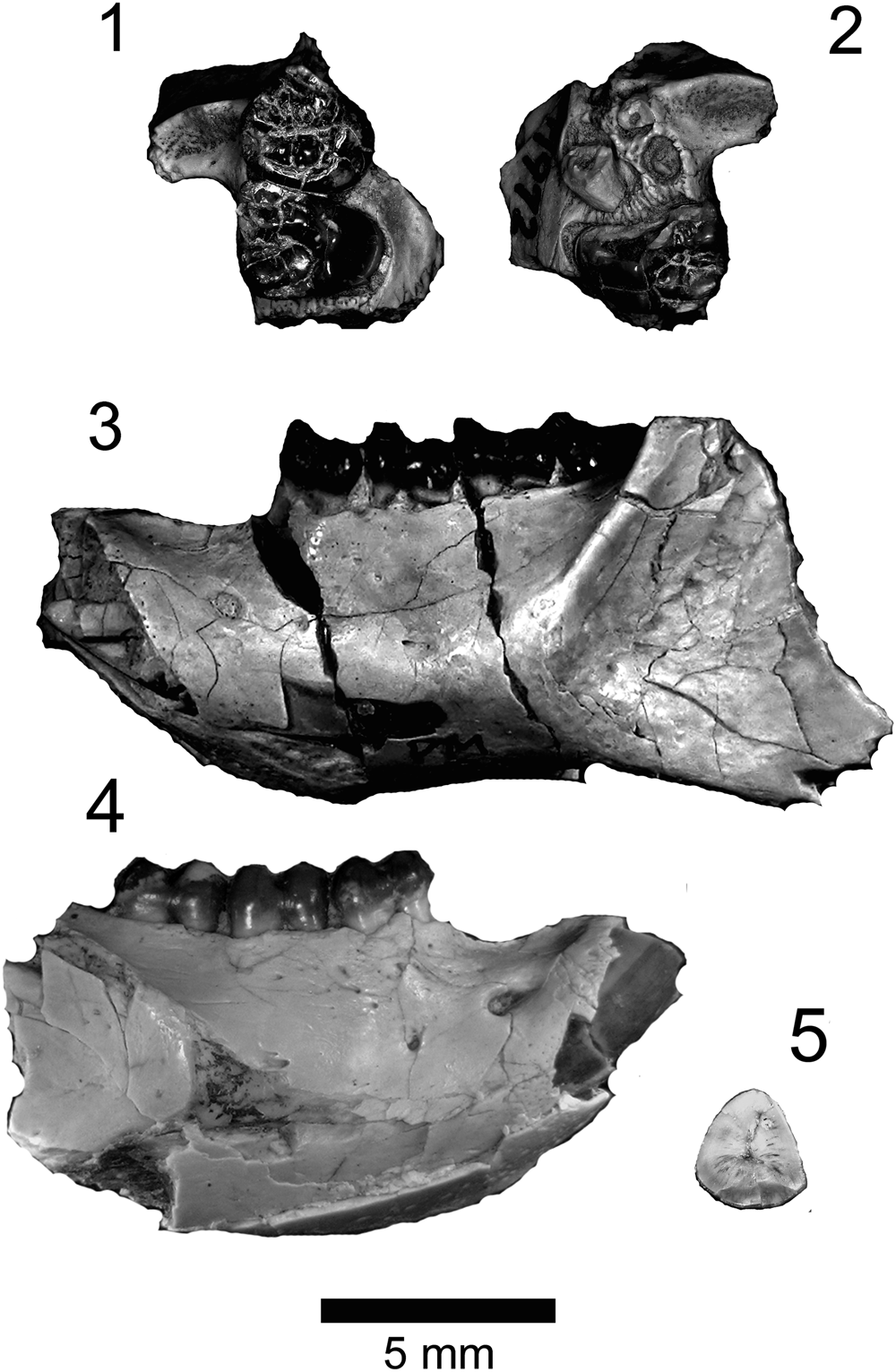
Maxilla and dentaries of Thisbemys intermedius n. sp. from the Washakie Formation. (1, 2) FMNH PM 41972, (1) right maxillary fragment with P4–M1, (2) left maxillary fragment with M1; (3) FMNH PM 55855, holotype, lateral view of left dentary; (4) FMNH PM 41999, right dentary; (5) FMNH PM 41999, cross-section of right i1 (anterior to bottom of page). All figures to same scale (below). Anterior to top of page for (1, 2), to left for (3), to right for (4).

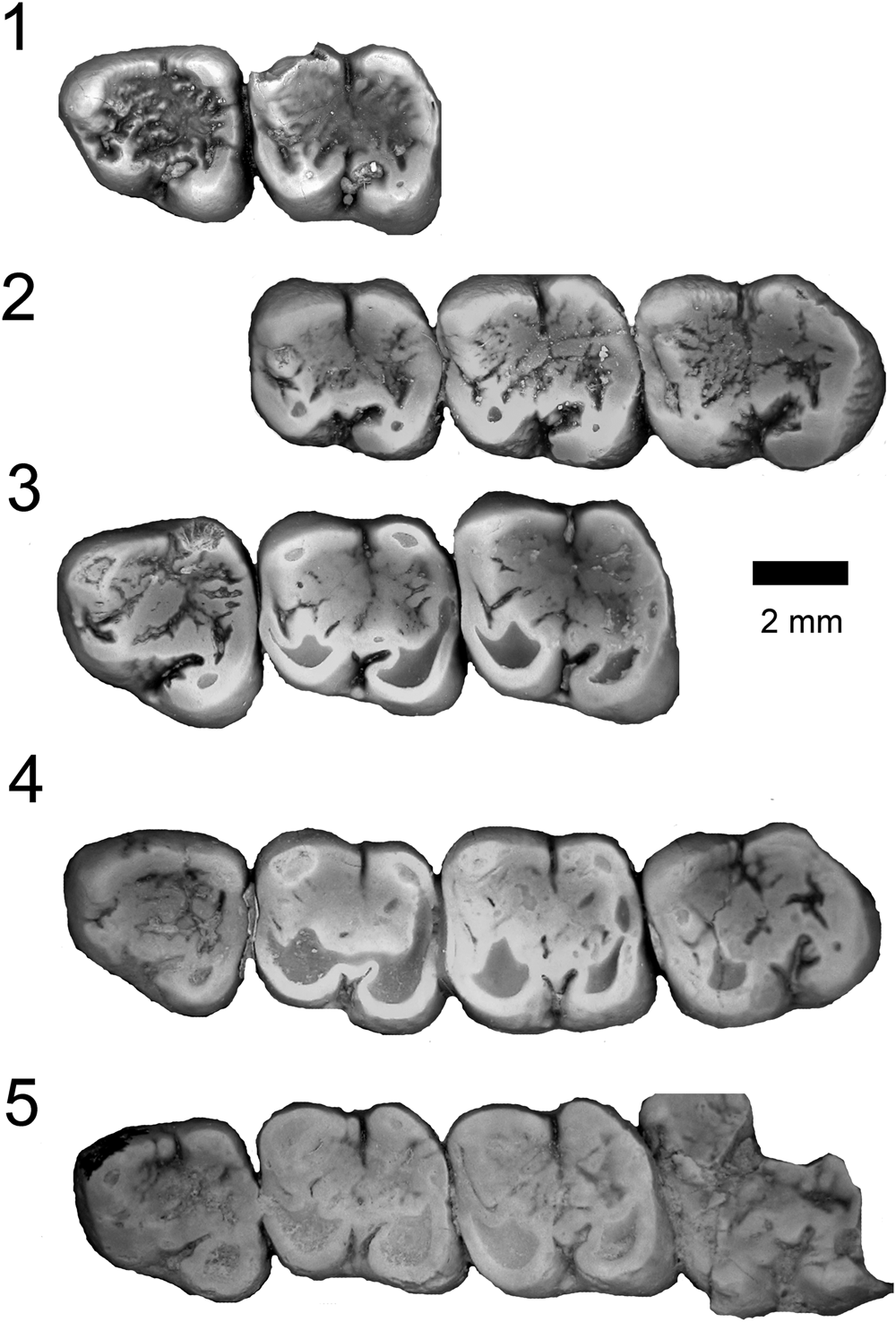
Lower dentitions Thisbemys intermedius n. sp. from the Washakie Formation. (1) FMNH PM 55085, right p4–m1 (reversed); (2) FMNH PM 55086, left m1–m3; (3) FMNH PM 55881, left p4–m2; (4) FMNH PM 55855, left p4–m3 (holotype); (5) FMNH PM 55812, left p4–m3 (partial). All figures to same scale. Anterior to the left on all figures.

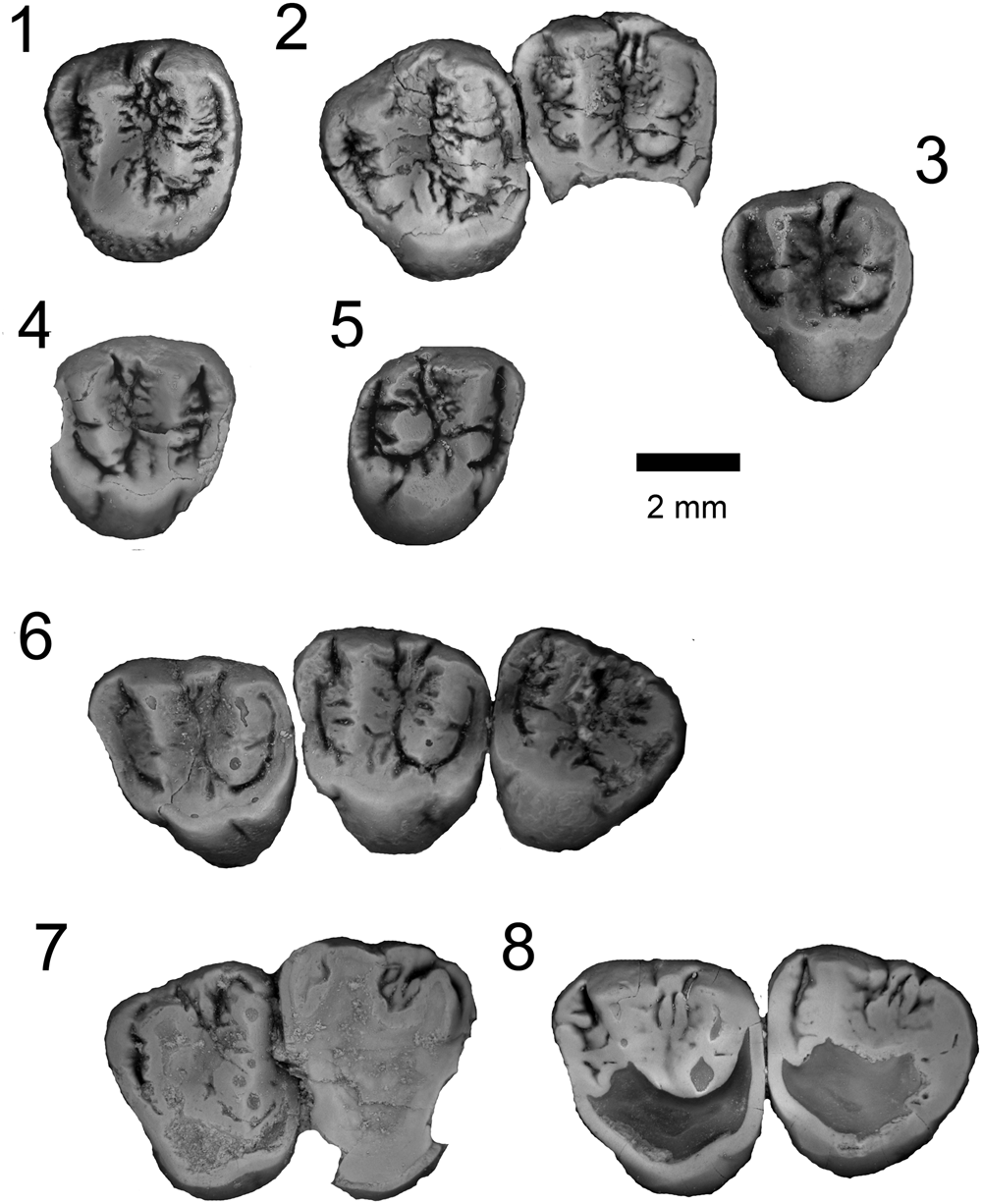
Upper dentitions of Thisbemys intermedius n. sp. from the Washakie Formation. (1) FMNH PM 55201, left P4; (2) FMNH PM 55809, left P4–M1(partial); (3) FMNH PM 56374, left dP4; (4) FMNH PM 55019, right M1 or M2; (5) FMNH PM 55020, right M1 or M2; (6) FMNH PM 56417, left M1–M3; (7) FMNH PM 55981, left P4–M1; (8) FMNH PM 55735, left M2–M3. All figures to same scale. Anterior to the right on (4, 5), to the left on all others.

Type specimen
FMNH PM 55855, right and left articulated dentaries with i1, p4–m3 (Figs. 1.2, 2.4).
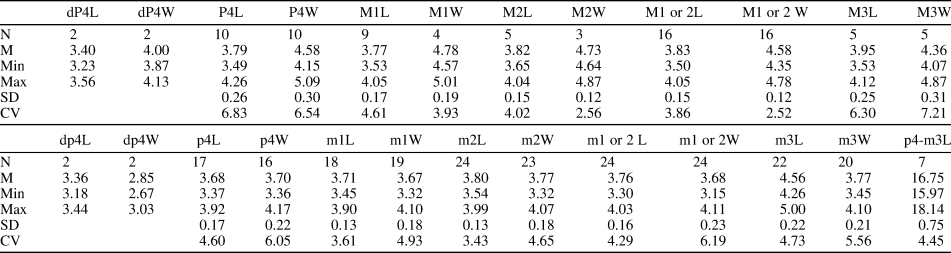
Dental measurements of Thisbemys intermedius n. sp. from the Washakie Formation. Abbreviations L, anteroposterior length; W, transverse width; N, number of specimens; M, mean; Min, minimum measurement; Max, maximum measurement; SD, standard deviation; CV, coefficient of variation. All measurements given in mm.

Diagnosis
Intermediate sized (Table 1), larger than T. plicatus and T. perditus, similar in size to T. corrugatus, smaller than T. uintensis and T. medius (Wood, Reference Wood1962, tables 35–38, 41–44); enamel crenulations on cheek teeth higher and more persistent than T. plicatus and T. perditus (not fusing at the bases until later stages of wear), less persistent than in T. corrugatus.
Occurrence
Lower Adobe Town Member, Washakie Formation, (early Eocene; Br3), Greater Green River Basin, Sweetwater County, Wyoming (see Appendix for list of specific localities).
Description
The dentary is relatively deep (Fig. 1.2, 1.3), ranging from 12.5 mm to 13.5 mm in depth below m1. The diastema is short, ranging from 7.5 mm to 10 mm in length, averaging ~50–60% the alveolar length of the cheek teeth. The dorsal surface of the diastema is a sharp ridge that dips only slightly below the alveolar margin of the cheek teeth. Ventrally, there is a slight symphysial flange below the anterior edge of m1, marking the posterior extent of the articular surface. The masseteric scar is marked by the convergence of two ridges (dorsal and ventral) meeting near mid-depth of the dentary ventral to m2. There are two main mental foramina, a larger one is ventral to the center of the diastema, approximately one-third the depth of the dentary below the dorsal surface of the diastema. A second minute foramen is also present on all specimens, directly posterior to the larger foramen and ventral to the anterior margin of p4. On some specimens there are one or more minute foramina on the dorsal half of the dentary, ventral to the tooth row.
The lower incisor is nearly equal in length and width in cross-section (average anteroposterior length = 5.05 mm, transverse width = 4.60 mm). The anterior enamel surface is flat to slightly rounded, but always rounded at the anterobuccal corner of the cross-section (Fig. 1.5). Enamel extends only slightly onto the lateral surface, with little or no presence on the medial surface. The medial side of the cross-section is flattened. In cross-section, the incisor is wider anteriorly, and tapers posteriorly.
The p4 is the smallest of the cheek teeth. It is narrower anteriorly than posteriorly. The total length average is nearly equal to the width of the talonid (Table 1). It is covered with crenulations in unworn specimens (Fig. 2.1), and the number of ridges decreases and they get thicker as the tooth wears (Fig. 2.3), until late stages when they are completely obliterated (Fig. 2.5; see Table 2 for definition of wear stages). This affect is due to the broadening of the crenulations near the bases, causing a merging of the ridges as they wear. The metaconid is the highest and most anteriorly placed cusp at the anterolingual corner of the tooth. The protoconid is greatly reduced in size relative to the metaconid and appears as a small curved ridge at the anterobuccal corner of the tooth. The trigonid basin is minute and disappears after moderate wear. A thick ridge runs posteriorly from the lingual side of the metaconid along the lingual margin of the tooth, ending near the center of the lingual side, where it is separated from the entoconid by a narrow, deep valley. In heavily worn specimens, this valley is obliterated and the ridge is continuous with the entoconid (Fig. 2.5). The hypoconid and entoconid are nearly equal in size, the former being only slightly larger. The hypoconid is round, but slightly obliquely compressed (anterolingual to posterolabial). The entoconid is slightly anteroposteriorly compressed. The ectolophid extends posteriorly from the posterior side of the protoconid, then angles slightly posterolingually, ultimately curving directly buccally, joining the anterolingual corner of hypoconid. There is only a slight swelling near the center of the ectolophid on some of the specimens indicating a mesoconid. The re-entrant valley between the hypoconid and ectolophid is short and directed posterolinguallly. The posterolophid is continuous along the posterior margin of the tooth from the posterolingual corner of the hypoconid to the posterobuccal corner of the entoconid. There is no distinct hypoconulid on the posterolophid, but the lophid appears to thicken near its center.
Definitions of wear stages of cheek teeth of Thisbemys.

The dp4 is smaller than p4 and typically lower-crowned. In overall morphology, it is similar to that of p4 (longer than wide, narrower anteriorly than posteriorly), but the cusps are smaller and less well defined. The crenulations of the enamel are just as distinct as those of p4.
The m1 and m2 are nearly identical, m1 being slightly smaller in specimens that have both (Fig. 2.2–2.5). However, isolated molars cannot be separated into m1 and m2 with confidence. As with the premolars, the number and size of the crenulations on the occlusal surface vary with attrition (Fig. 2). They are typically rhomboidal in occlusal outline. The trigonid is only slightly narrower than the talonid. Unlike p4, the protoconid is subequal in size to the metaconid and situated slightly more posteriorly than the metaconid. The anterior cingulid (=metalophulid I) runs the entire width of the anterior margin of the tooth from the metaconid to the protoconid. The metaconid is circular in occlusal outline, whereas the protoconid wears to a crescentic outline. The posterior arm of the protoconid (=metalophulid II) extends anterolingually from the protoconid, paralleling the anterior cingulid. A lophid running lingually from the apex of the metaconid also parallels the anterior cingulid. In some cases, these fuse to form a complete metalophulid II. Generally there is a minor break between their complimentary ends. In some specimens, the metalophid II is complete on m1 but not m2 (Fig. 2.3). A small transversely oriented trigonid basin is always formed between the metalophulid II and the anterior cingulid. The ectolophid is short and runs from the anterolingual corner of the hypoconid to the posterolingual corner of the protoconid. A minute mesoconid is marked by a central swelling of the ridge. In a few specimens, there is a short lophid extending buccally from the mesoconid (Fig. 2.4). The hypoconid is the largest of the cusps and obliquely compressed, as in p4. The remainder of the talonid is similar to that of p4. However, the hypoconulid is more distinct as a thickened swelling at the center of the posterior cingulid. The lophid extending posteriorly from the metaconid on the lingual side of the tooth is similar to that on p4, but the valley near its center is much deeper. The entoconid is obliquely compressed (anterobuccal-posterolingual). In more heavily worn specimens, the buccal cusps and ectolophid are replaced by wear facettids because they wear more quickly than the lingual cusps (Fig. 2.4, 2.5).
The m3 is longer than m1 and m2. The posterior width is equal to or slightly narrower than the anterior width. The differences between m3 and the other molars are due to the elongation of the talonid (Fig. 2.2, 2.4). The hypoconid is smaller than in m1 and m2, making the tooth narrower posteriorly than anteriorly. The posterior cingulid bows much farther posteriorly than in m1 and m2. The entoconid is still prominent.
The only cranial material are a few fragments or maxillae that retain the anterior base of the zygomatic arch (Fig. 1.1,1.2). The base of the zygomatic arch preserves the ridge for the attachment of the masseter (=protrogomorphy). The posterior margin of the zygomatic arch ranges slightly in position from being even with the posterior margin of P4 (Fig. 1.1), to being even with the metaloph of P4 (Fig. 1.2). No specimens retain any of the palatal surface medial to the lingual edge of the cheek teeth.
There are no specimens that contain P3, but based on its alveolus, it is clearly single-rooted and positioned anterior to the lingual root of P4 (Fig. 1.2). P4 is slightly smaller than M1 or M2 (Table 1). There is a distinct parastyle at the anterobuccal corner of the tooth that is continuous with an anterior cingulum that runs lingually from the parastyle along the anterior margin of the tooth until it reaches the anterior arm of the protocone, slightly more than half the width of the tooth (Fig. 4.1, 4.2). The paracone is separated from the anterior cingulum and parastyle by a narrow, deep valley. The protoloph runs lingually from the paracone, joining the anterior arm of the protocone just posterior to the lingual end of the anterior cingulum. There is no indication of a paraconule on any specimens. The mesostyle is prominent and anteroposteriorly compressed. Frequently, a low loph extends lingually from the mesostyle into the central valley between the protoloph and metaloph (Fig. 2.2). The metacone is continuous with the metaloph that curves slightly anteriorly, meeting the crescentic protocone just posterior to its center. A minute hypocone is a minor swelling on the posterior cingulum posterior and slightly lingual to the apex of the hypocone. The posterior cingulum runs along the posterior margin of the tooth from the hypocone, fusing at its buccal end, to the center of the posterior side of the metacone. The valleys between the cingula and the major lophs are relatively shallow and filled with crenulated enamel in unworn and little-worn specimens (Fig. 3.1, 3.2). As the teeth wear, due to the broadening of the crenulations near the bases, they become broader and merge with one another, resulting fewer recognizable crenulations. As dentine is exposed (more prominently on the lingual cusps first), the evidence of the enamel wrinkling is eliminated.
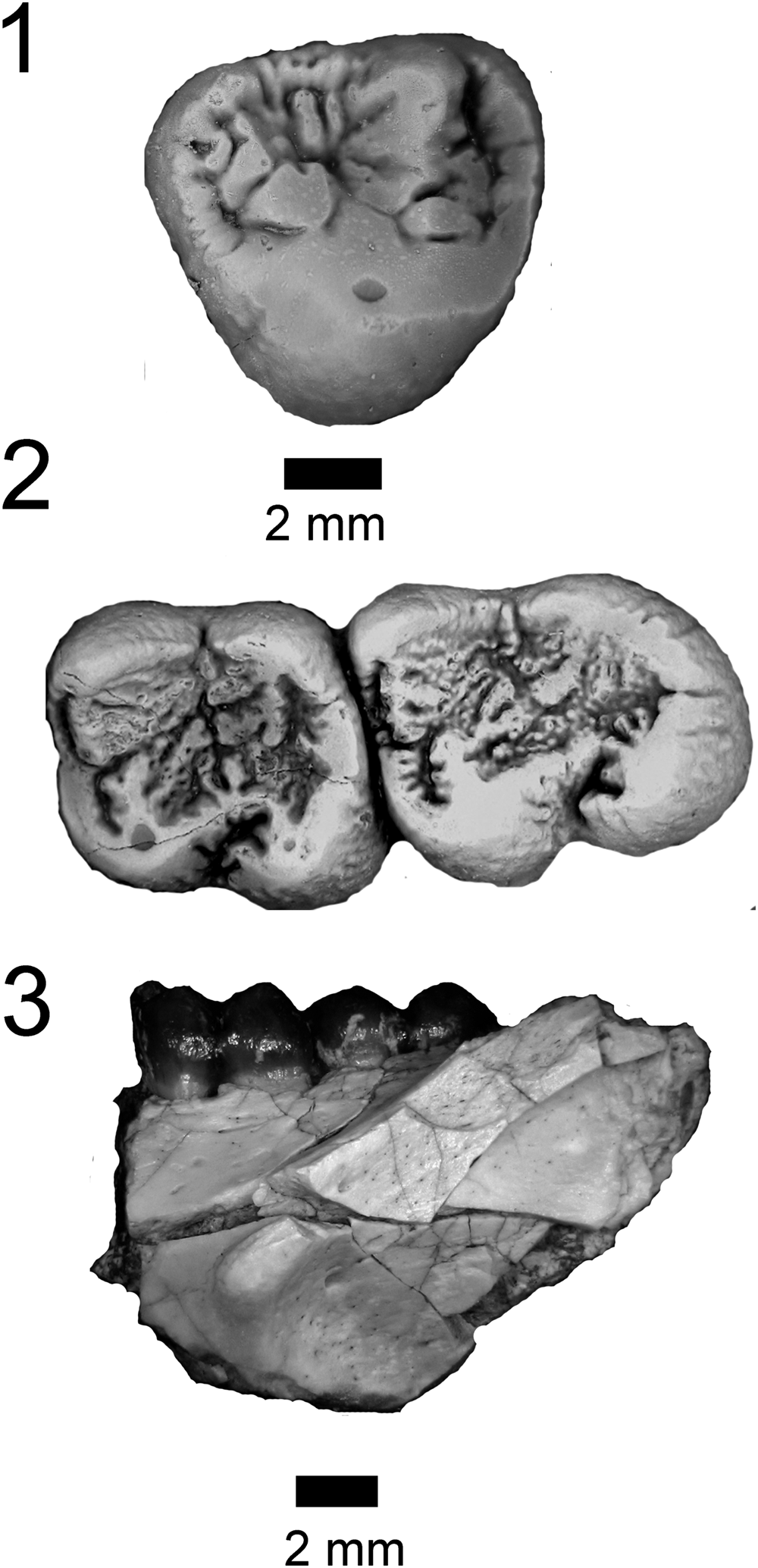
Cheek teeth and dentary of Thisbemys sp., cf. T. uintensis from the Washakie Formation. (1) FMNH PM 54964, right M3; (2, 3) FMNH PM 55083, (2) occlusal view of left m2–m3; (3) lateral view of dentary; (1, 2) are to same scale (above), (3) to scale below.

DP4 is similar to P4 in occlusal morphology, differing only in being smaller, more nearly triangular in outline, and slightly more molariform with a better development of the anterior cingulum and hypocone (Fig. 3.3).
As with the m1 and m2, M1 and M2 are nearly identical in morphology, varying only slightly in size, making it nearly impossible to separate these molars as isolated teeth. Again, the enamel surfaces of the unworn specimens bears minute crenulations that fill the basins (Fig. 3.4, 3.5), only to be reduced in number but broadened with wear (Fig. 3.6, 3.8) until they are completely eliminated at the latest stages of wear (Fig. 3.7). In overall morphology, the first two molars are similar to that of P4, but the cups of protoloph are larger and more distinct. The parastyle and anterior cingulum are as in P4, but the cingulum extends farther lingually, making the tooth wider anteriorly and overall more quadrate in occlusal outline. The anterior cingulum joins the anterior arm of the protocone. Unlike P4, there is a distinct, but small protoconule on the protoloph just buccal to the protocone. The protoloph joins the crescentic protocone at the same point where the anterior cingulum ends. A short loph extends buccally into the central valley of the tooth from the lingual border, but ends before reaching the center. The paracone has a short loph extending posteriorly from its apex along the buccal edge of the tooth. This loph is continuous with the mesostyle on some, but not all specimens. The mesostyle is transversely compressed, and frequently attached to a lophule extending lingually into the central basin of the tooth for a short distance. This lophule is always present, but not always continuous with the mesostyle. The metaloph and metacone are as in P4, but the metaloph is not complete to the hypocone until the later stages of wear. The hypocone is small, but larger than in P4, and situated posterior and slightly buccal to the apex of the protocone. The posterior cingulum is continuous from the hypocone to the posterobuccal corner of the tooth as in P4.
M3 is nearly triangular in occlusal outline and slightly smaller than M1 and M2 (Fig. 3.6, 3.8). The anterior half of the tooth is as in the anterior molars, but the metaloph and hypocone are greatly reduced. The metaloph consists of an anteroposteriorly compressed metacone at the posterobuccal corner of the tooth and is separated from a large, circular metaconule. The metaconule is not continuous with the hypocone. On heavily worn specimens, the metaloph is complete from the metacone to the protocone (Fig. 3.8). A hypocone is either completely lacking, or a minor swelling on the lingual end of the posterior cingulum (Fig. 3.4, 3.8).
Etymology
Latin, intermedius, in between.
Materials
FMNH PM 41972, right maxillary fragment with P4–M1, left maxillary fragment with M1, right dentary fragment with m2; FMNH PM 55201, isolated P4, M1 or M1, p4, m1 or m2, and i1; FMNH PM 56417, left maxilla with M1–M3, left dentary fragment with m1, isolated right M3 and right m2, associated cranial and postcranial fragments; FMNH PM 55374 and 55379, dP4; FMNH PM 55042, 55373, 55981, 55809, 55979, 56379, partial maxillae with P4–M1; FMNH PM 54987, 55163, 55337, 56377, 56388, P4; FMNH PM 56370, partial maxilla with left M1–M2; FMNH PM 55735, partial left maxilla with M2–M3; FMNH PM 55019, 55020, 55336, 55748, 55813, 55814, 55883, 55884, 56369, 56373, 56378, 56493, 58060, 58061, 58098, M1 or M2; FMNH PM 55082, 55338, 55375, M3; FMNH PM 58096, 59747, dp4; FMNH PM dentary with 55741, 55812, p4–m3; FMNH PM 41999, 55880, 55881, dentary with p4–m2; FMNH PM 54987, isolated p4, m1 or m2 and m3; FMNH PM 55085, 58101, partial dentary with p4–m1; FMNH PM 55164, dentary with right p4 and i1; FMNH PM 55289, 55806, 56386, 59741, p4; FMNH PM 55086, 55764, dentary with m1–m3; FMNH PM 55084, 55165, 55466, 56366, 56432, 56556, 57082, 59739, dentary with m1–m2; FMNH PM, 55043, 55740, 55882, 55976, 56366, 58099, 61621, dentary with m2–m3; FMNH PM 41998, 42000, 42019, 42049, 42050, 44580, 55291, 55350, 55736, 55761, 55807, 55847, 55856, 55985, 55987, 56372, 58091, 58093, 58094, 58102, 59748, m1 or m2; FMNH PM 55250, 55762, 55808, 55810, 56376, 56381, 58100, m3.
Remarks
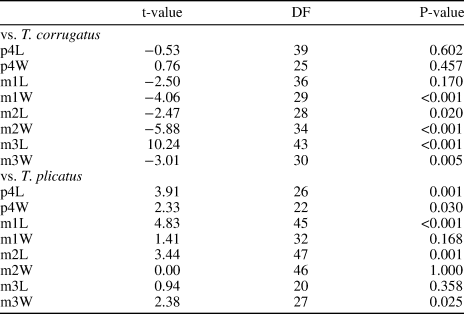
Morphologically, T. intermedius n. sp. differs little from the other known species of the genus, other than the size of the dentition and the persistence of the crenulations of the enamel on the cheek teeth. In size, it is larger than the earlier occurring T. plicatus (Br2: Wood, Reference Wood1962, tables 41, 42) and nearly equal in size to the contemporaneous T. corrugatus (Br3: Wood, Reference Wood1962, tables 35, 36). Statistical comparisons of the sample of T. intermedius n. sp. with both T. plicatus and T. corrugatus (Students t-test) demonstrated that T. intermedius n. sp. differed consistently from both the other species in nearly all dimensions of length and width of the cheek teeth (Table 3). The accessory lophule on M1 and M2, diagnostic of T. brevicrista (Ostrander, Reference Ostrander1986, fig. 1), is not present on any of the available specimens of T. intermedius n. sp.
Results of t-test comparison of measurements of lower cheek teeth of Thisbemys intermedius n. sp. with T. corrugatus and T. plicatus. Measurements for T. corrugatus and T. plicatus from Wood (Reference Wood1962, tables 35, 41). Abbreviations: DF, degrees of freedom; L, anteroposterior length; W, transverse width.

In morphology, the crenulated enamel of the cheek teeth of T. intermedius n. sp. is less persistent than that of T. corrugatus, and more so than T. plicatus and all other earlier occurring species of the genus. Although not necessarily diagnostic, the m1 and m2 of T. intermedius n. sp. average longer than wide in occlusal measurements; >70% of the specimens (N = 66) have m1 and or m2 that are longer than wide. Interestingly, among other species, the m1 and m2 of T. corrugatus (N = 172) and T. plicatus (N = 56) average wider than long (Wood, Reference Wood1962, tables 35, 41), and in T. peditus (including specimens referred to “T. nini;” N = 11) m1 averages longer than wide, and in m2 the average width and length are equal (Wood, Reference Wood1962, tables 37, 39).
The large sample of T. intermedius n. sp. allows for a better understanding of the variation in the structure of the crenulations of the enamel of the cheek teeth based on wear and has allowed for the definition of wear stages (Table 2). Due to the sequence of eruption of the cheek teeth, it quite often occurs that p4 and m3 are much less worn (at an earlier wear stage) than m1 and m2 (Fig. 2.4). Each tooth in every specimen was valued at its wear stage (see Appendix).
Thisbemys sp., cf. T. uintensis (Osborn, Reference Osborn1895)
Figure 4
- Reference Osborn1895
Paramys uintensis Osborn.
- Reference Wood1962
Thisbemys uintensis (Osborn); Wood.
Occurrence
Late Bridgerian (early Eocene; Br3), Lower Adobe Town Member, Washakie Formation, Sweetwater County, Wyoming.
Description
Only a fragment of the dentary is preserved on FMNH PM 55803 (Fig. 4.3). The dorsal ridge of the masseteric scar is preserved and extends anteriorly to a point ventral to the anterior root of m2, slightly more anterior than in other species (Wood, Reference Wood1962, fig. 36C).
Both of the preserved molars (m2, m3) are little worn and preserve a complex of enamel lophulids (Fig. 4.2) within the basins, as well as multiple furrows on the external sides of the teeth, particularly the buccal and posterior sides.
The m2 is rectangular to rhomboidal in occlusal outline. The metaconid is the tallest cusp of the trigonid and positioned slightly more anteriorly than the protoconid. The anterior cingulid is continuous across the anterior border of the tooth from the anterobuccal point of the metaconid to the anterolingual corner of the protoconid. The metaconid is obliquely compressed (anterobuccal to posterolingual), and a low metastylid crest extends posteriorly from its apex along the lingual edge of the tooth for half its length, where it ends in a deep, narrow valley. The metalophulid II is in two parts: a lophid extending buccally from the apex of the metaconid (posterior to, and paralleling the anterior cingulid), and a complimentary lophid extending lingually from the protoconid. The protoconid is crescentic in occlusal outline. The posterior arm of the protoconid continues posteromedially along the buccal edge of the tooth, then curves buccally, joining the anterior arm of the hypoconid. There is no indication of a mesoconid. There is a minor, low lophid extending anteriorly from the anterobuccal side of the hypoconid, partially blocking the buccal valley between the hypoconid and protoconid. The posterior cingulid (=posterolophid) is continuous from the posterolingual side of the hypoconid to the posterobuccal corner of the entoconid. Among the crenulations in the center of the tooth, is a small, lingually directed lophulid from the hypoconid that nearly reaches the center of the tooth. The entoconid is transversely compressed. A distinct lophulid extends buccally from the center of its buccal side, but ends approximately halfway across the tooth.
The m3 is typically much longer than m2, and narrower posteriorly than anteriorly. The anterior half of the tooth is similar to that of m2, but the complimentary lophulids from the metaconid and protoconid are not directly aligned as in m2, and the gap between them is larger. As is typical, m3 is elongated posteriorly compared to m2, with slightly smaller entoconid and hypoconid. The ectolophid is slightly longer and thinner than in m2.
The M3 referred here is also similar in morphology to M3s of other species of Thisbemys, but is assigned here due to its larger size (Fig. 4.1). The posterobuccal corner of the tooth is expanded (relative to M1 and M2). The anterior half of the tooth is similar to that of M1 and M2 in other species, but the metacone and hypocone are greatly reduced in size relative to the anterior molars. The metaconule is large and circular in outline. The metacone is reduced to a slight transversely compressed swelling at the posterobuccal corner of the tooth. There are multiple minute mesostyles along the buccal edge of the tooth between the paracone and metacone.
Materials
FMNH PM 54964, right M3; FMNH PM 55083, partial dentary with left m2–m3.
Measurements
FMNH PM 54964, M3: anteroposterior length = 5.26 mm; transverse width = 5.20 mm. FMNH PM 55083, m2: anteroposterior length = 4.20 mm, transverse width = 4.29 mm; m3: anteroposterior length = 5.14 mm, transverse width = 4.13 mm.
Remarks
Based on the highly crenulated enamel of the molars, these specimens are referable to Thisbemys. However, they are distinctly larger than the Washakie specimens referred here to T. intermedius n. sp. (Table 1). Wood (Reference Wood1962) diagnosed T. uintensis from the Uintan of Utah as having a hypolophid on m1 or m2 that was continuous with the ectolophid, but not the hypoconid (Wood, Reference Wood1962, fig. 39A). On the Washakie specimen, FMNH 55083, there is a short lophid extending buccally from the entoconid, and another short lophid extending lingually from the center of the ectolophid. While not complete across the entire tooth, it appears to be the same structure as in the holotype of T. uintensis. The referred M3 has a hypocone that is more distinct than in T. intermedius n. sp., and similar to that of the holotype of T. medius (Wood, Reference Wood1962, fig. 39E).
The holotype and only other known specimen of T. uintensis are from the Wagonhound Member of the Uinta Formation, Utah (Osborn, Reference Osborn1895; Wood, Reference Wood1962). This horizon is referred to the middle Uintan (Ui2: Robinson et al., Reference Robinson, Gunnell, Walsh, Clyde, Storer, Stucky, Froehlich, Ferrusquia-Villafranca, McKenna and Woodburne2004), however, Anderson (Reference Anderson, Janis, Gunnell and Uhen2008) mistakenly listed it as being from the later Myton Member (Ui3). The occurrence of these specimens from the late Bridgerian possibly extends the range of T. uintensis earlier into the late Bridgerian (Br3).
Comments on other recognized species of Thisbemys
Thisbemys brevicrista.—Ostrander (Reference Ostrander1986) named Thisbemys brevicrista based on a single specimen (KUVP 14233) that consisted of a maxilla in two parts with the right P4–M3 and left M2–M3 from the Upper Bridger Formation (Br3). The diagnostic morphology (and source of the species name) was the presence of a short transverse loph on M1 and M2 that originated along the lingual border of the tooth just anterior to the protocone and extended buccally a short distance into the valley between the anterior cingulum and protoloph, paralleling the protoloph (Ostrander, Reference Ostrander1986, fig. 1). Ostrander (Reference Ostrander1986) noted that a number of other specimens of Thisbemys from the same area were referable to other species of Thisbemys and lacked the diagnostic morphology of T. brevicrista.
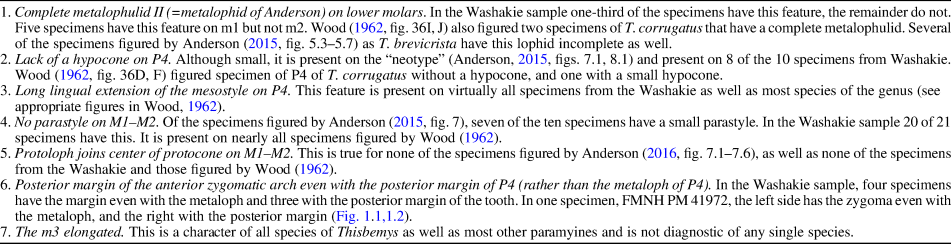
Recently, Anderson (Reference Anderson2015) allocated a number of specimens to T. brevicrista from a variety of fossil localities in the Bridger Formation. Anderson (Reference Anderson2015) assigned a neotype DMNH 56970, a maxilla with P4–M3, from the earlier Bridgerian Black Forks Member of the Bridger Formation, Sweetwater County, Wyoming (Br2). Although noting that the original holotype had been lost, it was listed as having been examined. However, the holotype is currently in the collections at the University of Kansas. Most significantly, it appears that the material referred by Anderson (Reference Anderson2015, fig. 7.1–7.6) does not possess the diagnostic character of T. brevicrista. Anderson's (Reference Anderson2015, figs. 4, 8.1) designated neotype, likewise, lacks this feature and comes from a lower horizon than the original holotype (Br2). Among the specimens figured by Anderson, the only specimen with the diagnostic character is a specimen referred to T. plicatus (Anderson, Reference Anderson2015, fig. 7.9). The other features listed in the emended diagnosis of T. brevicrista (Anderson, Reference Anderson2015, p. 321) all appear to be variable within the sample from the Washakie Formation, as well as the original referred material of other species (see Table 4).
Proposed diagnostic characters used to distinguish T. brevicrista by Anderson (Reference Anderson2015) that appear to be variable.

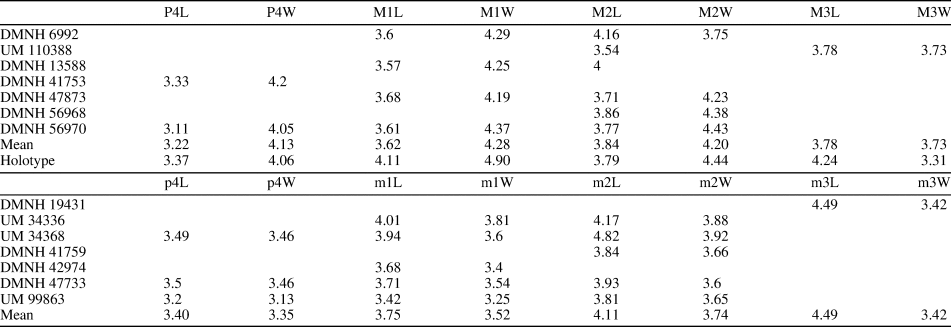
The size of the teeth of the material referred to T. brevicrista by Anderson (Reference Anderson2015, table 2) was incorrectly listed and should be reduced by 15% (Anderson, Reference Anderson2016). The conversion of Anderson's original table is presented in Table 5. In size, the material referred to “T. brevicrista” is most similar to that of T. plicatus (Table 5; Wood, Reference Wood1962, table 41). All but a single specimen referred to “T. brevicrista” is also limited to the earlier Bridgerian (Br2), with one specimen from higher in the section (Br3; Anderson, Reference Anderson2015). This suggests that the material identified as “T. brevicrista” by Anderson is more likely referable to T. plicatus. It is also possible that the diagnostic accessory loph on the upper molars of T. brevicrista is only an individual variation within T. plicatus (compare Anderson, Reference Anderson2015, fig. 7.9 with Wood, Reference Wood1962, fig. 38E). Examination of additional material from the type locality or area of T. brevicrista for the occurrence of this morphology is necessary to establish its viability as a distinct species.
Dental measurements for “Thisbemys brevicrista.” Recalibrated from Anderson (Reference Anderson2015, table 2), based on the adjustment cited by Anderson (Reference Anderson2016). Abbreviations L, anteroposterior length; W, transverse width. Measurements in mm.

Thisbemys plicatus and Paramys delicatior.—Wood (Reference Wood1962) named Thisbemys plicatus from the earlier Bridgerian of the Bridger Formation (Br2), differing from the type species in being slightly smaller and having less fine, and less persistent crenulations in the enamel of the molars. The student's t-test was run on the measurements of the cheek teeth of T. corrugatus in comparison with those of T. plicatus (data from Wood, Reference Wood1962, tables 35, 36, 41, 42), and with the specimens from Washakie. The measurements of all of the lower cheek teeth were significantly different (p < 0.05) between T. corrugatus and T. plicatus suggesting that there is a size difference and that Wood's (Reference Wood1962) separation of the species by stratigraphy is supported.
Wood (Reference Wood1962) cited the holotype of Paramys delicatior Leidy, Reference Leidy1871, from the same horizon as the T. plicatus material from the Bridger Basin. Paramys delicatior was differentiated from the type species of Paramys by its smaller size and wider lower incisor, but had “…very little crenulation; crenulations most prominent on p4;…” (Wood, Reference Wood1962, p. 34). In his original description of T. corrugatus, Wood (Reference Wood1959, p. 158) also noted that, “Most of the material in museum collections that has been referred to P. delicatior is actually referable to Thisbemys…”. However, the specimens of P. delicatior figured by Wood (Reference Wood1959, fig. 15; 1962, fig. 10) are moderately to heavily worn specimens. These specimens match those from the Washakie Formation at the same stages of wear in morphology. In addition, the cross-section of the lower incisor of P. delicatior is much wider relative to length than that of the type species of Paramys (Wood, Reference Wood1962, figs. 9C and L, fig.10C), similar to that of Thisbemys (Wood, Reference Wood1962, figs. 36M, 38M). This suggests that the specimens referred to T. plicatus by Wood (Reference Wood1962) are referable to P. delicatior, but should be included in Thisbemys as T. delicatior. However, this question of synonymy cannot be answered here—it will require re-examination of the available material before this synonymy can be verified.
Thisbemys nini
Anderson (Reference Anderson2015, fig. 5.11) figured a specimen of m2–m3 mistakenly identified as T. nini. Although this specimen was part of the original hypodigm of this species (Wood, Reference Wood1962), it was previously reassigned to T. perditus, and the former species (limited to the holotype) was transferred to the genus Paramys (Korth, Reference Korth1984).
Thisbemys perditus
Wood (Reference Wood1962) differentiated this species from other species of the genus by its smaller size and less-persistent crenulations on the cheek teeth (Wood, Reference Wood1962). In occurrence, it was limited to the late Wasatchian NALMA, earlier than other species of the genus (Wood, Reference Wood1962; Korth, Reference Korth1984; Anderson, Reference Anderson, Janis, Gunnell and Uhen2008). Anderson (Reference Anderson2015, fig. 2) figured this species as occurring throughout the Bridgerian as well. There is no record of this species later than the Wasatchian NALMA.
Conclusions
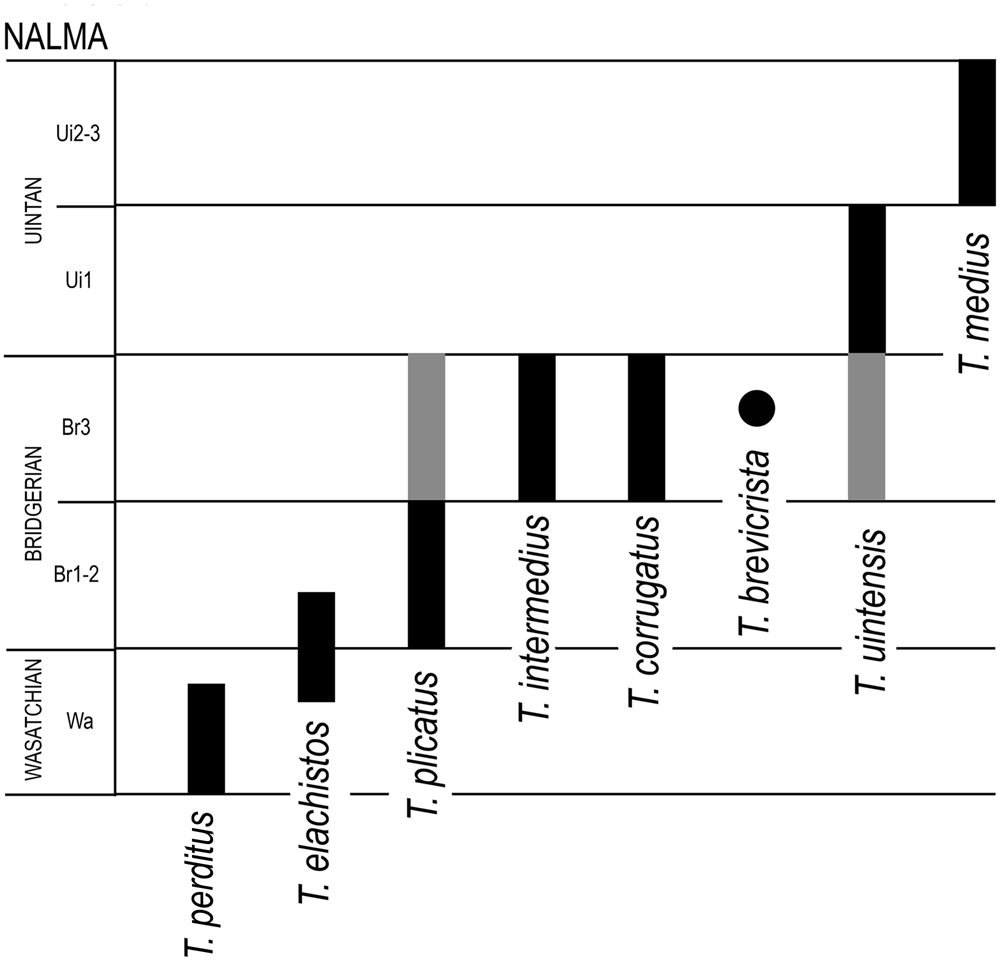
In all, as many as nine species of Thisbemys are recognizable from the early to middle Eocene intermontane basins of North America (Fig. 5), the greatest diversity being during the Bridgerian. Some confusion in the systematics of the genus is due to the ontogenetic changes in the dentition; as the cheek teeth wear, the occlusal morphology (minute crenulations in the enamel) are reduced in number, which has led to difficulties in the separation of species of Thisbemys from other genera. With the large sample of a single species from the Washakie Basin, it is possible to establish parameters for these changes in dental morphology (Table 2) and re-assess the validity of individual species. Ultimately, six species of Thisbemys are recognized, including the problematical T. brevicrista.
Occurrence of species of Thisbemys in Land Mammal Ages (NALMA). Width of intervals standardized, not representative of actual length of time. Black bars represent known occurrence; gray bars represent reported, but uncertain or unverified occurrence; black circle represents occurrence of single specimen.

The later-occurring Uintan NALMA species, T. medius and T. uintensis, are only definitely known from fewer than three specimens each, so the discovery of additional specimens from these later horizons would allow for a better assessment of these species and their relationship to the earlier-occurring species.
Acknowledgments
Specimens from FMNH were graciously loaned by W. Simpson of that institution with assistance from A. Stroup. All research was undertaken at the Rochester Museum and Science Center (RMSC) with permission of K. Murano-Santos. Loans were processed by E. Pietrzykowski of RMSC. Funding was provided in part by private donations to the Rochester Institute of Vertebrate Paleontology. G. McIntosh of the Rochester Museum Science Center assisted with the photography for Figures 2–5. M. Dawson, J. Massare, and G. McIntosh assisted with helpful discussions on systematics and statistics. Earlier versions of this manuscript were reviewed by three anonymous referees.
Appendix
Measurements and localities of individual specimens of Thisbemys intermedius from the Washakie Formation. Precise locality data for FMNH localities available through that institution. Measurements in mm. Wear states 1 (least) to 4 (most); * undetermined.