Introduction
Social relationships are central to quality of life in old age (Bowling Reference Bowling2005) and those with poorer social networks demonstrate not just a lower quality of life but elevated mortality rates as well (Berkman and Syme Reference Berkman and Syme1979; Holt-Lunstad, Smith and Layton Reference Holt-Lunstad, Smith and Layton2010). Emblematic of problematic social networks are the concepts of social exclusion, loneliness and isolation (Cattan et al. Reference Cattan, White, Bond and Learmouth2005). Loneliness and social isolation are two distinct but related concepts. Loneliness relates to the subjective and negative evaluation of the gap between an individual's desired and actual quantity and quality of social relations (Anderson Reference Anderson1998; De Jong Gierveld Reference de Jong Gierveld1987, Reference de Jong Gierveld1998; ElSadr, Noureddine and Kelley Reference ElSadr, Noureddine and Kelley2009; Perlman and Peplau Reference Perlman, Peplau, Gilmour and Duck1981; Townsend Reference Townsend, Shanas, Townsend, Wedderburn, Friis, Milhoj and Stehouwer1968; Victor et al. Reference Victor, Scambler, Bond and Bowling2000; Weiss Reference Weiss, Peplau and Perlman1982). Social isolation relates to the quantitative number of social relationships an individual has and describes a denuded social network.
Loneliness is associated with a range of significant negative health outcomes and this compromises the ability to live independently in the community. There are a range of studies that suggest loneliness/isolation (the terms are sometimes used interchangeably) is associated with negative physical and mental health outcomes including heart disease, depression, suicide (Luanaigh and Lawlor Reference Luanaigh and Lawlor2008) and dementia (Wilson et al. Reference Wilson, Krueger, Arnold, Schneider, Kelly, Barnes, Tang and Bennett2007). Mortality rates are significantly higher amongst the isolated/lonely (Holt-Lunstad, Smith and Layton Reference Holt-Lunstad, Smith and Layton2010; Patterson and Veenstra Reference Patterson and Veenstra2010). Loneliness is also associated with a range of compromised physiological parameters such as stress hormones (Hawkley and Cacioppo Reference Hawkley and Cacioppo2010). Loneliness and isolation negatively impact on maintenance of independence with the resultant implications for the utilisation of social- and health-care services (Concannon Reference Concannon2009). Certainly the converse is true in that not being lonely and/or socially isolated is protective against loss of independence and ill health and that this group is likely to be less reliant on health- and social-care services. Indeed, Cacioppo and his colleagues conclude that the ‘strength of social isolation as a risk factor (for poor health outcomes) is comparable to obesity, sedentary lifestyles and possibly even smoking’ because
[l]oneliness shows up in measurements of stress hormones, immune function, and cardiovascular function. Lonely adults consume more alcohol and get less exercise than those who are not lonely. Their diet is higher in fat, their sleep is less efficient, and they report more daytime fatigue. Loneliness also disrupts the regulation of cellular processes deep within the body, predisposing us to premature aging. (Shute Reference Shute2008)
They also conclude that ‘the physiological toll of loneliness is likely becomes more apparent with ageing. Since the body's stress hormones are intricately involved in fighting inflammation and infection, it appears that loneliness contributes to the wear and tear of ageing through this pathway as well’ (Science Daily 18 August 2007; see alsoErnst and Cacioppo Reference Ernst and Cacioppo1999; Paul, Ayis, Ebrahim Reference Paul, Ayis and Ebrahim2006).
There is now a significant body of work from a range of different countries examining the prevalence of loneliness in later life and identifying the key socio-demographic correlates. Victor, Scambler and Bond (Reference Victor, Scambler and Bond2009) demonstrate that in Western Europe, North America and Australasia the prevalence of loneliness amongst those aged 65+ is in the 8–10 per cent range, with approximately 20 per cent classified as sometimes lonely and the majority of the population defined as ‘not lonely’. Levels of isolation for those aged 65+ range from 6–10 per cent (Wenger Reference Wenger1984) and 13–15 per cent more recently (Victor, Scambler and Bond Reference Victor, Scambler and Bond2009) with rates much higher in deprived inner-city areas (Victor and Scharf Reference Victor, Scharf and Walker2005) and, potentially, in rural areas (Burholt Reference Burholt2010). However, there are a number of aspects of the experience of loneliness that require further attention from researchers and these are the relationship with age and variability across nation states.
The 1992 Eurobarometer Survey reported that ‘Older people were more likely than those aged 15–24 to say loneliness or isolation is the main problem facing older people; 36 per cent against an average of 44 per cent in other age groups’ (Walker and Multby Reference Walker and Multby1997: 54–5). Similar findings have been reported for the United States of America. The 2009 Pew Survey on ‘Growing Old in America’ reported that 29 per cent of those aged 18–64 expected loneliness to be a part of old age compared with 17 per cent of those aged 65 and over (Ayis, Gooberman-Hill and Ebrahim Reference Ayis, Gooberman-Hill and Ebrahim2003; National Council on Ageing 2006). The common stereotype is of loneliness being perceived as an experience almost exclusively confined to older people: it is part of ‘normal’ ageing.
The presumption of an association between increased age and loneliness has face validity given that a range of key transitions linked with loneliness occur more frequently with increased age, including: retirement from work, children growing up and leaving home (the empty nest syndrome), the increased prevalence of chronic health problems, and the bereavement of a spouse or entry into long-term care. Any of these events may signal the deterioration of physical capacity and health, resulting in a contraction of opportunities for social engagement and social activity.
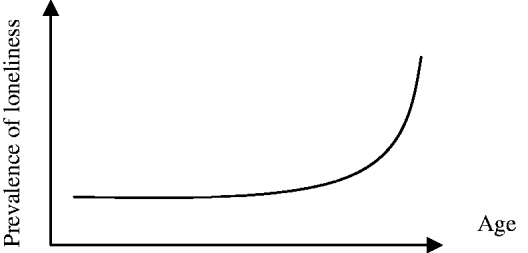
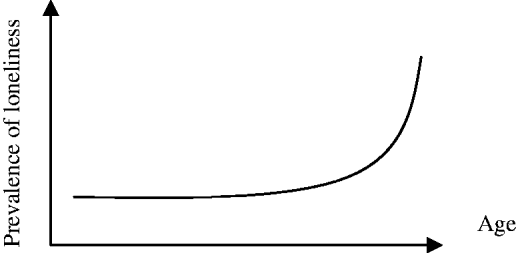
If we accept that this ‘loneliness increases (or accompanies) ageing’ hypothesis is true, then we would see low rates of loneliness for young people with a steady increase with age and a ‘step change’ in rates with entry into ‘old age’ (e.g. age 60). We can model this using the equation y=cx a, where y is the level of prevalence of loneliness, c is the constant or baseline, x is the parameter to be estimated, and a is age (see Figure 1 where the relationship between loneliness and age is described as a monotonic increasing function).
The ‘loneliness increase with ageing’ hypothesis.
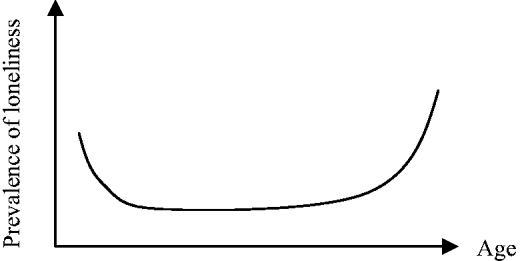
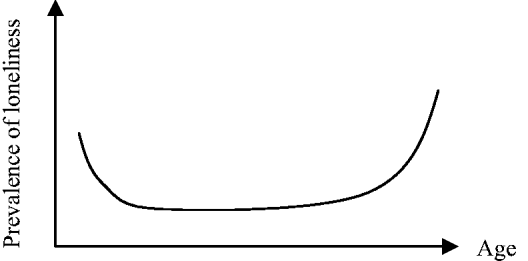
However, there is some empirical evidence to suggest that rates of loneliness are elevated in adolescence or early adulthood as well as old age. Data from New Zealand support this hypothesis that there is a non-linear relationship between age and loneliness (see Figure 2) with reported rates of loneliness of 20 per cent for those aged 15–24, decreasing to around 12–13 per cent in midlife and increasing to 18 per cent for those aged 65 and older.Footnote 1
A non-linear relationship between age and the prevalence of loneliness.
More recently, a publication by the Mental Health Foundation (2010), The Lonely Society, reports an almost ‘flat’ distribution of loneliness across the age groups with little evident relationship with age. Thus, there is no consensus regarding the relationship between age and loneliness. Furthermore, we have little evidence as to how the relationship between age and loneliness may vary with a range of socio-structural factors and cross-nationally.
Cross-national studies on loneliness among older people
Reported rates of loneliness in later life vary with place: rates are higher in urban areas than for the general population (Victor and Scharf Reference Victor, Scharf and Walker2005). There are a number of studies comparing a range of European nations with regard to the prevalence of loneliness among older people and we can distinguish two distinct types of approach: the comparison of ad hoc surveys across two (or more) nations that were not explicitly designed for conducting cross-national comparative analysis and studies designed to collect data from a range of nations that were explicitly designed for comparative research purposes. As far as we know, the study relating to loneliness that involves the largest number of nations is that reported by Stack (Reference Stack1998) who analysed data collected from the 1991 World Value Survey (WVS) across 17 nations. Nevertheless, he did not compare nations with regard to the prevalence of loneliness but pooled the 17 national samples together and analysed them as if they were from a single sample.
The use of ad hoc studies to compare loneliness across Europe encounters a series of comparability issues which we illustrate using the recent paper by Scharf and de Jong Gierveld (Reference Scharf and de Jong Gierveld2008) who compared the prevalence of loneliness and the effect of urban neighbourhood in Britain and The Netherlands. Both surveys used the same study population, those aged 60+ and the same measure of loneliness (the de Jong Gierveld scale). However, the British sample was drawn from three deprived urban neighbourhoods with the sample size 501, whilst the Dutch sample was much larger (3,508) and drawn from the whole nation, including non-deprived and rural areas; the Dutch data were collected in 1992 while the British data were collected at least eight years later in 2000–01; and response rates varied between studies: 62 per cent for the Dutch sample and 42 per cent for the British sample. Similar observations apply to the paper reporting the prevalence of loneliness among older adults in the Netherlands, Italy and Canada (van Tilburg, Havens and de Jong Gierveld Reference van Tilburg, Havens and de Jong Gierveld2004).
Studies with an explicitly cross-national focus on Europe that can be used to study loneliness in later life cross-nationally include the 1993 Eurobarometer Survey which covered ten nations (Grundy Reference Grundy2006) and the more recent SHARE (2004–06) which studied 12 nations (Börsch-Supan, Hank and Jürges Reference Börsch-Supan, Hank and Jürges2005; Sundström et al. Reference Sundström, Fransson, Malmberg and Davey2009), which does not include Russia and only Poland and the Czech Republic among the Eastern European nations. However, such studies are not without their challenges in spite of apparent methodological comparability. Regardless of the issue under study, undertaking cross-national comparisons of the experiences of ageing remains challenging, with some investigators arguing that this is an ‘impossible dream’.Footnote 2 Clemens Tesch-Römer and Hans-Joachim von Kondratowitz (Reference Tesch-Römer and von Kondratowitz2006) argued for a more theory-informed approach to comparative ageing research, one aspect of which is the theoretical basis underlying the selection of nations in cross-European research. Daatland (Reference Daatland2007: 94) thinks that ‘Tesch-Römer and von Kondratowitz are promoting an ideal which is difficult to satisfy because comparative studies may also have other motivations and merits than a search for explanations (theory) and general laws’. He proposed that some of the benefits of ‘atheoretical’ comparative studies include (a) add variation to the study matter and enabling us to pool competencies and perspectives; (b) help us see things differently; (c) put problems and ideas on the political agenda when they illustrate how things are done divergently elsewhere and are examples to be applauded or resisted.
The two approaches, we think, do not have to be incompatible if ‘atheoretical’ studies are taken as an exploratory and preliminary step toward subsequent studies of a more theoretical nature. Furthermore, although we recognise the importance of theory in studying ageing across multiple nations, we try to identify the underlying mechanisms that connect the target of explanation and the explaining factors as specifically as conditions allow (Hedström and Swedberg Reference Hedström and Swedberg1998). The challenge is to verify the causal effects of the mechanisms in empirical research because we often have to speculate on their causal effects without sufficient evidence. Although we shall discuss some mechanisms in the later part of this paper, here we focus on issues of cross-national comparative research, leaving the task of constructing and testing theories to a separate paper.
Despite the importance of theory, methodological challenges are more widely discussed than theoretical ones in cross-national gerontology research. As Fernández-Ballesteros points out:
Without doubt, cross-European research on ageing involves some specific methodological difficulties because different age groups from different cultures and different languages have to be assessed using standardized measures or instruments in a set of constructs. This condition maximizes the level of difficulty for developing, translating and adapting the procedures for data collection. (2007: 98)
Another dimension of variability is the instrument used for measuring loneliness. Two different instruments have been widely used at least in Europe: the de Jong Gierveld 11-point scale and the self-rating loneliness scale. Usually formulated with 11 questions without mentioning the word ‘lonely’ or ‘loneliness’, the de Jong Gierveld scale measures the intensity of loneliness at the time of survey; it does not measure the frequency of loneliness because the questions do not refer to any time-point or period. In contrast, the self-rating scale measures loneliness with a single item that clearly refers to the frequency of feeling lonely. For example, the World Value Survey (WVS) measures loneliness with the following question: ‘Do you ever feel very lonely?’ The responses are: 0=never, 1=seldom, 2=sometimes, and 3=frequently. A different albeit similar version was used in SHARE: ‘How often have you experienced the feeling of loneliness over the last week?’, with response categories of 1=almost all of the time, 2=most of the time, 3=some of the time, and 4=almost none of the time. In addition, among studies that all used the frequency approach, different response categories are employed. For example, Marja Jylhä (Reference Jylhä2004) used the measure in WVS as well when she analysed the data collected from Tampere (a city in Finland), but it is subtly different from the measure that was used by Christina Victor et al. (Reference Victor, Scambler, Bond and Bowling2000, Reference Victor, Scambler, Shah, Cook, Harris, Rink and de Wilde2002, Reference Victor, Scambler and Bond2009), which included response categories ‘always’, ‘often’, ‘sometimes’ and ‘never’.
The different approaches to measuring loneliness make it difficult to compare results across studies employing different instruments, although Victor et al. (Reference Victor, Scambler, Bond and Bowling2000) report that the two scales show good comparability in terms of identifying the ‘never lonely’ and the significantly lonely. For example, the 1992 Eurobarometer data reported that the percentage of people 60 years or older often feeling lonely in The Netherlands was at least 5 per cent (Walker and Multby Reference Walker and Multby1997: 26). Another survey carried out in the same year in The Netherlands and sampling people 55+ used the de Jong Gierveld loneliness scale and defined ‘respondents with a scale score of three or more are lonely’ (de Jong Gierveld Reference de Jong Gierveld, Daatland and Biggs2006: 181). Results from the two studies are hardly comparable unless we could treat those who reported being ‘often lonely’ as equivalent to those having a certain score on the de Jong Gierveld scale.
Our review above is not meant to be comprehensive; rather, it serves to illustrate the challenges to be overcome in undertaking a comprehensive and reliable evaluation of loneliness across a range of age groups and across a large number of nations. Although not without problems (see the last section for details), the European Social Survey (ESS) offers, in our opinion, the highest level of comparability that contemporary survey technologies facilitate and therefore offers a valuable source for a comparative study of loneliness across Europe. Thus far we have identified two potential components of variability in the experience of loneliness: age and nationality (or more accurately country of residence). More specifically, is age or nationality more strongly associated with the probability of reporting loneliness? These are the questions we are addressing in our research project, and in this exploratory study – a more formal and theoretical analysis will follow – we examine the relationship between age and loneliness across the 25 European nations participating in the third round of the ESS (2006–07). Although we report the prevalence of loneliness across all age groups, our ultimate concern is with older people (60+) in order to determine which are lonelier: younger or older age groups.
Data and method
Maximising comparability in the European Social Survey (ESS)
The ESS is a repeated cross-sectional survey that is ‘designed to chart and explain the interaction between Europe's changing institutions and the attitudes, beliefs and behaviour patterns of its diverse populations’.Footnote 3 Winner of the Descartes Prize in 2005 for its excellence in scientific co-operation among the participating nations, it offers a methodologically rigorous foundation for conducing comparative social research across Europe. Here we highlight the most important strategies employed by the ESS team to maximise the comparability of the data.
Comparability is firstly achieved through a consistent and innovative sampling strategy. All national samples target the same population, defined as ‘all persons aged 15 years or older resident in private households within the borders of the nation, regardless of nationality, citizenship, language or legal status’ (Häder and Lynn Reference Häder, Lynn, Jowell, Roberts, Fitzgerald and Eva2007: 34). This consistent definition of the study population offers us the opportunity to examine the relationship between age and loneliness across all adult age groups and across a large number of nations simultaneously. It is very unlikely, therefore, that any differences observed across nations are artefacts of differential sampling schemes or study populations.
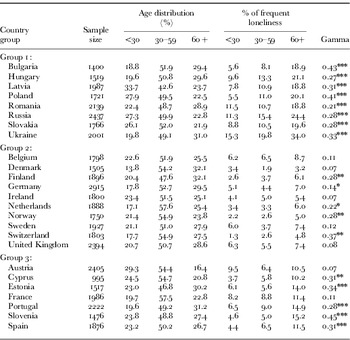
However, in practice each participating nation cannot follow precisely the same sampling procedures and protocols because of national differences in the sampling frames. Thus the ESS Sampling Panel requires that each national sample must achieve an equivalent ‘effective sample size’ ensuring each sample generates an equivalent level of precision, ‘equivalent to a simple random sample (SRS) of 1,500 respondents’ (Häder and Lynn Reference Häder, Lynn, Jowell, Roberts, Fitzgerald and Eva2007: 35). Columns two to five in Table 1 show the sample size of each nation and the distribution of respondents across three age groups for each nation.Footnote 4
Sample distribution and prevalence of frequent loneliness across age groups

Notes: The original age value is recoded into three groups as follows: less than 29.50=<30, 29.51–59.50=30–50, 59.51 and above=60 and above. Figures in the table are weighted by the design weight. Some row percentages do not add up to 100 due to rounding.
Significance levels: * p<0.1, ** p<0.05, *** p<0.001.
Another challenging task is to ensure that the fieldwork follows an agreed set of protocols and procedures (for details, seeBilliet, Koch and Philippens Reference Billiet, Koch, Philippens, Jowell, Roberts, Fitzgerald and Eva2007: 113–35). In the ESS, these standard procedures included personal interviews, a minimum of four visits before defining a contact as ‘non-response’ and the substitution of unreachable persons is not permitted. The ESS specifies a target response rate of 70 per cent for all nations, based upon uniform definitions of non-response and calculations of response rates.
A key challenge in cross-national research is to maximise the comparability of the questions or measures included in the questionnaire or the optimal equivalence between the languages and concepts. As Fernnández-Ballesteros (Reference Fernández-Ballesteros2007) points out, ‘Protocol translation/adaptation can indeed be considered the Achilles’ heel of cross-European research on ageing'. The Translation Panel of the ESS abandoned the usual ‘back translation’ due to its established shortcomings and adopted a forward translation strategy (Harkness Reference Harkness, Harkness, van de Vijver and Mohler2002, Reference Harkness, Jowell, Roberts, Fitzgerald and Eva2007). As discussed in the previous section, more challenging than linguistic translation is ensuring the maximum equivalence of the concepts being measured. With regard to loneliness in the ESS, the interviewer reads out the following statement to the respondent: ‘Using this card, please tell me how much of the time during the past week you felt lonely’, and the options are 1=‘None or almost none of the time’, 2=‘Some of the time’, 3=‘Most of the time’, 4=‘All or almost all of the time’ and 8=‘Don't know’. There have been some concerns over the use of such a single item for measuring a subjective and relatively complex concept such as loneliness, especially when used in a cross-national survey (Rook Reference Rook and Duck1988; Rotenberg and MacKie Reference Rotenberg and MacKie1999). One recent development for dealing with this problem is the use of anchoring vignettes (King et al. Reference King, Murry, Salomon and Tandon2004; Hopkins and King, Reference Hopkins and King2010). However, this method was not applied in the third round of ESS. Rather, a research team led by Willem Saris has created the Survey Quality Prediction (SQP) software for testing the quality and comparability of survey questions that were adopted in the ESS questionnaire (Saris and Gallhofer 2007 b). Saris and Gallhofer point out (2007 a: 53) that ‘the most unusual characteristic of the ESS is its attempt to assess the comparability of its final field questions in all countries and languages by means of Multitrait-Multimethod (MTMM) experiments, which allow error structures for several items to be compared and subsequently corrected for measurement error’. During the first two rounds, the team led by Willem Saris conducted six MTMM experiments in all participating nations, ‘specifically to detect whether the quality of our measurement instruments is the same in different countries’ (Saris and Gallhofer Reference Saris, Gallhofer, Jowell, Roberts, Fitzgerald and Eva2007a: 68). The results of these experiments help increase the comparability of the survey questions, including that on loneliness, thus offering the users of the data a tool for correcting measurement error and provide assurances about the comparability of the way that concepts such as loneliness are measured.
Analysis
As a preparation for a subsequent and more formal study, which will employ multi-level models in order to identify national and individual-level explaining factors for loneliness, our statistical analysis in this paper is descriptive and exploratory. We first report the prevalence of loneliness in the integrated sample of 25 nations in order to obtain an overall picture of loneliness across Europe, which also can be used as a reference for the following nation-level results. We then examine the relationship between age and loneliness at the national level to determine if there are different patterns in the relationship across nation states. Later on we shall combine the categories ‘all or almost all the time’ and ‘most of the time’ to create the category of ‘frequently lonely’ (or ‘frequent loneliness’) for the purpose of making cross-national comparisons. Moreover, we have three hypothetic trajectories of loneliness: an age-related linear increase; a non-linear trend (high rates in youth and old age) and constant levels of loneliness across the age groups.
Results
Age and loneliness in the combined sample
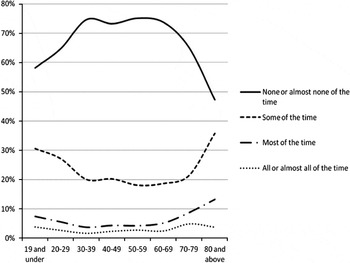
We start our analysis with the pooled data of all participating nations using eight age groups: 19 and under, 20–29, 30–39, 40–49, 50–59, 60–69, 70–79, 80 and above (Figure 3). For the frequent loneliness categories (‘all or almost all the time’ and ‘most of the time’), we see an ‘age-related’ trend increasing from 5.9 per cent of those aged 15–19 to 16.9 per cent for those aged 80+: a pattern consistent with the model shown in Figure 1. For the ‘sometimes lonely’ group, we observe a different pattern: those aged under 30 demonstrate higher levels than those of all other age groups except ‘the oldest old’ (those aged 80+): a non-linear U-shape distribution that replicates the model hypothesised in Figure 2. These data suggest that in Europe, frequent loneliness demonstrates an age-related pattern whilst for ‘sometimes loneliness’ the pattern is more non-linear. Regardless of the measure used, those in their middle ages (30–60) are the least lonely.
Age and loneliness in 25 European nations, 2006–07.

National variations in the relationship between age and loneliness
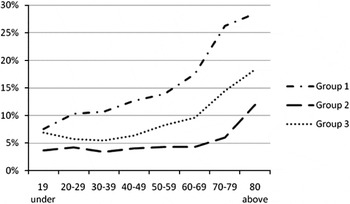
We now examine whether the patterns detected above hold for the participating nations of the ESS. Figure 4 shows the relationship between the percentage of respondents reporting frequent loneliness (‘all or almost all the time’ and ‘most of the time’ combined) and the eight age groups defined above for three groups of nations. The grouping was a result of studying the relationship for each individual nation (details not shown here due to limited space). The relationship between age and frequent loneliness for the nations in Group 1 (Bulgaria, Hungary, Latvia, Poland, Romania, Russia, Slovakia and Ukraine) shows a clear and almost linear pattern. In this group, Ukraine stands out as an exceptional case with the highest percentage of loneliness across all age groups, ranging from more than 10 per cent for the younger generations and higher than 30 per cent for the older people (60+). In great contrast, the rates of frequent loneliness for the nations in Group 2 (Belgium, Denmark, Finland, Germany, Ireland, Netherlands, Norway, Sweden, Switzerland and the United Kingdom) remain consistently low (below 10%) across almost all age levels except for those above 70. Nations in the third group (Group 3, including Austria, Cyprus, Estonia, France, Portugal, Slovenia and Spain) are different from the other two groups in that their rates of frequent loneliness are much lower than Group 1's but higher than Group 2's (especially for the people over the age of 60); in addition, the overall associational relationship for this group shows a gentle U-shaped curve due to the relatively higher rates for the younger generations. More generally, we see variation between nations in terms of the age at which the prevalence of frequent loneliness demonstrates a step change: the ‘trigger’ for the onset of an upward trend occurs at a younger chronological age (30–50) for nations in Group 1 than those in the other two groups (60–70).
Age and prevalence of loneliness in three groups of 25 European nations. For country groups, see Table 1.

The prevalence of ‘frequent loneliness’ across age and nations
Built on the patterns presented in Figure 4, this section presents some descriptive statistics that specify the relationship between age and frequent loneliness for each nation. In order to avoid small counts and to increase statistical power, we have put the respondents' age into three groups: ‘the young’ (under 30), ‘the middle-aged’ (30–59), and ‘the older’ (60 and above).
Statistics in columns six to eight in Table 1 (under ‘% of frequent loneliness’) appear to support the above groupings of nations. The most salient differences lie in the prevalence of frequent loneliness for the older people (60+), with the rates for Group 1 nations ranging from 19 to 34 per cent, those in Group 3 ranging from 10 to 15 per cent, and those in Group 2 the lowest (3–8%). For the respondents under the age of 30, it is not as easy to detect any consistent pattern with regard to the rates of frequent loneliness. More specifically, while it is generally true that young people (<30) in Group 1 nations reported higher percentages of frequent loneliness, there are some exceptions: the rates of Bulgaria and Poland are quite low (5.6 and 5.5%, respectively) and Belgium, Sweden and the United Kingdom in Group 2 have relatively higher rates (6.2, 6.0 and 6.3%, respectively). For the middle-aged (30–59), there seems to be clear distinctions between the three groups: those for Group 1 are all above 10 per cent except for Bulgaria (8.1%), and those for Group 2 are below 5 per cent except for Belgium (6.5) and the United Kingdom (5.5%), with the rates for Group 3 in between (5–9%).
Finally, we measured the correlation between age group and the presence of frequent loneliness (Gamma) and tested its statistical significance (the last column in Table 1). The results for Group 1 are highly consistent: the magnitude of the correlation is in the range of 0.27–0.43, which are highly significant as well (p<0.001). The results for the other two groups are mixed: the relationship between age and frequent loneliness is strong and statistically significant for Switzerland (Group 1, 0.37), Cyprus (0.31), Estonia (0.34), Slovenia (0.45) and Spain (0.31). Denmark, The Netherlands, Norway and Portugal have witnessed relatively weaker strength (0.22 and 0.28, and statistically significant at 0.05 level), indicating a clear relationship but at a lower level of prevalence.
Discussion and concluding remarks
Age, nationality and loneliness
Our motivation in conducting this research was to explore the potential patterns of relationship between age and loneliness across a large number of European nations. The ESS data offer a valuable opportunity for us to do so. We propose that reported loneliness is primarily associated with the nation that the person lives in as well as chronological age. We suggest two inter-connected reasons why we should consider the effect of age only after we have taken into account the effect of nationality. First, there is no consistent association between age and the prevalence of loneliness across all of the nations studied. In fact, national differentials in terms of the percentages of frequent loneliness (all or almost all the time and most of the time) at any particular age level are substantial. It is therefore misleading to associate age with loneliness without firstly specifying the nation in which the association is examined. This does not mean, however, that age has no association with loneliness. Rather, we suggest that the association only becomes relatively consistent when established for a particular group of nations and that we can develop a typology of nation states in terms of ‘loneliness levels’ and the associational patterns in relation to age.
Our data generally confirm the north–south divide of European nations with regard to the prevalence of loneliness reported in other studies. Broadly speaking, those living in Northern European nations report lower levels of loneliness across the age groups than those in Southern Europe, which is consistent with previous studies (Jylhä and Jokela Reference Jylhä and Jokela1990; Sundström et al. Reference Sundström, Fransson, Malmberg and Davey2009; Walker Reference Sundström, Fransson, Malmberg and Davey1993). People in most Northern European nations, including Denmark, Finland, Norway, The Netherlands, Ireland and Switzerland, report the lowest levels of loneliness across all three age groups: the prevalence for the young and the middle-aged are below 4 per cent and below 6 per cent for those aged 60+. However, this typology does not characterise all Northern Europe. Perhaps the most distinctive country within the Northern European area is Latvia where loneliness is much more prevalent than other Northern European nations across all age groups (7.8, 10.9 and 18.8%, respectively). Nevertheless, this traditional typology of North–South divide is limited because it fails to include Eastern European nations. Our results strongly suggest the North+West versus East divide, that is, it is those living in Russia and other Eastern European nations, not those living in Southern Europe, that report the highest percentages of frequent loneliness. The nations in which the highest levels of loneliness were reported were all former Soviet states, including Ukraine, Russia, Hungary, Poland, Slovakia, Romania, Bulgaria and Latvia. The percentages of young people reporting loneliness in some of these nations, such as Hungary, Romania, Russia and Ukraine, are even higher than those of older people in Northern and Western European nations (in the range of 10–15%). The middle-aged and the older people are in an even worse situation (16–20% and 20–34%, respectively).
Potential explanations for the national variations
How would we explain the above cross-national variations of the association between age and loneliness? To answer this question properly, we will have to firstly theorise the differences between the nations that participated in the third round of the ESS and then employ more formal statistical tools, especially multilevel models, which shall be done in a subsequent paper. Here, we set up the context for further investigation by offering a few observations.
When studying cross-national phenomenon such as loneliness, researchers look for cultural factors to explain observed variations. Johnson and Mullins (Reference Johnson and Mullins1987) emphasise the effect of a nation's value system on loneliness with the following model: cultural values→personality→expectation of social interactions→loneliness. They create the concept ‘loneliness threshold’ to describe the ‘the minimal level of social contact that is needed for a person to avoid the subjective experience of loneliness’ (Johnson and Mullins Reference Johnson and Mullins1987: 260). If such a threshold does exist, a nation with a lower loneliness threshold would have a higher percentage of people reporting loneliness. However, these authors did not say how we could determine this ‘minimal threshold’ for a particular nation, let alone comparing nations with regard to that threshold. An illustration of the effect of cultural values on loneliness is the study by Jylhä and Jokela (Reference Jylhä and Jokela1990), who explained the unusually high level of loneliness reported by Greek elders by pointing out that the concept of ‘privacy’ so central to Anglo-Saxon culture was alien to older people in Greece.
For two major reasons, we find it difficult to entirely adopt the above cultural perspective to explain national variations of loneliness. The first is that this approach seems to focus solely on the expectation of social interaction. It is now well established that loneliness arises when there is a perceived deficit or dissatisfaction of the quality or the quantity of social interactions. Thus, expectations alone cannot explain loneliness; it is the perceived gap between the expected and the actual social relations that account for loneliness. Even if we could determine the threshold, we must take great care when comparing nations with regard to the threshold because it is an individual-level measure and its intra-nation variation may not necessarily be smaller than the inter-nation variation. Another difficulty with the cultural approach is that while we appreciate the intention to explain an individual-level phenomenon with a factor at the higher national level, it is very difficult to isolate the mechanisms through which the higher-level factor brings about the individual feeling or behaviour. Referring to the Johnson and Mullins model, how do cultural values affect personality? And further how do different personalities affect expectations of social interactions? Is there a corresponding relationship between personality and expectation of social contacts? Answers to these questions presuppose some strong theories of the relationship between culture and individual feelings.
We suggest that it would be more fruitful to identify nation-level factors that make individual residents become more or less satisfied with their social relationships. The results reported in the previous section prompt us to ask the following question: what are the common features among nations such as Russia, Ukraine, Hungary, Romania and Latvia that could be meaningfully connected to worsening social relations and further to a frequent feeling of loneliness? We know that these nations have experienced dramatic political and economic changes since 1989 (Brucan Reference Brucan1998), but it remains very unclear how those changes have influenced social relations at the individual level. We could hypothesise two mechanisms by which economic and political changes would create a deficit of desired social relations and therefore loneliness. The first is that the transformations experienced by the above nations have forced people, especially the younger and middle-aged groups, to move away from their social relations in pursuit of a better material life somewhere else. At the operational level, we would expect a statistically significant effect of migration within a nation on the percentage of people feeling lonely, which has been confirmed by a study on loneliness among older people in China (Yang and Victor Reference Yang and Victor2008), another transitional nation that has been experiencing dramatic social and economic changes. Of course, whether this mechanism applies to Russia and Eastern European nations remains to be investigated. The other mechanism is less observable, that is, political and economic transformations mean that social relations have to be re-defined with new rules, including those related to code of behaviours, status and privileges. In other words, previously intimate social relations now become strained and it is now more difficult to establish friendly and trustworthy relations. These changes may be reflected in people's perceptions of others surrounding them, which in turn will make people feel more or less lonely.
Limitations
Our first objective was to depict a comprehensive picture of the relationship between age and loneliness in Europe. Since our empirical analyses draw on the data collected from the ESS, our definition of Europe relies on the nations that participated in that particular survey wave (Round 3, 2006–07). Although most European nations participated, some did not (Belarus and Czech Republic in the east, Luxembourg and Monaco in the west, Lithuania in the north, Albania, Greece and Italy in the south). There seems to be no reason to believe, however, that had these nations been included in the survey, the overall cross-national pattern of loneliness presented in this paper would have to be significantly altered.
Our analysis also illustrates the challenge and difficulties in carrying out cross-national comparative research. For example, studies vary in the minimum age used to define ‘older people’ which may range from 50 to 75 years and in the inclusion/exclusion of ‘non-community-dwelling’ populations. Often researchers have to compare a sample representing one nation's whole population of older people with a sample drawn from a specific city/region/area in another nation. Similarly, different sampling schemes may have been followed in different nations or the samples might be collected at different time-points. Even with so much effort and resources invested in maximising comparability, the ESS is still not devoid of the problems that face cross-national comparative studies: there is still a substantial variation of response rates across the participating nations from a little more than 50 per cent in Denmark and Switzerland to over 70 per cent in Latvia, Poland, Portugal, Romania, Russia and Slovakia; social desirability varies from one society to another, which is particularly relevant for studying loneliness; and the quality of interviewers across the participating nations (and within each nation) are very unlikely to be totally uniform. The ESS is not a longitudinal survey and therefore cannot be used for analysing temporal trends. Loneliness may not be the result of age per se but reflect cohort or period effects or of transitions that may accompany advanced age. To see the genuine effect of age we need to analyse longitudinal data. Available longitudinal studies, however, are often very small and cover a very limited number of nations, and not all of them measure loneliness or, if they do, not at each wave. Longitudinal studies including loneliness as a key variable have been carried out in several Northern European nations, but these studies tend to focus on only one region of a particular nation, and are therefore of limited utility in making cross-national comparisons (Tijhuis et al. Reference Tijhuis, de Jong Gierveld, Feskens and Kromhout1999, Zutphen, The Netherlands; Heikkinen Reference Heikkinen, Suutama, Ruoppila and Laukkanen1999, Jyväskylä, Finland; Samuelsson, Andersson and Hagberg Reference Samuelsson, Andersson and Hagberg1998, a rural area of Sweden).
Finally, the instrument used in the ESS does not distinguish emotional and social loneliness that was suggested by Weiss (Reference Weiss1973), although what the instrument measures is closer to social loneliness than to emotional loneliness as it refers to the deficit between desired social relations and the actual ones. Had the distinction been made in ESS, the results may turn out to be different. For example, in their study on The Netherlands, Italy and Canada, van Tilburg, Havens and de Jong Gierveld (Reference van Tilburg, Havens and de Jong Gierveld2004) found older people in the three locations differed with respect to emotional and social loneliness. As the ESS was not designed to measure the distinctive effect of each type of loneliness we cannot discuss the distinction in this paper.
Acknowledgements
We would like to thank the two anonymous reviewers and Jim Ogg for their thoughtful comments and suggestions. An earlier version of this paper was presented at a research group meeting in the School of Applied Social Sciences, University of Durham. Keming Yang would like to thank Roy Boyne, David Byrne, Richard Giulianotti, Ian Greener, Tiago Moreira and Juan Morillas for their comments.