Introduction
An increased demand for food by the growing world population has necessitated development of new agricultural procedures to increase food security and reduce the volume of waste produced in agriculture. Ecological management of insects plays an important role in successful eradication of major pests as a part of sustainable integrated pest management. Mass-rearing of insects for the sterile insect technique programs, in particular, has contributed to eradication of several major pests, such as the screw-worm fly, Cochliomyia hominivorax (Diptera: Calliphoridae), the tsetse flies (Glossina spp.) (Diptera: Glossinidae), the Mediterranean fruit fly Ceratitis capitata (Diptera: Tephritidae) and others (Krafsur, Reference Krafsur1998).
Several recent studies have shown that some insect species, if reared in large numbers, could be potentially useful in biotechnology. For example, the house fly, Musca domestica L., and the black soldier fly, Hermetia illucens (L.), can be used for biodegradation of organic waste (Sheppard et al., Reference Sheppard, Newton, Thompson and Savage1994; Barnard et al., Reference Barnard, Harms and Sloan1998; Čičková et al., Reference Čičková, Pastor, Kozánek, Martínez-Sánchez, Rojo and Takáč2012) and, thus, help to solve the problem of increased waste production by reducing its volume and recycling the nutrients into a high-value feedstuff.
An effective operation of a mass-rearing facility requires maintenance of high fecundity of the adults and high survival of the immature stages (eggs, larvae, pupae), as well as regular quality control tests to ensure high quality of produced insects. Accomplishment of these goals may prove difficult because high population density under which these insects are reared necessarily results in reduced fecundity and increased larval mortality (Readshaw & van Gerwen, Reference Readshaw and van Gerwen1983; Barnard et al., Reference Barnard, Harms and Sloan1998; Achiano & Giliomee, Reference Achiano and Giliomee2004; Pastor et al., Reference Pastor, Čičková, Kozánek, Martínez-Sánchez, Takáč and Rojo2011). Development of new methods to increase survival in all stages of the mass-rearing process may significantly reduce costs of breeding and increase overall productivity of the facility. Mass-rearing of insects used for biodegradation is especially problematic due to the very high density of the larvae needed to ensure high competition for food and optimal extraction of organic substances from the waste. Survival of house fly larvae reared in manure in biodegradation pilot plants and field biodegradation trials can be, depending on the manure and equipment used, as low as 22–47% (Barnard et al., Reference Barnard, Harms and Sloan1998; Sorokoletov, Reference Sorokoletov2006; Čičková et al., Reference Čičková, Pastor, Kozánek, Martínez-Sánchez, Rojo and Takáč2012). To decrease demand for fly eggs and reduce the cost of rearing under these conditions, new techniques need to be developed to increase larval survival.
In the present paper, we examine two different approaches that can be used to increase larval survival in the mass-rearing system, which uses the house fly larvae for biodegradation of pig manure. Successful implementation of these techniques might help to optimize rearing of fly larvae in mass-rearing facilities and reduce maintenance costs of adult colonies.
Materials and methods
Rearing of the houseflies
The house fly colony was established in 2005 as previously described (Pastor et al., Reference Pastor, Čičková, Kozánek, Martínez-Sánchez, Takáč and Rojo2011). Adults were kept in an air-conditioned room (25 ± 2 °C, 50–70% RH, 12:12 h light:dark) in a 30 × 30 × 30 cm screen cage at a high density (14.2 cm3 per fly) and provided with unlimited access to food (a mixture of powdered milk and sugar 1:1) and water (moist sponge). Oviposition substrate (pig manure) was wrapped in a piece of black cloth closed with a rubber band and provided in a special oviposition device (Pastor et al., Reference Pastor, Čičková, Kozánek, Martínez-Sánchez, Takáč and Rojo2011) from the fifth day after eclosion. The flies were allowed to oviposit for 12–14 h every day. After this period, the oviposition device was removed from the cage, the eggs were washed off from the cloth and an exact volume of eggs (1 ml ≈ 11,000 eggs) was prepared in calibrated tubes for seeding on the manure. In all treatments, a small sample (100–150) of eggs was taken directly from the syringe or calibrated tube, placed on a piece of moist sponge cloth and incubated at 24 ± 2 °C for 24 h to check the hatching rate of the eggs. Fresh pig manure used in the experiments was obtained from a commercial pig farm located in Miloslavov, Slovakia.
Two different types of pig manure were used in the experiments: in the substrate modification, the manure used came from pens with pigs fed standard growing diet and contained no sawdust. Survival of house fly larvae in this type of manure was generally low (47%), probably due to its compact semi-liquid consistency (65–85% moisture content) and suspected anaerobic processes. The second type of pig manure was obtained from pens with lactating sows and their piglets and contained variable amounts of sawdust (up to 50%), which was used as bedding. Larval survival in this type of manure was generally good (73%; Čičková et al., 2012), but its nutritional value for the larvae was lower than manure with sawdust. Both types of manure were frozen for 3–4 days at –20 °C to kill any invading arthropods and allowed to warm to room temperature 24 h before the start of the experiments. Following inoculation of the manure, larval rearing trays were transferred to the larval rearing room (24 ± 2 °C, ambient humidity, 12:12 h light:dark) and checked daily. Once most of the larvae pupated, the pupae were recovered from the manure by flotation in water and counted. Five hundred air-dried pupae were weighed (±0.0001 g) to check for mean weight of pupae. Total weight of biomass (g) was calculated as the number of recovered pupae multiplied by mean weight (g) of pupae. Larval survival (%) was calculated as the number of recovered pupae divided by the number of hatched first-instar larvae (based on the hatchability of eggs) and multiplied by 100.
Modification of the larval substrate
Two modifications of the manure were tested to increase larval survival: modified consistency of manure and incubation on a small amount of an alternative substrate with more suitable properties during early larval development.
In control, manure without sawdust (5 kg) was weighed and spread into larval trays and seeded with 5 ml of eggs dispersed in approximately 7 ml of water in a multiple zig-zag fashion directly from the calibrated tube. In the modified consistency treatment, manure without sawdust (5 kg) was placed into larval trays and mixed thoroughly with 300 g of degraded manure (manure previously decomposed by the house fly larvae for 11 days, devoid of any maggots or pupae; moisture content 25–40%). This modification resulted in a bulk of airy substrate similar to the manure with sawdust used in the second experiment. Modified manure was seeded with 5 ml of eggs similarly to the control treatment. In the alternative substrate + manure treatment, the eggs (5 ml) were seeded on the dog meal substrate (46 g of dry dog food (Friskies Junior, Purina, Bük, Hungary) soaked in 54 g of 0.9% brewer's yeast suspension in water), incubated at 24 ± 2 °C for 24 h, and the substrate with developing larvae was transferred to 5 kg of manure without sawdust placed in the larval tray. In this variant, the day when larvae were transferred to manure was considered to be the first day of the experiment.
In all treatments, larval trays were weighed and manure samples (approx. 30 g) were taken at the beginning of the experiment (day 1), on the fifth day of the experiment, and at the end of the experiment (day 8 in modified manure treatment or day 11 in control and alternative substrate + manure treatment). Manure samples were dried for 24 h at 40 °C, re-weighed and their moisture content was calculated. Low drying temperature was chosen because the samples tended to self-combust at ≥60 °C. Each treatment was replicated 20 times and results for each larval tray were recorded at the end of the experiment for egg hatch, number of recovered pupae, larval survival, mean weight of pupae, total weight of pupal biomass, weight of manure (with larvae/pupae), manure moisture on the first, fifth and eighth or eleventh day, and weight of manure residue (without pupae).
Dispersal of eggs during inoculation
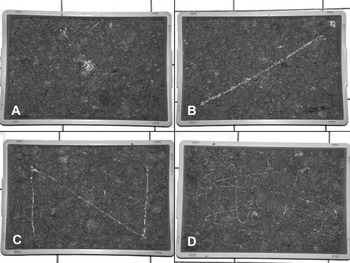
Manure with sawdust was weighed and loaded into larval rearing trays (5 kg per tray). For easier manipulation with the eggs and to allow precise replication of the dispersal patterns, the exact volume of eggs needed for biodegradation (2 ml) was sucked into a 20 ml syringe together with approximately 13 ml of water. The syringe was continuously shaken to avoid sedimentation, and the eggs were dispersed on the manure surface in one of the four different patterns: spot (a circle of 3–4 cm in diameter), diagonal, Z-line, and multiple zig-zag dispersal (fig. 1). Twenty replicates were evaluated for each dispersal pattern. Hatching rate of the eggs, number of recovered pupae, larval survival, mean weight of pupae and total weight of pupal biomass were recorded for each larval tray.
Dispersal patterns of eggs on the manure surface: (A) spot, (B) diagonal, (C) Z-line and (D) multiple zig-zag.

Statistical analysis
Data collected in all experiments were checked for normality by the Kolmogorov-Smirnov test and for homogeneity of variances by the Bartlett's test.
In the modification of larval substrate experiment, comparisons were made by one-way ANOVA followed by Tukey's (HSD) test of the following: weights of pupal biomass, weights of degraded manure (without fly biomass), manure moisture at the beginning and end of the experiment, and relative weight of manure with fly larvae/pupae on the fifth and last (8th or 11th) day of the experiment. Egg hatching percentage, the number of recovered pupae, larval survival, mean weights of pupae and manure moisture on the fifth day of the experiment did not conform to the assumption of homoscedasticity of the data and were analysed by the Welch's modification of ANOVA followed by Welch's approximation of Tukey's test (Zar, Reference Zar2010).
Egg hatching percentage, the number of recovered pupae, larval survival, mean weights of pupae and total weights of fly biomass in the egg dispersal experiment were analysed by one-way analysis of variance (ANOVA), and significantly different means were separated by Tukey's (HSD) test.
All calculations were made in OpenOffice.org Calc according to the formulas proposed by Zar (Reference Zar2010).
Results
Modification of larval substrate
The lowest larval survival (46.87 ± 2.14%) was recorded in the control variant with no modification of the manure. Maggots remained on the manure surface during the first few days of their development and burrowed into the substrate only after the upper layers were sufficiently dry and aerated. Most of the larvae pupated by the 10–11th day after egg-seeding. Adding previously degraded manure to the fresh manure greatly improved its consistency but resulted in only a slightly higher number of recovered pupae (table 1). The larvae, however, burrowed into the substrate shortly after hatching, and their development was fast; most of the larvae pupated by the 7–8th day after inoculation of manure. The highest larval survival (63.32 ± 3.30%) was observed in the alternative substrate + manure treatment. Following inoculation, the larvae quickly left the dog meal substrate and dispersed over the manure surface. They were crawling over the upper layers during the first few days, and larval development took 10–11 days, similarly to the control variant. Differences in the number of recovered pupae as well as larval survival among the treatments were statistically significant (F′ = 10.338; df′ = 2, 36; P < 0.001 and F′ = 8.598; df′ = 2, 36; P < 0.002, respectively; table 1).
Effect of manure modification on larval survival and weight of produced house fly biomass after mass-rearing in manure without sawdust (mean ± SEM)1.

1 Means in columns followed by the same letters are not significantly different (P = 0.05).
Mean weights of pupae differed significantly among the treatments (F′ = 5.600; df′ = 2, 35; P < 0.02). Pupae produced in the control variant were, on average, approximately 2 mg heavier than pupae produced in the other two treatments (table 1).
The weight of biomass obtained by biodegradation of manure was highest in the alternative substrate + manure treatment and was approximately 70 g higher than in control or modified manure treatments. This difference was also statistically significant (F = 13.360; df = 2, 57; P < 0.001).
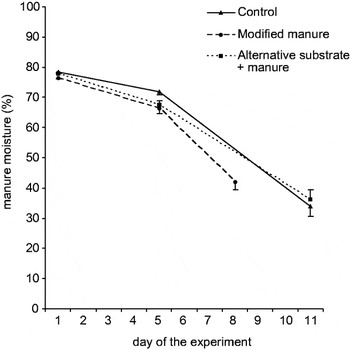
Initial moisture content of modified manure was slightly but significantly (F = 7.792; df = 2, 57; P < 0.01) lower than the other manure variants (mean initial moisture content 78.35%, 76.44% and 77.8% for control, modified manure and alternative substrate + manure treatments, respectively). A small but significant (F′ = 6.213; df′ = 2, 36; P < 0.01) difference in moisture content was also observed on the fifth day of the experiment, with moisture content of manure in the control variant being slightly higher than in the other two variants (fig. 2). Moisture content of degraded substrate in the end of the experiment (day 8 or 11) was not significantly different among the treatments (F = 1.760; df = 2, 57; P > 0.05) and reached on average 34.0–42.1%. Figure 2 shows a far greater rate of drying of the modified manure compared to the other two variants.
Decrease of manure moisture during biodegradation by the house fly larvae in different manure modification treatments. Error bars indicate 1 SEM.

Weight of degraded substrate at the end of the experiment (without house fly biomass) decreased to 1.36 kg in the control treatment, 1.51 kg in the alternative substrate + manure treatment and 1.94 kg in the modified manure treatment. The difference in weights of manure residue was significant (F = 18.013; df = 2, 57; P < 0.001; table 1).
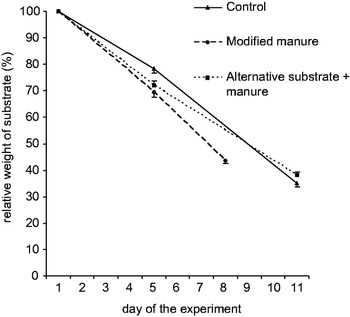
Relative weights of substrates with the developing house fly larvae/pupae decreased almost linearly in all three tested variants (fig. 3). Significant differences were observed on the fifth day of the experiment (F = 6.092; df = 2, 57; P < 0.01), with a lower decrease in the weight of manure with larvae in the control variant, as well as in the end of the experiment (F = 11.127; df = 2, 57; P < 0.001), with a significantly higher weight of the residue of modified manure with pupae.
Decrease in relative weight of manure with developing house fly larvae/pupae during biodegradation in different manure modification treatments. Initial weight (i.e. 100%) was 5.0 kg (control), 5.3 kg (modified manure) or 5.1 kg (alternative substrate + manure). Error bars indicate 1 SEM.

Dispersal of eggs during inoculation
Larval survival was lowest in the spot application treatment (59.23 ± 3.96%). In the diagonal, Z-line and multiple zig-zag dispersal patterns larval survival reached on average 72.5–74.6%. Significant differences were observed in the number of recovered pupae and larval survival among the different egg dispersal treatments at the end of the experiment (F = 5.558; df = 3, 76; P < 0.01 and F = 5.885; df = 3, 76; P < 0.01, respectively; table 2).
Effect of egg dispersal pattern on larval survival and weight of produced house fly biomass after mass-rearing in pig manure with sawdust (mean ± SEM)1.

1 Means in columns followed by the same letters are not significantly different (P = 0.05).
Mean weight of pupae differed significantly among the treatments (F = 5.781, df = 3, 76; P < 0.01). Significantly smaller pupae were produced if the eggs were dispersed in a diagonal, Z-line or multiple zig-zag pattern (table 2). In terms of biomass, the total weight of pupae recovered after biodegradation of 5 kg of pig manure with sawdust ranged among the four tested egg dispersal patterns from 205 g to 226 g, but the differences were not statistically significant (F = 1.269; df = 3, 76; P > 0.05).
Discussion
The presented results evaluate outcomes of experiments with house fly mass-rearing in two types of pig manure: manure without sawdust, where larval survival was generally low despite its high potential nutritional value for house fly larvae and therefore required a substantial modification of the substrate properties to improve the efficiency of rearing, and in manure with sawdust, where larval survival was generally good despite its lower nutritional value. In both instances, we sought for an easy-to-do method which could increase the survival of maggots and output of fly biomass.
In the case of manure without sawdust, the high mortality of the maggots seemed to be the result of unsuitable consistency and compact structure with little aeration of the substrate. Thus, we tried to improve the consistency by the addition of a small amount of previously processed manure, which resulted in better aeration and visually improved structure of manure. Barnard et al. (Reference Barnard, Harms and Sloan1998) found that mixing fresh poultry manure with previously degraded manure has detrimental effects on the survival of the house fly larvae and size of the resulting pupae. Comparison of our results with those of Barnard et al. (Reference Barnard, Harms and Sloan1998) is very limited because they observed only 0.9% larval survival at a density of 900 larvae per 100 g of fresh poultry manure with no addition of degraded manure and they also used higher (25, 50, 75 or 100%) increments of previously degraded manure. In our experiments, we recorded 46.7% larval survival in fresh pig manure at a density of approximately 1000 larvae per 100 g of manure with no modification. This suggests that the nutritional value of pig manure used in our experiments was much higher than that of poultry manure used by Barnard et al. (Reference Barnard, Harms and Sloan1998). Moreover, the amount of degraded manure added in this experiment was relatively low (5.7%) and thus unlikely to substantially decrease overall the substrate's nutritional value.
The dog meal substrate tested in this experiment was considered to be an alternative high-quality substrate and was expected to provide better physico-chemical properties and superior nutrition for the first-instar larvae. Indeed, our results have shown that a well-chosen alternative substrate may be used to increase larval survival even if the main substrate for larval mass-rearing does not have optimal properties. Thus, a substrate with relatively low larval survival could still be used for rearing the larvae, given that the most sensitive eggs and first-instar larvae can be maintained on a nutritious medium. A carefully chosen alternative substrate also could be used to manipulate nutritional value and composition of the resulting house fly biomass, as previously shown in the black soldier fly prepupae (St-Hilaire et al., Reference St-Hilaire, Cranfill, McGuire, Mosley, Tomberlin, Newton, Sealey, Sheppard and Irving2007). The difference in pupal size among the treatments is most likely the result of a relatively higher density of developing house fly larvae in the dog meal variant (Black & Krafsur, Reference Black and Krafsur1987). Low moisture content of the substrate is a limiting factor for the development of house fly larvae (Fatchurochim et al., Reference Fatchurochim, Geden and Axtell1989; Farkas et al., Reference Farkas, Hogsette and Borzsonyi1998; Achiano & Giliomee, Reference Achiano and Giliomee2005) and could cause smaller size of the resulting pupae and adults in the modified manure treatment (Fatchurochim et al., Reference Fatchurochim, Geden and Axtell1989).
The difference in the weight of degraded manure between the modified manure treatment and the control (0.58 kg) was nearly twice as high as could be expected because the amount of previously processed manure added was only 0.3 kg. This fact, together with the almost identical moisture level of resulting biodegraded manure (fig. 2), indicates that the level of biodegradation was lower, and more organic matter remained in the residue of modified manure than in the control or alternative substrate + manure treatments. Additionally, similar weights of manure residue in the control and alternative substrate + manure variants suggests that the level of biodegradation was similar and the difference in the weight of recovered house fly pupae is a result of adding substrate with high nutritional value for the larvae.
Experiments with different inoculation pattern on the surface of manure with sawdust have shown significant differences in the number of recovered pupae. Lower survival in the spot treatment may be caused by higher competition for food and depletion of nutrients, as well as increased amount of waste products of the large number of larvae (Rivers et al., Reference Rivers, Thompson and Brogan2011), which are, at the time of hatching and early development, concentrated in a relatively small area. It is also possible that egg and/or larval mortality were higher due to unfavourable conditions in the area where eggs were applied (e.g. high moisture, dry crusts, low nutritional value, etc.). This may be true especially in the case of heterogeneous substrates. Females of many fly species, including the house fly and the yellow dung fly (Scathophaga stercoraria L.), have been shown to choose their oviposition sites very carefully and prefer laying eggs on surface structures with substrate characteristics which maximize their offspring's survival (Zhemchuzhina & Zvereva, Reference Zhemchuzhina and Zvereva1985; Ward et al., Reference Ward, Foglia and Blanckenhorn1999; Pastor et al., Reference Pastor, Čičková, Kozánek, Martínez-Sánchez, Takáč and Rojo2011). Spreading the eggs on a manure surface increases the chance of eggs being placed on a location with favourable properties and may decrease competition between larvae during their early development. Interestingly, larval survival in the spot application of eggs was significantly different from the rest of the dispersal patterns, but no significant differences in the number of recovered pupae or larval survival were observed among the rest of the treatments (diagonal, Z-line and multiple zig-zag), which further differed in the degree of dispersal. Apparently, sufficient level of spreading was achieved in the diagonal variant and further spreading had no added beneficial effect on larval survival. The differences in the mean weight of recovered pupae are most likely a result of a lower number of developing larvae in the spot application treatment. Since there was more manure available per larva, competition for food was lower and allowed development of bigger, heavier pupae (Black & Krafsur, Reference Black and Krafsur1987).
The results obtained in this study imply that significant savings could be made if the most successful variants are employed. In the case of manure without sawdust, the cost of the ingredients (dry dog food, brewer's yeasts and water) needed for the most successful treatment (alternative substrate + manure) is, as of April 2012, estimated to be €20.30 per one ton of raw manure. The benefit of employing this method is expected higher production of biomass (88.6 kg ton−1 of raw manure in alternative substrate + manure treatment compared to 74.3 kg ton−1 of raw manure in control), which can become an economic advantage in terms of increased revenue after selling the products. On the other hand, this method may be used to decrease the volume of eggs needed for seeding the manure. While in the control treatment, it was necessary to seed the manure with 55,000 (5.0 ml) eggs to obtain 23,000–24,000 pupae; by employing the alternative substrate + manure treatment, similar number of pupae could be obtained by seeding the same amount of manure with only 43,000 (3.9 ml) eggs. Thus, to process one ton of raw manure without sawdust 780 ml of eggs would be needed for the alternative substrate + manure treatment as opposed to 1000 ml of eggs for the control variant. Such a saving would undoubtedly improve the functioning of the mass-rearing facility and decrease the maintenance costs and space requirements of adult fly colony.
The results of the egg dispersal experiments have shown that a simple dispersal of eggs can increase larval survival by as much as 15% and the amount of recovered fly biomass by 4 kg ton−1 of raw manure with sawdust at no cost.
Conclusions
Discovered differences in larval survival with respect to the degree of egg dispersal and modification of larval substrate are important to increase the efficiency of the mass-rearing process. Proper egg dispersal technique and substrate modifications may increase larval survival and thus decrease the number of eggs needed to produce the same number of larvae/pupae while maintaining a high level of biodegradation of animal wastes. This in turn decreases the number of adults needed for egg production and thus decreases the maintenance costs of the egg production colony.
Acknowledgements
The authors are thankful to Jana Mikušiaková (IZ SAS) for technical assistance and Leonard James Beans Foy (Alicante, Spain) for reviewing the manuscript and language corrections.
This study was financially supported by the Slovak Research and Development Agency, Grant No. VMSP-II-0025-09 ‘The development and testing of the technology for the biodegradation of livestock manure’.