The accurate production of spoken words based on the corresponding orthographic (written) stimuli requires both the assembly, or retrieval, of an appropriate segmental (phonemic) sequence and the integration with suprasegmental properties into a complete phonological specification. For stress-assigning languages the most salient suprasegmental property arguably concerns word stress. Theoretically, stress is usually understood as a syllable-level property causing one syllable to “stand out” in the phonological representation as well as in the acoustic instantiation (even though the relationship between phonological and acoustic salience is not only language dependent but can also be context dependent within a language as well; cf. Hirst & di Cristo, 1998; Laver, 1994). In stress-assigning languages, words cannot be pronounced without stress, so speech production models recognize the necessity of stress assignment and include some mechanism or component to assign stress in the process of constructing a phonological representation or using that to produce a pronunciation motor plan (e.g., Levelt, Roelofs, & Meyer, 1999).
INDEPENDENCE OF STRESS ASSIGNMENT FROM SEGMENTAL ASSEMBLY
Evidence that stress assignment constitutes a process distinct from segmental assembly in reading comes from both speech production planning and from neuropsychological data. In the speech production model of Levelt et al. (1999), lexical specification includes a “metrical frame” with the explicit assumption that “the metrical frame specifies the lexical word's number of syllables and main stress position” (p.21). This assumption was motivated by findings of Roelofs and Meyer (1998) that, in the context of a common segmental onset, syllable structure alone was not an effective prime, whereas number of syllables and stress position was. More recently, Schiller, Fikkert, and Levelt (2004) failed to obtain a stress priming effect but did find a regularity effect for Dutch, which they interpreted as consistent with a nonlexical stress assignment strategy for the predominant stress pattern.
With respect to the neuropsychological record, selective impairments in lexical stress assignment have been reported in Italian (Cappa, Nespor, Ielasi, & Miozzo, 1997; Laganaro, Vacheresse, & Frauenfelder, 2002). Patients with surface dyslexia, who presumably have impaired access to lexical information, are also impaired in stress assignment for irregular words, apparently following a regularization strategy (Galante, Tralli, Zuffi, & Avanzi, 2000; Miceli & Caramazza, 1993), assuming that observations from such patients can be used as evidence for determining what should be considered as regular pattern in a language (Janssen, 2003). In contrast, for patients with neglect dyslexia, who retain access to lexical information, stress assignment errors are not predominantly overregularizations (Rusconi, Cappa, Scala, & Meneghello, 2004). Stress pattern has also been reported to affect lexical access in patients with deep dyslexia in English (Black & Byng, 1986; but see also Black & Byng, 1989; Cutler, Howard, & Patterson, 1989).
In this context, the findings by Ashby and Clifton (2005) of stress effects on duration of fixations (in eye movements) are relevant, as they reinforce the conception that stress assignment is a final part of the word reading process, as a separate step of phonological assembly and recoding. Ashby and Clifton (2005), in particular, stated that “[g]iven the ample evidence that eye movement control is tightly linked to lexical access … finding lexical stress effects probably indicates that stress assignment is a customary part of word recognition for skilled readers. If stress effects arise from the additional time needed to assemble more units for phonological recoding, then those assembly processes might be the completion phase of lexical access …” (p.B97, emphasis added).
STRESS ASSIGNMENT INFORMATION SOURCES
Whether or not lexical entries are assumed to include information about their stress, it is not clear, in the process of reading a word, where stress assignment information is derived from and by what mechanism. Stress may be orthographically specified, it may be assigned by rule (based on phonological properties) or by default (on a fixed position), or it may be derived from the lexical representation (Colombo, 1992; Gutiérrez Palma, 2003; Schiller et al., 2004; cf. Rastle & Coltheart, 2000). The relevance of each option depends on the language: in languages with fixed stress, that is, where stress falls on the same syllable on every word (e.g., on the first or final syllable of every word, as in Finnish and French, respectively; Hirst & di Cristo, 1998), stress assignment in reading is not an issue. In languages with lexical stress, that is, where stress may vary in position and contributes to lexical identity, it is of interest to investigate the extent to which stress is assigned on a lexical or a sublexical basis, or a combination of these.
For example, in Spanish, Italian, and Portuguese, stress may fall on one of the last three syllables. There is a “regular” stress assignment, determined in part by syllable weight, and deviations from regularity are either marked orthographically (in Spanish and Portuguese) or are left to be determined lexically (except for final-syllable stress, in Italian; Colombo, 1992; Gutiérrez Palma, 2003; Nunes, Roazzi, & Buarque, 2003). In Italian, Colombo (1992) found a regularity by frequency effect in stress assignment when reading aloud, such that infrequent words with an irregular stress pattern were pronounced with longer response times than infrequent words with regular stress pattern. No difference was found for frequent words, an observation explained by Colombo with reference to fast lexical lookup and stress assignment derivation from the activated lexical source. More recently, Burani and Arduino (2004) contrasted stress regularity with stress neighborhood consistency and found that a multitude of “stress friends” (i.e., words sharing word-final phoneme sequence and stress pattern) affected word naming time, whereas conformance to the dominant stress pattern did not. Burani and Arduino (2004) suggested two alternative theoretical explanations that might account for this pattern: one based on “activation of lexical neighbors in the phonological lexicon,” and a second based on “consistency in print-to-sound mapping of sublexical units” (p.324).
In Spanish, Gutiérrez Palma (2003) found no effect of stress regularity (defined by the penultimate “default” pattern) in lexical decision response time for either low-frequency or high-frequency words. However, he did find an effect of syllabic structure, which determines stress assignment by phonological rule (Gutiérrez Palma, 2005; Gutiérrez Palma & Palma Reyes, 2004). Furthermore, Gutiérrez Palma (2003) investigated the value of the orthographically marked stress diacritic as a stress assignment information source in a series of priming experiments contrasting orthographic with structural (phonological) stress matching between prime and target, in which a late effect was found. This finding was interpreted as lexically mediated, in the context of stress neighborhoods that are activated on the basis of the pattern indicated by the stress diacritic. Thus, in Spanish, as in Italian, there is evidence for a multitude of information sources affecting stress assignment during reading, which may be brought in cooperatively or competitively in the processing of each word, depending on the word's phonological structure, orthographic marking, and conformance to the default metrical pattern.
STRESS ASSIGNMENT IN GREEK
Greek is characterized by free stress, and always marks stress position in the orthography with a special diacritic. The only phonological restriction on stress position is the “three-syllable rule,” which states that stress must fall on one of the last three syllables (Malikouti-Drachman & Drachman, 1989). Stress position is a lexical property influenced by morphological type. Certain conjugations and declinations affect stress position (Botinis, 1998; Malikouti-Drachman, 2002), because some inflectional morphemes impose their inherent metrical properties (“accenting suffixes” determine stress placement in interaction with the lexically assigned accent of word roots; Revithiadou, 1999).
Stress marking in Greek spelling has a long history. A wealth of phonologically inconsequential accenting and breathing marks were officially eliminated more than 2 decades ago, leaving a single “acute accent” mark as the sole stress diacritic, which every word with more than one syllable must bear on the vowel of its stressed syllable (Petrounias, 2002). Greek words with two or more syllables written without a stress diacritic are considered misspelled, and this is an issue explicitly taught and closely attended to by teachers in the first school grades. Therefore, Greek is useful for the study of stress assignment in reading because it provides a visual mark indicating the stressed syllable in every case in which a syllable must be stressed.1
The converse is not true, because Greek spelling dictates stress marking of every word with more than one syllable, including even two-syllable closed-class words that do not bear phonological stress and attach themselves metrically to an adjacent open-class word. In such cases the stress diacritic does not mark a stress-bearing syllable.
Recent studies of stress assignment in reading Greek have revealed that orthographic information is not, in fact, utilized to its fullest extent, and that additional factors are operative. Stress assignment errors (with respect to the printed diacritic) were found to be much more numerous in nonword reading (14.1%) than in word reading (1.6%), and they were strongly modulated by the indicated stress position, in contrast to phonemic errors, which depended primarily on phonological complexity (Protopapas, 2006). In a follow-up study, nonwords strongly resembling particular words, presented for reading without a stress diacritic, were typically pronounced with stress assignment by analogy to the corresponding word, whereas the majority of nonwords not resembling any particular words were pronounced with penultimate stress (Protopapas, Gerakaki, & Alexandri, 2006; their experiment 1). In a second experiment of the latter study, more stress assignment errors in nonwords not resembling words, presented with a printed diacritic, were made toward the penult than toward any other syllable. Taken together, these studies indicate that the existence of the diacritic as an obvious source of information does not imply that it is the preferred source, and that strong lexical and default metrical effects characterize stress assignment in reading.
The hypothesis that Greek has a preferred “default” stress assignment position on the penultimate syllable is consistent with phonological (Malikouti-Drachman, 2002) and developmental (Kappa, 2002) considerations, and in agreement with patterns in languages such as Italian, Portuguese, and Spanish. The existence of a default metrical pattern is by no means obvious. Beyond phonological considerations, it remains to be determined empirically whether a stress assignment bias exists that can be attributed to a default strategy, and if it does, to investigate where this default pattern may originate from. The origin question is important to the extent that it affects the operation of stress assignment. As mentioned, in Italian the “default” position seems to be determined not by a language-general metrical pattern but by stress neighborhoods (Burani & Arduino, 2004). In this case we cannot speak of a proper default but should rather refer to statistical effects of the lexicon, whereby operation biases are created by local majority. Thus, for Greek the question is not simply whether a default metrical pattern can be discerned, but also whether this pattern can be attributed to the language (or lexicon) in general or to local properties of partial lexical activation.
RATIONALE AND HYPOTHESES
Our long-term goal is to understand stress assignment in word reading, toward more inclusive cognitive models of reading. However, using real words to study stress assignment precludes independent manipulation of lexicality and metrical patterns, because we cannot control the salience of lexically derived stress assignment information with intact words. To the extent that stress can be based on lexical activation at all, once words are activated then stress is fully determined and it is not possible to test whether orthographic (i.e., diacritic) or structural (i.e., default) sources are also operative. To avoid these problems, we continue to use nonword stimuli.
Nonword reading is not an entirely unfamiliar task. If the adult vocabulary has been learned primarily through reading, then most words will have been read once as nonwords, as originally unknown words. Moreover, an item cannot be known to be a nonword before at least one reading is attempted. Nonword status is accorded when no known word matches the orthographic stimulus sufficiently; but if there is a great deal of similarity between a nonword stimulus and one or more known words, then lexical activation is expected to occur, much as word stimuli cause activation of all lexical entries they resemble (orthographic neighbors). Therefore, the well-practiced strategies a reader uses for word reading can be expected to be applied to nonword stimuli as well. The success of these strategies will depend in part on their applicability and in part on their efficiency.
For example, if words are typically read such that stress assignment is based on the written diacritic, then decoding of the diacritic will be highly practiced, hence efficient, and because this strategy can also be used with nonwords it is expected that nonwords will always be stressed on the syllable indicated by the diacritic. A finding that nonwords are not reliably stressed where the diacritic indicates is therefore inconsistent with the operation of an efficient decoding strategy for word stress assignment based on the diacritic.
As another example, if words are typically read such that stress assignment is based on lexical activation, then derivation of a metrical pattern from the lexicon will be highly practiced and efficient. When a nonword resembles a word sufficiently (i.e., enough to activate the lexical entry for the word), then it will be stressed by analogy to the activated word regardless of the position of the diacritic. When a nonword does not activate any lexical items sufficiently then this strategy will not apply and stress assignment failures should be observed. These failures can take the form of random stress assignment, or can be expressed by preferential assignment on a particular syllable. In the latter case, we would have evidence for a default stress assignment strategy, operative in the absence of specific stress position indicators.
In the recent Protopapas et al. (2006) study, schoolchildren from Grades 7–9 were tested on reading nonwords constructed to resemble or not resemble real words, which were presented without stress diacritics. Strong lexical effects were found, which were expressed as a tendency to stress items by analogy to the source words when similar. Default-pattern effects were seen in the stress assignment of items not similar to words. However, in that study no attempt was made to investigate the priority of the alternative sources of information. Children read aloud lists of items printed on a sheet of paper. One set of items was presented only without stress diacritics, whereas another set of items, not varying in resemblance to real words, was presented only with stress diacritics. Because of these methodological constraints, it was not possible to examine differences in response latencies among item groups. Moreover, the intermediate stage of reading skill attained by middle-school children makes it unclear whether those results should be interpreted in the context of skilled or developing reading.
In the present study we extend the previous findings and overcome these shortcomings by testing adults with the same pseudoword materials presented in a wider range of conditions. In the experiments reported here, items are responded to individually and response latencies are recorded. In Experiment 1 we investigate the relative importance of the three information sources, by presenting the nonwords not only without a stress diacritic, as before, but also with a stress diacritic, either on the same syllable as the source words or on a different syllable. By pitting sources of information against one another we now attempt to shed light on the priorities of the cognitive stress assignment mechanism. Furthermore, in Experiment 2 we examine the origin of the default metrical pattern by adding a secondary task to test an initial hypothesis that the default pattern is expressed as activation over working memory.
EXPERIMENT 1
This experiment was designed to replicate and extend experiment 1 of Protopapas et al. (2006), using the same nonword set in additional presentation conditions. The rationale for the original experiment was that if the reading of nonwords activates the use of metrical patterns based on words in the mental lexicon, then nonwords resembling specific words should be stressed by analogy to the words they resemble, whereas nonwords not resembling specific words would be stressed either randomly or by reference to a default stress pattern. Moreover, if stress assignment is a result of lexical activation, then nonwords resembling frequent words might be stressed by analogy to these words more often than nonwords resembling infrequent words, because frequent words can be expected to be activated more easily and more strongly than infrequent words. The frequency manipulation failed to produce significant findings in the error measures with the children, necessitating the collection of item-level response times for the present study in an attempt to increase the sensitivity of the procedure.
The design of the experiment involves three groups of nonwords constructed by modifying real words. Group 1 included nonwords based on high-frequency words that were minimally changed, Group 2 nonwords were based on high-frequency words that were changed beyond recognition, and Group 3 nonwords were based on low-frequency words that were minimally changed. There were three presentation conditions for reading aloud these items: without a stress diacritic (removing explicit orthographic information for stress assignment), with a stress diacritic on the same position as the source word (such that lexical and orthographic information are congruent), and with a stress diacritic on a different position (such that orthographic and lexical information work against each other).
In Groups 1 and 3 (which resemble the words they were derived from), lexical stress assignment information is uncontested in the first presentation condition, supported by the diacritic in the second condition, and opposed by the diacritic in the third condition. Therefore, the effect of presentation condition on stress assignment can indicate the relative strength of lexical and orthographic sources. Specifically, we measure the proportion by which participants stress each syllable, with respect to (a) the syllable bearing stress in the original word and (b) the syllable bearing the stress diacritic in the nonword stimulus. We expect word stress position to affect nonword stress assignment strongly in these item groups, and we expect the diacritic manipulation to modulate this effect moderately, providing a quantitative index of the strength of the diacritic compared to word resemblance as a source of stress assignment information.
In contrast, for items in Group 2 (which do not resemble any particular words), no lexical information is available. Therefore, the location of stress assignment should be more sensitive to presentation condition in Group 2 than in the other groups, because the orthographic source provides the only available information for this group. In this group we expect word stress position to have no effect, whereas the diacritic manipulation (presentation condition) should affect stress assignment very strongly, because the diacritic, when available, will be a lexically uncontested source. Thus, the comparisons among groups can also serve to indicate the extent to which reliance on lexical or orthographic sources alone is sufficient to determine correct stress assignment.
Method
Participants. Seventy-three graduate and undergraduate university students (30 men, 43 women) between the ages of 19 and 41 years (mean age = 27 years,SD = 5 years) participated in this experiment voluntarily, without monetary or other compensation.
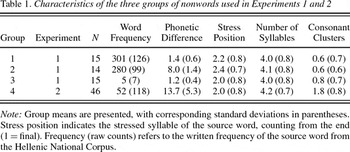
Stimuli. There were 15 minimally changed nonwords from high-frequency words (Group 1), 14 highly changed nonwords from high-frequency words (Group 2), and 15 minimally changed nonwords from low-frequency words (Group 3). The comparison between Groups 1 and 2 concerns word resemblance, whereas the comparison between Groups 1 and 3 concerns word frequency. Table 1 shows the average characteristics of the three item groups. Details of stimulus construction have been reported previously (Protopapas et al., 2006). Briefly, 92 real words that were three to five syllables long, including low-frequency and high-frequency items (based on the Hellenic National Corpus at http://hnc.ilsp.gr/en; Hatzigeorgiu et al., 2000), were turned into nonwords by changing one or more phonemes so that the result remained phonotactically acceptable. The amount of phonetic change was quantified on the dimensions of place and manner of articulation and voicing (1 point each). The nonwords were submitted to a pretest to determine which words, if any, would be produced in response to them. Minimally changed nonwords were discarded if participants failed to produce the exact original word, and highly changed nonwords were discarded if any words at all were produced, resulting in a total of 44 items in the three groups as mentioned above.

There were three forms of stimulus presentation (stress diacritic conditions) in this experiment: (a) nonwords appearing without a stress diacritic, constituting the no diacritic or “no” condition (identical to the stimuli in experiment 12
With the exception of απακερoται and φερασoτικo, which were changed to απακερoλαι (t → l) and φερασoτιλo, respectively (k → l).
Three experimental lists were then created, each containing 44 items. For every nonword, each of the three forms was randomly assigned to one of the three lists, resulting in a mixture of forms in every list, with each nonword appearing only once in each list. Each participant was tested with one of the three lists only.
Procedure. The nonwords were presented on a laptop computer screen, one at a time, for the participant to read aloud into a head-mounted microphone. Items were displayed for 1,500 ms in large (40 point) white Arial Greek typeface on black background. The vocal responses were automatically timed and recorded in temporal alignment with stimulus delivery under the control of the DMDX software program (Forster & Forster, 2003). The experimental procedure was preceded by a practice run including six items (nonwords different from those in the experiment) to familiarize the participants with the procedure and the type of stimuli. Testing took place in a quiet space at the University of Athens for some participants and at home for others.
Analyses. Phonetic accuracy in reading the nonwords was examined by counting segmental errors and analyzing their frequency of occurrence by nonword group, length (number of syllables), complexity (consonant clusters), and original word stress position.
In order to examine the central question of stress assignment behavior, we created and tested specific contrasts: (a) the lexical index (LexI) was formed, by subtraction, of the mean number of times nonwords were stressed on the syllable on which the corresponding original word was stressed minus the mean number of times stressed on any other syllable. Thus, a LexI of 1.00 indicates 100% stress assignment identical to the original word, 0.00 indicates no preference, and −1.00 indicates a complete mismatch between nonword stress assignment and original word stress position. (b) The penultimate index (PenI) was formed, by subtraction, of the mean number of times nonwords were stressed on the penultimate syllable minus the mean number of times stressed on any other syllable. Thus, a PenI of 1.00 indicates 100% stress assignment on the penult, 0.00 indicates equal proportions of penult and other, and −1.00 indicates that the item was never stressed on the penult. (c) Finally, the diacritic index (DiaI) was formed, by subtraction, of the mean number of times nonwords were stressed on the position indicated by the diacritic minus the mean number of times stressed on any other syllable. Thus, a DiaI of 1.00 indicates 100% stress assignment according to the diacritic, 0.00 indicates irrelevance of the diacritic, and −1.00 indicates perfect avoidance of the diacritic. This third index is only relevant for the dif condition, because in the no condition there is no diacritic and in the wrd condition the diacritic follows the source word and therefore DiaI would be identical to LexI.
For each item group and presentation condition, we tested each contrast against zero (indicating no significant tendency) and against one (indicating perfect reliance); we also compared the effects of presentation condition on LexI and PenI among item groups. These comparisons address the hypotheses concerning the effects of presentation (presence and position of the diacritic). Moreover, for each presentation condition, we compared the indices between the item groups, to address the hypotheses concerning the lexical effects (resemblance and frequency).
All statistical testing was done both with averaging first across nonwords (subjects analysis) and with averaging first across participants (items analysis). Differences were considered statistically significant when both tests (indexed by 1 and 2, respectively) exceeded the usual criterion of p<.05. Occasional tests of particular interest meeting a less stringent criterion of p<.10 are mentioned as “marginally significant.”
Results
Data from 13 participants were discarded because of insufficient recorded responses, either caused by too many failures to respond (including timed-out responses) or because of poor adjustment of the vocal trigger. A criterion of at least 80% recorded responses (36 out of 44 items per participant) with associated response times left workable data from 60 participants, 20 with each experimental list. Responses and response times were separated according to diacritic condition, combining corresponding data from the three experimental lists.
Analysis of segmental errors. Each response was rated for phonetic accuracy (listening to the recorded responses on the computer), receiving one point for each incorrect phoneme produced (or missing). This segmental error score did not vary with presentation condition (F1, F2<1) or stress position, F1(2, 118)=7.204, p=.001, F2(2, 35)<1, and there was no interaction of condition with item group or word stress position (all F<1). There was a significant main effect of item group, F1(2, 118)=17.007, p<.0005, F2(2, 35)=4.685, p=.016, with more segmental errors on Group 2 items, not interacting significantly with word stress position, F1(4, 236)=5.498, p<.0005; F2(4, 35)=1.230, p=.316.
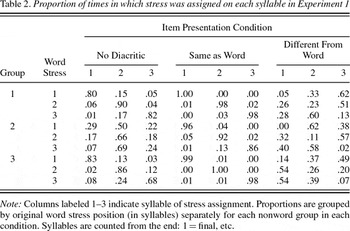
Analysis of stress assignment. Table 2 shows the proportions of stress assignment in each position for every combination of presentation condition, item group, and original word stress position. The pattern for the no condition is identical to that observed in Protopapas et al. (2006): stress is assigned on the same syllable as the source word in Groups 1 (more so) and 3, and mostly on the penultimate syllable in Group 2. In the wrd condition, stress is almost always assigned on the same syllable as the source word, perhaps somewhat less so in Group 2. In the dif condition, stress is relatively rarely assigned on the same syllable as the source word, and usually follows the printed diacritic instead.

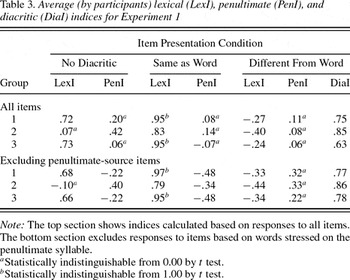
The contrasts to test specific hypotheses, indices LexI, PenI, and DiaI, are shown in Table 3. In the no and dif conditions all values in the table are statistically different from 1.0 (in a t test, p<.05 both by participants and by items). However, in the wrd condition, LexI is statistically indistinguishable from 1.0 for Groups 1 and 3, but not for Group 2. For items based on words originally stressed on the penultimate syllable, there is a confound between LexI and PenI because there is no difference between the lexical and default hypothesis predicting stress assignment. For this reason Table 3 also lists the contrasts calculated on the subset of nonwords that excluded items based on words originally stressed on the penult. As shown in the table, exclusion of those items did not affect the aforementioned pattern of LexI differences.

In a 3 × 3 analysis of variance (ANOVA), the interaction between presentation condition and group was significant for LexI, F1(4, 236)=28.04, p<.0005; F2(4, 82)=11.75, p<.0005, but not for PenI, F1(4, 236)=14.87, p<.0005; F2<1. In a 2×3 analysis, excluding the no condition, the interaction was not significant for either index: LexI, F1(2, 118)=1.08, p=.34; F2<1; PenI, F1, F2<1, suggesting that the differential effects of presentation condition among groups arise from the presence (vs. absence) of the diacritic. In separate analyses for each group, presentation condition significantly affected LexI in every group: Group 1, F1(2, 118)=271.27, p<.0005; F2(2, 28)=296.55, p<.0005; Group 2, F1(2, 118)=245.57, p<.0005; F2(2, 26)=132.64, p<.0005; Group 3, F1(2, 118)=328.75, p<.0005; F2(2, 28)=172.86, p<.0005, but failed to affect PenI: Group 1, F1(2, 118)=81.69, p<.0005; F2<1; Group 2, F1(2, 118)=81.13, p<.0005; F2(2, 26)=1.80, p=.185; Group 3, F1(2, 118)=50.11, p<.0005; F2<1.3
The possibility cannot be dismissed that lack of statistical power, because of the relatively small number of items, may have prevented these tests from reaching statistical significance. However, taking into account that no such problem was evident in the LexI comparisons, where the F values were very large both by participants and by items, it is at least safe to conclude that effects on LexI are more substantial and more robust than effects on PenI.
In pairwise comparisons, with per-group Bonferroni adjustment for multiple comparisons, the differences in LexI were significant for each pair of presentation conditions in each group (all p<.0005 by participants and by items except for the comparison by items between no and dif in Groups 1 and 3, where p<.005). It is important that the effect sizes (partial eta squared) of presentation condition on LexI for the comparisons between no and wrd and between wrd and dif were .32 and .93, respectively, in Group 1, .76 and .90, respectively, in Group 2, and .36 and .93, respectively, in Group 3 (by participants; corresponding effect sizes by items were .52 and .97, .83 and .98, and .54 and .96, respectively). Given the corresponding significant interaction, this means that the presence of the diacritic has a significantly larger effect on stress assignment for Group 2 items, compared to the other groups, with respect to the original word stress position, as expected.
Turning to the comparisons between groups,4
In these multiple comparisons there is no α level correction because we apply a principled reduction of power, by selectively excluding items, as a more conservative test of the significance of the observed effects.
In the wrd condition, the same pattern is observed. Taking into account all items, LexI differs significantly between Group 1 and Group 2, t1(59)= 3.46, p=.001; t2(27)=2.98, p=.006, but not between Group 1 and Group 3, t1<1; t2(28)=.02, p=.314. PenI differs by participants only between Group 1 and Group 2, t1(59)=2.06, p=.044; t2(27)= .00, and between Group 1 and Group 3, t1(59)=3.28, p=.002; t2 (28) <1. Excluding all items derived from words stressed on the penultimate syllable, both LexI and PenI differ significantly between Group 1 and Group 2: LexI, t1(59)=3.89, p<.0005; t2(16)=2.41, p=.028; PenI: t1(59)=3.59, p=.001; t2(16)=2.20, p=.043, and not at all between Group 1 and Group 3 (t1 and t2<1 for both indices).
The pattern in the dif condition is the same for LexI but different for PenI. Specifically, LexI differs significantly between Group 1 and Group 2, t1(59)=3.24, p=.002; t2(27)=2.43, p=.022, but not between Group 1 and Group 3 (both t1 and t2<1). PenI does not differ in either group comparison (both t1 and t2<1 in both cases). The new index, DiaI, differs significantly between Group 1 and Group 2, t1(59)=2.33, p=.023; t2(27)=2.22, p=.035, but only by participants between Group 1 and Group 3, t1(59)=2.64, p=.011; t2<1. Excluding all items derived from words stressed on the penultimate syllable, LexI again differs significantly between Group 1 and Group 2, t1(59)=3.00, p=.004; t2(16)=2.21, p=.042, but not between Group 1 and Group 3 (both t1 and t2<1), PenI does not differ in either group comparison (both t1 and t2<1 in both cases), whereas DiaI differs marginally between Group 1 and Group 2, t1(59)=1.81, p=.076; t2(16)=1.77, p=.097, and does not differ between Group 1 and Group 3 (both t1 and t2<1).
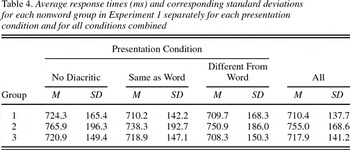
Analysis of response times. Table 4 shows the response times by nonword group and presentation condition. There was no difference in mean response time between presentation conditions, F1(2, 118)=1.422, p=.245; F2(70)<1, and no significant interaction of condition with group (F1, F2<1) or with word stress position, F2(4, 70)=1.784, p=.141. There was a significant effect of group, F1(2, 116)=15.027, p<.0005; F2(2, 35)=3.631, p=.037, with Group 2 items requiring longer response times to read, not interacting significantly with word stress position (F2<1). There was no significant main effect of word stress position on response time, F1(2, 232)=1.506, p=.226; F2<1.

Discussion
The pattern of stress assignment in the no condition reveals a strong lexical source of information and a weaker but substantial default pattern. As in the children study (Protopapas et al., 2006), neither lexically based nor default stress assignment indices approach 1.0 in this condition, suggesting the existence of additional factors in the process. Consistent with the children study, no frequency effects were obtained in the comparison between Groups 1 and 3. The failure of the frequency manipulation to produce reliable differences either in stress assignment or in response times warrants further investigation to determine whether the words that were chosen and altered to produce the nonword stimuli do in fact give rise to reliable frequency effects themselves.
The manipulation of diacritic (i.e., presentation condition) has allowed us to observe the effects of all three information sources, alone and in combination. The effects of this manipulation on LexI are strongest (double effect size) for Group 2 items, as expected, given that items in this group were not subject to lexical influences, further attesting to the importance of lexical information for stress assignment. Differences in PenI are not robust, consistent with a comparatively less important, or less consistent, role of the default pattern in stress assignment. It is also possible that additional sources of information (e.g., morphology) may have been operative for some items, thus increasing within-group item variance and rendering group differences in PenI statistically insignificant.
The wrd condition is the only one in which near-perfect performance is observed, as shown by LexI being indistinguishable from 1.0 for Groups 1 and 3. It is important that LexI remains lower and significantly different from 1.0 for Group 2, confirming earlier observations that the printed stress diacritic alone is insufficient to guarantee an intended stress pattern (Protopapas, 2006). Group 2 items, which did not resemble the particular words they were derived from, but bore a diacritic consistent with their stress pattern, were stressed as indicated by the diacritic on average only 91% of the time (LexI = 0.83).
The interpretation that the diacritic is not the only factor determining stress assignment is strengthened by the results of the dif condition, in which DiaI reached 0.85 for Group 2 only, and remained substantially lower (0.63 and 0.75) for the other groups. In other words, for items on which the diacritic did not have to work against a lexically derived hypothesis, it was consistent with the observed stress assignment >90% of the time. When resemblance to particular words provided stress assignment information conflicting with the diacritic, this caused a proportion of about 10% of the items to be stressed consistently with the lexical information despite the visible diacritic. LexI was higher for Groups 1 and 2 of the dif condition by about as much as DiaI is lower, suggesting that this playout between lexical and orthographic information does not interact with the existence or operation of a default pattern. Consistent with this interpretation, there is little difference in PenI among the groups for this condition, indicating a more or less constant fall-back to default.
The analysis of response times parallels that of segmental errors and reveals simply a word superiority effect: Group 2 nonwords, which do not resemble particular words, are read more slowly and less accurately. There is no effect of word stress position or (diacritic) presentation condition on either speed or accuracy of reading. Particularly notable is the lack of a significant response time difference between the no and wrd conditions in the context of an identical pattern of stress assignment indices in these two conditions. This could mean that our design is not sufficiently sensitive, or powerful, to detect differences in response time arising from manipulations of the amount of information relevant to stress assignment; or it might mean that the effect of lexical activation on stress assignment is so large that adding the diacritic on the orthographic representation produces no appreciable facilitation in reading the nonword aloud with a given stress pattern.
In sum, this experiment showed that, under these particular testing circumstances involving substantial time pressure, all three potential sources of stress assignment information are active during nonword reading, and none is sufficient to determine stress assignment performance independently of the others. When uncontested by other sources, lexical information alone could account for about 80% of item readings, the diacritic for about 90%, and the default pattern for about 60%. Lexical information adds or removes at least 10% from diacritic information when consistent or inconsistent with it, respectively. Thus, when lexical and diacritic assignments coincide, performance becomes statistically indistinguishable from perfect.
EXPERIMENT 2
In Experiment 1 we have revealed substantial interactions between all three alternative sources of stress assignment information in reading Greek. An important question concerns the origin of the default pattern and the nature of the process in which it is applied in those cases in which it demonstrably affects performance. As noted in Protopapas (2006), the proportion of penultimate-stress words in Greek printed news texts (about 28%) is higher than either final- (19%) or antepenultimate-stress (16%) words, but lower than the two combined; thus, the penultimate metrical pattern concerns only a relative majority and not a vast preponderance over the printed corpus (which also includes 38% monosyllables, mostly closed-class words). To the extent that this count constitutes a reasonable approximation to general frequency of use, statistical considerations may seem somewhat weak to support a penultimate default pattern on the basis of lexical neighborhood activation.
To further investigate the source and role of penultimate stress assignment as a default pattern, here we replicate Experiment 2 of Protopapas et al. (2006) with adult participants using a time-limited presentation procedure as in Experiment 1 above, and with the addition of two task load conditions. Specifically, in comparison to a no-load (“baseline”) group of participants, who were only required to read aloud the nonwords presented on the screen (with the stress diacritic), two groups of participants performed the same reading task while retaining in memory small amounts of verbal material, as a secondary task.
For one of these groups (termed the “syllables” group), the material to be retained, and later recalled, was a set of three syllables. In this condition there was thus increased cognitive load, potentially interfering with the reading task to the extent the latter is not fully automated, but no specific effect on stress assignment was expected. For the second task load group (termed the “nonwords” group), the material to be retained was a three-syllable nonword (made up of the exact same three syllables used with the syllables group), which was stressed on the first syllable, that is, on the antepenult. For the nonwords group, the secondary task presents the participants with the same amount of (segmental) verbal information as in the syllables group; therefore, the total cognitive load is about the same (to the extent that no useful chunking is performed). However, the existence of a stress pattern to be retained during reading creates a potential conflict between the reading (primary) and memory (secondary) tasks.
If metrical patterns are activated separately from the segmental descriptions of the items they are related to, and if they are available as a distinct representation over working memory, then the combination of primary and secondary tasks can create a specific conflict situation with respect to stress assignment, over and above any effects on performance from the cognitive load of the memory task that are common between the two additional-load conditions. In this situation, if assignment of the default stress pattern is mediated by activation based on the cumulative properties of the stored lexicon, it is possible that the metrical pattern of the secondary task might interfere with the metrical pattern from the reading task, with the anticipated effect that the preponderance of stress assignment errors would be shifted from the penult (the “language default”) toward the antepenult (the pattern active because of the secondary task). If, on the other hand, the default pattern reflects a structural property of the language or of the language processing mechanisms, not connected to transient patterns of activation over working memory, then the existence of an active metrical pattern from the secondary task should not be expected to shift the stress assignment error proportions away from the penult.
Method
Participants. The same 73 graduate and undergraduate university students who participated in Experiment 1 also participated in this experiment. Each person participated in one of the three load conditions only.
Stimuli. Forty-six nonwords were used, the characteristics of which are listed in Table 1 as Group 4. They were created in the same manner as for Experiment 1 (described in detail in Protopapas et al., 2006, listed in their table A2). Briefly, 72 real words were changed beyond recognition (by several phonemes) and then submitted to a pretest for resemblance to words. Nonwords were discarded if any words at all were produced in response to them.
For the secondary (memory) task, the following eight sets of three consonant–vowel (CV) syllables were created: pa-ci-su, fεo-ta-li, ko-zi-mε, si-tu-rε, vi-xo-na, ðo-pε-fi, zu-lε-po, and ma-ko-ra.
Procedure. As in Experiment 1, the nonwords to be read were presented on a laptop computer screen, one at a time. Items were displayed for 1500 ms in large (40 point) white Arial Greek typeface on black background. The vocal responses were received via headset microphone, automatically timed and recorded in temporal alignment with stimulus delivery under the control of the DMDX software. The experimental procedure was preceded by a practice run including six items (nonwords different from those in the experiment) to familiarize the participants with the procedure and the type of stimuli. Testing took place in a quiet space at the University of Athens for some participants and at home for others.
For the no-load condition, participants simply read each nonword aloud, in a procedure identical to that of Experiment 1, except that every six items they were asked to press space to continue. For the syllable load condition, at the beginning of the experiment and every six items thereafter the normal read-aloud procedure was interrupted by the auditorily presented message “remember the syllables” followed by the three syllables of a set spoken in citation form, each with falling intonation and with a slight pause between them, to discourage chunking of the three syllables into a single nonword (because combined recall would entail some stress assignment, which was to be avoided). At the end of each six-trial block, and at the end of the experimental list, a prompt on the screen instructed the participant to write down the recalled items (i.e., the most recent three syllables each time). For the nonword load condition, instead of referring to “syllables” the oral instruction asked participants to “remember the word” followed by the three syllables spoken as a single (non)word stressed on the antepenult. The eight sets were used in the same order, as listed above, for all participants in both conditions. An additional three-syllable set was used prior to the six familiarization trials to familiarize participants with the secondary task.
Results
Data from 13 participants were discarded because of insufficient recorded responses, either caused by too many failures to respond (including timed-out responses) or because of poor adjustment of the vocal trigger. A criterion of at least 80% recorded responses left workable data from 60 participants, 20 from each experimental list.
Analysis of memory performance. Performance on the secondary task was assessed by measuring the number of incorrect phonemes produced in the participants' responses and divided by 6, that is, by the total number of phonemes to be recalled. The mean number of memory errors per phoneme was 0.33 in both conditions with a secondary task, indicating that some attention was paid to the memory requirement while reading out the printed nonwords. There was no difference in secondary task performance between the syllable and the nonword load condition, F(1, 38)<1. It is crucial that in the nonword load condition all but one memory response were produced with the correct antepenultimate stress pattern, confirming that the intended stress pattern remained active during the reading task.
Analysis of segmental errors. Each response was rated for phonetic accuracy (listening to the recorded responses on the computer), receiving one point for each incorrect phoneme produced (or missing). This segmental error score did not vary significantly with load condition, F1(2, 57)=1.336, p=.271; F2(2, 86)=12.654, p<.0005, or with stress position, F1(2, 114)=1.547, p=.217; F2(2, 43)<1, and there was no interaction between the two, F1(4, 114)=1.287, p=.279; F2(4, 86)=1.819, p=.133. There was a significant effect on segmental errors from number of syllables, F1(2, 114)=39.069, p<.0005; F2(2, 43)=20.443, p<.0005, and number of consonant clusters, F1(2, 114)=25.275, p<.0005; F2(2, 43)=5.948, p=.005, neither of which interacted with load condition: syllables, F1(4, 114)<1, F2(4, 86)=1.676, p=.163; clusters, F1 (4, 114) <1, F2(4, 86)=1.558, p=.193. Both of these main effects were attributable to corresponding linear trends (all p<.002). Thus, it seems that phonetic accuracy in nonword reading was affected significantly only by phonological complexity and not by stress position or by the additional demands of the secondary memory task.
Analysis of stress errors. Each response was rated for stress assignment accuracy, with respect to the printed stress diacritic. Stress errors did not differ significantly between load conditions, F1(2, 57)<1; F2(2, 86)=2.856, p=.063, or between stress positions, F1(2, 114)=1.970, p=.144; F2(2, 43)=1.481, p=.239, and there was no significant interaction between the two, F1(4, 114)=1.254, p=.292; F2(4, 86)=2.593, p=.042. There was a significant effect on stress errors from number of syllables, F1(2, 114)=10.392, p<.0005; F2(2, 43)=4.904, p=.012, and a corresponding linear trend (both p<.005), but no effect of number of consonant clusters, F1(2, 114)=1.878, p=.158; F2(2, 43)=1.053, p=.358. Neither of these two phonological complexity factors interacted significantly with load conditions: syllables, F1(4, 114)<1, F2(4, 86)=1.425, p=.233; clusters, F1(4, 114)<1, F2(4, 86)<1. Thus, the stress assignment accuracy in nonword reading was affected significantly only by one phonological complexity factor and not by stress position or by the secondary task.
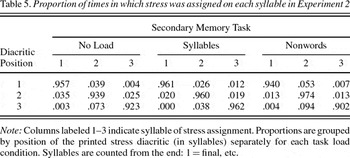
Table 5 shows the distribution of stress assignment syllable with respect to the position of the diacritic, for each load condition. The overall stress error rate was around 5%, about the same as in the comparable wrd condition of Experiment 1 for Group 2 (items not resembling words, presented with stress diacritics in the same position as the original words). Note that stress errors toward the penult are more numerous than errors toward other positions. There is a highly significant interaction between stress diacritic position and stress assignment position on stress assignment accuracy, F1(4, 228)=15.510, p<.0005; F2(4, 86)=17.141, p<.0005, and no corresponding three-way interaction with task load condition (F1, F2<1). The interaction between diacritic position and stress error position is trivial, because the position of the diacritic constrains the possible positions of error (e.g., with the diacritic on the final syllable, errors on the final are not possible). More importantly, there is a main effect of stress error position, F1(2, 114)=11.306, p<.0005; F2(2, 86)=18.569, p<.0005, consistent with a nonuniform distribution of errors over syllables of incorrect stress assignment.

In direct comparisons of error proportions, separately for each diacritic position, by ANOVA with condition as a second factor, highly significant differences were found between penult and final: for diacritic on the antepenult, F1(1, 57)=17.422, p<.0005; F2(1, 14)=32.648, p< .0005, and between penult and antepenult: for diacritic on the final, F1(1, 57)=8.205, p=.006; F2(1, 14)=13.257, p<.0005, but not between antepenult and final (for diacritic on the penult: F1, F2<1). None of these stress error position comparisons interacted significantly with secondary load condition (all F1<1, and p>.1 for all F2). Therefore, the penult was the most frequent position toward which stress assignment errors were made in every case.
Analysis of response times. Table 6 shows the response times by diacritic position and load condition. There was no effect of stress diacritic position on response time, F1(2, 114)=1.320, p=.271; F2(2, 43)<1, and no interaction of diacritic position with load condition, F1(4, 114)=1.088, p=.366; F2(4, 86)<1, whereas the main effect of condition was significant by items only, F1(2, 57)<1; F2(2, 86)=9.023, p<.0005.

Discussion
The results of this experiment suggest that, for adult readers, the position of the stress diacritic does not affect reading performance, in terms of either the phoneme string or the assignment of a metrical pattern, or even the response time. Naturally, phonological complexity affected phoneme accuracy, perhaps to some extent because of the time pressure imposed by the nature of the task, and also affected stress assignment accuracy.
Even though only few stress assignment errors were made, their distribution over target syllables was clearly nonuniform: the penultimate syllable emerged as the “preferred” syllable toward which most of the few stress assignment errors were made. This pattern of results is consistent with the existence of a default metrical pattern, which is applied only when other options for stress assignments have failed (or have had insufficient time to be completed). The overall low proportion of stress assignment errors, and the robustness of stress assignment in the face of a secondary task that also loads verbal working memory, suggests that by adulthood stress assignment processes have become fully automatic.
It is important that the secondary task failed to affect the distribution of stress assignment errors over syllable positions, which remained nonuniform toward the “default” penultimate syllable regardless of the activation of a competing metrical pattern because of the memory load. If metrical preferences resulted from activation of metrical patterns expressed in working memory representations, then the imposition of a pattern activated by a secondary task should have affected the error distribution toward this extraneous pattern and away from the penult, or should have increased the response time to items with different metrical patterns. The persistence of the default pattern toward the penult remains consistent with the structural hypothesis that considers it a property of the language or of the cognitive mechanisms of written language processing.
This finding can be taken as inconsistent with the hypothesis that default biases arise from lexical neighborhood activation, to the extent that lexical activation is hypothesized to result in representation of a metrical pattern in working memory and this metrical pattern may then interact with other information that happens to be present. However, the representation of the metrical pattern to be applied to a (non)word being read may be so strongly connected to the segmental-level assembly as to be unavailable for independent experimental manipulation or interference from working memory activity. Alternatively, it is possible that the default pattern arises from lexical neighborhood activation and affects reading directly, without a mediating working memory representation. This latter alternative can be tested in future research using a secondary memory-load task in which small sets of words, rather than individual nonwords, will have to be remembered, experimentally manipulating whether the stress pattern of these words matches the default.
GENERAL DISCUSSION
In a stress assigning language, such as Greek, the explicit assignment of a stress pattern to a word is a necessary step in reading the word aloud, and perhaps in silent reading as well. Here we examined the effects of three possible sources of stress assignment information in reading Greek, a particularly appropriate language for such investigations because stress is not phonologically determined independently of lexical identity and because stress is normally represented orthographically with a special diacritic. Therefore, lexical information as well as orthographic information are always potentially available sources for stress assignment. In addition, the existence of a default metrical pattern was posited, which could also affect the reading process. The potential of each source to affect stress assignment was examined using nonword stimuli with varying resemblance to words (to control lexical activation), manipulating the presence and the position of the written diacritic (to control orthographic information).
The results confirmed earlier findings (with schoolchildren) that stress assignment in reading Greek is not entirely determined by the diacritic, because adult participants made more stress assignment errors when the position of the diacritic was not supported by lexical information. In addition to this evidence for lexical effects, resemblance of the nonword stimuli to words was found to strongly affect stress assignment, thus confirming the availability and use of a lexical route for stress assignment. The importance and automatic involvement of this lexical route is appreciated more clearly in its involvement with nonword stimuli, for which it should properly not apply were it not for similarity based activation. Lexical information was even able to partially override orthographic information, in the case of nonwords resembling words but bearing the diacritic on a syllable inconsistent with the word stress position.
Reliance on visual (orthographic) information appears to be stronger for adults than for children in that stress “errors,” that is, stress assignment on syllables other than the one marked with the diacritic, were much more difficult to observe than with secondary education children (cf. Protopapas et al., 2006). This is consistent with an increase in the automaticity of orthographic processing of stress, such that by adulthood the cost of fully processing the diacritic is not prohibitive, even in the face of unknown items with high phonological complexity, which place high demands on phonological decoding processes at the segmental level. In contrast, such conditions caused 12- to 15-year-old children (in experiment 1 of Protopapas et al., 2006, replicating previous observations of Protopapas, 2006) to deviate from the orthographically marked stress assignment as much as 18% of the time, suggesting that their reading mechanisms are not yet sufficiently mature to process effortlessly complex novel items.5
It should be noted, however, that the populations of adults and children are not directly comparable, because the secondary education sample is more representative of the general population than the student and graduate student adult sample. Therefore, the clear trend toward more efficient decoding of the stress position in the older participant group may reflect in part a sample selection bias.
Greek orthography is highly consistent for reading, as the large majority of words can be read correctly on the basis of grapheme to phoneme correspondences. Even though graphemes are often composed of two or more letters, most of their effects on phonology are predictable. The diacritic is a highly consistent orthographic mark of stress assignment, essentially perfectly reliable in school materials. Use of the diacritic is obligatory in regular spelling, even though spelling with capital letters omits diacritics and lack of diacritics seems increasingly commonly encountered in informal communication. First-grade teachers are instructed to incorporate use of the diacritic in reading and writing, integrated with other aspects of written language from the very beginning of formal schooling (Velalidis, Voujoukas, Kalapanidas, Kanakis, & Melas, 1994). Therefore, Greek readers might be expected to form strong associations from the orthographic use of the diacritic early on, and to maintain them through their experience with printed materials as part of a statistically justified reliance on phonological assembly. In this light, it may be somewhat unexpected to find strong lexical effects on stress assignment in reading, indicative of a reliance on sight vocabulary rather than on graphophonemic decoding, whereas it is expected that processing of the diacritic would be fully automated in skilled readers, as seen in the present study.
The results also confirmed the existence of a default metrical pattern stressing the penultimate syllable, which was only seen to predominate when other sources were unavailable or insufficient. In Protopapas et al. (2006), the effect of the default pattern was relatively strong for children, seen both in fewer deviations from the orthographically marked syllable for items marked on the penult, as well as in more “stress errors” toward the penult than toward other syllables (their experiment 2). This effect was much weaker for adults, in the present study, and only seen in the target syllable proportions (Experiment 2 above). This finding again suggests that for these adult participants visual processing is sufficiently automatic that the default pattern need only apply when no other information is available, as in the “no” condition of Experiment 1 with Group 2 items, which did not resemble any words. In that case, because neither lexical nor orthographic information was available, a clear preference for stress assignment on the penult was seen even for the adults.
The origin of the default pattern was investigated in the dual-task conditions of Experiment 2, in which a memory load was added to interfere with phonological processing of the item to be read. In particular, activation of a metrical pattern other than the default in the nonword recall condition was expected to interfere with the default metrical pattern and cause a shift of misplaced stress away from the penultimate syllable. Because no shift was observed we cannot argue for an activation-based strategy underlying the default pattern. A number of interpretations consistent with the present findings cannot at present be distinguished and warrant further investigation. First, the default pattern may indeed be based on activation of lexical neighborhoods, consistent with the findings by Burani and Arduino (2004) for Italian and Gutiérrez Palma (2003) for Spanish, but this activation may not interfere with working-memory activation of rehearsed phonological codes (as in our secondary task). This activation may be phonologically based or may reflect print-to-sound regularities. The lack of interference with working memory patterns may be taken as weak evidence favoring the latter of these two options.
Second, the default pattern may not arise from lexical activation but may be a fixed property of the stress assignment mechanism, possibly reflecting an underlying property of the Greek language. In this case, one would not expect influence from competing active patterns, consistent with the lack of an effect that was observed. Third and finally, because of the overall low stress misplacement rate (with respect to the diacritic), the experimental procedure may simply have been insufficiently sensitive to detect the interference from working memory activity because of the retained item in the secondary task. The interference may have been overridden by the high automaticity of stress decoding, which was seen in the overall performance, in the lack of a response time difference between conditions with and without the secondary task, and in the lack of an increased proportion of “stress errors” for items not stressed on the penultimate syllable.
In Experiment 2, both segmental and stress errors were affected by stimulus length (number of syllables) and neither was affected by stress position. Only segmental errors were affected by the number of consonant clusters. The evidence for independence of stress assignment from segmental assembly is thus weak for these adults. However, the proportion of stimuli not responded to within the alloted time limit was substantially higher in Experiment 2 (range = 5.5–7.6% in the three load conditions) compared to Experiment 1 (1.6–3.0% by stimulus presentation condition); the corresponding mean proportions (Experiment 1: M=.0164, SD = .0288; Experiment 2: M=.0644, SD = .0631) were significantly different, F(1, 118)=28.745, p<.0005. This suggests that the reading aloud process did not always have sufficient time to complete, at the segmental level, and thus may have precluded stress assignment from applying on the metrical frame.
Taking into account the observed automaticity in decoding the diacritic by the adults, it remains possible that stress assignment in reading is at least in part separate from segment-level assembly but the difference may be difficult to detect in time-pressured situations because stress assignment is very efficient. That is, either segmental assembly completes and then stress assignment combines rapidly or segmental assembly fails and stress assignment cannot be detected because there is no segment sequence to be stressed or misstressed. Stress assignment and segment-level success can thus appear correlated, as if directly influenced by the same factors, even if they are in large part independent. This interpretation is consistent with the conclusion of Ashby and Clifton (2005) that stress assignment is a separate, final step of phonological assembly.
Future studies of stress assignment in reading Greek should take into account an additional source of stress assignment information, based on morphology. Specifically, certain inflectional morphemes carry stress assignment information, and their effect can be clearly seen in stress shifts between different inflected forms of the same root (Revithiadou, 1999). Thus, the ending of an item, be it a word or nonword, may indicate not only the part of speech it represents (or should be interpreted as) but also the stress assignment it should receive. Segmental frequency and syllable frequency may also affect stress assignment if certain patterns are correlated with specific word forms or with parts of speech that constrain stress. This possibility must be directly addressed, or at least controlled for, by considering the complete stress neighborhoods of the stimuli.
Studies of stress assignment bear potential implications for the study of dyslexia, that is, the specific difficulty in learning to read and write in the absence of mental retardation and when adequate educational resources and opportunities are provided. Currently, the “phonological hypothesis” is the most widely accepted theory for a core deficit underlying the difficulties of children with dyslexia (Ramus, 2003; Snowling, 2000). This hypothesis concerns the inadequacy of phonological representations, to the extent that both lexical specification and orthography-to-phonology decoding are particularly inefficient. However, the hypothesis has thus far been restricted to segmental level representations, thus missing much of the full complexity of phonological representations (Leal & Suro, 2004; Ramus, 2001). Recent investigations have indeed revealed significant effects of stress. For English-speaking children, word-level prosodic skills predicted word reading accuracy in fourth graders (Whalley & Hansen, 2006), and “metrical stress sensitivity” accounted for variance in spelling, after partialling out phonological awareness or vocabulary, in a group of 5- to 7-year-olds (Wood, 2006). Moreover, acquisition of (spoken) word stress was found to be significantly delayed in a group of 3-year-old Dutch children at risk for dyslexia (de Bree, Wijnen, & Zonneveld, 2006).
The inadequacy of phonological representations in dyslexia is typically revealed using “awareness” tasks, in which segments must be explicitly manipulated in tasks such as phoneme deletion. Phonemic awareness training, that is, awareness of the segmental level, is found to be beneficial for subsequent learning to read and for improved reading performance (Torgesen et al., 2001). By analogy, one may wonder whether stress awareness training might also improve reading performance (Gutiérrez Palma, 2003, p. 132), especially if stress assignment is impaired in children with dyslexia. Despite a dearth of studies on this issue, preliminary findings of Leal and Suro (2002) suggest that this may be the case. Relevant to this question, a stress assignment screening procedure is used in Italian to detect students with dyslexia (Paulesu et al., 2001), suggesting that stress assignment may indeed be an area of particular difficulty in dyslexia. In agreement with a view of stress assignment as being a difficult component of the reading process for the less mature readers, Protopapas (2006) found that stress assignment errors in Greek, although rare in word reading, are quite common in children's nonword reading, and that stress assignment accuracy is weakly but significantly correlated with reading skill (as measured by word reading speed and segmental accuracy).
CONCLUSION
Our experiments have provided evidence in favor of the hypothesis that multiple sources of information are available and actively taken into account when reading aloud, in agreement with the pioneering studies by Colombo (1992). Our use of nonword stimuli, which enabled manipulation of lexical information, necessitates additional work with real words before strong conclusions for word reading can be confidently stated. Even though it is reasonable to expect that well-practiced decoding and retrieval routines, based on word reading experience, would also predominate with nonword stimuli, it remains to be documented empirically that the interplay between the various competing sources of stress assignment information is the same for words and nonwords.
A specific finding in need of further substantiation is the lack of response time differences between conditions of orthographic information (existence or not of the diacritic) and cognitive load (secondary memory task). In particular, it would be premature to conclude, on the basis of our results, that omission of the stress diacritic does not affect lexical access in word reading, before confirming using word stimuli, including unambiguously stressed items as well as minimal stress pairs (i.e., word pairs with identical segmental composition but different metrical patterns). Future investigations should further clarify the role of each individual source of stress assignment information in reading, focusing on the most ecologically relevant task of reading words in coherent text context and connecting to other suprasegmental processes affecting phrase-level intonation.