Few concepts have been more fundamental to the contemporary literature on civil conflict than the role of “state strength” in the production of stable, sovereign polities.Footnote 1 Indeed, a central point of consensus in modern conflict studies is that challenges to state sovereignty are more likely to arise in political contexts characterized by “state weakness.”Footnote 2 While such conflicts are characterized by diverse historical legacies, the observation of large-scale violence between state and insurgent forces represents, at the very least, a clear sign that a state's influence has failed to reach significant portions of the population and territory it claims to govern.Footnote 3 Insurgency, rebellion, and other forms of collective antistate violence are thus generally characterized as forms of political action that reflect fundamental weaknesses in a state's ability to buy off or coerce would-be challengers.Footnote 4
While this work has revealed many of the foundational mechanisms underlying the production of civil warfare, much of the literature on insurgent mobilization and suppression has been characterized by an overly narrow approach to the concept of state strength, which has focused almost exclusively on elements of so-called “hard power.” In particular, the empirical operationalizations of state strength utilized in the quantitative literature on civil war have generally relied on measures of economic advancement, such as gross domestic product (GDP) per capita, as proxies for state effectiveness. Different causal interpretations have been attached to such findings, with some authors focusing on the utilization of these material resources as “sticks” to coerce compliance, and with others focusing on their utilization as “carrots” to purchase compliance. However, within the confines of this debate, an important point has been missed: states do not rely exclusively on carrots and sticks to suppress the mobilization of nascent insurgencies. They also rely on emotionally charged messages to induce voluntary compliance with state rule. That is, state capacity is premised—at least in part—on the normative power of communication.
In making this argument for the importance of normative influence—that is, “soft power”—in the context of militarized challenges to state sovereignty, I draw both on theorists of international politics who have critiqued the field's tendency to equate state power with material power,Footnote 5 and on theorists of modern nationalism, who have highlighted the crucial role played by mass communication technologies in the production of unified and stable polities.Footnote 6 These authors correctly note that while force and wealth have always been vital tools of state-building, modern states are also built on a foundation of symbolic capacities: technologies that enable leaders to more effectively communicate normative demands for state loyalty and national unity, and thereby to more reliably suppress the emergence of militarized challengers.
Central to this account are mass media technologies that allow political elites to broadly and publicly disseminate political messages to their citizenry; messages that consist of images, narratives, and other symbols designed to characterize state authority as beneficial and just, thereby inducing voluntary compliance with state dictates. I argue that strong mass media infrastructures dramatically lower the production cost of such normative influence, while at the same time generating powerful economies of scale in the development of political loyalties. As a result, strong mass media systems should be expected to produce substantial barriers to the mobilization of insurgent forces challenging state rule.
In other words, the mechanisms available to states for producing stability and sovereignty are not exhausted by the material tools of force and wealth. Utilizing newly compiled global data on mass media accessibility in the post–World War II period, I show that this second face of state power—soft power—is a crucial component of state influence and control, even in the life-or-death context of insurgent warfare. Contrary to much of the conventional wisdom in the field, this statistical evidence demonstrates that mass media infrastructure represents one of the most powerful forces for peace and stability yet observed in the modern world, producing more than a tenfold decrease in a country's likelihood of experiencing the onset of civil war. Moreover, through a combination of standard regression analysis, nonparametric tests of predictive accuracy, Bayesian model averaging, and optimized matching estimators, I show that the pacifying effect of mass media technology cannot be attributed to material capacities, economic development, or social modernization, and in fact is one of the most robust relationships yet identified in the quantitative literature on civil conflict. By demonstrating the uniquely powerful effects of a factor that can only enhance a state's strength by increasing its ability to communicate broadly, I seek to provide new evidence for the fundamental importance of nonmaterial state capacities; evidence, that is, for a form of state influence that arises not through the dissemination of dollars or bullets, but through the dissemination of symbols.
Existing Approaches to State Strength
Many have recognized the importance of state capacity in understanding the emergence of armed conflict between states and nonstate actors.Footnote 7 While the approaches to conceptualizing state strength have varied widely, most treatments in the quantitative literature on civil conflict have tended to rely on measures of economic development (that is, GDP per capita).Footnote 8 Fearon and Laitin in particular have argued that GDP per capita is negatively related to the probability of civil war onset because it serves as a useful proxy for a state's capacity to project coercive force.Footnote 9 States with greater levels of material resources, they argue, can use their military leverage to deter the mobilization of insurgent forces, and to field more effective counterinsurgency campaigns. This focus on coercive force as the locus of state strength reflects a central tradition in international relations scholarshipFootnote 10 that highlights the use of material resources to achieve an internal monopoly on the deployment of collective violence, suppressing the emergence of domestic security dilemmas by increasing the expected costs of rebellion. It also reflects a major strand of work in political sociologyFootnote 11 that highlights the importance of coercive instruments of surveillance, deterrence, and outright force in the development of effective state institutions.
In contrast, Collier and Hoeffler have claimed that GDP per capita is actually capturing, not coercive capacities, but rather the economic capacity to compete for the labor of rebel recruits.Footnote 12 Their argument thus mirrors the cost-benefit logic above but reverses its direction: rather than preventing conflict by increasing the costs of rebellion, material resources are said to prevent conflict by increasing the benefits of the alternatives to rebellion. This focus on the use of material resources to purchase internal peace follows in the footsteps of a large body of work in international relations and comparative politics that emphasizes the provision of goods by the state to gain support from politically relevant communities.Footnote 13 Thus, while some portions of the field have focused on the state's provision of “bads” (that is, sanctions), and others have focused on the state's provision of “goods” (that is, inducements), the conceptualizations of state power that have underpinned our quantitative analyses have generally been limited to mechanisms rooted in the deployment of material capacities.Footnote 14
While a number of important insights have been gained through these approaches, such attempts to quantify state capacity have also faced two key difficulties. First, the reliance on aggregate measures of economic advancement creates a problem of observational equivalence between the mechanisms proposed in the literature. The negative relationship between GDP per capita and civil conflict could represent state success in coercing compliance just as easily as it could represent state success in purchasing compliance, or any number of alternative mechanisms. Thus, while such measures can demonstrate that state capacity is important, they cannot reveal how state capacity operates. Second, and more fundamentally, previous attempts to quantify state capacity have been rooted in an overly narrow conceptualization of the mechanisms of political influence, a conceptualization that assumes a state's power is equivalent to its material power.
Let us define political power quite simply as the capacity to influence the actions of others; that is, the capacity to produce behaviors in others that would not otherwise have been observed.Footnote 15 State strength, in this sense, is then simply a state's capacity to influence the behavior of individuals or groups, most basically by preventing their use of violence against the state and against each other.Footnote 16 In pursuing this most fundamental of goals, it is quite obvious that one of the most basic tools available to states is the use of material resources to manipulate the expected costs and benefits of particular political actions, especially to raise the costs and lower the benefits of collective violence. However, we would do well to remember the admonition of Barnett and Duvall, that “scholars should be attentive to a range of technologies and mechanisms as they consider how one actor is able to directly control the conditions of behavior of another actor.”Footnote 17 In fact, the mechanisms of state power are not exhausted by the creation of material costs and material benefits. State influence is exercised, not only through the deployment of force (“sticks”) and wealth (“carrots”), but also through the deployment of symbols.
It is this fundamental immateriality of modern state power that lies at the root of Nye's famous division between “hard power” and “soft power” in the realm of international politics.Footnote 18 According to Nye, the co-optive influence of soft power is rooted in the generation of “attraction”; a form of normative influence, which is conceptually quite distinct from the application of coercion or payments.Footnote 19 Rather than relying on costs and benefits, soft power is derived from an agent's ability to lead others to “develop preferences or define their interests in ways consistent with its own.”Footnote 20 It is, in other words, the capacity to make others “want what you want.”Footnote 21
This basic distinction between the materiality of hard power and the immateriality of soft power has a long history in the study of international relations. Indeed, it can be traced at least as far back as Carr, who argued for a similar distinction between “propaganda power,” which is derived from the normative opinions of mass publics, as opposed to “military power” and “economic power,” which are derived from the deployment of violent and nonviolent sanctions.Footnote 22 It is also a close relative of what Lukes has called the “third dimension” of power: the ability to secure the compliance of others by shaping their values, preferences, and beliefs.Footnote 23 In this sense, Nye's argument is rooted in the constructivist distinction between a “logic of consequences,” in which behaviors are chosen according to their expected costs and benefits, and a “logic of appropriateness,” in which behaviors are chosen according to their perceived rightfulness and legitimacy.Footnote 24
Although they used different terminologies, each of these thinkers recognized that citizens do not comply with state dictates merely because they fear the consequences of disobedience. They also comply because they believe that disobedience is wrong, and believe that many others join them in this feeling. There is thus enormous political influence to be achieved through the manipulation of normative ideas. As Goldstein and Keohane argued, to exercise influence over such ideas is to exercise influence over the “road maps” that guide actors towards particular definitions of right and wrong.Footnote 25 Influence, in other words, over what counts in the normative evaluation of behavior.Footnote 26
As a result, the competitive dynamics surrounding the emergence of challenges to state sovereignty cannot be reduced to the operation of material forces alone. Recall that Weber's oft-cited definition of state sovereignty referred to the achievement, not of a monopoly on the use of force, but a monopoly on the “legitimate” use of force.Footnote 27 Weber recognized that while no state would ever quash all instances of internal violence, successful states could facilitate the production of collective values that would render physical aggression against state forces unacceptable to large portions of the population and thus limit the scope of any attempts to fuel the eruption of antistate violence.Footnote 28 In other words, those living under the auspices of successful states refrain from challenges to state sovereignty because their social roles have been constituted in a symbolic environment that effectively characterizes political violence as normatively unacceptable.Footnote 29
This analysis parallels Krasner's distinction between mechanisms of “control,” those limited forms of influence that can be produced through the application of brute force; and mechanisms of “authority,” which achieve greater compliance at lower cost through the generation of “legitimacy.”Footnote 30 According to this view of state power, legitimacy represents a nonmaterial form of state capacity that arises when states succeed in inculcating in their citizens a “mutually recognized right” to demand popular compliance with state dictates.Footnote 31 In Lake's apt terms: “Legitimacy is the bridge between compulsion and choice, the alchemist's dross through which pure coercion is transformed into rightful rule or authority.”Footnote 32
In other words, Mao was wrong to claim that political power stems exclusively from the “barrel of a gun.” Rather, the legitimacy of appeals to state loyalty must be spoken into existence, on the basis of images, narratives, and other symbols that at least some portion of the population are willing to accept as valid interpretations of their lived realties. It is through this “alchemy” that political communication produces, maintains, and transforms prevailing visions of the political regime and the political community. As Smith argues, such messages
work essentially as persuasive historical stories that prompt people to embrace the valorized identities, play the stirring roles, and have fulfilling experiences that political leaders strive to evoke for them, whether through arguments, rhetoric, symbols, or “stories” of a more obvious and familiar sort.Footnote 33
Indeed, this seems to be the defining feature of soft power: precisely because of its inherently immaterial character, soft power can only be exercised through mechanisms of communication. That is, soft power can arise only when a particular pattern of political communication causes it to be felt.
Herein, then, lies the fundamental difficulty facing researchers who would subject this second face of state power to quantitative empirical scrutiny: because it originates in the emotional content of diverse political messages, the operations of soft power are inherently difficult to observe and quantify on a global basis. However, such difficulties need not lead us to abandon the pursuit of systematic, global research on the effects of soft power. Rather, we can study the effects of political ideas by measuring variation in the conditions of their production and dissemination, especially those provided by modern technologies of mass communication. In other words, we can move forward effectively by applying a structural empirical approach to constructivist theoretical concepts.
Mass Communication and the Mass Production of Political Loyalties
The theoretical linkage between technologies of mass communication and the production of state loyalty has a long history in the sociological literature on the development of nationalism in modern Europe. One of the most prominent descriptions of this relationship was given by Deutsch, who famously claimed that boundaries between national communities were defined first and foremost by “relative barriers to communication” that function to heighten the social and political relevance of national cleavages, while lowering the salience of subnational and extra-national commitments.Footnote 34 Deutsch correctly recognized that the production of compliance in modern states, even in highly authoritarian settings, relied extensively on the use of communication to produce voluntary attachments.Footnote 35 In this way, modern national states—those that arose over the course of the nineteenth and twentieth centuries—represented a fundamental shift in the “technology of statecraft” through which states secured the loyalties of those living within their boundaries.Footnote 36 As Snyder notes, before this period “it hardly mattered that monarchs and subjects often spoke different languages and lacked a common national identity,” because states and would-be states competed primarily on the grounds of material resource extraction and physical coercion.Footnote 37 However, by the late eighteenth century, states were coming to rely increasingly on the generation of influence through the mass production of political loyalties; that is, through the production of a widespread willingness to fight and die for an imagined nation.Footnote 38
It is no coincidence that this transition began at precisely the same historical moment that the development of cheap commercial printing technologies and long-distance trade routes were fundamentally altering the costs of engaging in mass communication on a truly national scale. Snyder claims that the particular bundle of ideas that came to be labeled “nationalism” rose to ascendance at this moment because such fundamental technological shifts led it to become a newly “valuable commodity in the marketplace of ideas.”Footnote 39 That is, he argues that shifts in technology—especially communication technology—were important, not because they altered ideas directly, but because they altered the structural forces operating on the competitive production and dissemination of ideas by political actors. In applying the logic of the “marketplace” to the realm of normative ideas, Snyder thus recognized that while normative influence is always subject to contestation by a diverse array of actors, there are nevertheless strong patterns that can be observed in aggregate behavior; patterns generated by the incentives facing competing producers of symbolic attachments.
Following in the footsteps of this structural logic, I argue that the introduction and expansion of technologies of mass communication—such as television, radio, and newsprint—can be expected to inhibit the mobilization of violent challenges to state sovereignty by increasing the ease with which collective loyalties can be constituted on a national scale. In other words, mass media technologies facilitate the maintenance of stability and sovereignty by altering the structural forces operating on the production and dissemination of normative appeals to national unity and state loyalty. More specifically, I propose that mass media technologies enhance the production of normative political influence by states in two key ways: (1) by lowering costs of production, and (2) by strengthening economies of scale. I examine each in turn.
To fix ideas, suppose that state influence, I, is generated through a two-input production function that combines efforts devoted to mechanisms of material influence, M, and efforts devoted to mechanisms of normative influence, N:
 $$
I = M^\alpha N^\beta
$$
The Cobb-Douglas functional form captures the assumption that these two technologies of influence are mutually reinforcing, and that neither can be effective if the other is completely absent, while the α and β parameters govern the responsiveness of the influence production function to increases in M and N respectively. In economics, it is generally assumed that most production technologies will be characterized by declining marginal returns, that is, α,β < 1, meaning that each additional unit of effort devoted to a particular technology will generate less output than the previous unit. Let us suppose further that the state has some finite level of effort, E, that represents the maximum quantity of resources that it can devote to the production of influence. This implies that the state faces a “budget constraint,” of the following form:
 $$
E = c_M M + c_N N
$$
where c M and c N represent respectively the relative “costs” of each additional unit of “effort” devoted to material and normative technologies of influence.
To see how the generation of influence through domestic soft power would be affected by the introduction of mass media technologies, consider first the effects of expanding mass media accessibility on the production costs of normative influence, c N . As noted above, normative influence necessarily occurs through acts of communication; that is, through repeated instances of exposure to images, narratives, and other symbols that highlight particular dimensions of a situation rather than others, and thereby incline actors to define emotion-laden categories—that is, “right” versus “wrong” or “us” versus “them”—in ways that are congruent with the interests of the influencer. As rates of mass media receivership increase within a society, the most basic political impact thus concerns the sheer reproducibility of political messages and symbols. In the absence of mass media infrastructure, political leaders and would-be leaders must physically travel to numerous small-scale venues to disseminate their political messages. In contrast, with thousands of flickering screens dotting the hinterland, or thousands of newspapers dotting city corners, each instance of state authority-making can be instantly and effortlessly reproduced for thousands of citizens in far-flung corners of the country.Footnote 40 Whatever the nature of such communicative influence, there can be little doubt that it would be increased by greater rates of dissemination. With each new television watcher, radio listener, or newspaper reader that is added to the network, the per-unit cost, c N , of producing each individual-level instance of normative influence is thus necessarily decreased. In other words, we should expect that mass media technologies will lower the production costs of normative influence.
Taken alone, this principle may at first glance appear to be a sufficient justification for the expectation that mass media technologies would produce barriers to insurgent mobilization. If normative influence can be produced at lower cost, then the quantity of normative influence produced by the state should increase, and the likelihood of effective challenges to state sovereignty should decrease. However, it is important to remember that in arenas characterized by political conflict, this process of normative influence is necessarily rife with competition and rivalry:
Because no political community is simply natural and all are products of contestation and compromises, the politics of people-making, involving both force and stories, is always an ongoing as well as competitive politics, even within apparently well-established and unified political communities … Inside and outside every political community, in rival political parties, in civil associations, in ethnic minorities, and in neighboring regimes, there are always rival would-be leaders.Footnote 41
As Smith reminds us, political ideas do not arise of their own volition, nor do they arise in isolation. They are deployed strategically by both leaders and would-be leaders, who use images, narratives, and other symbols to encourage recipients to jointly imagine themselves as members of a particular abstract collective, and thereby convince them of the legitimacy of the joint sacrifices they make on that basis.
In the production of political loyalties, states thus face a wide variety of challengers. Rather than a single “firm” (that is, the state) simply seeking to maximize its production of influence, we instead find a complex ecology of rival producers, promoting a wide diversity of normative agendas. Given the competitive nature of this environment, the aggregate effects of a decrease in the cost of normative influence are less clear than they appear at first glance. In principle, such a decrease in cost could benefit the production of anti-state messages just as much as it benefits the production of pro-state messages. Especially in a context of contested sovereignty, in which insurgents can be expected to utilize mass media technologies to disseminate normative appeals that contradict those issued by the state, we would therefore have no reason to expect that a decrease in c N would increase the “market share” of the state's production of influence, relative to the influence of its challengers.
Why then, would a strong mass media system aid the state more than its competitors? The answer lies in what could be called the “second-order” effects of mass media technologies. Consider Anderson's claim that the “unified fields of exchange and communication” made possible by mass printing technologies in the seventeenth and eighteenth centuries, were “the embryo of the nationally imagined community.”Footnote 42 He argues that the invention of the world's first mass communication technology facilitated the production of national loyalties, not simply because of an increased ease of message dissemination, but rather because the daily consumption of normative political messages through such media represented an “extraordinary mass ceremony,” in which “each communicant is well aware that the ceremony he performs is being replicated simultaneously by thousands (or millions) of others.”Footnote 43 Mass communication technologies thus make it possible for a mass audience to be addressed collectively, thereby offering the nation “an image of itself … as a knowable community.”Footnote 44
Anderson recognized that because the national community is composed of thousands or millions of members whom a given individual will never have the opportunity to meet face-to-face, it is only through the collective nature of such mass rituals that widely dispersed individuals could be brought to congruent notions of their shared identities and values. In other words, as experimental work in social psychology has repeatedly shown, political messages tend to achieve greater normative impacts when they are perceived to have been more widely disseminated.Footnote 45 Indeed, this is precisely why mass media technologies—such as newspapers, radios, and televisions—represent such powerful vehicles for normative influence.Footnote 46 The synchronized and public nature of mass communication technologies allow leaders to convert nationalist images, narratives, and symbols into elements of “common knowledge,” which are known by all to have been seen by all, and which thereby achieve even greater normative impact.Footnote 47 This positive interdependence in the reception of normative appeals implies that the symbolic capacities generated by mass media technologies will be subject to increasing marginal returns, as every additional recipient added to the network increases the medium's potential impact for all other recipients.Footnote 48 That is, we should expect that mass media technologies will strengthen economies of scale in the production of normative influence.
In terms of the expressions given here, this means that expanded access to mass media infrastructure will be associated, not only with a reduction in the per-unit cost of normative influence, c N , but also with an increase in the returns-to-scale of normative influence, such that β > 1. In other words, mass media technologies make it possible for each additional unit of effort devoted to normative influence to generate greater output than the previous unit, to a degree that increases with the density of mass media reception. This means that as mass media access expands within a society, large-scale producers of normative influence (that is, states) will be increasingly favored in their competition with small-scale producers (that is, would-be states).Footnote 49 This second-order strengthening of the technologies of normative influence also implies that strong mass media systems, because they can reach a greater proportion of the population, will generate more powerful incentives for the production of normative appeals that are capable of achieving widespread popular acceptance. Mass media technologies thus function to tilt the normative playing field in favor of broad claims to national unity and state loyalty. As a result, even in a competitive context characterized by numerous potential challengers to state authority, states will increasingly be favored over their challengers in the production of normative influence.
Taken together, these two principles—decreased costs of production and increased economies of scale—thus imply that basic patterns of political conflict will be strongly conditioned by cross-national variation in the strength of mass media systems. In particular, because mass media systems that reach a greater proportion of the population can be expected to lower production costs and strengthen economies of scale in the generation of normative influence, we should also expect such systems to facilitate the maintenance of state sovereignty and stability. By focusing attention on the causal effects of variation in mass communication infrastructure, I seek to show that state power can be enhanced by a factor whose presence is easily measurable and quantifiable, but whose effects could only originate in nonmaterial mechanisms.Footnote 50 TV screens cannot transmit bullets, and they cannot transmit dollars; they can only transmit symbols. Mass media technologies thus offer an opportunity to cleanly isolate the generation of soft power through voluntary communication.
Moreover, by focusing on civil war as the outcome of interest, I position the analysis in what many would consider a “difficult” arena for the demonstration of the causal effects of “mere” communication. In doing so, I seek to show that the effects of soft power are not simply a matter of cultural window dressing, and that patterns of communication exercise enormously powerful effects even in the context of a life-or-death struggle for state existence. Patterns of communication are, in other words, central to patterns of human security. Furthermore, the focus on civil war allows me to sidestep what would otherwise be a thorny empirical issue: the problem of identifying what counts as “success” in the production of state influence. Because the desire to not be challenged militarily is universal to all states, the outbreak of civil war represents an unambiguous signal that a state lacks the capacity to satisfy even its most basic desires for compliance. It is therefore an ideal empirical indicator of the failure of state power.
The theoretical account presented here implies that states with high levels of mass media accessibility will be more effective producers of normative influence—that is, soft power—relative to their challengers, and will therefore be less likely to experience the emergence of effective militarized challenges to state sovereignty. Civil warfare should, in other words, be seen as a form of collective action that is structurally facilitated not only by material weakness on the part of the state, but also by symbolic weakness. This leads directly to the main hypothesis:
H1: Ceteris paribus, states with high levels of media accessibility will be less likely to experience the onset of civil war.
Of course, it will not have escaped the notice of some readers that the perspective advanced in this article stands at odds with the claims generally found in recent qualitative work on the relationship between mass communication and collective violence. Examinations of hateful and inflammatory mass media messages in Rwanda, Yugoslavia, and elsewhere have repeatedly found that discourses of ethnification fanned the flames of divisive nationalist sentiments that became the rallying cries for all variety of barbarous massacres and the bloody deaths of thousands of civilians.Footnote 51 Such analyses have convinced many that the mass media should be viewed as one of the primary culprits in fomenting intergroup divisions and animosities.Footnote 52 The problem is that these conclusions have generally rested on questionable evidentiary foundations. Because they have essentially selected their cases on the dependent variable, these studies of the relationship between mass media and mass violence observe mass communication behavior only in those countries that are experiencing the outbreak of large-scale civil conflict. It should hardly be surprising that in the midst of brutal civil wars the mass media have frequently been observed to transmit inflammatory messages. However, this observation does not constitute evidence that mass media systems are generally inclined to the promotion of collective violence, nor does it provide any insight into the factors that allow some countries to avoid the outbreak of such conflict in the first place. In the following section, I show that expanding our focus to the full universe of cases reveals quite a different picture. In fact, consistent with the theory of normative influence presented earlier, this macro-level evidence demonstrates that mass media technologies represent some of the most powerful forces for peace and stability yet observed in the modern world.
Data and Methods
To subject this conjecture to empirical scrutiny, I compiled data on mass media transmission capabilities in 177 countries for the period 1945–99. To capture the concept of variability in rates of mass media accessibility across societies, I construct the media density index (MDI) on a country-year basis as follows:
 $$
MDI_{it} = {{TV_{it} + Radio_{it} + Newspaper_{it} } \over {Population_{it} }} \times 100
$$
where TV it is equal to the number of television receivers in use for broadcasts to the general public in each country-year, Radio it is equal to the number of radio receivers in use for broadcasts to the general public, Newspaper it is equal to the circulation of daily newspapers (those published at least four times a week), and Population it is equal to the country's total population.Footnote 53 These three technologies represent the most powerful vehicles for the mass production of political messages available to states in the post–World War II period,Footnote 54 and thus together serve as the ideal measure of variation in state capacities to produce soft power.
By examining variation in this quantity on a global basis, it becomes possible to observe the tremendously unrepresentative nature of the cases that have been referenced most frequently in the literature on mass media and mass violence. Figure 1 shows a kernel density plot of the cross-national distribution of the media density index as of 1989, shortly before the outbreak of civil war in Yugoslavia. As the figure shows, Yugoslavia's value of 40.5 is well below the global average of 62.2 (shown by the dashed line) for this period. Rwanda's value of 6.3 is even lower, placing it among the weakest states in the system. We should therefore not be surprised that these countries were unable to maintain internal peace and stability, and one should also not be surprised that the normative messages that came to dominate under these circumstances tended strongly towards vitriol and division. Indeed, this is precisely the pattern of political communication that the theory I've articulated would lead us to expect in contexts characterized by the weakness of mass media technologies.Footnote 55
Kernel density plot

Such observations clearly demonstrate the need for a global analysis of the relationship between variation in mass media strength and the probability of experiencing militarized challenges to state authority. The results reported next are based on logistic regressions, using Huber/White robust standard errors adjusted for clustering by country. The dependent variable, civil war onset, equals 1 for all country-years in which a civil war started and 0 for all others. Following Sambanis, a civil war is defined as an armed challenge to state sovereignty in which the combatants have publicly stated political objectives, recruits are drawn from the local population, and the fighting causes at least 500 deaths in the first year or 1,000 deaths in the first three years.Footnote 56 This yields a list of 144 civil war onsets for the period 1945–99.
In addition to the main independent variable, the media density index, several control variables are included in the analysis, all of which have figured prominently in the literature on civil war.Footnote 57 gdp per capita measures a country's level of economic development and wealth. land area, Footnote 58 population, and mountainous terrain are included as measures of the difficulties faced by governments seeking to control large populations across broad and difficult terrain. As in most previously reported models, these variables are log-transformed because they are expected to have diminishing marginal effects as they grow larger.Footnote 59 oil exporter is a dichotomous indicator that equals 1 if a country derives at least one-third of its export revenues from fossil fuels. democracy is measured using the standard twenty-one-point scale derived from the Polity IV data set,Footnote 60 and democracy 2 is included to capture the “inverted-U” relationship found in some previous studies.Footnote 61 Finally, ethnic fractionalization and religious fractionalization are included to control for the presence of preexisting identity cleavages in the society. As a check against the potential bias produced by duration dependence I also include peace years, which measures the number of years since the last period of civil war in a given country, along with a natural cubic spline of peace years.Footnote 62 To guard against spurious results due to reverse causation, all independent variables are lagged by one year.
Main Results
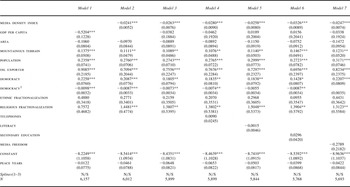
Table 1 reports the results from the main models. Model 1 is a baseline specification with control variables, including gdp per capita, drawn from the previous literature. Model 2 removes the gdp per capita variable while adding the media density index to the baseline specification. Model 3 presents the combined specification, with both gdp per capita and the media density index included in a single model. The evidence drawn from these models is strongly supportive of H1. The coefficient for the media density index is negative and statistically significant (p < 0.001), indicating that higher levels of mass media accessibility are generally associated with lower probabilities of civil war onset. In addition to being statistically significant, the media density index is also quite significant in substantive terms. Holding all other variables constant at their means, a shift from the 5th percentile to the 95th percentile of the media density index results in more than a tenfold decrease in the probability that a country will experience a civil war, moving from a yearly onset probability of 3.2 percent to a probability of 0.09 percent.Footnote 63 As Figure 2 shows, the magnitude of this effect outstrips the substantive impacts of every other statistically significant variable in the model.
Logit regressions—civil war onset

Notes: All independent variables lagged by one year. Robust standard errors in parentheses. N/S indicates that splines were included, but were not significant.
* p < .10;
** p < .05;
*** p < .01.
Substantive effects
Notes: Based on coefficients and standard errors from Model 3. First differences are calculated by holding all other variables at their means while shifting the variable of interest from the 5th percentile to its 95th percentile. The only exception is for DEMOCRACY, which is shifted from a value of 1 (pure authoritarianism, which produces the lowest probability of civil war onset) to a value of 12 (the type of mixed regime that maximizes the probability of civil war onset). Note that while the effect of the MEDIA DENSTH INDEX is negative, whereas the other effects are positive, effect magnitudes are presented on a common axis to ease comparison.

It is also interesting to note that once the media density index is added to the combined model specification, the apparent impact of gdp per capita is reduced substantially, and ceases to be statistically significant. This is quite surprising, as the finding that wealthy countries—those with strong material capabilities—are less likely to experience civil war is one of the few results that has been consistent across multiple authors and specifications throughout the civil conflict literature.Footnote 64 At first glance, it seems plausible that this finding is simply an artifact of multicollinearity, but there are several reasons to reject that explanation. First, while gdp per capita is certainly correlated with the media density index, comparing Model 1 with Model 3 shows little expansion in the standard error of the gdp per capita coefficient when the media density index is added to the model, contrary to what one would expect if multicollinearity were driving the result.Footnote 65
Second, if mass media accessibility is simply serving as a (presumably noisy) proxy for the material capabilities produced by high levels of economic development, then the information contained in the media density index should provide no additional predictive leverage in selecting country-years that are likely to experience the onset of civil war. To test this conjecture, I generate receiver operating characteristic (ROC) curves for Models 1, 2, and 3 (see Figure 3). The area under each curve, the AUC statistic, represents a measure of the overall predictive accuracy of each model.Footnote 66 Hence the difference between two AUC statistics can be used as a nonparametric test of the difference in predictive accuracy between competing models.Footnote 67
ROC curves
Note: Numbers in parentheses refer to Models 1 to 3 from Table 1, AUC statistics are calculated for each corresponding model. The p-values test likelihood that two AUC statistics are equal, that is, H0: AUCi − AUCj = 0.

Comparing Model 1 with Model 2 reveals that when the media density index strongly outperforms gdp per capita as a predictor of civil war onset (p = 0.004). Moreover, comparing Model 1 with Model 3 reveals that even once the information contained in the gdp per capita variable is known, statistically significant increases in predictive accuracy can be gained by adding the media density index to the specification (p = 0.007). However, comparing Model 2 with Model 3 reveals that the reverse is not the case: once the information contained in the media density index is known, no statistically significant increase in predictive accuracy can be gained by adding gdp per capita to the specification (p = 0.954). This asymmetry of predictive success is important for two reasons. First, if on purely instrumentalist grounds one cared only about accurately predicting which country-years were likely to experience the onset of civil war, then the results indicate that one should always prefer to make such predictions on the basis of mass media density rather than aggregate levels of economic development. Second, the results demonstrate that while these two indicators are partially correlated, the predictive successes achieved by the media density index cannot be attributed to the effects of economic development, and that mass media technologies are likely to be the more proximate cause of the observed reduction in civil war likelihood.
Alternative Explanations
However, given such correlations, one might still suspect that the media density index is simply serving as a proxy for the aggregate effects of modernization, whether through the provision of greater levels of personal wealth and life satisfaction,Footnote 68 or through the creation of an informed citizenry that can hold its government accountable.Footnote 69 In contrast, the theoretical framework advanced in this study explicitly claims that the unifying effects of mass media strength are not attributable to the forces of material wealth, or to the production of accurate knowledge among the citizenry, but rather to the strengthening of economies of scale in the marketplace of ideas. To examine this claim more closely, Models 4 to 7 add measures for aspects of modernization that are associated with broader advances in material well-being and knowledge, but which, unlike mass media technologies, do not generate economies of scale in the production of normative influence. Model 4 adds a count of the number of telephone lines per capita; Model 5 adds a measure of per capita adult literacy rates; Model 6 adds the per capita enrollment in secondary schools.Footnote 70 Finally, Model 7 adds a dichotomous indicator of media freedom coded as 1 for any country-year in which the mass media were free from content restrictions or censorship on the part of the state.Footnote 71 Table 1 reports the results. None of newly added variables reach conventional levels of statistical significance, and their addition to Model 3 does nothing to reduce the statistical or substantive significance of the media density index. In addition to demonstrating that aggregate increases in modernization and knowledge have no discernible effect on the probability of civil warfare, these results also provide additional confirmation that the media density index is not simply serving as a proxy for the presence of a more educated or more technologically advanced society, nor is it serving as a proxy for the freedom of information. Rather, this evidence indicates that it is mass media technologies specifically, and their ability to generate economies of scale in the marketplace of ideas, that are responsible for the observed decrease in the probability of civil war onset.
Still, many have argued that the effects of mass media lie primarily in the provision of information, and that mass media's influence will therefore be felt most strongly in the presence of high levels of media freedom.Footnote 72 In other words, it could be that while media freedom has no direct impact on the probability of civil war, it nevertheless conditions the effectiveness of mass media density. To investigate this possibility, I split the observed country-years into two categories: those where media freedom = 0, and those where media freedom = 1, and then ran separate regressions on each subsample with the full set of control variables from Model 3. The results indicate that the media density index exercises significant and substantial effects under both conditions (p = 0.007 and p = 0.03, respectively), and that there is no statistically significant difference in the magnitude of effects across the conditions (p = 0.19).Footnote 73 In other words, mass media density continues to generate domestically pacifying effects, even in the face of state censorship. To ensure that this result is not an artifact of the coding procedure used to generate the media freedom variable, I conduct the same split-sample exercise by dividing the observations into those that are above and below the global mean level of democracy. The results are unchanged: the media density index exercises significant and substantial effects under both conditions, and there is no statistically significant difference in the magnitude of effects across the conditions.
Hence, whatever mechanism is responsible for the pacifying effects of mass media density must be operating in both democratic and authoritarian contexts. While at first glance this may seem surprising, it is precisely the pattern we would expect to see if the effects of mass media technologies occur through the generation of economies of scale in the production of normative influence. As Snyder reminds us, “Not all successful modern states are democracies, but with very few exceptions, all have had to find some way to attract the active loyalty of the majority of their people.”Footnote 74
It is thus important to remember that the politics of normative influence are not confined to liberal, democratic settings. While states have adopted widely varying “idioms” of statehoodFootnote 75 —that is, the categories and principles through which the right to rule is constituted—nearly all rely on the generation of voluntary compliance through the production of some form of normative influence, and therefore benefit from an increase in the ease with which such influence can be produced. As a result, the basic dynamics of competition, cost, and scale described in the previous section can be expected to arise under both democratic and authoritarian institutional structures.
A similar split-sample exercise also allows one to investigate the claims referenced earlier, concerning the apparent role of mass media in stoking the flames of ethnic hatred. That is, perhaps the broadly pacifying effects of mass media technology have a tendency to break down in the face of divisive demographic cleavages.Footnote 76 To investigate this possibility, I first form subsamples above and below the mean level of ethnic fractionalization, then form subsamples above and below the mean level of religious fractionalization, and then run separate regressions on each subsample as before. Regardless of which index of demographic diversity is used, the results are the same: the media density index exercises significant and substantial pacifying effects under both conditions (p-values ranging from 0.001 to 0.025), and there is no statistically significant difference in the magnitude of effects across the conditions. In other words, when viewed from a global perspective, there is no evidence that mass media systems are generally inclined to the promotion of collective violence, even in the face of preexisting ethnic divisions. The apparent relationship between mass media and ethnic violence noted in previous studies thus appears to be spurious: a flawed inference arising from a tendency to focus on a small number of unrepresentative cases—Yugoslavia and Rwanda, in particular—characterized by unusual levels of mass media weakness.
Robustness Checks
To ensure that these results are robust to alternative statistical specifications, Model 3 was reestimated, first using a rare events logit estimator,Footnote 77 second using a population-averaged GEE estimator with an AR(1) error correlation structure, and finally using a fixed-effects specification. In each case, the results are substantively identical to those reported in Model 3, so I omit them here in the interest of space.Footnote 78 I also tested the individual components of the media density index in separate models, and found them to each be statistically significant: radio density (p < 0.001), television density (p = 0.04), and newspaper density (p = 0.01), with similar substantive effect magnitudes to those found for each unit increase of the media density index. Additional models utilized alternative indicators of democracy from VreelandFootnote 79 and Gates and colleagues.Footnote 80 These models reproduce the apparent absence of a direct effect of regime type on the probability of civil war found by these authors, but otherwise are substantively equivalent to the models reported in Table 1.
Nevertheless, it is well known that such statistical results can change dramatically when different combinations of independent variables are included in the model. Unfortunately, if there are a total of n independent variables, then there are 2 n possible model configurations. Traditional regression analysis leaves the reader with no means for determining whether the presented models are actually reflective of this universe of potential model specifications, or whether they were cherry-picked to reflect the analyst's theoretical expectations. A recently developed solution to this difficulty, known as Bayesian model averaging (BMA), averages over a variety of potential model specifications to generate a posterior distribution of the likelihood that each parameter will be nonzero in the best model specifications.Footnote 81 Here, model probabilities are judged using the Akaike Information Criterion (AIC) prior. Following the advice of Montgomery and Nyhan,Footnote 82 I allow the BMA algorithm to search the entire space of potential model configurations using the full set of independent variables from Table 1, with the only restriction being that the three cubic splines must enter or leave the specification as a group. This generates a search space of 65,536 potential model specifications.
The results, presented graphically in Figure 4, show the posterior probability of inclusion—that is, Pr(β ≠ 0)—for each independent variable. The differences between the media density index and the other indicators of material wealth and modernization could not be more stark. The media density index achieves the highest inclusion probabilities of any of the variables considered, 99.7 percent, followed closely by population at 99.2 percent, religious fractionalization at 93.9 percent, and mountainous terrain at 92.4 percent. In contrast, gdp per capita fails to even cross the 50 percent threshold. The other modernization indicators, telephones, secondary education, literacy, and media freedom do not fare much better, with posterior inclusion probabilities ranging from 29.3 percent to 60.1 percent. This provides further evidence that the statistical and substantive significance of the media density index in the models reported earlier is neither a result of convenient specification choices, nor a simple artifact of collinearity between various indicators of economic advancement, but rather a result of the media density index's remarkably robust ability to predict the onset of civil war.
Bayesian model averaging
Notes: Dependent variable is CIVIL WAR ONSET. Bars represent posterior inclusion probabilities for each independent variable, using the Akaike Information Criterion (AIC) prior, and the full search space of 65,536 potential model specifications.

Still, the framework of Bayesian model averaging, as with all regression-based techniques, necessarily incorporates a number of functional form assumptions, particularly assumptions of linear and independent effects, which could easily be violated in this sample. As a final check of the robustness of the relationship, I therefore use an optimized matching estimator which, due to its nonparametric form, avoids the need for functional form assumptions altogether, while ensuring that any observable factors that might have caused certain countries to be selected into high levels of mass media density are accounted for in the estimation of the causal effect of mass media technologies. To estimate this causal effect, I first dichotomize the media density index by assigning a 1 to all observations greater than or equal to the global median, and a 0 to all others. To achieve optimal balance among the covariates, I then rely on an evolutionary search algorithm known as “genetic matching,” which produces optimally balanced samples by searching over a vector of parameterized weights that are applied to each of the covariates and to an aggregate propensity score, finding the set of weights that, when used to draw treatment and control groups, minimizes the maximum imbalance among the full set of covariates.Footnote 83 This procedure estimates a negative average treatment effect on the treated (ATT) of −0.216 for the high media density treatment condition, which is strongly statistically significant (p = 0.001). In contrast, the same procedure yields a substantively small (−0.015) and statistically insignificant (p = 0.378) estimate of the effect of gdp per capita. The clear implication is that mass media strength is the proximate cause of the reduction in civil war likelihood that in previous analyses had been attributed to the material effects of aggregate levels of economic development.
However, such results should not be taken to imply that material forces are unimportant to the generation and suppression of civil conflict. Rather, they indicate that gdp per capita is a poor indicator of those forces because it suffers from excessive aggregation. As a broad measure of economic development, this indicator inevitably serves as a proxy for numerous dimensions of state strength, of both the “hard” and “soft” varieties. The key advantage of the media density index is that it is more narrowly construed and thus allows us to cleanly isolate the pacifying effects of soft power, ensuring that the observed effects could only have arisen through the normative influence of communication. The fact that gdp per capita ceases to be statistically significant once we account for this soft power dimension does not necessarily imply that hard power exercises no effects, but rather that future demonstrations of the utility of hard power will have to rely on more narrowly construed empirical indicators.
Conclusion
Taken together, the results presented in this study demonstrate that the pacifying effect of mass media technologies represents one of the most robust empirical relationships yet discovered in the quantitative study of civil war. In making this demonstration, I also hope to have shown that there is no necessary opposition between constructivist theory and quantitative methods.Footnote 84 On the contrary, by applying a structural empirical approach to constructivist theoretical concepts, this analysis has sought to provide rigorous, systematic evidence for the fundamental importance of nonmaterial state capacities. By focusing on a form of technology whose presence is readily observable and measurable, but whose effects could arise only through the dissemination of symbols, this evidence makes clear that the mechanisms available to states for the production of influence extend far beyond the material forces of coercion and payment. Even in the life-or-death context of militarized challenges to state sovereignty, the normative influence of political communication—that is, soft power—still holds enormous sway. Moreover, the evidence indicates that the “mass” communication technologies of newspaper, radio, and television have played a unique role, separate from the broader trends of economic modernization and development, because these particular technologies have stood apart in their ability to strengthen economies of scale in the marketplace of ideas, and have therefore frequently functioned to tilt the normative playing field in favor of political actors promoting broad idioms of national unity and state loyalty.
Of course, communication technologies are constantly evolving, so we must be wary of assuming that today's rules will continue to operate in tomorrow's world. As new technological innovations arise, states and their challengers must constantly adapt their tactics, developing new modes of contestation as they seek advantage in an ever-changing communicative environment. New forms of communication technology can thus be expected to generate new patterns of political conflict. For instance, while the centralized “mass” communication technologies that formed the focus of this analysis have generally functioned to the advantage of states over their challengers, it is far from clear that the same will be true of the Internet, cell phones, and other forms of “social” media, which instead facilitate decentralized horizontal connections between individuals. The results presented in this article should therefore certainly not be taken to imply that all forms of communication technology will necessarily have pacifying effects, or that the technological contexts of the twentieth century are likely to remain unchanged in the twenty-first century. Rather, they serve to demonstrate the fundamental inadequacy of approaches to state strength that focus exclusively on hard power resources, while ignoring the crucial role of normative communication in the production of internal peace and stability. They demonstrate, in other words, that armed conflicts are not prevented through arms alone.