Introduction
The nature of language teaching in elementary schools is changing. In the United States, as the number of children learning English as an additional language increases, teachers are looking for new approaches to help children work at age-appropriate learning tasks at the same time they learn English. Models of pull-out ESL, where an ESL specialist works with children outside of the regular classroom, are not appropriate in communities where a large proportion, perhaps even a majority, of the children come from homes where a language other than English is spoken, and where many or most of the children need robust ongoing support for language development across subject areas. While some special attention to getting started with the new language will always be required for newly arrived immigrant children, teachers in such contexts need to incorporate a focus on language into subject-area learning in ways that enable their students to continue to learn language and content simultaneously across the school years. While the notion of content-based language teaching has helped us understand how language classrooms can build on and support content-area teaching (see Dalton-Puffer Reference Dalton-Puffer2011 for an overview), teachers now need new ways of incorporating a focus on language in the content classroom.
This changing situation in our schools offers new opportunities for applied linguists and SLA researchers. We need research on pedagogical approaches that enable teachers to focus on disciplinary goals while supporting students’ English language development in classrooms with children who are learning the language of instruction at the same time they are learning what the instruction is focused on teaching. In this talk I will describe the research I am doing with Annemarie Palincsar and other colleagues at the University of Michigan, where we are using the constructs of systemic functional linguistics (SFL) to support mainstream teachers in talk about language in the service of their instructional goals. This work is showing us new ways that applied linguistics can inform and support the work of language learning and teaching.
Supporting a focus on language and meaning
The Language and Meaning project I’m engaged in with my colleagues is a three-year endeavor to develop an instructional approach that supports academic language development with functional grammar metalanguage from SFL. We are working in a diverse Arabic language community in a high poverty urban fringe school district. In this context, the majority of children are bilingual, and classrooms have a mix of proficiency levels. Some students have recently arrived in the United States, while many others were born here. Most of the children come to kindergarten not knowing English, as they speak Arabic at home and in the community. This is a community much like many in the US where outside of school the children have few opportunities to use academic English, so need classroom instruction to help them develop English to high levels of proficiency for academic tasks. At the same time, their teachers often lack the knowledge about language that they need to support learning in such classroom environments for children who are not going to get a lot of practice outside.
Our project uses design research (Collins, Joseph & Bielaczyc Reference Collins, Joseph and Bielaczyc2004; Anderson & Shattuck Reference Anderson and Shattuck2012) to study the development of an intervention and its enactment in real contexts through iterative cycles of design and implementation. We have been working in five schools with teachers and children from grades 2 to 5 to support content learning through talk about language and to support language learning through talk about content. We engage in cycles of creating, piloting, refining, implementing, and studying the ways SFL's functional grammar can support the instructional goals of teachers of L2 English learners in the early grades. We offer the teachers professional development to prepare them to implement new ways of talking about text, and then observe their teaching to learn from the classroom context. Our goal is to support learning through opportunities for teachers and children to engage in interaction in meaningful curricular activities, using metalanguage to make explicit what's needed to accomplish the goals of the learning context.
Supporting students in continuing to develop language proficiency across the years of schooling is especially challenging, because all children in our schools are, in a sense, continuing to learn English while they learn school subjects. But those learning English as an additional language are expected to continue to develop their knowledge of school subjects, at grade level, while at the same time catching up on the language that many of their peers began learning as a mother tongue. What we often see is that these children may develop fluency in everyday registers through interaction with their peers, even as they continue to struggle with the language of schooling, the language they need to accomplish school learning and succeed in school across the years and subject areas. By conceptualizing the challenges of L2 learning at school as the development of new consciousness about language that can be supported in the context of meaningful curricular activities, our project is developing approaches that can be used with children across a broad range of proficiency levels.
A construct from SFL that helps us think about the challenges of language learning in schooling contexts is the notion of register. Michael Halliday's theory of register defines it as variation in the constellations of language resources that we draw on according to the social contexts we engage in (Halliday Reference Halliday1985; Halliday & Hasan Reference Halliday and Hasan1989). The language choices we make vary according to what we are talking about, who we are in relation to each other, and the way the language is being used – whether in person, in writing, in interaction with other modalities, and so on. These differences in context result in the use of different registers as we use language to engage in different activities and tasks.
This notion of register helps us recognize why and how language use in schooling tasks is different from other contexts. Children develop informal interactional registers through their out-of-school experiences and engagement with peers, but they often have many fewer opportunities to develop the registers of the subject areas and tasks they are engaged in at school. These tasks call for formal ways of presenting knowledge but also informal ways of interacting about that knowledge, and SFL research helps us understand what aspects of language are best put into focus in different subject areas and tasks (e.g., Christie & Derewianka Reference Christie and Derewianka2008; Christie Reference Christie2012). The theory sees language learning as expanding meaning potential, with growth in language seen as growth in the ability to do and mean and participate. SFL gives us a functional grammar, a grammar that connects with meaning and lets us relate lexico-grammatical forms to larger systems of meaning in the language, as well as to what is being done in the social context. This makes the functional grammar a powerful resource for talking about language and relating it to context and purpose, as it can support teachers and learners in recognizing and exploring the different language resources needed to accomplish different tasks in different subject areas.
Each subject area, from the earliest years of schooling, presents children with its own specialized registers. Learners develop use of these registers over long trajectories, across the years of schooling. For example, children start learning science in the early grades and continue doing so all the way through school, developing facility with science registers as an aspect of learning the subject. Registers of science and other subjects can be recognized as varying with the activities of the subject area. We can describe the register of science in general and abstract terms, but we can also identify features of the registers that children are engaged in when they are doing a hands-on science experiment, when they are presenting their findings from that experiment, and when they write about that experiment. These registers build on and interact with each other as children learn the language of science and the content of science simultaneously, as Pauline Gibbons (Reference Gibbons2006) has so deftly shown.
To address the challenges of learning different registers to accomplish different tasks across grades and subject areas, we need to conceive of school learning and language development as going hand-in-hand, with the language learning supported in the context of disciplinary learning for all students. That means conceiving of language development as expanding linguistic repertoires to achieve different purposes, and not just as developing accuracy in language use. In the contexts I’m going to describe, we don't focus on errors and accuracy, but instead on supporting children as they participate in meaningful activities related to school learning so they come to be confident in their language use as they engage in disciplinary tasks.
This approach also fits with the goals of teachers in our project, as they don't want to be doing something separate from the curriculum with children in school: they want children's work on language learning to be done at their cognitive levels, with grade-level content and materials, and in support of disciplinary goals. I am going to describe some ways that explicit talk about language, using functional grammar as a metalanguage as students participate in the registers of schooling, offers opportunities for learning both language and content. We use the language of the disciplinary area and texts at grade level, and we support interaction about the language of those texts in activities that enable children to engage with new knowledge even when the language through which that knowledge is presented is difficult for them, putting language teaching in the service of learning content.
As I am talking about metalanguage I want you to think about it both as a thing and as a process (Berry Reference Berry2010). We have metalinguistic terminology such as noun, verb, sentence, word – any terms we use to refer to language. But it is the process of talking about language that is the most important use of metalanguage. I am going to describe how we are using the functional, meaning-focused metalanguage of SFL to support metalinguistic awareness, interaction about language and meaning, and noticing of form–meaning connections, raising consciousness about language by being explicit about how language works. Using terminology from SFL and engaging in talk about text, we can be explicit with children about how valued disciplinary meanings are made in different subject areas.
The disciplinary meanings in focus here come from and support the goals of the primary school language arts (subject English) curriculum. Thinking about disciplinarity in language arts focuses us on literary analysis and writing in response to literature, so our approach builds from reading to writing through rich discussion about the language choices authors make in writing the stories children read in the elementary years, and supports children's writing by focusing them on language choices they can make to write in valued ways. Teachers engage children in grade-appropriate activities that involve them in learning to use registers that are functional for achieving the goals of the subject English classroom, drawing on and incorporating metalanguage that helps learners recognize and use language that enables them to learn and to demonstrate their learning. I only have time here to present one aspect of the SFL metalanguage that has been productive in our research (for more on the project, see Schleppegrell Reference Schleppegrell2013).
Supporting learning through grammatical metalanguage
Our key concern was identifying how to use SFL in ways that teachers would find useful and usable. To introduce ways of talking about language and meaning, we first used the SFL construct processes of different types. This construct refers to the different ways clauses present meanings, and it puts a focus on the meanings construed in verbs and verb phrases. We adopted Martin & Rose's (Reference Martin and Rose2003) distinction of four process types, asking teachers and students to learn to identify and talk about clauses as processes of doing, saying, sensing, or being. What the processes metalanguage offered us was a way of helping the children identify meaningful phrases and segments rather than labeling individual words. If children are asked to identify the verb in a sentence, complications immediately arise when they encounter verb phrases such as
(a) If the record player hadn't been broken, he would have gone sooner.
(b) Some kids in the back started snickering.
(c) It might have gotten scratched.
In each of these cases, asking ‘what is the verb?’ leads to discussion about auxiliaries (hadn't been), verb + ing constructions (started snickering) and/or modality (would have gone). Teachers adopt the SFL notion of process to focus students on meaningful segments, and their work with those segments gives them understanding about how the structures contribute to meaning as well as how they are formed. Identifying the processes in the examples above puts the focus on the whole phrases hadn't been broken, would have gone, started snickering, and might have gotten scratched. These larger segments can then be analyzed in terms of the meanings they present, identifying whether they are processes of doing, sensing, saying, or being.
Initially teachers asked children to identify processes in the stories they were reading and label them as one of the four process types, to help students think about a character and what that character does, thinks, feels, and says. Through this activity, misunderstandings of meaning were often uncovered, giving teachers insight into how the children understood what they were reading. In addition, these activities provided a way for the children to revisit a text to enable them to work more closely with the language of the author in support of a key language arts goal, analyzing character development.
For example, in a fifth-grade classroom where we were doing research, one story in the curriculum was La Bamba by Gary Soto, about a boy, Manuel, who plans to perform in the school talent show. The children were asked to work together to identify Manuel's ‘sensing processes’ as a way of focusing them on how his feelings range from nervous and apprehensive to elated and proud as the story evolves. One of the processes a small group identified was in the sentence He yearned for the limelight. One student asked, ‘Is yearned one?’ (a sensing process). Another said, ‘Yeah,’ but then a third said, ‘No, wait, he did it’ (so it would be a doing, not a sensing process). That led another to ask, ‘What does yearned mean again?’ The answer from another was, ‘Surprised’. Another said, ‘Let's see what it says here. . .he yearned for the limelight’. The group decided this was not a sensing process and they moved on, identifying wanted, knew, realized, and forgotten as sensing processes. Subsequently, however, they returned to the yearned example, and in discussion with the teacher came to understand the meaning of yearned, what yearned for the limelight means, and what this means in terms of what Manuel is feeling.
Interaction like this showed us that the metalanguage had value in promoting talk about meaning in context as students focused on noticing meanings of different kinds (here, for example, on how feelings are represented in language). We were pleased with the interaction about word and textual meaning that the activities stimulated and the ways students engaged with each other in exploring the text, identified meaningful segments and noticed how different meanings were presented in language. Through this student talk and sharing, many misunderstandings of word and phrase level meanings surfaced and were addressed, and questions about the relationships within a clause came into focus.
However, we also noticed that this identification of processes in itself was not supportive of the content learning in robust ways. It remained a kind of labeling exercise, where learners found verbs and verb phrases and categorized them, and the activity did not further connect to the broader goals of English language arts by stimulating conversation about the character's development in the story overall. Feedback from the teachers indicated that while they saw the value of these activities, they would be unlikely to continue devoting time to them unless we could help them connect the work to their larger language arts goals. While the categorization did help students begin to think about language in terms of the ways particular instances related to larger meaningful categories, we wanted to better support teachers in making this relevant to their disciplinary goals. That led us to consider more deeply how we could situate the use of metalanguage in the service of content goals in the subject English classroom.
In addition, as the children did this work, we recognized that there were instances where feelings were not presented in a sensing process. For example, at one point the teacher in the story is trying to fix the record player and the text says, ‘Darn’, he growled, trying to force the lever. The students recognized that growled was a saying process and not a sensing process and so decided it was not relevant to their task. Since the goal of the task was to explore characters’ feelings, we realized that ignoring such examples was not supportive of the disciplinary objective.
So we thought more about how the use of the metalanguage of process type could better support teachers’ pedagogical goals. Having in mind that Halliday has said the goal of analysis with functional grammar is recognizing ‘how a text means what it does’ (Halliday Reference Halliday1985), we focused our attention on exploring meaning as the first step, rather than identifying particular forms. Instead of beginning by identifying processes of a certain type, we had the children identify places in the text where particular meanings were in focus. In our next implementation of the activities, we had the children find sentences where characters’ feelings were presented and then categorize these instances according to whether the feelings were shown or told by the author. In writing in schools, teachers often tell students to ‘show it, don't tell it’ as a way of encouraging them to use more vivid language, and we wanted students to become more conscious about when and how an author shows or tells.
The insight we were working with was that we could link the identification of process types to the notion of showing and telling in creative writing and literature. We saw that when authors tell attitudes, they typically use being or sensing processes. He was angry and disappointed, for example, describes the character's feelings explicitly, with a being process, and she felt sad tells explicitly what is going on inside the character's head, with a sensing process. As being and sensing processes tell us about feelings, no interpretation of the attitude is needed. When authors show attitudes, on the other hand, they often use doing or saying processes. So, for example, when the author writes, ‘Darn’, he growled, he is telling us at the same time that the teacher said something as well as how he said it. There is an attitude expressed there, and interpretation is involved in recognizing the meaning in how the character said it.
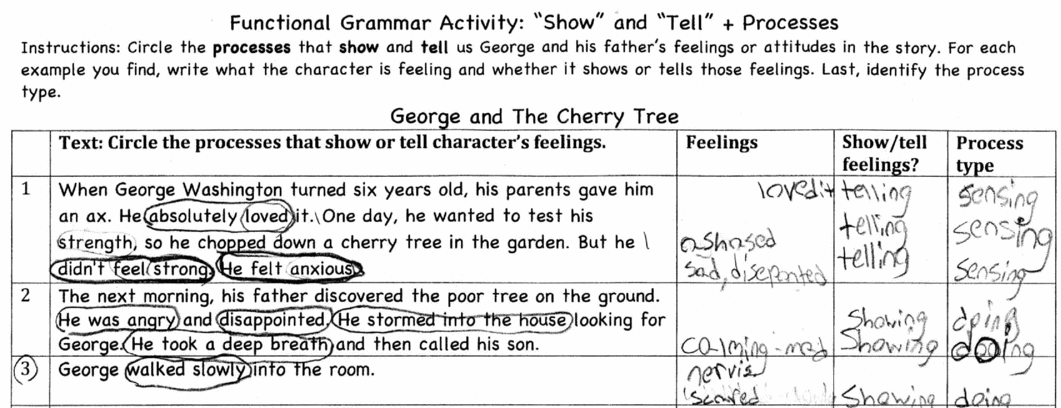
Figure 1 is an example of how we are helping children begin to see patterns in these ways authors use language (see Moore & Schleppegrell Reference Moore and Schleppegrell2014, for more on this). In this case, the children have read a well-known story about George Washington and how he chopped down a cherry tree but was honest about it when his father asked him if he had done it. As Figure 1 shows, students are first asked to identify processes that show or tell feelings. They then interpret the feelings, making the focus on meaning primary. We see that here the children interpret the process walked slowly in relation to the story as showing that George was ‘nervous and ‘scared’ and identify this as a doing process. The pattern that clearly emerges is that sensing and being processes tell feelings and saying and doing processes show feelings. But we include examples that also help children recognize that this is a pattern, not a rule, as our goal is not just that children identify and label segments of text, but instead that they engage in interpreting literature and are supported with strategies that help them do that. For example, metaphors like his face became red as a cherry, presented in a being process, is another way authors show attitudes (Moore & Schleppegrell Reference Moore and Schleppegrell2014). Further, as a way of supporting students in writing about characters’ attitudes, we engage them very directly in practice interpreting the attitudes they identify as shown.
A support for exploring meaning in text

Of course the picture of how characters’ attitudes are presented in literature is even more complicated than this. If we take the notion of feelings as an area of meaning and ask how feelings are expressed in language, we see that feelings can be expressed in adjectives, verbs, adverbs, or even nouns. For example, in one story the children work with, the character's feeling is presented as a grumble that grows as she becomes more frustrated. Teachers used the SFL construct participant to help children identify nouns and noun phrases that also present attitudinal meanings and explored what they contributed to our understanding of the character.
The key point is that the functional, meaning-focused metalanguage provides tools teachers can use to engage English language learners in activities that research tells us are supportive of L2 development because they stimulate interaction and discussion about language, promote noticing of patterns in language, and encourage the exploration of meaning in context. At the same time, the use of this metalanguage also connects with and supports the teachers’ goals for grade-level subject area learning. By identifying characters’ feelings and attitudes and using the functional grammar to explore how an author has told or shown those feelings, we promote noticing of patterns that are more general and can be seen in other texts as well.
Students using the language in focus
We know that a key issue in language teaching is engaging learners in productive use of the language they are learning, so I also want to talk briefly about the ways this meaning focus is supporting children in engaging in extended oral discourse and then in writing. This example comes from a classroom event in which third grade (eight-year-old) children have been exploring the meaning of the sentence He walked slowly into the room. The children have discussed the meaning of this sentence in pairs, and now the teacher is building a chart in the front of the classroom where she is asking each pair, ‘What did you put to interpret he walked slowly into the room?’ Sani says, ‘George feels disappointed’. The teacher asks if they also included why George feels disappointed. This is a key move that our pedagogy is supporting, and we see that it often elicits extended classroom discourse, as the children have already engaged in talk about the example and are ready to say more about it to the whole class. Sani says
I think that he's disappointed because think about it, maybe, pretend you’re George and pretend that your father, your father is George father and pretend that you just got called from your father and um, and your, you know that your father thinks that you cut down the tree, so, you’re gonna, when he calls you you’re going to be disappointed in yourself for killing a nice, beautiful little tree.’
The teacher says ‘Ok, so, he because he's walking slowly, is he in a hurry to get to his father?’And Sani replies
He actually doesn't want to get there. He’s, that's why, let's pretend, like if somebody walks slow like this, [gets up and walks slowly] do you think that they’re in a hurry? They could run if they’re in a hurry but instead they wanna walk.
The teacher asks ‘What if he was anxious to get to his father?’ and Sani says
He would have ran. He wanted to walk slow because he didn't want to get there.
At this point, another child calls out, ‘because he might get in trouble’.
This is an example of the extended talk about content that we see when the children have had an opportunity to engage in small-group meaning-focused discussion before talking with the whole class about the stories they are reading. Note that in the example I just presented, it might be typical practice for a teacher to take the first part of the student's contribution – that they thought George was disappointed – write it on the chart, and move on to the next group to ask what they wrote. But this teacher continues the conversation, asking the student to expand what she has said. When she does this, you can see that all the talk the children have done about this story, re-reading and doing the work to analyze the author's language using the grammatical metalanguage, has prepared this student to talk now at length about the meaning of one phrase. Related to this is our focus on having the students report on how they know the character feels that way, enabling them to connect their knowledge of the world to the meanings in the text. The focus on doing processes also often stimulated the kind of acting out that Sani does in illustrating how the character walked slowly. Ultimately, the work with functional grammar gave students more language for talking about language. The lessons engaged students meaningfully with text, and thus gave them more to say along with the language to say it, as illustrated in their extended turns; not typical of the kind of discourse previously observed in these classrooms.
We have many examples of this kind of extended discourse following the close reading and re-reading with a focus on relating language forms to meanings. This lesson does not look like typical grammar teaching in a language learning classroom, but it is focusing students on language in meaningful ways that support their grammatical development by expanding their language resources. The meaningful grammatical metalanguage helps them revisit texts, unpack and discuss meaning, and engage in interaction in the context of shared experience; all of which are supportive of L2 development.
The approach also helps teachers move from reading to writing through rich discussion, giving students opportunities to use the language they have explored as they write their own texts about the characters they have analyzed. We use the work on interpreting evidence from a text to offer the children more intensive scaffolding of the writing of a character analysis. Interpreting evidence from a text is an important goal of the language arts classroom, a content goal that can be supported through a focus on language–meaning connections with use of the SFL metalanguage. A character analysis is a kind of persuasive text through which the writer makes a claim about a character and supports it with evidence from the text (Christie & Derewianka Reference Christie and Derewianka2008). In this case, after reading the story, the children wrote about whether they think George is a good boy in the way he behaves. This prompt enables them to take one of two positions, and in the example in Figure 2 the student argues that George is a good boy because he told the truth. The teachers present the genre as having four key stages: Claim, Orientation to Evidence, Evidence, and Analysis. The analysis stage is further divided into an interpretation of the evidence and evaluation. Our classroom activities support teachers in presenting and modeling each of these stages and the children engage in oral rehearsal before writing, focusing in particular on interpreting their evidence.
An example of the character analysis genre
For each stage, some guidance points children toward language features that are functional for their writing of that stage. For example, for the Claim, they’re told they’ll probably use a ‘being’ process (e.g., in a verb of being or having) and because to state the claim (in Figure 2, ‘George is a good boy because he was telling the truth’). The notion of circumstances of time and place is SFL metalanguage that students have learned and here are advised to consider in their Orientation to Evidence stage (‘Right after George chopped the tree. . . .’). These are not rigid requirements but rather advice, as we see in Figure 2, as the writer has not used a being or sensing process in interpreting evidence, but instead uses the Interpretation stage to interpret the quotation he presented as evidence (‘George cried out. . .’) by telling the reader that George was in fact telling the truth. The Evaluation stage (‘This shows that. . .’) is of great importance to the teachers, who are looking for what they had previously referred to as ‘good conclusions’ to students’ writing. Teachers report that being able to name the stage Evaluation and provide clearer guidance to students about what a good conclusion is has been of great value to them in helping students improve their writing. In these ways we are scaffolding language choices in purposeful contexts with a focus on how and why particular language choices are functional for doing particular things.
I am not arguing for these specific scaffolds or activities, as they remain in the process of development in our project and are still being adapted. My point is that we have seen through this work that the metalanguage of SFL is well suited to linking with the language arts disciplinary goals related to analyzing characters, as it makes interpretation – something abstract that may be hard for teachers to support – more accessible and concrete. The metalanguage offers a mode of inquiry that enables children to abstract from any instance of language use and start thinking about what that instance means and how it relates to the language system as a whole; for example, by thinking about the process types used by authors for different purposes. This raises their language awareness in purposeful ways related to particular goals and tasks. It enables students to reflect on language and discover patterns at the same time as supporting the content goals of learning. We are also working in other content areas and with a wider range of SFL metalanguage, and feedback from the teachers we are working with indicates that they are enthusiastic about and supportive of the approach.
Conclusion
One of the things we often hear these days is that English language learners need explicit attention to language in order to develop academic language proficiency (e.g., August & Shanahan Reference August and Shanahan2006; Genesee et al. Reference Genesee, Lindholm-Leary, Saunders and Christian2006; Gersten et al. Reference Gersten, Baker, Shanahan, Linan-Thompson, Collins and Scarcella2007). But what should teachers be explicit about in teaching English language learners? The notion of explicitness is understood in different ways: in some cases referring to being explicit about procedures for learning, in other cases being explicit about rules of the language, or being explicit about how to organize a piece of writing. I have made a case here for being explicit about how language means what it does, through the use of a linguistic metalanguage, a functional grammar, in working with children in school. Being more explicit about how language means what it does enables the kind of consciousness-raising that stimulates meaningful interaction in the classroom, supporting pattern finding and the learning of language along with learning in the subject areas.
Language is a complex, dynamic, adaptive system of patterns and not a set of rules, and learners’ language develops and emerges as they learn from experience in response to interaction and feedback (Ellis & Larsen-Freeman Reference Ellis and Larsen-Freeman2006). We can support L2 development to advanced levels by raising learners’ consciousness about language, drawing their attention to particular language choices and providing opportunities for explicit learning about language through metalanguage. In order to do that well, we need to think about the demands of the learning context and the curricular goals operating in that context.
So to address the challenges we are facing in our schools today, I encourage us to see language learning as the development of new consciousness about language that can be supported in a context of meaningful curricular activity, using meaning-focused metalanguage to be explicit about how disciplinary meanings and knowledge are presented in language. In research on language teaching and learning, we need to conceptualize L2 development as ‘ability to participate in meaningful contexts of language use’ rather than just as more correct usage. In assessment, too, we need new measures of L2 development that address expansion of language resources and not just accuracy, recognizing the different proficiencies developed in different contexts and providing supports for teachers to engage in subject-specific activities that support academic language development along with participation in curricular activities.
What I have shown here is how a functional linguistics metalanguage can help us achieve those goals in one curricular area. As applied linguists and researchers in SLA work toward preparing teachers for the new contexts in which children are learning language and learning content in the elementary school classroom, we can make important contributions to pedagogy and L2 development by promoting language-based content teaching, where teachers are supported in focusing on their content goals through activities that enable them to talk about language and focus on language in ways that help them achieve those goals.
Acknowledgement
My thanks go to Annemarie Palincsar, Jason Moore, and other members of the ‘Language and Meaning’ Project, as well as the teachers and children we have worked with, for their many contributions to the work presented here. The research reported here was supported by the Institute of Education Sciences, U.S. Department of Education, through Grant R305A100482 to the University of Michigan. The opinions expressed are those of the authors and do not represent views of the Institute or the U.S. Department of Education.
Dr. Mary Schleppegrell is Professor of Education and Chair of Educational Studies at the University of Michigan, Ann Arbor. Her research studies the role of language in learning with particular attention to the needs of English language learners, and she draws on systemic functional linguistics to identify the demands of teaching and learning in different subject areas. She is the author of The language of schooling (Erlbaum, 2004) as well as other books, journal articles, and book chapters. With her colleague Annemarie Palincsar she is currently involved in a three-year project to develop a functional grammar approach for elementary school teachers and language learners.