Cardiac surgery is associated with an increased risk of bleeding complications. Bleeding complications are particularly challenging in children in whom even small volumes of blood products used during treatment may cause volume overload. Thus, a tailored and targeted therapy is especially important in this patient group.
Cardiac surgery in general and the use of cardiopulmonary bypass in particular impairs haemostasis in several ways. Priming of the cardiopulmonary bypass circuit causes substantial haemodilution and dilutional coagulopathy, even if the circuit is primed with fresh frozen plasma and whole blood with a view to achieving a haematocrit value of 0.30–0.35.Reference Fenger-Eriksen, Anker-Moller, Heslop, Ingerslev and Sorensen1 The surface of the circuit and the oxygenator stimulate excessive contact activation with consumption of platelets and coagulation factors.Reference Chan, Leaker and Burrows2–Reference Williams, Bratton, Nielsen and Ramamoorthy4 Furthermore, hypothermia impairs both platelet function and coagulation factor activityReference Reed, Bracey, Hudson, Miller and Fischer5, as does the administration of heparin.Reference Khuri, Valeri and Loscalzo6 Thus, there is an obvious need for a quick and reliable measurement of the haemostatic capacity in children after cardiac surgery because of these haemostatic changes and children are highly susceptible to major cardiovascular instability in the presence of severe volume overload.Reference Slonim and Luban7
Owing to the turnaround times of approximately 60 minutes, conventional coagulation analysis of, for instance, prothrombin time, activated partial thromboplastin time, and platelet count are of limited use in the management of perioperative bleeding complications. A number of new point-of-care tests have therefore been developed and refined to guide haemostatic intervention. Whole-blood coagulation profiles as supplied by rotating thromboelastometry (RoTEM®; Pentapharm GmbH, München, Germany) are currently included in the perioperative management of adult cardiac patients in many operating theatres and intensive care units because the method has the advantage of fast turnaround times enabling targeted therapy to be initiated 15–20 minutes after blood sampling.Reference Despotis, Joist and Goodnough8 RoTEM® visualises the dynamic properties of the continuous whole-blood clot formation, allowing the plasmatic coagulation system to interact with platelets and red cells, thereby providing useful additional information on platelet function. From a theoretical point of view, RoTEM® provides more information on the entire coagulation process from the initiation of coagulation, fibrin formation, clot retraction, and fibrinolysis including the time span of the processes than conventional tests. Thus, the advantage of this technique lies in its potential to measure the individual parts of the clotting process, at the bedside, with minimal delays.Reference Despotis, Joist and Goodnough8–Reference Cammerer, Dietrich, Rampf, Braun and Richter10
RoTEM® analysis in adult cardiac patients is shown to provide the basis for a targeted therapy and to improve outcome after cardiac surgery, indicated, for instance, by a reduced use of blood products.Reference Despotis, Joist and Goodnough8, Reference Ak, Isbir and Tetik9, Reference Royston and von11, Reference Shore-Lesserson, Manspeizer, DePerio, Francis, Vela-Cantos and Ergin12 However, before it is implemented into routine care among children, the performance of RoTEM® should be documented on a larger scale in this population, and there is currently no evidence that RoTEM® is as equally efficient as conventional coagulation testing in children with cardiac defects or whether the treatment algorithm should be adjusted for this particular patient group. The aim of the present study was to investigate whether RoTEM® analysis can reveal haemostatic changes in children undergoing cardiac surgery with a performance at least comparable to conventional coagulation tests.
Methods
Children scheduled for primary congenital heart surgery were consecutively included in the study from January, 2007 to September, 2008. The inclusion criteria were: age 0–15 years, elective congenital heart surgery, and use of cardiopulmonary bypass. Children were excluded if they had previously undergone cardiac surgery or had an ongoing infection. None of the children received any medication interfering with coagulation or platelet function before the surgery.
Procedure
Children were anaesthetised with sevoflurane and fentanyl 20–75 micrograms per kilogram and muscle relaxed with cisatracurium 0.15 milligram per kilogram, followed by a continuous cisatracurium infusion. In low-dose fentanyl cases, sedation was maintained with intravenous midazolam 0.1 milligram per kilogram during aortic cross-clamping and intravenous pentobarbital 5 milligrams per kilogram if circulatory arrest was applied. Anticoagulation during cardiopulmonary bypass was achieved by means of unfractionated heparin – 300 international units per kilogram – with dose adjustment according to the achieved activated partial thromboplastin time. All children were subjected to standardised procedures for cardiopulmonary bypass and monitoring. This included the use of Jostra HL20 circuit® (Austin, Texas, USA) and Medos Hilite® (Vingmed, Roskilde, Denmark) infant/paediatric oxygenator, primed with fresh frozen plasma, Ringer's lactate, and red blood cells to obtain a haematocrit value of 0.28–0.30.
Clinicians were blinded to the RoTEM® data. Thus, haemostatic interventions during and after surgery were not guided by the RoTEM® analysis results from the study protocol. For both the RoTEM® analysis and the conventional coagulation tests, preoperative blood samples were obtained before heparinisation. Following administration of protamine sulphate® (Leo Pharma Nordic, Malmö, Sweden), post-operative samples were obtained after weaning off extra corporal circulation, aiming at an activated clotting time below 150 seconds. Conventional coagulation tests were repeated on post--operative day 1 at 5:00 am.
The following clinical variables were obtained from the medical records after surgery: surgical procedure, complexity of congenital heart disease according to Risk Adjusted Classification of Congenital Heart Surgery-1,Reference Jenkins, Gauvreau, Newburger, Spray, Moller and Iezzoni13 duration of cardiopulmonary bypass, post-operative drain production, and haemostatic treatment. For receiver-operating characteristic curve analysis, patients were divided into “bleeders” – more than 20 millilitres per kilogram per 24-hour chest tube drainage – and “non-bleeders” – less than 20 millilitres per kilogram per 24-hour chest tube drainage. Owing to clinical practice, data were recorded prospectively in an electronic intensive care database and a laboratory database during the study period.
According to the Danish law on ethics, the present study is categorised as a method validation study and therefore did not require approval. Blood sampling obtained to evaluate a new test and test results that will not influence the patient's diagnosis or treatment can be performed without obtaining consent from the patient or his/her guardians, as long as the intervention itself is harmless to the study person involved (Acceptance letter; 3 November, 2006, Regional Ethics Committee, Aarhus County, Denmark). Therefore, written informed consent was not obtained from the patients or their parents. The study was approved and registered by the Danish Data Protection Agency.
Coagulation tests
The conventional coagulation tests were: activated partial thromboplastin time, prothrombin time, fibrinogen (functional), fibrin D-dimer, thrombin clotting time, antithrombin (STA-R Evolution, Diagnostica stago, Asnières, France), factor XIII (functional) (ACL TOP, Instrumentation Laboratory, Barcelona, Spain), and platelet count (Sysmex, XE-2100, Kobe, Japan). Anticoagulation was achieved by means of 3.2% sodium citrate – activated partial thromboplastin time, prothrombin time, fibrinogen, fibrin D-fimer, thrombin clotting time, antithrombin, and factor XIII – and ethylenediaminetetraacetic acid – platelet count.
Whole-blood coagulation was performed using RoTEM®. Our standardised procedure for RoTEM® analysis included blood sampling from the arterial line. Blood was anticoagulated with 3.2% sodium citrate and rested for 30 minutes at room temperature. Standard assays were performed both pre- and postoperatively. In the In-TEM® (Pentapharm GmbH, München, Germany) assay, the coagulation was initiated by contact activation of coagulation factors VII and X-XII to evaluate the internal coagulation pathway. In the Ex-TEM® (Pentapharm GmbH, München, Germany) assay, the coagulation was initiated by thromboplastin – tissue factor – applied to evaluate the external coagulation pathway. The Fib-TEM® (Pentapharm GmbH, München, Germany) assay was also activated by thromboplastin, but cytochalasin D was added to block platelet function. The Fib-TEM® result reflects the fibrinogen level and the ability of fibrinogen to polymerise. Hep-TEM® (Pentapharm GmbH, München, Germany) analysis is comparable to the In-TEM® assay, but heparinase is added and a difference in clotting time of more than 25% between the In-TEM® and Hep-TEM® measurements reflects residual heparinisation.
The whole-blood coagulation profile in each assay was described by: clot initiation reflected by clotting time (seconds) and clot formation time (seconds); clot propagation in terms of maximum velocity of clot formation (millimetres per second) and time to maximum velocity (seconds) and finally, whole-blood clot stability was expressed by maximum clot firmness (millimetres).
Statistical analyses
The majority of data did not follow the normal distribution, and the data are therefore presented as median and interquartile range – p25 to p75. Differences between groups were tested non-parametrically using Wilcoxon's signed-rank test. Repeated samples from one patient are considered dependent. The receiver-operating characteristic curve analysis was used to identify cut-off points for RoTEM® and conventional coagulation tests that produced optimal sensitivity and specificity.Reference Akobeng14 A blood loss of more than 20 millilitres per kilogram per 24 hours after surgery was considered as the true diagnosis of severe bleeding. STATA 11.0 was used for statistical analysis, and GraphPad® Prism 5 was used to draw the figure.
Results
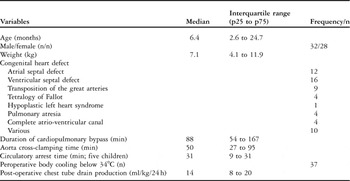
Table 1 shows the demographic and clinical characteristics of the 60 children. The group comprised children with various congenital heart defects of which the most common were septal defects, but transposition and other cardiac and/or vascular abnormalities were also present. Surgical procedures ranged from simple, low-risk procedures – Risk Adjusted Classification of Congenital Heart Surgery-1 class I – to the most complex ones carrying a high mortality risk – Risk Adjusted Classification of Congenital Heart Surgery-1 class V1.Reference Jenkins, Gauvreau, Newburger, Spray, Moller and Iezzoni13
Demographic and clinical characteristics of the study population (60 children).

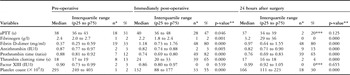
All conventional coagulation tests changed significantly during surgery (Table 2). The most pronounced changes were observed for activated partial thromboplastin time, prothrombin time, thrombin clotting time, and platelet count. Analysis performed 24 hour after surgery showed that changes remained present in prothrombin time, thrombin clotting time, and platelet count, whereas the values for the other tests tended to normalise. The level of antithrombin and factor XIII activity remained largely unchanged in all children. When we applied the age-specific reference ranges by Monagle et alReference Monagle, Barnes and Ignjatovic15 and local reference ranges, abnormal results were most common immediately after surgery, Table 2.
Pre- and post-operative test results of conventional coagulation parameters among 60 children undergoing heart surgery.
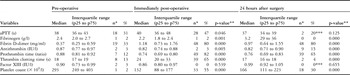
aPTT = activated partial thromboplastin time
aPTT, fibrinogen, fibrin D-dimer, and antithrombin are related to age-specific reference intervals published by Monagle et alReference Monagle, Barnes and Ignjatovic15
Prothrombin time, thrombin clotting time, factor XIII, and platelet count are related to local reference ranges
*Patients outside reference intervals
**As compared to pre-operative tests (Wilcoxon's signed-rank test)
***n < 10
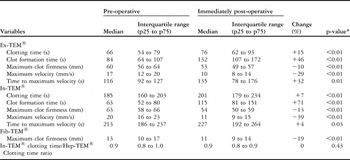
Table 3 shows the major changes observed in all parameters indicating an overall decreased haemostatic potential. The most pronounced change was found in clot formation time in all assays – prolonged by 46–71%; however, propagation was also severely impaired, which was indicated by a reduced maximum velocity. The Fib-TEM® assay showed a 19% reduction in maximum clot firmness, indicating a reduced fibrinogen level or impaired polymerisation following cardiopulmonary bypass. The RoTEM® results were not indicative of any residual heparin in the post-operative samples.
Pre- and post-operative test results of RoTEM® analysis among 60 children undergoing heart surgery.
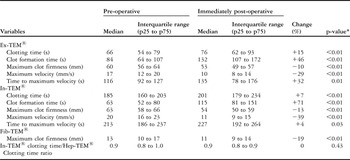
*Wilcoxon's signed rank test
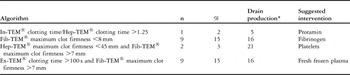
We applied the RoTEM® guidelines published by Görlinger et alReference Gorlinger, Kong, Nimmo and Sorensen16 to guide haemostatic intervention in adults during and after cardiac surgery. On the basis of the algorithm and in the case of bleeding, our results indicated that further substitution might be needed in 21 out of the 60 children (Table 4).
Evaluation of the post operative RoTEM® results according to the guidelines by Görlinger et alReference Gorlinger, Kong, Nimmo and Sorensen16.
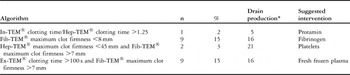
The algorithm is used on the assumption that the children showed excessive bleeding and the numbers who needed further substitution after surgery are indicated as well as the suggested intervention
*Median drain production in ml/kg/24 h
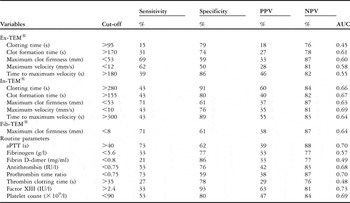
In order to compare performance of conventional coagulation tests with RoTEM® analysis, we performed a receiver-operating characteristic curve analysis. Patients were divided into “bleeders” – more than 20 millilitres per kilogram per 24-hour chest tube drainage – and “non-bleeders” – less than 20 millilitres per kilogram per 24-hour chest tube drainage – and we found a prevalence of 25% with severe bleeding. As can be seen in Table 5, the area under the curve is approximately 0.65 for both groups, with slightly higher performance for individual variables. The negative predictive values of RoTEM® parameters were acceptable and comparable to the results obtained with conventional coagulation tests.
Diagnostic properties of RoTEM® parameters and conventional coagulation tests in children undergoing congenital heart surgery are indicated.
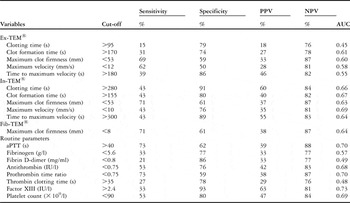
True diagnosis is considered a blood loss above 20 ml/kg/24 h
aPTT = activated partial thromboplastin time; AUC = area under the curve for receiver-operating characteristic curve analysis; NPV = negative predictive value; PPV = positive predictive value
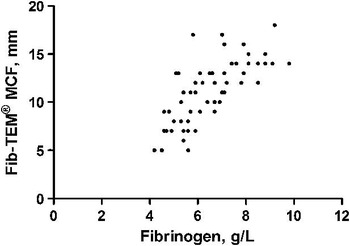
Fib-TEM® maximum clot firmness and plasma fibrinogen showed the strongest association when we compared RoTEM® parameters with conventional coagulation tests (r = 0.71, p < 0.01; Figure 1).
Scatter plot of post-operative Fib-TEM® maximum clot firmness and fibrinogen in the 60 children after surgery for congenital heart disease.

Discussion
Both the conventional coagulation tests and RoTEM® analysis demonstrated significant changes in the haemostatic capacity of 60 children having undergone congenital heart surgery, and the two approaches performed equally well with regard to negative predictive values for post-operative bleeding.
A number of children presented with abnormal conventional coagulation test results before surgery; and values were abnormal even when age-specific reference ranges were applied. This was expected as previous studies have shown that major pathophysiological differences exist and that these differences may affect haemostasis in children with congenital heart defects.Reference Miller, Mochizuki and Levy17 Immediately after surgery, the conventional coagulation tests showed marked changes in the majority – more than 50% – of the children. Only fibrinogen, antithrombin, and Factor XIII remained within the normal reference range. Although the fibrinogen level was within the reference range, it is well known that an improved haemostatic capacity can be obtained at higher levels.Reference Blome, Isgro and Kiessling18 In treatment algorithms, it is generally recommended that the fibrinogen level is brought to a level above 1 gram per litre.Reference Gaarder, Naess and Frischknecht19 Apart from the age-related haemostatic capacity, the variation in the severity of the underlying cardiac disease and, accordingly, in cardiopulmonary bypass times, the extent of cooling and other perioperative factors may account for some of the variation in the haemostatic changes observed after cardiopulmonary bypass among children. Much variation in haemostatic response after cardiopulmonary bypass has also been reported in adult patients.Reference Cammerer, Dietrich, Rampf, Braun and Richter10
Previous data on age-dependent differences in RoTEM® clotting profiles have shown conflicting results. Thus, Chan et alReference Chan, Summerhayes, Ignjatovic, Horton and Monagle20 showed no differences in reference ranges for children (1 month–16 years) as compared with adults. However, Edwards et alReference Edwards, Naik-Mathuria, Gay, Olutoye and Teruya21 found significantly shorter clotting times in neonates, and a recent study by Oswald et alReference Oswald, Stalzer and Heitz22 supports the theory that RoTEM® reference ranges are age dependent.Reference Oswald, Stalzer and Heitz22 This indicates that age may play a role and should, indeed, be considered when interpreting RoTEM® results.
In accordance with similar studies in adults, the RoTEM® analysis performed well with respect to negative predictive values for major bleeding after cardiopulmonary bypass,Reference Reinhofer, Brauer, Franke, Barz, Marx and Losche23 whereas positive predictive values of RoTEM® were of limited value. To compare the predictive values in this paediatric study with a similar study in adults, we applied the cut-off points published by Reinhöfer et alReference Reinhofer, Brauer, Franke, Barz, Marx and Losche23 to our data. Our definition of post-operative bleeding was comparable to that used in the study of adult cardiac surgery patients. We found a lower specificity for all parameters of the Ex-TEM® assay (50–86%) than was reported by Reinhöfer et al,Reference Reinhofer, Brauer, Franke, Barz, Marx and Losche23 whereas the In-TEM® analysis (61–91%) performed better in children than in adults. The reduced ability to predict clinical outcome in children as compared with adults could be due to the developmental differences in concentrations of fibrinogen and coagulation factors II, V, VII, and X, as shown in the studies by Monagle et al.Reference Monagle, Barnes and Ignjatovic15
Before implementation of the RoTEM® analysis, it is vital to know how well this method performs in predicting the actual need of haemostatic components. In spite of the significantly shorter turnaround time of RoTEM®, it is mandatory that the results guide the treating clinician on an efficient and tailored haemostatic intervention. The RoTEM® analysis seems sensitive enough to detect changes, as major deviations were observed in the majority of RoTEM® assays. Importantly, the present study indicates that treatment algorithms for adults cannot be directly extrapolated to children. However, we cannot deduce from the present changes in the RoTEM® profiles which haemostatic intervention is appropriate, and nor can we determine the proper timing of intervention.
Our study was designed to describe changes in conventional coagulation tests and RoTEM® analysis after cardiac surgery in children, but not to evaluate the effect of any intervention. A cause–effect relationship, therefore, cannot be deduced from the observations. Cardiac surgery and cardiopulmonary bypass imply that all children per se suffer from some degree of coagulopathy.Reference Chan, Leaker and Burrows2 One of the major limitations of the study is that we do not know the extent to which this coagulopathy is reflected in the post-operative drain production because observations are influenced by the fact that children received haemostatic intervention independently of the RoTEM® results. In addition, we cannot exclude that some children developed coagulopathy after blood sampling and therefore showed excessive bleeding without detectable impairments in coagulation tests.
In conclusion, RoTEM® can detect haemostatic impairments in children undergoing cardiac surgery, and the method should be considered as a supplement in the perioperative care of children where targeted transfusion therapy is necessary to avoid volume overload.
Acknowledgement
This study was supported by the Danish Children's Heart Foundation – founded by The Danish Heart Foundation, Snedkermester Sophus Jacobsen og hustru Astrid Jacobsens Fond and Hørslevfonden.