Kawasaki Disease is an acute vasculitis of unknown origin that affects mainly small-to-medium-sized vessels.Reference Newburger, Takahashi, Gerber and Gewitz 1 Kawasaki disease is a well-known disease in children as it occurs most often in children younger than 5 years of age, but it has been described to occur in adolescents and even in adults. Acute Kawasaki disease in adults is very rare, and therefore it is often unrecognised.Reference Wolff, Hansen and Zakowski 2 In this study, we report the case of an adult with acute Kawasaki disease.
Case report
A-26-year-old Paediatric Resident in our Hospital was assessed. He was previously healthy, reported no family history of rheumatic disease, and he had no contacts with patients with similar symptoms.
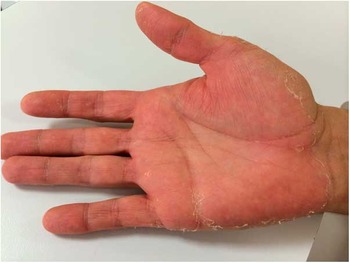
He reported a 4-day history of illness that began in June 2014 with fever, headache, rhinorrhoea, sore throat, arthralgia, and general malaise. On physical examination, the patient’s temperature was 38.5°C. He had conjunctival redness, dry oral mucosa, an erythematous pharynx, and a 2×2-cm right cervical lymphadenopathy. Diagnosis of viral pharyngitis was suspected and symptomatic treatment was provided. After 2 days, as the fever resolved, an erythematous maculopapular rash appeared on his torso and spread to his extremities, associated with hyperaemia and oedema of his palms and soles. The diagnosis of parvovirus B19 was suspected and laboratory tests were performed. His haemoglobin level and leucocyte and platelet counts were normal, and IgM and IgG for parvovirus B19 were negative. His fever and all the other symptoms resolved. After 10 days (14 days since the onset of the fever), desquamation of his fingers, palms, toes, and soles began (Fig 1). Kawasaki disease was suspected based on the diagnostic criteria for childhood Kawasaki disease – that is, the presence of symptoms such as conjunctival changes, pharyngitis, cervical lymphadenopathy, exanthema, oedema, and desquamation of palms and soles. New laboratory tests that included full blood count, acute phase reactants, hepatic functional tests, and viral serology for parvovirus, Ebstein-Barr virus, Hepatitis A and B, and Human Immunodeficiency Virus were performed and reported as normal. An echocardiogram was performed and was found to be normal with normal coronary arteries. As he no longer had fever, with normal acute-phase reactants, and was already at day 14 when the diagnosis was made, immunoglobulin was not administered, but treatment with an antiplatelet dose of aspirin at 100 mg/day was initiated. The follow-up echocardiograms at 2 and 8 weeks showed no coronary aneurysms. Aspirin was therefore discontinued and currently our patient remains asymptomatic.
Palm desquamation in an adult patient with Kawasaki disease.

Discussion
Kawasaki disease is the most common acquired heart disease in children in developed countries.Reference Newburger, Takahashi, Gerber and Gewitz 1 The incidence of Kawasaki disease in Latin America and in Mexico is unknown, as Kawasaki disease is not reportable, but recent studies have demonstrated that diagnosis of the disease in Latin American countries is increasing, although acute Kawasaki disease in adults has not been reported in Mexico.Reference Salgado, Ulloa-Guiérrez and Estripeaut 3 , Reference Garrido-García, Soto-Blanquel and Espinosa-Rosales 4
Of note is that there are differences in various aspects of Kawasaki disease between races. Loomba et al, recently compared clinical findings, laboratory values, echocardiography findings, and treatment efficacy among children of different races in a Paediatric Hospital in the United States of America.Reference Loomba, Raskin, Gudausky and Kirkpatrick 5
The occurrence of Kawasaki diseases is rare after 10 years of age, but cases of acute Kawasaki disease in adolescents and even in adults have been reported. The first case of Kawasaki disease in adults was reported in 1979 by Everett, and a few cases have been reported since then.Reference Everett 6 A recent review of adult acute Kawasaki disease by Kontopoulou showed that only 100 cases have been reported worldwide, with n=33 patients from North America, n=2 from South America, n=9 from Asia, n=2 from Africa, and n=54 from Europe, with 43 cases in France.Reference Kontopoulou, Kontopoulos, Vaidakis and Mousoulis 7 Interestingly, only a few adult Kawasaki disease patients are reported from Asia, despite being the region of the world with most cases of the disease in children. This observation probably supports the theory of an infectious agent, with most adults in an Asian population already being exposed early in childhood.
In addition, Kawasaki disease has been reported frequently in patients with human immunodeficiency virus-related diseases (21 of the 100 reported cases). Kawasaki disease was associated with severe immunosuppression and a high viral load, but neither cardiovascular complications nor death occurred in these patients.Reference Stankovic, Miailhes, Bessis, Ferry, Broussolle and Sève 8
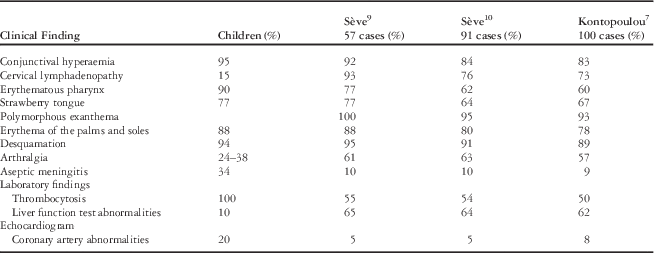
The diagnostic criteria for Kawasaki disease were developed in 1967 for children and have not been validated in adults. “Complete” Kawasaki disease presents with 5 or more days of fever and at least four of the classical clinical signs: conjunctival hyperaemia, oral changes, cervical lymphadenopathy, polymorphous exanthema, and extremity changes.Reference Newburger, Takahashi, Gerber and Gewitz 1 Clinical signs of Kawasaki disease in adults differ from the classical signs present in children. Sève, in 2005, summarised the difference in clinical and laboratory presentation between children and adults with Kawasaki disease. Cheilitis, meningitis, and thrombocytosis were observed in a larger percentage of children, whereas arthralgia, adenopathy, and liver function abnormalities were more common in adults.Reference Sève, Tankovic, Smail, Durand, Marchand and Broussolie 9 Since Sève’s review, more cases of Kawasaki disease in adults have been reported, and, although no statistical analysis is possible, there is a different clinical picture between Kawasaki disease in children and adults. Clinical and laboratory differences between Kawasaki disease in children and adults are summarised in Table 1.Reference Kontopoulou, Kontopoulos, Vaidakis and Mousoulis 7 , Reference Sève, Tankovic, Smail, Durand, Marchand and Broussolie 9 , Reference Sève and Lega 10
Clinical picture of Kawasaki disease in adults compared with children.

The diagnosis of Kawasaki disease in our patient was established after he developed desquamation of palms and soles. In retrospect, he had clinical signs compatible with Kawasaki disease: conjunctival hyperaemia, oral changes, cervical lymphadenopathy, and a maculopapular rash that initially was thought to be due to a B19 Parvovirus infection, but was discounted after negative immunological tests. He also presented with arthralgia – a common feature of adult Kawasaki disease. Differential diagnosis of adult Kawasaki disease should include viral and vector-borne diseases, scarlet fever, hypersensitivity drug reaction, toxic shock syndrome, adult-onset Still’s disease, systemic lupus erythematous, and hypersensitivity drug reaction.Reference Sève, Tankovic, Smail, Durand, Marchand and Broussolie 9 , Reference Sève and Lega 10
The recommended treatment for Kawasaki disease in adults is similar to that of children, with intravenous gammaglobulin administered before the 10th day from the onset of fever. In our patient, as in most of the reported cases of adult Kawasaki disease, the diagnosis was established after the acute phase, and gammaglobulin was not administered. In adults, as in children, the beneficial effects from the administration of gammaglobulin after the resolution of fever cannot be expected. Despite the lack of administration of gammaglobulin in most adult Kawasaki disease patients, the development of coronary artery aneurysms is less frequent (8%)Reference Stankovic, Miailhes, Bessis, Ferry, Broussolle and Sève 8 compared with children who do not receive gammaglobulin (25–30%). The reason for this difference has not been established.
Conclusions
This is the first report of acute Kawasaki disease in the adult population in Mexico and the third in Latin America. As acute Kawasaki disease is rare in adults, it is important to recognise the possibility of the disease in patients with prolonged fever associated with unusual clinical features.
Acknowledgement
None.
Conflicts of Interest
None.