In politics, most people lack knowledge and direct personal experience with the key issues, groups and events. Instead, they must rely on indirect information often reported via the mass media when forming political opinions (Lippmann Reference Lippmann1922, 59). A wealth of research demonstrates that how the media presents or frames political issues substantially shapes how ordinary people think about them (Chong and Druckman Reference Chong and Druckman2007a; Nelson, Clawson and Oxley Reference Nelson, Clawson and Oxley1997; Zaller Reference Zaller1992). Yet not all media frames are equally persuasive, and recent research has sought to identify the factors regulating the persuasiveness of political communications, often referred to as the strength of communications. Indeed, researchers have described the question of what makes a political communication strong as ‘perhaps the most pressing question’ (Druckman Reference Druckman2011, 297) in political communications research.Footnote 1
Importantly, past research on the factors shaping communication strength has focused on the effect of communications as presented by media (or other elite) sources directly to non-specialists. While this focus has been a laudable starting point for theorizing about communication strength, it neglects how a substantial part of citizens’ exposure to political communications comes not directly from the media but rather from fellow citizens in their social networks (Bond et al. Reference Bond2012; Choi Reference Choi2015; Druckman, Levendusky and McLain Reference Druckman, Levendusky and McLain2018; Huckfeld and Sprague Reference Huckfeldt and Sprague1987; Mutz and Mondak Reference Mutz and Mondak2006). As recognised by Katz and Lazarsfeld (Reference Katz and Lazarsfeld1955), political communications have a two-step structure: communication originates in elite sources and then disseminates to most lay individuals via their social networks.Footnote 2
We argue that the two-step nature of the communication flow fundamentally challenges how we should theorize about communication strength. Specifically, it necessitates careful consideration of how cognitive biases shape the strength of political communication: fast-and-frugal psychological processes that direct how people receive, store, retrieve and evaluate information (Gigerenzer and Goldstein Reference Gigerenzer and Goldstein1996). While past research indicates that such biases do affect communication strength in the first step of the communication flow (Arceneaux Reference Arceneaux2012), we argue that they are particularly important to communication strength in the second step. When citizens receive media communications (that is, the first step), professional journalists (or other elite actors) have taken care to formulate their frames in a coherent manner, following journalistic norms and rules regarding, for example, narrative flows (Gamson and Modigliani Reference Gamson and Modigliani1989; Gilliam and Iyengar Reference Gilliam and Iyengar2000). Well-crafted media communications might alleviate ordinary citizens’ cognitive work during reception and increase the likelihood that they will be able to process – and be influenced by – the frames, even if they might resonate less with cognitive biases. However, the second step of the communication flow is different. When media stories are transmitted within social networks, citizens are on their own: they must retrieve and recollect the communications themselves. Given the well-established limitations on citizens’ political knowledge and interests,Footnote 3 there are reasons to be sceptical about the ability of citizens to relay media frames in a coherent and, hence, persuasive manner to fellow citizens. Yet, while political scientists have lamented the general lack of political sophistication among ordinary citizens, a consistent line of research in the psychological sciences indicates that the human mind is exceptionally capable of encoding, recollecting and evaluating specific types of information: those that fit basic cognitive biases (de Martino et al. Reference De Martino2006; Gigerenzer and Selten Reference Gigerenzer and Selten2002; Kahneman Reference Kahneman2011; Tooby and Cosmides Reference Tooby and Cosmides1992).
Here, we utilize this psychological research to develop a novel theory of communication strength in the two-step communication flow. We argue that, despite their general lack of political sophistication, citizens are able to recollect communications that resonate with cognitive biases reliably and persuasively. Consequently, such communications will travel farther and with greater strength in the social networks of lay individuals. Thus while the direct effects of media frames might be short-lived, as demonstrated in past research (Lecheler and de Vreese Reference Lecheler and de Vreese2013), our two-step model highlights how media communications that resonate with cognitive biases will endure in citizens’ social networks. This implies that citizens are continuously exposed to such communications in their everyday political conversations, hence increasing their persuasive reach and strength.
We test this model, focusing on one of the most widely used types of political communication: episodic frames (Gross Reference Gross2008; Iyengar Reference Iyengar1991). An episodic frame takes ‘the form of a case study or event-oriented report and depicts public issues in terms of concrete instances’, whereas a thematic frame ‘places public issues in some more general or abstract context’ and ‘presents collective and general evidence’ (Iyengar Reference Iyengar1991, 14). The distinction between episodic and thematic frames in communication research is aligned with distinctions in psychological research on cognitive biases. Multiple psychological theories converge on the prediction that the human mind is psychologically biased to better process vivid social information relative to abstract thematic information (Cosmides and Tooby Reference Cosmides and Tooby2006; Fowler and Schreiber Reference Fowler and Schreiber2008; Petersen and Aarøe Reference Petersen and Aarøe2013; Zillmann and Brosius Reference Zillmann and Brosius2000). We integrate psychological theories about a cognitive bias favouring vivid social information and our argument about the strength of bias-resonating communications in social networks. While episodic frames might not necessarily affect policy preferences more strongly than thematic frames when people are directly exposed to media communications, we predict that episodic frames’ resonance with cognitive biases increases their strength in the second step of the communication flow. Specifically, we predict that episodic frames (1) are more reliably recollected and transmitted between peers in social networks and (2) shape opinions more strongly in the course of these continued transmissions.
We test these predictions introducing a novel research design optimally geared towards investigating the psychological underpinnings of the transmission of political communications within social networks in the general public.Footnote 4 In online survey experiments fielded to nationally representative samples, we implement the children’s game ‘Telephone’.Footnote 5 Across three tests, we demonstrate that citizens are able to recollect and transmit episodic frames more reliably than thematic frames in the two-step communication flow – both for news stories for which episodic and thematic frames are dually available and those where one frame type dominates. Secondly, and most importantly, we reveal how this ‘episodic’ bias in the recollection and transmission of political communication is consequential for persuasion effects on opinions. Across multiple peer transmissions of political communication, ordinary citizens are able to relay episodic frames in a manner that influences the opinions of their audiences more strongly than thematic frames.
The Two-step Model and a Theory of Communication Strength
In politics, the flow of information has a two-step dynamic: While communications are typically first presented by media sources, their further dissemination among citizens is facilitated in a second step, in which individuals hear about them via their peer networks (Katz and Lazarsfeld Reference Katz and Lazarsfeld1955), either in classical face-to-face conversations (Druckman, Levendusky and McLain Reference Druckman, Levendusky and McLain2018) or in the form of social media posts in the growing digital environment (Choi Reference Choi2015).
The information transmitted to citizens in the two-step flow ‘is never a full record of important events and developments in the world’ but rather ‘selective’ representations of reality (Zaller Reference Zaller1992, 7). These selective ‘communications’ can be conceptualized as political framesFootnote 6 emphasizing ‘a central organizing idea or story line’, suggesting the ‘essence of the issue’, and implying ‘a policy direction or implicit answer to what should be done about the issue’ (Gamson and Modigliani Reference Gamson and Modigliani1987, 140, 143). The strength of a political communication or frame refers to its effectiveness in influencing how people understand political issues and their opinions about them.
Few studies have examined the factors that explain the strength of political communications (Druckman Reference Druckman2011; O’Keefe Reference O’Keefe2002, 156). Most research has identified strong frames inductively by asking pre-test participants to assess the strength of different communications (Chong and Druckman Reference Chong and Druckman2007a, 641). Other studies have investigated the strength of various rhetorical characteristics of communications (Gerber and Green Reference Gerber and Green2000; see also Chong and Druckman Reference Chong and Druckman2007b, 117). Recent research has moved towards a more psychological focus, suggesting that ingrained cognitive biases may affect communication strength. Specifically, Arceneaux (Reference Arceneaux2012) found that when people are in an emotional state that activates a cognitive bias, communications that resonate with the bias will be strong. Importantly, however, these previous studies all focus on the first step, in which media frames are presented directly to the citizens. We know next to nothing about the strength of political frames in the second step, when ordinary citizens recollect and transmit media communications.
Considerable research on citizens’ political sophistication suggests that any frame will become dramatically weaker when it moves from the first to the second step. Dating back to the seminal work of Converse (Reference Converse1964), a common position has been to lament the lack of political knowledge and clear thinking among the citizenry. It has been argued that the mass public is ‘awash in ignorance’ of politics (Kinder Reference Kinder1998, 785) and that ‘nothing strikes the student of public opinion and democracy more forcefully than the paucity of information most people possess about politics’ (Ferejohn Reference Ferejohn1990, 3).Footnote 7 When ordinary citizens receive media communications (that is, the first step), trained journalists have taken professional care to formulate the frames in a coherent manner that meets journalistic reporting conventions, follow scripts that ‘facilitate comprehension by distilling experience and knowledge’, and ‘provide an orderly and quite predictable set of scenarios and roles’ (Gilliam and Iyengar Reference Gilliam and Iyengar2000, 650). Hence, in the first step of the communication flow, citizens are presented with a streamlined ‘media package’ about an issue (Gamson and Modigliani Reference Gamson and Modigliani1989), which facilitates message encoding and reduces the need for interpretation and inferences.
The situation is different in the second step of the communication flow. Here, citizens themselves retrieve and recollect the frame. This might seem like an easy cognitive feat: it is merely about repeating what they read in the newspaper or saw on television. But decades of research on memory indicate that this is not how we recollect information. As Zaller (Reference Zaller1992, 93–4) argues, people do not store attitudes in their long-term memory as in a file drawer, ready to be pulled out; rather, they construct them on the spot. It is the same with complex informational structures such as frames (Boyer Reference Boyer2001). Recollecting a frame in a coherent and persuasive way requires significant mental processing; information is easily lost and the story line easily blurred (Bebbington et al. Reference Bebbington2017, 92). Accordingly, there is reason to believe that the strength of a political frame rapidly deteriorates when transmitted among lay individuals with low levels of political competence. This was already foreshadowed in the original works on the two-step flow of information, which argued that successful transmissions in the second step were refined to a narrow segment of ‘opinion leaders’ or ‘word-of-mouth specialists’.Footnote 8
Since the original formulation of the classical perspective, however, research on information processing and cognitive biases has advanced significantly. This research arguably implies that some political frames will be able to survive transmissions in social networks even among the least sophisticated. Specifically, psychological research suggests that not all information is equal; some information is easier to process and receives more attention. This is referred to as ‘cognitive biases’, which are built-in predispositions (or heuristics) that give direction to the filtering, encoding and retrieval of information as well as the production of inferences in social decision making (Boyer Reference Boyer2001; De Martino et al. Reference De Martino2006; Gigerenzer and Goldstein Reference Gigerenzer and Goldstein1996; Gigerenzer and Selten Reference Gigerenzer and Selten2002; Tooby and Cosmides Reference Tooby and Cosmides1992; Tversky and Kahneman Reference Tversky and Kahneman1974). Such biases and heuristics can compensate for a lack of detailed knowledge in decision making (Gigerenzer and Goldstein Reference Gigerenzer and Goldstein1996; Kahneman Reference Kahneman2011; Tooby and Cosmides 2006). Consequently, we argue that if political frames fit the mind’s cognitive biases, citizens will be able to transmit them more reliably and with greater strength in the second step of the communication flow than frames lacking such a fit. In fact, given the importance of citizens’ own competences in the second step, there is reason to believe that cognitive biases are even more important for frame strength in the second than in the first step of the communication flow.
A Theory of Episodic Bias and Communication Strength in the Two-step Flow
To explore the importance of this framework for understanding communication strength, we turn to a prominent distinction in research on political communication and real-world political communication: the distinction between episodic and thematic frames. Episodic and thematic news frames represent two fundamental types of frames that are used across issues, time, and space in political news coverage and debates (Gross Reference Gross2008, 171; Iyengar Reference Iyengar1991, 2). A number of studies have investigated the effects of episodic and thematic frames in the first step of the communication flow when media frames are presented directly to the public. In contrast, the study of how these frames are recollected, transmitted and how they influence opinions in the second step of the flow has been absent.
From a psychological perspective, episodic frames carry vivid, intimate social information. Multiple lines of psychological research converge on the prediction that people are particularly good at encoding and producing inferences about such intimate social information compared to large-scale abstract information. Evolutionary theories, for example, emphasize how crucial parts of the human decision-making apparatus evolved to help our ancestors navigate life in small-scale groups (Cosmides and Tooby Reference Cosmides and Tooby2006, 181–2; Tooby and Cosmides Reference Tooby and Cosmides1992). For most of human evolutionary history, our ancestors lived in relatively small groups of 30–250 individuals (Dunbar Reference Dunbar1998; Kelly Reference Kelly1995) and would have evolved to make decisions on the basis of information available in such face-to-face interaction (Cosmides and Tooby Reference Cosmides and Tooby2006; Fowler and Schreiber Reference Fowler and Schreiber2008; Haley and Fessler Reference Haley and Fessler2005; Kurzban Reference Kurzban2001; Petersen and Aarøe Reference Petersen and Aarøe2013; Tooby and Cosmides Reference Tooby and Cosmides1992). Similarly, various strands of psychological research have demonstrated that social decisions and emotional reactions in everyday life are deeply affected by the social cues inherent to face-to-face interactions, such as the presence of bystanders (Haley and Fessler Reference Haley and Fessler2005), eye contact (Kurzban Reference Kurzban2001), facial expressions (Scharlemann et al. Reference Scharlemann2001), facial features (such as attractiveness and masculinity) (Sell et al. Reference Sell2009; Wilson and Eckel Reference Wilson and Eckel2006) and other kinds of non-verbal cues (Brown, Palameta and Moore Reference Brown, Palameta and Moore2003). These effects also generalize to political attitudes: when people have clear perceptions of the motivations and characteristics of specific individuals influenced by policies, they are able to form political attitudes more easily and more strongly (Petersen and Aarøe Reference Petersen and Aarøe2013). Hence, across multiple lines of research, the evidence shows that the human mind has a built-in bias towards relying on vivid, intimate social information when making decisions. Such information is exactly the kind contained in episodic rather than thematic frames. Accordingly, we refer to this cognitive bias as an ‘episodic’ bias.
Research on political communication has investigated the relative strength of episodic and thematic frames in the first step of the communication flow. These studies have consistently shown that episodic cases involving specific individuals elicit stronger emotional reactions than thematic, abstract information describing political issues in terms of general statistics (Aarøe Reference Aarøe2011; Gross Reference Gross2008; Small and Loewenstein Reference Small and Loewenstein2005). When it comes to the impact on policy opinions, however, the evidence from past studies is more mixed. Research on ‘exemplification effects’ in news reports (Zillmann and Brosius Reference Zillmann and Brosius2000) and studies on ‘the base-rate fallacy’ (Bar-Hillel Reference Bar-Hillel1980) have shown that information about concrete individuals affects how people perceive social problems more strongly than abstract statistical information (Brosius and Bathelt Reference Brosius and Bathelt1994; Ostfeld and Mutz Reference Ostfeld and Mutz2014; Zillmann et al. Reference Zillmann1996, 437; see also Zillmann and Brosius Reference Zillmann and Brosius2000, 61–62). Some research has found that individuals exposed to episodic frames expressed more message-consistent attitudes than those who read thematic frames in the first step (Springer and Hartwood Reference Springer and Harwood2015). Other studies, however, have found no difference in the average persuasive effect of episodic and thematic frames on policy opinions in the first step of the communication flow (Aarøe Reference Aarøe2011; Gross Reference Gross2008).
Here, we conduct the first systematic test of the relative strength of episodic and thematic frames in the second step of the communication flow: how citizens recollect and transmit episodic and thematic news stories to others, and how these recollected frames influence the opinions of these fellow citizens.
Our first prediction is that, due to their fit with episodic bias, episodic frames will be recollected and transmitted to a larger extent than thematic frames in the two-step flow of political communication (Hypothesis 1).Footnote 9 In the second step of the communication flow, we predict that episodic bias will increase the persuasiveness of episodic relative to thematic frames. As reflected in the mixed findings in the past literature, the strength of episodic relative to thematic frames in shaping political opinions might be less clear-cut in the first step of the communication flow. Media stories, even with abstract statistics, are usually well narrated in the first step. As argued above, however, when the frames deteriorate in the second step, cognitive biases (including episodic bias) should increase in importance and shape the strength of different frames more profoundly.Footnote 10 Specifically, if people are better at processing vivid social information that resonates with the episodic bias, episodic frames should be more persuasive than thematic frames when recollections of media stories are transmitted among citizens in peer networks (Hypothesis 2). Finally, we also explore the role of individual differences in citizens’ political sophistication. Classical theories addressing the effects of elite communication argue that citizens with low levels of political sophistication have a particularly limited ‘reception and understanding of communications from the political environment’ as well as a limited ability to use this information to formulate statements about policy (Zaller Reference Zaller1992, 21, 42). Similarly, as emphasized above, the classical work on the two-step flow of communication confined the successful transmission of political frames to opinion leaders – well-connected citizens with particularly high levels of political sophistication (Katz Reference Katz1957). Nonetheless, if the episodic bias constitutes a general psychological bias, this suggests that episodic frames that fit this bias represent an exception. Indeed, if the episodic bias constitutes a general psychological bias that enables people to encode vivid social information and transmit it in persuasive ways, all citizens (regardless of their political sophistication) should be able to recollect episodic frames and transmit them persuasively (Hypothesis 3).
Test 1. Frame Transmission in a Two-step Communication Flow
Test 1 investigated the implications of episodic bias for the dissemination of episodic and thematic frames when examining the citizen-to-citizen transmission of media news stories. According to Hypothesis 1, episodic frames should be recollected and transmitted to a larger extent than thematic frames in the two-step flow of political communication.
Research design and measures
To investigate how episodic and thematic frames spread in social networks, we adopted a method from social psychology specifically designed to experimentally create the artificial networks through which a text is passed. This design, called the transmission chain design (Mesoudi, Whiten and Dunbar Reference Mesoudi, Whiten and Dunbar2006; see also Barlett Reference Barlett1932), analyses how a text changes when it is repeatedly recollected by chains of subjects in a manner similar to the children’s game of ‘Telephone’. The first subject in a chain reads a text and recollects it. The next subject in the chain reads the first subject’s recollection of the text, and the third subject in the chain reads the second subject’s recollection of the first subject’s recollection of the original text. This design is ‘uniquely effective in revealing cumulative and systematic bias’ in the recall and transmission of information (Mesoudi, Whiten and Dunbar Reference Mesoudi, Whiten and Dunbar2006, 406). Specifically, as Mesoudi and Whiten (Reference Mesoudi and Whiten2008, 3491) emphasize, ‘by comparing the rates at which different kinds of material degrades, the researcher can infer the operation of systematic biases’.Footnote 11 For the first time, this design was implemented in consecutive online web surveys administered to nationally representative samples to investigate the longer-term persistence of episodic bias in the transmission of media frames in the two-step communication flow. Specifically, frames were passed through chains of respondents in three consecutive nationally representative samples collected by YouGov in Denmark. Using quota sampling, three cross-sectional samples were drawn from the agency’s standing online panel to approximate national representativeness on the parameters of gender, age, geography and education. Survey 1 (first transmission round) was collected from 30 October to 12 November 2012 (n=620), Survey 2 (second transmission round) 5–17 December 2012 (n=621), and Survey 3 (third transmission round) 15–29 January 2013 (n=623). Each respondent only participated in one survey.
Experimental stimuli
To initiate the transmission chain design in Survey 1, all of the respondents read a newspaper article about a proposal to reduce social welfare benefits. Hence, we focus on a salient issue that represents a sizeable part of public spending in Western democracies and constitute an important aspect of public policy (Ford Reference Ford2015, 630). In the experiment, we varied the overall issue framing of the news article. The respondents read the article either with a ‘pro’ financial motivation framing or a ‘con’ destitution framing. Importantly, each news article included both an episodic and a thematic part. As Iyengar (Reference Iyengar1996, 62) emphasizes, ‘few news reports are purely episodic or thematic’. To mimic real-world news reports, we therefore included both an episodic and a thematic pro financial motivation frame in the article with the pro framing and both an episodic and a thematic con destitution frame in the article with the con framing. This design allows us to investigate the transmission of the episodic and thematic frames when they appear in competitionFootnote 12 while controlling for the direction of the frame, hence increasing internal validity in this crucial respect. To control for order effects, we randomly varied whether the episodic or thematic frame appeared first in each news article. Thus the basic experimental design was a full factorial 2 (pro financial motivation frame or con destitution frame) × 2 (episodic or thematic frame first in article) design.
The news articles were written by a professional journalist working on the basis of the authors’ instructions to ensure experimental control. The episodic and thematic financial pro frames emphasized the need to increase the financial motivation of social welfare recipients to find work. The episodic and thematic destitution con frames emphasized how social welfare recipients were expected to become more destitute. Importantly, the episodic pro and con frames both focused on the motivations of a specific, named individual, whereas the thematic variants provided abstract and statistical information about the motivations of welfare recipients.Footnote 13
Specifically, the episodic pro financial motivation frame reported the story of 31-year-old Jesper Jørgensen, who preferred not to work, staying at home instead and playing war games on the Internet. He was not motivated to find a job but explained that he would be if the social welfare benefits were lower. The thematic pro financial motivation frame reported statistics on the number of unemployed people who would earn less than DKK 1,000 per month more by getting a job instead of living on social welfare benefits, together with statistics describing how more welfare recipients would find work if social welfare benefits were lower. The episodic con destitution frame reported the story of 35-year-old Rikke Hansen, a single mother who would like to find employment but had difficulty due to a back injury and problems with anxiety. She struggled to make ends meet, and further cuts to social welfare benefits would exacerbate her problems. The thematic con destitution frame reported statistics on the proportion of social welfare recipients living in outright poverty who suffer from physical and mental health issues. This frame noted that many of those in this group were providing for children. The frame described how cuts to social benefits would push more social welfare recipients into poverty (see Appendix A1.1 for full wording of the frames and supplemental discussion of their construction).
All of the episodic and thematic frames were matched on structure, including length (approx. 101 words) and use of quotes. A separate pre-test fielded to a nationally representative sample (n=50) validated that the four frames did not differ in terms of cohesive quality as measured on an index including the evaluation of the fluency, readability, and coherence of structure and language (see Appendix A1.2).
Experimental design and procedure
In the first survey (first transmission), the respondents were randomly assigned to read one of the four versions of the news article. After reading the article, they were taken to a new screen and instructed to recollect (in writing) the news story to a new participant in the study. In the second and third surveys (second and third transmissions), each respondent was randomly assigned to read a recollection from the previous survey.Footnote 14 After reading the recollection, the respondents were taken to a new screen and asked to write a recollection for a new participant. In all three surveys, the respondents were instructed:
[T]o recollect the story as accurately and literally as you can and including as many details from the article as possible. But you should not worry if you cannot remember everything. Your recollection will be passed on to a new participant in the study who will be charged with recollecting your recollection of the news story to a new participant. Therefore, we ask you to write as clearly as possible.
Following the procedure used in Lyons and Kashima (Reference Lyons and Kashima2001) and Kashima (Reference Kashima2000), the instructions explicitly emphasized the interpersonal nature of the communication by explaining that the recollection would be passed on to a new participant in the study (see Appendix A1.3 for further discussion of the recollection instructions). Note that, to simulate the two-step flow, our design entails that the direct source of the message to be transmitted is different in transmission 1 (media) than in transmissions 2–3 (another participant). Importantly, our analytical focus is to compare episodic and thematic information within each transmission round, holding the source constant. In contrast, between-round comparisons are complicated by the fact that both the direct source and the quality of the message (due to participants’ rewriting) are different.Footnote 15
Dependent measures
To measure how much of the information from the episodic and thematic frames the respondents recollected, we rely on automatic dictionary-based content analysis.Footnote 16 This method matches key words in the respondents’ recollections to the original news article using dictionaries. This approach provides a highly reliable and precise count of how much information from the original frames the respondents recollected.Footnote 17
To create the coding dictionaries, we identified the forty most important words in each of the four original episodic and thematic pro and con frames. To ensure that the dictionaries were as complete as possible, we then followed the Laver and Garry (Reference Laver and Garry2000) procedure and had twenty-five respondents (university students) in a separate survey identify the twenty most important words in each of the four frames. Words that were identified by at least 20 per cent of the respondents were added to the dictionaries. To control for word frequency, words that were among the 150 most commonly used words in the Danish language were unselected (Korpus 90 2013). This removed small, arbitrary and high-frequency words like ‘and’, ‘in’, ‘to’ and ‘of’, which could potentially bias the results if distributed disproportionally across the dictionaries. Finally, words such as ‘social welfare recipient’ and ‘social welfare’ (and close synonyms) were unselected from the dictionaries, as they were confounded with the general topic of the proposal and not unique to the frames. Appendix A1.5 reports the four dictionaries.
Using the dictionaries, the recollections were coded to measure how large a proportion of the information from the original episodic and thematic frames from the relevant input article the respondents recollected. This provides net measures of the proportion of correctly recollected information from the original episodic and thematic frames ranging from 0–1, where 0=no information from the dictionary was recollected and 1=all of the information from the dictionary was recollected.
Following recommendations made by Grimmer and Stewart (Reference Grimmer and Stewart2013), the automatic computer-assisted coding procedure was validated by human coding performed by two coders. The results show very high correlations between the automatic computer-assisted coding and human coding (Pearson r=0.91 or higher; see Appendix A1.6 for details). Finally, all of the key analyses reported below were replicated using dictionaries in which all of the words had been stemmed (Grimmer and Stewart Reference Grimmer and Stewart2013, 272). Stemming removes the ends of the words, ensuring the capture of slightly different words and conjugations referring to the same basic concept (see Appendix A1.7 for details).
Results
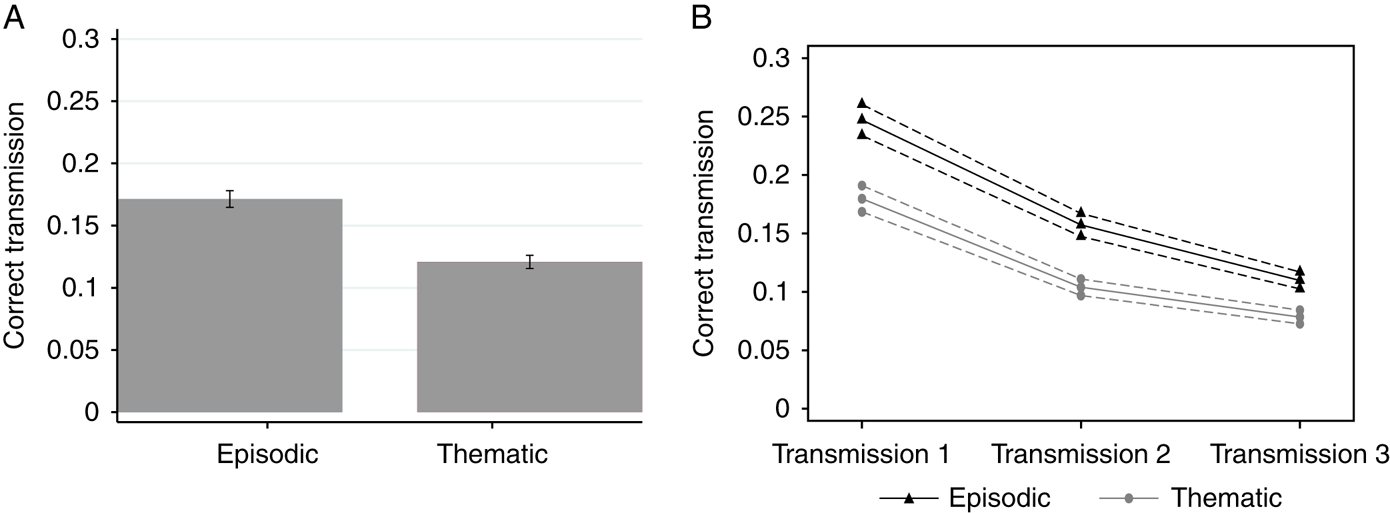
Are episodic frames transmitted to a greater extent than thematic frames? Figure 1 shows the proportion of transmitted information from the original episodic and thematic frames for all transmission rounds pooled and by transmission round. Entries are estimated using paired sample t-tests.
Transmitted information from the original episodic and thematic frames. Note: entries are mean proportions of transmitted information with 95 per cent confidence intervals. The findings were estimated using paired samples t-tests. In Panel A, n=1,515. In Panel B, n=512 in transmission 1, n=485 in transmission 2, and n=518 in transmission 3.

As seen in Figure 1, Panel A, the proportion of transmitted information from the original episodic frames was 0.17 across the three transmissions combined. In contrast, the proportion of transmitted information from the original thematic frames was only 0.12 (mean difference=0.05, p<0.001, Cohen’s d =0.42, see paired sample t-tests in Appendix A2.1). Thus, across the three citizen-to-citizen transmissions, the proportion of transmitted episodic information was on average 42 per cent larger than the proportion of thematic information. These results support Hypothesis 1.
As seen in Panel B, the proportion of correctly transmitted information from the original frames declines with each transmission. As Panel B shows, however, respondents transmitted a larger proportion of the episodic frames than the thematic frames in all three transmission rounds. In Panel B in the first transmission, the proportion of transmitted information from the original episodic frames was 0.25, while the proportion of transmitted information from the original thematic frames only reached 0.18 (mean difference=0.07, p<0.001, Cohen’s d=0.48). In the second and third transmissions, the mean difference in the proportion of transmitted information from the episodic and thematic frames was 0.05 (p<0.001) and 0.03 (p<0.001), respectively (Cohen’s d=0.56 and 41). Thus in the first, second and third transmissions, the proportion of transmitted information from the episodic frames was, respectively, 39 per cent, 50 per cent and 38 per cent greater than the proportion of transmitted information from the thematic frames.Footnote 18 The findings in Figure 1, Panels A–B, replicate (1) using the stemmed dictionaries, and when separately analysing (2) the pro and con frames and (3) the news articles in which the episodic frame appeared first and the articles in which the thematic frame appeared first (see Appendices A2.2–A2.4).Footnote 19, Footnote 20
The findings in Figure 1 support an episodic bias shaping citizen-to-citizen transmissions of media news stories such that people transmit more episodic than thematic information when these types of information are presented in the same news article. Real-world news stories typically feature a mix of episodic and thematic information (Iyengar Reference Iyengar1996, 62). In this respect, our research design ensures high external validity and realism. At the same time, this choice could raise concerns about the degree of causal traction in our research design. Specifically, because of the dual presence of episodic and thematic information in the original news story, one concern might be whether the automated content analysis accidentally counts some words from the recollections of the thematic frame as episodic and vice versa.
To address this concern, we conducted an additional experimental study with a nationally representative sample (n=403). In this study, the respondents were randomly assigned to read either one of the original episodic frames or one of the original thematic frames and then recollect the frame (see Appendix A3.1 for details on the research design). This research design allows us to conduct an automated content analysis in recollections produced after the respondents had read only an episodic or a thematic frame. Hence, we eliminate any potential confounds associated with the dual presence of both types of information. Importantly, the results from this experimental design replicate the finding that episodic frames are recollected more than thematic frames (mean proportion correctly transmitted information in the episodic condition=0.18, and the thematic condition=0.08, mean difference=0.10, p<0.001 in an independent samples t-test, Cohen’s d=0.76).Footnote 21 In sum, these findings support Hypothesis 1 and are consistent with the argument for an episodic bias for the encoding and transmission of vivid, intimate social information.
Test 2. Persuasion in the Second Step of the Communication Flow
The aim of Test 2 was to investigate the implications of episodic bias for the persuasiveness of socially transmitted frames. In Test 1, we saw that information from episodic frames is more likely to be transmitted among citizens. In Test 2, we ask whether it is also more likely to be transmitted in persuasive ways in the two-step flow. We predict this to be the case due to the effects of episodic bias on the processing of episodic information in both the sender and the receiver (Boyer Reference Boyer2001; Gigerenzer and Selten Reference Gigerenzer and Selten2002; Petersen Reference Petersen2015). First, episodic bias should enable senders to communicate more clearly about episodic information and coherently connect fragmented episodic information, given its resonance with intuitive ways of thinking. Secondly, episodic bias should help the receivers process the information. Overall, in the second step of the communication flow, the loss of information and the absence of professional journalistic skills places heavier requirements on citizens’ cognitive abilities to comprehend, memorize and make inferences about the information they receive from fellow citizens.Footnote 22 Cognitive biases facilitate the processing of fragmented information (Boyer Reference Boyer2001; Gigerenzer and Selten Reference Gigerenzer and Selten2002; Petersen Reference Petersen2015), especially in situations with high cognitive requirements (Macrae, Milne and Bodenhausen Reference Macrae, Milne and Bodenhausen1994). Thus, as summarized in Hypothesis 2, recollected episodic information should not just be more plentiful but also more persuasive than thematic information when received by citizens in the second step. To examine this hypothesis, Test 2 investigates whether the persuasiveness of recollected frames depends more on the amount of received episodic information than received thematic information.
Research design and measures
To investigate the persuasive effects of episodic and thematic frames in the second communication step, the data described in Test 1 included a measure of the respondent’s opinion on the policy proposal covered in the frames. Specifically, respondents were asked: ‘Do you support or oppose the proposal to cut welfare benefit rates?’ Answers were measured on a seven-point scale with endpoints labelled ‘strongly oppose’ and ‘strongly support’ and recoded to range from 0–1, higher values indicating higher support for the proposal (MSurvey 1=0.50, MSurvey 2=0.47, MSurvey 3=0.49). Opinions on the proposal were measured after the respondents had read the news article (Survey 1) or the recollection of the news article (Surveys 2–3) and after they had written their own recollection.
We need information about two additional factors in order to investigate the persuasive effects of episodic and thematic frames in the second communication step. First, we need to measure whether the original issue framing of the policy proposal was a pro or con frame. Secondly, we must measure the extent to which the original issue frame was recollected to the respondent in episodic or thematic terms. To obtain a measure of the first factor, we simply use the experimental condition of the first respondent in the given transmission chain. To obtain a measure of the second factor, we use the coding of the recollection that each respondent received and read in the second and third transmissions. Specifically, we use the proportions of correctly recollected information from the original episodic and thematic frames that each respondent read before stating their opinions on the policy proposal. Because respondents only read recollections (rather than the original articles) in the second and third transmission rounds, our analyses are restricted to these two rounds.
The variation in the amount of information from the episodic and thematic frames that the respondents received in the recollections is observed rather than experimentally varied. Hence, to increase the internal validity, we include a very rich set of control variables related to both the characteristics of the respondent who wrote the recollection and the respondent who received it. This ensures that any differences in the effects on the opinion of the received information from the episodic and thematic frames is not confounded by, for example, systematic differences in the demographic characteristics, cognitive and political sophistication, or ideological leanings. Specifically, we control for gender, age, education, need for cognition, need for affect, and the political ideology of the sender and receiver. Finally, we also control for the sender’s opinion on the proposal. See Appendix A4.1 for measurement details for all control variables.
Results
Does information from episodic frames have stronger persuasive effects when frames are transmitted in social networks? To investigate Hypothesis 2, we first regress support for the policy proposal on issue frame condition (1=financial pro frame, 0=destitution con frame), amount of received information from the episodic and thematic frame, respectively, and the two-way interactions between the issue frame condition and the amount of episodic and thematic information that the respondent received as input. If recollected information from episodic frames has a stronger persuasive effect than thematic information, then the effect of receiving the pro frame (relative to the con frame) should increase, as people receive more information from the episodic frame. In contrast, the amount of information that people receive from the original thematic frame should have little or no bearing on the effect of the issue frame on policy support. To test this, we estimate two different models with a restricted and an extended set of control variables, respectively. An overview of the findings is reported in Table 1 (see Appendices A5.1–A5.2 for the full regression table, including control variables and analyses of robustness using the stemmed dictionaries).
The effect of received episodic information on the impact of the issue frame on opinion

Note: entries are unstandardized OLS regression coefficients with robust standard errors in parentheses. All variables range between 0 and 1. The simple model includes controls for the gender, age, education, and political ideology of the sender and the receiver. In the extended model, controls for the need for cognition and the need for the affect of the sender and the receiver were further added as well as a control for the opinion on the proposal of the sender.
*p<0.05, **p<0.01, ***p<0.001
In Table 1, we report unstandardized regression coefficients from ordinary least squares (OLS) regressions, as past research emphasized that such coefficients provide the best measure of effect size in regression analysis (Achen Reference Achen1982, 76–7). Given the coding of the variables, each coefficient can be interpreted as the change in percentage points in policy support for welfare cuts when the independent variable changes from its lowest to its highest value.
Table 1 (Models 1 and 4) tests the interaction effects when combining transmission rounds 2 and 3. In both the models with and without extended controls, we observe a positive and significant moderating effect of the amount of received information from the episodic frame on the impact of the issue frame on policy support (simple model: b=0.40, p=0.014, extended model: b=0.38, p=0.020). There is no moderating effect of the amount of received information from the thematic frame on the effect of the overall issue frame on support for the proposal (simple model: b=−0.20, p=0.416, extended model: b=−0.16, p=0.500). Across two model specifications, this demonstrates that the effect of receiving a pro frame relative to a con frame increases with the amount of information the respondent received from the original episodic frame. The amount of information from the thematic frame has no effect. This is clearly in line with the view that when frames are transmitted among citizens in social networks, episodic frames are more persuasive.
Importantly, the results in Table 1, Models 2–3 and 5–6 indicate that the effect of information from the original episodic frame on the impact of the issue framing on opinions may be driven by the third and final transmission round. Thus, in the second transmission round, the interaction between the direction of the frame and the amount of received information from the episodic frame is in the expected direction but not significant (simple model: bpro×episodic input=0.25, p=0.221, extended model: bpro×episodic input=0.27, p=0.194). In the third transmission, the interaction effect is clearly statistically significant (simple model: bpro×episodic input=0.65, p=0.022, extended model: bpro×episodic input=0.68, p=0.024). Neither transmission 2 nor transmission 3 displays any observable, significant moderating effect of the received amount of information from the thematic frame. If anything, the negative sign of the effect suggests that thematic information reduces the persuasiveness of the issue frame.
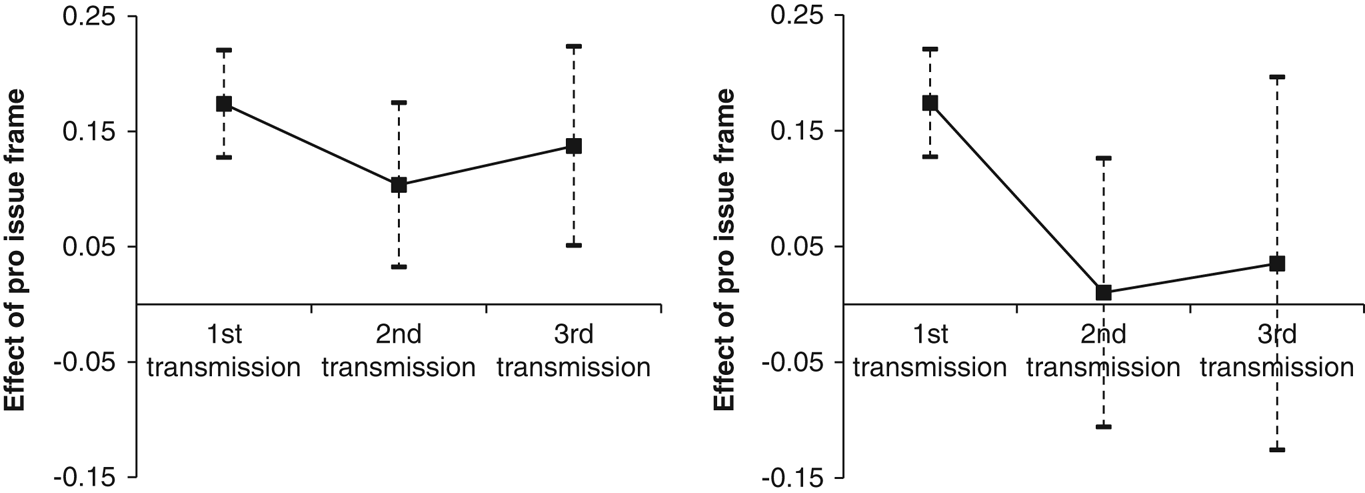
To facilitate comprehension and illustrate effect sizes, Figure 2 proceeds from the results in Models 2–3, Table 1, and illustrates how much the information from the episodic and thematic frames, respectively, affects the impact of the issue frame on policy support. Specifically, Figure 2 displays the effect of receiving a pro frame relative to a con issue frame for a respondent who received a high amount of information from the episodic frame and a low amount of information from the thematic frame. Panel B in Figure 2 shows the effect for a respondent who received a high amount of information from the thematic frame and a low amount of information from the episodic frame. To provide a baseline for comparison, Figure 2, Panels A–B also include the simple effect of receiving the pro relative to the con frame in transmission 1. In this round, all of the respondents received the original news article and, hence, had the full episodic and thematic frame available (the regression estimating this effect is reported in Appendix A5.2).Footnote 23
Effect of receiving the pro compared to the con issue frame on support for the proposal by transmission and amount of received episodic and thematic information .Note: the effect of the pro relative to the con issue frame on support for the policy proposal is illustrated for a case in which the amount of information from the episodic frame (Panel A) and the thematic frame (Panel B) is kept at a value of 0.25 (high amount) and the amount of information of the other type is kept at 0.08 (low amount) in transmissions 2–3. The 80th percentile on a variable averaging across the amount of received information from the episodic and thematic frames across transmissions 2–3 is 0.25, 0.08 is the 20th percentile. The effects are illustrated using Models 2–3 in Table 1 and illustrated with 95 per cent confidence intervals. Note that the confidence intervals are relatively wide. This reflects the low number of cases above the 80th percentile for one information type and below the 20th percentile for the other information type.

The results in Figure 2 are striking. As seen in Panel A, when the recollected frames (or recollections of recollected frames) are dominated by information from the episodic frame, they are almost as effective at shaping opinions as the original news articles containing the frames. There is little decay in the effect of the issue frame on policy opinion. In contrast, Panel B shows that when recollections are dominated by information from the thematic frame, the direction of the original issue frame ceases to have any discernable effect on policy opinion in either the second or third transmissions. The findings in Test 1 demonstrated that, on average, people transmitted less thematic than episodic information. The findings in Figure 2, Panel B show that among those who happened to receive a high amount of thematic information, the original issue frame already lost its effect on opinions in the second transmission. Thus the findings in Figure 2 further support Hypothesis 2 and the notion that ordinary citizens are unable to package information from the thematic frames into coherent recollections that are able to persuade those in their social network. This is only the case for information from episodic frames.Footnote 24
Test 3. Recollection and Persuasion in the Two-Step Flow Across Political Sophistication
Test 3 explored the role of individual differences in citizens’ political sophistication. Psychological research on the underpinnings of episodic bias implies that this bias emerges from general, deep-seated psychological processes (Cosmides and Tooby Reference Cosmides and Tooby2006). On this basis, citizens’ capacity to recollect episodic frames and transmit them persuasively is likely independent of their political sophistication (Hypothesis 3). This contrasts with the emphasis on the importance of political sophistication in traditional lines of political communication research (Katz Reference Katz1957; Zaller Reference Zaller1992).
Research design and measures
We rely on the data from Tests 1–2. In accordance with past research, we use education as our measure of political sophistication (Aarøe and Jensen Reference Aarøe and Jensen2015; Arceneaux, Johnson and Maes Reference Arceneaux, Johnson and Maes2012; Hetherington Reference Hetherington2001; Sniderman, Brody and Tetlock Reference Sniderman, Brody and Tetlock1991). As summarized by Sniderman, Brody and Tetlock (Reference Sniderman, Brody and Tetlock1991, 21), education is ‘well measured’, ‘covaries with political awareness and information’ and constitutes the ‘the handiest proxy’ for measuring political sophistication. Specifically, as in the previous analyses in the article, education was coded on a seven-point scale with the endpoints ‘lower primary and secondary school [Fokeskole]’ and ‘PhD degree’ (ranging from 0–1). To secure internal validity, we draw on the same control variables as in Test 2 (see Appendix A4.1 for all measurement details).
Results
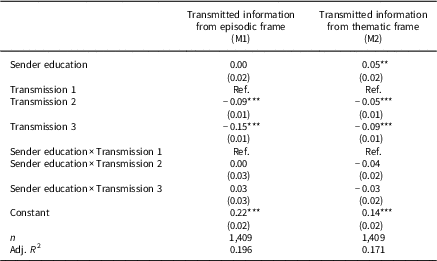
Is the capacity to transmit episodic frames independent of political sophistication? To investigate this, Table 2 shows the association between the education of the sender and the amount of transmitted information from the episodic frame (Model 1) and the thematic frame (Model 2). The entries are unstandardized OLS regression coefficients. The results control for transmission round as well as gender, age, political ideology, need for affect, need for cognition and the sender’s opinion on the proposal (see Appendix A7.1 for a regression table including coefficients for all control variables). The results in Model 1 show that the education of the sender does not influence the amount of episodic information transmitted across the three transmissions (b=0.004, p=0.875), and this result is not significantly moderated by transmission round (F (2, 1397)=1.14, p=0.320). Consistent with the notion that the episodic bias constitutes a general psychological bias, this supports Hypothesis 3 – that the capacity to transmit episodic frames is independent of individual differences in political sophistication.
Effect of sender’s education on the amount of transmitted information

Note: entries are unstandardized OLS regression coefficients with robust standard errors in parentheses. All variables range between 0 and 1. The model includes controls for the gender, age, political ideology, need for affect, need for cognition, as well as for the opinion on the proposal of the sender variables.
*p<0.05, **p<0.01, ***p<0.001
As seen in Model 2, education is significantly associated with the amount of transmitted thematic information (b=0.05, p=0.010), and this relationship exists across all transmission rounds (that is, it is not significantly moderated by transmission round (F(2, 1397)=1.35, p=0.259). This result is consistent with classic theories on the role of opinion leaders that emphasize how individuals high in political sophistication have a stronger capacity to receive political communications (Zaller Reference Zaller1992) and drive public debates (Katz Reference Katz1957; Weimann Reference Weimann1991). The finding that education increases information transmission from the thematic frame is important, because it supports the notion that the capacity to transmit political communication independently of individual differences in sophistication is unique to bias-consistent episodic information. This supports Hypothesis 3.
Is the capacity to transmit episodic frames persuasively independent of political sophistication? If citizens are equally capable of transmitting episodic information persuasively regardless of their level of education, the positive interaction in Table 1 between the amount of received episodic information and the issue frame condition (pro frame×episodic input) should be unmoderated by individual differences in the sender’s education. To investigate this, we replicate the analysis reported in Table 1, Models 4–6 and add the education of the sender as a moderator of the effect of the amount of received information from the episodic and thematic frames, respectively, to the framing effect on opinion. Table 3 shows an overview of the findings (see Appendices A7.1–A7.2 for the full regression table, including control variables and analyses of robustness using the stemmed dictionaries).
Effect of sender’s education on the impact of received episodic information on the impact of the issue frame on opinion

Note: entries are unstandardized OLS regression coefficients with robust standard errors in parentheses. All variables range between 0 and 1. The models include controls for the gender, age, education, need for cognition, need for affect, and political ideology of the sender and the receiver as well as for the opinion on the proposal of the sender.
*p<0.05, **p<0.01, ***p<0.001
As in Table 1, the findings in Table 3, Model 1 show a positive and significant moderating effect of the amount of received information from the episodic frame on the impact of the issue frame on policy support across transmissions 2–3 combined (bpro×episodic input=0.73, p=0.040). Importantly, as seen in Model 1, this interaction effect is unmoderated by the sender’s level of education (bEpisodic input×pro frame×sender’s education=−0.09, p=0.286). This result is consistent with the notion that, regardless of whether senders are highly or poorly educated, they are capable of persuasively transmitting episodic information such that the framing effect increases as the receiver gets more of the episodic information.
Consistent with the findings in Table 1, Models 2–3 in Table 3 indicate that the effect of information from the episodic frame on the impact of the issue frame on policy support is driven by the third and final transmission round. It is important to note that this interaction is also unmoderated by the sender’s education (bEpisodic input×pro frame×sender’s education=−0.27, p=0.111) in transmission round 3.
Interestingly, the results in Model 3 indicate that the effect of thematic information on the impact of the issue frame on policy support in transmission round 3 is moderated by the education of the sender (bThematic input×pro frame×sender’s education=0.51, p=0.039). This result is in line with the results in Table 2. Consistent with Hypothesis 3, it indicates that citizens’ capacity to transmit bias-inconsistent information in persuasive ways does depend on their education. This result is also consistent with the notion that the shared capacity of people high and low in political sophistication to transmit political communication persuasively is unique to bias-consistent information, such as episodic frames. This supports Hypothesis 3.Footnote 25
CONCLUSION
Political communication spreads in a two-step flow. The exposure of many citizens to political communication does not originate directly from media and elite sources but rather from recollections from fellow citizens in their social networks (Bond et al. Reference Bond2012; Choi Reference Choi2015; Druckman, Levendusky and McLain Reference Druckman, Levendusky and McLain2018; Katz and Lazarsfeld Reference Katz and Lazarsfeld1955; Mutz and Mondak Reference Mutz and Mondak2006). Yet past research on the factors that constitute a strong political frame has focused uniquely on the first step of the flow, when people are exposed to communications directly from political elites. Integrating advances in the psychological sciences on deep-seated cognitive biases and their built-in inferential mechanisms (Gigerenzer and Selten Reference Gigerenzer and Selten2002; Kahneman Reference Kahneman2011; Tooby and Cosmides Reference Tooby and Cosmides1992), we have presented an initial theoretical and empirical exploration of the factors that make a frame strong in the two-step flow of political communication. An appreciation of the two-step nature of communication processes, we argue, changes how we should theorize and study the strength of political communication. In particular, this highlights the importance of cognitive biases. In the second step of the communication flow, the recollection, transmission and reception of political communication fully depends on the ability of citizens to process complex information and turn it into coherent and persuasive narratives – a process that is facilitated by the fit between this information and cognitive biases. We acknowledge that not all news spreads in a two-step fashion, and that direct exposure remains an important source of media effects. Nevertheless, we believe that two-step processes are of sufficient importance, especially in the context of modern social media environments (Choi Reference Choi2015), to make the present argument broadly applicable.
To test our argument, we focused on the case of episodic and thematic frames, two of the most fundamental types of political communication (Gross Reference Gross2008; Iyengar Reference Iyengar1991). We argued that episodic frames resonate with deep-seated cognitive biases that facilitate citizens’ interpretations and inferences about intimate social information as the kind of information that is prominent in episodic frames – what we termed ‘episodic bias’. Consistent with the predicted role of cognitive biases, our findings support the prediction that when citizens transmit frames in the second step of the communication flow, they recollect and transmit episodic information to a greater extent than thematic information, and they package the episodic information more persuasively. Furthermore, consistent with the argument that these processes reflect a deep-seated, general psychological bias, the findings indicated that the capacity to transmit episodic information persuasively applies to citizens with high and low political sophistication alike.
In constructing the original news articles, we made a number of methodological choices that balanced considerations regarding internal, measurement and ecological validity as well as the strength of the stimuli (see ‘Research design and measures’ in Test 1 and Appendix A1.1 for a detailed discussion and suggestions for future research). Still, an important step for future research is to extend the generalizability of the theory and findings by testing our model of communication strength across different issues, using different operationalizations of episodic and thematic frames (including, for example, news articles with episodic and thematic frames advocating in competing directions), and examining whether similar results are obtained for frames that appeal to other cognitive biases. Finally, as discussed in Appendix A1.3, future research should vary the instructions about what to recollect and to whom. This would increase the ecological and external validity of the findings and expand the utility of the transmission chain design in political communication research.
Our findings contribute to the study of political communication strength in numerous ways. First, while recent research has uncovered evidence of how fundamental biases influence the effect of frames on opinion in the first step of the communication flow (Arceneaux Reference Arceneaux2012), our findings suggest that cognitive biases may be even more consequential for frame strength in the second step. Secondly, our findings also shed novel light on the mixed empirical support for the popular intuition that vivid episodic frames are stronger. As Brosius and Bathelt have emphasized in social information processing, ‘[s]uch weak support is in sharp contrast to most people’s day-to-day experience. Almost everyone is able to report vivid experiences that – even years later – come to mind easily and are remembered as having been very influential’ (Brosius and Bathelt Reference Brosius and Bathelt1994, 50). Our findings provide an answer to this puzzle by highlighting how important aspects of the influence of cognitive biases on communication strength might not become manifest until the second step of the communication flow. Finally, we believe the present article offers an important methodological contribution. In order to understand the flow of political communication from media through social networks, we have introduced the transmission chain design into the study of political communication (Barlett Reference Barlett1932; Mesoudi, Whiten and Dunbar Reference Mesoudi, Whiten and Dunbar2006).Footnote 26 We have also provided the first implementation of this design in nationally representative online surveys, allowing us to pair the internal validity of experimental protocols with the external validity of representative sampling. In this manner, we have introduced a new methodological device in large-scale political communication research that is specifically geared to uncover cumulative and systematic biases in the spread of communications.
As emphasized by Druckman (Reference Druckman2011), strength does not equate normative desirability. Whereas prior research on framing has emphasized the fundamental role of (commercial) journalistic news criteria in shaping which frames come to set the agenda in public debate (Gross Reference Gross2008; McManus Reference McManus1994), our findings highlight the role of the psychological ‘news criteria’ emerging from the cognitive biases of the human mind. Our findings suggest that human psychology generates a focus on single cases and episodic evidence in parallel to the media news criteria. As the present findings suggest, this psychology prompts people to tweak recollections of political communication into an episode-oriented format that does not focus on the most general and statistical evidence but, instead, is the one most likely to influence and persuade others when forming representations of political issues.
Supplementary Material
Data replication sets are available in Harvard Dataverse at:
https://dx.doi.org/10.7910/DVN/EM3AZ2 and online appendices at: https://doi.org/10.1017/S0007123418000273
Acknowledgements
We would like to thank Vin Arceneaux, Jason Barabas, Jamie Druckman, James Fowler, Jennifer Jerrit and Rune Slothuus for helpful advice and comments during the preparation of this article. We would also like to acknowledge helpful feedback from presentations of the research in these forums: the 2013 annual meeting of the International Society for Political Psychology, the 2013 annual meeting of the American Political Science Association, the 2013 annual meeting of the Danish Political Science Association and the section for Political Behavior and Institutions at the Department of Political Science, Aarhus University.