Implications
The profitability coming from the sale of dairy goat kids slaughtered at 60 or 90 days of life and fed diets alternative to the use of goat milk (cow milk, commercial milk replacer and fermented cow colostrum) was studied. The use of goat milk was economically unviable and that of cow milk was the most advantageous. Large impacts on profitability were associated to meat selling price, cost of the liquid diet and slaughter weight. Kids slaughtered at 90 days of life achieved higher weight and ensured better financial performances compared with kids slaughtered at 60 days.
Introduction
The global research on sheep and goats has advanced considerably in recent years (Resende et al., Reference Resende, IAMA, Biagioli, Lima, Boaventura Neto and Pereira2010). For example, in Brazil, the number of published articles focusing on small ruminants has increased by 220% (Coordenação de Aperfeiçoamento de Pessoal de Nível Superior, 2009), but the effective number of goats has decreased by 1.7% in the last decade (Food and Agriculture Organization, 2011). This negative trend could be attributed in part to an insufficient examination of economic factors in goat studies. In fact, new production methods do not always lead to better performances from a production perspective, nor do they guarantee increased profitability due to the costs involved in their implementation.
In dairy goat farming, the high number of male kids born per year holds great potential for meat production, but male kids are often, especially in Brazil, slaughtered shortly after birth (Costa et al., Reference Costa, Beltrão Filho, Medeiros, Villarroel, Santa Cruz and Santos2010). This procedure is adopted mainly because goat milk has a high market value, and thus kid production costs during the suckling phase would be high in addition to the need for rigorous care.
Yáñez (Reference Yáñez2002) estimated the growth curve of Saanen dairy goats from 5 to 35 kg of BW and concluded that the most economic practice is to sell the uncastrated animals at 9 kg of carcass. The study recommended slaughtering male kids preferably at a young age, because as the animal approaches physiological maturity the muscle mass deposition rate drops, while fat deposition increases. As observed by Pereira Filho et al. (Reference Pereira Filho, Resende, IAMA, Silva Sobrinho, Yáñez and Ferreira2005), this phase is characterized primarily by an accumulation of visceral fat, which is of little commercial value in goat farming.
Within this context, the search for alternatives that can reduce production costs and ensure greater economic returns for dairy goat producers are primordial factors driving the growth and sustainability of this activity (Costa et al., Reference Costa, Beltrão Filho, Medeiros, Villarroel, Santa Cruz and Santos2010). The natural strategy for reducing costs during the suckling phase involves replacing goat milk with diets of lower cost, such as those based on cow milk, commercial milk replacers or fermented cow colostrum. Other alternatives include early weaning (Lu and Potchoiba, Reference Lu and Potchoiba1988) and restricting milk doses (Goetsch et al., Reference Goetsch, Detweiler, Sahlu and Dawson2001), both of which lead to an increased consumption of solid food, which is cheaper compared to liquid diets.
Although there are many studies on the effect of the substitution of goat milk in the kids feeding, studies with cost analysis are scarce, especially with the use of advanced tools, such as the Monte Carlo techniques. This method could be used to define the risks of raising male dairy kids for slaughter and the factors that have the greatest influence on the final economic result. Thus, this study aimed to analyze the economic viability of feeding kids, to be slaughtered at 60 and 90 days of age, with diets alternative to goat milk, such as cow milk, commercial milk replacer, and fermented cow colostrum. In addition, the risks associated with adopting the practices proposed herein were analyzed using the Monte Carlo techniques, and the parameters of greatest significance for the final economic result were determined.
Material and methods
Animals and treatments
This study used the performance data of 48 male goat kids of the Saanen (n=24) and Alpine (n=24) breeds weighing 3.37±0.20 kg (mean±SD) at birth. The animals were allocated to different groups following a fully randomized design and a 4×2 factorial scheme. The four factors (liquid diets) tested were goat milk, cow milk, commercial milk replacer (Lactal® – Nutron Cargill Company, Itapira, São Paulo, Brazil) and fermented cow colostrum. Each group was then divided into two additional groups by age of slaughter: 60 and 90 days of age. The number of replicates required per treatment (six animals for each factor and level) was determined through power analysis (Morris, Reference Morris1999) for the primary response variables, including liquid diet intake, concentrate intake, hay intake, slaughter weight and daily weight gain. The effect of breed was tested and was not significant (P>0.30) for any of the variables considered, in accordance with other studies (Andrighetto et al., Reference Andrighetto, Bailoni, Zancan and Dalvit1994; Medeiros et al., Reference Medeiros, Vieira, Ferreira, Silveira and Tierzo2005; Maia et al., Reference Maia, Sousa Leal, Araújo Neto, Rego, Silva and Lima2009) which did not observe differences between Saanen and Alpine kids. For this reason and to analyze criteriously the effect of the diets and the slaughter age, according to the aim of this work, breed effect was removed.
The goat milk was obtained from the Goat Sector of the Universidade Federal de Viçosa (Viçosa, Brazil), and the cow milk was obtained from the Dairy Cow Sector of the same University. Both were collected before giving to the animals. The animals were held in individual cages (1.0×0.75 m) and given 1.0 kg of liquid diet each day, as suggested by Lu and Potchoiba (Reference Lu and Potchoiba1988) and Goetsch et al. (Reference Goetsch, Detweiler, Sahlu and Dawson2001). For 30 days, 0.5 kg of liquid diet was provided in the morning and 0.5 kg was provided in the afternoon. From the 31st day onward, 1.0 kg of the liquid diet was offered only once each day to reduce labor costs and stimulate the intake of solid feeds, that is, a Tifton 85 (Cynodon dactylon) hay and a concentrate mixture, both offered ad libitum from the 24th day onward. The daily consumption of hay and concentrate was calculated as the difference between the amount offered and the amount left in the bucket.
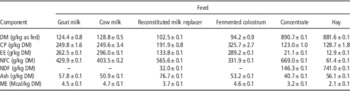
The concentrate mixture was prepared in accordance with the National Research Council (2007) recommendations for goats with an average daily gain of 150 g, without taking into consideration the nutrients provided in the milk. The mixture consisted of the following ingredients: soybean meal (176 g/kg), corn meal (799 g/kg), dicalcium phosphate (5 g/kg), ground limestone (16 g/kg), mineral salt (2 g/kg) and mineral and vitamin premix (2 g/kg). The compositions of the liquid and solid feeds are reported in Table 1.
Chemical composition of the feeds given to the kids during the experiment

DM=dry matter; EE=ether extract; NFC=non-fiber carbohydrates; ME=metabolizable energy.
Economic and statistical analysis
The economic analysis consisted of two steps: the first involved assessing the profitability of producing kids, and the second involved an economic risk analysis of this practice using the Monte Carlo techniques. Facilities, equipment and maintenance costs varied according to production system characteristics and were ‘fixed’ for similar systems that adopted the same handling conditions.
In the first phase of the analysis, the variables used for the economic assessment were calculated. The average gross income (AGI) was obtained by multiplying BW (BW) by the price of the live weight at slaughter per kg (PkgBS), that is, AGI=BW×PkgBS. The market price was the same regardless BW at slaughter. The selling prices of manure, skin and offal were not computed in AGI.
The solid feed costs (SFC) were calculated by multiplying the total concentrate intake (CI) by its corresponding price (ConP) and then adding the product of the total hay intake (HI) and its corresponding price (HayP), that is, SFC=(CI×ConP)+(HI×HayP).
The liquid food costs (LFC) were computed by multiplying the total liquid diet intake (LDI) by its corresponding price (LDP), that is, LFC=LDI×LDP.
The labor costs (LABOR) were obtained as the product of the amount paid to employees per hour for a farmer worker with minimum salary in Brazil (1.31 US$/h) and the number of work hours spent for each kid (hours) in the different treatments proposed, that is, LABOR=1.31×hours. To calculate the number of hours actually worked, a chronometer was used to measure the time required for an experienced employee to carry out the tasks involved in each treatment. This measurement was collected once per week throughout the entire experimental period. The value of each measurement was multiplied by seven to estimate the total labor hours of each week. The sum of all weekly hours was calculated and then divided by the number of animals in each treatment.
The total costs (TC) were calculated as the sum of the aforementioned costs, increased by 5%, which was attributed to the combined costs of veterinarian medication, waste of liquid and solid feeds and energy used for hay grinding, that is, TC=(SFC+LFC+LABOR)×1.05. It is important to emphasize that only animals fed fermented colostrum had diarrhoea, so veterinarian medication was used just for the FC kids at both slaughter ages.
The average gross margin (AGM) were calculated as the difference between the gross income and total cost, that is, AGM=AGI–TC.
The average profitability (AP) was calculated as the quotient between the AGM and TC expressed as a percentage, that is, AP=(AGM/TC)×100.
The second phase of the analysis used a model for stochastic simulation based on the Monte Carlo techniques, which was ran for 1000 iterations. The computer-assisted analysis was conducted using Microsoft Excel 2007 (Microsoft, Seattle, Washington, USA) in combination with @Risk 5.5 (Palisade Corporation, Ithaca, NY, USA). This type of simulation approach enables countless opportunities for sensitivity analyses, which, due to the capacity to assess a large breadth of possible responses, allow for a more comprehensive examination of investment risks (van Asseldonk et al., Reference van Asseldonk, Jalvingh, Huirne and Dijkhuizen1999). Finally, the parameters with greater implications for the final economic result were determined using sensitivity plots.
The market price values used as inputs were gathered during a period of 10 years (2004 to 2014) and adjusted for the month of October 2014, using the General Market Price Index (i.e. Índice Geral de Preços de Mercado) developed by the Getúlio Vargas Foundation (Fundação Getúlio Vargas, 2014), taking into consideration the prices applied in the region of Viçosa (Minas Gerais, Brazil) at an exchange rate of US$1.00 : R$2.21. In the case of fermented colostrum, which is not a commercialized product, an estimate of cow-milking costs over the first three postpartum days was made, which accounted for paper towels, iodine, detergent, disinfectant, water, work to prepare it and electricity.
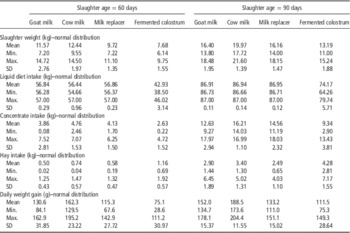
The descriptive statistics and the selected distributions for each variable in the database are shown in Tables 2 and 3. The optimal distribution for each variable was determined using the χ2 test.
Descriptive statistics of input variables computed to estimate average profitability

1 SW=slaughter weight.
Performance data used as input for the average profitability analysis

Regression analysis was used to evaluate the relationships between model result variations and the input data. Standard regression coefficients were used to classify the inputs. These provide a measure of the importance of each input by varying it from its mean value by a fixed fraction of its standard deviation while all other input values remain at their mean values (Helton and Davis, Reference Helton and Davis2002).
Results and discussion
Deterministic production costs
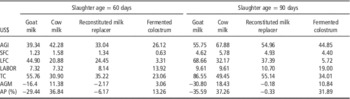
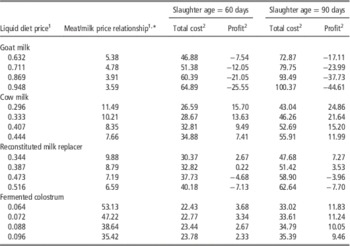
The calculated cost, income, gross margin and profitability values for goat kids fed the four liquid treatments (goat milk, cow milk, milk replacer and fermented cow colostrum) and slaughtered at 60 and 90 days of age are shown in Table 4. Costs associated with the liquid diets, with the exception of fermented cow colostrum, accounted for the largest portion of the total costs, varying between 65.04% and 80.53% of TC for cow milk at a 90-day slaughter and goat milk at a 60-day slaughter, respectively. Labor costs were the highest for fermented cow colostrum, ranging between 55.86% and 62.01% of TC for kids slaughtered at 90 and 60 days, respectively. This can be attributed to two reasons. First, this feed is very cheap (0.08 US$/kg), so LFC is low. According to Saalfeld et al. (Reference Saalfeld, Pereira, Silveira, Schramm, Valente, Borchardt, Gularte and Leite2013), fermented colostrum should be classified as having a cost of zero because excess of colostrum does not have any market destination and is normally disposed of in nature. Although in Brazil, as in many other countries, there is no established price for this product, we decided to compute the costs of milking in the 3 days postpartum so that dairy cow farmers could be paid for this work. The second reason for the high percentage of labor costs in the TC of fermented colostrum was the labor-intensive food preparation and feeding. In particular, fermented colostrum was diluted in water and milk during the adaptation phase and only in water after this phase. The kids seldom ingested the entire quantity of fermented colostrum provided and spent considerably more time feeding than those fed the other liquid diets. This was most likely due to the high acidity level of fermented colostrum (Saalfeld et al., Reference Saalfeld, Pereira, Silveira, Schramm, Valente, Borchardt, Gularte and Leite2013), which demands more care and, as a consequence, higher labor costs.
Economic analysis (in US dollars) of dairy kid production fed different liquid diets and slaughtered at 60 or 90 days of life

AGI=average gross income; SFC=solid feed costs; LFC=liquid feed costs; LABOR=labor costs, TC=total costs, calculated with the following formula=(SFC+LFC+LABOR)×1.05; AGM=average gross margin, AP=average profitability.
On the basis of the veterinarian’s examination, all kids were healthy until slaughtering, except for some animals fed fermented colostrum, which had diarrhoea from the 5th to 10th day, probably due the change of the diet during the adaptation phase. The cost of veterinary treatments was US$ 4.38 for FC kids slaughtered at 60 or 90 days of life. The value spent on antidiarrheal medication was added into total cost (Table 4).
We would like to emphasize that the minimum salary in Brazil changes independently of the annual inflation. In last 20 years (from 1994 to 2014) the minimum salary has advanced 934.29% in absolute terms, while inflation in the period was 399.81%. In real terms, the minimum salary has advanced 534.48% in the same period. This means that the purchasing power of a worker, who earns the minimum salary, in late 2014, will be more than five times higher than the purchasing power of those who earned the minimum salary in late 1994.
Costs associated with solid feeds ranged between 2.21% and 12.93% of TC for the goat milk treatment for 60 day-slaughter and for the fermented colostrum treatment at 90 day-slaughter, respectively (Table 4). These results suggest that even if supplied ad libitum, as was done in this study, solid feed still represents a small margin of TC at this stage of life. This is a relevant finding, considering that the solid diet is beneficial to ruminal development, as demonstrated by Górka et al. (Reference Górka, Kowalski, Pietrzak, Kotunia, Jagusiak and Zabielski2011).
Goat milk and commercial milk replacer diets resulted in a negative AGM at 60 days of age (US$ −16.4 and US$ −2.17, respectively) and at 90 days of age (US$ −30.8 and US$ −0.18, respectively). This can be partly attributed to the high TC resulting primarily from the high market value of these two liquid feeds. These results suggest that goat farmers, even those who choose to raise only females, should seek alternative diets that are less costly than goat milk, such as cow milk or fermented cow colostrum. In addition, this practice enables goat farmers to sell the milk that would be otherwise destined to the suckling kids, thereby generating a higher profit.
Although fermented colostrum yielded the smallest AGI of all diets, the AGM for this treatment was positive at 60 days of life (US$ 3.06) and also at 90 days of life (US$ 10.84). These results are in accordance with the observations of Azevedo et al. (2013), who found that calves fed fermented colostrum diluted in water had a lower final weight and total weight gain, but lower cost per kg of total weight gain, compared with those fed whole milk or fermented colostrum diluted in milk.
The comparative analysis between the treatments that yielded a positive balance (i.e. cow milk and fermented colostrum) revealed that animals fed cow milk had higher BW at slaughter (Table 3) and, as a consequence, higher AGI (Table 4) than those fed fermented colostrum. A comparison between the two slaughter ages within the same treatment revealed that the AGI yielded from slaughtering at 90 days was 60.55% higher for kids fed cow milk and 71.71% higher for kids fed fermented colostrum compared to that from slaughtering at 60 days. These results suggest that longer milk-intake periods may be favorable when handling practices are similar to those adopted in the present study.
Although these findings may serve as an example of how this model can be used in decision making, this type of profitability analysis should not be considered definitive. In real scenarios, each farmer must perform the economic analysis using values that are specific to his or her herd, workforce, supply market, and product-destination market.
Effects of meat price
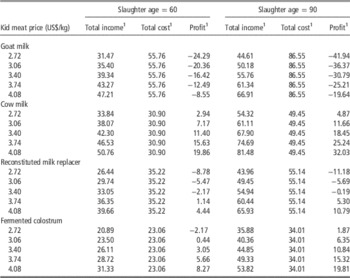
Kirton (Reference Kirton1970) and Madruga et al. (Reference Madruga, Arruda, Araújo, Andrade, Nascimento and Costa1999) reported that kid meat had greater approval from a sensory panel, as it was found to be more tender, juicier and tastier compared with meat of older animals of the same species. Therefore, in a scenario characterized by high kid meat price, raising dairy goat kids could be advantageous to goat farmers. In cattle, Rodrigues Filho et al. (Reference Rodrigues Filho, Mancio, Gomes, Silva, Lana, Rodrigues, Soares and Veloso2002) found that adding 10% to the price per kg of beef would make raising male dairy calves viable, with a small profit margin. Table 5 shows the results of our simulation in which only the price per kg of kid meat varied while the total cost of the actual situation (Table 4) was used as a reference and the production costs were kept unchanged. The results demonstrate that even with the highest attempted value increase, that is, 20% above the mean value, a positive balance was not observed for animals fed goat milk slaughtered at 60 days (US$ −8.55/animal) and also for those slaughtered at 90 days (US$ −19.64/animal). In contrast, a positive balance was obtained for kids fed the commercial milk replacer beginning with meat price increases of 3.53% and 6.56% for the 90- and 60-day conditions, respectively.
Simulation of kid meat price variation and its effect on gross income and net profit per animal for different liquid diets

1 In US $/animal.
The highest profit was observed when kid meat was sold at 4.08 US$/kg under conditions where kids were fed cow milk and slaughtered after 90 days, yielding a profit of US$ 32.03 per animal. This value is 61.69% higher than the profit obtained using fermented colostrum after 90 days (US$ 19.81/animal), which was the second highest profit achieved among the studied treatments. Although this was not economically measured, an advantage of the use of commercial milk replacers and fermented colostrum may be their capacity to be stored without the use of electrical equipment, for example, refrigeration.
Goat meat has important nutritional characteristics. This meat is a source of high biological-value protein (Amaral et al., Reference Amaral, Pelicano, Yañez, Souza, Machado, Sugohara and Resende2007), has less cholesterol (40 mg/100 g) compared to lamb meat (62 mg/100 g) and beef (70 mg/100 g) (Souza and Visentainer, Reference Souza and Visentainer2011), and has a lower fat content, with a lower proportion of saturated fat and calories, compared to other types of red meat (Madruga et al., Reference Madruga, Arruda, Araújo, Andrade, Nascimento and Costa1999; Malan, Reference Malan2000). However, despite these characteristics, goat meat is not widely consumed in Brazil (~0.4 kg/inhabitant per year) in comparison, for example, to beef (40 kg/inhabitant per year) (Silva Sobrinho and Osório, Reference Silva Sobrinho and Osório2008). This is likely due to the fact that the goat meat available in the market usually comes from adult animals, being often of low quality, and has similar prices to beef meat. Therefore, it would be important to provide consumers with kid meat, which has a better quality than adult goat meat, at a reasonable price. The advertisement of its nutritional properties and support by the government and large companies would also be useful.
Effects of liquid feed prices
When choosing a certain feeding system, prospective analyses must consider the risk of production costs being increased as a result of higher prices for agricultural inputs. In light of this, the costs and profits resulting from variations in liquid diet prices were calculated with average meat prices held at a fixed value of 3.40 US$/kg (Table 6).
Effect of liquid diet price on production cost and profit per animal

*Kid meat price=3.40 US$/kg.
1 In US$/kg.
2 In US$/animal.
It is evident that the ratio between meat price and liquid diet price drops as the liquid diet price increases, which in turn causes profits to drop. Based on this, the cost in adopting a commercial milk replacer diet should not exceed US$ 33.05/animal and US$ 54.94/animal to achieve a system that generates a positive balance under 60- and 90-day slaughter conditions, respectively. This implies that the commercial replacer (liquid diet, ready for supply to the animals) cannot cost more than US$ 0.39 and 0.43/kg (considering the 1 : 9 water-dilution guideline suggested by the manufacturer) for the 60- and 90-day feeding regimes, respectively. This value represents the maximum investment required to buy the replacer divided by the total amount of diet consumed. Then, dividing the maximum feasible cost paid for the reconstituted commercial milk replacer (US$ 0.39/kg) by the kid meat price (US$ 3.40/kg), we found that for the 60-day rearing regime to be economically viable, the total replacer cost should not exceed 11.47% of the animal-selling price. Applying the same reasoning to the use of fermented colostrum under the 60-day regime, the invested value should not exceed US$ 0.15/kg, which corresponds to 4.41% of the meat sale price (US$ 3.40/kg). In a study on Criollo kids raised in Argentina, Paez Lama et al. (Reference Paez Lama, Egea, Grilli, Fucili, Allegretti and Guevara2013) reported that the cost of milk replacer should not exceed 20% of meat sale price.
Stochastic risk analysis
An examination of this type of data based on deterministic economic analysis, as presented here, is extremely relevant. However, such analysis does not always account for the large array of possibilities and uncertainties that are inherent to a production system, especially when considering different countries or regions within a large country, such as Brazil, in which great trading price variations occur. In this case, it would be more appropriate to use stochastic simulation models that allow the simulation of infinite iterations among variables and, through this, the determination of whether investment in a production system is advisable and of the risks involved (van Asseldonk et al., Reference van Asseldonk, Jalvingh, Huirne and Dijkhuizen1999). For this reason, risk analysis using the Monte Carlo method was also conducted.
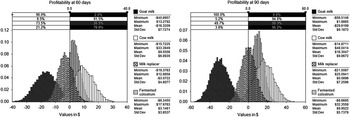
A total of 1000 iterations among the variables were conducted, and overlapping plots were used to compare the profitability results (Figure 1). Net returns had a 98% chance of being negative when goat milk was used to feed dairy goat kids. Therefore, regardless of the age at slaughter, the goat milk diet is not advisable. In contrast, the use of cow milk involved a minimal level of risk to provide negative returns, that is, 8.5% for the animals slaughtered at 60 days and 5.2% at 90 days of age, with positive returns of 9.56 and 16.30 US$/animal when liquid feeding was performed over 60 and 90 days, respectively. Positive returns were also observed for the fermented colostrum treatment when animals were slaughtered at 60 days (US$ 3.15/animal) and at 90 days (US$ 9.95/animal). However, there was a 21.2% risk associated with raising animals on the fermented colostrum diet and slaughtering after 60 days. Differences in the risk probability between slaughter ages were more distinct in the case of commercial milk replacer. There are extreme risks associated with kids fed commercial milk replacer and slaughtered at 60 days, that is, a 73.5% probability of negative returns, with an average profitability level of −3.07 US$/animal, whereas animals fed this diet and slaughtered at 90 days face a lower risk (49.7%) of not making profit.
Probabilistic overlapping histogram of the average gross margin (in US$/kid) for dairy kids slaughtered at 60 or 90 days and fed goat milk, cow milk, reconstituted commercial milk replacer, and fermented cow colostrum.

Previous economic studies on goat kid production in Argentina, Chile and Mexico reported different results from ours. Paez Lama et al. (Reference Paez Lama, Egea, Grilli, Fucili, Allegretti and Guevara2013) argued that it was not viable to raise male kids in Argentina using an artificial suckling system, and Perez et al. (Reference Perez, Maino, Morales and Soto2001) suggested that it was uneconomic to raise kids in Chile under then-current market conditions. With respect to Mexico, Galina et al. (Reference Galina, Palma, Pacheco and Morales1995) observed that feeding animals with milk substitutes was more costly than using goat milk. The differences between our results and those cited above are likely due to differences in the market prices of goat milk, kid meat and of the feed alternatives taken into consideration.
Relative importance of the variables studied
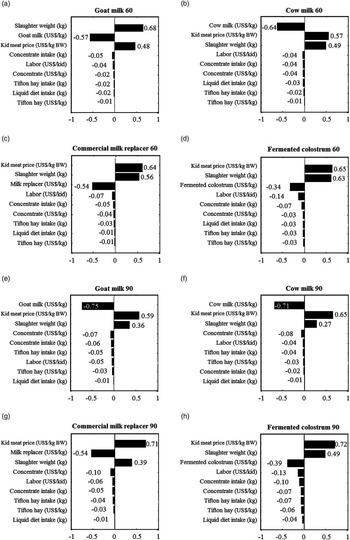
In addition to assessing the risks associated with producing dairy kids under different liquid diets and slaughter ages, the present study conducted an analysis of the relative importance of the variables studied here on the final results of the model using tornado diagrams (Figure 2). Standard regression coefficients for the inputs of average gross profitability were calculated and ranked in terms of level of influence, as represented by the length of the sensitivity bars for each input. The tornado diagram is organized so that the most sensitive entry is listed at the top, with progressively less sensitive entries listed toward the bottom.
Standard regression coefficients of inputs affecting average gross margin, ranked for extent of variability, for dairy kids slaughtered at 60 or 90 days of age and fed goat milk (a, e), cow milk (b, f), reconstituted commercial milk replacer (c, g), and fermented cow colostrum (d, h).

Two variables had a considerably negative impact on profitability (Figure 2). The first and most important variable was the liquid diet cost (US$/kg), for which the regression coefficients ranged from −0.34 to −0.75, corresponding to fermented colostrum treatment after 60 days and goat milk treatment after 90 days, respectively. Thus, considering that goat kids normally adapt well to diets alternative to goat milk (Morand-Fehr et al., Reference Morand-Fehr, Hervieu, Bas and Sauvant1982), the search for more economic options is paramount.
The second variable with the greatest negative impact on profitability was labor cost (US$/kid), which ranged between −0.04 and −0.14. The lowest value was observed for cow milk after 60 and 90 days and goat milk after 60 days, whereas the highest value was obtained for fermented colostrum after 60 days. Although prolonged liquid feeding requires high labor costs (Table 4), which are associated with handling processes similar to those adopted in this study, it does not have strong negative impacts on profitability if we compare the same feeding treatment at varying slaughter ages. For example, kids fed goat milk and slaughtered at 60 and 90 days of age had a labor cost of −0.04 (Figure 2a) and −0.05 (Figure 2e), respectively.
An interesting result of the study was that the impact of concentrate price (US$/kg) was greater for animals slaughtered at 90 days (varying from −0.07 to −0.10) than for those slaughtered at 60 days (varying from −0.02 to −0.04). This can be attributed to the fact that animals slaughtered at 90 days consumed 3.2 to 3.5 times more concentrate than animals slaughtered after 60 days (Table 3).
Two variables had a positive influence on profitability (Figure 2). The most important was the kid-selling price (US$/kg), for which the regression coefficient was between 0.48 and 0.72 for the 60-day goat milk treatment and 90-day fermented colostrum treatment, respectively. These results confirm that goat farmers should carefully consider market parameters and meat selling prices, as they may otherwise risk rendering their production systems non-viable. The second variable with the greatest positive influence on profitability was kid weight at the time of slaughter, which had regression coefficients between 0.27 and 0.68 for the 90-day cow milk condition and the 60-day goat milk condition, respectively. This variation was expected because animal performance was influenced by the diet and age of slaughter implemented (Table 3).
This study demonstrated that the combination of a deterministic analysis and the Monte Carlo techniques is very useful for comprehensive and detailed economic analysis of dairy kid’s production. Feeding dairy kids with goat milk was not economically viable regardless of the age of slaughter. The use of a commercial milk replacer had a high risk of being unprofitable at 60 days and medium risk at 90 days. In contrast, cow milk and fermented colostrum presented minimal risks of negative profitability, but further studies should be conducted to improve the adaptation to and consumption of fermented colostrum by dairy kids. A longer liquid feeding period of 90 days lead to greater profitability than a shorter period. Therefore, we recommend feeding dairy kids with cow milk for 90 days.
The methodology applied in this work can be used to assess the economic impact and the risks associated to other choices to be taken in the production cycle of goat kids, such as optimal weight gain, optimal slaughtering weigh or utilization of solids feeds together with liquid diets.
Acknowledgments
The authors are grateful to Ana HD Francesconi for the technical and linguistic revision. We would like to thank CAPES and CNPq (Conselho Nacional de Desenvolvimento Científico e Tecnológico) for giving a master scholarship and funding the research, respectively. They also thank the anonymous reviewers for their helpful suggestions and comments.