Implications
β-Adrenergic agonist (β-AA) and immunocastration have been associated with changes in carcass composition affecting meat production. They have been used as tools to increase the lean meat production to supply the growing animal protein demand and adipose tissue deposition, respectively. However, information about their effects in Bos indicus cattle and possible interactions are still scarce. In this study, it was observed that zilpaterol hydrochloride (ZH) supplementation increased meat production by improving retail cuts and subprimal weights whereas immunocastration reduced retail cuts and without increase fat trim.
Introduction
Castration has long been used in beef cattle production, because castrated animals have more fat in their carcasses than bulls, leading to more succulent and tender beef (Dunshea et al., Reference Dunshea, D’Souza, Pethick, Harper and Warner2005). Further, steers have lower sexual and aggressive behavior (Katz, Reference Katz2007) compared with bulls, which helps to improve meat quality (Shackelford et al., Reference Shackelford, Koohmaraie, Wheeler, Cundiff and Dikeman1994). Traditionally, castration is a surgical procedure associated with pain, infection, bleeding (Moloney et al., Reference Moloney, Allen, Ross, Olson and Convey1990), and in some cases, death of the animal (Vanderwert et al., Reference Vanderwert, Berger, Shanks and Bechtel1985). In recent years, however, there has been increased public concern regarding the welfare issues associated with surgical castration (Marti et al., Reference Marti, Devant, Amatayakul-Chantler, Jackson, Lopez, Janzen and Schwartzkopf-Genswein2015). In this sense, some technologies, such as anti-gonadotropin-releasing factor vaccines, have been proposed as an animal welfare-friendly alternative to reduce sexual and aggressive behavior and improving carcass and meat quality in bulls (Amatayakul-Chantler et al., Reference Amatayakul-Chantler, Hoe, Jackson, Roça, Stegner, King, Howard, Lopez and Walker2012 and Reference Amatayakul-Chantler, Jackson, Stegner, King, Rubio, Howard, Lopez and Walker2013) without pain or risk of death.
Despite the benefits of castration on docility and meat quality, bulls are more efficient at producing muscle than steers and heifers (Gonzalez et al., Reference Gonzalez, Schwartzkopf-Genswein, Caulkett, Janzen, McAllister, Fierheller, Schaefer, Haley, Stookey and Hendrick2010), which is attributable to the anabolic properties of androgens, in particular testosterone (Katz, Reference Katz2007). As consequence, steers or immunocastrated (ImC) males have shown lower performances and carcass weights (Amatayakul-Chantler et al., Reference Amatayakul-Chantler, Hoe, Jackson, Roça, Stegner, King, Howard, Lopez and Walker2012 and Reference Amatayakul-Chantler, Jackson, Stegner, King, Rubio, Howard, Lopez and Walker2013; Andreo et al., Reference Andreo, Bridi, Tarsitano, Peres, Barbon, Andrade and Prohmann2013; Miguel et al., Reference Miguel, Faria, Roça, Santos, Suman, Faitarone, Delbem, Girao, Homem, Barbosa, Su, Resende, Siqueira, Moreira and Savian2014; Marti et al., Reference Marti, Devant, Amatayakul-Chantler, Jackson, Lopez, Janzen and Schwartzkopf-Genswein2015), which can lead to increased fat deposition and reduced the retail cut weights compared with intact males.
The β-AA are nutrient repartitioning agents that increase animal performance, subprimal yields and lean tissue deposition in heifers (Montgomery et al., Reference Montgomery, Krehbiel, Cranston, Yates, Hutcheson, Nichols, Streeter, Bechtol, Johnson, Terhune and Montgomery2009; Cônsolo et al., Reference Cônsolo, Ferrari, Mesquita, Goulart and Silva2015 and Reference Cônsolo, Mesquita, Rodriguez, Rizzi and Silva2016a), bulls (Cônsolo et al., Reference Cônsolo, Rodriguez, Goulart, Frasseto, Ferrari and Silva2016b) and steers (Avendaño-Reyes et al., Reference Avendaño-Reyes, Torres-Rodríguez, Meraz-Murillo, Pérez-Linares, Figueroa-Saavedra and Robinson2006; Montgomery et al., Reference Montgomery, Krehbiel, Cranston, Yates, Hutcheson, Nichols, Streeter, Bechtol, Johnson, Terhune and Montgomery2009; Arp et al., Reference Arp, Howard, Woerner, Scanga, McKenna, Kolath, Chapman, Tatum and Belk2014). However, most of studies regarding the use of β-AA were carried out using European beef breeds (Bos Taurus), with few information about its effects on B. indicus breeds. Besides, no data were found regarding the combined effects of immunocastration and β-AA supplementation on tissues distribution and retail cuts yields. It is important to point that B. indicus (Nellore) breed accounts for ~80% of the Brazilian beef herd. Further, the meat produced by these animals accounts for ~15.3% of the world trade in beef (Food and Agriculture Organization of the United Nations Statistics (FAOSTAT), 2014).
Thus, our hypothesis is that using immunocastration carried out just before entering to feedlot, associated with growth promoters, such as ZH and ractopamine hydrochloride (RH), will improve lean tissue deposition in a similar way to non-castrated (NoC) males. Therefore, the aim of this study was to evaluate the combined effects of immunocastration and a diet containing ZH or RH on retail cuts, bones, and fat trim weights of feedlot finished B. indicus (Nellore) cattle.
Material and methods
All procedures used for these experiments involving animal care were conducted in accordance with the Institutional Animal Care and Use Committee Guidelines, approved by the College of Animal Science and Food Engineering by protocol no. 13.1.541.74.0.
Animals and feeding
In all, 96 20-month-old Nellore bulls with an average BW of 409±50 kg were weighed, tagged and divided in two groups, according to BW (heavy and light, so that each group had similar distribution of weights. Half of each group received two doses of an immunocastration vaccine (Bopriva®; Zoetis Ltda, Campinas, SP, Brazil) that were administered within 30 days of each other, and the other half was not immunized. Afterward, the animals were transferred to the feedlot facilities at the Animal Science Department of the College of Animal Science and Food Engineering at the University of Sao Paulo, Pirassununga, SP, and housed in two feedlot facilities.
The first group (n=48), composed by 24 ImC (Bopriva) and 24 NoC animals, was housed in four pens (12 animals/pen) equipped with electronic gates (American Calan Inc., Northwood, NH, USA) which allowed individual control (CO) of feed intake. To avoid problems of aggressive behavior between ImC and NoC groups in the same pen, they were divided by sex condition. Therefore, there were two pens with ImC (12 animals each) and other two pens with NoC (12 animals each) animals. The second group (n=48) was housed in individuals pens as previously described by Antonelo et al. (Reference Antonelo, Mazon, Nubiato, Gómez, Brigida, Gomes, Netto, Leme and Silva2017). Both facilities had covered feed bunks, concrete floors and automatic waterers.
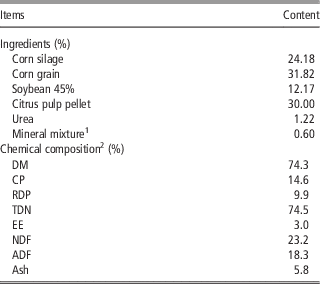
Initially, all animals were submitted to a 21-day adaptation period. At the end of the adaptation period, the animals were fed a total mixed common diet containing 76% concentrate and 24% roughage (Table 1). After 70 days on feed (33 days before slaughter), the animals were split into three groups corresponding to the diet treatments. Then, six treatments were block assigned to the animals in a 2×3 factorial arrangement. The factors were two sex conditions, ImC and NoC, and three diets: CO without β-AA; ZH, with 80 mg/day of ZH (Zilmax®; Merck Animal Health, Summit, NJ, USA); and RH, with 300 mg/day of RH (Optaflexx®; Elanco Animal Health, Greenfield, IN, USA). The animals were in the feedlot for a total of 100 days, during which they were fed ZH and RH for the last 30 and 33 days, respectively. The ZH diet was removed 3 days before harvest according to the withdrawal period required by law for this product, whereas RH diet was removed 1 day before harvest according to the required fasting period. Further information about diet, facilities and management can be found in Antonelo et al. (Reference Antonelo, Mazon, Nubiato, Gómez, Brigida, Gomes, Netto, Leme and Silva2017).
Dietary ingredients and chemical composition (dry matter (DM) basis) of the basal finishing diet

RDP=rumen digestible protein; TDN=total digestible nutrient; EE=ether extract.
1 The trace mineral mixture contained (per kg): zinc, 1715 mg; iron, 420 mg; calcium, 160 g; selenium, 6 mg; phosphorus, 17 g; manganese, 720 mg; magnesium, 14.3 g; copper, 360 mg; cobalt, 21.6 mg; iodine, 21.6 mg; sodium, 57 g; sulphur, 22.9 g; NNP – equivalent protein, 395 g; monensin sodium, 714.3 mg; vitamin A, 71 500 UI; vitamin D3, 8940 UI; vitamin E, 208 UI.
2 Diets were formulated to meet or exceed all nutrient requirement of finishing steers (National Research Council, 2000).
Carcass data collection
The animals were taken to a federally inspected slaughterhouse and harvested according to the Sanitary and Industrial Inspection Regulation for Animal Origin Products. The cold carcass weight (CCW) was recorded after 24 h of chilling. The left side of each carcass was first divided into the following cuts: wholesale special hindquarter, forequarter with five ribs and combined plate, flank and short ribs.
Then, the wholesale cuts were individually weighed and divided into retail cuts, bones and trimmings. The retail cuts were defined as all cuts trimmed of excess fat to a thickness of ~5 mm. The trimmings were calculated by difference (wholesale cut weight minus the weight of retail cuts and bones), and total retail product weight and total fat trimmings were obtained by determining the sum of the weight of those tissues in wholesale cuts multiplied by two to represent the whole carcass.
Statistical analysis
All statistical analyses were conducted using SAS (SAS Institute Inc., Cary, NC, USA). Data were analyzed in a block design with a 2×3 factorial arrangement of treatments using the MIXED procedure. The model included the fixed effects of sexual condition (ImC and NoC), diet type (CO, RH and ZH) and their interactions. The blocks (initial BW) were considered as random effects and animal was considered the experimental unit. The covariance structures of random effect (block) were tested, and the best fitted was chosen, based on the smallest value of corrected Akaike criteria according to Wang and Goonewardene (Reference Wang and Goonewardene2004).
The data means were compared using Student’s t test, and differences were considered statistically significant when P⩽0.05.
Results
No interaction was found between sexual condition and diet for any evaluated trait, which means that effects of factors are independent.
Sexual condition
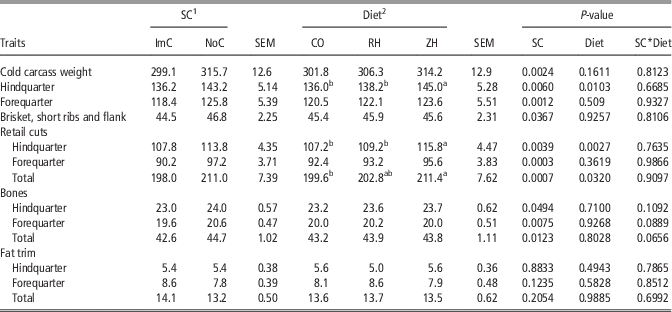
The immunocastration decreased the CCW by 16.6 kg compared with that in the NoC group (P=0.0024; Table 2). The ImC group had smaller hindquarter (P=0.0060); forequarter (P=0.0103); and brisket, short ribs and flank (P=0.0367) weights.
Effect of sexual condition (SC) and diet on carcass, retail cuts, bones and trimming weights (kg) of Bos indicus (Nellore) cattle

ImC=immunocastrated; NoC=non-castrated males; CO, control; RH, ractopamine hydrochloride; ZH, zilpaterol hydrochloride.
a,b Values within a row with different superscripts differ significantly at P<0.05.
1 ImC (Bopriva®; Zoetis Industry Veterinary Products LTDA, São Paulo, SP, Brazil) males.
2 CO diet without RH or ZH inclusion; RH (Elanco Animal Health, Greenfield, IN, USA) fed to 300 mg/day; ZH (MSD Animal Health, São Paulo, São Paulo, Brazil) fed to 80 mg/day.
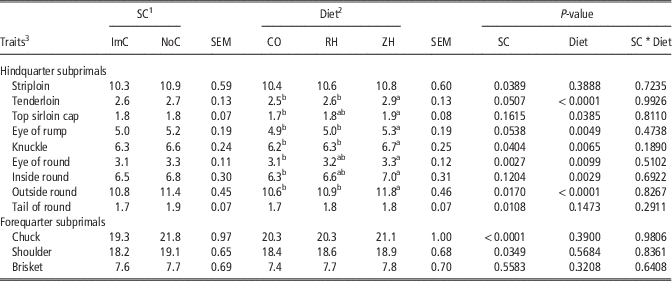
In the same way, immunocastration also decreased the retail cut weights of the hindquarter (P=0.0039), forequarter (P=0.0003) and in total (P=0.0007), as well as the bone of the hindquarter (P=0.0494), forequarter (P=0.0075) and in total (P=0.0123). Consequently, most muscles from hindquarter and forequarter were heavier for NoC animals, including striploin (P=0.0389), tenderloin (P=0.0507), eye of rump (P=0.0538), knuckle (P=0.0404), eye of round (P=0.0027), outside round (P=0.0170), tail of round (P=0.0108), chuck (P<0.0001) and shoulder (P=0.0349; Table 3). However, fat trimming did not differ between ImC and NoC groups (Table 2).
Effects of sexual condition (SC) and diet (DT) on subprimal yield (kg) of Bos indicus (Nellore) cattle

ImC=immunocastrated; NoC=non-castrated males; CO, control; RH, ractopamine hydrochloride; ZH, zilpaterol hydrochloride.
a,b,c Values within a row with different superscripts differ significantly at P<0.05.
1 ImC (Bopriva®; Zoetis Industry Veterinary Products LTDA, São Paulo, SP, Brazil) males.
2 CO diet without RH or ZH inclusion; RH (Elanco Animal Health, Greenfield, IN, USA) fed to 300 mg/day; ZH (MSD Animal Health, São Paulo, São Paulo, Brazil) fed to 80 mg/day.
3 Values expressed based on half carcass weight.
β-Adrenergic agonist
There was no difference among treatments for CCW (Table 3). Animals fed ZH showed higher retail cut weights on hindquarter (P=0.0027) compared with RH and CO groups. In addition, total retail cuts were higher for ZH compared with CO (P=0.0320), with no differences between CO and RH or RH and ZH (Table 2). There was no effect of treatments on the retail cuts of the forequarter, bones or fat trim.
The treatments also did not differ for forequarter, brisket, short ribs and flank (Table 2). Animals that were fed ZH had a greater increase in hindquarter (P=0.0103) compared with the RH and CO groups. Consequently, most muscles from the hindquarter were heavier in animals that were fed ZH, including the tenderloin (P<0.0001), eye of rump (P=0.0049), knuckle (P=0.0065) and outside round (P<0.0001), compared with the CO and RH groups (Table 3). Others cuts, such as the top sirloin cap (P=0.0385), eye of round (P=0.0049) and inside round (P=0.0029), were heavier for animals fed ZH compared with the CO group, with no differences between the RH and ZH or the CO and RH groups.
Discussion
Immunocastration in beef cattle has been reported as an effective practice to reduce testosterone levels and sexual behavior (Marti et al., Reference Marti, Devant, Amatayakul-Chantler, Jackson, Lopez, Janzen and Schwartzkopf-Genswein2015), but it also reduces animal performance (Amatayakul-Chantler et al., Reference Amatayakul-Chantler, Hoe, Jackson, Roça, Stegner, King, Howard, Lopez and Walker2012; Marti et al., Reference Marti, Devant, Amatayakul-Chantler, Jackson, Lopez, Janzen and Schwartzkopf-Genswein2015; Gómez et al., Reference Gómez, Netto, Antonelo, Silva, Sene, Silva, Dias, Leme and Silva2017), and increase body fat (Amatayakul-Chantler et al., Reference Amatayakul-Chantler, Jackson, Stegner, King, Rubio, Howard, Lopez and Walker2013; Freitas et al., Reference Freitas, Leão, Araujo Neto, Marques, Ferreira, Garcia and Oliveira2015) compared with NoC animals. In this work, CCW was reduced by 16.6 kg (5.2%) when compared with NoC. This smaller CCW also reflected in smaller weights of retail cuts (13 kg; 6.2%).
Although some studies have reported an increase in fat depots as a result of immunocastration (Freitas et al., Reference Freitas, Leão, Araujo Neto, Marques, Ferreira, Garcia and Oliveira2015; Andreo et al., Reference Andreo, Bridi, Soares, Prohmann, Peres, Tarsitano, Giangareli and Takabayashi2016), in this study, no change on fat trim carcass was observed when measured by weight. However, when it was measured as a percentage of CCW, the immunocastration increased total fat trim by 13% compared with intact animals (4.6×4.0%, respectively; data not shown). Others studies reported that the use of an immunocastration vaccine improved carcass fat deposition, and yield grade Choice, thus improving the meat quality parameters compared with those in NoC animals (Amatayakul-Chantler et al., Reference Amatayakul-Chantler, Hoe, Jackson, Roça, Stegner, King, Howard, Lopez and Walker2012; Andreo et al., Reference Andreo, Bridi, Tarsitano, Peres, Barbon, Andrade and Prohmann2013).
The ImC animals had a 5.6 kg lower total mean hindquarter, forequarter and brisket, short ribs and flank weight and, consequently, most carcass muscles were heavier for NoC bulls. On the other hand, Rodriguez et al. (Reference Rodriguez, Unruh, Villarreal, Murillo, Rojas, Camacho, Jaeger and Reinhardt2014) did not find any differences in subprimal yield between surgically castrated or intact males. Conflicting results between these results could be due to the differences in management and environment, including differences in the castration age and castration procedures.
The bone weight was also reduced by immunocastration, probably due to the lower growth rate observed for ImC animals compared with NoC. Berg and Butterfield (Reference Berg and Butterfield1976) had reported that heavy animals have higher proportion of muscle and bones, but lower fat in their carcass. These results are in accordance with Rodriguez et al. (Reference Rodriguez, Unruh, Villarreal, Murillo, Rojas, Camacho, Jaeger and Reinhardt2014), who found higher bone weight in bull carcasses compared with that in castrated animals at 3 and 7 months of age.
In this work, higher weights of commercial cuts were observed in NoC animals when compared with the ImC, but without differences in the total amount of fat trimmings. This may indicate that the short amount of time between ImC and slaughter (100 days) was time enough to reduce muscle growth, but not to increase body fat. Similar results were reported by Gómez et al. (Reference Gómez, Netto, Antonelo, Silva, Sene, Silva, Dias, Leme and Silva2017), who found no differences in renal, pelvic and inguinal fat between NoC and ImC.
In the same way, several studies have shown an increase on lean tissue deposition besides a decrease in adipose tissue by β-AA supplementation (Avendaño-Reyes et al., Reference Avendaño-Reyes, Torres-Rodríguez, Meraz-Murillo, Pérez-Linares, Figueroa-Saavedra and Robinson2006; Arp et al., Reference Arp, Howard, Woerner, Scanga, McKenna, Kolath, Chapman, Tatum and Belk2014; Cônsolo et al., Reference Cônsolo, Mesquita, Rodriguez, Rizzi and Silva2016a and Reference Cônsolo, Rodriguez, Goulart, Frasseto, Ferrari and Silva2016b). According to the results found in this work, it is possible to infer that the increase on subprimal weights by β-AA supplementation is independent of cattle sexual condition. As consequence, both technologies can be used independently of each other, and the β-AA effect should be the same in NoC and ImC cattle.
Growth promotion technologies, such as ZH and RH, are well known for improving lean tissue deposition, subprimal yield and meat production in feedlot cattle during the finishing diet (Avendaño-Reyes et al., Reference Avendaño-Reyes, Torres-Rodríguez, Meraz-Murillo, Pérez-Linares, Figueroa-Saavedra and Robinson2006; Arp et al., Reference Arp, Howard, Woerner, Scanga, McKenna, Kolath, Chapman, Tatum and Belk2014; Cônsolo et al., Reference Cônsolo, Mesquita, Rodriguez, Rizzi and Silva2016a and Reference Cônsolo, Rodriguez, Goulart, Frasseto, Ferrari and Silva2016b). Other studies have reported ~10 to 20 kg carcass weight increases in animals fed ZH (Avendaño-Reyes et al., Reference Avendaño-Reyes, Torres-Rodríguez, Meraz-Murillo, Pérez-Linares, Figueroa-Saavedra and Robinson2006; Rathmann et al., Reference Rathmann, Bernhard, Swingle, Lawrence, Nichols, Yates, Hutcheson, Streeter, Brooks, Miller and Johnson2012; Cônsolo et al., Reference Cônsolo, Mesquita, Rodriguez, Rizzi and Silva2016a), and ~5 to 10 kg increases in animals fed RH (Avendaño-Reyes et al., Reference Avendaño-Reyes, Torres-Rodríguez, Meraz-Murillo, Pérez-Linares, Figueroa-Saavedra and Robinson2006; Bryant et al., Reference Bryant, Engle, Galyean, Wagner, Tatum, Anthony and Laudert2010; Cônsolo et al., Reference Cônsolo, Rodriguez, Goulart, Frasseto, Ferrari and Silva2016b) when compared with CO ones.
The differences in muscle deposition and subprimal weights between RH and ZH could be caused by differences in the β receptor, which is coupled to provide a cellular β-AA effect. The RH binds to a β1 receptor, and ZH binds to a β2 receptor (Mersmann, Reference Mersmann1988). It is already reported that bovine animals have greater amounts of β2 cellular receptor than β1 (Mersmann, Reference Mersmann1988); as consequence, ZH can provide greater effect on muscle hypertrophy and subprimals yield compared with RH for beef cattle supplementation, as supported by our data.
The data from this study has showed that ZH was more efficient in increasing muscle deposition and retail cut weight in Nellore males, mainly in the hindquarter. Consequently, most subprimal cuts from the hindquarter were increased by ZH compared with CO whereas RH compared with CO increased few subprimal cuts from the hindquarter. The ZH had the most pronounced effect on subprimal yield than RH. In general, our results are in agreement with others (Hilton et al., Reference Hilton, Montgomery, Krehbiel, Yates, Hutcheson, Nichols, Streeter, Blanton and Miller2009; Kellermeier et al., Reference Kellermeier, Tittor, Brooks, Galyean, Yates, Hutcheson, Nichols, Streeter, Johnson and Miller2009; Garmyn et al., Reference Garmyn, Brooks, Hodgen, Nichols, Hutcheson, Rathmann and Miller2014; Martin et al., Reference Martin, Garmyn, Miller, Rathmann, Brooks, Hodgen, Pfeiffer, Thomas, Yates and Hutcheson2014; Cônsolo et al., Reference Cônsolo, Rodriguez, Goulart, Frasseto, Ferrari and Silva2016b), which reported subprimal cuts were most pronounced in the hindquarter compared with forequarter of ZH fed cattle. This increase is especially important because the higher prices subprimal are situated in hindquarter; as consequence, ZH can promote a greater production of high prices subprimals, which can improve industry profitability.
Cônsolo et al. (Reference Cônsolo, Ferrari, Mesquita, Goulart and Silva2015) reported similar data when ZH was fed to Nellore heifers, which empty BW gains and empty body protein gains increased compared with the CO by 842 and by 221 g/d, respectively, compared with CO heifers. In addition, Rathmann et al. (Reference Rathmann, Bernhard, Swingle, Lawrence, Nichols, Yates, Hutcheson, Streeter, Brooks, Miller and Johnson2012) also reported that ZH supplementation promoted the desired changes in carcass and gain composition in British heifers due to greater muscle mass deposition. These results provide evidence that ZH increases beef productivity and consequently could increase the profitability of the meat industry.
In summary, based on these results is possible to state that immunocastration decreases carcass and retail cut weights whereas ZH supplementation lead to an improvement in carcass lean tissue and retail cuts.
Acknowledgments
The authors are grateful for the financial support by grant no. 2013/07985-2 from the Foundation for Research Support of the State of Sao Paulo (FAPESP); Coordination of Improvement of Higher Education Personnel (CAPES) for the scholarship provided to the first author and also to the Dom Glutão Slaughterhouse for allowing to make carcass measurements in their facilities.