INTRODUCTION
Disturbed or violent behaviour is a notable feature of adult inpatient mental health settings, and this is perhaps particularly true of psychiatric intensive care units (PICUs).
The Healthcare Commission’s National Audit on Violence (Royal College of Psychiatrists, 2007) found that levels of experienced violence were high in mental health services for adults of working age across England and Wales. Compared to results from the previous audit conducted between 2003 and 2005, an increase in both the frequency and severity of violence was noted. Amongst nursing staff, nearly 50% said that they had been physically assaulted, and 66% of nursing staff on forensic units were ‘threatened or made to feel unsafe’ in the previous year, with 33% having been physically assaulted. The prevalence of threats and assaults was much greater in PICUs (78% and 61% respectively). The Audit found that although the effectiveness with which staff teams prevent and manage violent incidents was noted to have also increased, considerable variation was noted in the ways that services across the country were able to respond to actual incidents of violence.
The potentially high-risk nature of interventions for managing such behaviour requires staff to make difficult, and often controversial, clinical judgements about how best to address such situations when they occur. As an illustration of the potential controversy attracted by decision making, 25–38% of service users surveyed in the Healthcare Commission Audit stated that interventions such as medications, physical restraint, and seclusion were being used ‘too quickly’ to manage severely disturbed or violent behaviour, with patients in PICUs more likely to feel so (32–47%). The most frequently mentioned reason for using such interventions too quickly was the impact of low staffing levels on wards. Only a minority of all nursing staff surveyed (6–13%) agreed with the assertion that such interventions were used too quickly. The discrepancy between staff and service user views has also been reported by Duxbury (2002), who found that service users viewed such interventions as ‘controlling’. The same author also found that service users attributed aggressive behaviour to external factors such as the physical and poor psycho-social environment, whereas staff attributions were additionally concerned with internal service user factors.
The task of unit-based staff in selecting appropriate interventions is made more difficult by the relative lack of research evidence on the efficacy or appropriateness of the range of interventions on offer. In this respect, the publication of The National Institute for Clinical Excellence (NICE) guidelines on the management of violent behaviour in inpatient settings is a welcome development. The NICE guidelines highlight the dangers associated with prolonged physical interventions, such as restraint. They further state that ‘to avoid prolonged physical intervention an alternative strategy, such as rapid tranquillisation or seclusion (where available), should be considered’ (2005, p45). The guidelines suggest that interventions such as rapid tranquillisation, physical intervention and seclusion should only be considered once de-escalation and other strategies have failed to contain the behaviour of a service user. Such interventions are regarded as management strategies and are not regarded as primary treatment techniques. The guidelines point to a lack of evidence relating to the effectiveness of these three interventions, particularly for the use of physical intervention and seclusion. In respect of these three interventions, the guidelines do not promote an order of preference, and suggest that choice of intervention in any individual case would depend on a number of factors that should be guided primarily by:
• ‘Service user preference (if known).
• Clinical needs of, and risk to, the service user.
• Obligations to the service users affected by the disturbed/violent behaviour.
• The protection of staff, service users and visitors.
• Facilities available within the particular setting.
The intervention selected must amount to a proportionate and reasonable response to the risk posed’ (2005, p42). In support of the above recommendation, there is some evidence in the literature to suggest that choice of intervention is influenced by a range of contextual factors. Tobin et al. (1991) drew attention to the relationship between the use of various strategies to manage violence, the nature of the target, and the context in which the violence occurred. A later study by Agarwal & Roberts (1995) examined the use of different strategies to manage violence and their relationship with a variety of factors. They found that seclusion was used more often if the aggression was aimed at staff members or property, but less often when aimed at other service users. Also, aggression following a staff request or attributed to psychosis was more likely to be dealt with by seclusion, when compared with aggression that followed friction between service users. The authors also found that seclusion use was predicted by the age of the service user, with younger individuals more likely to be secluded.
In terms of establishing an order of preference for a range of interventions to manage disturbed behaviour, Klinge (1994), reporting on the views of staff within a forensic mental health unit, found that 63% favoured the use of medication over physical procedures, and that 65% said that they would prefer seclusion over restraint in cases where medication could not be used. Responses also indicated that staff demonstrated a tendency to choose to treat service users as they themselves would want to be treated. Staff gender and level of education was also found to impact on perceptions of the use of various interventions. Gender differences have been reported elsewhere, in addition to differences based on experience of using particular intervention (Whittington et al. Reference Whittington, Bowers, Nolan, Simpson and Neil2009). The authors found that male staff and those more experienced in implementing ‘coercive’ interventions expressed greater approval of them. In this study of staff and service users in an acute mental health setting, both groups rated observation and PRN medication among their most preferred interventions.
Each of the management strategies described in the NICE guidelines is currently employed on a PICU within the regional medium secure unit where the current study was undertaken. The PICU in question is an eight-bed facility, which frequently acts as an admission unit, taking the majority of its admissions from prisons. Frequently, those individuals who are admitted are acutely psychotic and many will have been managed in segregation whilst in prison, often with insufficient medication. Given the lack of evidence surrounding the use of interventions such as seclusion, and a perception of differing views within the PICU staff team, and the wider secure unit as a whole, the authors embarked upon a study to elicit the views of staff with respect to choices of intervention for the management of disturbed behaviour.
METHOD
The PICU staff team comprised the unit-based nursing staff and the multi-disciplinary team responsible for the management of services users on the unit. Sixty staff were surveyed in total and each was asked to complete a questionnaire. The questionnaire posed one central question, ‘In your opinion, in which order should staff use the following methods of management of serious aggression on the ICU?’. Respondents were presented with five choices of intervention and asked to rank them in order of preference. The five choices were:
• Prolonged restraint by staff without medication
• A period of seclusion in the seclusion room
• Speaking to a member of staff on a one to one basis
• Prolonged restraint by staff in order to give medication by injection
• Being offered/taking PRN medication.
Furthermore, via a free text box, staff were invited to suggest other techniques for intervention or make further comments if they wished to do so.
RESULTS
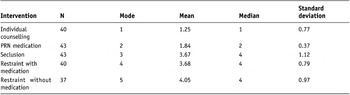
Forty-three staff completed the questionnaire, representing a response rate of 71.7%, although not every respondent assigned a rank to every choice. With reference to the mean, mode and median ranks, lower scores indicate more preferable options for intervention. Table 1 below shows frequency data for each of the options as the PICU staff ranked them.
Descriptive statistics of ranks assigned to interventions by staff

A Kolmogorov-Smirnov test revealed that the data were not normally distributed and they were therefore analysed using non-parametric statistical tests. A related-samples Friedman test revealed significant differences between the choices of intervention as ranked by the PICU staff team (χ2 = 100.67, n = 35, df = 4, p < 0.001). A further Wilcoxon signed ranks test revealed a significant difference between the ranks assigned to individual counselling as the first choice intervention, and the offer of PRN medication as the second choice intervention (z = −4.32, p < 0.001). However, when differences between the ranks assigned to seclusion, restraint with medication and restraint without medication were analysed using the Friedman test, no significant differences were found (χ2 = 100.67, n = 37, df = 2, p = 0.43). Thus, whilst seclusion was most frequently ranked as the third choice intervention (by 41.9% of respondents) the results suggest that in terms of preference it cannot be statistically separated from restraint. Ranks assigned to seclusion also had the greatest standard deviation (mean = 3.67, sd = 1.12), suggesting the greatest variance among the views of the staff in terms of where it should sit in the order of interventions.
In summary, descriptive analysis of the data revealed a clear preference for individual counselling as the first choice of intervention. A clear second choice was offering PRN medication. The other three choices, namely restraint with medication, restraint without medication, and seclusion, were less easily separated.
DISCUSSION
Consistent with NICE Guidelines, the results suggest that staff on the PICU favoured the less invasive options of individual counselling and the offer of oral PRN medication as the two most highly ranked choices of intervention for the management of disturbed behaviour. Seclusion was the most popular third choice intervention, although it cannot be clearly distinguished from the use of restraint, whether or not this was accompanied by the administration of medication by injection. This is an interesting finding in that, whilst anecdotally staff often express views about the limited utility of NICE guidance within tertiary services, their responses in this study echo the NICE Guidelines in that no single one of these interventions is given primacy over any other.
Qualitative responses to the questionnaire were few, although those that did make comments suggested that choice of intervention once de-escalation strategies had failed was very much dependent on the situation. Thus, choice of intervention beyond counselling and offers of PRN medication was seen as an issue of clinical judgement, dependent on a range of factors. One respondent made an argument that seclusion was safer and less invasive than restraint or rapid tranquillisation, particularly from a physical health point of view. Anecdotal evidence suggests that this is a popular view, due in part to the fact that the decision to seclude an individual, and their management in, and indeed after, seclusion from that point forward, is subject to considerable scrutiny and regular review, as a function of stringent policy governing its use. Equally popular, however, is the view that seclusion should only ever be an intervention of last resort, and it seems fair to state that its use remains controversial within mental health settings.
The results of this study are somewhat limited, in that they only reflect the views of the staff working on one PICU in one medium secure unit. Future research in this area would ideally extend this line of enquiry to staff on other PICUs, and other clinical staff who have an interface with PICUs, whilst perhaps not being directly involved. It is interesting to note that the NICE guidance suggests that one of the factors that should dictate choice of intervention is service user preference. Thus, the views of service users would be very important to sample in shaping policy on the management of disturbed behaviour. One possibility is to work towards a point where service users are able to make an advance directive about their management in the event that they become extremely disturbed or violent. This could then be considered with respect to the choice of intervention in any such situation, should it occur.