Introduction
Cochlear implantation is a well-established therapy for children and adults with pre-lingual and post-lingual deafness, and it has been used increasingly since its introduction into clinical practice.Reference Crowson, Semenov, Tucci and Niparko1,Reference Driver and Jiang2 A cochlear implant is an electronic device that is surgically implanted and permits individuals with severe-to-profound hearing loss to regain or access some hearing. In many parts of the world, such intervention has become a routine procedure in cases of severe-to-profound deafness where conventional rehabilitation with acoustic stimulation is no longer helpful.Reference Tange, Grolman and Drechsler3 Although a cochlear implant does not result in ‘restored’ or ‘cured’ hearing, it does allow better perception of sound and helps a person with deafness to understand speech. Moreover, auditory perception from a cochlear implant is different from that of normal hearing and takes time to learn or relearn.
A large body of research shows the positive effects of cochlear implants on speech perception, speech production, and language and communication.Reference Bat-Chava, Martin and Kosciw4–Reference Svirsky, Robbins, Kirk, Pisoni and Miyamoto10 Benefits have also been reported for social competence,Reference Bat-Chava and Deignan11–Reference Christiansen and Leigh13 reading abilityReference Tomblin, Spencer and Gantz14 and academic achievement.Reference Fagan, Pisoni, Horn and Dillon15 Such studies suggest that cochlear implants have a large positive impact on recipients’ lives, particularly for improving communication. However, fewer studies have focused on the possible broader benefits, including health-related quality of life (QoL), in cochlear implant recipients.
Health-related QoL is a measure of well-being across various domains and is defined by the World Health Organization as reflecting ‘an individual's perceptions of their position in life in the context of the culture and value systems in which they live, and in relation to their goals, expectations, standards and concerns.’16 Health-related QoL is generally understood as a multi-dimensional construct that focuses on an individual's perception of the impact of a health condition and related treatment on his or her health, well-being or functioning in relation to physical, psychological and social aspects of life.Reference Eiser and Morse17
Recently, there has been increased interest in more holistic outcome measures such as QoL when assessing the influence of cochlear implants on recipients. Such evaluations have highlighted the range of ways in which a cochlear implant may influence a recipient's everyday experiences and general well-being. Therefore, health-related QoL measurements can be useful in assessing the impact of a health-related condition such as hearing loss or cochlear implantation on an individual's daily life. Improvements in QoL have been reported among adult recipients of cochlear implants.Reference Cohen, Labadie, Dietrich and Haynes18–Reference Orabi, Mawman, Al-Zoubi, Saeed and Ramsden20
In this study, QoL outcomes in children who had undergone cochlear implantation in India are investigated using the Glasgow Children's Benefit Inventory questionnaire, which is a generic, health-related benefit measure for children following an otorhinolaryngological intervention. Previous studies have reported benefits among children in terms of QoL following cochlear implantation.Reference Stacey, Fortnum, Barton and Summerfield21–Reference Speaker, Roberston, Simoes-Franklin, Glynn, Walshe and Viani24 However, to our knowledge, no previous studies have previously investigated health-related QoL among children in this region. In India, there may be several factors that reduce uptake of cochlear implant surgery despite the potential benefits, including the cost of surgery (which is particularly important among rural populations and only partially subsidised by the government) and parental attitudes towards surgery.Reference Dutt, Mcdermott, Jelbert, Reid and Proops25,Reference Chundu, Manchaiah, Stephens and Kumar26,Reference Dev, Lohith, Pascal, Dutt and Dutt33 Therefore, it is important to investigate the broad benefits of cochlear implants on the lives of children in order to encourage uptake among appropriate patients.
This study aims to assess the impact of cochlear implantation on the QoL of Indian children assessed using the Glasgow Children's Benefit Inventory. Changes in QoL are evaluated following the use of a cochlear implant, in addition to the effect of patient and clinical factors on these changes.
Materials and methods
Participants and study design
Children (aged under 18 years) who had undergone cochlear implantation were recruited to participate in this study. All children who had a minimum of 12 months’ hearing experience with their cochlear implant and were attending auditory verbal therapy sessions were approached for inclusion.
Participants were receiving treatment at Vani Pradan Kendra, a non-profit organisation for individuals with hearing impairment located in Bangalore, India. Vani Pradan Kendra offers a variety of therapies, including cochlear implant habilitation, hearing aid prescription, and speech, yoga and music therapies for hearing loss, provided by ENT surgeons, audiologists, and speech pathologists and habilitationists. The majority of patients at Vani Pradan Kendra are from underprivileged backgrounds in urban areas of South Bangalore.
After the study had been explained, the patients’ parent or caregiver and speech therapist gave verbal consent for the child to participate. Initially, demographic data including age, sex, duration of hearing loss, education, age at implant, type of operation and type of device received were collected. Subsequently, the participant's parent or caregiver completed the Glasgow Children's Benefit Inventory (see below for full details). For those who did not speak English or were unable to read, a speech therapist provided an oral translation of the questionnaire in the respondent's native language and recorded the answers.
Outcome assessment
To assess QoL changes following cochlear implantation, the Glasgow Children's Benefit Inventory questionnaire was administered verbally to the parent or caregiver of the cochlear implant user. The Glasgow Children's Benefit Inventory is a validated assessment that was developed to provide a generic, health-related benefit measure for children following an otorhinolaryngological intervention.Reference Garg, Singh, Chadha and Agarwal27 It was designed to be completed by parents or caregivers on behalf of children. The questionnaire retrospectively evaluates the subjective effects of an otorhinolaryngological intervention on a child's day-to-day life.
The Glasgow Children's Benefit Inventory comprises 24 questions across four domains: emotion, physical health, learning and vitality.Reference Kubba, Swan and Gatehouse28 Each question is rated on a 5-point Likert scale from –2 to + 2 where: –2 = much worse; –1 = a little worse; 0 = no change; +1 = a little better; and + 2 = much better. Scores are subsequently converted to a summary score between –100 and + 100, where a negative number indicates worsened QoL and a positive number reflects improved QoL.
Data analysis
Data were analysed with SPSS® (version 24) statistical software. A non-parametric Mann–Whitney U test was conducted to compare Glasgow Children's Benefit Inventory total and the domain scores between age groups, sex and educational level. Education was categorised into groups based on nursery, primary and secondary education levels. Furthermore, correlation analyses were conducted to investigate any relationship of Glasgow Children's Benefit Inventory total and domain scores with age at implant and with the period between implant and study inclusion (i.e. the length of experience with the implant). A p-value of less than 0.05 (two-tailed) was considered to indicate statistical significance.
Results
Participant characteristics
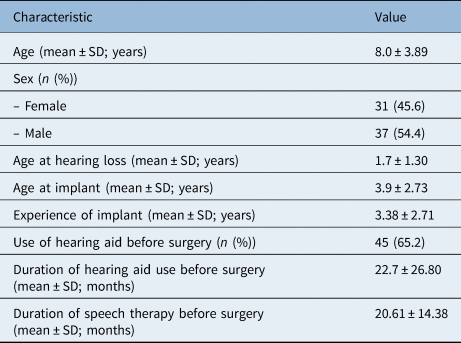
Sixty-nine participants aged between 2 and 18 years met the inclusion criteria, representing all children receiving speech therapy at Vani Pradan Kendra between May 2016 and May 2017. There was no demographic information available for one participant, who was therefore excluded from the further analyses, giving a final sample size of 68 participants. The basic characteristics of the 68 participants are presented in Table 1. Participants had received surgery for a cochlear implant at a mean age of 3.9 years (SD = 2.73 years) and had a mean hearing experience with their implant of 3.38 years (SD = 2.71 years). Hearing loss was identified in all children before the age of 6 years (mean 1.7 years, SD = 1.30 years), and the majority had used a hearing aid before surgery (n = 45; 65.2 per cent) for a mean of 22.7 months (SD = 26.80 months).
Basic characteristics of participants

Data missing for one participant giving n = 68. SD = standard deviation
Glasgow Children's Benefit Inventory responses
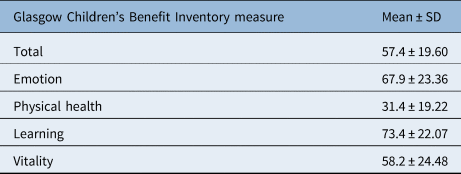
Overall, the Glasgow Children's Benefit Inventory indicated a general benefit of cochlear implants, with a mean total score of + 57.4 (SD = 19.60) and scores ranging from + 2.08 to + 91.67. This result indicates that all children experienced an improvement in QoL following cochlear implant surgery (Table 2).
Glasgow Children's Benefit Inventory total and domain scores for all participants

Data missing for one participant giving n = 68. SD = standard deviation
Domain scores also indicated that the benefit experienced by participants was seen across all domains. The largest benefits were seen for learning (mean = +73.4; SD = 22.07; range, +4.1 to + 100.0) and emotion (mean = +67.9; SD = 23.36; range, +2.8 to + 100). However, most participants also saw benefits in physical health (mean = +31.4; SD = 19.22; range, –7.1 to 71.4) and vitality (mean = +58.2; SD = 24.48; range, 0 to 100). However, there were some participants who showed no mean change (scoring 0, n = 4), reduced QoL (scoring less than 0, n = 1) for physical health and no mean change (scoring 0, n = 1) for vitality.
Factors influencing the scores
There was no demographic information available for one participant, who was therefore excluded from the following analyses, giving a final sample size of n = 68. There was no significant effect of age at study inclusion, gender or education on the benefits experienced by children after cochlear implant in terms of total Glasgow Children's Benefit Inventory score or any domain scores (all p > 0.05).
We also investigated whether the age at which participants received their implant influenced the benefit that they experienced. There was a significant negative relationship between the age at implant and total Glasgow Children's Benefit Inventory scores (Pearson's r = –0.316, p = 0.08), as well as physical health (r = –0.359, p = 0.003) and vitality (r = –0.374, p = 0.02) domain scores. This suggests that as age at implant increased, the benefits experienced by children decreased.
Finally, it was investigated whether the period between a child's age at implant and study inclusion affected the benefits reported (i.e. the amount of experience a child had with the implant). There was a significant positive relationship between the amount of experience with the implant and total Glasgow Children's Benefit Inventory scores (r = 0.335, p = 0.004), as well as emotion (r = 0.260, p = 0.032) and learning (r = 0.250, p = 0.040) domain scores.
Discussion
In this study, QoL among Indian children who had undergone cochlear implantation was investigated using the Glasgow Children's Benefit Inventory. The effect of various factors including age, gender, education and length of experience with the implant on Glasgow Children's Benefit Inventory scores was also assessed. An overall benefit was observed among children with cochlear implants, with improvements in all four domains (emotion, physical health, learning and vitality) of the Glasgow Children's Benefit Inventory. Moreover, there appeared to be greater benefits for younger children, and the longer a child had used their implant, the greater the reported improvements in QoL.
Early hearing loss can have broad consequences for a child's development, leading to diminished cognitive, behavioural and social development.Reference Kubba, Swan and Gatehouse28 Therefore, effective treatment is essential to avoid adverse outcomes, and children are increasingly receiving cochlear implantation to improve outcomes. Although early studies focused on outcomes such as language and communication, more recent research has focused on broader outcomes such as QoL. This is particularly important because clinical improvements do not always reflect real-world improvements, suggesting that QoL and daily functioning may play a significant role.Reference Clark, Wang, Riley, Carson, Meserole and Lin29
Parents of children who had undergone cochlear implant surgery reported improved QoL following implantation, with improvements in both total Glasgow Children's Benefit Inventory scores and domain scores. The children included in this sample from India were a range of ages and had differing lengths of experience with their implant, but all experienced at least a degree of improvement in QoL. This is consistent with the results of previous studies, although these have mostly been conducted in Western populations, including the USA and UK.Reference Stacey, Fortnum, Barton and Summerfield21–Reference Speaker, Roberston, Simoes-Franklin, Glynn, Walshe and Viani24 Indeed, a recent review of studies suggests that children who have received a cochlear implant have a similar QoL to their normal-hearing peers.Reference Crowson, Semenov, Tucci and Niparko1
The results of the present study suggest that there was no effect of age, gender or education on reported changes in QoL. However, a previous study reported an effect of gender on outcomes, with male children experiencing worse QoL than female children.Reference Almeida, Matas, Couto and de Carvalho30 It is possible that the smaller sample in the current study was not sufficiently powered to identify such differences between genders. Nonetheless, further research is required to determine the factors associated with worse outcomes. This could identify children who may require more support or intervention following cochlear implantation. For example, the same study found that several other factors were associated with worse QoL, including the use of hearing aids, additional comorbidities and parental education.Reference Almeida, Matas, Couto and de Carvalho30
The current results suggest that, although all children experienced improved QoL, those who received a cochlear implant at an older age experienced a smaller increase in QoL than those undergoing treatment earlier. Such results support the need for early intervention in children with hearing loss, because children who receive a cochlear implant at a young age appear to be more likely to have positive outcomes in terms of QoL. Some previous studies have shown that older age at implant is associated with worse QoL outcomes.Reference Stacey, Fortnum, Barton and Summerfield21,Reference Loy, Warner-Czyz, Tong, Tobey and Roland22 The authors of one study, conducted in the UK, suggested that cochlear implantation could lead to improved communication skills, educational achievements and QoL but only if children undergo treatment before they are five years old.Reference Stacey, Fortnum, Barton and Summerfield21 These early years may represent a critical period of development and learning for children, which may be hampered by hearing loss. Moreover, there is evidence that using hearing aids for longer and delaying cochlear implantation is associated with reduced language learning, suggesting that such delays may be detrimental to language development.Reference Sach and Barton31 Early intervention to restore hearing loss can therefore have broad benefits for children, and cochlear implantation should be offered to appropriate patients as soon as a diagnosis of profound hearing loss is confirmed.Reference Stacey, Fortnum, Barton and Summerfield21
As might be expected, the length of experience a child had with their implant was positively correlated with their reported improvements in QoL (i.e. the longer a child had had their implant the greater the benefits they experienced). This was true for total Glasgow Children's Benefit Inventory scores but also for emotion and learning domain scores.
Improved outcomes with longer experience with an implant are consistent with previous studies.Reference Bat-Chava, Martin and Kosciw4,Reference Loy, Warner-Czyz, Tong, Tobey and Roland22 The emotion domain comprises experiences of several kinds, including self-consciousness, embarrassment, self-esteem and self-care, and learning comprises progress and development, easy distraction and concentration.Reference Garg, Singh, Chadha and Agarwal27 The current results suggest that improvements in these factors are associated with longer experience with an implant. This may relate to more opportunities to develop language and communication across a longer period, which in turn affects other areas of life and boosts a child's confidence. However, it must be considered that it is difficult to disentangle whether the relationship between duration of use and better outcomes is confounded by the age at implantation, because children who receive an implant earlier will have longer experience with their implant.
• Some studies show that cochlear implantation is associated with higher quality of life (QoL) after implantation, although there is limited research in this field
• Previous research demonstrates that India presents unique circumstances that impact perspectives regarding cochlear implantation
• QoL outcomes after cochlear implantation have not been studied in India and are understudied in other developing countries
• Cochlear implantation led to improved QoL among Indian children, with the largest benefits reported in the learning domain
• Greater improvements were associated with earlier implantation, supporting early intervention in children with profound hearing loss
This study is novel in that it investigates children in India, where one must consider particular factors that affect help-seeking for hearing loss in children. These factors may not be relevant in other countries that have been previously investigated, such as the UK and USA. Parents in India may have particular concerns regarding the costs of surgery, especially in rural areas, and may have more negative attitudes towards surgical intervention, which lead them to avoid such treatment.Reference Dutt, Mcdermott, Jelbert, Reid and Proops25,Reference Chundu, Manchaiah, Stephens and Kumar26,Reference Dev, Lohith, Pascal, Dutt and Dutt33 Highlighting the benefits of cochlear implantation for QoL and everyday functioning may improve uptake of surgery, because it has been shown that a parent's decision to seek cochlear implant surgery is more influenced by their child's reduced functioning than by an objective measure of hearing loss.Reference Kubba, Swan and Gatehouse28 It is also possible that evidence for improvement in health-related QoL outcomes may influence policy and reimbursement, as has occurred elsewhere in the world.Reference Kubba, Swan and Gatehouse28 This is strengthened by evidence showing that cochlear implants may be cost-effective, leading to both clinical and non-clinical costsavings by improving QoL, enhancing academic achievement and improving vocational outcomes.Reference Crowson, Semenov, Tucci and Niparko1
The current study is subject to some limitations, which should be kept in mind when considering the results. Firstly, the sample was relatively small, and this may limit the power of the analyses. However, to our knowledge, this is the first study of QoL outcomes after cochlear implantation to be conducted in India. Further studies in similar populations are required to further support our findings. Secondly, the Glasgow Children's Benefit Inventory is a retrospective measure completed by parents, which may introduce some bias. However, comparing health-related QoL measures before and after an intervention may detect small differences that are masked by large variations in inter-subject QoL and may be limited by floor and ceiling effects.Reference Garg, Singh, Chadha and Agarwal27 Moreover, a retrospective measure allows investigation of a relatively infrequent procedure for which prospective data collection would be difficult.Reference Garg, Singh, Chadha and Agarwal27 Finally, information about clinical outcomes or any comorbidities was not collected so the effects of these on QoL outcomes could not be assessed.
Conclusion
In conclusion, QoL appears to improve following cochlear implantation in Indian children when measured with the Glasgow Children's Benefit Inventory. Greater improvements are seen with earlier implantation and longer experience with an implant, supporting the need for early intervention in children with profound hearing loss.
Acknowledgements
The authors thank the participating parents and the staff of Vani Pradan Kendra for their support and efforts in the completion of this study.
Competing interests
Ms. Dev is an honorary research assistant at Vani Pradan Kendra, Bangalore.