


1. Introduction
The analysis of ice cores from Antarctica and Greenland has provided important constraints on global palaeoenvir-onmental conditions during the Holocene and late Pleistocene. One of the most significant results has been the identification of large variations in atmospheric CO2 content in phase with late-Quaternary Glaciol cycles, with minima in atmospheric GOy concentrations occurring during Glaciol periods (Reference LoriusLorius and others, 1985; Reference Barnola, Raynaud, Korotkevich and LoriusBarnola and others, 1987; Reference DelmasDelmas, 1992). A number of hypotheses have been put forward which hold increased oceanic biological production responsible for decreased atmospheric CO2 content during Glaciol periods (Reference Pedersen, Nielsen and PickeringPedersen and others, 1991, and references therein). in his “iron hypothesis”, Martin (1990) suggested that primary production in much of the present-day surface ocean is limited by the availability of dissolved iron, much of which is derived from atmospheric deposition. From this premise he argued that increased deposition of atmospheric dust during Glaciol periods alleviated this iron deficiency, particularly in the Southern Ocean, thus stimulating phyto-plankton production and affecting a biological drawdown in atmosphericCO2.
Part of the information required to evaluate this hypothesis is a knowledge of past and present-day deposition of atmospheric iron over the Southern Ocean. An increased atmospheric iron flux to the Southern Ocean during the Last Glaciol Maximum (LGM) has been suggested based on analyses of iron in marine sediments ( Reference KumarKumar and others, 1995) and aluminium and dust particles in ice cores from continental Antarctica (Reference De Angelis, Barkov and PetrovDe Angelis and others, 1987). However, it is difficult to accurately quantify past atmospheric iron fluxes into the ocean from these measurements. The deep-sea sediment record is filtered by océanographie and diagenetic processes, whereas the ice-core measurements may reflect local (continental) environmental conditions and rely on the assumption of some constant iron/aluminium or iron/dust mass ratio.
Here we present measurements of total-dissolvable iron in sections of ice cores from Law Dome, East Antarctica. The coastal site of Law Dome is mainly exposed to maritime atmospheric circulation (Morgan and others, 1997), and annual precipitation over the Law Dome summit region is thought to be similar to that over much of the Southern Ocean (personal communication from P. Reid, 1997). The deposition of iron-bearing mineral aerosol over the Law Dome summit region is therefore expected to be representative ofthat over the adjacent region of the Southem Ocean. Together with estimates of snow-accumulation rates based on  stratigraphy, chemical measurements and ice-flow models, our iron measurements allow us to estimate atmospheric iron deposition over Law Dome and adjacent ocean waters during the late Holocene. in addition, a measurement of the iron concentration in ice dating from approximately 18000 BP allows a preliminary estimate of atmospheric iron deposition for this region during the LGM.
2. Methods
2.1. Sample materials
Samples analyzed in this study are sections of ice cores recovered from Law Dome, situated on the coast of Wilkes Land (Fig. 1). Law Dome is a small coastal ice cap with a summit elevation of 1370 m a.s.l. and a maximum ice thickness of around 1200 m (Morgan and others, 1997). Ice flow from the Law Dome summit is separated from that of the main East Antarctic ice sheet by Totten and Vanderford glaciers. Law Dome projects into a zone of easterly maritime atmospheric circulation, which produces a high snow-accumulation rate decreasing from east to west (Morgan and others, 1997). Samples were taken from three ice cores, each of which has been dated using δ18 O stratigraphy and other measurements (Morgan and McGray, 1985; Reference Etheridge, Wookey, Rado and BeaudoingEtheridge and Wookey, 1989; Morgan and others, 1997):
Location of ice-core sites at Law Dome, East Antarctica. Inset: Antarctica, showing location of Law Dome, Dome C and Voslok.
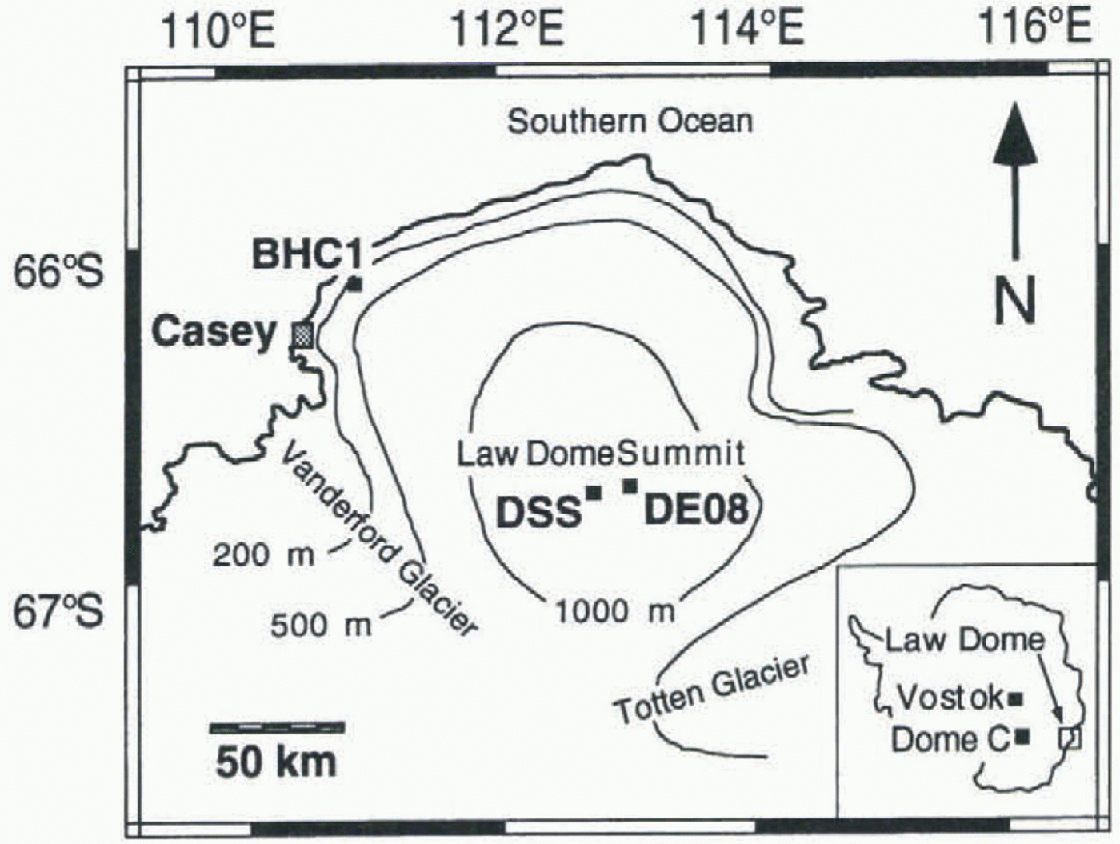
(1) core DSS, drilled 4.0 km south-southwest of the Law Dome summit, at 66°46'11"S, 112°48'25” E (Fig. 1). This site lies on an accumulation isopleth which crosses the summit, with a surface accumulation rate of 640 kg m −2 a−1 (Morgan and others, 1997). The core was drilled in several stages, beginning with a thermally drilled section (0—82 m, diameter 200 mm), and then an electro-mechanically drilled section in a fluid-filled hole (82-1200 m, diameter 100 mm). The core reached a depth of 1200 m below the ice sheet in 1993, and spans a time period extending back through the LGM. However, the ice from the LGM section was brittle and has broken into small pieces unsuitable for trace metal analyses;
(2) core DE08, drilled 16 km east of the Law Dome summit, at 66°43'19"S, 113°11'58” E (Fig. 1). This site has a very high surface accumulation rate of around 1100 kg m −2 a−1 (Etheridge and others, 1996). The core was thermally drilled (diameter 200 mm) to a depth of 234 m in 1988, and spans the past 180 years of deposition. The core has been used for detailed palaeo-CO2 measurements (Etheridge and others, 1996); and
(3) core BHCl, drilled 110 km northwest of the Law Dome summit, at 66°07'50” S, 110°56'7"E (Fig. 1). This core was thermally drilled (diameter 120 mm) to a depth of 300 m in 1982. The core site has a surface accumulation rale of 60 kg m−2a−1, and lies along an ice-flow line beginning at the Law Dome summit. This core was drilled along with several others in order to study the ice-flow mechanics of the Law Dome region. Down-core δ 18O measurements show a distinct Holocene-LGM transition, with average δ 18O values decreasing by 7.0‰ (Morgan and McCray, 1985). Ice-flow models suggest that ice in the LGM section of this core was originally deposited near the Law Dome summit, and core DSS (near the summit) also displays a δ 18O change of 7.0‰ at the Holocene-LGM transition (Morgan and others, 1997).
Samples analyzed in this study include late-Holocene sections from cores DSS and DE08, which provide seasonal and longer-term information on atmospheric iron deposition during the present interglaciol, and a single section from core BHG1, from which we tentatively infer the atmospheric deposition of iron during the LGM.
2.2. Analytical methods
For the iron analyses, all cleaning, reagent preparation and sample processing were performed under class 3.5 fillered-air conditions using trace-metal clean techniques, in an effort to avoid sample contamination. High-purity deion-ised water (≤18 MΩcm resistivity) was used for all cleaning and reagent preparation. Equipment used for the handling or storage of samples and reagents was either low-density polyethylene (LDPE), Teflon-FEP or Teflon-PTFE. The LDPE bottles used for sample storage were cleaned by soaking for 2 days in ~6M hydrochloric acid and then suspended for 2 days over the fumes of gently boiling ~6M hydrochloric acid (Tschopcl and others, 1980). After cleaning, the bottles were stored for more than 3 months filled with 0.1% doubly quarts-distilled hydrochloric acid, and rinsed with deionised water immediately before use. Other plasticware was cleaned by successive 2 day soaking in ~6M reagent-grade hydrochloric acid, ~1M singly quartz-distilled hydrochloric acid, and ~0.1M doubly quartz-distilled hydrochloric acid, with deionised water rinsing between each soaking step.
The drilling process is known to significantly contaminate the outer surface of the ice cores with trace metals such as iron, which penetrate some depth into the core (Boutron and Batifol, 1985). To obtain uncontaminatcd subsamplcs of the ice cores for trace metal analysis, it is necessary to “decontaminate” the ice cores by mechanically removing the contaminated outer layers of each core section. in this study we have used the lathe technique described in Candclonc and others (1994), where 4-5 successive layers around each core section are removed in addition to the visibly contaminatcd outermost layer. Iron was measured in subsamples from these layers. Where the inner layers contain a relatively low and constant concentration of iron, these inner layers are assumed to be uncontaminated (see section 3). Core sections DSS 28A-1,2,3 and BHC1 132A were decontaminated and subsampled at the Cooperative Research Centre for the Antarctic and Southern Ocean Environment (Antarctic CRC) in Hobart, and the remaining core sections were decontaminated at the Laboratoire de Glaciologie et Géophysique de l'Environnement (LGGE) in Grenoble. Acid-cleaned chisels constructed of a zirconium-oxide ceramic were used in the decontamination procedure performed at the Antarctic CRC, and stainless-steel chisels were used at LGGE. Procedural blanks were evaluated for both methods by decontaminating artificial ice cores made from deionised water. The Antarctic CRC decontamination-procedure blank was 0.006 ng Fe g−1, whereas the LGGE decontamination-procedure blank was below the limit of detection.
Ice-core subsamples taken during the decontamination procedure were immediately transferrer! into 11 LDPE bottles and allowed to melt. Aliquots of these meltwaters were then transferred (after mixing) into 60 ml LDPE bottles and acidified with 0.1 % (by volume) Seastar doubly quartz-distilled hydrochloric acid; the 60 ml meltwater aliquots from samples processed at LGGE were immediately refrozen (unacidified) and later transporled to the Antarctic CRC, where they were melted and acidified. All of the acidified meltwaters were stored at room temperature for more than 3 months before measurement of the operationally defined “total dissolvable” iron concentrations. Experiments in our laboratory (data not presented) have shown that the Fe concentrations of ac idified Antarctic snow samples increase for up to 3 months following acidification, then remain approximately constant. The initial increase in Fe concentration is presumably due to dissolution of dust particles present in the snow (procedural blanks demonstrate that this increase in Fe concentration is not due to cumulative contamination from the storage bottles). Total-dissolvable Fe concentrations were measured in the acidified meltwaters using flow injection analysis (FIA) with spectrophotometric detection, following a modifica-tion of the method of Reference Measures, Yuan and ResingMeasures and others (1995). This method had a detection limit of approximately 0.006 ng Fe g −1 (without preconcentration) and an estimated analytical uncertainty of < 10% for concentrations of >0.020 ngg−1. in addition, total-dissolvable Fe was determined in 17 meltwater samples by both FIA and high-resolution inductively coupled plasma mass spectrometry (HR-ICPMS). The two analytical methods were in excellent agreement ([Fe]ICPMS] = 1.06[Fe]FIA- 0.013 ngg−1. r2 = 0.98, n = 17, where [Fe] is the total-dissolvable iron concentration in ngg−1). However, the HR-ICPMS method had a higher limit of detection than FIA and had a significant analytical blank. Only the FIA Fe determinations are reported here.
3. Results and Discussion
The total-dissolvable Fe concentrations measured in the meltwaters are reported as nanograms of iron per gram of solution (ngg−1). A procedural blank of 0.006 ngg−1 arising from the decontamination, acidification, storage and analysis of the samples has been subtracted from the concentration data presented here.
3.1. Evaluation of the decontamination procedure
The total-dissolvable Fe concentrations measured in sub-samples from the decontamination of three sections of ice core (BHG1 132A, DSS 28A-1,2,3 and DE08 55B-a,b) are shown in Figure 2. Relatively low and constant Fe concentrations were measured in meltwaters from the three innermost layers of each core section, suggesting that the decontamination procedure was successful in each case. The Fe concentration of the innermost layer of core section DSS 28A-1,2,3 (Fig. 2) is an average of subsections DSS 28A-1, DSS 28Λ-2 and DSS 28A-3, which were taken from a single decontaminated core section; likewise, the Fe concentration of the innermost layer of core section DE08 55 B is an average of subsections DE08 55B-a and DE08 55B-b, which were taken from a single decontaminated core section. The Fe concentrations of the outer layers of core section BHC1 132A are significantly higher than those in the DSS and DE08 sections. This is thought to reflect the cumulative con-tamination of the outer core during storage and handling, given that BHC1 was drilled earlier than the other cores. However, the Fe concentration measured in the centre of this core section is thought to be reliable (i.e. uncontaminated) and is corroborated by elevated dust concentrations measured in LGM sections of the DSS core (Li and others, 1998). Effective decontamination for Fc is assumed for the other core sections discussed here, based on aluminium measurements in the layers resulting from the decontamination procedure (S. Hong, unpublished data). The total-dissolvable Fc concentrations discussed below are for the innermost layer of each core section, and are assumed to represent the uncontaminatcd iron concentration of each ice-core section.
Total-dissolvable iron concentrations in ice-core layers removed during decontamination procedures.

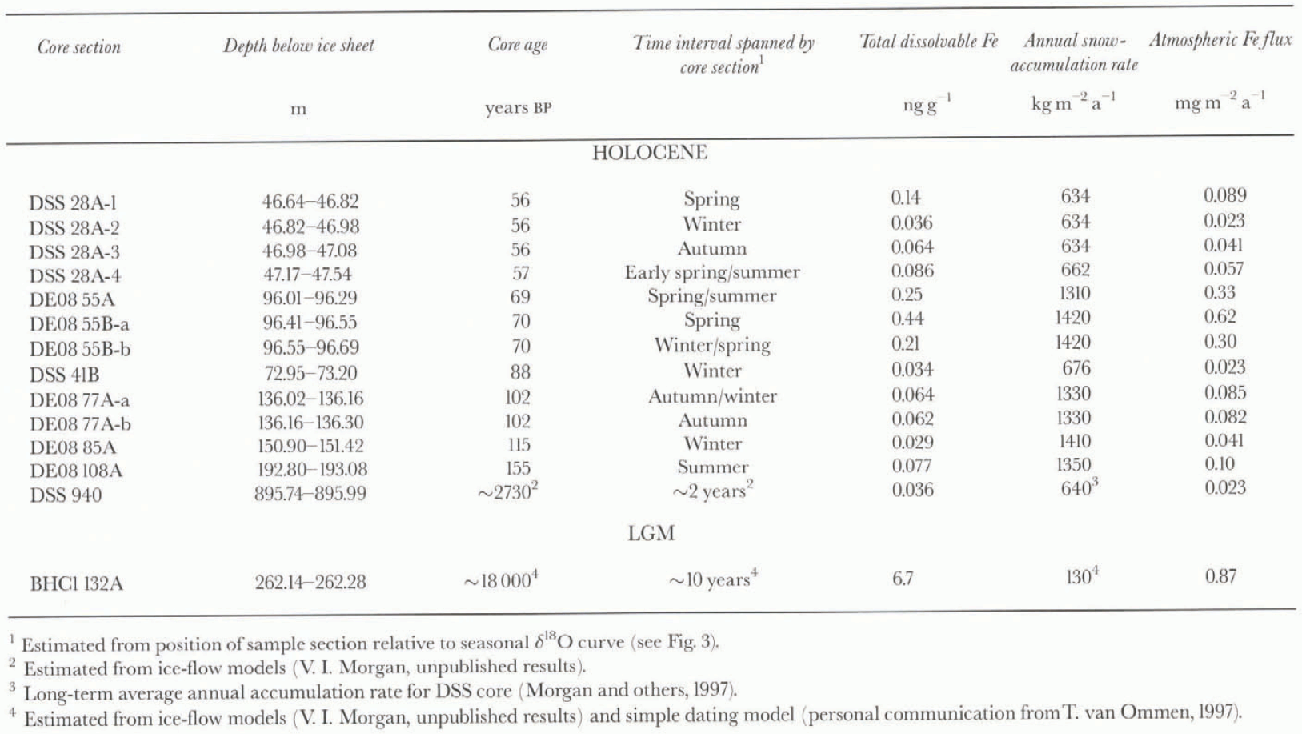
Data for ice core sections used in this study
3.2. Down-core iron concentrations and estimated atmospheric deposition
The total-dissolvable Fe concentrations measured in 14 decontaminated ice-core sections are presented in Table 1, together with estimates of the age of each core section in years before present (BP), the time interval spanned by each core section, and the annual snow-accumulation rate for each core section. Also shown in fable 1 is the average atmospheric iron flux for each core section, calculated as described below. Annual snow-accumulation rates for the DSS and DE08 core sections were calculated from measurements of annual layers as described in Morgan and others (1991), except for section DSS 940, for which we use the DSS long-term average snow-accumulation rate of 640 kg m −2 a−1 (Morgan and others, 1997). The accumulation rate for the LGM section of core BHC1 has also not been measured; however, a simple dating model suggests that the LGM snow-accumulation rate may be as low as 20% of the average Holocene accumulation rate for the DSS core (personal communication fromT. van Ommen, 1997). We therefore use a value of 130 kg m−2 a−1 as a lower limit of the snow-accumulation rate for core section BHC1 132A, assuming that this core section was deposited close to the DSS site, as predicted by ice-floyv models (Morgan and others, 1997).
The iron present in atmospheric dust is deposited onto the ice sheet by dry, wet and fog deposition (Reference Davidson, Bergin, Kuhns, E. W and BalesDavidson and others, 1996). Given the high snow-accumulation rate at the Law Dome summit, each of these processes is likely to be important in the deposition of iron-bearing mineral aerosol in our study region. Dry deposition is a relatively continuous process, whereas wet and fog deposition are episodic, and accompany snowfatl and fog events which typically last for several days. Factors which may affect an increase in the flux of iron from the atmosphere to the ice sheet include (1) an increase in the atmospheric concentration of iron-bearing aerosol, which will increase dry, wet and fog deposition, (2) an increase in precipitation (thus snow-accumulation rate), which will increase wet and fog deposition, and (3) a number of other variables such as aerosol-particle size and wind speed (see Davidson and others, 1996).
We have calculated an average atmospheric iron flux for each core section from the product of the total-dissolvable Fe concentration of the ice and the annual snow-accumulation rate. The average iron fluxes calculated for these sections will therefore include periods of above-average flux accompanying snowfall and fog events, and periods of below-average flux dominated by dry deposition. The upper sections from cores DSS and DE08 used in this study integrate atmospheric deposition over periods of 1 7 months, based on annual snow-accumulation rates. in the absence of short-term snow-accumulation rate measurements, we have used annual snow-accumulation rates to calculate atmospheric Fe fluxes for these samples, because snow accumulation rates at locations on Law Dome are thought to be relatively constant throughout the year, on average (Reference Van Ommen and MorganVan Ommen and Morgan, 1997). Tl should be noted, however, that snow-accumulation rates over periods of less than 1 year will deviate from the annual average, which introduces some uncertainty into our seasonal iron-flux estimates.
The DSS 28A core sections provide a record ofatmospheric iron deposition over almost an entire year (Fig. 3), from early spring to summer 1940 (DSS 28A-4, 57 BP), autumn 1941 (DSS 28A-3, 56 BP), winter 1941 (DSS 28A-2, 56 BP) and spring 1941 (DSS 28A-1, 56 BP). Analyses of these ice samples show that Fe concentrations in the spring/ summer core sections are 2-4 times higher than those in the winter core section. Assuming that seasonal snow-accumulation rates are relatively uniform at the DSS site, these initial results suggest a seasonal cycle with a maximum deposition of atmospheric Fe in the spring or summer, decreasing to a low in winter. The simplest interpretation of this seasonal variation in Fe flux, given a uniform seasonal snow-accumulation (thus precipitation) rate, is that it may reflect seasonal variation in the atmospheric concentration of Fe-bearing mineral aerosol. A similar seasonal variability has been observed in measurements of AÍ and M η in aerosol at Neumayer Station on the Dronning Maud Land coast ( Reference Wagenbach, Görlach, Moser and MünnichWagenbach and others, 1988), and in measurements of Fe in aerosol at the South Pole (Reference Tuncel, Aras and ZollerTuncel and others, 1989). Seasonal variation in atmospheric Fe deposition is also suggested by the data from core sections DE08 55B-a and DE08 55B-b (table 1), for which the Fe concentration in the spring core section is more than twice that in the immediately preceding winter/spring section.
(a) Seasonal position of ice-core sections relative to δ18O valuesfor ice-core sections DSS28A. (b) Total-dissolvable Fe concentrations in these ice-core sections.

Notably, however, the Fe fluxes estimated for core sections DE08 55A and DE08 55B are significantly higher than those calculated for all other Holocene core sections in this study: the annual maximum Fe flux estimated from the DE08 sections for calendar years 1927-28 (69-70 BP) is nearly 7 times that estimated from the DSS sections for calendar years 1940-41 (56-57 BP). The high Fc concentrations measured in core sections DE08 55A and DE08 55B are thought to be reliable, based on the decontamination profiles obtained (see profile for DE08 55B, Fig. 2), and cannot be explained by the higher precipitation rale at the DE08 site relative to DSS, because other DE08 sections contain Fe in concentrations similar to the DSS core sections. We therefore suggest that there may be significant temporal variations in atmospheric iron deposition at Law Dome on a time-scale of decades or less, perhaps as a result of variations in the atmospheric concentration of Fe-bearing mineral aerosol. Reference Maggi and PetitMaggi and Petit (1998) suggest that a maximum in the dust concentration of the Hercules Névé firn core (northern Victoria Land) for the period 1932-42 may reflect arid conditions in South America during that time, which resulted in elevated atmospheric dust concentrations reaching Antarctica. The timing of our proposed dust maximum over Law Dome, around 1927 28 based on our limited data, tloes not agree with the Hercules Névé record, but it maybe that these two locations derive continental dust from different sources. For example, red dust from Australia is reported in New Zealand snow during 1928 ( Marshall and Kiclson, 1929, referenced in Reference Warren and WiscombeWarren and Wiscombe, 1980), suggesting Australian continental dust as a possible source of the high Fe concentrations in the DE08 core sections from 1927-28.
Clearly, further iron measurements together with estimates of seasonal snow-accumulation rates are required to reliably define the seasonal and interannual range in atmospheric iron deposition over Law Dome during recent-Holoccnc time. The average value of the atmospheric Fe fluxes estimated from the late-Holocene core sections analyzed in this study is 0.14 ± 0.18mgm −2a−1 (n = 13), or 0.052 ± 0.030 mg m −2 a−1 (n = 10) if the data from 1927-28, which may reflect anomalous climatic conditions, are excluded. Our average late-Holocene flux of 0.056-0.14mg Fem−2a−1 is in agreement with a recent ordcr-of-magnitude estimate of 0.1 mgm−2m a−1 for aerosol Fe flux over the Southern Ocean derived from mineral aerosol measurements (Reference DonaghayDonaghay and others, 1991). in addition, our average late-Holocene Fe flux agrees with estimates of Holocene iron deposition which we calculate for the inland Antarctic sites of Vostok (0.046 mg Fe m −2 a−1 and Dome C(0.077 mg Fe m−2 a−1) from ice-core aluminium and accumulation-rate data (Delmas, 1992), assuming a crustal Fe/Al ratio of 0.841 (Reference Taylor and McLennanTaylor and McLennan, 1985). This suggests that Al and perhaps particle data from inland Antarctic ice cores may provide a useful record of iron deposition over coastal Antarctic regions during the late Holocene.
The total-dissolvable Fc concentration of 6.7ngg−1 measured in the LGM section of core BHC1 (BHC1 132 A) is nearly 50 times higher than the average Fe concentration of our Holocene samples (0.14 ngg). Using an estimated snow-accumulation rate of 130 kg m −2 a−1 for the LGM section of core BHC1 yields an atmospheric Fe flux of 0.87 mgm −2 a−1 (table 1), which is 6-16 times greater than our average estimated Holocene Fe flux. The LGM Fe flux we have estimated for Law Dome is significantly less than would be predicted from aluminium measurements in the Vostok ice core, which imply LGM dust fluxes around 30 times greater than Holocene values (calculated from AÍ data presented by De Angelis and others, 1987, and snow-accumulation rates presented by Reference Yiou, Raisberk, Bourles, Lorius and BarkovYiou and others, 1985). This lack of agreement between LGM Fe-flux estimates derived from coastal (Law Dome) and inland (Vostok) Antarctic ice cores implies relative changes in atmospheric circulation, precipitation and/or dust composition (i.e. Fe/Al ratio) during the last 20 ka. However, it should also be noted that there is a large uncertainty in the Fe flux we have calculated for Law Dome during the LGM. The snow-accumulation rate we have used is poorly constrained, and our LGM flux estimate is based on a single core section representing around 10 years of accumulation from a period in which climatic conditions may have been highly variable.
4. Conclusions
Our initial results suggest that there have been significant variations in the flux of aerosol iron onto the Law Dome region of East Antarctica and adjacent ocean waters, on time-scales ranging from seasonal to Glaciol-interglaciol. Iron analyses of ice-core sections dating from the past century suggest: (1) a roughly 2-4-fold change in Fe flux during a single annual cycle, with the greatest atmospheric Fe flux occurring during the spring or summer; and (2) as much as 7-fold variations in the annual maximum Fe flux on a time-scale of decades. Our average estimated flux of aerosol iron over Law Dome during the late Holocene (0.056-0.14 mg m −2 a−1) is in agreement with a recent order-of-magnitude estimate of present-day atmospheric Fe deposition over Antarctica and the Southern Ocean. Our preliminary estimate of 0.87 mg m −2 a−1 for aerosol Fe flux over Law Dome during the LGM, if representative of aerosol Fe flux over much of the Southern Ocean, is consistent with Martin's “iron hypothesis” (Martin, 1990), i.e. that atmospheric deposition of iron over the Southern Ocean during the LGM was significantly higher than during the Holocene. That our estimated LGM Fe flux is significantly less than that calculated from aluminium measurements in the Vostok ice core, suggests that Antarctic ice cores may provide only local rather than regional records of atmospheric deposition on a Glaciol interglaciol time-scale. However, additional measurements of iron and snow-accumulation rates in ice cores from Law Dome and other locations are needed to belter constra in the temporal and spatial variability of aerosol iron deposition during the late Quaternary.
Acknowledgements
The authors gratefully acknowledge the contributions of A. Townscnd, T. van Ommen, D. Mackey and R. Brand, and the constructive reviews of two anonymous referees. The principal funding for this work was provided by the Antarctic CRC and the Australian Antarctic Division. Travel funding for P. R. Edwards' work in Grenoble was provided by the Australian Department of Industry, Science and Technology.



