Introduction
Affective and psychotic disorders are now thought to represent different combinations of the same continuously distributed dimensions of symptoms (Hafner, an der Heiden, & Maurer, Reference Hafner, an der Heiden and Maurer2008). Particularly at early stages, the most frequent and stable symptom patterns of these two groups of disorders are: (1) depressive symptoms (e.g., depressed mood, worrying, anxiety); (2) negative symptoms (e.g., loss of energy, slowness, difficulties of concentration); and (3) functional (social and cognitive) impairment (Hafner et al., Reference Hafner, an der Heiden and Maurer2008). Separate lines of research showing that declines in certain cognitive functions, such as, verbal memory and executive functions are characteristic of (and often precede) very early stages of both affective (Burt, Zembar, & Niederehe, Reference Burt, Zembar and Niederehe1995) and psychotic (Brewer et al., Reference Brewer, Francey, Wood, Jackson, Pantelis, Phillips and McGorry2005) disorders. Thus, it is becoming increasingly important to identify the best cognitive markers for early intervention and to prevent further cognitive damage (Simon et al., Reference Simon, Cattapan-Ludewig, Zmilacher, Arbach, Gruber, Dvorsky and Umbricht2007).
Affective disorders (i.e., anxiety, depression, bipolar) have typically been associated with a range of neurocognitive deficits including difficulties with attention, psychomotor speed, memory and executive functioning (Castaneda, Tuulio-Henriksson, Marttunen, Suvisaari, & Lonnqvist, Reference Castaneda, Tuulio-Henriksson, Marttunen, Suvisaari and Lonnqvist2008; Hermens, Naismith, Redoblado Hodge, Scott, & Hickie, Reference Hermens, Naismith, Redoblado Hodge, Scott and Hickie2010; Hickie et al., Reference Hickie, Naismith, Ward, Turner, Scott, Mitchell and Parker2005; McDermott & Ebmeier, Reference McDermott and Ebmeier2009; Naismith et al., Reference Naismith, Hickie, Ward, Turner, Scott, Little and Parker2002, Reference Naismith, Hickie, Turner, Little, Winter, Ward and Parker2003; Ottowitz, Dougherty, & Savage, Reference Ottowitz, Dougherty and Savage2002; Shenal, Harrison, & Demaree, Reference Shenal, Harrison and Demaree2003). Similarly, cognitive deficits are at the core of dysfunction in psychosis (Elvevag & Goldberg, Reference Elvevag and Goldberg2000; Mohamed, Paulsen, O'Leary, Arndt, & Andreasen, Reference Mohamed, Paulsen, O'Leary, Arndt and Andreasen1999), with learning/memory and executive functions (organization and mental flexibility, in particular) being the most characteristically impaired (Danion, Huron, Vidailhet, & Berna, Reference Danion, Huron, Vidailhet and Berna2007; Elvevag & Goldberg, Reference Elvevag and Goldberg2000; Mohamed et al., Reference Mohamed, Paulsen, O'Leary, Arndt and Andreasen1999). Despite evidence of specific deficits emerging at illness onset and some persisting with the duration of disease (Castaneda et al., Reference Castaneda, Tuulio-Henriksson, Marttunen, Suvisaari and Lonnqvist2008; Hoff et al., Reference Hoff, Sakuma, Wieneke, Horon, Kushner and DeLisi1999; Quraishi & Frangou, Reference Quraishi and Frangou2002), it remains unclear whether there are unique profiles of neuropsychological deficits that may distinguish patient subtypes (i.e., despite the early diagnosis). Such subtypes should be explored as they may link more directly with different risk factors, pathophysiologies or developmental trajectories.
The majority of neuropsychological (and neurobiological) studies have examined the affective and psychotic disorders separately, despite the accumulating evidence of clinical and neuropathological overlap (Boks, Leask, Vermunt, & Kahn, Reference Boks, Leask, Vermunt and Kahn2007; Goldberg, Andrews, & Hobbs, Reference Goldberg, Andrews and Hobbs2009). In particular, there are numerous studies showing shared genetic vulnerabilities in anxiety, depression, bipolar disorder, and schizophrenia (Berrettini, Reference Berrettini2000; Boks et al., Reference Boks, Leask, Vermunt and Kahn2007; Burmeister, McInnes, & Zollner, Reference Burmeister, McInnis and Zollner2008; Lewis et al., Reference Lewis, Levinson, Wise, DeLisi, Straub, Hovatta and Helgason2003; Maier et al., Reference Maier, Lichtermann, Minges, Hallmayer, Heun, Benkert and Douglas1993); the assumption is that both the symptoms and genetic risk factors are in part unique and in part overlapping (Burmeister et al., Reference Burmeister, McInnis and Zollner2008). Similarly, a large neuroimaging study (Bilder et al., Reference Bilder, Wu, Bogerts, Ashtari, Robinson, Woerner and Degreef1999) comparing brain abnormalities in patients with schizophrenia to those with a mood disorder finds support for a “continuum” rather than a “diagnostic specificity” hypothesis, suggesting that syndromal characteristics are related to neurodevelopmental risk and the degree of deviation. Upon reviewing the literature on schizophrenia and bipolar disorder, Hill, Harris, Herbener, Pavuluri, and Sweeney (Reference Hill, Harris, Herbener, Pavuluri and Sweeney2008) suggest that neuropsychological measures can help to identify both shared and illness-specific phenotypes.
There is increasing debate about the taxonomic classification of the affective and psychotic disorders (Andrews et al., Reference Andrews, Goldberg, Krueger, Carpenter, Hyman, Sachdev and Pine2009; Boks et al., Reference Boks, Leask, Vermunt and Kahn2007) and despite the criticisms of “lumping” versus “splitting” (Jablensky, Reference Jablensky2009), a recent proposal (Andrews et al., Reference Andrews, Goldberg, Krueger, Carpenter, Hyman, Sachdev and Pine2009) offers a new “meta-structure” for the organization of mental disorders suggesting only five clusters, with common clinical and risk factors to determine within-cluster similarities or differences. Perhaps one of the most significant changes within this proposal is that bipolar disorder becomes part of the psychotic cluster (Goldberg et al., Reference Goldberg, Andrews and Hobbs2009), rather than one of the mood disorders. However, the authors concede that schizophrenia and bipolar disorder are at different ends of the psychosis continuum; while it was symptom similarity that supported bipolar and unipolar disorder being “together” (Goldberg et al., Reference Goldberg, Andrews and Hobbs2009). Interestingly, it may be that depressive symptoms are key epiphenomena linking various psychiatric phenotypes; certainly for the anxiety, bipolar, depressive, and psychotic disorders, particularly at their early stages (Hafner et al., Reference Hafner, an der Heiden and Maurer2008).
The clinical staging model (McGorry, Hickie, Yung, Pantelis, & Jackson, Reference McGorry, Hickie, Yung, Pantelis and Jackson2006) provides an enhanced clinical framework for linking the development of clinical syndromes with differential patterns of neuropsychological performance. This model suggests that depressive and psychotic disorders develop across time, moving sequentially in adolescence and the early adult years from high risk states with mild to moderate symptoms to more severe symptoms associated with first episode and more chronic forms of illness (Hetrick et al., Reference Hetrick, Parker, Hickie, Purcell, Yung and McGorry2008; McGorry et al., Reference McGorry, Hickie, Yung, Pantelis and Jackson2006). Most research suggests an association between symptom severity and level of neuropsychological impairment; more severe symptoms of depression have been associated with greater impairments in executive functions (McDermott & Ebmeier, Reference McDermott and Ebmeier2009; Paelecke-Habermann, Pohl, & Leplow, Reference Paelecke-Habermann, Pohl and Leplow2005), psychomotor speed (McDermott & Ebmeier, Reference McDermott and Ebmeier2009; Sobin & Sackeim, Reference Sobin and Sackeim1997), and memory (Burt et al., Reference Burt, Zembar and Niederehe1995; Landro, Stiles, & Sletvold, Reference Landro, Stiles and Sletvold2001; McDermott & Ebmeier, Reference McDermott and Ebmeier2009). Deficits in these domains have been linked to underlying structural (Hickie et al., Reference Hickie, Naismith, Ward, Turner, Scott, Mitchell and Parker2005; Naismith et al., Reference Naismith, Hickie, Ward, Turner, Scott, Little and Parker2002) and functional (Hickie et al., Reference Hickie, Ward, Scott, Haindl, Walker, Dixon and Turner1999, Reference Hickie, Naismith, Ward, Little, Pearson, Scott and Parker2007; Naismith, Hickie, Ward, Scott, & Little, Reference Naismith, Hickie, Ward, Scott and Little2006; Naismith, Lagopoulos, et al., Reference Naismith, Lagopoulos, Ward, Davey, Little and Hickie2010) brain changes and have been proposed to be possible endophenotypes or markers for depression (Burt et al., Reference Burt, Zembar and Niederehe1995; Hasler, Drevets, Manji, & Charney, Reference Hasler, Drevets, Manji and Charney2004; Landro et al., Reference Landro, Stiles and Sletvold2001; Sobin & Sackeim, Reference Sobin and Sackeim1997; Tsourtos, Thompson, & Stough, Reference Tsourtos, Thompson and Stough2002). Additionally, there is considerable evidence suggesting that deficits in some domains such as memory are related to disease duration (Hickie et al., Reference Hickie, Naismith, Ward, Turner, Scott, Mitchell and Parker2005; Sheline, Sanghavi, Mintun, & Gado, Reference Sheline, Sanghavi, Mintun and Gado1999), whereas psychomotor speed may be related to etiological risk factors such as cerebrovascular disease (Hickie et al., Reference Hickie, Scott, Naismith, Ward, Turner, Parker and Wilhelm2001); confounding factors include the effects of institutionalization, medical and psychiatric co-morbidities, and long-term medication use. Therefore, evaluation of potential endophenotypes (such as neuropsychological profiles) may be better informed by the examination of younger subjects, who are at early stages of affective or psychotic disorder (and, therefore, vulnerable to a wide range of illness course trajectories). Results derived from studies that focus on early stages of illness also have the potential to inform early detection and targeted intervention strategies (Lewinsohn, Solomon, Seeley, & Zeiss, Reference Lewinsohn, Solomon, Seeley and Zeiss2000; McGorry et al., Reference McGorry, Hickie, Yung, Pantelis and Jackson2006).
This study assessed key neuropsychological functions in young (16 to 30 years) outpatients with an early diagnosis of an affective or psychotic disorder who all met criteria for current depressive symptomatology. The aim was to determine whether there are distinct neuropsychological profiles (from traditional tests covering a range of cognitive domains) within a large, heterogeneous, yet similarly depressed group of individuals. Cluster analysis was used to group patients in such a way that the similarity between individuals within one cluster is maximized whilst simultaneously minimizing the similarity between participants from different clusters.
Methods
Subjects
One hundred forty outpatients aged 16 to 30 years were recruited from specialized referral services for the assessment and early intervention of mental health problems in young people (Scott et al., Reference Scott, Naismith, Whitwell, Hamilton, Chudleigh and Hickie2009). Patients were determined to have a primary diagnosis of anxiety disorder, depressive disorder, bipolar disorder, or first-episode psychosis by a psychiatrist, according to DSM-IV-TR criteria (American Psychiatric Association, 2000). Patients were invited to participate in this research and undergo a subsequent clinical and neuropsychological assessment (see details below). All participants were asked to abstain from drug or alcohol use for 48 hr before testing and informed that they may be asked to undertake an alcohol breath test and/or a saliva drug screen. Only patients presenting with depressive symptomatology at the time of the assessment were included in this study; this was determined by a psychiatrist or experienced research psychologist who administered the Hamilton Depression Rating Scale (HDRS, 17-item) (Hamilton, Reference Hamilton1967) to quantify current (over the last 7 days) mood symptoms. Patients were required to have a total score >7 for inclusion [Note: HDRS total scores of 8–13 correspond to “mild depression,” 14–18 to “moderate depression,” 19–22 to “severe depression,” and ≥23 as very severe depression (American Psychiatric Association Task Force, 2000)]. Patients were excluded if they were currently experiencing a manic or mixed episode.
Thirty-one patients were found to have a total HDRS score below 8 and their data was subsequently removed from analysis. Primary diagnoses for the remaining (n = 109), “currently depressed” cases were as follows: n = 10 with an anxiety disorder [social anxiety (n = 5); generalized anxiety (n = 1); panic (n = 1); obsessive compulsive (n = 1); not otherwise specified (n = 2)]; n = 49 with a depressive disorder [major depressive (n = 47); dysthymic disorder (n = 2)]; n = 19 with a bipolar disorder [bipolar I (n = 9); bipolar II (n = 10)], and n = 31 were diagnosed with first-episode psychosis [schizophrenia-spectrum (n = 8); affective-spectrum (n = 11); psychotic disorder not otherwise specified (n = 12)].
All patients were receiving clinician-based case management and relevant psychosocial interventions at the time of assessment. Additionally, patients who were treated with psychotropic medications were assessed under “treatment as usual” conditions, that is, medications were not interrupted in any way. At the time of assessment, 23% of patients were not taking any psychotropic medications; 27% were taking a second-generation anti-depressant only; 13% an atypical anti-psychotic medication only; 32% were taking a combination of psychotropic medications that included an anti-depressant and/or an anti-psychotic and the remaining 5% were taking another psychotropic medication.
Exclusion criteria for all participants were medical instability (as determined by a psychiatrist), history of neurological disease (e.g., tumor, head trauma, epilepsy), medical illness known to impact cognitive and brain function (e.g., cancer, ECT in last 3 months), intellectual and/or developmental disability (a predicted IQ score < 70), insufficient English for testing or psychiatric assessment, and current substance dependence. The study was approved by the University of Sydney Human Research Ethics Committee and all participants gave written informed consent.
Clinical Assessment
A psychiatrist or trained research psychologist conducted the clinical assessment (in a semi-structured interview format) to inform the diagnostic classification and to determine the nature and history of any mental health problems. As a proxy measure for duration of illness, the age that each patient first engaged a mental health service was recorded. In addition to the HDRS, the assessment included the Brief Psychiatric Rating Scale (BPRS) (Overall & Gorham, Reference Overall and Gorham1962) to quantify current general psychiatric symptoms and the social and occupational functioning assessment scale (SOFAS) (Goldman, Skodol, & Lave, Reference Goldman, Skodol and Lave1992); where a patient's functioning is rated from 0 to 100, with lower scores suggesting more severe impairment. Patients were also asked to complete a self-report assessment that included the Kessler-10 (K-10) (Kessler et al., Reference Kessler, Andrews, Colpe, Hiripi, Mroczek, Normand and Zaslavsky2002), which is a brief instrument designed to detect psychological distress (Andrews & Slade, Reference Andrews and Slade2001) and the Depression Anxiety and Stress Scales (DASS) (Lovibond & Lovibond, Reference Lovibond and Lovibond1995) which measures the three related negative emotional states of depression, anxiety, and tension/stress.
Neuropsychological Assessment
Premorbid intelligence (“predicted IQ”) was estimated on the basis of performance on the Wechsler Test of Adult Reading (Wechsler, Reference Wechsler2002). The following tests (all chosen due to their sensitivity to subtle cognitive changes in mood) formed the “traditional” neuropsychological battery: “psychomotor speed” was assessed using the Trail-Making Test, part A (TMT A), with “mental flexibility” assessed by part B (TMT B) (Strauss, Sherman, & Spreen, Reference Strauss, Sherman and Spreen2006). “Simple attention” for routine mental operations was assessed using the mental control subtest of the Wechsler memory scale, third edition (Wechsler, Reference Wechsler1997). “Visual memory” was assessed by the 3-min delay of the Rey-Osterrieth Complex Figure Test (ROCF) (Strauss et al., Reference Strauss, Sherman and Spreen2006). “Verbal learning” and “verbal memory” were assessed by the Rey Auditory Verbal Learning Test (RAVLT) (Strauss et al., Reference Strauss, Sherman and Spreen2006); variables assessed were: immediate recall (sum of trial 1-5; RAVLT A1-A5) and 20-min delayed recall (trial 7; RAVLT A7). Finally, “verbal fluency” was assessed by the letters (FAS) subtest of the Controlled Oral Word Association Test (COWAT) (Strauss et al., Reference Strauss, Sherman and Spreen2006).
Following a short break, participants were assessed by five tests from the Cambridge Automated Neuropsychological Testing Battery (CANTAB) (Sahakian & Owen, Reference Sahakian and Owen1992). The CANTAB tests have the advantage of being non-verbal (i.e., language-independent; culture-free); we, therefore, selected complementary tests of attention, memory and executive functioning to validate the traditional neuropsychological measures used for the cluster analysis (see below). “Processing speed” was indexed by the five-choice reaction time latency in the Reaction Time task; “set shifting” was indexed by the total adjusted errors score from the Intra-Dimensional/Extra-Dimensional task; “sustained attention” was indexed by the A prime (sensitivity to the target) measure of the Rapid Visual Information Processing task; “visuo-spatial memory” was indexed by the total adjusted errors score from the Paired Associate Learning task; and finally, “working memory” was indexed by the span length score from the Spatial Span task.
Statistical Analyses
Statistical analyses were performed using SPSS for Windows 17.0. To control for the effects of age, neuropsychological variables were converted to “demographically corrected” standardized scores (i.e., Z-scores) using the following established norms: TMT (Tombaugh, Kozak, & Rees, Reference Tombaugh, Kozak and Rees1998), mental control (Wechsler, Reference Wechsler1997), ROCF (Meyers & Meyers, Reference Meyers and Meyers1995), RAVLT (Rickert & Senior, Reference Rickert and Senior1998), and COWAT (Tombaugh et al., Reference Tombaugh, Kozak and Rees1998). Similarly, CANTAB Z-scores, based on an internal normative database of the 3000 healthy volunteers (http://www.cantab.com), were calculated for each subject. Prior to analyses, outliers beyond ±3.0 Z-scores for each neuropsychological variable were curtailed to values of +3.0 or −3.0 (depending on the direction) so that the cluster solutions were not influenced by individuals with extreme scores, that is, skewed distributions (Naismith et al., Reference Naismith, Hickie, Ward, Turner, Scott, Little and Parker2002) and to enable a consistent range across variables, given that the normative data for mental control and ROCF are limited to this range. There were no outliers beyond +3.0 for the five remaining variables and the number of cases beyond −3.0 did not exceed 10% (there were no outliers for COWAT).
A hierarchical cluster analysis using Wards method of minimum variance with a squared Euclidean distance measure was conducted to identify patterns of impairment across the seven traditional neuropsychological variables. Our cluster analysis technique was based on previous similar studies (Delano-Wood et al., Reference Delano-Wood, Bondi, Sacco, Abeles, Jak, Libon and Bozoki2009; Goldstein, Reference Goldstein1990; Hermann, Seidenberg, Lee, Chan, & Rutecki, Reference Hermann, Seidenberg, Lee, Chan and Rutecki2007) and statistical recommendations (Norusis, Reference Norusis2010). Unlike other statistical techniques (e.g., factor analysis), cluster analysis does not identify a particular statistical model (Norusis, Reference Norusis2010); it is simply a classification technique for forming homogeneous groups within complex data sets (Borgen & Barnett, Reference Borgen and Barnett1987). There are no stringent rules about the number of cases (and the corresponding number of variables) required for cluster analysis, however, hierarchical clustering is recommended for smaller data sets (Norusis, Reference Norusis2010); the type and number of variables are typically chosen on theoretical grounds (Delano-Wood et al., Reference Delano-Wood, Bondi, Sacco, Abeles, Jak, Libon and Bozoki2009; Goldstein, Reference Goldstein1990). Ideally, a good cluster solution is when the data segregates into theoretically meaningful subsets (Delano-Wood et al., Reference Delano-Wood, Bondi, Sacco, Abeles, Jak, Libon and Bozoki2009) and this is usually achieved by examining cluster characteristics at successive steps until a reasonable number of relatively homogenous groups is obtained (Norusis, Reference Norusis2010).
One-way between-subject analyses of variance (ANOVAs) were used to assess differences in demographic, clinical and neuropsychological variables among cluster groups. The χ 2 test was used to compare the ratio of females to males across cluster groups. Significance levels were set at p < .05. Effect sizes were calculated (d = mean difference/mean standard deviation) to evaluate pair-wise group comparisons (where d > 0.8 was considered to be a large effect size). Based on a similar methodology (Delano-Wood et al., Reference Delano-Wood, Bondi, Sacco, Abeles, Jak, Libon and Bozoki2009) we also conducted a confirmatory (standard) discriminant function analysis (DFA) to determine which combinations of the neuropsychological variables best distinguish the cluster groups and whether these combinations could reliably predict cluster-group membership. Finally, the cluster solution was independently validated by examining how each cluster-group compared on a profile of non-verbal neuropsychological measures (from the CANTAB battery).
Results
Cluster Characteristics
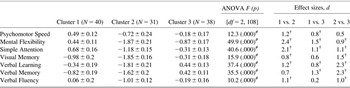
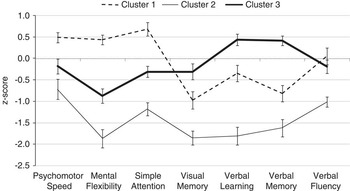
Agglomeration coefficients generated by cluster analysis revealed a demarcation point between three- and four-cluster solutions, suggesting that a three cluster solution best distinguished the cases; this was confirmed by inspection of the dendrogram. The resultant clustering revealed three relatively well-sized groups (cluster 1: n = 40; cluster 2: n = 31; cluster 3: n = 38), further suggesting that the appropriate number of clusters was selected. Table 1 shows the cluster group mean (curtailed) Z-scores (and standard deviations) for each of the seven neuropsychological variables. ANOVA determined main effects of “cluster-group” for each neuropsychological variable; and effect size calculations (d) estimate the pair-wise cluster-group differences (see Table 1). The largest effect sizes were evident in mental flexibility and verbal learning/memory variables. The neuropsychological differences among cluster groups are best represented by the profiles illustrated in Figure 1.
Mean Z-scores (±standard deviation) for neuropsychological variables across the three clusters with corresponding results for ANOVA

Note. Effect sizes (d) for each pair-wise cluster comparison are also provided. † denote large effects sizes (d > 0.8). remained significant even after controlling for predicted IQ. ANOVA = analysis of variance.
Profile of Z-scores (with standard error bars) for traditional neuropsychological measures by cluster group.

The cluster profiles depicted in Figure 1 are described as follows: cluster 1 shows poor visual and verbal memory, with normal (i.e., Z-score between −0.5 and 0.5) psychomotor speed, mental flexibility, verbal learning and verbal fluency, and average-to-high average simple attention; subsequently labeled: the “poor memory” cluster. In contrast, cluster 3 shows a profile distinguished by poor mental flexibility with the remaining domains varying within the normal range (although verbal learning and memory is in the average-to-high average range); subsequently labeled: the “poor mental flexibility” cluster. Finally, cluster 2 is characterized by poor performance across all measures (in the low average to borderline range) with marked impairments in mental flexibility, verbal learning, and (visual and verbal) memory; subsequently labeled: the “impaired attention and memory” cluster.
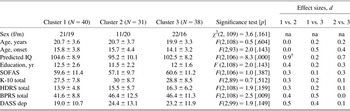
Table 2 shows the cluster-group mean Z-scores (and standard deviations) for demographic and clinical variables; with the corresponding between-group tests with effect size calculations. According to χ 2 analysis, the clusters do not differ significantly in the distribution of each gender; although there is a lower ratio (approximately 1:2) of females to males in cluster 2. ANOVAs for the subsequent variables revealed a main effect of “cluster-group” for two variables: predicted IQ and BPRS total. Closer inspection of the pair-wise cluster-group comparisons show that for IQ, there was a significant effect size for the difference between cluster 1 and cluster 2, with the latter showing lower mean IQ. To determine whether IQ differences may have affected the between-group tests performed for each of the seven neuropsychological variables, we conducted ANCOVAs controlling for IQ; all variables remained significant (see Table 1).
Mean scores (±standard deviation) for demographic and clinical variables across clusters; between-group differences were tested by chi-square or ANOVA

Note. Effect sizes (d) for each pair-wise cluster comparison are also provided. † denote large effects sizes (d > 0.8). ANOVA = analysis of variance; SOFAS = social and occupational functioning; HDRS = Hamilton Depression Rating Scale; BPRS = Brief Psychiatric Rating Scale; DASS dep = Depression Anxiety and Stress Scales depression subscale.
In terms of general psychiatric symptoms (indexed by BPRS total), there were no large effects sizes in any pair-wise comparison; all clusters showed a mean score in the “moderately ill” range (Leucht et al., Reference Leucht, Kane, Kissling, Hamann, Etschel and Engel2005). However, cluster 1 was at the lower end of this range compared to the other cluster groups who were both in the middle of this range (see Table 2). Notably, the three cluster groups did not significantly differ in age, age of onset, years of education, or the rating of social and occupational functioning (SOFAS). Similarly, there were no significant differences in self-reported psychological distress (K-10) or depression (DASS), nor in the clinical ratings of current depression (HDRS); each cluster-group was in the mild-to-moderate impairment/symptomatic range (Andrews & Slade, Reference Andrews and Slade2001; Keller, Reference Keller2003; Lovibond & Lovibond, Reference Lovibond and Lovibond1995).
Relationship Between Cluster Membership and Primary Diagnosis or Medication
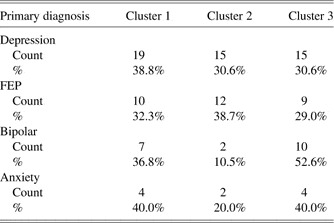
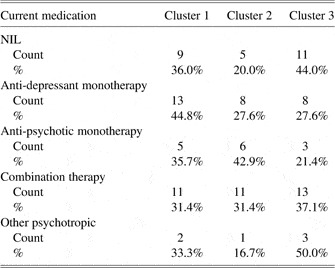
The three cluster-groups did not differ significantly [χ 2(8,109) = 6.23; p = .398] with respect to primary diagnoses. A closer inspection of Table 3 reveals that the diagnostic categories are equally distributed across clusters for the two largest categories (depression and FEP); however, for the smaller two categories (bipolar and anxiety) there is an unequal distribution, with both categories being relatively under-represented within cluster 2. Similarly, with regard to the distribution of medication categories, the three cluster-groups did not differ significantly [χ 2(8,109) = 5.08; p = .749]. As with the primary diagnosis data, the larger medication categories tended to be relatively well distributed across the three cluster groups (Table 4); although it is interesting to note that the largest number of individuals on anti-depressant monotherapy was in cluster 1, whereas the largest number of individuals on anti-psychotic monotherapy was in cluster 2 (although the differences are marginal).
Cross-tabulation of cluster by primary diagnosis

Cross-tabulation of cluster by medication category

Discriminant Function Analysis
With the seven neuropsychological variables entered (simultaneously) as predictors, DFA confirmed distinct neuropsychological profiling by generating two functions to separate the three cluster-groups. The first function accounted for 64% of the differences among the clusters (Wilk's λ = 0.168; p < .001). The second function explained the remaining variance (36%) and was also statistically significant (Wilk's λ = 0.486; p < .001). The structure matrix showed a clear delineation of “attentional” (function 1), with high discriminant loadings for mental flexibility (r = .674) and simple attention (r = .616); versus “verbal learning/memory” (function 2) performance with high discriminant loadings for verbal memory (r = .679) and verbal learning (r = .533). The resultant DFA showed an overall correct classification rate of 94.5%; more specifically, 97.5% of cluster 1 cases, 90.3% of cluster 2 cases and 94.7% of cluster 3 cases were correctly classified. A cross-validation (“leave-one-out”) technique confirmed the stability of this classification procedure with an overall correct rate of 88.1%; with 90.0% of cluster 1 cases, 83.9% of cluster 2 cases and 89.5% of cluster 3 cases correctly classified. Overall, the DFA findings supported the clustering technique; the additional empirical evidence provide by this DFA was that the cluster groups were maximally separated by two key cognitive domains: “attention” versus “verbal learning/memory.”
Independent Validation of the Clusters
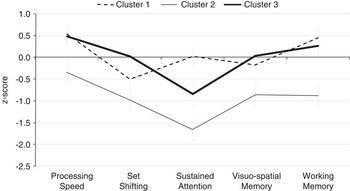
Figure 2 shows how the three cluster-groups compared on a range of independent, non-verbal (CANTAB) neuropsychological measures that were not used to determine clustering. Cluster 1 showed a normal level of performance across the independent measures, with average-to-high average performance in processing speed and working memory. Cluster 3 showed a similar independent profile to cluster 1, but with a marked difference in sustained attention (in the low average range), consistent with the original profile. Finally, as seen in the original solution, cluster 2 showed the worst profile, with a marked deficit in sustained attention.
Profile of Z-scores (with standard error bars) for Cambridge Automated Neuropsychological Testing Battery (CANTAB) (all non-verbal) measures by cluster group.

Discussion
This study identified three distinct neuropsychological profiles in young outpatients who were all determined have at least mild levels of current depression. The three cluster groups were relatively balanced in size: one group (cluster 1; n = 40) was characterized by impairments in memory with relative strengths in attentional measures; on the other hand, another group (cluster 3; n = 38) was characterized by impairment in mental flexibility, with intact memory and verbal measures. The final group (cluster 2; n = 31) showed reduced performance in all cognitive domains with marked impairments in both mental flexibility and memory. The profiles for two of these cluster groups (clusters 2 and 3) were somewhat validated by a profile of independent neuropsychological variables, which primarily distinguished the groups according to sustained attention. For cluster 1, performance in the two independent memory tests was normal; suggesting that for these patients, memory problems may be specific to tasks that that involve organization and/or verbal skills.
Our findings indicate that for young individuals at the early stages of a major psychiatric disorder, their current depression may not uniformly involve particular neuropsychological deficits or patterns of deficits. On the other hand, there appears to be a moderate number (almost one in three) of depressed outpatients who show a global neuropsychological deficit with attention and memory being particularly impaired; a pattern consistent with what might be expected from other studies of older individuals with affective and/or psychotic disorders (Castaneda et al., Reference Castaneda, Tuulio-Henriksson, Marttunen, Suvisaari and Lonnqvist2008; Elvevag & Goldberg, Reference Elvevag and Goldberg2000; Taylor Tavares, Drevets, & Sahakian, Reference Taylor Tavares, Drevets and Sahakian2003). This impaired cluster may represent a group of individuals with pre-existing developmental or illness-acquired cognitive difficulties, whose problems appear more severe and possibly more enduring, despite an early diagnosis of an affective or a psychotic disorder (Hafner et al., Reference Hafner, an der Heiden and Maurer2008).
The neuropsychological heterogeneity, despite comparable levels of current depression, indicates that the deficits seen in early affective or psychotic disorders may be characterized by a variety of cognitive profiles and severity levels. The neurobiological correlates of this variability are not well understood. However, the present findings do suggest that a single pathophysiology among young people presenting with affective or psychotic disorders is not apparent. In other words, the neuropsychological diversity within a sample of diagnostically heterogeneous, yet symptomatically comparable, young outpatients may be a prelude to (or act as markers for) particular illness course trajectories that may transpire, despite an early “primary” diagnosis. For example, a patient diagnosed with first-episode depression with psychotic features may only ever experience one psychotic episode but have persistent problems with mood and, therefore, functioning; in this scenario, neuropsychological profile rather than primary diagnosis may play a more important role in predicting outcome and informing treatment decisions.
In older, chronically depressed patients cognitive deficits have been found to have a substantial and unique contribution to disability; suggesting that efforts to ameliorate cognitive deficits may in turn reduce levels of disability (Naismith, Longley, Scott & Hickie, Reference Naismith, Longley, Scott and Hickie2007). Thus, for younger depressed patients with emerging cognitive deficits, tailored and targeted interventions such as cognitive remediation may be particularly effective in improving psychosocial outcomes (Naismith, Redoblado-Hodge, Lewis, Scott, & Hickie, Reference Naismith, Redoblado-Hodge, Lewis, Scott and Hickie2010; Redoblado Hodge et al., Reference Redoblado Hodge, Siciliano, Withey, Moss, Moore, Judd and Harris2010). Despite the treatment options available, clinical practice would benefit from neuropsychological profiling as it appears to provide more information about the underlying neurobiology; and for young patients this is likely to be more indicative of outcomes then the diagnosis may suggest. As clinical research in early intervention in mental health moves to implement a “pathways-to-illness” or “illness-staging” model (McGorry et al., Reference McGorry, Hickie, Yung, Pantelis and Jackson2006), the potential value of neuropsychological testing (cross-sectionally and longitudinally) needs to be emphasized. This study demonstrates the considerable illness heterogeneity that is still likely to exist within these clinically defined subgroups. The potential predictive capacity of neuropsychological profiling in these subgroups now needs to be further explored.
To our knowledge this is the first study to undertake neuropsychological clustering in young depressed outpatients within the early stages of an affective or a psychotic disorder. Our approach is novel in this regard and there are some limitations. First, we found that inter-cluster differences may be associated with intellectual ability and possibly other factors, such general psychiatric symptom severity and gender. Our study involved a relatively small sample size for a complex statistical technique such as cluster analysis (Borgen & Barnett, Reference Borgen and Barnett1987); future studies with much larger sample sizes could better assess the influence of premorbid ability on cluster assignment and also evaluate the impact of factors known to affect cognitive functioning, such as gender and medication (Goldstein, Reference Goldstein1990). It should be noted that, with regard to depressive symptoms, the sample assessed here can be regarded as “non-responders” to medication [since their HDRS scores were >7 (American Psychiatric Association Task Force, 2000)]; however, we did not measure HDRS before treatment so we cannot determine whether there have been changes in mood due to medication.
Second, factors such as the cross-sectional design (and, therefore, diagnostic accuracy) and potential selection bias (help-seeking outpatients) may limit the generalizability of this study. The primary diagnoses (made by the referring psychiatrist) in this study were not validated by a structured diagnostic interview, so any conclusions about the accuracy or distribution of these psychiatric disorders in this sample should be made with caution. Future studies with a longitudinal design could help to clarify both diagnostic and functional aspects which can be prone to significant changes in this vulnerable age group. Third, while attempts were made to control for the effects of extreme scores (which have the potential to create very small, independent clusters), we acknowledge that some cognitive functions (e.g., mental flexibility) may play a more important role in identifying unique profiles of neuropsychological function.
Our attempt to validate the clustering with a profile of cognitive measures from separate, non-verbal computerized tests should be treated with caution; however, it did provide further support for measures of attention being particularly sensitive to the patient subtypes. It is possible that the deficits observed across the clusters, that is, the poor learning, memory and mental flexibility may be subserved by a fundamental deficit in attention. We observed a “graded segregation” of clusters in the measure of sustained attention (see Table 2), which may support this suggestion; however, clusters 2 and 3 then “switch” in terms of their level of performance for the verbal learning and memory tasks, indicating that fundamental attention processes may not directly impact on learning and memory. Overall, the neuropsychological evidence suggests that there may be different neurobiological systems affected in patient subtypes.
Notwithstanding these limitations, this study suggests that despite very similar levels of current (in particular, depressed) symptomatology, young individuals in the early stages of illness have underlying neuropsychological heterogeneity. This suggests then, that distinct neuropsychological profiling has the potential to predict longer-term psychiatric outcomes and, therefore, enhance early, individually tailored intervention strategies.
Acknowledgments
The authors thank Catherine Chudleigh, Eleanor Frow, and Rico Lee for their assistance with data collection. We also thank individuals that participated in this study. No financial or other relationships exist that could be interpreted as a conflict of interest pertaining to this manuscript. This study was supported by the following National Health & Medical Research Council funding sources: Program Grant (No. 566529), Centres of Clinical Research Excellence Grant (No. 264611), Australia Fellowship (No. 511921) and Clinical Research Fellowship (No. 402864).