Introduction
Although Antarctica is largely pristine, relatively volatile persistent organic pollutants (POPs) can be carried there by long-range atmospheric transport (Risebrough et al. Reference Risebrough, Walker, Schmidt, De Lappe and Connors1976). Their highly lipophilic and persistent nature allows ready accumulation in organisms and subsequent biomagnification through the food web. Here, we describe the distribution and concentration profiles of dioxin-like PCB congeners, and estimate transference rates through the food web in various Antarctic organisms.
Methods
Antarctic organisms from various trophic levels were collected from around Narębski Point and Marian Cove, Barton Peninsula, King George Island, South Shetland Islands between 2007 and 2008. Marine sediment and marine animals were hand-collected by SCUBA divers or by using nets. The muscles and livers of southern giant petrel, brown skua, south polar skua, and gentoo penguin were collected from fresh carcasses. The eggs of south polar skua, Antarctic tern, gentoo penguin, and chinstrap penguin were collected at the beginning of the breeding season. The Aantarctic krill, black rockcod and Antarctic silverfish were collected using a fishing lamp and nets near King Sejong Station. Antarctic limpets, clam, and crustacea were collected at inter tidal zones near Narębski Point. Pooled samples were treated and extracted according to the US Environmental Protection Agency (USEPA) method 1668A (USEPA 1999), and dioxin-like PCB congeners were analysed and quantified using high-resolution gas chromatography/high-resolution mass spectrometry (HRGC/HRMS) on a DFS mass spectrometer (Thermo Fisher Scientific, Bremen, Germany) using EPA method 1668A (USEPA 1999) for PCB congeners (Park et al. Reference Park, Lee, Kim, Kim and Lim2009).
Results and discussion
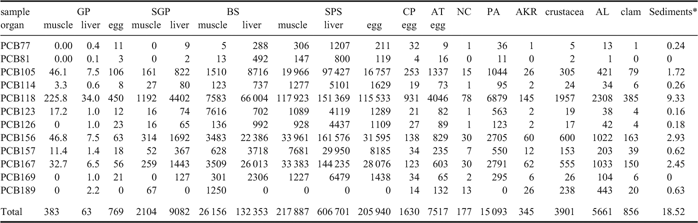
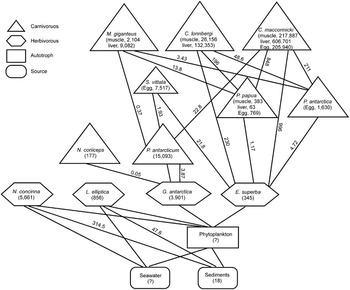
Samples were analysed for dioxin-like PCB congeners (IUPAC 77, 81, 105, 114, 118, 123, 126, 156, 157, 167, 169, and 189) (Table I). The dioxin-like PCB concentrations were 18.52 pg g-1 in sediments from c. 20 m depth in Marian Cove. The mean dioxin-like PCB concentrations were 0.35 ng g-1 in krill, 3.9 ng g-1 in amphipods, 15.1 ng g-1 in silverfish, 4.1 ng g-1 in gentoo penguin, and 1.6 ng g-1 in chinstrap penguin eggs. Species of south polar skua and brown skua regarded as predators, scavengers, and kleptoparasites in this area (Malzof & Quintana Reference Malzof and Quintana1998) had the highest concentration of ΣPCB. The uptake of contaminants by lower level biota, such as plankton, bivalves, and crustaceans is by bioconcentration from the abiotic environment. Biomagnification in higher trophic level biota is from contaminant uptake is by feeding on lower trophic levels (Gray Reference Gray2002). The higher concentration of dioxin-like PCBs in predators (brown skua and south polar skua) compared with amphipods etc. confirms the importance of biomagnification. The highest transference rates were observed in the link between the highest carnivorous predators (two skua species) and their major prey, penguins and krill (Fig. 1). This study is the first to report dioxin-like PCB concentrations and bioaccumulation in various food web levels around Narębski Point (ASPA No. 171). Further comprehensive studies of contamination, including other POPs and heavy metals, will be conducted in this area.
Concentrations of dioxin-like PCB congeners (pgg-1 wet weight) in Antarctic biota.
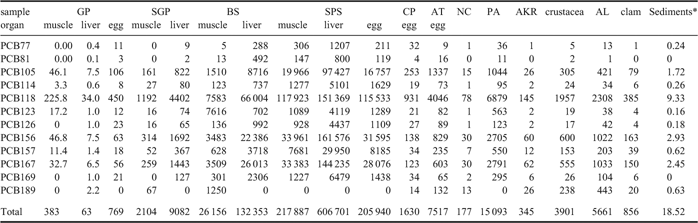
GP = gentoo penguin, Pygoscelis papua, SGP = southern giant petrel, Macronectes giganteus, BS = brown skua, Catharacta lonnbergi, SPS = south polar skua, Catharacta maccormicki, CP = chinstrap penguin, Pygoscelis antarctica, AT = Antarctic tern, Sterna vittata, NC = Notothenia coriiceps, PA = Pleuragramma antarcticum, AKR = Antarctic krill, Euphausia superb, crustacea, Gondogeneia antarctica, AL = Antarctic limpet, Nacella concinna, clam = Laternula elliptica.
* pg g-1 dry weigh.
Transference rates of PCBs and ecological relationships between organisms and the abiotic environment. The numbers within the boxes are the total PCB concentrations (pg g-1) and the numbers on the lines are the transference rates.

Acknowledgements
This study was supported by the Study of the Polar Environment using Ecotoxicoproteomics (PE09110) and a Status and Changes of Polar Indicator Species and Coastal/Terrestrial Ecosystems (PE10040) grants funded by the Korea Polar Research Institute (KOPRI).