Introduction
In 2015, the influx of people arriving in Europe and applying for asylum peaked at 1.2 million—a fourfold rise compared with the previous year—creating significant political rifts within the EU and igniting a global media discussion on what has been labeled the migrant or refugee crisis. Countless images of mayhem and dismay on both land and sea, iconized by the photo of a three-year-old Syrian boy Alan (Aylan) Kurdi found lying dead on the Turkish beach, dominated headlines around the world and prompted international responses, while also opening a division in the public imaginary over how to deal with the crisis (Pilipets & Winter Reference Pilipets, Winter, Wimmer, Wallner, Winter and Oelsner2018). The images, or their parts, have frequently been utilized as semiotic resources for the multimodal cultural artifacts generally known as internet memes—vehicles for recontextualization and subsequent circulation—in two general kinds of discourses on social media: one aimed at gaining support and relief for refugees, the other to denounce welcoming policies, increase border control, and facilitate deportation processes (Thelwall Reference Thelwall, Vis and Goriunova2015; Plascencia Reference Plascencia2017).
A growing body of literature indicates that the participatory culture of digital discourse provides a means for the efficient use of internet memes as a tool for political participation and satire (e.g. Shifman Reference Shifman2014; Häkkinen & Leppänen Reference Häkkinen and Leppänen2014; Heiskanen Reference Heiskanen2017; Laineste & Voolaid Reference Laineste and Voolaid2018). Social networks provide an excellent grassroots conductor for the circulation of such discourses with unparalleled speed, reach, and influence. Furthermore, their permeating presence and endless iterations wield the capacity to employ the ebb and flow of social life, pieces of popular culture and technological affordances for political commentary and increasingly also identity politics (Gal, Shifman, & Kampf Reference Gal, Shifman and Kampf2015). Although memes pertaining to the migrant crisis have been often described as ‘preposterous, uncultured, weird, humorous and silly expressions’ (Pilipets & Winter Reference Pilipets, Winter, Wimmer, Wallner, Winter and Oelsner2018:160, original emphasis; cf. Goriunova Reference Goriunova2014:5), the discussions they provoke show a considerable degree of complexity that problematizes binary categorizations (positive/negative, pro-/anti-migration and the like) of the sentiments about the crisis (cf. Nerghes & Lee Reference Nerghes, Lee, Akkermans, Fontaine, Vermeulen, Houben and Weber2018), which is illustrated on the countryball memes and reactions to their portrayal of the crisis on Facebook.
Countryball memes appear in a simple, easy-to-draw multipane comics format featuring ball-shaped characters in color schemes combinations based on the flags of both contemporary and historical countries or unions. The narrative usually revolves around reinterpreting and reinventing geopolitical events and international relations in a satirical manner divorced from the constraints of political correctness, mostly by drawing on national or sociocultural stereotypes and mixing linguistic resources from multiple languages. Since their conception in 2009, the original normative blueprints of countryball memes mark it as a ludic memetic format, whereby the cultural logic behind communicative practices and organization of social life in digital niches dedicated to it intended to be rooted in jocularity, playfulness, and conviviality despite the seemingly disparaging veneer.Footnote 1
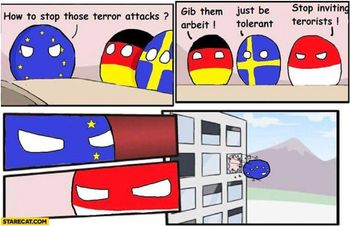
However, the format has been appropriated by some Facebook pages rendering various events of geopolitical significance (including the sociopolitical ramifications stemming from the migrant crisis) in a serious, nonludic way to exploit its popularity to propagate particular political perspectives. This article follows two Facebook pages (POLANDBALL and Czechball) producing and circulating countryball memes satirizing the political discussions stemming from the inter-EU conflict over the migrant crisis in 2017 and related issues, including the terror attacks often attributed to the migrants (see Figure 1). These events have stirred notable tensions between the ludic uptake and the serious uptake of the crisis-related countryball memes manifested in reflexive conflicts among participants in the comment sections, which point to multilayered and transcontextual complexity in the sentiments about the crisis.
A countryball comic stripFootnote 2 circulating in the wake of the 2017 London Bridge attack.

In addressing this complexity, we are, however, faced with analytical problems concerning the communicative affordances and constraints of the online infrastructures, which challenge many of the established methodological frameworks (Blommaert Reference Blommaert2018; Pennycook Reference Pennycook2018). These include, among others, the indeterminacy of social actors participating in the comment sections (social media accounts may be incomplete, anonymous or simply ‘fake’), new types of ephemeral and seemingly ad hoc sociality (forms of groupness or togetherness coalescing and pertaining only to a particular meme), and the nonlinear aspects of meaning-making and identity work reaching beyond the immediate interaction (e.g. accessing one's profile information and prior communicative inputs). In this view, the technosocial infrastructure of Facebook constitutes more than background context. It is an exploitable reservoir of indexical cues and resources not available in ‘offline’ communication that needs to be taken into consideration if we wish to understand the ways in which participants invoke, negotiate, and ratify sentiments about the crisis.
To this end, the conceptual toolkit of contemporary linguistic ethnography and interactional sociolinguistics (e.g. Goodwin & Goodwin Reference Goodwin, Goodwin, Auer and DiLuzio1992, Reference Goodwin, Goodwin and Duranti2004; Scollon & Scollon Reference Scollon and Scollon2004; Blommaert & Rampton Reference Blommaert and Rampton2011) influenced by symbolic interactionism (Blumer Reference Blumer1969) has been instrumental in capturing the intricacies of technologically mediated human interaction (see e.g. Al Zidjaly Reference Al Zidjaly2015 and Jones, Chik, & Hafner Reference Jones, Chik; and Hafner2015 for an overview). In what follows, however, this article draw on Simondon's theory of individuation (Reference Simondon1989, Reference Stiegler2009), which adds useful conceptual points to account for the dynamic and largely unpredictable interrelation not only between the individual and the social, but also the technical in communicative action. It proposes that both individuals and collectivities engaging with crisis-memes emerge (individuate) concurrently, along with epistemic, affective, and ideological stances that participants display towards the crisis and towards one another in the comment sections. This enables us to document the ways in which minute ‘micro’ details of moral-evaluative judgments and value attributions unfold on a moment-to-moment (comment-to-comment) basis, and how they provide evidence of the spatiotemporal (chronotopic) conditions of the larger ‘macro’ normative and ideological frameworks (Rampton Reference Rampton2006; Blommaert & De Fina Reference Blommaert, De Fina, Ikizoglu, Wegner and Fina2017:1; cf. Bakhtin Reference Bakhtin1981; Agha Reference Agha2007). We thus turn to the sentiments about the crisis as chronotopic representations invoked by the nano-politics of identity (Parkin Reference Parkin, Arnaut, Blommaert, Rampton and Spotti2016) in terms of concrete and observable effects of social action prompted by the countryball memes.
Facebook, identity, and Simondon
Similarly to other social media, Facebook users construct, perform, and inhabit multifaceted and multisited identities unfolding in a number of interactional contexts (updating, editing, and modifying individual profiles as well as ‘liking’, ‘sharing’, commenting, or otherwise reacting to published content dispersed over countless sites), which are archived, accessible (albeit depending on privacy settings), mediated, and ordered through technology (i.e. algorithms sorting out the visibility of such contexts and their relevance for others). Identity work thus informs and is informed by the technosocial infrastructure and cannot be established a priori in analysis because of its nonlinear and disembodied character. And while such environments are predicated on constant flux, we find observable patterns of communication (e.g. reiterating countryball stereotypes) pointing to interactionally negotiated identities and identity claims (e.g. expressing alignment with the countryball satire) and categorizations (e.g. taking countryballs seriously rather than as a ‘joke’), which in turn index some degree of social cohesion and organization (countryball communities). At the same time, we also observe ‘light’ types of loose and ephemeral collectivities organized around temporal interests, lifestyles, causes, or events (often reflected in internet memes) based on phatic forms of sociality (Blommaert & Varis Reference Blommaert and Varis2015).
To account for these social realities, this article draws inspiration from the French philosopher Gilbert Simondon and his theory of individuation (Reference Simondon1989, Reference Simondon2009), through which identity is approached as an emergent and tentative byproduct (or effect) of communicative actions that, at the same time, feed into the technosocial infrastructure facilitating them. We thus move from specific human users utilizing and crafting specific linguistic, semiotic, and discursive resources in rendering specific identities and alignments on social media (Seargeant & Tagg Reference Seargeant and Tagg2014; Leppänen, Westinen, & Kytölä Reference Leppänen, Westinen and Kytölä2017) to communicative and interactional phenomena showing an increasingly intertwined relationship between human and nonhuman, infrastructural and artifactual entities involved in identity work pertaining to the online-offline nexus (Pennycook Reference Pennycook2018).
Simondon's point of departure is individuation—an on-going process in which the individual perpetually comes into being (Simondon's dictum is that being is becoming) as part of resolving conflict or incompatibility with the social and environmental milieu. The conflict arises in, for example, arguments about the supposed reading of countryball memes on a particular countryball page. Individuation is inevitably a co-individuation between individuals and their environment; that is, in this case, the collectivity (or ‘collective’ in Simondon's terms) of people subscribing to and/or engaging with a Facebook page on the one hand, and Facebook's interface and infrastructure with its affordances and constraints on communicative action on the other. According to Simondon (Reference Simondon2009), the individuated subject arises as a transient result of individuation, not as its instigator (the subject is an effect, not a cause), whereby identities, individuals, and communities are to be viewed as interrelated and emergent rather than self-constituted, closed, or finished entities.
Simondon's emphasis on ontogenesis (becoming) rather than ontology (being) sets his approach apart from Durkheimian and Durkheim-influenced sociology in which the link between the individual and the social (or the collective) is ontological and presupposes that ‘collective tendencies have an existence of their own [and that] they too affect he individual from without’ (Durkheim Reference Durkheim1951:309). By giving analytical precedence to ontogenesis, Simondon presents a relational approach that is not concerned with a need to postulate an ontological or methodological primacy in the ‘micro’ or the ‘macro’ (Bencherki Reference Bencherki2017:779), nor with reconciling the two levels or bridging the gap between them (cf. Giddens Reference Giddens1984; Latour Reference Latour2005). Instead, Simondon privileges action itself rather than the social actors or systems at play. Observe how the focus on action places Simondon's approach in proximity to the tradition of Mead (Reference Mead and Morris1934/1962), Goffman (Reference Goffman1974, Reference Goffman1981), and others (summarized as symbolic interactionism by Blumer Reference Blumer1969).
But Simondon's understanding of action extends beyond particular acts of meaning-making situated in particular interactions. For Simondon, action marks change in a sense of resolving a pre-individual affective-emotional tension or conflict (instigated here by the countryball memes). Resolving the tension leads to individuation, whereby observable acts of individuation (e.g. comments acting on the ludic-serious tension) are only ‘left-overs’ of this pre-individual state.Footnote 3 As Grosz (Reference Grosz, Boever, Murray, Roffe and Woodward2012:38) puts it: ‘Simondon is interested in understanding how pre-individual forces, the forces that constitute the condition for both natural and technological existence, not yet individuated, produce individuals of various kinds’. Focusing on reflexive and indexical left-overs of individuation, this article considers such forces as chronotopically conditioned. However, before addressing the chronotopic aspects of individuation, its communicative and technological dimensions reaching beyond the individual are outlined below.
Transindividual individuation
As previously noted, individuation never occurs in isolation—it is always related to the individual's interior (‘psychic’ individuation concerning the formation of the psychology of individuals, such as personal stance, emotions, and normative orientations) as well as exterior (‘collective’ individuation concerning the formation of the link between such individual states and the individual's social and environmental milieu). Here, Simondon can be read against the backdrop of Bakhtinian dialogism. Simondon argues, alongside Bakhtin, that the interplay between the internal and external is not given but emergent and reciprocal (i.e. dialogic), while it is also inseparable from the milieu in which they occur, thus allowing for a nonstatic, dynamic perspective on coming-to-being (cf. ‘being-as-event’ in Bakhtin Reference Bakhtin1993:31–32) in which the micro-macro distinction dissolves. From the communicative perspective, for Simondon, language plays a similar role to that posited by symbolic interactionists; it is ‘the instrument of expression, vehicle of information, but not the creator of significations. Signification is a relation of beings, … signification is relational, collective and transindividual’ (Simondon Reference Simondon1989:200; cf. Blumer Reference Blumer1969:2). Similarly to contemporary interactional approaches to discourse (e.g. Scollon & Scollon Reference Scollon and Scollon2004; Rampton Reference Rampton2006; Blommaert & Rampton Reference Blommaert and Rampton2011; Blommaert Reference Blommaert2018), Simondon approaches language as ontologically inseparable from context, whereby the relationship between form and meaning does not occur on its own, but in dialogic relation to the self (individual), others (collective), and spatiotemporal conditions allowing for the interplay between the two (transindividual). By extension, in so far as being is perpetual becoming, context is a dynamic, evolving, and largely unstable component of communication, rather than abstract or latent presence that can be readily assumed and/or assigned to pre-existing categories (Szabla & Blommaert Reference Szabla and Blommaert2018).
In a similar vein, technology is a live site of individuation. It necessarily takes into consideration the algorithms operating behind the architecture of a given medium. Every Facebook page brings every one of its posts to the attention of a certain number of people who ʻlike’ the page but do not necessarily subscribe to the same sets of moral values and normative orientations. Simondon builds on and expands earlier theorizations of social systems in cybernetics (i.e. the preoccupation with the principles of organization and control in such systems; cf. Hymes Reference Hymes1964:24; Bateson Reference Bateson1972) that postulate a main tendency towards homeostatic regulation characterized by reduction or elimination of any divergences from ‘normal’ functioning on the basis of interindividual relations. It is argued that the ‘normal’ functioning in countryball collectivities is ludic and thus fundamentally grounded in ‘play’ (Huizinga Reference Huizinga1950/2014), whereby countryball memes are to be principally conceived of as resources for amusement unconstrained by the gravity of everyday life. However, Simondon adds that at the same time social systems (including such collectivities) also consist of transindividual relations (e.g. beliefs and values), which cannot be predicted within ‘normal’ functioning and which allow for the introduction and competition of different normativities that might take hold in subsequent configurations of the system.
This article focuses specifically on the transindividual aspects of individuation (or transindividual individuation in Simondon's vocabulary), more concretely on individuation resolving ludic-serious tensions through metapragmatically reflexive dialogue among participants, which arises from negative evaluation of crisis-related memes (i.e. when the meme is no longer interpreted as ludic). In the Simondonian view, the conditions are themselves individuated and expressed through partial or temporary solutions to these tensions. Inspired by Bakhtin's (Reference Bakhtin1981) notion of chronotope (expressing the inseparability of time and space with respect to personhood), such solutions are approached here as chronotopic representations intrinsically linked to a particular locale and personhood (Agha Reference Agha2007), including models of subjectivity and interpersonal relations. Chronotopes, in this sense, connect specific time-space arrangements with normative ideological and moral orders that frame specific political, historical, social, and cultural phenomena that unfold through interaction. Memes and comments on them then represent testaments to transindividual individuation that invokes spatiotemporal configurations conditioning the production and interpretation of communicative practices and identity work (Blommaert Reference Blommaert2015; Karimzad & Catedral Reference Karimzad and Catedral2018). Finally, seen as an impetus for individuation in relation with specific chronotopic conditions, memes (and participants’ engagement with them) provide insights into the perceptions of the political and social issues pertaining to the migrant crisis that unfold simultaneously in multiple contexts.
Individuation of memetic chronotopes
Discourse on the migrant crisis is undoubtedly rife with moral-evaluative statements concerning nationality, religion, ethnicity, gender, race, class, and other categorical identity ascriptions and distinctions, which are chronotopically grounded (Blommaert & De Fina Reference Blommaert, De Fina, Ikizoglu, Wegner and Fina2017). Particular chronotopic configurations define the diacritics of success and failure to be recognized not only as good or bad, but also in terms of more fine-grained categories, such as true, accurate, authentic, appropriate, and other blends of epistemic/moral judgments and evaluations (C. Goodwin Reference Goodwin2007). The images of the migrant crisis posited and mediated through internet memes land in different social niches and the social effects they produce can be approached as chronotopic representations that
enlarge the ‘historical present’ of their audiences by creating chronotopic displacements and cross-chronotope alignments between here-and-now and persons altogether elsewhere, transposing selves across discrete zones of cultural spacetime through communicative practices that have immediate consequences for how social actors in the public sphere are mobilized to think, feel and act. (Agha Reference Agha2007:324)
This translocal experience is facilitated by the core nature of internet memes—their capacity to imitate and reiterate linguistic and discursive-semiotic fragments of other chronotopes, by which they simultaneously connect various social and cultural timespaces through recognizable communicative resources and practices (one can imagine, for example, the countless variations and resemiotizations of the ‘horse dance’ from the 2012 K-pop hit single ‘Gangnam style’). Such communicative practices, Agha contends, are not devoid of tensions and paradoxes in the social effects they produce. They are constantly invoked, affirmed, negotiated, and/or challenged in mundane, everyday interactions through historically shaped and socioculturally loaded indexicals, that is, communicative resources such as tropes pointing to various degrees of sharedness and, therefore, to some extent presupposed histories of meaningful usage related to context-specific sociocultural meaning reservoirs. However, while such presuppositions surface as individual action (e.g. comments) rendering particular chronotopic representations, their significance is ratified collectively through locally enacted processes of authentication, legitimization, or verification. Thus, for example, chronotopic representations of the migrant crisis circulated through countryball memes may be accepted as a ludic form of humorous expression (in accordance with the ludic presuppositions stemming from the indexical orders of the countryball genre), as well as opposed as a serious form of political commentary and advocacy. The result is dependent on both individual and collective individuation that coalesces into a particular social formation making up the comment section.
Furthermore, the focus on the transindividual relations invites us to take the technosocial aspects of individuation on board in analysis, particularly the utilities of Facebook's user interface regimenting the interactive and relational chronotopic work in the comment sections. Through the interplay between the interior and the exterior, the transindividual relation emerges and lends itself to a way of understanding of the individual in the new type of loose and elastic collectivities appearing on social media. Countryball Facebook pages, as one type of such collectivities, are in this sense considered ludic light communities constituting focused but diverse coagulations of people (Blommaert & Varis Reference Blommaert and Varis2015:54) organized around particular meme-posts. Unlike longer-lasting communities of practice (Wenger Reference Wenger1998; Eckert & McConnell-Ginet Reference Eckert and McConnell-Ginet1999) or more ephemeral affinity spaces (Gee Reference Gee, Barton and Tusting2005), light communities are not necessarily geared towards building durable social ties, sustained participation, or transferring knowledge. Each kind of coagulation emerges as an effect of transindividual individuation engendered by the underlying algorithms promoting each meme-post and related content to a certain number of Facebook users, which usually results in different sets of participants who coagulate (individuate) around it. As previously noted, countryball memes are by default designed to prompt ludic individuation: (i) they create a site of meaning-making and identity work located outside what is commonly perceived as ‘useful’ or ‘rational’ (i.e. a Facebook page devoted to the countryball phenomenon with its resources for individuation); (ii) they are based on voluntary and authentic performance of the self in terms of individuation; (iii) they lack centralized mechanisms of control restricting the process of individuation; (iv) they are enclosed by a particular spatiotemporal configuration such as a post and its comment section marking the site of individuation; and (v) they consist of a nontrivial activity demanding certain knowledge and skills that can be learned and policed (Huizinga Reference Huizinga1950/2014:7–14).
The final point is central to this article—the process of individuation can be and often is ratified along different lines or normative benchmarks that bespeak multiscalar granularity in the chronotopic representations of the crisis and their discursive uptake. The notion of scale becomes useful as it helps to identify how signs constituting memes ‘widen or narrow the range of potential referents as well as the outcome of discursive processes that increase or decrease a sign's potential for uptake’ (Goebel & Manns Reference Goebel and Manns2018:6; cf. ‘scopes of understandability’ in Blommaert Reference Blommaert2015). The ludic-serious tension can be explained as the problem of different scales that triggers individuation. As geopolitical satire memes, countryball memes weave together multiple signs of different values and scales developed in different chronotopes (such as those appearing in serious political debates or press), which are modified and recontextualized to generate a semiotic configuration of personhood (e.g. migrants, Europeans) in terms of meaning-making activity at a lower, more niched scale (e.g. in ludic light communities pertaining to Facebook meme pages). The discrepancy between different scales is subsequently navigated by the participants through the prism of their normative orientations and alignments as part of individuation. This uptake in terms of microscopic socionormative ratifications illuminates cognitive and affective aspects of participants, who express their views, stances, and opinions, which in turn informs of macroscopic structures, phenomena, and processes in relevant participant frameworks.Footnote 4 Importantly, this ratification is predicated not only on the situated communicative input (e.g. individual comments in a particular page), but also on technological affordances offered by the platform—more precisely, on the access to profiles containing discernable identity diacritics, against which the input is also measured as part of individuation. The following section lays out some relevant specifics of the countryball genre with two examples, which provides background for the discussion of their uptake.
Countryball chronotopes
The comics lend themselves to chronotopic depictions of the geopolitical realities behind the migrant crisis, which, similarly to any political event, invites conflicting views and arguments. However, it has to be borne in mind that the countryball genre has kept its recognizable communicative patterns and scripts based on the ludic reiteration of the national and cultural stereotypes, which now offer communicative resources available not only for crafting countryball memes, but also for meaning-making and identity work related to countryball and other memetic content. The article concentrates on two countryball Facebook pages: POLANDBALL and Czechball. The POLANDBALL page has functioned as a major international hub for countryball fans all over the world, and continues to uphold the ludic ethos in covering geopolitical issues not necessarily limited to Poland. It was established in 2009 soon after the first comics emerged from the international section of a German-based image forum Krautchan. In the following years (roughly between 2010 and 2014) it inspired countless other, more locally oriented and grounded, offshoots ranging from national Brazilball, Germanyball, or Czechball to regional (e.g. Saxoniaball or Berlinball), historical (e.g. Yugoslaviaball or Prussiaball), and other (e.g. CommunistBall or Spaceball) countryball pages. These second-generation countryball platforms can be distinguished by publishing and highlighting more nationally and/or ideologically specific interests through the countryball prism while maintaining a translocal network through sharing content, forming alliances, and competing with other pages. Even though such pages largely follow the indexical (normative) orders (Blommaert Reference Blommaert2005) of the countryball genre to attain recognizability, the ludic uptake is not necessarily part of the preferences and expectations in the communicative conduct among the audiences they attract.
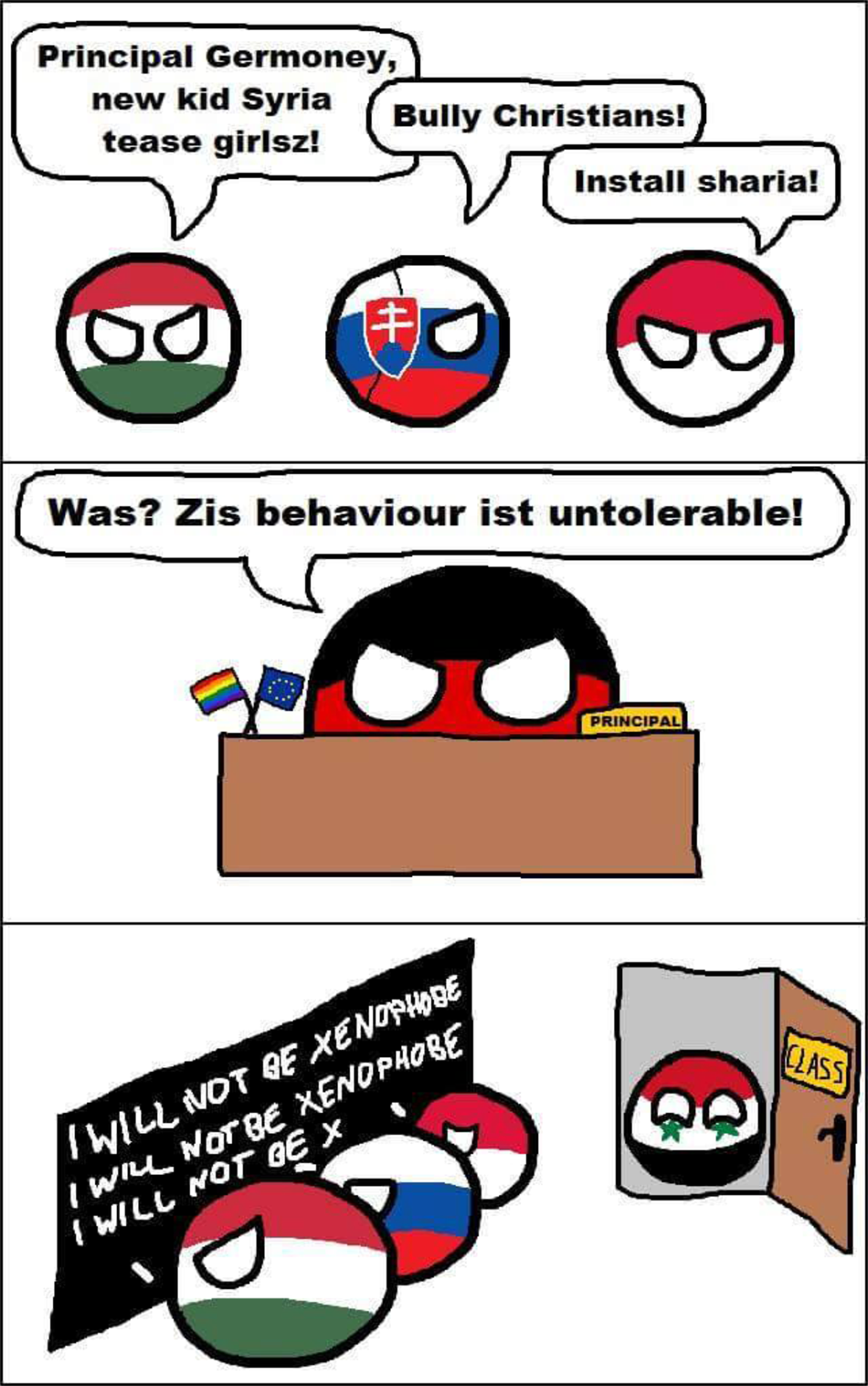
Focusing on such differences, this analysis concentrates on excerpts from POLANDBALL and Czechball pages, and attention is paid specifically to the posts and comments pertinent to the migrant crisis in the light of the controversy surrounding the EU's plans to implement the disputed quota plan, followed by legal actions against eastern states refusing to participate. Consider the posts below (Figures 2 and 3). Both posts are illustrative of the tense political atmosphere across the whole EU in the aftermath of the crisis and other related concerns (Nič Reference Nič2016). The issue was palpable in all major 2017 election campaigns and subsequent negotiations across all of Europe (e.g. the French presidential election, German federal election, Czech legislative election, or Austrian legislative election). While giving rise to the far-right movements and increasing prominence of anti-immigration rhetoric and policies (Davis & Deole Reference Davis and Deole2018), the refusal to abide with the valid relocation scheme and reluctance to fulfil the legal obligations in accepting a share of asylum seekers eventually crystalized into a formal complaint by the European commission against the Czech Republic, Hungary, and Poland (Europa.eu 2017).
Posted on the POLANDBALL page, June 10, 2017.

Posted on Czechball, August 11, 2017.

The vast majority of countryball comics depicting the issue mostly aligns with the stance taken by the V4 countries in keeping with what could be called the ‘anti-migrant camp’, although the discussions in the comment sections call for a more nuanced approach and vocabulary. Countryball discourses highlight and build on mixed forms and contents that Bakhtin referred to as heteroglossia (Bakhtin Reference Bakhtin1981), that is, ‘the co-existence of socio-ideological contradictions between the present and the past, between differing epochs of the past, between different socio-ideological groups in the present’ (Bakhtin Reference Bakhtin1981:291). The notion of heteroglossia in particular draws attention to how particular points of view are indexed and how participants engage with larger social, historical, and ideological processes encapsulated in the stereotypes mobilized by the countryball satire.
For example, Germanyball (Figure 2) is traditionally addressed as ‘Germoney’ (a portmanteau of ‘Germany’ and ‘money’), which has become a trope potentially signifying a number of ideologically related stereotypical connotations, including not only the typical efficiency-oriented, yet humorless and workaholic breadwinning father-figure of the European Union, but also that of Germany actually being the ‘Fourth Reich’, which succeeds in conquering Europe through trade and financial discipline only to exploit its economic muscle to dictate key policies on a transnational scale. Subsequently, this trope is central to reframing of the European negotiations over the migrant crisis into a well-known scenario: school detention. The whole frame of this disciplinary action constitutes a chronotopic configuration that clearly defines power relations in the narrative through established roles of an indisputable principal (‘Germoney’) and subservient students (Hungary, Slovakia, Poland). As the design suggests, the comics are based on an simple, accessible format that supports its grassroots nature (i.e. anyone can draw one since it does not require any advanced artistic competence or mastery of a graphics editing software) with one interesting corollary—it evokes a child-like discourse to alleviate the gravity of the situation, and to make the satire socially acceptable even though it sometimes accommodates potentially offensive content. Through appropriating the national and sociocultural stereotypes as part of narrative patterns and scripts, the comics are effective in their capacity to provoke an affective response, carving up a path to further ‘hyper-humorous, hyper-ironic [and] hyper-distanced adaptations’ (Pilipets & Winter Reference Pilipets, Winter, Wimmer, Wallner, Winter and Oelsner2018:169; Milner Reference Milner2016).
Looking closely at the image, it is possible to recognize several heteroglossic details that are nevertheless significant in this respect. First the mixed linguistic practices drawing on communicative resources from multiple languages, such as grafting the Hungarian digraph sz onto English orthography (girls to ‘girlsz’), approximating phonological inventories between English and German (this /ðis/ to ‘zis’) or replacing entire cognate words (what to ‘was?’). Heteroglossia serves as an indispensable facet of the countryball satire by dint of foregrounding artificiality in the sense of highlighting or exaggerating emblematic communicative features associated with particular languages or accents. Furthermore, this goes beyond purely linguistic performance to semiotic (e.g. note the small LGBT and EU flags at the table) and discursive levels in which characters are stereotypically portrayed and interpreted.
Figure 3 portrays V4 countries in a heroic last stand against what seems to be a foreign invasion, invoking a chronotopic chunk of historical conditions (Blommaert Reference Blommaert2015) redolent of the notorious Battle of Thermopylae. Locked in an impossible military situation and united by a common enemy, the V4 countries, like the allied Greek city-states in 480 BC, are portrayed vis-à-vis an overwhelming force threatening to ‘rape’ women, take ‘money’ and secure dominance of ‘Islam’ (as shouted by the invading 8ballsFootnote 5 in the picture). The invoked chronotope also brings another important aspect into the picture, namely the idea of the very existence being at stake—that of the possibility of losing traditions, culture, and way of life in general, as professed by many high-profile populist voices. In the same vein, a closer inspection of the weapons held by the countryballs reveals at least two indexically laden semiotic items: a traditional Slavic battle axe and an AK-47 assault rifle. While the former dates back to the earliest periods of Slavic tribes, the latter marks a hallmark of Soviet weaponry that is still being used in post-Soviet countries, though in slightly modified versions. Both items, however small, are employed as semiotic tropes conveying cross-chronotopic continuity, coherence, and consistency; they connect distant pasts with the contemporary present while evoking a sense of brotherhood further cementing the unity and resolution to preserve the shared legacy. Interestingly enough, this cross-chronotopic synchronization of different signs also gives rise to voices and incentives corroding the seemingly unified and homogenous image of the antimigrant sentiment, as demonstrated in the excerpts from the discussions in the comment sections below.
The data were collected in March 2018 without the author's active participation and without using any data elicitation techniques. The following interpretations are based on the author's previous research in the countryball communities (Procházka Reference Procházka2016, Reference Procházka2018) and long-term systematic observation spanning more than three years.
POLANDBALL (2017): “How the fuck are you supposed to meet a muslim in real life living in Recife, Brazil?”
The first excerpt comes from a twenty-eight-comment-long discussion taking place in the comment section below Figure 2. The discussion is prompted by Participant 1 (P1), who dismisses the satire portrayed in the comics, placing it on par with mere proliferation of right-wing propaganda based on unfounded preconceptions. His reasoning and argumentation behind the dismissive claim is subsequently attacked by nearly half of the following comments from other participants. The first five comments are sufficient for illustration. Both comments and participants are marked numerically in their succession in order to preserve anonymity, but also to transcribe the comments embedded within Facebook's interface as closely as possible. Comments are numbered in parentheses, English translations are given in single quotes as needed, square brackets [ ] contain my explanatory notes, and braces { } signal tagging other participants. The texts have not been edited otherwise.
(1) Participant 1: Typical rightist propaganda. Cant come up with coherent arguments, so it has to limit itself to distorting other peoples ideologies. Nobody is arguing in favor of “bullying christians” or “installing Sharia Law”. Refugees are being accepted because most of them are just normal people trying to escape war and terror. Refusing them because of the 1 in 1.000.000 rotten apple is downright cowardice. Suicide bombers are scary and flashy, but if you look at the numbers, its a stastically insignificant cause of death. You might as well ban peanuts, they kill several times more people through choking or allergies and are just as likely to “take over europe”.
(2) Participant 2: It's a meme.
(3) Participant 3: aqui o tipico estupido.
‘here is a typical dumb person.’
(4) Participant 4: Typical leftist reaction. It's a joke, genius.
(5) Participant 5: Shut the fuck up
(6) Participant 6: Then take a few refugees to your home
Most of the comments reproaching P1 are derived from the fact that P1 breaks from the ludic ethos generated by (countryball) memes. His taking the meme at face value indicates a serious mode of engagement with rational reasoning that runs counter to the satirical conception of the comics. In the words of Huizinga (Reference Huizinga1950/2014:11–12), P1 becomes a ‘spoil-sport’, who is to be repudiated because he threatens the very fabric of social reality therein. P2 and P4 thus invoke the ludic normative-moral order as a baseline for interpreting memes while P5 and P6 resort to dismissive directives. Finally, P3 answers with an insult in Brazilian Portuguese—a linguistic choice that is addressed later. What needs to be noted is that P1 sets a divisive standpoint (“Typical rightist propaganda”) right from the onset, which quickly colors the ensuing argument into political trench warfare that lays out the reciprocally opposing ideological positions in the participant framework (e.g. “Typical leftist reaction” by P4 and “Then take a few refugees to your home” by P6). Eventually, P1 feels pushed to respond to the critique and clarify his standing in comment (11).
(11) Participant 1: I realize its meant as a joke, I even laughed at it. I choose to comment because i know there plenty of people who take this as a joke but also belive the message behind it and use those same arguments. Also, people commenting here must be really retarded to not realize they just prove my point by spamming this “autism” bs [bullshit]. Gtfo [get the fuck out] and come back if you have real arguments.
Initially, P1 seemingly (re)aligns with the ludic normative expectations, acknowledging also the humorous aspects of the satire and even admitting to having a laugh, which might be interpreted as a partial change in ‘footing’ (Goffman Reference Goffman1981), but, as shown below, this is not the case. He displays awareness of the ludic order in its complexity (“I realize its meant as a joke”, “i know plenty of people”, and “people commenting here”)—the intricate cross-chronotopic nestings: the norms pervading the communicative space where the countryball post is located within a given countryball page in connection with a wider countryball universe, and the fact that each layer brings together different audience constellations, yet remains grounded in the ludic order that marks the memetic genre of countryball. Consequently, it is the reiteration of the form that lends itself to recognizability, which in turn secures its sociocultural coherence of the ludic order. This is precisely the extent to which P1 aligns with the ludic order; however, in this particular case he engages in a metapragmatic dialogue against it in two directions. On the one hand, he retains his original footing by specifying the rationale behind the first comment, namely the assumption that there are people who “belive the message behind it and use those same arguments”, more precisely that there are nonparticipants (i.e. mere readers or ‘lurkers’ in modern jargon) who would not recognize the ludic baseline given the fact that not everybody has a sufficient level of access to the countryball universe to recognize it. On the other hand, those who do respond to him in defense of the ludic order are not ratified as valid participants. On the contrary, they collectively dispatched as “really retarded” while their arguments are not accepted as “real” or substantial; they are invalidated as “‘autism’ bs”.Footnote 6
The reason splitting P1's response between nonparticipating lurkers and responding participants can be understood in terms of Simondon's technics—a relational process of circumstantial creation and innovation wherein concrete machines (e.g. meme generators and meme templates or even whole meme genres) enter into complex and dialogic relation with their environments, including human as well as nonhuman agency (cf. Stiegler Reference Stiegler1998). And as Letiche & Moriceau (Reference Letiche and Moriceau2017:4) point out, ‘society's technics stand in relationship to its values, possibilities and creativity’ in the sense that participants share (to varying degrees) states of pre-individuality, yet the vectors of individuation may differ depending on the particular social constellations (audiences) coagulating around a particular post. P1 is concerned that the technosocial conduits of Facebook (the affordance of sharing content among individuals, groups, other pages, etc.) will bring the meme to different audiences (not necessarily consisting of countryball fans) with likely nonludic interpretation, possibly hijacking the format to further a political agenda, which leads him to modulate the participant framework. The following part of the discussion illuminates the significance of the technics in terms of further modulation of the participant framework during P1's exchange with another participant.
(19) Participant 17: How the fuck are you supposed to meet a muslim in real life living in Recife, Brazil? The left shouldnt support muslims, as muslims approach towards civil rights is very similar than the far right's views. Do you want your country flooded with millions of little bolsonaros?
(21) Participant 1: {Participant 17} Eu não sei que tipo de imagem absurda os paulistas tem de Recife e outras capitais do nordeste, mas é ÓBVIO que existem muçulmanos aqui, ja tive dois colegas de classe e um professor que são islamicos, sem contar com as dezenas que ja encontrei pelas mídias sociais. Eu não gosto nem um pouco da visão de mundo dos muçulmanos, mas não ao ponto de deixa-los apodrecer em uma terra de ninguem como o Iraque ou a Síria.
‘I do not know what kind of absurd image the Paulistas have of Recife and other capitals of the northeast, but it is OBVIOUS that there are Muslims here, I already had two classmates and a teacher who are Islamic, not counting the dozens that I have already found by social media. I do not like the world view of Muslims at all, but not to the point of letting them rot in a land of no one like Iraq or Syria.’
Being able to extract personal information or recognize emblematic traits of one's identity, such as ethnicity or nationality, from one's profile appears to be a key factor in identity work and individuation on Facebook. Thus, seeing P1 as of Brazilian nationality, P3 chooses to address P1 in Brazilian Portuguese to issue a more personal insult. Likewise, P17 brings the argument to local scale by dint of invoking chronotopic conditions pertinent to P1's home region (Recife) located in the northeast of Brazil. Interestingly, however, by specifying the country to which the city belongs (Brazil), the message is clearly addressed to the entire audience rather than just P1 (note also that P17 mentions your rather than our country even though she too is later identified as Brazilian). This alignment and scalar shift to local milieu serve to expose and (dis)individuate P1 in two important ways. On the one hand, she attempts to discredit P1's point of view by pointing to the general scarcity of the Muslim population in Brazil, which is largely situated in southeastern states São Paulo and Paraná (as opposed to P1's northeastern region), rendering his arguments baseless. On the other hand, she assumes that P1 is a left-leaning person based on his denunciation of “rightist propaganda” in comment (1), which is likewise discredited by linking “The left” and “muslims approach” while putting this shared “view” on par with that of the far-right in comment (19). Furthermore, she deploys a powerful indexical “bolsonaros” invoking far-right populist discourses connected with Jair Bolsonaro, a controversial far-right politician and then-candidate for the 2018 Brazilian presidential elections. This has significant bearings on the subsequent response by P1 who directs his response solely to P17, as he switches to Brazilian Portuguese and singles out P17 as one of “Paulistas” (i.e. denizens of São Paulo), by which the whole participant framework changes.
P17's retrieving and utilizing the word ‘Recife’ as well as P1's ‘Paulistas’ serve as indexical ‘shifters’ (Silverstein Reference Silverstein, Basso and Selby1976) that facilitate identification of spatiotemporal and personal deictics, which in turn enable a shift in participant roles and interaction. Following Goebel & Manns (Reference Goebel and Manns2018:8), ‘Recife’ might be described as a ‘scalar shifter’ employed to ‘organize units and unitizations of scale in discourse to enable the identification of relevant participant frameworks with respect to timespace’. In this vein, P17 down-scales global discourse on migrant crisis to local, or more specifically, regional time-space configurations, by which she also narrows down the participant framework. By contrast, the term ‘Paulistas’ also represents a ‘cultural shifter’ used to ‘organize units and unitizations of personhood in discourse to enable the identification of relevant participant frameworks with respect to group membership’ (Goebel & Manns Reference Goebel and Manns2018:7). P1 in this sense draws attention to the underlying socioeconomic divide in the country, namely the difference in chronotopic representations of the poorer north and northeast (including Recife) and richer south and southeast (including São Paulo), which also allows him to sustain credibility of his footing by recounting personal experience that runs counter to P17's claims. It can be also noted that the personal encounter is jointly negotiated as a prerequisite before any moral-evaluative judgements and value attributions with regard to the term ‘muslim’ (and being “Islamic”) can be ratified.
Generally speaking, P1 performs a number of defensive discursive moves that might also be interpreted as attempts to establish and maintain authenticity throughout the communicative exchanges. Authenticity has arguably become a core value of social media platforms (Tolson Reference Tolson2010) with increasing importance in memetic discourses (Shifman Reference Shifman2018). It might be possible to see P1's communicative inputs as moment-to-moment points in his individuation process steering towards authenticity—refusing the apparently propaganda-bent inauthentic take on the migrant crisis in comment (1), denouncing the positive relational work towards this inauthentic portrayal (i.e. taking it seriously) by other members of the community, yet confessing to have enjoyed the ludic-satirical veneer of the comics in comment (11), and dismissing the inauthentic portrayal of his offline spatiotemporal condition in comment (21). The process can be also described as transindividual disindividuation—P1 struggles for authenticity in a way that is not ratified by the ludic light community, thus posing an obstacle to effectuation of the pre-individual potential, and by extension, to his individuation. His individuation then rests on discontinuing or renouncing the ludic order pertinent to the community throughout the course of unfolding interaction, and renegotiating his position in the community.
However, the following excerpt shows that even when the ludic order is less pertinent to the community (i.e. when a similar resolution of the ludic-serious tension is in fact ratified by part of the community), similar courses of (dis)individuation might not be mutually ratified.
Czechball (2017): “Fake heroes and overreacting biggots”
The second excerpt presents fragments from a sixty-one-comment-long discussion taking place in the comment section below Figure 3, which was posted on the Czechball page. The discussion starts with Participant 1 (P1) directly attacking the key indexical attribute invoked by the comics—heroism—by invalidating its fundamental nature, namely that of an impending threat. By referring to statistics, he unveils its underlying spuriousness that he consequently attributes to the current populist discourses on anti-immigration in V4 countries. Although this move could again be classified as a transgressive individuation against the ludic nature laminating countryball pages, the reactions also include positive responses, in contrast to P1 (henceforth P1PB) from the comments originating from the POLANDBALL page.
(1) Participant 1 But there's 0 muslims on your countries you ain't got to fight shit? You're acting like Americans. Fake heroes and overreacting biggots
(2) Participant 2: Surrounded, dood [dude]
(3) Participant 1: Surrounded? lol [laughing out loud]
(4) Participant 3: {Participant 1} you are absolutely true.

(5) Participant 1: When i Wiki the amount of muslim in Czech, Polska, Magyar [Hungary] and Slvak i see not even 1% LOL. All your neighbours, even Germany for Polan, don't even reach 5–6% muslim. Islam is not even 5% of entire EU right now
How the fuck can you be surrounded by 5% of Europe, of which 0,1% lives in your countries? Idiots, delusionals lol
And i am atheïst and i hate Religion, i'm not here to defend Islam, trust me. But you have stay real, man
(6) Participant 1: {Participant 3} yeah i probably get hate reacts from Nazi Slavs, i don't care, we all know my facts are true see Wiki
Oh and by the way, i love Czech's gun laws, i have 0 problem with that. I would actually consider going to Czech if they leave EU

The point of contention remains similar to the first excerpt—the license to criticize in the matter of migration is predicated on genuine experience or encounter with Muslims and their presence in specific chronotopic conditions. P1 stands his ground and displays a relatively high degree of responsiveness to both supportive and dismissive replies. Similarly to P1PB, he dismisses the inauthentic portrayal of the corollaries stemming from the migrant crisis, urging P2, whom he views as a mouthpiece of dismissive voices ‘taking it seriously’, to “stay real”. However, despite the seriousness of the argument, both P1 and P2 deploy familiarizing vocatives “dood”Footnote 7 in comment (2) and “man” in comment (5) indexing social proximity, which also allows P1 to also address P2 in a more personally friendly manner.
In addition, he also attempts to establish rapport with supportive respondents (P3), although such responses are rare compared to the negative ones. This is also reflected in his highlighting a positive alignment with the Czech gun policy in the light of the Czech political as well as public dissent aimed to negate the 2017 EU Directive extending restrictions on gun possession. Another similarity to P1PB can be found in the effort to establish a nonludic mode of rational reasoning that draws on statistics and “facts” while striving for authentic presentation of the self by disclosing personal orientation and intent (e.g. “And i am atheïst and i hate Religion, i'm not here to defend Islam”). Moreover, both P1PB and P1 attribute strong indexical tropes (“autism” and “Nazi”) to their perceived opponents who do not subscribe to the same mode of reasoning. P1 remains unswerving even when P6 invokes local spatiotemporal conditions pertinent to the contemporary situation.
(13) Participant 6: Well idk [I don't know] about you Netherlandish guy, but in Czechia it matters a lot cuz [because] Elections soon…. A lot parties here wants them in and even presidential candidates wishes them here
(14) Participant 1: Well… You should vote anti-Immigration obviously. I do too. Unfortunately, many Dutch people, like in other West Euro countries, are too much Leftist and Humanitarian and they would invite EVERYONE here lol…
All i'm saying is, don't act like you are already having problems with immigration / muslims, because you don't even have 0,5%
Like P17 in the first excerpt, P6 gains knowledge about P1's Dutch nationality from his profile and utilizes it to underline the contrast in chronotopic representations through deictics anchoring to a place (“in Czechia”), time (“Elections soon”) and personhood with respect to stancetaking (“Well idk about you Netherlandish guy”). P6 is thus able to question P1's imposed insights without inciting conflict with the help of prepositioned hedges “Well” and “idk”. P1 reaffirms his footing via the scalar shifter “West Euro countries” that performs an upward scale-jump from situated (Dutch/Czechia) chronotopic conditions to wider international geographical (“West Euro Countries”) and political (“Leftist and Humanitarian”) constellations.
In the course of his exchange with multiple other participants, P1 continually informs others about his understanding of the relevant chronotopic conditions and his positioning towards or in them. Three pieces of information are crucial for P13 who subsequently engages in a conflict with P1 approximately from the middle of the discussion thread: P1's willingness or readiness to leave his country in comment (6), relegation of his anticipated opponents to the adherents of Nazi ideology (comment (6)), and purportedly welcoming view of his (Western) compatriots in comment (14). Although P1 and P13 could be easily recognized as anti-immigration proponents, their interaction and chronotopic work reveals a finer gradient in such normative categories. Their conflicting divergence is highly reminiscent of the schismogenesis process described by Bateson (Reference Bateson1935:175) as ‘a process of differentiation in the norms of individual behaviour resulting from cumulative interaction between individuals’.
(35) Participant 13: {Participant 1} if i would be you a would care about my home the netherlands. If you like it or not we hungarians are not going to let them in. We have dignity. Call us nazi fun fact one we were. Call us racist fun fact two we are. Atleast we know where are we belongs. When in the netherlands beetween the newborns the most fovourite name is mohammed i would shout off my mouth. Btf [by the way] hungary is not a jungle these migrants has money if they want to go germany then buy an airplane ticket thats it. Not central europe is dying. Its western europe. We eated in two world wars your ancestors sickness. Not anymore. If you want to filled your home with third words rats. And want that your child or grand child will be a subhuman then do it. Just dont try to act like smart… because you dont know anything. Btf [by the way] i am atheist aswell.
(36) Participant 1: And then why do Hungarians come to the West?
You easterners keep complaining about muslims, but you yourselves are migrating everywhere for the €€€ criminals too! You're unfair, hypocrits
 You easterners keep complaining about muslims, but you yourselves are migrating everywhere for the €€€ criminals too!
 You're unfair, hypocrits
Both P1 and P13 profile themselves as atheists and supporters of nationalism sharing anti-immigration sentiments, yet their invoked (or imagined) chronotopic representations of such sentiments differ dramatically, and throughout the exchange they continue to diverge even more (note the winking smileys conveying sanctimoniousness). This divergence continues along the intersecting axis of ‘thick’ identity categories, including race, class, and gender. In his first comment in (35), P13 targets specifically race category, openly admitting to being racist (as a “fun fact”) while comparing migrants with “third words rats” and their descendants as “subhuman”, which is the reason why Western Europe “is dying”. Accepting P1's precategorization of his opponents, P13 invokes the discourses of Nazism to render his chronotopic depiction of the possible ramifications of the welcoming policies while diminishing their negative connotations of such discourses by situating them in a moral framework predicated on dignity and historical continuity. Even though P1 does not question P13's race-oriented reasoning, he retains his footing by attributing P13's chronotopic representation to underlying hypocrisy as he highlights the economic reasons motivating migration flows, which also include East-West European migration, thereby giving prominence to class rather than race aspects. The following fragment brings the category of gender and sexual orientation into focus.
(39) Participant 13: … Your nations was always menthal illed. Worse than russians. Enjoy your gay pride shits. The non existed [nonexistent] genders also abortation. Well “mate” creator of the west was greec and they are from the balkan
not from western europe. The west is europe and not western europe. And again not my nation is dying (40) Participant 1: Why are you people so worried about gay pride and gender things? Does it concern you? Do they hurt you or take your freedom..? You are taking theirs though by saying theyre “weak and not real.” YOU are the person making the trouble not them
See? You think different, you are different. End of arguement. Don't expect a warm welcome here with such thoughts
(43) Participant 13: That country witch is not capable to repuduce themself deserve the oblivion. They did nothing. But when you favorizing themyou and They create the grave of your nation
. No child no no future “your freedom” sure.(44) Participant 1: Just accept that you're no different than a muslim for me
other culture, other thoughts, other language, hating gays lol [laughing out loud] just like a muslim. What's the difference?
 not from western europe. The west is europe and not western europe. And again not my nation is dying


 . No child no no future
 “your freedom” sure.
 other culture, other thoughts, other language, hating gays lol [laughing out loud] just like a muslim. What's the difference?
P13 continues along the same transnational scale to recount the reasons for the alleged demise of the Western Europe, which brings him to the issues of gender, more precisely to “non existed genders” in comment (39) as well as “gay pride shits” in (39). P1 then insists that P13 gives arguments to support his claims while questioning his authenticity in terms of belonging to Western civilization in the light of P13's claims and insinuations that are in fact “no different than a muslim” in (44). What lies at the heart of such qualities in fact resonates with Huntington's (Reference Huntington1993) controversial ‘clash of civilizations’ discourse positing a characterization of Islam as antithetical to a wide range of Western values (e.g. gender equality, sexual diversity, democracy, and universalism), which will likely be a source of future conflict between Western and Islamic civilizations in the post Cold War world. This depiction then attains to an invoked chronotope in which such qualities of ‘muslim’ become a benchmark for value attributions and judgements laid by the participants, for example, “hating gays lol just like a muslim” in (39) or “Your nations was always menthal illed” in (44).
Although the comment thread cannot be discussed here in its entirety, the present fragments suffice to show that P1's individuation throughout his exchange with P13 and other participants gives way to an emerging intersectional perspective that continually informs the chronotopic representations on multiple scales. The scales range from lower scale levels of specific nation-states to the higher scale levels of the transnational east-west divide in Europe to universal, borderless imagined qualities of Islam followers that are, in turn, superimposed via the indexical ‘muslim’ onto lower scale levels. ‘muslim’ becomes a mutually shaped matrix through which participants understand, assign meaning, and display a stance toward ‘big’ sociological category diacritics, such as nationality, race, class, gender, ethnicity, and sexuality in concrete spatiotemporal terms. The relation between form, function, and meaning of ‘muslim’ and other indexicals is not predefined or given; rather, it is constantly negotiated throughout the interactional exchange in relation to particular chronotopic conditions and their representation, as the participants attempt to impute intelligibility to their own actions.
Interestingly enough, both P1PB and P1 individuate against the ludic ethos of the satire and its uptake by invoking serious (‘real world’) normative orders, yet they are both reproached by others on different grounds, depending on the prominence given to the ludic order in a particular social constellation. While it has been argued that memes have moved from being an instrument of playful and often in-group humorous expression to being an instrument of wider, serious political participation (e.g. Shifman Reference Shifman2014; Gal et al. Reference Gal, Shifman and Kampf2015), the present article argues that the notion of the ludic and its presence (or absence) offers a productive analytical optic, through which it is possible to account for the recognizability and reflexivity of the social actions with perennial reciprocal bearing on social life.
Concluding remarks
This article has attempted to demonstrate that memes and meme-related discourses testify against binary oppositions in approaching the strands and sentiments about the migrant crisis (e.g. Thelwall Reference Thelwall, Vis and Goriunova2015; Plascencia Reference Plascencia2017; Nerghes & Lee Reference Nerghes, Lee, Akkermans, Fontaine, Vermeulen, Houben and Weber2018; Pilipets & Winter Reference Pilipets, Winter, Wimmer, Wallner, Winter and Oelsner2018). In their capacity to trigger transindividual networked individuation, memes emerge as a possible key to understanding the potential of contemporary semiotic production against the backdrop of prevalent populist discourses centered around nationalist hate, anti-Islamic propaganda, and fear mongering. The present work reveals that the communicative environment generated by the memes calls for a more nuanced distinction in the light of their propensity to display and incite a variety of resonating as well as discording narratives and perspectives that are continually introduced, negotiated, and/or challenged in such environments in terms of chronotopic representations.
Careful attention to the minute details of the communicative practices—specifically value attribution and moral evaluation that stems from such processes—informs of the largely overlooked granularity in the sense of normativity and precisely how it is reflexively recognized by participants in a given social constellation as it comes into light through the invocation of particular chronotopes. In this way, the concept of chronotope seems helpful in uncovering the representations of time and space, and how they relate to social life in particular communicative spaces in the sense of participants’ individual personal perceptions and interpersonal relevance with respect to the migrant crisis on different scales going from local or regional scope of nation-states to translocal or transnational scales of European Union or Visegrad countries. By contrast, the concept of individuation then lends itself to uncovering the implications of the normatively polycentric and translocal nature of Facebook meme pages. By dint of individuation, participants’ interactions subsequently shape and reshape the normative-ideological prisms for chronotopic work in such communicative spaces that in turn set the parameters for invoking chronotopes and the subsequent negotiation of their representation.
Simondon's theory of individuation invites us to look at how technology, individuals, groups, communities, and other entities, both human and nonhuman, arise not in but as dynamic and reciprocal relations. It offers a hitherto largely unexplored perspective on how contemporary transcultural flows foster the emergence of countless elaborate appearances and modes of self-presentation on a daily basis through a dialogic relationship with the technics. The action-oriented chronotopic approach to individuation then extends attention to the organizing principles behind Facebook meme pages and other new forms of social collectivities hosted by the new media. Finally, this opens up a path to a more precise description of people's meaning-making processes and interactional work in the contemporary online-offline nexus, particularly who they are and what social effects their actions bring about.