INTRODUCTION
The construction, performance, and realization of subjectivity through language use is a key concern of sociolinguistic research. In the present study we aim at furthering our understanding of the practices and resources employed in these processes by juxtaposing two ubiquitous sociolinguistic concepts—participation and stance. Both concepts have proven to be compelling for examining the intricate ways in which events, contexts, relationships, and identities—indeed, social reality—are dynamically constructed and negotiated through language use. Studies informed by each of these concepts underscore the inherently dialogic and intersubjective nature of roles, attitudes, and utterances (C. Goodwin & M. Goodwin Reference Goodwin, Goodwin and Duranti2004; Kockelman Reference Kockelman2004; Du Bois Reference Du Bois2007). These studies span a wide range of disciplines and traditions, and accordingly employ highly diversified conceptualizations of participation and stance. Some adhere to clearly defined analytic frameworks, whereas others apply the terms in a more open-ended, loosely defined, manner.
In the present study we adopt the former approach and explore the intersection of participation and stance through the specific lenses of two analytic frameworks: Goffman's canonical and inspiring participation framework, and more specifically his work on production format (Goffman Reference Goffman and Goffman1981), and Du Bois’ more recent, yet oft-cited and influential, stance triangle (Du Bois Reference Du Bois2007). We demonstrate the utility of the methodological integration of these two frameworks by examining how Goffman's concepts enrich and shed light on the analysis of stance-taking in a discursively rich social environment dedicated to public participation through displaying stance—museumgoers’ contributions to museum commenting platforms. We begin by discussing the core concepts of participation and stance-taking.
The concept of participation is one of the cornerstones of sociolinguistic research. It involves both micro-level realization, as interlocutors construct and negotiate their role and involvement through specific patterns and resources of language use, and macro-level consequences for sociocultural and political power and representation (e.g. as demonstrated by studies on the discourse of public participation in a range of media platforms and genres; Thornborrow Reference Thornborrow2001, Reference Thornborrow2015; Myers Reference Myers2010; Noy Reference Noy2016). From the Goffmanian micro-interactionist perspective adopted in the present study, participation may be viewed, as suggested by C. Goodwin (Reference Goodwin2007a) and C. Goodwin & M. Goodwin (Reference Goodwin, Goodwin and Duranti2004), as the process whereby interactants use sequenced actions to demonstrate to each other their forms of involvement in, and ongoing understandings of, the events they are engaged in. Thus, participation frameworks are intersubjectively, dynamically, and reciprocally constructed.
Against the backdrop of this general understanding of participation, in his seminal paper ‘Footing’ (Reference Goffman and Goffman1981), Goffman provides a specific toolkit for the actual detailed analysis of the ongoing co-construction of participation frameworks. A key component of this toolkit is Goffman's deconstruction of ‘the speaker’ into three separate roles or functions, which may be merged or distinguished in various constellations. These roles, subsumed under the heading ‘production format’, are (a) the animator, responsible for the physical delivery of the utterance, (b) the author, responsible for the composition and wording of the utterance, and (c) the principal, who bears the social and moral responsibility for the content and goals of the utterance (Goffman Reference Goffman and Goffman1981; for further discussion, see Levinson Reference Levinson, Drew and Wootton1988; Irvine Reference Irvine, Silverstein and Urban1996; Kockelman Reference Kockelman2004; C. Goodwin Reference Goodwin, Holt and Clift2007b).
The abundance of research employing Goffman's (Reference Goffman and Goffman1981) toolkit for the analysis of discourse in diverse contexts has demonstrated that language users draw on a range of lexical, grammatical, structural, and paralinguistic resources to signal their specific role constellation as animators, authors, and/or principals (Davies & Harré Reference Davies and Harré1990; Scollon Reference Scollon1995; C. Goodwin Reference Goodwin2007a). Such signaling serves multiple functions: for instance, it may create and underscore distance between speaker and utterance in order to convey an ironic attitude or allow for playful performances. It may alternatively highlight emotional involvement or claim increased trustworthiness by enlisting epistemic and moral authority. Such signaling is especially salient in institutional settings, where it is used to demonstrate, construct, and (re)negotiate divisions of power and responsibility between individuals and institutions (Tannen Reference Tannen1984; Kärkkäinen Reference Kärkkäinen2006; Kiesling Reference Kiesling2011; Hamo Reference Hamo, Weizman and Fetzer2015; Wortham & Reyes Reference Wortham and Reyes2015).
As a pervasive, highly meaning- and value-laden communicative action, stance-taking has been attracting growing attention in sociolinguistic research. Like the concept of participation, it allows for exploring micro-macro connections, as stance-taking is a locally realized public act that has bearing on social norms, relations, and identities; and like participation, it has been examined from a wide gamut of research traditions and disciplines. This myriad scholarly interest in stance has also rendered the term somewhat ambiguous, in at least two respects. First, the burgeoning focus on stance as an object of study has sometimes resulted in under-specified and amorphous uses of the term. The delimitation of stance—the identification of constituting factors that distinguish stance-taking from other communicative actions and mark it as a specific and bounded category—is an analytic challenge (Taha Reference Taha2017).
Second, the theoretical heterogeneity of studies of stance results in quite diversified definitions of the term, each focusing on different aspects and subcategories of stance, including, for instance, epistemic and affective stances.Footnote 1
One of the more influential attempts at integrating (some of) the varied approaches to stance and offering a holistic analytic framework has been Du Bois’ (Reference Du Bois2007) stance triangle. Du Bois highlights the inseparability of evaluation, positioning, and alignment in public acts of stance-taking: when someone (stance subject1) expresses an attitude towards something (stance object), she necessarily conveys her position—vis-à-vis the object, and more generally, her social positioning, identities, and values. She also necessarily (dis)aligns with other participants (stance subject2) and their (counter)stances. Du Bois’ oft-cited stance triangle has been productively employed in the study of online/digital language practices (Barton & Lee Reference Barton and Lee2013), humor (Bucholtz, Skapoulli, Barnwell, & Lee Reference Bucholtz, Skapoulli, Barnwell and Janie Lee2011), gender (Tanaka Reference Tanaka2009), and affect in non-European languages (Iwasaki & Yap Reference Iwasaki and Yap2015).
Du Bois’ (Reference Du Bois2007) terminology of ‘stance subjects’ is evidence of the close affinity of the concepts of stance and subjectivity. Yet as Kockelman (Reference Kockelman2004:144) points out, ‘perhaps the defining characteristic of stance markers… is that although in practice they are intersubjectively or interpersonally constituted…, ideologically they are understood by speakers to be subjective or personal’ (cf. Thompson Reference Thompson2016). This critical perspective on the concept of stance may be understood as two-fold. First, it may be a call to acknowledge the centrality of mutual reflexivity and joint accomplishment in language use. While these features are admittedly somewhat neglected in Goffman's work on footing, which has been criticized as assuming a clear dichotomy and separation between speakers and hearers (C. Goodwin Reference Goodwin2007a), they are paramount to Du Bois’ analytic approach, which is based on examining ‘dialogic syntax’, and foregrounds the key role of parallelism and repetition in constructing intersubjectivity (Du Bois Reference Du Bois2007).
Second, Kockelman's (Reference Kockelman2004) claims may be understood as a comment on the cultural privileging of subjects and of subjectivities as clearly bounded, essential, stable, and coherent entities, which the concept of stance—as explored by Du Bois and elsewhere—seems to echo. As Goffman (Reference Goffman and Goffman1981) demonstrates, in contrast to this popular (Western) understanding of subjectivity, the subject, or speaker, may be a bifurcated and multi-layered construct. For example, in a study of stance-taking in the context of social justice and awareness classes, Taha (Reference Taha2017) demonstrates how school students are called upon to express stances by evoking and performing the ‘shadow subjects’ of victims of social oppression. Thus, while students’ moral and affective stances are understood as expressions of their principalship, that is, their own personal learning and commitment, they are predicated on the performance of multiple imagined subjectivities of others.
Accordingly, the two analytic models presented above—namely participation framework and stance-taking—seem to complement and counter-balance each other's limitations. In the present analysis we therefore promote an integrated approach to analyzing subjectivities in language use. We argue that subjectivity is inherently dialogic and may be manifested as the various creatively constructed constellations of principalship and authorship as they intersect with the triad of stance subject1, stance object, and stance subject2. We do so based on the analysis of rich data that is rarely examined in the shape of museumgoers’ public contributions to museum commenting platforms, specifically to the visitor book in the Florida Holocaust Museum.
In what follows, we begin by briefly discussing museums and museum commenting platforms as devices that afford stance-taking and participation, followed by a description of the Florida Holocaust Museum and the framing of its commenting platform. We proceed to analyze the relations between museumgoers’ stance-taking activities and emergent roles in terms of participation/production format. We conclude by discussing forms of shared authorship and shared principalship, and contributors’ commitment to such co-authored and co-principled texts.
STANCE-TAKING AS PARTICIPATION IN MUSEUMS
Museums are essentially media institutions (institutions whose modus operandi concerns mediation), which offer semiotically dense public spaces that sustain a public sphere of and for learning and deliberation (Hooper-Greenhill Reference Hooper-Greenhill1995/2013; Knell Reference Knell2004; Macdonald Reference Macdonald2006). Like other forms of mass media, museums utilize their unique material and semiotic resources (e.g. spacious physical settings, visual design, and collections and artifacts selectively purchased, displayed, and framed) in order to offer mediated narrations and an ‘authentic report on reality’ in the aim of constructing a collective visitor experience (Thumim Reference Thumim2010; Andermann & Simine Reference Andermann and Arnold-de Simine2012). These unique resources give rise to specific affordances for public engagement and participation.
In the past, museums have held a top-down approach to their visitors, based on the view of museums as institutions aimed at educating the populace (the ‘transmission model’, where museumgoers were viewed as ‘receivers’ of messages). Recently, however, museums have been shifting to more participatory and interactive approaches, involving museumgoers in more ‘democratic’ ways. Macdonald (Reference Macdonald2005:120) observes that museums currently ‘seek to access visitors’ own active meaning-making, and the assumptions, motives, emotions and experiences that this may involve’, resulting in what Andermann & Simine (Reference Andermann and Arnold-de Simine2012:4) call the ‘“textualization” of museums themselves’.
Our inquiry focuses on museum commenting platforms (MCPs) in heritage and history museums, which serve to elicit comments on behalf of museumgoers on the historical events and the cultural narratives that museums mediate, and whereby participation and stance-taking activities are publicly performed. Moreover, with the historical shift museums have been undergoing during the last two decades from object-centered to audience-centered institutions, MCPs—ranging from more traditional museum media, such as visitor books, to the latest digital technologies—have become both strategic and widespread institutional devices for engaging museumgoers (Thumim Reference Thumim2010; Noy Reference Noy2017a).
To be sure, multiple other social actions comprise participation in the museum, and museumgoers can and do produce stance displays without engaging in MCPs—family members or classmates discussing an exhibit, for instance. Yet MCPs are special precisely in that they are the institution's devices for eliciting public demonstrations (or in museum vernacular: displays) of participation, in the form of stance-taking, and under particular predesignated circumstances.
Taking a closer look at these predesignated circumstances, we note three interrelated features of MCPs that afford stance-taking as participation. First, the public quality of stance displays: as Katriel (Reference Katriel1997:71) notes, through engaging in MCPs museumgoers ‘inscribe themselves into the museum text’, and their discourse instantaneously becomes part of the museum's essentially public display. In this capacity, MCPs serve to stabilize visitors’ onsite stance displays and to make them institutionally public—that is, in line with the museum's view of ‘publicness’.
Because the texts are public, when museumgoers turn to writing in museums, what they see are inscriptions written by earlier visitors. Visitors, who the first author observed, unfailingly read texts written by earlier visitors before engaging in writing themselves (a finding that corroborates findings in other studies; see Macdonald Reference Macdonald2005). When asked, they explained that they ‘want to see who writes here’, or that they ‘just want to see what others write’. These responses suggest that, before committing to institutional participation in the shape of writing, visitors ‘check the water’ by studying others’ publically displayed identities (as ritually coded in names and places of origin) and stances, which shape their decision if and how to participate.
Second, stance-taking activities are physically situated interactional moves (see for instance C. Goodwin Reference Goodwin, Holt and Clift2007b), and therefore of specific interest for us are the material settings and symbolic framing that afford such activities. MCPs’ physical location in the museum and particularly within the chronological ordering of the visit is typically near the exit, where the location of the platform predesignates time (and not only space) for interaction.
Thus located, Katriel (Reference Katriel1997:71) observes that MCPs allow visitors to produce an ‘audience-contributed gesture of closure’. Here ‘gesture’ concerns the aforementioned public act of mediated participation, and ‘closure’ means that in terms of sequence, a response (a third turn) is not expected (and if it will come, whether from the museum's staff or from future visitors, the stance-taker knows s/he will not be there to receive it). Writing marks the end of the interaction for the stance-taker.
Third, when presenting MCPs, museums address their visitors specifically and explicitly with instructions, questions, and requests for participation (Thumim Reference Thumim2009; Noy Reference Noy2017a). Applying an interactional approach to MCPs, we argue that museums elicit museumgoers’ stance-taking activities through the combination of two interactional moves, one local and the other global. Locally, the request for participation that museums make in MCPs can be viewed as the first pair part of an interaction (a stance lead), where visitors’ responses comprise the second pair part (a stance follow). Globally, Du Bois (Reference Du Bois2007:141) reminds us that ‘the very act of taking a stance becomes fair game to serve as a target for the next speaker's stance’. If we can say that the museum is institutionally taking a stance—through what the museum displays, and to varying degrees of explicitness and coherence (see below)—then the location of the MCP is where a counter-stance by visitors is afforded.
Taking this a bit further, we might think of the physical space that the MCP affords as the institutional pre-allocation of the interactional ‘floor’ to visitors and their responsive discourse. This global reciprocal organization of stance-counter-stance is rather implicit and involves asymmetry in the distribution of both sociocultural and interactional power between the stance-takers: the museum and its visitors. The stance lead on the local level works to make the expectation for reciprocity more explicit and concrete, thus encouraging visitors to partake in the dialogue and complete it.
We lastly note that MCPs, such as visitor books, are often written media, which nonetheless possess a mixture of monologic and dialogic qualities. On the one hand, their monologic traits are relatively apparent, as mentioned earlier: contributions to MCPs are regarded as final gestures that close off both the visit and any potential further on-site interaction. Accordingly, they are expected to act as stable and finite texts. Furthermore, as museumgoers read, think, and talk before committing to writing in MCPs, they orient to an implicit expectation of producing literate language, that is, a coherent, well-structured, stylistically and generically appropriate discourse (Noy Reference Noy2015).
On the other hand, as discussed above, museumgoers’ contributions to MCPs are inherently responsive, and in this sense, dialogic. In the following analysis we underscore the linguistic patterns that indicate such responsiveness. Moreover, as contributions to MCPs are by definition spatiotemporally situated, they are not detached or isolated texts but rather highly contextualized, ‘immediate’ utterances that are part of the sequentially organized ritual of the visit. In this sense, like ‘new’ media, MCPs—including the ‘old’ medium of the visitor book—blur distinctions between written and spoken language, and between monologue and dialogue (Herring Reference Herring, Schiffrin, Tannen and Hamilton2001; Gruber Reference Gruber2017).
THE FLORIDA HOLOCAUST MUSEUM COMMENTING PLATFORM
The Florida Holocaust Museum (FHM) was established in 1992 and is one of the largest state/regional Holocaust museums in the US (and one of a handful that are accredited by the American Alliance of Museums). It is located in the touristic area of downtown St. Petersburg, Florida, where it receives some 30,000 visitors every year. The museum is housed in a three-story building, where the first floor hosts the permanent exhibition, entitled ‘History, heritage and hope’. Typically of Holocaust museums, the exhibition portrays the roots of Medieval European anti-Semitism, moving chronologically from the more distant past to the events leading to the rise of the Nazi Party and the Holocaust. Most items on display are authentic historical documents (travel documents of Jewish citizens of the Reich, personal letters and journals that Jews kept before and during the Holocaust, segments of Torah scrolls desecrated by the Nazis, and so on), and nontextual objects, including prominently a railroad boxcar used to transport Jews to Auschwitz and Treblinka. As in other Holocaust museums in the US (and globally), the focus on authenticity serves to battle the spread of Holocaust denialism. This goal leads to an attempt to supply a fully coherent and directive narrative experience, where items on display serve to index a ‘victimological profile [that] is explicitly stabilized’, as Luke (Reference Luke2002:39) critically observes with regards to the main US Holocaust museum in Washington, DC.
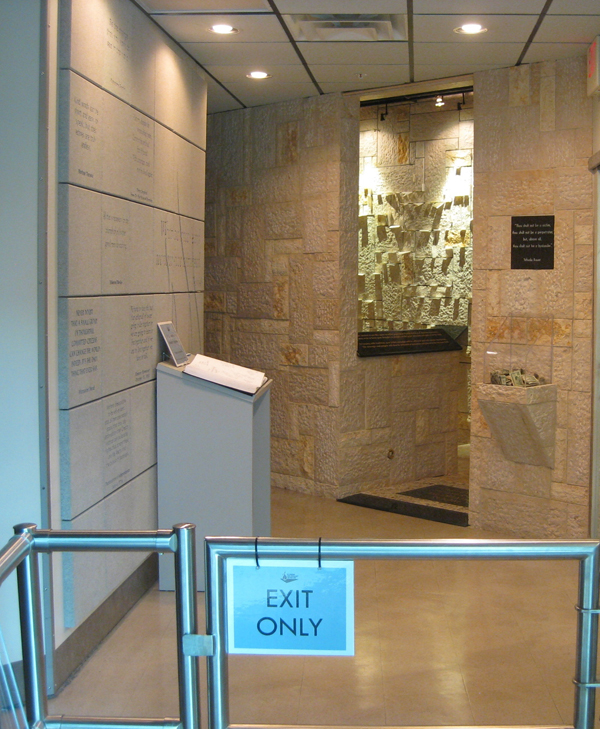
Visitors in the FHM follow a circular route—the museum's ‘institutional sequencing of ideals’ (Russo & Watkins Reference Russo, Watkins, Cameron and Kenderdine2007:58)—at the end of which they reach the exit that is located near the entrance. This is also where the museum's commenting platform is strategically located, typically of MCPs. The platform is offered in a small passageway, where visitors must pass when leaving the museum (see Figure 1).
The Florida Holocaust Museum commenting platform.

The MCP is an installation that consists of a visitor book, a sign with instructions, and a writing utensil. The book is a 150-page volume that consists of large, white unruled pages. During the time the first author studied the museum, between November 2012 and July 2014, the book was about three fourths full, containing 3,064 texts. The texts are almost entirely monolingual (98% are in English, and a few in Spanish and Hebrew). The average length of a text is 16.3 words, excluding signatures (which is in the range of other MCPs; cf. Noy Reference Noy2009:425 and Stamou & Paraskevolpoulos Reference Stamou and Paraskevolpoulos2003:38, who report averages of nineteen and thirteen words per text, respectively). Visitors who walk by the large book may refrain from writing in it, but they can hardly avoid noticing the texts inside it (it is typically left open). In the way that the FHM narrates the Holocaust and in the strategic location of the MCP, the museum offers its visitors both a relatively clear stance with regards to the Holocaust and a noticeable stance-lead.
Observations indicate that about a third of the visitors who pass by the book stop to read it, and approximately 10% read and write (similar to the findings reported by Macdonald Reference Macdonald2005:125 and by Noy Reference Noy2016:317 with regards to historical sites in Germany and Israel). Different variables shape visitors’ choices of participation, some of which are mundane, including, for instance, that by the time they conclude the visit some are in a hurry, or that museum docents (and school teachers) play a role as they draw visitors’ attention to the MCP. One occasionally hears docents near the book say ‘please don't forget to write here about your visit’ and ‘read what it says [points at wall] and write your own impressions’, and, when encouraging school-age visitors to write, ‘don't worry, we don't check your writing!’.Footnote 2
The sign near the book addresses visitors directly in the second person, ‘Tell us about your Museum experience!’, and below in smaller letters, ‘Thank you for your visit’. The first part is a directive that serves to elicit participation, specifically an instruction that concerns assessment or evaluation (at least implicitly). It presupposes that visitors know what ‘experience’ means, that they had one in specific relation to this visit, and that it is articulable. Through this invitation, visitors are made institutionally entitled to be authors and principals, composing their texts and assuming responsibility for the stance they demonstrate.
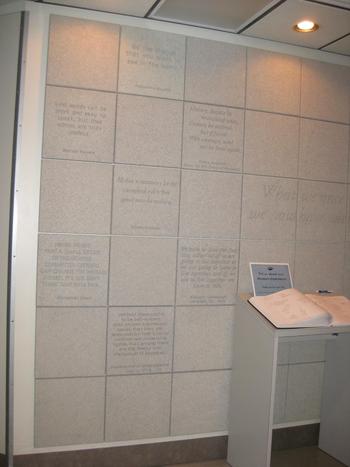
Behind the book and the pedestal an aesthetic wall is erected, with eight engraved inspirational quotes in handwritten-like script (Figure 2). For instance, ‘Be the change that you want to see in the world. Mahatma Gandhi’; ‘Kind words can be short and easy to speak, but their echoes are truly endless. Mother Theresa’; and, in especially large script and right above the book and the stand, a biblical text is etched, ‘What we once heard we now have witnessed. Psalms 48’. All of the texts on the wall are displayed with their sources, which are commonly taken to possess and indicate moral authority. Visibly displayed as they are, these idioms are part of the immediate discursive context of this MCP. Observations show that visitors often look at the engraved wall before they write or while they do so, and that docents end their museum tour near the MCP, where they sometimes read aloud a few of the sayings on the wall and encourage visitors to write.
Engraved inspirational quotes.
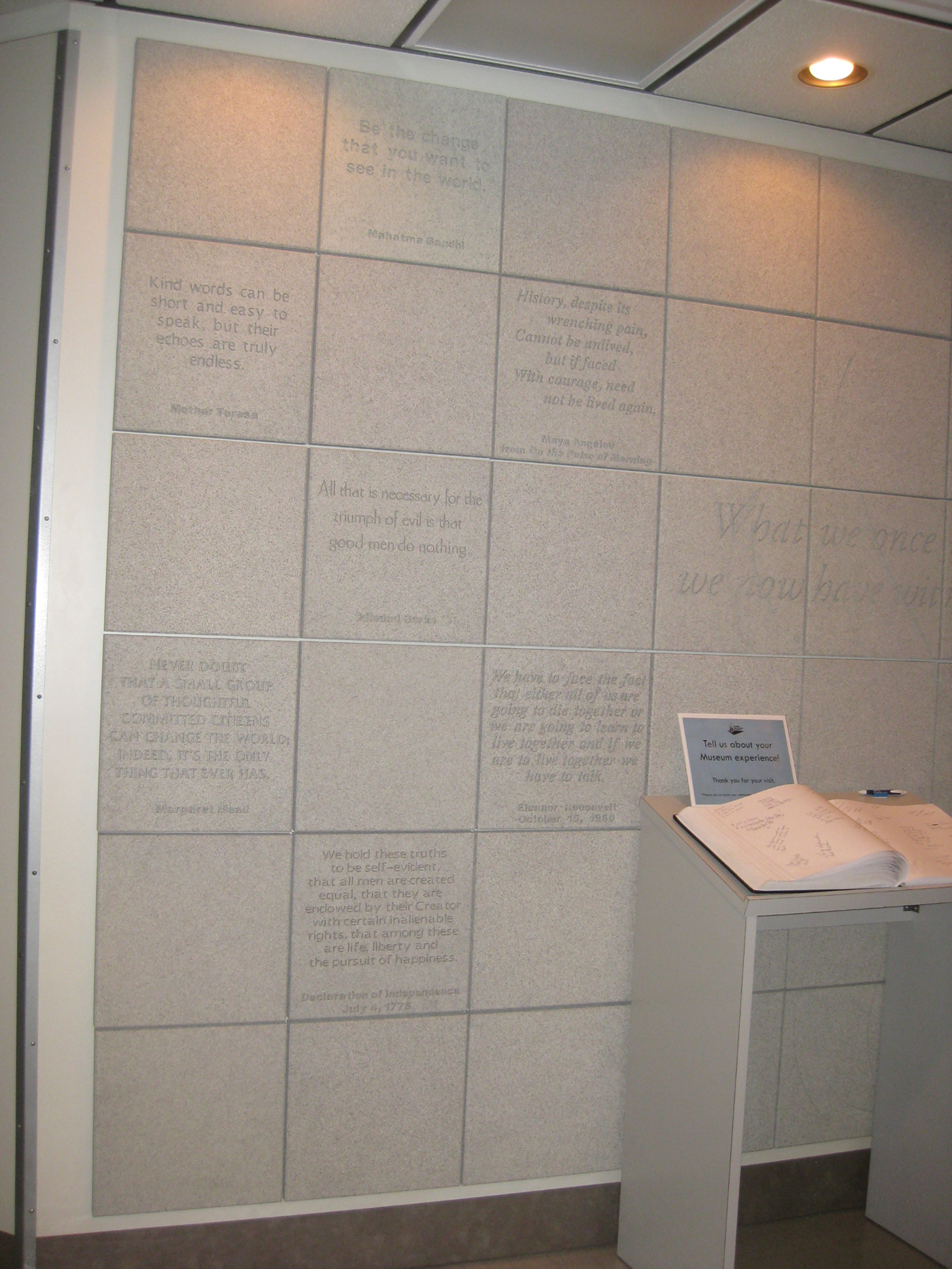
As the museum's executive director indicated, the wall was constructed around 2008 for inspiring hope in visitors as they end their visit and feel ‘crushed’ by historical events (interview with B. Gelman, November 6, 2014). By reading the inspirational quotes and also by writing in the book nearby, the director suggested that visitors will feel empowered and hopeful, and will “tell themselves, ‘I can make a difference in the kind of world we have’”. As a result, she continued, visitors will be “forward looking, instead [of feeling crushed]”. Along these lines, the museum texts on the sign and on the wall actually avoid mentioning the museum's main theme, namely, the Holocaust.
The engraved texts can also be viewed as supplying a convention for establishing ‘attributability of utterances’ (Du Bois Reference Du Bois2007:146), which in turn underlies stance-taking and participation in the public sphere. From a Goffmanesque perspective, Du Bois’ attributability can be seen as closely associated with marking principalship, and thus the MCP emerges also as an institutional device whereby visitors are afforded the opportunity to ‘own’ what they write (see also Taha Reference Taha2017). Furthermore, these texts also supply an illustration of the generic expectations of visitors’ discourse: short, optimistic, and signed/attributed morally suffused utterances.
STANCE-TAKING AND PRODUCTION FORMAT IN MUSEUMGOERS’ DISCOURSE
The overwhelming majority of museumgoers’ texts are aligned with and offer positive evaluations of the museum (mostly praises and compliments). Put negatively, the discourse this MCP mediates is quite homogenous in terms of its alignment and lack of negative or critical evaluations. This reflects a strong and commonly held stance in relation to both Holocaust remembrance and to the institutions that pursue it, and suggests that the specific type of museum is of significance.Footnote 3 Heterogeneity in visitors’ discourse may be found not so much in terms of (mis)alignments or negative/positive evaluations, but in the variations in how they are publically accomplished, and what sort of subjectivity they underscore. More specifically, as the following analyses reveal, through different constellations of stance objects, authors and principals, museumgoers variously position themselves vis-à-vis the museum and its content. Accordingly, the next four subsections illustrate lexical repetitions and how these shape authorship, positioning the museum as stance object, referencing history as stance object and how that establishes shared principalship, and dual stance objects and nonaligned texts and how these serve in (re)claiming principalship. These analyses supply evidence that substantiate the argument that stance and subjectivity are inherently dialogically constructed—even in settings that are seemingly monologic; and that in their performance, language users select from multiple contextual and discursive resources, ranging from immediately available physical and interactional contexts to cultural and institutionally mediated (macro)Discourses.
Sharing authorship through repetition
One of the salient characteristics of the discourse of the FHM's commenting platform is the prevalence of the words experience and thank you, which appear on the sign near the book (and less frequently thanks and thankful).Footnote 4 Each of these words appears in about a fifth of all of the texts, which is a high enough frequency to ‘color’ the corpus (the occurrences of the word museum, which also appears on the sign, lie just a little behind). Insofar as the high frequencies of experience and thank you are related to the appearance of these words on the sign, they suggest repetition. Here are a few examples.Footnote 5
(1) Repetitions: experience
a. Great Experience!
b. I love/ the experience/ xoxo
c. a memorable expeience
d. Great experience, I will/ never for get this experience/ Pam [surname]
e. Words cannot/ describe this/ experience, but it/ will stay in my/ heart and soul./ Ethan [surname]/ 2-13-14
f. 2/21/14 / Very Moving Experince./ NO Words_I promise/ to Never Forget!!!
The first three texts (1a–c) use experience in brief utterances that illustrate different ways of positively evaluating it. Notwithstanding texts that include only signatorial elements (some 8% of the texts), attesting to having or having had a positive experience comprises a minimum unit or formula of aligned participation in this MCP. The formula includes experience together with an adjective or a verb that serves as a stance predicate that intensifies (“Great”) or demarcates in some other positive way (“memorable”) the value of the experience (intensifiers often accompany stance-taking and evaluations; see Kärkkäinen n Reference Kärkkäinen2012). Example (1f) supplies a nice illustration of the use of different types of intensifiers, including lexical (“Very”), punctuation (exclamation marks), and typographical (capitalization). The last two types indicate the writer's use of resources available in written expression. Lexically, recurring intensifiers include great, super, best, always, never, ever, so (often repeated), extremely, life-changing, extraordinary, amazing, forceful, fantastic, awesome, mind-blowing, absolutely, and a lot. In terms of punctuation, exclamation marks are the most often used intensifiers, and appear in 28% of the texts (!), often multiple times and sometimes as drawings (triangular and aestheticized exclamation marks). Underlining is used as well (single, double, triple, and wavy underlining, sometimes underlining the entire text). Typographical means are used frequently, too, including capitalization, which is pervasive (sometimes the entire text is capitalized), if often used inconsistently (“God BLESS/ ALL WHO Put/ this togEthEr !!!”).
Oftentimes, discourse associated with memory and remembrance is employed in the capacity of assessing and positively characterizing ‘experience’. In some texts, themes concerning remembrance are employed in relation to the present or to the moment of writing (“memorable expeience”), and in others they are employed in relation to the future (1d, 1f). The latter cases are commissive speech acts that are common in visitors’ discourse, and serve to demonstrate understanding of and alignment with the museum's message (emphatically so in Holocaust moral and remembrance discourse; Noy Reference Noy2016, Reference Noy2017b). In examples (1e–f), the ineffable argument is introduced, likewise, to characterize and intensify the ‘experience’. Experience here is portrayed as inner (“in my heart”) and therefore outside the reach of language—which is how visitors are expected to publically articulate it.
(2) Repetitions: Thank you
a. Thank you./ Russell + Amy/ [surname], AZ
b. Thank/ you/ Claire [heart]
c. Thankyou for/ this opportunity/ to learn and attempt/ to understand what/ happened …/ Ken [surname]
d. 3-2-14/ Very informative/ thank you Rikki and/ Mark. Loved the/ experience for the/ kids.
e. lest we forget/ Thank you!/ Elizabeth [surname]/ California
f. I had a great time reading all the story/ They wear so tatching i was trying not to cry/ Im so happy I came/ [smiley]/ thank you/ for having me/ Love Katie
The picture is similar with regards to the repetition of “thank you”, which, together with a signature, seems to suffice as a token of participation in (2a–b). The latter example actually includes a small drawing of a heart, adding an emotional register. While expressions of gratitude sometimes appear at the beginning of the text in (2a–c), they are more often employed towards the end (2d–f), where they also serve to mark the text's completion—in parallel to the museum's sign. As texts (2c–e) evince, elaboration usually serves to detail what visitors are thankful about: information (educational register) and/or avoiding forgetfulness (moral register).
While repetition and parallelism may serve multiple functions in discourse (Tannen Reference Tannen1989; Johnstone Reference Johnstone1994), their use to create resonance as part of a responsive stance act has been discussed as a central feature constructing alignment between stance-takers (Dori-Hacohen Reference Dori-Hacohen2017; Du Bois Reference Du Bois2007). In the above texts, this is underscored by the use of ‘format tying’, which is typical of question-answer and request-reply sequences, where the response repeats various elements of the question/request (M. H. Goodwin Reference Goodwin1990:177–88). As commonly taught in schools, ‘good’ answers include part of the question. Moreover, by underscoring through repetition the semantic fields of gratitude and experience, which are both highly associated with evaluative and affective discourse in contemporary Western culture, visitors visibly demonstrate that they appropriately identify, respond to, and align with the museum's invitation to provide an experiential stance, as discussed above.
These functions contribute to the positioning of museumgoers as obedient and dutiful, which in turn acknowledges and validates the museum's privileged and authoritative position. From the perspective of production format, this is further supported by the interpretation of the repetition in the above examples as a way for contributors to establish a form of shared authorship with the museum (more on this in the conclusion).
The museum as stance object
Contributing to the MCP requires visitors to select stance objects as the focal point of their stance-taking. Drawing on Jakobson's (Reference Jakobson, Waugh and Monville-Burston1957/1990) distinction between speech event and narrated events, we suggest a conceptual distinction between two possible stance objects: the museum, as the institution that narrates the past (in the context of the speech event), and the narrated historical events themselves.
The most salient stance object in visitors’ discourse in the present study concerns the speech event, as about a third of the texts that this MCP mediates use a variety of means to instantiate the museum as their stance object—either explicitly or implicitly (by referring to things associated with it such as experience, display, docents, etc.).Footnote 6 This choice of stance object allows visitors to evaluate the entity they take to be accountable for mediating history and to endow them with an emotional and/or educational experience—and such evaluations are routinely positive. The salience of the museum as stance object may be in part a result of the MCP and specifically the museum sign, which not only speaks ‘on behalf’ of the museum's staff (‘tell us’), but also references the museum (‘your Museum experience’).
The choice of the museum as stance object is illustrated by the examples discussed above, to varying degrees. This is relatively evident in texts using repetition of ‘experience’: as the experience is seen as generated by the museum and related to it, evaluating it establishes the museum as the stance object. The case of repetitions of “thank you” is slightly more complex: Such texts extend gratitude to the museum (reciprocating the gratitude the museum extended: “Thank you for your visit”): “thank you for having me” (2f), thus directly addressing it and establishing it as predominantly an interlocutor. At the same time, as gratitude is predicated on the positive evaluation of the museum, they also implicitly invoke it as a stance object. The museum may be invoked as stance object in other ways, as the following examples demonstrate.
(3) The museum as a stance object
a. Fantastic museum/ -Ryan [surname]
b. This museum/ is very interesting a/ a tear jerker!/ VERY TOUCHING/ Holly, Georgia, Hannah [the entire text is encircled]
c. this museum - and/ the experiences it has offered me -/ still brings so much more for me/ to learn every time I come.
d. Sobering/ JG
e. Reflective…/ ANitA [surname]/ Feb 6, 2014
f. Change a pric?e/ affordable to everyone!/ (a non?e ticket)
g. God BLESS/ ALL WHO Put/ this togEthEr!!!
h. 2\22\13/ Your efforst are not/ in vain. The work displayed/ here are appreciated and/ so is your efforts to/ keep history alive as/ an example for us today/ CBO
i. HeLLO!!!/ MARK WAS SOOOO/ ADORABLE!!!/ 12\11\12 Lore [surname] [smiley]
j. Seeing the boxcar/ made it so real/ Imagining the real/ peaople-that rode to/ pepole/ persons/ their death/ Amanda
Texts (3a–c) reference and characterize the museum explicitly. In the first text the museum is simply “fantastic”, and in the second text adjectives and multimodal intensifiers are employed to positively evaluate and characterize the museum intellectually, emotionally, and spiritually. As shown earlier, intensifiers are generally employed to display involvement and emphasize positive evaluation. Text (3c) focuses on educational ‘experience’ (“to learn”) and explicitly draws a connection between the museum and the visitor's experience. This connection, displayed via a hyphenated clause, suggests that over and above the relation between ‘experience’ and museum, these might be two (different) stance objects that the writer is weighting (trying to tie them into one object). The text also establishes a membership category of a ‘regular’ visitor, namely one who frequents the museum (“every time I come” suggests a special category of participatory entitlement; see Noy Reference Noy2016). This category in turn validates this visitor's evaluation, as s/he can judge the museum from a vantage point and evaluate it as ‘still’ educational.
The next two texts (3d–e) include only a stance predicate (adjective), with the stance object missing. These utterances may be understood as elliptically referring back to the ‘museum experience’ mentioned in the MCP sign, or as expressive utterances assessing the effect the museum had on the visitor—which is precisely what visitors are invited and entitled to attest to. “Sobering” and “Reflective” are positive evaluations of the effect/experience, and therefore function also as expressions of appreciation (as if saying, ‘the museum is doing its work properly’). Example (3f) too has the museum as its implied object, by mentioning one of its qualities (“price”), albeit for the purpose of critiquing and negatively evaluating it.
Other means that visitors draw on to place the museum as the stance object include referring to its staff. Texts (3g–h) address the museum by referring schematically to those agents who are involved in its daily operation. Those social agents are characterized by categories of activities (“Put[ing] this togEthEr!!!”) and by exerting “efforts”. These texts are directed at, and commend, both those ‘behind the scenes’, who visitors usually do not meet, and docents and guides who work in the front stage—all of whom are seen as professionally involved in Holocaust commemoration and remembrance. In the latter case, they are mentioned by name, usually docents who have guided the visitors in the museum (“Mark” in (3i)), and Holocaust survivors who spoke with them (as part of planned or ad hoc activities that the museum holds, where visitors meet with survivors and hear their stories). Museum staff are evaluated positively (“Amazing Tour from Alana!”) and often thanked personally (“Thank you to Debbie our wonderful guide… A truly moving experience. 2/25/13 – [surname] Family”). Another way, if infrequent, to evaluate the museum is by referencing something, and not someone, associated with it. The last text (3j) evokes the museum's metonymic artifact, the boxcar, which is the largest and most impressive item on display.
Sharing principalship: History as a stance object
While the museum and the visit is the most salient and widespread stance object, some texts (14%, see note 6) do focus on history and the Holocaust (and things associated with them) in their stance-taking. The relative scarcity of this choice of stance object may be in part due to the fact that as mentioned earlier, neither the sign nor the idioms etched on the wall reference the museum's main theme, namely the Holocaust. In parallel, the word appears in less than 5% of visitors’ texts.
By using history as the stance object, such texts are addressing the narrated events and not the speech event. They address history in general, but also sometimes the agents and actors who populate it.
(4) History as a stance object
a. God bless these/ sacred souls./ They are in peace/ now with the/ angels!
b. God Forgive Them/ ?? M de [surname]
c. AN/ INCRdiblE TRAgEdy―/ BRiNgS TEARS To My EyES/ Butch [surname]
d. Ron [surname]/ Canada/ just unbelievable./ that this could/ happen.
e. It was not right for Hilter/ to do that to them.
Texts (4a–e) employ various means to mark history and the Holocaust as the objects of their stance. The first two examples clearly address the narrated events: in the first case these are victims, and in the second text, possibly the perpetrators (who need forgiveness, in which case this is a rare reference). At stake are clearly not actors involved in commemoration, but actors commonly understood to be occupying the historical scene. Texts (4c–e) address a “tragedy”, an unspecified thing (“this”) that occurred in the past, and mention a historical figure (Hitler, misspelled).
As discussed above, the museum in its entirety may be understood as presenting a moral stance regarding the Holocaust. Texts that place the Holocaust as their stance object seem to respond to this stance, and to the museum as stance subject2. As they echo the museum's original negative evaluation of the Holocaust, they align with it. From the perspective of production format, this may be understood as a form of shared principalship: in order to produce personally owned moral stances, museumgoers appropriate and echo previously articulated, institutionally mandated, stances (see Taha Reference Taha2017, for a similar pattern in the case of school students’ stances in a social justice awareness educational program).
(Re)claiming principalship
As discussed above, the majority of contributors to the FHM's visitor book position themselves as compliant and dutiful museumgoers, and choose to share some of their authorship or principalship with the museum. However, few contributions claim individually unique principalship. This is the case when texts place the Holocaust as their stance object, and hence the museum as stance subject2, while presenting somewhat divergent and misaligned counter-stances, as the following examples illustrate.
(5) History as stance object: misalignment
a. IT STiLL goes oN And oN/ with different groups./ “When will we ever LearN”/ ??
b. This level of violence and/ hate is overwhelming ― but/ the worst part is that it/ Continues today./ May we learn./ KeNtucky/ Somerset/ 2-10-14
c. Those who/ for get the Past are doomed to repete it.
d. Peace/ in/ the world/ or the/ world in/ peices/ SILaS
Texts (5a–d) have the events of the past as the jump-board for addressing concerns in the present and in the future, which they do critically through negative evaluations. In this sense, they only partially and ambivalently align with the museum: while they share the general moral perspective against hate and genocide, they are not aligned with the optimistic and redemptive tone presented by the museum (recall that the core exhibition is titled ‘History, Heritage and Hope’) and the wall of engraved idioms. These texts draw moral insights from the past to the present (“Continues today”) and to various political contexts (“different groups”). With text (5a) this is straightforward and begins with the deictic “IT”, which references the past only to indicate and stress that it is recurring (“STiLL goes oN And oN”). The negative evaluation of past events is implicit, and the text explicitly addresses their recurrence (and implicitly, lack of prevention) as its stance object. The text ends pseudo-formulaically, with a rhetorical question within quotation marks, which expresses doubt with regards to possible positive moral change in the future. The use of quotation marks is relatively common, and serves to signal that the text is taken to be a familiar saying or idiom, and that the visitor knows that citing it is part of a proficient performance in this context. Text (5b) is similar in content and structure, and begins by addressing the past (“This”) and clarifying its negative immensity (“hate”, “overwhelming”)—to then shift to the moral lesson that has not been learned. The latter is evaluated negatively and amounts in fact to the “worst part” (over and above the historical events themselves).
Texts (5c–d) are different in that all they do is state a moral idiom or a generalized moral assessment (resonating the ones etched on the nearby wall). Such texts do not explicitly articulate nor delineate a transition from past to present (conditional, causal, or other), and the object of their stance is the moral lesson or the moral takeaway. Here the stance-takers do not see it necessary to explicitly evaluate the museum or the past it narrates. In Jakobson's (Reference Jakobson, Waugh and Monville-Burston1957/1990) terminology, these texts are positioned somewhere in between the speech event and the narrated events, where museumgoers are explicating a combination of narrative resolution and coda (which functions in ‘returning the verbal perspective to the present’; Labov & Waletzky Reference Labov and Waletzky1967/1997:35) of the narrated events as they morally appear in and take effect on the speech event. While these texts resonate with the ones etched on the nearby wall, they diverge in key and register: they are less optimistic and more colloquial.
Another discursive pattern that may facilitate the construction of an individually unique principalship is the production of typically more extended texts that combine both the speech event and the narrated events as their stance objects. As we have already seen, for instance in regards to the relations between the museum and the experience it bestows (text (3c): “this museum – and the experiences it has offered me –”), stance-takers sometimes shift between stance objects. Such shifts may be clear or gradual, marked explicitly or accomplished implicitly. Consider the following examples.
(6) Dual stance objects
a. Bless all of you/ who've compiled this/ material ―― May it/ never happen again!/ God bless you/ and them
b. 3\20\13/ Very moving – – The displays/ are beautifully doNe + well/ explained but … ./ - - We Don't Learn - - -/ Killings are still Taking place/ Today in many parts of our world!/ Will we ever learn???/ Barb [surname]
c. Awesome./ America is headed/ there now. Do something/ about it. I AM/ Windy/ [surname]
This set of texts illustrates utterances whose stance objects are twofold and include the museum and the Holocaust (on twofold objects in stance-taking see Bucholtz et al. Reference Bucholtz, Skapoulli, Barnwell and Janie Lee2011). Text (6a) begins by evaluating the museum through evaluating the museum staff, who are recognized for having “compiled this material”. The text then shifts to express hope that “it”—now pointing to the historical events—will not repeat. The shift in stance objects is marked by a paratextual sign (a long dash), after which the second stance object is introduced. An association is suggested between the first and the second utterances/objects, where the expression of hope complements the evaluation that preceded it: those working in the museum are viewed as involved in preventing “it” from recurring in the future. The use of “it” here is interesting: it does not function as an anaphoric intra-textual reference to objects previously mentioned in the visitor's text (“this material”), but rather may be read as referring to the narrative that the museum narrates, as well as more generally, to the Holocaust as a commonly shared and recognizable narrative of collective memory. Such referencing highlights the dialogic and socioculturally sensitive nature of stance-taking, whereby stance objects are not necessarily explicitly invoked, but rather are locatable in prior discourse and larger contexts recognized as relevant through familiarity with the ‘sociocultural field’ (Du Bois Reference Du Bois2007:220). The very last line, too, addresses the two objects, and in a similar sequence: first addressing the museum staff, followed by extending the blessing to victims (“and them”). Note that this text begins and ends with blessings, albeit differently: the opening blessing commends those working in the museum, while in the second occurrence “God” is mentioned, and it does not suggest a commending function but more of a religious or spiritual function.
Text (6b) also clearly has the museum as its stance object in the beginning, which it establishes this time by relating to the museum's “displays”, together with highly positive evaluations that address both the display and its effects (“very moving”). At this point the contrastive “but” is introduced, followed by four periods and a line break, which marks the transition between stance objects. Now these are the “Killings” that are at the focus, and the fact that they are currently (not just in the past) widespread on a global scale. The current condition is tied to the past in a way that is seen as problematic (“We Don't Learn”), resting on an implied expectation that human action can improve morally with time as a result of a learning curve. The second part of the text, which has past events as its stance object, begins with a statement (an assessment: “We Don't Learn”) and ends with a rhetorical question that serves as a critique, “Will we ever learn???”. The dual-object structure corresponds with the quality of the evaluation: the museum is evaluated positively, and in contrast humanity's immorality is evaluated negatively. Note that both the observation and the rhetorical question are formulated in the first-person plural form, suggesting that visitors are ‘speaking’ on behalf of, and sharing principalship with, all visitors or more than that—on behalf of humanity. Such entitlements occur frequently in individual expression in public media, where participants ‘are often not speaking just for themselves as individuals, but on behalf of broader social constituencies or groups’ (Thornborrow Reference Thornborrow2015:3). Finally, note that while the text's first three lines, where the museum is the object, have no pronouns, the second part, which has the historical events and their moral lesson as its stance object, includes two pronouns. In line with Du Bois (Reference Du Bois2007:158), we suggest that the former part functions more as ‘an object-centered act of evaluation’, while the latter part functions more as ‘a subject-centered act of positioning’, and we would add moral positioning. The way the contrastive is used might suggest an implicit criticism of the museum. Positioned as it is after three compliments (“Very moving”, “beautifully done”, “well explained”), the contrastive “but” may be saying something to the lack of effect or efficiency of the museum's narration as a pedagogical institution. The text might be covertly arguing that while the museum's account of the Holocaust is satisfactory, there is a larger context—other contexts, events, places, and times—that is left unaddressed.
Text (6c) is similar but more concise. After a one-word evaluation of the museum (a stance predicate lacking a stance object; see analysis of examples (3c–d) above), the text immediately shifts—using a line break—to expressing moral concern, with the narrated events as its object. The moral concern is similar to the one expressed in text (6b), but much more specific and urgent, because the possible recurrence of tragic events is argued now to be propelled by “America” itself. The argument is that America is not merely indifferent (a bystander), but actually perpetuating genocides. The expression of impending predicament is followed by a directive (“Do something”), which is morally dramatized by its contrast to the visitor's actions, which are amplified by capitalization and underlining, but remain unspecified (“I AM”). Unlike future-facing commissive speech acts and directives, the stance-taker attests she is already acting morally; she is already a moral agent.
Both texts (6b–c) position their authors’ identities as essentially and explicitly moral. Over and above the ritual expressing of (moral) appreciation to the museum, these visitors shift moral objects to take a stance in relation to current atrocities. Furthermore, like (6b), and perhaps less implicitly, the text is critical of the museum or at least uses the museum to spell out its moral platform. The word “Awesome”, which is arguably a bit out of place in a Holocaust museum, and the immediate shift that follows it, might suggest a light cynical tone, or that the visitor used the word as a ‘token’ to be then able to move to what she was centrally seeking to express.
Finally, we have seen that when texts include more than one stance object, stance-takers typically mark the shift between stance objects. On this MCP this is done in a visual manner. Line breaks, dashes, three periods, and other paratextual means (over and above textual means) help clarify that a stance object shift is underway. Within the highly visual environment that the museum encompasses, visitors are using available and relevant resources—specifically those associated with writing—to clarify their messages. In this way visitors might be said to be not only articulating and composing texts, but also curating them.
CONCLUSIONS
The present study analyzed museumgoers’ texts using the concepts of participation framework and stance triangle. This integrated approach contributed to our understanding of the realization of subjectivity in language use by highlighting two of its central features: its inherent dialogicity and the multiplicity of its contextual resources. First, as the analyses above reveal, museumgoers are highly attuned and responsive to various elements of the setting, such as the sign that addresses them, the wall with engraved idioms, other texts, artifacts, and activities in the museum, and the physical location of the MCP. Thus, the encompassing and immersive material contexts that museums supply and the design of their participatory media seem to have a significant impact on the ways visitors pursue stance-taking activities (Noy Reference Noy2016, Reference Noy2017a). This underscores that stance-taking, regardless of the medium and mode in which it is accomplished, is inherently dialogic, and what is or what becomes relevant in and for public acts of stance-taking is always negotiated in interaction. To add on this, observations in this and in other studies (Macdonald Reference Macdonald2005) indicate that museumgoers usually engage MCPs collaboratively, and their texts, whether signed (attributed) individually or collectively, are also a result of talk and discussion that take place before and during the act of composing the text (but are not explicitly referenced therein).
Second, stance-taking draws on multiple resources, ranging from the immediately preceding discourse (the sign, for instance), to the museum as a whole (the museum as ‘prior text’), and beyond: to larger discourses such as culturally recognizable macro-narratives or commonsensical ‘truths’ that visitors import/index. By locating stance objects and stances in the immediate and nonimmediate locally present prior discourse, as well as in culturally shared (macro)Discourses, museumgoers demonstrate two-fold competence: As museumgoers, they indicate that they understand the contents, contexts, and consequences of the museum narrative, while appropriately focusing on their political and moral relevance (cf. Taha Reference Taha2017). As stance-takers, their location of relevant stance content in prior discourse does ‘not depend solely on the presence of explicit words, gestures, prosody’, as Du Bois (Reference Du Bois2007:149–51) suggests, ‘but is grounded ultimately in the systematic knowledge which participants control regarding what can be expected to be present in any stance’. It also demonstrates their proficiency in the ‘salient dimensions of the sociocultural field’ (Reference Du Bois2007:220), highlighting that stance-taking is inherently contextualized and cultural-sensitive.
The dialogicity and multiplicity of contextual resources allow language users to construct various subjectivities—individually owned and institutionally mandated by degrees—and to express different levels of commitment to them. Given that museum commenting platforms are explicitly dedicated to affording authorship and principalship to museumgoers, the choice of many of the contributors to the FHM's visitor book to share authorship or principalship with the museum may be perplexing. From a critical perspective, it may be interpreted as submission to institutionally mediated hegemonic-authoritative discourse. Reversely, it may be viewed as museumgoers’ purposeful use of multiple available resources (Kockelman Reference Kockelman2004; Kärkkäinen Reference Kärkkäinen2006; Kiesling Reference Kiesling2011; Thompson Reference Thompson2016)—including hegemonic discourse—in the performance of their own subjectivities.
The latter interpretation is supported by a salient characteristic of visitors’ discourse: it is highly assertive and self-assured. It involves the frequent use of intensifiers of different sorts (recall, for instance, the high frequency of very, note 4), and compared to other data, lacks modality markers (I guess, I think, I assume) and hedging (Kärkkäinen Reference Kärkkäinen2006; Myers Reference Myers2010). As these discursive resources minimize the distance between contributors and their texts, connote the merging of speaker roles (Goffman Reference Goffman and Goffman1961, Reference Goffman and Goffman1981), and construct a highly confident epistemic stance (Simon-Vandenbergen & Aijmer Reference Simon-Vandenbergen and Aijmer2007; Vukovic Reference Vukovic2014), they enable contributors to the MCP to display their commitment to co-authored and co-principaled texts as expressions of their own moral subjectivity (Kockleman Reference Kockelman2004; Taha Reference Taha2017).
These high levels of commitment may point at the fact that at the conclusion of their visit, museumgoers—at least those who are writing—tend to express certainty with regards to both their epistemic and affective stances. Completing their visit, with the high moral stakes that are at the crux of this museum's discourse (the ‘sociocultural field’ of the Holocaust), visitors do participation by articulating stance with visible conviction. Their demonstrable certainty also echoes the corresponding high modality and certainty of the engraved inspirational quotes on the nearby wall.
Our findings indicate that many of the contributors to the FHM's visitor book choose to share authorship and principalship while maintaining their moral commitment and the attributability of the text to themselves. These findings illustrate how employing Goffman's concepts of authorship and principalship may illuminate and enrich the analysis of acts of stance-taking in various contexts and platforms. They also highlight the centrality of various linguistic and paralinguistic markers of commitment as resources for both constructing participation frameworks and taking stances, and point to commitment as a significant point of intersection of these two concepts. Overall, the present study and the integrated analytic framework it promotes contribute to the full appreciation of the inherently intersubjective and dialogic nature of stance-taking, participation, and subjectivity.
APPENDIX: TRANSCRIPTION CONVENTIONS
- /
line break
- \
places where a forward slash appears in the original
- wor?d
unclear letter
- ??
undecipherable word
- [ ]
nonverbal signs, additions, and clarifications