Introduction
Recalcitrant seeds lose viability when dried below 12–31% water content and do not tolerate sub-zero storage (Roberts, Reference Roberts1973). They are usually spherical, voluminous, large (larger than 4 cm or 4 g) and surrounded by moist and permeable tissues during dispersal. They also usually have large embryos and little or no endosperm (Chin et al., Reference Chin, Krishnapillay, Stanwood, Stanwood and McDonald1989; Pammenter and Berjak, Reference Pammenter and Berjak1999; Farnsworth, Reference Farnsworth2000; Tweddle et al., Reference Tweddle, Dickie, Baskin and Baskin2003; Daws et al., Reference Daws, Garwood and Pritchard2005; Hamilton et al., Reference Hamilton, Offord, Cuneo and Deseo2013). In addition, these seeds have the following characteristics: lack of post-maturation drying, leading to high water content during dispersal (>35%); rapid and uniform germination; limited storability and no formation of persistent soil seed banks. It is thought that morphophysiological characteristics work to minimize water loss and, consequently, seed death by desiccation damage (Berjak et al., Reference Berjak, Farrant, Pammenter and Taylorson1989; Ellis et al., Reference Ellis, Hong and Roberts1990; Hong et al., Reference Hong, Linington and Ellis1998; Pammenter and Berjak, Reference Pammenter and Berjak1999, Reference Pammenter and Berjak2000; Kermode and Finch-Savage, Reference Kermode, Finch-Savage, Black and Pritchard2002; Berjak and Pammenter, Reference Berjak and Pammenter2008). Drying causes structural damage in recalcitrant seeds. However, seed drying does not represent a problem for the natural regeneration of species, as recalcitrant seeds usually germinate shortly after dispersal and form a seedling bank in the forest understorey (Tweddle et al., Reference Tweddle, Dickie, Baskin and Baskin2003). Furthermore, recalcitrant seeds are more common in non-seasonal and constantly moistened environments and are found less frequently in dry and seasonal environments, where their dispersal is usually concentrated in a period just before or during the months with greater precipitation (Roberts and King, Reference Roberts, King, Chin and Roberts1980; Dickie et al., Reference Dickie, Balick and Linington1992; Tompsett, Reference Tompsett1992; Hong et al., Reference Hong, Linington and Ellis1998; Tweddle et al., Reference Tweddle, Dickie, Baskin and Baskin2003; Pritchard et al., Reference Pritchard, Daws, Fletcher, Gamene, Msanga and Omondi2004; Daws et al., Reference Daws, Garwood and Pritchard2005).
Swartzia langsdorffii Raddi [(Fabaceae – Faboideae (Swartzieae)] is a perennial woody species that reaches up to 20 m in height (Paiva et al., Reference Paiva, Landgraf, Rodrigues, Pedroso, Oliveira Filho, Gavilanes and Paiva2004) and is distributed throughout the south-eastern region of Brazil, associated with the Atlantic rainforest and seasonal forest formations (Santos, Reference Santos1979; Marangon et al., Reference Marangon, Soares and Feliciano2003). The fruits of S. langsdorffii are follicles, large (6–9 cm) and lignified, have abundant secretion of resins, mainly composed of tannins, saponins and lipids, and contain 2–4 large seeds surrounded by an aril (Colpas and Oliveira, Reference Colpas and Oliveira2003). The fruits are dehiscent but only open after dispersal during the dry season (austral winter) and the fruit tissues remain intact, covering the seeds for many months while in the soil.
Although the seeds of S. langsdorffii are large, rounded, surrounded by fleshy tissues and have high water content – typical characteristics of recalcitrant seeds – their dispersal begins in August, the month with the lowest precipitation of the year. Thus, the objectives of this study were: (1) to characterize the physiological behaviour of S. langsdorffii seeds in relation to their desiccation sensitivity/tolerance; and (2) to assess the morphophysiological characteristics that enable the seeds to remain viable even after the diaspores (fruits containing arillated seeds) have been dispersed.
Materials and methods
Diaspore collection and processing
S. langsdorffii diaspores were collected from five trees in the municipality of Lavras, Minas Gerais, Brazil (21°14′S; 45°00′W, 918 m above sea level) in August 2010 and August 2011, after the beginning of natural dispersal, when the seeds have a dark orange colour (mature diaspores). Diaspores were opened with a knife to remove the seeds and, when necessary, the seed aril was manually removed to perform the laboratory experiments. Subsequently, the seeds were rinsed in tap water, blotted dry and maintained in a perforated plastic bag under laboratory conditions for up to 10 d.
Diaspore biometry and seed viability assessment
The number of seeds per diaspore and biometric characteristics of the fruits and seeds were obtained from 135 fruits and 60 seeds. The water content of the different parts of the diaspores was determined separately for the fruit, aril and seed, using the oven method at 103°C for 17 h (ISTA, 2004), with four replicates of 20 g each. For this, the structures were cut in small parts to facilitate water loss, and the results were expressed on a fresh weight basis. Seed viability, with and without the aril, was assessed by germination tests in plastic trays (40 × 25 × 8.5 cm) with a 6-cm layer of washed, autoclaved and pre-moistened sand. Seeds were sown 1 cm deep and placed in a germination incubator (Mangelsdorf, São Paulo, Brazil) at 25°C under constant light. The experiments were designed with four replicates of 15 seeds each, and the emergence of the shoots was assessed weekly until all seeds germinated or had died (rotted).
Structural characterization of the seeds
Five samples, containing seed coat, embryonic axis and cotyledons, were fixed separately in modified Karnovsky solution (2.5% glutaraldehyde, 2.5% formaldehyde and 0.001 M CaCl2 in 0.05 M sodium cacodylate buffer, pH 7.2; Karnovsky, 1965) for at least 24 h. After fixation, the samples were transferred to a 30% glycerol solution for 30 min. Subsequently, the samples were cryofractured in liquid nitrogen, depending on the tissue area to be observed, and washed in distilled water. After sectioning, the samples were dehydrated in a graded acetone series (25, 50, 75 and 100% v/v) for 10 min each, with three repetitions for the 100% concentration. After dehydration, the samples were transferred to a critical point device (Bal-Tec, São Paulo, Brazil), mounted on stubs, sputtercoated with gold (Bal-Tec) and examined under a scanning electron microscope (SEM) LEO EVO 40 XVP (São Paulo, Brazil).
For analysis by light microscopy, seeds were fixed in formalin–acetic acid–alcohol (FAA 50) and conserved in 70% ethanol. The embryonic axis was isolated from the cotyledons for the inclusion procedure. The samples were dehydrated in a graded alcohol series and embedded in hydroxyethyl methacrylate (Leica®, São Paulo, Brazil) according to the manufacturer's instructions. The resulting material was sectioned longitudinally in a rotating microtome to obtain sections of approximately 5 μm thickness. The sections were stained with 0.05% toluidine blue O (O'Brien and McCully, Reference O'Brien and McCully1981), and the resulting slides were mounted with Permount® synthetic resin. The toluidine blue stains cells having a primary wall blue purple, cells with a primary and secondary lignified wall light green and the phenolic compounds dark green. The images were recorded using a trinocular microscope (Primo Star, Carl Zeiss®, São Paulo, Brazil) connected to a digital camera (Axiocam Erc 5S, São Paulo, Brazil).
Seed drying and storage
The diaspores collected in 2010 and 2011 were processed (seeds taken out as described above), and the seeds were placed in plastic trays (40 × 25 × 8.5 cm) in a single layer and subjected to the drying process in a climate-controlled room [20 ± 2°C and 50 ± 2% relative humidity (RH)]. The target weights (Cromarty et al., Reference Cromarty, Ellis and Roberts1985) corresponding to 40, 35, 30, 25 and 20% water content were calculated to monitor seed drying. Seed samples of each water content target were used to determine drying velocity and to assess the seedling emergence, as described above.
For the storage experiment, carried out in 2010, seeds were removed immediately after diaspore collection and placed in semipermeable perforated plastic bags. The bags containing seeds were stored in the dark in a cold chamber at a constant temperature of 5°C and 40% RH. Each month for 5 months a sample was collected to assess seed water content and seedling emergence, as described above.
Seed germination in field conditions
These experiments were started in August 2010 and August 2011 and were carried out in the understorey of a seasonal semi-deciduous montane forest with an emergent canopy (Veloso et al., Reference Veloso, Rangel Filho and Lima1991) located at the Federal University of Lavras (UFLA), Lavras, Minas Gerais, Brazil. The Köppen climate classification for Lavras is Cwa with Cwb characteristics, and there are two well-defined seasons: a dry season from April to September and a rainy season from October to March (Köppen, Reference Köppen, Köppen and Geiger1936).
In August 2010, four blocks with 200 diaspores each were randomly distributed in a single layer directly above the litter in the forest understorey. From August 2010 to January 2011, samples containing ten diaspores per block were collected every 15 d to assess seed water content and germination. Approximately 20 seeds were obtained from the ten diaspores sampled; five seeds were used to determine the seed water content and 15 were used to count the number of germinated, dead and firm seeds. The criterion used to assess germination was protrusion of the radicle ≥ 1 mm. Seeds were considered dead if they were rotten, and firm seeds were those with an intact and apparently healthy structure but no protrusion of a primary root.
A second experiment was executed between August and December 2011 to assess the relationship between environmental variables and water content of the fruits, arils and seeds. A total of 600 diaspores per block were distributed over the litter in a single layer, and fruit, aril and seed water contents were assessed monthly (as described above), together with the soil moisture, which was measured using four replicates of 20 g of soil each (EMBRAPA, 1997). The environmental data – mean, maximum and minimum air temperature and rain precipitation – were collected from the climate station situated near the forest, at UFLA.
Statistical analysis
All data were submitted to normality and homoscedasticity tests; if data were normal and homoscedastic (P≥ 0.05), they were submitted to an analysis of variance (ANOVA) at 5% probability. When statistically significant differences were found (P≤ 0.05), qualitative means were compared using the Tukey test at 5% probability (R Development Core Team, 2011) and quantitative data were subjected to regression analysis (SigmaPlot® software – Systat Software Inc., San José, California, USA). When the data distribution was not normal and/or homoscedastic, data were submitted to Generalized Linear Models (GLM) tests (R Development Core Team, 2011), and the means analysed as described above. Furthermore, biometric data were subjected to a box-plot analysis using SigmaPlot® software. A Pearson correlation analysis was conducted using R 2.12.0 software (R Development Core Team, 2011) with data of moisture content of fruits, arils, seeds and soil, and the environmental data collected from the Climate Station of Engineering Department of UFLA. Only the means obtained before the rainy season were included in this latter analysis to avoid the influence of rain on the moisture values.
Results
Diaspore biometry and seed viability assessment
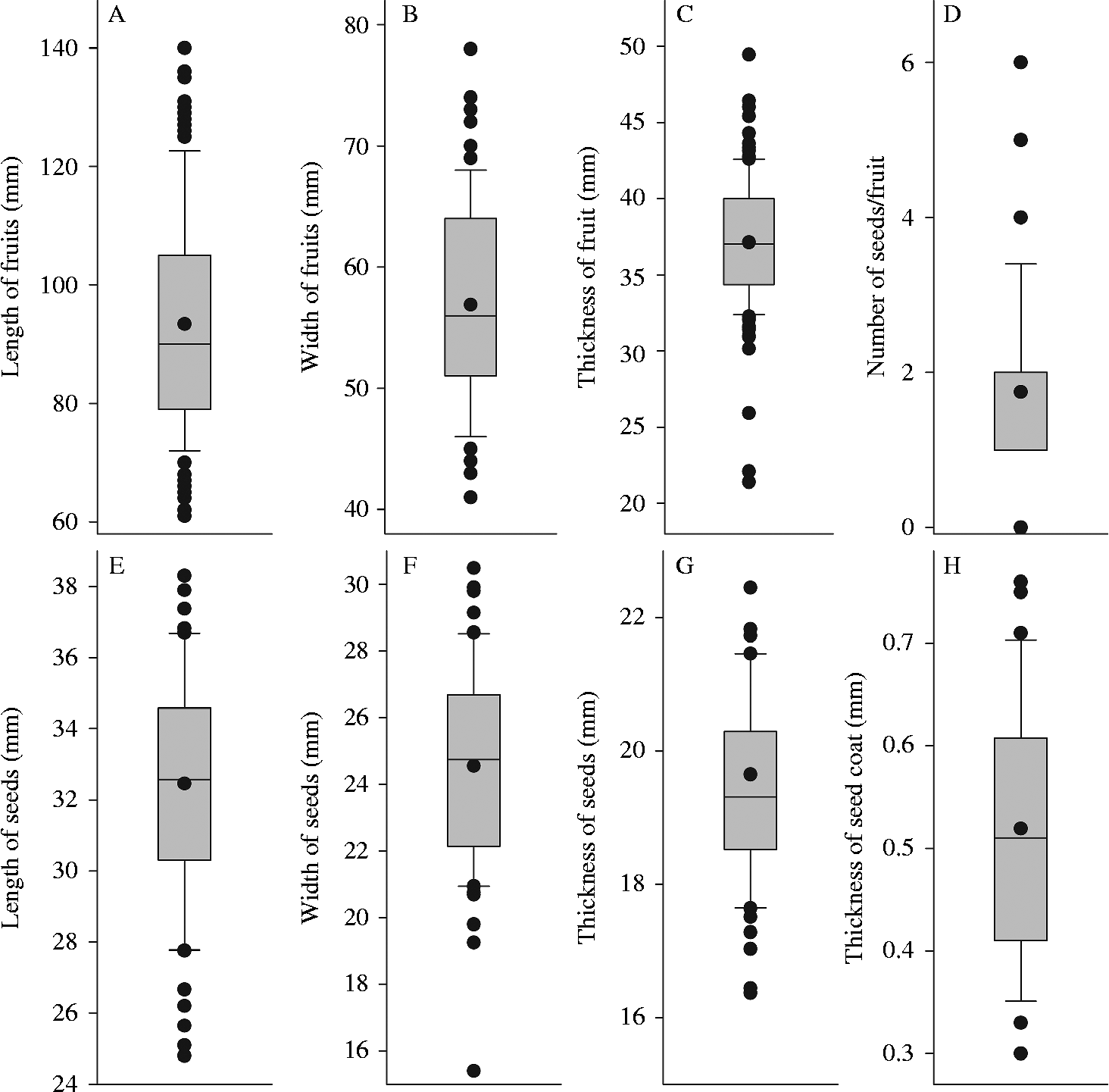
The fruits had an average length of 93 ± 18.8 mm, a width of 57 ± 8.1 mm and a thickness of 37 ± 4.2 mm, and we counted 2.0 ± 1.0 seeds per fruit (Fig. 1A, B, C and D). The seeds had an average length of 32.5 ± 3.3 mm, a width of 24.5 ± 2.9 mm and a thickness of 19.6 ± 2.0 mm. The seed coat had an average thickness of 0.5 ± 0.1 mm (Fig. 1E, F, G and H), and the seed, aril and fruit had an average water content of 47.7% ( ± 0.46), 77.2% ( ± 0.69) and 83.3% ( ± 0.54), respectively, at dispersal.
Length, width and thickness of fruits and seeds, number of seeds per fruit and seed coat thickness of Swartzia langsdorffii. The circles inside the boxes indicate the mean, the circles outside the boxes indicate outliers present in the data and the lines inside the boxes indicate median values.

A significant difference (P ≤ 0.0001) was found between the percentage of shoot emergence in seeds with and without aril. Seeds with aril reached 32% germination, with shoot emergence beginning on the 42nd day after sowing and stabilizing on the 80th day. Seeds without aril had 100% germination, with shoot emergence beginning on the 27th day after sowing and stabilizing on the 49th day.
Structural characterization of the seeds
S. langsdorffii seeds have a seed coat with pores that are distributed evenly over its surface (Fig. 2A, B). These pores consist of regions where the cells of the seed coat are discontinuous and form gaps, which may be observed by the naked eye as small whitish points. Those pores have subepidermal parenchymal tissue with large intercellular spaces (Fig. 2B), which can be observed along the entire extension of the thin seed coat in a cross-section (Fig. 2C). The embryo is axial and contains two fleshy cotyledons. The embryonic axis is composed of a hypocotyl–radicle axis that has a conical shape and reduced size (Fig. 2D), as compared to the cotyledons. A single, small, convex protuberance was observed in the middle region of the seed, opposite to the hilum, where the micropyle is located. Numerous stomata could be observed in the hypocotyl region closer to the cotyledon node (Fig. 2E). The plumule is located between the cotyledons and is not easily observed.
Ultrastructure of Swartzia langsdorffii seed parts. (A) General view of the seed coat, showing the presence of pores (arrows). (B) Detail of the pore, showing loose subepidermal tissue and large intercellular spaces. (C) Longitudinal section of the seed, with the thin seed coat, showing intercellular spaces in the mesophyll, as well as some cotyledonary tissue. (D) General aspect of the embryonic axis, with numerous stomata dispersed randomly in the hypocotyl region and few stomata in the radicle region. (E) Detail of the stomata in the hypocotyl region (arrowhead). CO, cotyledon; HY, hypocotyl; RA, radicle; SC, seed coat. Scale bars: (A, C, D) 200 μm; (B, E) 20 μm.

Anatomically, the plumule is rudimentary and has little relief above the cotyledon node and no leaf primordia (Fig. 3A, B). The protoderm consists of radially elongated cells, and the fundamental meristem displays isodiametric cells with thin cell walls and a conspicuous nucleus (Fig. 3B). The hypocotyl–radicle axis has an approximately conical shape, with a pointed apical region and wider distal region as a result of the wide cotyledon node (Fig. 3A). Differentiated stomata were observed in the cotyledon protoderm close to the plumule (Fig. 3B, C). Stomata were also observed in the protoderm of the distal region of the axis (hypocotyl) (Fig. 3D, E). The protoderm has cells with conspicuous phenolic content throughout the entire extension of the embryonic axis (Fig. 3D, F); the procambium displayed elongated cells and the fundamental meristem appeared distributed irregularly over the cortex and medulla (Fig. 3A). In the extremity of the radicle, a group of cells was observed with reduced size and irregular shape that form a primordial cap (Fig. 2D, Fig. 3A, F, G). Amyloplasts and granules that were stained an intense green colour were observed in this region and proximal to it, indicating the presence of phenolic compounds in the cells of this region (Fig. 3G).
Anatomy of the Swartzia langsdorffii embryo. (A) General aspect of the embryonic axis. (B) Detail of the undifferentiated plumule. (C) Detail of the stomata on the cotyledons. (D and E) Detail of the stomata on the embryonic axis, with arrows indicating the position of stomata and arrowheads indicating phenolic compounds. (F) Detail of the hypocotyl–radicle axis and presence of phenolic compounds (arrowheads). (G) Detail of the apical cells of the primordial root cap with amyloplasts. Scale bars: (A) 200 μm; (F) 100 μm; (B, C, D, E) 20 μm; (G) 10 μm.

Seed drying and storage
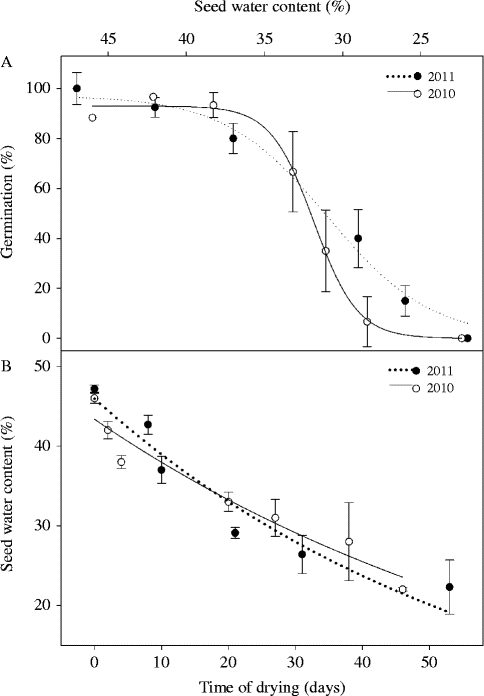
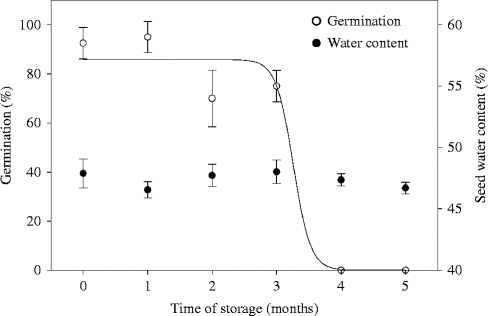
The initial water content of the seeds was 46% and dropped to 22% after 46–55 d of artificial drying (Fig. 4B). The critical point after which seeds lost 50% viability (Pammenter and Berjak, Reference Pammenter and Berjak1999), measured as germination capacity, was reached at moisture levels between 33 and 38%, and the lethal point was reached at 22%, when all seeds had lost viability. The drying behaviour of the seeds collected in 2010 and 2011 was similar (Fig. 4A). Water loss followed an exponential decay, occurring more rapidly until the 10th day, when the critical moisture point (38%) was reached, while subsequently water loss was slower and the lethal point (22% moisture) was reached around the 50th day after the start of the drying process (Fig. 4B). Seeds that were stored in a cold chamber with an initial water content of 47% had an initial viability of 92.5% and lost viability after 4 months of storage. The seed water content remained constant during this period (Fig. 5).
Effects of drying at 20°C and 50% RH on germination and water content of Swartzia langsdorffii seeds collected in 2010 and 2011. (A) Germination percentage in relation to the seed water content (2011: R 2= 0.98; 2010: R 2= 0.99) expressed on a fresh weight basis. (B) Water content of the seeds during drying (2011: R 2= 0.93; 2010: R 2= 0.94) expressed on a fresh weight basis.

Germination percentage and water content (fresh weight) of Swartzia langsdorffii seeds during storage in a cold chamber (5°C/40% RH). R 2 = 0.96.

Seed germination in field conditions
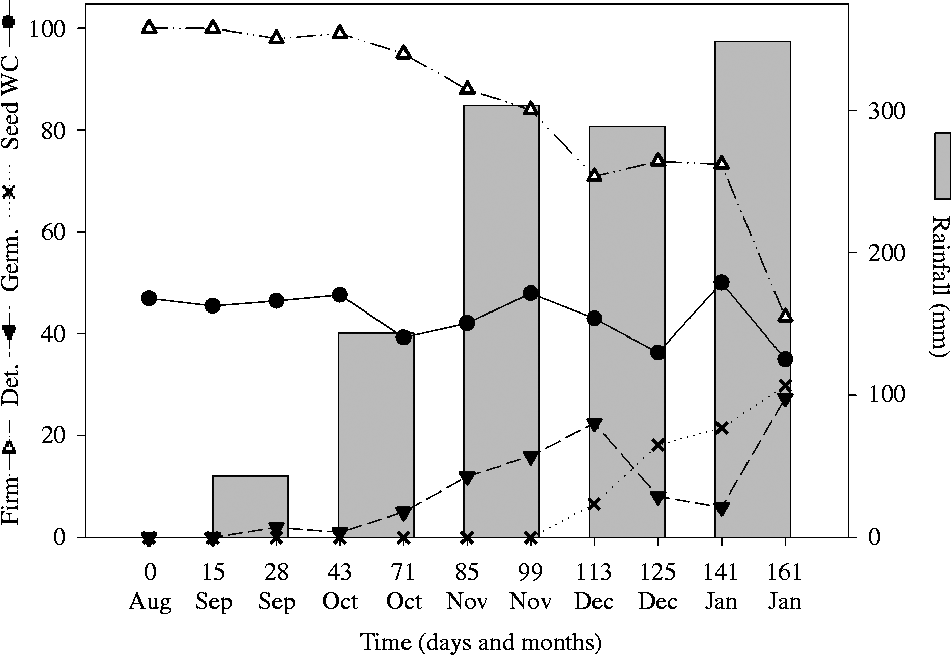
Significant variation was present in the mean moisture values (P< 0.0001) and germination percentage (P< 0.0001), as well as in the number of dead (P< 0.0001) and firm (P< 0.0001) seeds during the experimental period. The seed water content ranged from 35 to 48%, remaining near or above the critical point (Fig. 6) that was determined in the laboratory experiment (Fig. 4A). Germination was observed after 15 December, 5 months after the dispersal of the diaspores, and reached 30% in January. The rainy period began after 15 September, and until the end of October there were sparse rainfall events followed by many days with no rain. Germination began 113 d after dispersal, when rains had become abundant and regular (Fig. 6). The percentage of firm seeds remained stable until the 43rd day, after which it gradually decreased to 43%. Dead seeds were first found on the 28th day and reached a maximum percentage of 27% at the end of the experiment (Fig. 6).
Percentage of germinated, dead and firm seeds and water content of Swartzia langsdorffii seeds placed in the field in 2010. Bars indicate cumulative monthly precipitation.

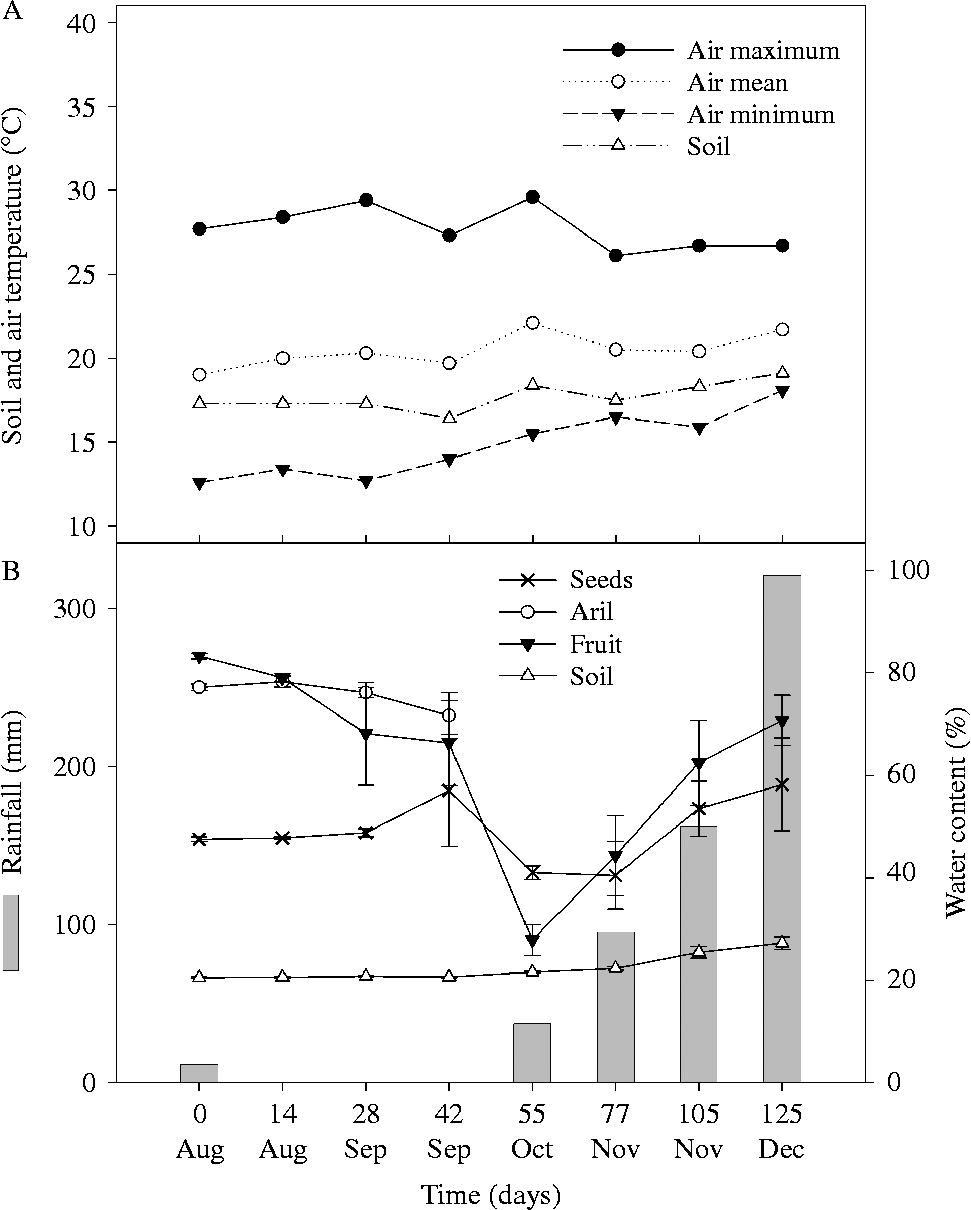
A wider difference between minimum and maximum air temperatures was observed in the first 3 months of the experiment, followed by a decrease in this range in October, with an increase in the minimum air temperature, coinciding with the beginning of the rainy season. During the experiment, the maximum temperature ranged from 26.1 to 29.6°C, mean temperature ranged from 19.0 to 22.1°C and minimum temperature ranged from 12.6 to 18.1°C. The soil temperature remained stable at approximately 17.0°C until the 28th day, after which it gradually increased to 19.1°C at the end of the experiment (Fig. 7A).
(A) Maximum, mean and minimum air temperatures, and soil temperature in the experimental area. (B) Water content of S. langsdorffii seeds, arils and fruits, soil water content and precipitation from August to December 2011.

There was significant variation in the water content of the fruits (P< 0.0001), arils (P< 0.0001), seeds (P= 0.0012) and soil (P< 0.0001) during the experimental period (Fig. 7B). The water content of the fruits varied between 27.9 and 83.3%, of the arils between 71.7 and 78.3%, of the seeds between 41.0 and 57.1%, whereas the water content of the soil varied between 20.4 and 26.9%. Similar to the experiment conducted in the previous year, the water content of the seeds remained above the critical point for germination (Figs 6A and 7B).
The seed moisture content was not correlated with either the fruit or aril moisture content, but showed a strong negative correlation (P= 0.0026; R= − 0.98) with the soil temperature. However, the fruit water content had strong negative correlation with the mean (P= 0.0158; R= − 0.94) and minimum (P= 0.0347; R= − 0.90) air temperatures and soil water content (P= 0.0035; R= − 0.98). After 55 d from the beginning of the experiment there was a decrease in the water content of the fruit, a significant increase in the mean and minimum air temperatures and an increase in the soil temperature (Fig. 7A, B). As described above, only the means collected before the rainy season were used to perform this analysis, since all the evaluated parameters showed increased water contents after the beginning of the rainy period.
Discussion
S. langsdorffii seeds are desiccation-sensitive since they lose their viability when dried to 22% water content (Fig. 4). Desiccation-sensitive seeds usually have large volumes, round shapes, large embryos, thin seed coats and high water content during dispersal, and are usually dispersed inside the diaspores composed of water-permeable and moist structures (Tompsett, Reference Tompsett1992; Farnsworth, Reference Farnsworth2000; Tweddle et al., Reference Tweddle, Dickie, Baskin and Baskin2003; Daws et al., Reference Daws, Garwood and Pritchard2005; Jayasuriya et al., Reference Jayasuriya, Baskin, Baskin and Fernando2012; Hamilton et al., Reference Hamilton, Offord, Cuneo and Deseo2013), as the morphological results show in this work. The seed size of recalcitrant species is often considered an ecological advantage; being larger and generally rounder, seeds have a smaller surface area to volume ratio which slows water loss and delays desiccation-induced viability loss (Farnsworth, Reference Farnsworth2000; Pammenter and Berjak, Reference Pammenter and Berjak2000; Tweddle et al., Reference Tweddle, Dickie, Baskin and Baskin2003; Hamilton et al., Reference Hamilton, Offord, Cuneo and Deseo2013), and, as recalcitrant seeds tend to form seedling banks, these seeds are expected to be large (Pammenter and Berjak, Reference Pammenter and Berjak2000). The correlation between seed size and desiccation sensitivity has been found in different studies conducted in tropical forests (Souza and Válio, Reference Souza and Válio2001; Daws et al., Reference Daws, Garwood and Pritchard2005; Yu et al., Reference Yu, Baskin, Baskin, Tang and Cao2008) and seeds classified as recalcitrant were larger than those classified as orthodox. Although S. langsdorffii has a large embryo that occupies the entire seed, most of the embryo consists of cotyledons.
Thin seed coats enable gas exchange with the environment (Berjak and Pammenter, Reference Berjak and Pammenter2000; De Souza and Marcos Filho, Reference De Souza and Marcos Filho2001; Hamilton et al., Reference Hamilton, Offord, Cuneo and Deseo2013), which may be enhanced by the presence of pores and intercellular spaces; they also do not prevent the expansion of the embryonic axis. Pores have been reported for soybean seed coats and are common in the Fabaceae family, with pore formation occurring in the later seed developmental stages, concomitantly with the beginning of maturation drying (De Souza and Marcos Filho, Reference De Souza and Marcos Filho2001). Thus, pores may aid viability maintenance, allowing gas exchange between the seeds and their surrounding structures. Additionally, the presence of a large amount of stomata in the hypocotyl region of the embryonic axis of S. langsdorffii may facilitate gas exchange and maintain active metabolism even when the seeds are surrounded by the diaspore structures, considering that, according to Berjak et al. (Reference Berjak, Farrant, Pammenter and Taylorson1989), recalcitrant seeds have a high requirement for oxygen, due to their high metabolic activity during and after dispersal. According to these authors, this high metabolic activity is due to the fact that the recalcitrant seeds continue to develop after shedding and it is not possible to detect when germination metabolism begins.
Although the water content of S. langsdorffii seeds remained unaltered during cold storage, there was a complete loss of viability after the fourth month. Several authors have reported on chilling sensitivity in tropical species, recommending storage at temperatures above 15°C (Berjak and Pammenter, Reference Berjak and Pammenter2008; Dresch et al., Reference Dresch, Scalon, Masetto and Mussury2014). In addition, seed storage at high water content is often hampered by fungal contamination of the seed coat (Calistru et al., Reference Calistru, Mclean, Pammenter and Berjak2000). A massive presence of fungi, which completely covered the seed coat, was observed, starting in the third month of storage at 5°C. When the seeds were opened to assess the presence of contaminations inside the seeds, it was confirmed that fungal infection only occurred on the outside of the seed coat.
Phenolic compounds act as protection against fungal and bacterial pathogens (Constabel et al., Reference Constabel, Yip, Patton and Christopher2000) and also as germination inhibitors (Maciel et al., Reference Maciel, Borges and Borges1992; Colpas et al., Reference Colpas, Ono, Rodrigues and Passos2003). They have high antioxidant activity, protecting cells from abiotic stresses (Swigonska et al., Reference Swigonska, Amarowicz, Krol, Mostek, Badowiec and Stanislaw2014). The massive presence of phenolic compounds in the embryonic axis of S. langsdorffii seeds could indicate a possible strategy to avoid early germination and protect against pathogens and possible environmental stresses, as seeds are dispersed during the dry season and take more than 100 d to start germination (Fig. 6). Colpas and Oliveira (Reference Colpas and Oliveira2003) also noted these compounds in S. langsdorffii pericarp.
In relation to seed dispersal, considering morphological traits of diaspores such as colour, size and texture, Martins et al. (Reference Martins, Cazotto and dos Santos2014) suggested that S. langsdorffii diaspores are dispersed by mammals, since the bright colour and odour of the pericarp and aril may attract these animals. However, S. langsdorffii diaspores are rich in secondary compounds such as tannins and saponins in the pericarp (Colpas and Oliveira, Reference Colpas and Oliveira2003), and saponins in the aril (data not published). These secondary metabolites are known for their strong role in seed defence against herbivory and pathogens (Cipollini and Levey, Reference Cipollini and Levey1997) and, specifically for saponins, as a strong antinutrient (Francis et al., Reference Francis, Kerem, Makkar and Becker2002). More research is required to understand the specific role of the diaspore in S. langsdorffii seed dispersal.
Numerous studies have correlated the dispersal of desiccation-sensitive seeds in seasonal habitats with the periods of the year with highest precipitation (Farnsworth, Reference Farnsworth2000; Pammenter and Berjak, Reference Pammenter and Berjak2000; Tweddle et al., Reference Tweddle, Dickie, Baskin and Baskin2003; Pritchard et al., Reference Pritchard, Daws, Fletcher, Gamene, Msanga and Omondi2004). However, S. langsdorffii seeds are desiccation sensitive and dispersed in the month of the year with the lowest precipitation. The dispersal of other recalcitrant seeds has also been associated with the dry season, as reported by Dussert et al. (Reference Dussert, Chabrillange, Engelmann, Anthony, Louarn and Hamon2000), Daws et al. (Reference Daws, Garwood and Pritchard2005) and Yu et al. (Reference Yu, Baskin, Baskin, Tang and Cao2008); however, these authors reported that these species are associated with swamp or riparian environments.
The pericarp of S. langsdorffii remained intact for approximately 3 months after the beginning of the experiments, followed by drying in the tissues that were not in contact with the soil, but no deterioration; however, the tissues in contact with the soil were subject to deterioration. These seeds maintain their high water content during a long period after dispersal, and it is possible that the pericarp protects seeds from desiccation by creating a moist microclimate in the field. Chacón and Bustamante (Reference Chacón and Bustamante2001) studied seeds of Cryptocarya alba and stated that the presence of a pericarp decreases seed water loss after dispersal, especially during the dry season. The same role for the pericarp was proposed by Sobrino-Vesperinas and Viviani (Reference Sobrino-Vesperinas and Viviani2000) in seeds of Quercus suber. Thus, the possible microclimate created by the pericarp, composed of the moisture of the aril and the soil, the presence of the structures in the axis such as the pores and stomata, chemical composition and the morphology of S. langsdorffii seeds could favour maintenance of their viability until the beginning of the rainy season.
Acknowledgements
We thank the Laboratório de Microscopia Eletrônica of Universidade Federal de Lavras for help in the ultrastructure analysis. We also thank José Pedro for the fruit collection; Dr Peter Toorop for help during the designing and development of this work; Dr Wilson Vicente Souza Pereira for help with the statistical analysis; and Dr Efisio Mattana, the reviewers and the editor for valuable suggestions to improve the manuscript.
Financial support
Funding was received from FAPEMIG (Fundação de Amparo à Pesquisa do estado de Minas Gerais) for T.A.A.V., for the Laboratório de Microscopia Eletrônica and the Laboratório de Anatomia Vegetal (Project CRA APQ 04619-10) of the Universidade Federal de Lavras. CNPq (Conselho Nacional de Desenvolvimento Científico e Tecnológico) provided funding for fruit collection and reagents.
Conflicts of interest
None.