Knowledge of spore to spore generation time is extremely important for several reasons. As it is the shortest generation time, it indicates the maximum nucleotide substitution rate over time and provides a rate limit for the evolution of a species. In population genetics most calculations involving time use ‘generations’ as the unit of measurement and in order to convert these ‘generations’ into ‘years’, knowledge of generation time is needed but rarely available. Knowledge of generation time may also be essential for conservation purposes and assessments of migration history. This knowledge also makes it possible to estimate both the age of a population and also to determine to what extent a population represents the genetic diversity of a species (Rosenberg & Nordborg Reference Rosenberg and Nordborg2002). In this paper we present a method for assessing generation length for lichens using Cliostomum corrugatum (Ach.) Fr. as an example. This lichen was selected for investigation because it is restricted to forests with long temporal continuity (Lättman et al. Reference Lättman, Lindblom, Mattsson, Millberg, Skage and Ekman2009) and information on generation time is essential to estimate the rate of dispersal at the landscape level.
Cliostomum corrugatum is an epiphytic crustose lichen with distinctive morphology and clearly delimited habitats making it relatively easy to find and identify in the field. It has a greyish thallus which bears conspicuous, light yellow to light brown, apothecia, 0·5–1·2 mm wide, as well as black pycnidia, 0·2–0·5 mm wide. Its geographical distribution in Sweden largely reflects that of Quercus robur L. as it is chiefly confined to the coarse bark of old trunks in old stands of this tree species, often in relatively dry and semi-open forests or parklands (Thor & Arvidsson Reference Thor and Arvidsson1999). It occurs mainly on the flat outer parts of the bark but is occasionally found on the coarse bark of other deciduous trees and on decorticated stumps, old wood, and twigs of Picea abies L. In northern Europe it is rare and red-listed, for example, in Sweden, Near Threatened; in Norway, Critically Endangered, and in Finland, Near Threatened (Lättman et al. Reference Lättman, Lindblom, Mattsson, Millberg, Skage and Ekman2009). Cliostomum corrugatum produces sexual spores but not vegetative diaspores, such as soredia or isidia, and we assume that new thalli establish from sexually produced spores. Based on results of Lättman et al. (Reference Lättman, Lindblom, Mattsson, Millberg, Skage and Ekman2009) we assume no dispersal limitation at the spatial scale studied. Suitable habitats, i.e. old oaks will probably be colonized as soon as their bark is coarse enough to be a suitable habitat.
On a site in the province of Östergötland, (south-central Sweden) all Quercus robur trunks >200 cm circumference were examined in April 2006 from ground level to 2 m in a search for Cliostomum corrugatum. Preliminary studies had shown a very low occurrence of C. corrugatum on trees with a circumference < 200 cm in agreement with later studies (Johansson et al. Reference Johansson, Bergman, Lättman and Milberg2009; Ranius et al. Reference Ranius, Johansson, Berg and Niklasson2008). The occurrence and the size of the largest C. corrugatum thalli with apothecia and the size of the largest apothecia were recorded. Data for the largest thallus on each trunk was used to determine the smallest trunk size colonized by C. corrugatum. The relationship between the square root of the thallus area and trunk circumference was examined using linear regression analysis in R 2.7.2 (R development core team, 2005) and the average circumference at the time of spore germination was determined using the point at which the regression line intercepts the x-axis. The minimum circumference value was compared to that of the smallest trunk with fertile lichens. The time (in years) between spore germination and spore production was subsequently calculated by dividing the difference (in mm) between this circumference value and the circumference of the thinnest trunk carrying lichen by 2π multiplied by the annual radial growth.
Carlsson (Reference Carlsson2004) found an annual radial growth of 1·6–2·4 mm of oaks at a single location with a circumference of 200 cm. Compared to this Carbonnier (Reference Carbonnier1975) gives a value of 2·4 mm on good soils in southern Sweden and an assessment based on data in Tree-ring Database, NOOA Paleoclimatology (http://www.ncdc.noaa.gov/paleo/paleo.html) gives a value of 1.6 mm, with a standard deviation of 1.0 mm (28088 measurements from 9 data sets referring to Europe north of latitude 54 after the year 1700). As the soil conditions on the studied site are good it seems reasonable to assume an annual radial growth of 2 mm.
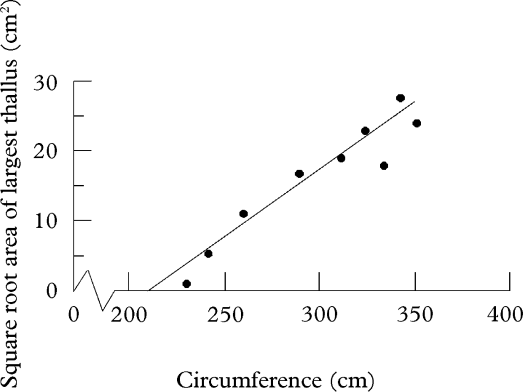
Seventeen large Quercus robur trunks were examined. Trunks with a circumference >350 cm were not included because cracks in the bark that limit the growth of thalli in some directions, are most frequent on older trees. In addition, as the life span of lichens is limited, older trees may support thalli representing later colonizations. Also, the comparatively small thallus (40 cm2) on a trunk with a perimeter of 280 cm was omitted as it probably represents a late colonization event. The linear regression analysis gave a minimum value for oak circumference at which colonization by C. corrugatum occurs of 215 ± 16 cm, P=0·001, r 2=0·826 (Fig. 1). The smallest circumference of trunks with fertile specimens of C. corrugatum was 240 cm. During the time from colonization to formation of apothecia an oak will increase its perimeter by 25 ± 16 cm. The time span from spore to spore may thus be calculated to approximately 20 years (250/(2π × 2) = 20). If the standard error of the average circumference (16 cm) is taken into account the time span will be 7–25 years.
The relationship of the size of the largest thallus of Cliostomum corrugatum on each Quercus robur and the circumference of the trunk.

The observations supported the assumption of a correlation between thallus age, as indicated by thallus size, and the formation of apothecia because all fertile thalli were at least 30 cm2. There was also a correlation between tree age and occurrence of thalli indicating good dispersal properties to appropriate substrata of a certain age, although one tree was thought to have been colonized late. Of course, other factors, such as microclimatic conditions might affect dispersal so that specific values (e.g. of minimum circumference) might only be relevant to the site. Small thalli with well-developed apothecia were not encountered, indicating a correlation between thallus size and formation of apothecia. Further, as apothecia are absent on the smallest trees this also indicates relatively rapid colonization when the trees develop a suitable bark structure for colonization. All these observations suggest that it would be appropriate to apply the results to a larger geographic area.
The method described here uses observations on the smallest/youngest tree with sterile thalli, thus identifying the shortest possible generation length, rather than average spore to spore generation length which is probably significantly longer. Within population genetics the latter value would be more useful. It seems reasonable to assume an average length of about 25–30 years. On the other hand, a minimum value also indicates possibilities. It shows the maximum rate of evolutionary processes and in this case also indicates a fairly high average rate as all thalli on bigger oaks are fertile.
The importance of other means of dispersal, for example, vegetative diaspores, should be considered. Since no soredia or isidia have been reported in C. corrugatum, it seems reasonable to assume meiospore dispersal as all larger thalli possess apothecia. There is of course a possibility of production of non-viable spores in the apothecia observed but it seems reasonable to assume functionality.
The pycnidia of the thallus produce mitotic conidia that may also function as spermatia, fungal diaspores, or maybe both, as has been known from studies since the 19th century (Vobis Reference Vobis1980). As far as we know none of these studies concerns C. corrugatum, but the possibility of dispersal by pycnoconidia should not be neglected. If pycnoconidia act as dispersal units the shortest generation time from spore to spore may be underestimated by our method.
This study is part of the multi-disciplinary project “Ecological and Societal Systems in Interaction” a multidisciplinary project aiming at identifying and describing processes behind environmental and conservation policies of public authorities at different levels in the Baltic Sea area. The project is hosted at and is a part of the strategic development of environmental sciences at Södertörn University and is generously funded by Östersjöstiftelsen. Economic support from the regional county administration (Stockholm läns landsting) is also acknowledged. The leader of the course Field Studies of the Biological program of Södertörn University, Mikael Lönn, made student participation and inclusion of this project in the course possible. Finally, we are also grateful to Jörg Brunet for help with references and to Stefan Ekman for the calculations of the average annual growth from NOOA data. Together with two unknown referees, the latter also contributed useful comments which greatly improved the manuscript. Finally we thank Anthony Wright for linguistic revision of the text.