INTRODUCTION
Traditionally, investigations into the developing lexicon were largely focused on measuring the volume of words children comprehend as if word knowledge were an all-or-none phenomenon. However, a rich history of behavioral and computational research with adults supports the notion that word knowledge is not all-or-none (Frishkoff, Perfetti & Westbury, Reference Frishkoff, Perfetti and Westbury2009; Stein & Shore, Reference Stein and Shore2012). Specifically, word knowledge becomes increasingly decontextualized as partial knowledge becomes more robust over time with experience (Yurovsky, Fricker, Yu & Smith, Reference Yurovsky, Fricker, Yu and Smith2014).
Infants’ initial understanding of words also seems to be restricted to certain situations containing rich contextual cues (e.g. social support, or concurrent presentation of the word with the visual referent). This suggests that their knowledge of newly learned words may be partial (Carey & Bartlett, Reference Carey and Bartlett1978; Kucker, McMurray & Samuelson, Reference Kucker, McMurray and Samuelson2015). For instance, given few exposures of a word and its corresponding concept, infants may overgeneralize (e.g. representing all four-legged animals as dog), or undergeneralize word meaning (e.g. representing the word juice only for orange juice in a certain cup). Indeed, recent connectionist models have corroborated this idea of partial knowledge as a central characteristic of lexical development (McMurray, Reference McMurray2007; McMurray, Horst & Samuelson, Reference McMurray, Horst and Samuelson2012; Munakata, Reference Munakata2001; Yu, Reference Yu2008). Though partial word knowledge is often enough for young children to illustrate understanding in certain scenarios – e.g. when given social support – eventually, adultlike levels of understanding that are decontextualized are achieved.
The majority of empirical research examining decontextualized word comprehension in infants has utilized paradigms in which spoken words and visual referents are presented simultaneously (Bergelson & Swingley, Reference Bergelson and Swingley2012; Hendrickson & Friend, Reference Hendrickson, Friend, Baiz, Goldman and Hawkins2013; Hendrickson, Mitsven, Poulin-Dubois, Zesiger & Friend, Reference Hendrickson, Mitsven, Poulin-Dubois, Zesiger and Friend2015; Meints, Plunkett & Harris, Reference Meints, Plunkett and Harris1999). However, comprehending utterances about unseen objects is a critical component of decontextualized language (Gallerani, Saylor & Adwar, Reference Gallerani, Saylor and Adwar2009; Saylor, Reference Saylor2004). Infants must understand that when a speaker refers to an absent object, they intend to focus the listener's attention on a representation of that object independent of the present context (Saylor & Baldwin, Reference Saylor and Baldwin2004). That is, the representation of the word must be activated spontaneously, and in the absence of a probe (Werker, Cohen, Lloyd, Casasola & Stager, Reference Werker, Cohen, Lloyd, Casasola and Stager1998).
To test absent object knowledge, the extant research uses naturalistic paradigms with rich contextual support. For example, knowledge is measured in the same context in which the word–object association was first learned, or in a scenario in which other associative cues are available (Ganea, Reference Ganea2005; Huttenlocher, Reference Huttenlocher and Solso1974; Saylor, Reference Saylor2004). From this work we have learned that children begin to produce labels for absent objects between ages 1;6 and 2;0, and can use verbal information to update their representation of an absent object over this same period as well (Ganea, Shutts, Spelke & DeLoache, Reference Ganea, Shutts, Spelke and DeLoache2007; Greenfield, Reference Greenfield1982; Veneziano & Sinclair, Reference Veneziano and Sinclair1995). However, there is some evidence that the beginnings of absent object comprehension emerge earlier (Ganea, Reference Ganea2005; Ganea & Saylor, Reference Ganea and Saylor2013; Liszkowski, Schäfer, Carpenter & Tomasello, Reference Liszkowski, Schäfer, Carpenter and Tomasello2009; Osina, Saylor & Ganea, Reference Osina, Saylor and Ganea2013; Saylor, Reference Saylor2004). Specifically, it has been shown that, given a newly learned word–object pairing, infants aged 1;2 can reference absent objects, but only with rich contextual support. In the current study we extend this research to investigate whether infants at 1;2 are able to demonstrate absent object knowledge, even in the absence of contextual support.
Investigating decontextualized word knowledge early in development can be problematic because it is difficult to assess lexical–semantic representations in largely preverbal infants without some level of cue support. In research with adults, priming studies have proved useful for this purpose (McNamara, Reference McNamara1992; McRae & Boisvert, Reference McRae and Boisvert1998). Priming effects – faster response times to semantically related compared to semantically unrelated stimuli – have been found in adults within modality (Meyer & Schvaneveldt, Reference Meyer and Schvaneveldt1971), such that spoken words prime related spoken words, and across modalities, such that spoken words prime related images and vice versa (Antos Reference Antos1979; Holcomb & Neville, Reference Holcomb and Neville1990).
Recently, adult priming methodologies have been used with infant populations and have proven to be promising for studying the development of decontextualized lexical representations (Arias-Trejo & Plunkett, Reference Arias-Trejo and Plunkett2009, Reference Arias-Trejo and Plunkett2013; Luche, Durante, Floccia & Plunkett, Reference Luche, Durrant, Floccia and Plunkett2014). Using infant looking time, these studies have found evidence of auditory priming for semantically related word pairs between ages 1;6 and 2;0 (Luche et al., Reference Luche, Durrant, Floccia and Plunkett2014; Styles & Plunkett, Reference Styles and Plunkett2009), and cross-modal priming for semantically related word–picture pairs at around 1;9 (Arias-Trejo & Plunkett, Reference Arias-Trejo and Plunkett2009, Reference Arias-Trejo and Plunkett2013).
In the current study, we used a priming paradigm because it allows for the asynchronous presentation of words and referents, and thus provides a novel way to investigate the emergence of absent object knowledge without contextual support. Previous research has suggested that representations of word–object relations are more robust when children have more exposure and familiarity with the word–object pairing (Shinskey & Munakata, Reference Shinskey and Munakata2005). Further, robust compared to weak word–object knowledge is thought to better serve the retrieval of representations of absent objects in decontextualized scenarios (Ganea, Reference Ganea2005, Ganea & Saylor; Reference Ganea and Saylor2013; Munakata, Reference Munakata2001). Thus, we used a cross-modal priming paradigm to test infants’ knowledge of highly familiar words in the absence of objects. We reasoned that if infants reference absent objects with very little contextual support early in development, they are likely to do so for highly familiar words.
An understanding of words requires infants to not only grasp the relation between a word and a concept, but also to appreciate that a word may refer to a variety of exemplars (Arias-Trejo & Plunkett, Reference Arias-Trejo and Plunkett2009, Reference Arias-Trejo and Plunkett2013). For example, infants must understand that the word dog refers to dogs of many different breeds and not just to a Labrador. Therefore, to have a more comprehensive understanding of infants’ ability to reference absent objects for highly familiar words, another goal for the current investigation was to determine the extent to which words evoke strictly prototypical representations of absent objects.
To summarize, we exploited the priming paradigm to examine whether highly familiar spoken words can prime representations of absent objects early in the second year (Experiment 1), and further, to determine whether the representation that is primed is strictly prototypical (Experiment 2). Specifically, we familiarized infants with passages containing two target nouns. Subsequently, infants were presented with silent animations of four words – two with which they were previously familiarized (primed targets) and two they had not heard during familiarization (unprimed non-targets). Looking time to primed and unprimed animations were averaged and compared statistically to determine if hearing passages with familiar words caused infants at 1;2 to activate prototypical (Experiment 1) as well as atypical (Experiment 2) representations of the same words.
EXPERIMENT 1
METHODS
Participants
The final sample included eighteen monolingual English-hearing infants (10 F; 8 M) ranging in age from 1;1·5 to 1;2·5 (M = 1;2). Only those infants with at least 80% exposure to English were included in the study. Estimates of daily language exposure were derived from a language questionnaire administered to parents (Bosch & Sebastián-Gallés, Reference Bosch and Sebastián-Gallés2001; Sundara & Scutellaro, Reference Sundara and Scutellaro2011). All infants were full-term and had no diagnosed impairments in hearing or vision. Five additional infants were tested but excluded from analysis because they failed to complete testing (n = 3), never looked away from the screen (n = 1), or had total looking times more than two standard deviations from the mean (n = 1). Parents filled out the MacArthur-Bates Communicative Development Inventory: Words and Gestures (MCDI: WG), a parent report checklist of language comprehension and production developed by Fenson et al. (Reference Fenson, Dale, Reznick, Thal, Bates, Hartung, Pethick and Reilly1993). The average MCDI: WG comprehension score was 27 words (range = 8–56 words), and the average MCDI production score was 7 words (range = 0–27) out of a possible 396 words.
Stimuli
The four target words used in the study – dog, car, ball, shoe – were selected to be highly familiar nouns to English-hearing infants at 1;2. At least 86% of children age 1;2 comprehend these four words based on the MCDI: WG comprehension and production norms. All four target words were consonant-initial and monosyllabic.
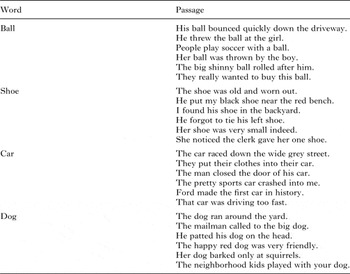
Four, six-sentence passages, one for each of the four target words, were generated. The passage containing the target word dog was taken directly from the stimuli in Jusczyk and Aslin (Reference Jusczyk and Aslin1995). The other three passages were created to match the above-mentioned passage in number of syllables. Of the six sentences, two had the target word near the beginning of the sentence, two sentence-medially, and two sentence-finally. The passages are presented in Table 1.
The four six-sentence passages

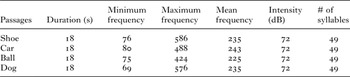
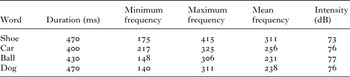
An American English-speaking female from the northwestern United States recorded the four familiarization passages in infant-directed speech. Passages were recorded in a soundproof booth using a Shure SM81 table-top microphone. All sentences were digitized at a sampling frequency of 44 KHz and 16-bit quantization using Praat (Boersma & Weenink, Reference Boersma and Weenink2006). The four passages were matched for overall duration (18 secs) and the total number of syllables (49). The average pitch, pitch range, and the average intensity of the four passages, as well as the target words embedded in these passages, were comparable (see Tables 2 and 3).
Acoustic analyses of familiarization passages

Acoustic analyses of four target words

The animated images were selected to be prototypical exemplars of the four target words. To validate that these images were in fact good examples of each noun, we asked five native English-speaking adults to choose the animation that best visually represented the noun from an assortment of animations. During visual display, motion was coupled with each of the objects in order to sustain the child's attention (Werker et al., Reference Werker, Cohen, Lloyd, Casasola and Stager1998). The car and the shoe were spinning, the dog was walking, and the ball was bouncing.
Procedure and design
For the priming task, infants sat on their caregivers’ lap in front of a TV monitor at a distance of 3·5 ft. Visual stimuli were presented on a 24·5″ by 21″ display on the monitor. Audio stimuli were played using Bose loudspeakers located behind the TV monitor at an average of 72 dB SPL. A Sony digital video camcorder was placed below the TV monitor. The camera was connected to a second TV monitor in an adjacent room where an experimenter coded the infant's eye-gaze. Both the experimenter and the parent listened to music through Peltor noise-cancelling headphones so as not to influence the infant's behavior.
An infant-controlled version of the visual fixation procedure implemented using Habit X (Cohen, Atkinson & Chaput, Reference Cohen, Atkinson and Chaput2004) was used for testing. The design was adapted from Jusczyk and Aslin (Reference Jusczyk and Aslin1995) to an auditory–visual cross-modal priming paradigm. The head-turn preference procedure used by Jusczyk and Aslin has two phases. During the familiarization phase infants hear repetitions of six-sentence passages containing two of four target words (cup, dog, feet, bike). In the test phase that follows, infants are presented with each of the four words repeated in isolation (e.g. car, car, car …)
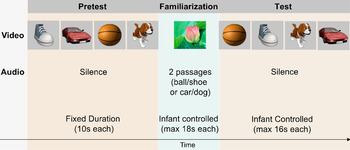
In the present study, three modifications were made to Jusczyk and Aslin's (Reference Jusczyk and Aslin1995) paradigm. First, we adapted the study from the head-turn preference procedure to a visual fixation procedure. This was done in order to present both visual and auditory stimuli. Second, a video-only pretest phase was added before the familiarization phase. This was necessary because pilot testing showed that infants liked the animations to such an extent that without familiarization they tended to look at the animations for the entire duration of the test trials. Third, instead of presenting infants with target vs. non-target words auditorily during the test trials, we presented visual animations of target vs. non-target words sequentially (see Figure 1).
Experiment 1 design schematic.

The priming task was done in three phases. First in the pretest phase infants saw the four animated images (dog, car, ball, shoe) each representing one noun, one at a time, with no audio stimuli for a fixed duration of 10 seconds. The order of presentation of the four animations during the pretest phase was randomized across infants. During the familiarization phase that followed, infants heard two passages, each with one out of the four words, while viewing a static image of a flower. The image was presented in order to focus the infant's attention on the screen. Each passage was presented for 18 seconds or until the participant looked away for more than 1 second, at which point, an attention getter would appear on the screen to bring the infants focus toward the monitor for the next trial. The two audio passages alternated until infants accumulated a total listening time of 60 seconds. Half of the infants were familiarized with the Ball/Shoe passages and the other half with the Dog/Car passages.
During the test phase that immediately followed familiarization, infants were presented with silent animations of the referents of the four words – two that matched the meaning of target words in the familiarization passages (primed; e.g. dog and car), and two they had not heard during familiarization (unprimed; e.g. ball and shoe) – in three blocks, for a total of twelve trials. The trials were presented for a maximum of 16 seconds or until the child looked away for more than 1 second. A trial was repeated if the infant failed to look at the screen for at least 1 second. Looking times to primed vs. unprimed animations were averaged separately and compared. To demonstrate a priming effect, infants had to look significantly longer at the primed compared to the unprimed animations.
RESULTS AND DISCUSSION
During the pretest phase, looking times to each animation were near ceiling (10 s): ball (9·2 s), car (9·3 s), shoe (9·3 s), and dog (9·6 s). To determine whether infants preferred one picture over another regardless of condition in the pretest phase, we first analyzed looking time in a repeated-measures ANOVA with the within-subjects variable Word (dog, car, ball, shoe), and the between-subjects variable Condition (Dog/Car vs. Ball/Shoe). There was no main effect of Word, suggesting that across conditions infants showed comparable looking times to all images during the pretest phase. Additionally, there was no significant Word × Condition interaction (all non-significant ps ⩾ ·5)
Next, looking times to primed vs. unprimed animations presented during the test phase were analyzed using a repeated-measures ANOVA. These results are presented in Figure 2. In this analysis there were two within-subjects variables, Block (1st, 2nd, and 3rd) and Trial-Type (primed, unprimed), and one between-subjects variable, Condition (Dog/Car, Shoe/Ball). Unsurprisingly, there was a main effect of Block (F(2,15) = 6·59, p = ·009,
 $\eta _p^2 $
= ·332), showing that infants had shorter looking times towards the end of the experiment. We also found a main effect of Trial-Type (F(1,16) = 7·12, p = ·017,
 $\eta _p^2 $
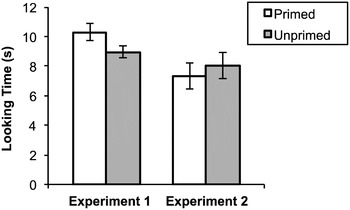
= ·308), such that infants looked significantly longer at primed (M = 10·30 s; SD = 2·5) compared to unprimed animations (M = 8·96 s; SD = 1·8); fifteen out of eighteen infants showed this pattern of results. There was no significant interaction between Block × Trial Type, demonstrating that the effect of Trial-Type was consistent through all three blocks. Additionally, there was no significant Trial-Type × Condition interaction, indicating that a similar effect was observed for both conditions.
Average looking times (in seconds ± SE) to primed and unprimed referents in Experiments 1 and 2.

Thus, in Experiment 1, infants at 1;2 were able to segment highly familiar words from continuous speech, and at a later time identified a prototypical visual referent even in the absence of contextual support. Due to the asynchronous presentation of auditory and visual stimuli it is likely that infants did not merely associate words and visual referents, but had to retrieve a representation of the word spontaneously.
EXPERIMENT 2
Beyond referencing unseen objects in contextually impoverished scenarios (e.g. without social support, or associative cues), one further challenge infants face is referencing multiple objects, whose features may be quite different, with the same word (Ganea & Harris, Reference Ganea and Harris2013). In particular, it is unknown whether words evoke strictly prototypical representations of absent objects. Therefore, in Experiment 2 we presented multiple exemplars of each word, ranging in typicality, and again tested infants’ ability to reference absent objects without contextual support.
METHOD
Participants
The final sample included sixteen monolingual English-hearing infants (11 F; 5 M) ranging in age from 1;1·6 to 1;2·6 (M = 1;2·2). Participant inclusion criteria were identical to those in Experiment 1. Four additional infants were tested but excluded from analysis because of experimenter error (n = 1), never looking away from the screen (n = 2), and having total looking times more than two standard deviations from the mean (n = 1). The average MCDI: WG comprehension score was 43 words (range = 11–66 words), and the average MCDI production score was 10 words (range = 1–27).
Stimuli and procedure
The procedure was identical to Experiment 1 with one modification. Instead of using one prototypical animation per word for pretest and test, we presented three exemplars, ranging in typicality, for each word. This resulted in twelve (instead of 4) different pretest trials and different animations for each word in every block of the test phase.
Of the three animations for each word used in Experiment 2, one was the prototypical animation used in Experiment 1. We obtained typicality judgments of the visual stimuli to be used in Experiment 2 from seven adult native speakers of English who were students in an American university. The design of the adult typicality judgment task was modeled after a similar task used in Meints et al. (Reference Meints, Plunkett and Harris1999). Each image was presented to the participants on a computer monitor with the name of the concept and a typicality rating scale that ranged from 1 (very typical) to 7 (very atypical) directly under the displayed image. Prior to participating, adults received written instructions to clarify the difference between typical and atypical stimuli. Similar to Meints et al., within the instructions participants were given the example that certain birds (e.g. ostrich) do not necessarily represent good examples of birds. Participants saw a total of twelve images – one for each target word from Experiment 1 (4), and the two additional images of each target word for Experiment 2 (8). The results of the typicality ratings confirmed the validity of the pre-assessment of the images. The overall mean typicality rating for the four images used in both Experiments 1 and 2 was 1·9; the average for the four mildly atypical images was 2·45; and the average for the four moderately atypical images was 3·3. These ratings are comparable with those obtained from Meints et al.
RESULTS
To determine whether infants preferred one picture over another regardless of condition during the pretest phase, we first analyzed looking time in a repeated-measures ANOVA with the within-subjects variables Word (dog, car, ball, shoe) and Block (1st, 2nd, and 3rd), and the between-subjects variable Condition (Dog/Car vs. Ball/Shoe). Unlike in Experiment 1, there was a significant main effect of Word (F(3,12) = 5·09, p = ·017,
 $\eta _p^2 $
= ·560), such that infants seemed to prefer the animations of the word dog. This word preference did not interact with condition (F(3,12) = 2·5, p = ·11). Because of this we analyzed the data in two ways, first including all words in the analysis, and second excluding dog trials for both conditions.
Then we analyzed looking time to primed vs. unprimed animations using a repeated-measures ANOVA with two within-subjects variables, Trial-Type (primed, unprimed) and Typicality (prototypical, intermediate, atypical), and the between-subjects variable Condition (Dog/Car, Shoe/Ball). Neither the main effect of Trial-Type nor the interaction of Trial-Type × Condition or Trial-Type × Typicality was significant (all non-significant ps > ·1).Footnote
1
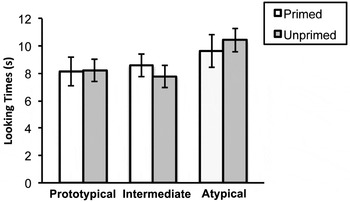
There was, however, a marginal main effect of Typicality (F(2,13) = 3·31, p = ·069,
 $\eta _p^2 $
= ·337), such that infants looked longer at the atypical animations compared to animations at the other two levels of typicality (Figure 3). Further, we found a significant Trial-Type × Typicality × Condition interaction. Given the significant three-way interaction, we examined the effects of Trial-Type × Condition separately for each level of Typicality (prototypical, intermediate, atypical). There were no significant main effects or interactions for the Prototypical stimuli and the stimuli with Intermediate typicality (all non-significant ps > ·4). For the Atypical stimuli there was no main effect of Trial Type (F(1,14) = 0·265, p = ·62), however there was a significant Trial-Type × Condition Interaction (F(1,14) = 7·67, p = ·015,
 $\eta _p^2 $
= ·354). We did not probe the interaction further, given that this data was from very few trials and in view of the already established overall preference for the dog animations.
Average looking times (in seconds, ± SE) to primed and unprimed referents across the three levels of typicality in Experiment 2.

We also analyzed the data excluding trials in which the dog animation was used. Again we compared looking time to primed vs. unprimed animations using a repeated-measures ANOVA with two within-subjects variables, Trial-Type (primed, unprimed) and Typicality (prototypical, intermediate, atypical), and the between-subjects variable Condition (Car/Dog, Shoe/Ball). Although the pattern of looking times was in the expected direction, the main effects of Trial-Type (F(1,14) = 2·05, p = ·17) and Typicality (F(2,13) = 2·08, p = ·17) were not significant, and there were no significant Trial-Type × Typicality, Typicality × Condition, or Trial-Type × Condition interactions.
Why did we see a significant difference in looking times using the prototypical animations in Experiment 1 but not in Experiment 2 (see Figure 2)? We think it is likely due to the amount of time infants had to display an effect. That is, in Experiment 2 each of the prototypical animations was presented once (total of 4 trials), whereas the same animations were displayed three times each (total 12 trials) in Experiment 1. Further, recall that in Experiment 2 infants looked significantly less at the prototypical vs. the atypical exemplars. Although comparing looking times across different groups of infants is problematic, we also see that on average, across prime and unprimed conditions, infants looked less at the prototypical animations when presented in Experiment 2 (M = 8·17) compared to when these exact animations were presented in Experiment 1 (M = 9·63). Part of this reduction might be expected, given that the presentation order of the prototypical and atypical images was randomized across infants. Thus, about two-thirds of the infants saw the prototypical animation only in blocks 2 or 3, not 1. It is well known that infants tend to have shorter looking times towards the end of experiments, that is across successive blocks, accounting at least partly for the lower looking times to prototypical animations in Experiment 2. However, it is also possible that the presence of atypical exemplars themselves rendered the prototypical exemplars less interesting in Experiment 2 compared to Experiment 1.
GENERAL DISCUSSION
In this study we investigated whether young children demonstrate decontextualized absent object knowledge early in the second year of life, and further examined the extent to which words evoke strictly prototypical representations of absent objects. In two experiments, infants at 1;2 were familiarized with passages containing two target words (e.g. dog and car) and subsequently presented silent animations of four highly familiar words – two that matched the meaning of target words within the passages (primed; dog and car), and two that did not (unprimed; ball and shoe). In Experiment 1, the referents were a single prototypical exemplar of each word, whereas in Experiment 2, the referents ranged in typicality.
Infants’ success in Experiment 1 combined with their failure in Experiment 2 suggests that early in the second year infants are able to use words to guide attention to absent referents as long as they are prototypical exemplars. Infants’ inability to robustly direct their attention to exemplars that range in typicality after hearing a word suggests limits in comprehending labels for absent objects at this age. Although null results are difficult to interpret, the current study demonstrates that decontextualized knowledge for referents for absent objects is fragile early in the second year of life and may be influenced by a variety of factors, for example typicality of referents, the number of presentations, the presence of competing stimuli. This interpretation is consistent with previous research which shows that both representational (strength of word understanding) and contextual factors (e.g. temporal gap, social cues, familiarity) influence young children's understanding and production of labels for absent objects (Ganea, Reference Ganea2005; Ganea et al., Reference Ganea, Shutts, Spelke and DeLoache2007; Ganea & Harris, Reference Ganea and Saylor2013; Osina, Reference Osina, Saylor and Ganea2013).
How were infants able to successfully evoke the absent referents in Experiment 1? It is possible that hearing a highly familiar word activated a prototypical representation of the word prior to the infants seeing the referent. Consistent with previous interpretations of absent object comprehension (Ganea, Reference Ganea2005), this interpretation suggests that when hearing words referring to absent objects, infants activate the representation of the referent in higher-level semantic stores and possibly maintain that representation in working memory to serve in future processing (Ganea & Saylor, Reference Ganea and Saylor2013).
Alternatively, it is possible that a stored representation of the word form could have been held in infants’ verbal working memory long enough to trigger an association with the referent when it appeared on the screen. That is, hearing the familiar word did not automatically activate a representation of the corresponding referent, but instead initiated a situation in which the word form and referent were simultaneously associated at a later point – i.e. when the referent appeared on the screen. Though possible, we find this alternative interpretation less likely for many reasons.
Target words were embedded in sentential frames consisting of other words (see Table 1). Thus, for the alternative interpretation to be correct, infants would have had to activate the target word form for both primed words, and hold them in verbal working memory through the presentation of competing incoming auditory input, then later associate these with the correct referent. Though we find the interpretation that the word activated the representation of the absent referent more plausible, future work is needed to tease apart the adequacy of these accounts in explaining the observed data.
As previously discussed, there are several possible ways in which variation in typicality might have contributed to the null findings in Experiment 2. Infants received less overall exposure to each exemplar compared to Experiment 1. Further, infants were required to identify and integrate multiple exemplars ranging in typicality as referring to one word. Therefore it is possible that infants failed in Experiment 2 not due to the specific typicality (or lack thereof) of the referents per se, but instead because categorizing multiple novel exemplars of the same concept spontaneously is difficult at this age. Discerning whether infants’ failure to reference multiple exemplars of absent objects in Experiment 2 is due to considerations of typicality or basic limitations in categorization is an empirical question that needs further investigation.
In sum, using a novel infant-friendly adaptation of a cross-modal priming paradigm we show that infants’ decontextualized absent object knowledge is in place at age 1;2, but fragile. Given highly familiar words, infants’ absent object knowledge appears robust when given one prototypical exemplar, but too fragile to overcome the variation when that prototypical exemplar is presented alongside several atypical exemplars. This research contributes to the growing literature delineating how early word knowledge transitions to more adultlike knowledge states throughout the second year of life. Moreover, our findings demonstrate a novel method for exploring lexical–semantic knowledge without the concurrent presentation of related visual stimuli in young children.