Background
Dementia is considered to be one of the largest global challenges the public health and social care sectors face today (Alzheimer's Disease International, 2015) and with increasing numbers of carers worldwide providing care (Harwood et al., Reference Harwood, Sayer and Hirschfield2004), it is critical that supportive services receive increased priority. A global action plan (World Health Organization, 2017) and increasing numbers of countries developing dementia strategies indicate the international realisation of the growing impact of dementia. As part of the global action plan, the World Health Organization (2017) envisions people with dementia and their carers receiving the care and support they need to be able to lead a life that they feel is meaningful. To achieve this ambition, it is important that we optimise services offering care and support by listening to the perspectives of people with dementia and their carers to understand their experiences with these services.
There has been great interest in understanding and predicting the use of general health-care services for some time. The Andersen behavioural model of health service use is frequently utilised to describe the complex relationship between environmental factors, population characteristics and health behaviours when accounting for use of services (Andersen, Reference Andersen1968). The model considers a variety of predisposing, enabling and needs factors relevant when analysing reasons for service use (Andersen, Reference Andersen1995) and has been applied, for example, to home care use by older people (Kempen and Suurmeijer, Reference Kempen and Suurmeijer1991). Despite the increase in numbers of people affected, and presumably demand for care services, reports of those services that are available being under-utilised are common, with many barriers that prevent help-seeking for people with dementia having been identified (Lawton et al., Reference Lawton, Brody and Saperstein1989; Brodaty et al., Reference Brodaty, Thomson, Thompson and Fine2005; Robinson et al., Reference Robinson, Buckwalter and Reed2005; Werner et al., Reference Werner, Goldstein, Karpas, Chan and Lai2014).
Carers often perceive themselves as managing and therefore ‘services are not needed’, others are ‘reluctant to use services’ even if they are struggling to manage. Some carers are willing to use services but the ‘service characteristics’ are not suitable for them and many carers simply ‘do not know about services’ (Brodaty et al., Reference Brodaty, Thomson, Thompson and Fine2005). Furthermore, the literature suggests that spouses might be most reluctant to use services (Robinson et al., Reference Robinson, Buckwalter and Reed2005) or that some carers do not identify themselves as carers (Brodaty et al., Reference Brodaty, Thomson, Thompson and Fine2005; Svanberg et al., Reference Svanberg, Stott and Spector2010; Molyneaux et al., Reference Molyneaux, Butchard, Simpson and Murray2012); they consider their role part of their duty as a family member and therefore are reluctant to use services (Winslow, Reference Winslow2003; Brodaty et al., Reference Brodaty, Thomson, Thompson and Fine2005; Macleod et al., Reference Macleod, Tatangelo, McCabe and You2017). A lack of information was frequently reported as a barrier to service use (Bruce and Paterson, Reference Bruce and Paterson2000; Greenwood and Smith, Reference Greenwood and Smith2015; Macleod et al., Reference Macleod, Tatangelo, McCabe and You2017), whereas past positive encounters and supportive professionals providing information and help facilitated service access (Greenwood and Smith, Reference Greenwood and Smith2015; Macleod et al., Reference Macleod, Tatangelo, McCabe and You2017).
Family carers require more information and support (MaloneBeach et al., Reference MaloneBeach, Zarit and Spore1992), especially from their general practitioners (GP) (Vetter et al., Reference Vetter, Steiner, Kraus, Moises, Kropp, Moller and Kohler1998; Buono et al., Reference Buono, Busato, Mazzetto, Paccagnella, Aleotti, Zanetti, Bianchetti, Trabucchi and De Leo1999; Thyrian and Hoffman, Reference Thyrian and Hoffmann2012), in particular when acknowledging that as the severity of dementia progresses service use is more likely to be required (Leon et al., Reference Leon, Neumann, Hermann, Hsu, Cummings, Doraiswamy and Marin2000). The literature suggests that carers might be more accepting of services with more flexibility and personalised support (MaloneBeach et al., Reference MaloneBeach, Zarit and Spore1992; Greenwood and Smith, Reference Greenwood and Smith2015) and it is recognised that providing access to services tailored to individual needs is essential to support the physical, mental and social demands of a care-giving role (World Health Organization, 2017). Health-care professionals can play an important role in empowering people with dementia and their carers by ensuring that they are aware of what options are available to them (MaloneBeach et al., Reference MaloneBeach, Zarit and Spore1992; Wolfs et al., Reference Wolfs, de Vugt, Verkaaik, Verkade and Verhey2010). Even when satisfaction with service use is reported, a need remains for clearer care pathways and management to improve appropriate and timely interventions (Górska et al., Reference Górska, Forsyth, Irvine, Maciver, Prior, Whitehead, Flockhart, Fairnie and Reid2013).
Often, the timing of service intervention is reactive to a sudden change in the situation of the carer or the person with dementia, which results in a formal care intervention occurring in a crisis situation (Stephan et al., Reference Stephan, Bieber, Hopper, Joyce, Irving, Zanetti, Portolani, Kerpersheroek, Verhey, de Vugt, Wofls, Eriksen, Røsvik Marques, Gonçalves-Pereira, Sjölund, Jelley, Woods and Meyer2018). In contrast, formal care interventions in a timely fashion might assist in preventing future crises. To enable a more proactive and needs-driven approach to service use, a European research collaboration on the Access to Timely Formal Care (Actifcare) project across Germany, Ireland, Italy, The Netherlands, Norway, Portugal, Sweden and the United Kingdom aimed to understand experiences of service use better and explore facilitating factors that enabled service access as well as reasons for not using services for people with dementia and their carers in Europe. This large-scale project employed a mixed-methods approach utilising a broad range of research methodology, including the interviews with carers that form the basis for this report.
Aims
The aim of this paper is to explore experiences of timely access of formal care services from the perspectives of carers of people with dementia from the cohort study of the Actifcare project. We addressed the following specific research question:
• What experiences do carers of people with dementia have with regard to timely access to formal dementia care services, and what were their views on facilitators/barriers to use of services?
Methods
Sample
Participants in the Actifcare project were people meeting the diagnostic criteria for dementia outlined by the DSM-IV-TR, with a Clinical Dementia Rating score of 1 or 2 or a Mini-Mental State Examination score ⩽24 indicating mild to moderate dementia. Participants were community dwelling when recruited into the study, however, during the study period some of the people with dementia moved into care homes. For each person with dementia, an unpaid carer (family, friend or neighbour) who had contact with the person with dementia at least once a week participated, and in this paper it is the carers’ perspective that is reported. For detailed inclusion and exclusion criteria of the Actifcare study, see the project protocol reported by Kerpershoek et al. (Reference Kerpershoek, de Vugt, Wolfs, Jelley, Orrell, Woods, Stephan, Bieber, Meyer, Engedal, Selbaek, Handels, Wimo, Hopper, Irving, Marques, Gonçalves-Pereira, Portolani, Zanetti and Verhey2016).
Procedure
In the Actifcare cohort study participant dyads were interviewed at baseline, six months and 12 months. At all stages participants’ service use was recorded using a ‘service use checklist’ developed for this project (Kerpershoek et al., Reference Kerpershoek, de Vugt, Wolfs, Jelley, Orrell, Woods, Stephan, Bieber, Meyer, Engedal, Selbaek, Handels, Wimo, Hopper, Irving, Marques, Gonçalves-Pereira, Portolani, Zanetti and Verhey2016). To expand further on this record of service use, the final follow-up included a semi-structured interview to retrospectively explore experiences of service (non-)use over the year. A proportion of the interviews were conducted jointly with the dyad, while others were conducted separately. In each dyad interview, the carer's perspective was specifically recorded. As the extent of information provided by people with dementia proved more limited than that from the carer's viewpoint, this paper focuses specifically on the carers’ perspective. The interview questions included descriptive, exploratory and open-ended questions about service use (see supplementary materials). Interviews were audio-recorded for note-taking purposes, and the data include verbatim descriptions or annotations of services, as well as the researchers’ summary of carers’ responses.
Analysis
Content analysis (Mayring, Reference Mayring2014) descriptively explored common experiences of (non-)use of services and identified frequencies of occurrence. The interview responses were collated into an Excel database with responses categorised into separate spreadsheets containing either participants who were receiving services or those who were not using services. Although within the Actifcare project, the primary focus has been on formal care services involving personal care for the person with dementia, for the purposes of the current analysis, a broader definition of care was used in order to capture the wide range of experiences of services discussed in the carer interviews. Participants accessing any formal care services in relation to dementia, including home nursing and other home services, day care, nursing home, hospital, supportive services, and pharmacological and psycho-social interventions were considered to be using services. Services were grouped to include a range of different types of services accessed, which is recommended for better understanding of reasons for service (non-)use (Biegel et al., Reference Biegel, Bass, Schulz and Morycz1993).
The first and second authors (HJ and LK) reviewed the data to cluster participant answers and generated categories that described the experiences of services being reported and whether they were positive or negative. A proportion of responses were independently categorised and any disagreements were resolved by a third author (BW). The clusters of answers described the types of services accessed, service timeliness, reasons for (non-)use of services, satisfaction with service access or no access, and factors considered to facilitate or hinder service access. Once the authors were satisfied with the robustness of the descriptive categories, frequencies were calculated with SPSS (version 22).
Results
This paper reports findings from 390 interviews in total, of which 36 were completed in the Netherlands (NL), 54 in Germany (DE), 56 in the United Kingdom (UK), 45 in Sweden (SE), 50 in Norway (NO), 40 in Ireland (IE), 57 in Portugal (PT) and 52 in Italy (IT).
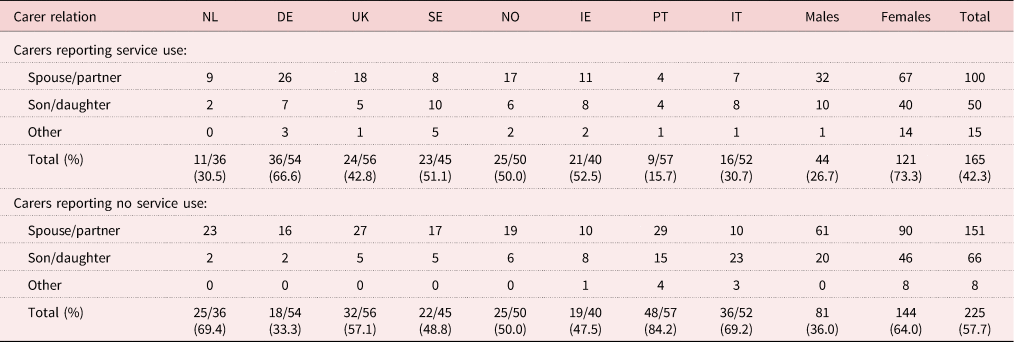
The relationships of the carer to the person with dementia included 251 (64.4%) spouses and partners, 116 (29.7%) sons and daughters, and 23 (5.9%) other relationships (son/daughter-in-law, sibling, other relative, friend or neighbour). Overall, 42.3 per cent of participants reported service use, with the proportion being similar for spouses (40%) and son/daughter (43%) carers (see Table 1).
Carers’ relationships to the person with dementia and reports of service use

Notes: NL: The Netherlands. DE: Germany. UK: United Kingdom. SE: Sweden. NO: Norway. IE: Ireland. PT: Portugal. IT: Italy.
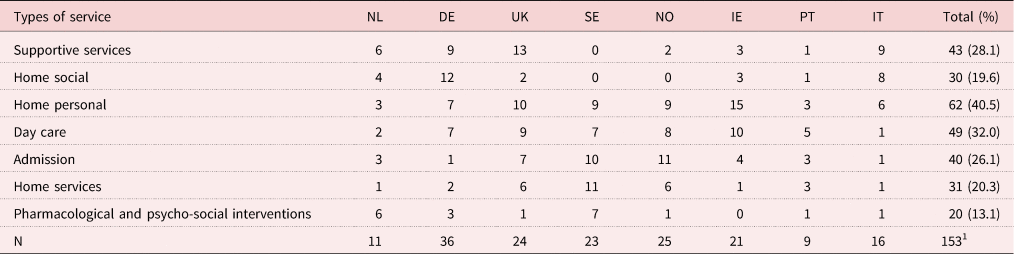
The range of service use reported was clustered into seven categories. (a) ‘Supportive services’ involved services that were initiated following diagnosis to provide support for the person with dementia or their carer. This included the memory clinic, mental health support, Alzheimer's cafes and social support groups for people with dementia or carers. The most common of these was the memory clinic. (b) ‘Home social’ involved services that were designed to provide company or social activities for the person at home, such as sitting services. (c) ‘Home personal’ involved services that were designed to support personal care needs whilst at home, these included community carers providing support with washing, dressing, assisting with eating or physiotherapy for gait movement problems. (d) ‘Day care’ included all attendance (inclusive of respite) at a day care centre. (e) ‘Admission’ included all admissions (including respite) to nursing home, care home and long-term hospital stays. The most common of these was care home admissions. (f) ‘Home services’ involved domestic and maintenance services that occurred at the person's home that were taken up due to the person's dementia, including gardening or cleaning services, adaptations to the home, meals on wheels (companies delivering food) and medication delivery to the person's home (not involving administering medication). The most common of these was cleaning and meals on wheels services. (g) ‘Pharmacological and psycho-social interventions’ involved both medication for the person's memory or psycho-social interventions for people with dementia including Cognitive Stimulation Therapy and cognitive training combined with exercise. The most common of these was medication for the person's memory. In total, 153 participants reported the types of services they were accessing; various combinations of services were accessed which are reflected in the total figures (see Table 2).
Types of services accessed

Notes: NL: The Netherlands. DE: Germany. UK: United Kingdom. SE: Sweden. NO: Norway. IE: Ireland. PT: Portugal. IT: Italy. 1. Twelve missing data.
The timeliness of access to formal dementia care services
Responses of 147 participants who elaborated on their use of services indicated that the majority (107, 72.8%) considered that they had accessed services on time, whilst four (2.7%) indicated that they had accessed services too early, 32 (21.8%) too late and four (2.7%) reported mixed feelings of some timely access and other services being accessed either too late or too early.
Amongst the majority of carers who considered services to be ‘timely’, a range of experiences were described, including services becoming available when the condition worsened or when there was an unexpected crisis. However, even when access was considered ‘timely’ some carers were still dissatisfied:
The worsening of [person with dementia's] condition was very sudden so everything has been done very quickly and at the right time. (Timely service access/IT daughter carer ID 8006)
It was at the right time. Although it happened very suddenly because of the unexpected hospitalisation. (Timely service access/UK wife carer ID 3002)
Yes, but there should be more information available about what supports and services there are and how to access them. (Timely service access/IE wife carer ID 6041)
The few carers who considered service access to be ‘too early’ mostly related this to care home use and the carer's feelings of regret or guilt, or being guided by professionals:
At the time it felt like the timing was right. But with what we now know, we would do things differently. (Service access too early/NO husband carer ID 5044)
He entered a care home too soon. (Service access too early/UK wife carer ID 3008)
Initially felt it was too soon for [person with dementia] to attend respite and day care services – other patients there were more dependent. Encouraged to stick with it by the doctor. (Service access too early/IE wife carer ID 6020)
Amongst the carers who considered service access ‘too late’, a range of experiences were outlined. These included accessing care following concerns arising during crisis, a lack of awareness and a lack of support resulting in service access ‘too late’.
May have been beneficial if received care a bit sooner. Only accessed care after crisis situation – was worried that things would deteriorate rapidly. (Service access too late/IE daughter carer ID 6002)
If we had been more aware of what was available then services might have been accessed sooner, instead we were left alone to struggle and had to find help privately ourselves. (Service access too late/UK wife carer ID 3039)
I should have looked earlier, but she [person with dementia] rejects it. (Service access too late/DE husband carer ID 2012)
Too late. GP should have helped more. The difference the support makes is huge. Things were very bad before the support started and it need not have become that bad. (Service access too late/IE partner carer ID 6005)
The carers also described the challenge of finding services themselves and the difficulty in receiving the level of support required. Moreover, the slow process was also reported as a reason for late support:
Possibly a little late but it is difficult to find services on your own. (Service access too late/UK wife carer ID 3053)
Too difficult to get. Basically you have to be on the phone crying to get it, even if the public health nurse requests 20 hours (she did this three times), you still only get six. Getting any kinds of needs review takes six months, this is too long as huge amounts of change can happen in this timeframe. (Service access too late/IE son carer ID 6034)
Support came too late; merely due to the fact that it took a long time before the diagnosis. (Service access too late/NL husband carer ID 1032)
Although only a small number of carers reported ‘mixed feelings’, this did serve to highlight that the perception of timeliness differed by service type:
Memory clinic and day care were on time. Support group was too early. (Mixed service access/NL wife carer ID 1014)
Time was right, but it was not the right service at the right moment for my husband. (Mixed service access/DE wife carer ID 2017)
Interestingly, there were very few reports of other services such as home personal care and day care being initiated before admission. Of those admitted during the year, none reported receiving a combination of both home personal care and day care, and only five out of 61 (8.2%) had received home personal care and three out of 45 (6.7%) had received day care.
Satisfaction with service use
For those participants accessing formal care services, 144 participants elaborated on their answers when asked to what extent they were satisfied with the formal care services they were using. Responses included 98 (68.1%) participants reporting feeling satisfied with the services they were accessing, 17 (11.8%) reported feeling dissatisfied with the services they were accessing and 29 (20.1%) reported mixed feelings of satisfaction, being happy with some services but not with others.
Of those participants who were not accessing care services, 122 participants elaborated on whether they thought that formal care services should have been introduced. Two-thirds of participants (82, 67.2%) were satisfied that care had not been introduced. A small proportion (21, 17.2%) were dissatisfied with their situation and felt that formal care services should have been introduced. The remaining participants (19, 15.6%) reported mixed feelings that some services should have been introduced but not others, or were satisfied with some aspects of not accessing formal care services but not with every aspect of their situation.
A variety of explanations were given for their satisfaction with not using services, such as the consideration that services were not necessary or needed yet, often because the carer considered they were coping, or they expressed a preference not to use formal care services despite challenges:
[Carer is] capable of taking care of [person with dementia] and would not change anything. (Satisfied with no service use/notes on PT husband carer ID 7007 interview)
[The person with dementia] is better with his family. (Satisfied with no service use/PT sister-in-law carer ID 7001)
The proportion of participants who reported that they were dissatisfied with not accessing services indicated a range of experiences from difficulty in coping or accepting services, to a lack of information and awareness:
Not at all satisfied, formal care should have been introduced long ago, but [her husband] refuses. (Dissatisfied with no service use/SE daughter carer ID 4013)
Not satisfied, not been given any information about services and we're unaware of what services are available. (Dissatisfied with no service use/UK husband carer ID 3076)
The remaining mixed feelings appeared to reflect either internal or external conflicts or a resilience involving coping and proactive awareness of support:
Currently don't feel formal care services are needed as [carer] is managing well. However, [carer] is looking into support groups for both [person with dementia] and [carer] as feels this might be of help. (Mixed feelings about no service use/notes on UK wife carer interview ID 3059)
Reasons for service use
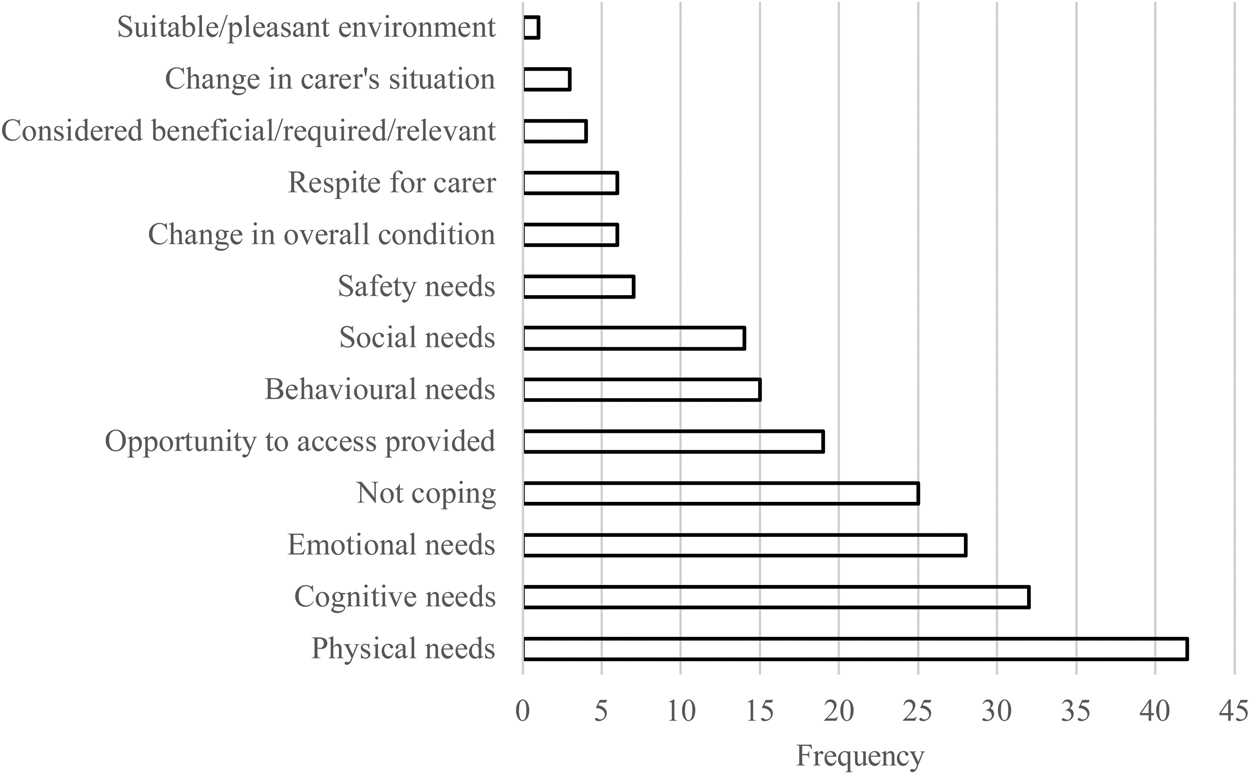
Of the 165 participants who had accessed services over the year, 150 were able to specify reasons why they sought formal care services. Often, there were multiple reasons, relating either to the person with dementia, the carer or both. A number of carers cited changes in the person with dementia, including cognitive (21.3% of carers) or behavioural changes (10%). The potential of services to meet the individual needs of the person using formal care services was also frequently reported; these included physical needs, e.g. relating to mobility or incontinence (34.7%), emotional (18.7%) and social (9.3%) needs. In some cases, formal care services were accessed when it was considered no longer possible to cope without a service (16.6%) or the opportunity to take up services arose (12.7%) (see Figure 1).
Reasons why participants using services accessed formal care services.

Reasons for non-use of services
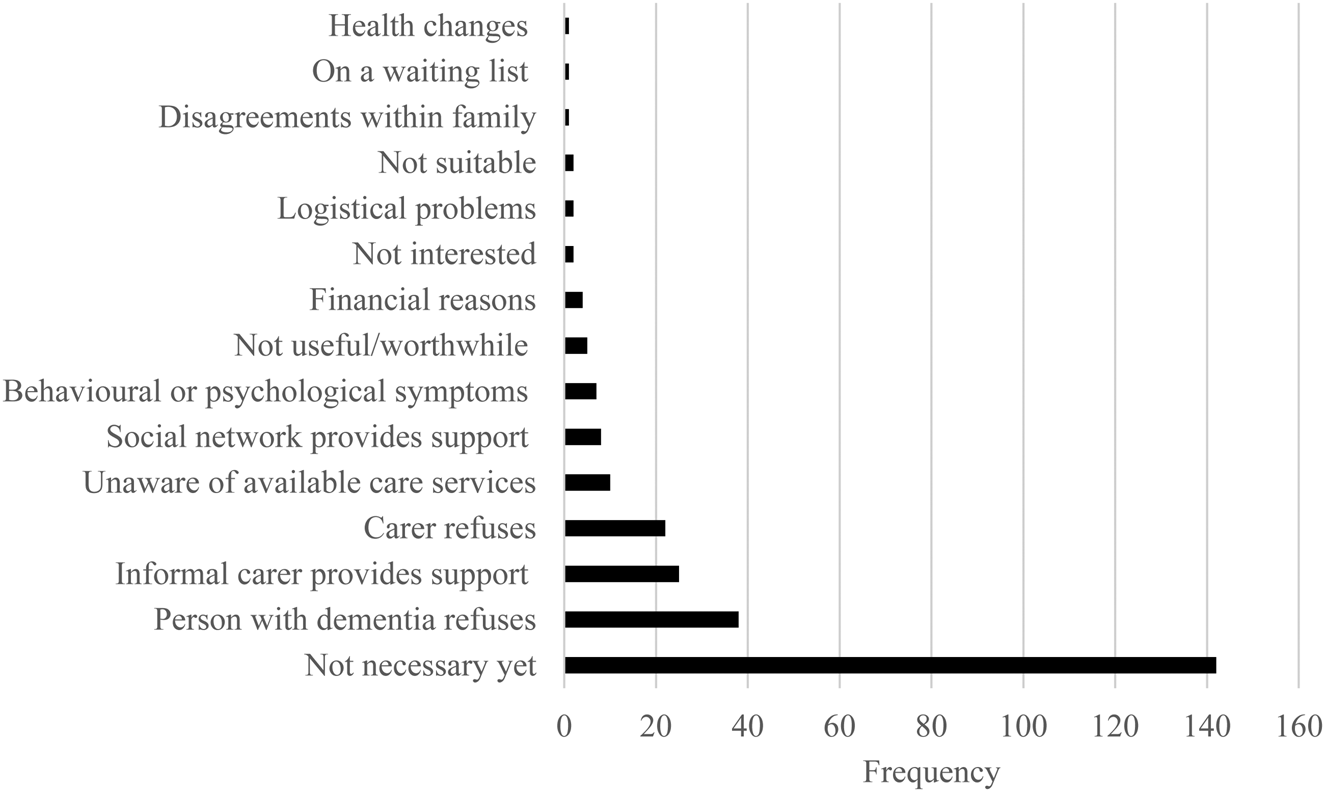
Of the 225 participants not using any services over the previous 12-month period, 198 participants specified reasons for not using formal care services. Participants provided multiple reasons for non-use of services that related either to the person with dementia, the carer, or practical and service provision issues. The most common reason for not accessing services was the perception of them as not necessary yet (71.7% of carers). Other frequent reasons given included either the person with dementia (19.2% of carers) or their carer (11.1%) refusing to use a service. Less frequently reported reasons included a lack of awareness of available care services (5.1%), or the carer (12.6%) or their social support network being considered able to provide support (4%), negating the need for a formal care service. Very few carers reported not using services because they were considered not useful or worthwhile (2.5%), unsuitable (1%) or because of logistical problems (1%). Only one carer reported disagreements within the family or placement on a waiting list hindering service access (see Figure 2).
Reasons why participants not using services did not access formal care services.

Facilitators and barriers to service use
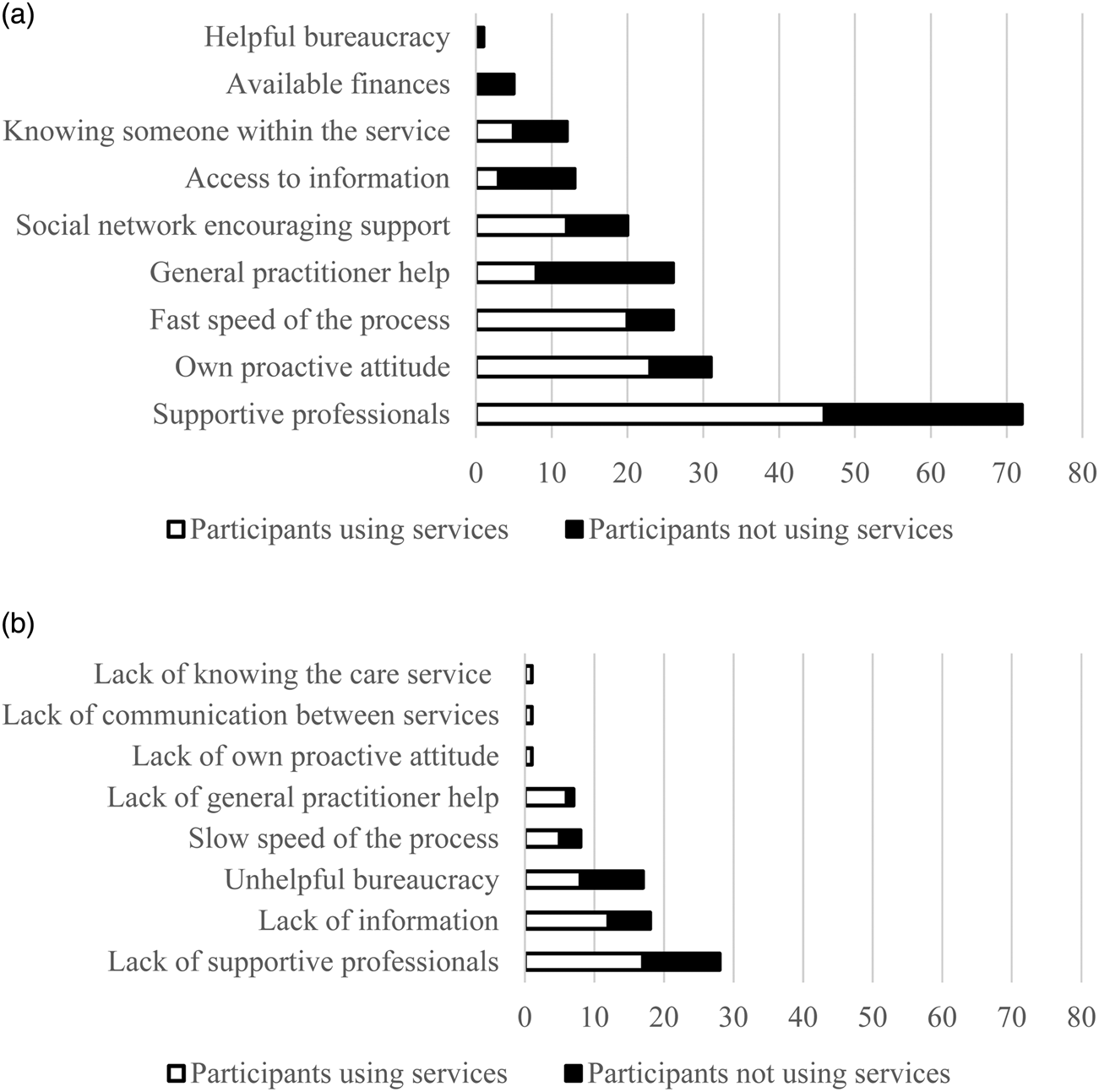
For all 390 participants, factors that were considered either facilitators or barriers to service use ranged from characteristics of the services and professionals involved, to personal attributes and situational factors related to the individuals. The main aspects outlined included whether they experienced supportive professionals (25.6%), the speed of the process (8.7%), whether they had a helpful GP (8.5%) or the dyad's own proactive attitude (8.2%), e.g. whether they investigated service availability for themselves rather than depending on professionals. Furthermore, participants reported that information (or lack thereof) (7.9%) could both facilitate or hinder service access. This included participants discussing the amount of available information and the quality or appropriateness of information in relation to their particular situation or about a specific service (see Figure 3).
Factors considered (a) facilitators or (b) barriers to formal care service use.

Discussion
To the best of our knowledge, this is the largest European study that has investigated timely service access by people with dementia and their carers. The majority of participants in this study reported timely access of services or satisfaction with not using services. However, some carers reported that they had accessed services at the wrong time or were dissatisfied with not using services. The positive experiences reported by the majority of carers in this European sample appear to be an unusual finding in the literature, which largely reports barriers to service use. Furthermore, a recent study reported a lack of timely diagnosis of dementia and carers’ experiences of delays (Woods et al., Reference Woods, Arosio, Diaz, Gove, Holmerova, Kinnaird, Mátlová, Okkonen, Possenti, Roberts, Salmi, van den Buuse, Werkman and Georges2018). The barriers reported in this study are in line with previous research reporting barriers to service use (Vetter et al., Reference Vetter, Steiner, Kraus, Moises, Kropp, Moller and Kohler1998; Buono et al., Reference Buono, Busato, Mazzetto, Paccagnella, Aleotti, Zanetti, Bianchetti, Trabucchi and De Leo1999; Brodaty et al., Reference Brodaty, Thomson, Thompson and Fine2005; Greenwood and Smith, Reference Greenwood and Smith2015). This highlights the need to refine further the process of introducing formal care to improve timely care and satisfaction with decisions of service use.
In this cohort study, most of the services were accessed to provide personal care at home or to meet physical needs, while only a limited number of services were used for companionship or social activities at home. This suggests the range of service provision requires expansion to include more services for higher-level social needs, particularly within the person's own home in the community. These findings reflect the continued predominance of the medical model view of dementia with a primary focus on meeting physical care needs almost to the exclusion of all other needs. This is in line with previous research, establishing that services meeting social needs are often under-represented or lacking (Phillipson et al., Reference Phillipson, Jones and Magee2014), although the need for a biopsychosocial approach to care, that moves beyond only addressing medical needs, is recognised by political decision makers and stakeholders across Europe (Broda et al., Reference Broda, Bieber, Meyer, Hopper, Joyce, Irving, Zanetti, Portolani, Kerpershoek, Verhey, de Vugt, Wolfs, Eriksen, Røsvik, Marques, Gonçalves-Pereira, Sjölund, Woods, Jelley, Orrell and Stephan2017).
Explorations of admission, and reports of use of home personal and day care services indicated that over 75 per cent of those admitted did not report use of alternative services such as day care or personal care at home. Furthermore, none of the participants reporting accessing a combination of day care and home personal care services went on to admission in the 12-month period of this study. This is an interesting finding that might indicate that such a ‘community care package’ might prevent long-term care admission. This would support the ‘balance of care’ notion that suggests enhanced community services could support people appropriately at home, avoiding residential or hospital placement (Tucker et al., Reference Tucker, Hughes, Burns and Challis2008). Further research is needed to determine whether this finding was simply a reflection of where the people in this sample were in relation to their journey with dementia, or whether indeed the right combination of community care services is able to reduce the likelihood of long-term care admission.
Many of the reasons outlined for accessing services support the suggestion in previous research of the increased likelihood of service use with dementia progression (Leon et al., Reference Leon, Neumann, Hermann, Hsu, Cummings, Doraiswamy and Marin2000) and service uptake during crisis situations (Vroomen et al., Reference Vroomen, Bosmans, van Hout and de Rooij2013; Stephan et al., Reference Stephan, Bieber, Hopper, Joyce, Irving, Zanetti, Portolani, Kerpersheroek, Verhey, de Vugt, Wofls, Eriksen, Røsvik Marques, Gonçalves-Pereira, Sjölund, Jelley, Woods and Meyer2018). An interesting finding of the current study was how access was frequently described as opportunistic: services were taken up as the opportunity was presented to participants. This suggests that although some carers may not proactively seek services, they are open to service use when the possibility is presented to them. This novel finding might be considered fitting when considered within the context of research reporting challenges faced in help seeking (Werner et al., Reference Werner, Goldstein, Karpas, Chan and Lai2014).
The reasons provided for not using services support previous research reporting no need for services or reluctance to use services (Winslow, Reference Winslow2003; Brodaty et al., Reference Brodaty, Thomson, Thompson and Fine2005) and a preference for specifically tailored services (Buono et al., Reference Buono, Busato, Mazzetto, Paccagnella, Aleotti, Zanetti, Bianchetti, Trabucchi and De Leo1999). Our results are consistent with research describing factors that prevent help seeking, such as a lack of sufficient information and knowledge of services (Vetter et al., Reference Vetter, Steiner, Kraus, Moises, Kropp, Moller and Kohler1998; Buono et al., Reference Buono, Busato, Mazzetto, Paccagnella, Aleotti, Zanetti, Bianchetti, Trabucchi and De Leo1999; Bruce and Paterson, Reference Bruce and Paterson2000; Brodaty et al., Reference Brodaty, Thomson, Thompson and Fine2005; Greenwood and Smith, Reference Greenwood and Smith2015; Macleod et al., Reference Macleod, Tatangelo, McCabe and You2017). Surprisingly, the results provide only very limited support for previous research describing logistical challenges (Buono et al., Reference Buono, Busato, Mazzetto, Paccagnella, Aleotti, Zanetti, Bianchetti, Trabucchi and De Leo1999; Blackstock et al., Reference Blackstock, Innes, Cox, Smith and Mason2006) and a sense of withdrawal or resignation to the situation and low expectations (Walters et al., Reference Walters, Iliffe and Orrell2001). This might be a reflection of this sample's considerable contentment with service (non-)use or perhaps attitudes to service use are changing. Furthermore, the long process of applying to access services (Brodaty et al., Reference Brodaty, Thomson, Thompson and Fine2005) was reported in this sample, in addition to the suggestion that a faster process can facilitate service use. Our findings on reasons for service use are in line with research suggesting the likelihood of service use increases when carers are no longer able to cope alone without support (Vetter et al., Reference Vetter, Steiner, Kraus, Moises, Kropp, Moller and Kohler1998) or where there have been positive previous experiences facilitating service access and increased familiarity (Greenwood and Smith, Reference Greenwood and Smith2015). It was clear that many preferred to seek support from close relatives and trusted primary health-care professionals (Werner et al., Reference Werner, Goldstein, Karpas, Chan and Lai2014). Our findings also support research advocating a collaborative partnership between carers and health-care professionals to support the care of people with dementia (MaloneBeach et al., Reference MaloneBeach, Zarit and Spore1992; Keady et al., Reference Keady, Clarke and Adams2003; Brodaty and Donkin, Reference Brodaty and Donkin2009) and highlight the important support role of front-line health-care professionals (Buono et al., Reference Buono, Busato, Mazzetto, Paccagnella, Aleotti, Zanetti, Bianchetti, Trabucchi and De Leo1999; Werner et al., Reference Werner, Goldstein, Karpas, Chan and Lai2014; Greenwood and Smith, Reference Greenwood and Smith2015).
It is interesting to note that the only care professional explicitly referred to by participants was the GP. This might be considered problematic due to the various constraints of primary care provision (Hinton et al., Reference Hinton, Franz, Reddy, Flores, Kravitz and Barker2007; Franz et al., Reference Franz, Barker, Kim, Flores, Jenkins, Kravitz and Hinton2010; Stewart et al., Reference Stewart, Loskutova, Galliher, Warshaw, Coombs, Staton, Huff and Pace2014) and highlights the need for a specialist key contact person in dementia care (Macleod et al., Reference Macleod, Tatangelo, McCabe and You2017; Stephan et al., Reference Stephan, Bieber, Hopper, Joyce, Irving, Zanetti, Portolani, Kerpersheroek, Verhey, de Vugt, Wofls, Eriksen, Røsvik Marques, Gonçalves-Pereira, Sjölund, Jelley, Woods and Meyer2018). The National Institute for Health and Care Excellence (2018) guideline published in the UK recently recommended that a single named professional should be responsible for co-ordinating care; such developments in policy make improvements to dementia service provision vital.
Overall, there is a need to improve access to services. We identified that a proactive attitude is a facilitator to service access, perhaps because information about services is not readily available. In future carers will increasingly make use of the internet to seek information, presenting a challenge to service providers to ensure that accurate, relevant and up-to-date information is available. The support of professionals may be needed to assist carers in navigating the wide range of information available on the internet. Although a proactive attitude of those using services is a facilitator to service access, it is important to acknowledge that this would not be needed if there was more easily obtainable service information. The perception of services is of key importance (MaloneBeach et al., Reference MaloneBeach, Zarit and Spore1992), and increased familiarity was considered beneficial. Services could, perhaps, consider offering trial sessions for individuals to discover the service and become more familiar to enable an informed decision of whether to take up a service. The findings in this study support recommendations for tailored services with more flexibility (Buono et al., Reference Buono, Busato, Mazzetto, Paccagnella, Aleotti, Zanetti, Bianchetti, Trabucchi and De Leo1999; Macleod et al., Reference Macleod, Tatangelo, McCabe and You2017). Services might consider reflecting on the suitability and need of a service to allow for adaptation and improvements to match individuals more appropriately. If the perceived value of services can be improved through better information and exposure then this might facilitate timely access of services and reduce reactive uptake during crisis situations.
The findings from this study also highlight the need to accept that many people with dementia and their carers do not feel the need for support from services. It is important to recognise the value of autonomy (Menne and Whitlatch, Reference Menne and Whitlatch2007) and respect decisions of whether or not to use formal care services. Regardless of diagnosis, every person experiencing dementia is an individual and not all services are suitable nor required, but when they are, it is important for this transition into service use to be made as easy as possible. The experiences of timely access and use of dementia care services reported here indicate a positive outlook, suggesting that many people with dementia and their carers in Europe experience both timely access and satisfaction with their (non-)use of services. However, the findings also highlight the need for continual developments for improved experiences for the substantial minority who are less satisfied.
A limitation of the current study might be that the presence of people with dementia in many of the interviews has constrained the ability of the carers to communicate openly. Furthermore, it is important to recognise that this paper presents data from the carers’ perspective only and is limited to the 12-month period. Although at times the carers’ answers suggested a joint representation, the researchers could only assume this to be an accurate view of the carer, regardless of any suggestion that the carer was able to answer on behalf of the person with dementia. The researchers had planned to collect more extensive data from the perspective of the person with dementia but, particularly in cases where the person with dementia was in the more advanced stages, this proved challenging. The experiences presented in this study are informative for both service providers and those considering accessing dementia care services. There is a need for more large-scale studies on service utilisation among carers of people with dementia (Robinson et al., Reference Robinson, Buckwalter and Reed2005) to build on these findings and develop empirically based interventions and improve practice. Although this study draws on carers’ experiences in eight European countries and differences in culture and service structures and availability are undoubtedly relevant, areas of consistency have been indicated with studies from outside Europe, e.g. Australia (Brodaty et al., Reference Brodaty, Thomson, Thompson and Fine2005) and North America (Greenwood and Smith, Reference Greenwood and Smith2015). Future research requires investigation of dementia care service experiences in a variety of countries, to achieve a full understanding of the influence of cultural and structural factors.
Conclusion
These results highlight that timing remains essential for appropriate formal care service use. There is a need for more simplified service access pathways that are easier for carers to understand, and that consider the difficult balance between planning ahead to avoid crisis situations and preventative strategies. Barriers preventing service access must be addressed and insights into facilitators embraced. These findings can help service providers and health and social care professionals to empower people with dementia and their carers to make informed decisions about service use to enable satisfaction with appropriate and timely support.
Supplementary material
The supplementary material for this article can be found at https://doi.org/10.1017/S0144686X19001119
Author contributions
All authors contributed to the design, analysis or interpretations of the data, and preparation of the manuscript.
Financial support
The research reported in this study was a European Union Joint Programme-Neurodegenerative Disease Research (JPND) project (grant number 733051001). The project is supported through the following funding organisations under the aegis of JPND (www.jpnd.eu): Germany: Bundesministerium für Bildung und Forschung (BMBF; 01ED1401); Ireland: Health Research Board (HRB; grant number JPND-2013-2); Italy: Italian Ministry of Health; The Netherlands: The Netherlands Organization for Health Research and Development (ZonMW)/Alzheimer Netherlands (733051001); Norway: Research Council of Norway; Portugal: Fundação para a Ciência e a Tecnologia (FCT-JPND-HC/0001/2012); Sweden: Swedish Research Council (SRC); and United Kingdom: Economic and Social Research Council (ESRC; grant number ES/L008831/1). The funders played no role in this study.
Conflict of interest
The authors declare no conflicts of interest.
Ethical standards
The authors confirm adherence to ethical guidelines and legal requirements of the study countries. This study was subject to ethical approval; a favourable ethical review was provided in the following ethics committees: Germany: Ethics Committee of the Medical Faculty, Martin Luther University Halle-Wittenberg (2014-89); Ireland: Dublin City University Research Ethics Committee (2014_070); Italy: Comitato Etico, IRCCS San Giovanni di Dio ‘Fatebenefratelli’ (44/2014); The Netherlands: Medische Ethische Toetsings Commissie (NL49382.068.14/METC 143038); Norway: Regional Committee for Medical and Health Research Ethics, South-East (B 2014/862); Portugal: Ethics Committee of the Nova Medical School/Faculdade de Ciências Médicas, Universidade Nova de Lisboa (22/2014/CEFCM); Sweden: Regional Ethics Review Board (Dnr 2014/863-31/5); United Kingdom: Wales Research Ethics Committee 5, Bangor (14/WA/1040).