


The Alcohol Harm Reduction Strategy for England (Prime Minister's Strategy Unit, 2004) outlines a range of measures to reduce the public's consumption of alcohol. Heavy alcohol consumption has been implicated in the development of anxiety and depression (Reference SchuckitSchuckit, 1983). Many cross-sectional studies have identified considerable comorbidity between anxiety and depression, and alcohol abuse. For example, data from four large community-based epidemiological studies (nÏ 22 000) in Europe and the USA consistently demonstrated a two- to threefold increase in the lifetime prevalence of anxiety and depression in those with DSM–III or DSM–III–R alcohol abuse or dependence (Reference Swendsen, Merikangas and CaninoSwendsen et al, 1998). The temporal nature of the association is difficult to determine from cross-sectional studies, with uncertainty arising as to whether alcohol is a risk factor or a form of self-medication (Reference Miller, Klamen and HoffmannMiller et al, 1996). The results of existing longitudinal studies on the relationship between alcohol consumption and anxiety and depression are conflicting. An early meta-analysis of eight longitudinal studies found that baseline alcohol consumption was significantly associated with later depression (Reference Hartka, Johnstone and LeinoHartka et al, 1991). However, little adjustment for confounding was made. More recent reports have, in general, found no association between alcohol consumption and incident depressive illness (Reference Moscato, Russell and ZieleznyMoscato et al, 1997; Reference Wang and PattenWang & Patten, 2001), although there is some evidence that women may be at greater risk (Reference Wang and PattenWang & Patten, 2001). Gilman & Abraham (Reference Gilman and Abraham2001) observed increased odds of major depression at 1 year when diagnosed with alcohol dependence at baseline, also finding that women were at greater risk. The 18-month follow-up of participants of the Psychiatric Morbidity Among Adults Living in Private Households, 2000 survey (Reference Singleton and LewisSingleton & Lewis, 2003) provides an opportunity to determine whether excessive alcohol consumption and abnormal patterns of use are risk factors for incident anxiety and depression in the general population. To our knowledge this is the first such study performed in England and Wales. The study also examined the reverse relationship, considering whether anxiety and depression are risk factors for the development of abnormal patterns of alcohol consumption.
METHOD
Psychiatric Morbidity Among Adults Living in Private Households, 2000
Data were used from the 18-month followup of the Psychiatric Morbidity Among Adults Living in Private Households, 2000 survey (Reference Singleton and LewisSingleton & Lewis, 2003). The original study was a cross-sectional survey of a nationally representative sample of 8580 adults (aged 16–74 years) living in private households in Great Britain (Reference Singleton, Bumpstead and O'BrienSingleton et al, 2001). Participants in the original survey were classified according to their score on the Clinical Interview Schedule – Revised (CIS–R; Reference Lewis, Pelosi and ArayaLewis et al, 1992). All those identified as having a mental disorder (CIS–R score ≥ 12, probable psychosis, or drug or alcohol dependence) at the time of the cross-sectional survey and those with sub-threshold symptoms (CIS–R score 6–11) were eligible for follow-up. In addition, a random 20% of those with no evidence of a mental disorder (CIS–R score Î 6) were also followed-up.
In total, 3536 participants were selected for follow-up. Of these, 3045 were located by the interviewers. For the remaining 491 (14% of the sample) contact was not possible because the household had moved and could not be traced, or for other reasons, such as the death of the individual. Of the 3045 who were successfully located, 2413 (79%) completed the follow-up interview, 503 (17%) refused to be interviewed, and for 129 (4%) the interviewer was unable to contact the person.
Ethical approval for the study was obtained from the London Multi-Centre Research Ethics Committees in England.
Measurement of alcohol use
Most information was collected face-to-face by lay interviewers using computer-assisted interviewing. However, responses for questions about alcohol and drug use were directly entered into the computer by the participants themselves.
In both the baseline and the 18-month follow-up surveys, alcohol use was recorded using the Alcohol Use Disorders Identification Test (AUDIT; Reference Saunders, Aasland and BaborSaunders et al, 1993). The AUDIT comprises ten questions relating to alcohol use and its consequences in the previous 12 months. A score of 8 or more out of 40 has been suggested to denote hazardous alcohol use (Reference Saunders, Aasland and BaborSaunders et al, 1993).
Those who scored 10 or more on the AUDIT were asked to complete the Severity of Alcohol Dependence Questionnaire (SAD–Q; Reference Stockwell, Murphy and HodgsonStockwell et al, 1983) to assess dependence. The SAD–Q consists of 20 questions, covering a range of symptoms of dependence, each scored from 0 to 3. The reference period is the 6 months prior to the interview. A total score of 3 or less indicates no dependence, a score of 4–19 indicates mild dependence, 20–34 indicates moderate dependence and 35–60 indicates severe dependence.
Alcohol use was classified in four ways:
-
(a) hazardous drinking: AUDIT score ≥ 8;
-
(b) above government guidelines: more than 21 units per week for men or more than 14 units per week for women;
-
(c) binge-drinking: six or more drinks on one occasion on at least a monthly basis (same definition used for men and women);
-
(d) dependence: AUDIT score ≥ 10 and SAD–Q ≥ 4.
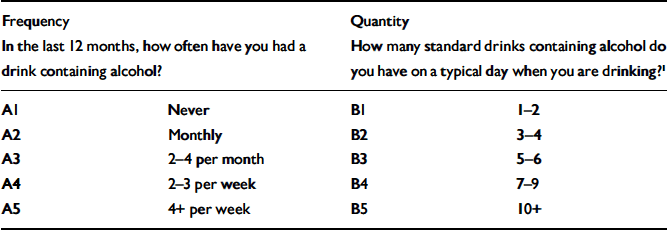
Alcohol use above government guidelines was based on two AUDIT questions concerning the frequency and amount of alcohol consumed (Table 1). Those classified as exceeding guidelines were identified using the following combinations of responses: men – A4 B5, A5 B4, A5 B5 and women – A4 B4, A4 B5, A5 B3, A5 B4, A5 B5.
Ascertainment of alcohol use above government guidelines using the Alcohol Use Disorders Identification Test for frequency and quantity
| Frequency | Quantity | ||
|---|---|---|---|
| In the last 12 months, how often have you had a drink containing alcohol? | How many standard drinks containing alcohol do you have on a typical day when you are drinking?1 | ||
| A1 | Never | B1 | 1–2 |
| A2 | Monthly | B2 | 3–4 |
| A3 | 2–4 per month | B3 | 5–6 |
| A4 | 2–3 per week | B4 | 7–9 |
| A5 | 4+ per week | B5 | 10+ |
At baseline the AUDIT assessed use over the year prior to interview; at the follow-up interview the reference time period related to the whole period between interviews. The SAD–Q assessed dependence in the 6 months prior to interview in both surveys.
Measurement of psychiatric morbidity
Anxiety and depression was used as a diagnostic category, as most people with significant psychiatric problems have symptoms of both, and many meet the criteria for more than one diagnosis. The CIS–R has been validated as a measure of common mental disorders (Reference Lewis, Pelosi and ArayaLewis et al, 1992), covering diagnoses of depressive illness, generalised anxiety disorder, obsessive–compulsive disorder, panic disorder, phobias, and mixed anxiety and depressive disorder. It comprises 14 sections, with possible scores within each ranging from 0 to 4 (except the section on depressive ideas which has a maximum score of 5). A total score of 12 or more was used to indicate the presence of disorder. Owing to questions relating only to the previous week, a true measure of incident anxiety and depression was not obtainable for the period between baseline and follow-up, as cases may have presented and then subsequently recovered. However, this phrase, or ‘new onset’, will be used as shorthand with the understanding that a random misclassification may have occurred. It is recognised that the CIS–R can be used to diagnose generalised anxiety disorder, and yet produce a score less than 12. This occurred in very few cases at baseline, and so the ensuing degree of bias was small.
Data-set
In total, 2406 participants completed the baseline and follow-up surveys. Of these, 750 had a CIS–R of 12 or more at baseline and were therefore excluded from analyses examining predictors of anxiety and depression at 18 months’ follow-up. The cohort therefore comprised 1656 individuals, of whom 1578 (95%) had data available on a range of potential confounders at baseline (indicators of socio-economic status, life events, type of area (urban/rural), size of primary support group, current smoking habits, illicit drug use in the previous year, use of psychotropic drugs or therapy, hospital treatment in the past 3 months for mental health problems, and consultations with mental health professional(s) in the past year).
Statistical analysis
All analyses were conducted using Stata version 8 (Stata Corporation, 2003). Probability weights were used to account for the stratified sampling procedure and non-response in all analyses.
Logistic regression was used to examine the association between alcohol use and onset of anxiety and depression (CIS–R score 512) at 18 months. Univariate associations (in terms of odds ratios and their 95% CI) are reported. Associations were adjusted for baseline CIS–R score and potential confounding factors, both individually and cumulatively.
Further analyses examined the association between anxiety and depression at baseline and alcohol use (binge-drinking, hazardous drinking or dependence) at follow-up. Individuals who were classified as binge drinkers (nd 752), hazardous drinkers (nd 669), or dependent on alcohol (nd 309) at baseline were excluded from these additional analyses. Complete data, including information on possible confounders, were available for 1562, 1645 and 1987 individuals, respectively.
RESULTS
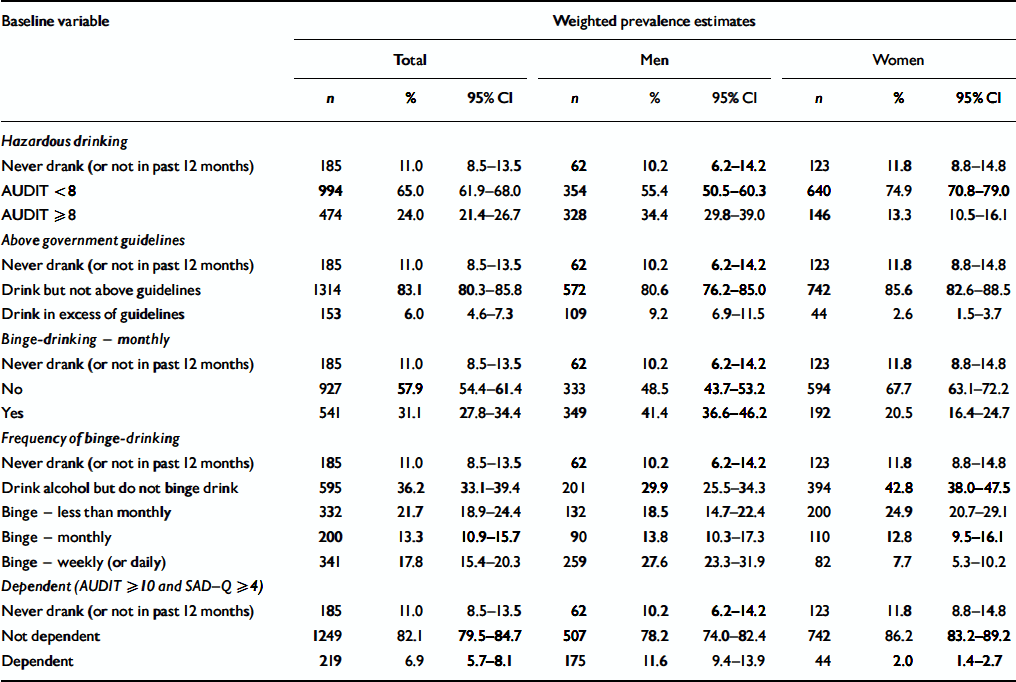
After weighting to account for the stratified sampling strategy and non-response, the prevalence of hazardous drinking was 24% at baseline (Table 2). Only 6% of the population reported drinking in excess of government guidelines, but the prevalence of binge-drinking was substantially higher (31%).
Prevalence of alcohol use at baseline
| Baseline variable | Weighted prevalence estimates | ||||||||
|---|---|---|---|---|---|---|---|---|---|
| Total | Men | Women | |||||||
| n | % | 95% CI | n | % | 95% CI | n | % | 95% CI | |
| Hazardous drinking | |||||||||
| Never drank (or not in past 12 months) | 185 | 11.0 | 8.5–13.5 | 62 | 10.2 | 6.2–14.2 | 123 | 11.8 | 8.8–14.8 |
| AUDIT <8 | 994 | 65.0 | 61.9–68.0 | 354 | 55.4 | 50.5–60.3 | 640 | 74.9 | 70.8–79.0 |
| AUDIT ≥8 | 474 | 24.0 | 21.4–26.7 | 328 | 34.4 | 29.8–39.0 | 146 | 13.3 | 10.5–16.1 |
| Above government guidelines | |||||||||
| Never drank (or not in past 12 months) | 185 | 11.0 | 8.5–13.5 | 62 | 10.2 | 6.2–14.2 | 123 | 11.8 | 8.8–14.8 |
| Drink but not above guidelines | 1314 | 83.1 | 80.3–85.8 | 572 | 80.6 | 76.2–85.0 | 742 | 85.6 | 82.6–88.5 |
| Drink in excess of guidelines | 153 | 6.0 | 4.6–7.3 | 109 | 9.2 | 6.9–11.5 | 44 | 2.6 | 1.5–3.7 |
| Binge-drinking – monthly | |||||||||
| Never drank (or not in past 12 months) | 185 | 11.0 | 8.5–13.5 | 62 | 10.2 | 6.2–14.2 | 123 | 11.8 | 8.8–14.8 |
| No | 927 | 57.9 | 54.4–61.4 | 333 | 48.5 | 43.7–53.2 | 594 | 67.7 | 63.1–72.2 |
| Yes | 541 | 31.1 | 27.8–34.4 | 349 | 41.4 | 36.6–46.2 | 192 | 20.5 | 16.4–24.7 |
| Frequency of binge-drinking | |||||||||
| Never drank (or not in past 12 months) | 185 | 11.0 | 8.5–13.5 | 62 | 10.2 | 6.2–14.2 | 123 | 11.8 | 8.8–14.8 |
| Drink alcohol but do not binge drink | 595 | 36.2 | 33.1–39.4 | 201 | 29.9 | 25.5–34.3 | 394 | 42.8 | 38.0–47.5 |
| Binge – less than monthly | 332 | 21.7 | 18.9–24.4 | 132 | 18.5 | 14.7–22.4 | 200 | 24.9 | 20.7–29.1 |
| Binge – monthly | 200 | 13.3 | 10.9–15.7 | 90 | 13.8 | 10.3–17.3 | 110 | 12.8 | 9.5–16.1 |
| Binge – weekly (or daily) | 341 | 17.8 | 15.4–20.3 | 259 | 27.6 | 23.3–31.9 | 82 | 7.7 | 5.3–10.2 |
| Dependent (AUDIT ≥ 10 and SAD–Q ≥ 4) | |||||||||
| Never drank (or not in past 12 months) | 185 | 11.0 | 8.5–13.5 | 62 | 10.2 | 6.2–14.2 | 123 | 11.8 | 8.8–14.8 |
| Not dependent | 1249 | 82.1 | 79.5–84.7 | 507 | 78.2 | 74.0–82.4 | 742 | 86.2 | 83.2–89.2 |
| Dependent | 219 | 6.9 | 5.7–8.1 | 175 | 11.6 | 9.4–13.9 | 44 | 2.0 | 1.4–2.7 |
Eighteen per cent of the population reported binge-drinking at least once per week; 7% of the population were dependent on alcohol (Table 2); 11% of the population reported abstinence from alcohol over the preceding 12 months (Table 2). Overall, alcohol use was more prevalent among men (Table 2); 41% of men reported monthly binges compared with 21% of women. Men were almost six times more likely to be dependent on alcohol (weighted prevalence 11.6%) than women (2.0%; Table 2).
Associations between baseline alcohol consumption and anxiety and depression at follow-up
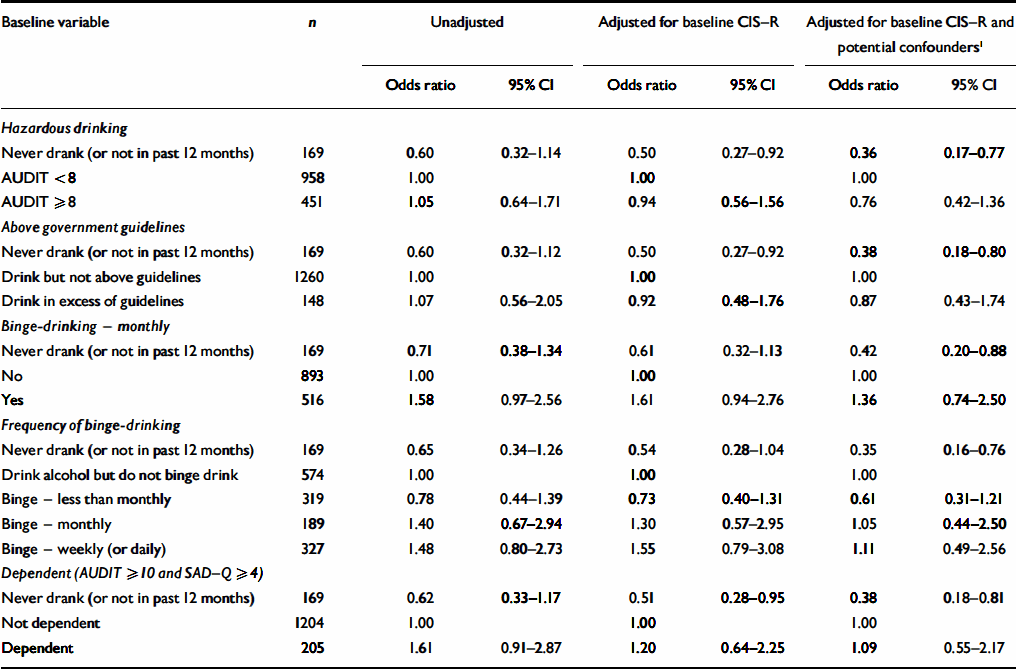
Of the 1656 individuals who were not classified as having anxiety and depression at baseline, 184 had a CIS–R score of 12 or more at follow-up (weighted prevalence 6.3%, 95% CI 5.0–7.6). Hazardous drinkers (AUDIT score ≥ 8) did not have an increased odds ratio of developing anxiety and depression at follow-up compared with non-hazardous drinkers (adjusted odds ratio=0.76, 95% CI 0.42–1.36). Those who had not consumed alcohol in the preceding 12 months were less likely to develop anxiety and depression at follow-up compared with non-hazardous drinkers. This association strengthened after adjustment for baseline CIS–R and potential confounders (adjusted odds ratio=0.36, 95% CI 0.17–0.77). Those individuals who drank above government guidelines at baseline had a comparable odds of anxiety and depression at followup as those who drank within recommended limits (adjusted odds ratio=0.87, 95% CI 0.43–1.74) (Table 3).
Associations between alcohol consumption and anxiety and depression at follow-up
| Baseline variable | n | Unadjusted | Adjusted for baseline CIS–R | Adjusted for baseline CIS–R and potential confounders1 | |||
|---|---|---|---|---|---|---|---|
| Odds ratio | 95% CI | Odds ratio | 95% CI | Odds ratio | 95% CI | ||
| Hazardous drinking | |||||||
| Never drank (or not in past 12 months) | 169 | 0.60 | 0.32–1.14 | 0.50 | 0.27–0.92 | 0.36 | 0.17–0.77 |
| AUDIT < 8 | 958 | 1.00 | 1.00 | 1.00 | |||
| AUDIT ≥ 8 | 451 | 1.05 | 0.64–1.71 | 0.94 | 0.56–1.56 | 0.76 | 0.42–1.36 |
| Above government guidelines | |||||||
| Never drank (or not in past 12 months) | 169 | 0.60 | 0.32–1.12 | 0.50 | 0.27–0.92 | 0.38 | 0.18–0.80 |
| Drink but not above guidelines | 1260 | 1.00 | 1.00 | 1.00 | |||
| Drink in excess of guidelines | 148 | 1.07 | 0.56–2.05 | 0.92 | 0.48–1.76 | 0.87 | 0.43–1.74 |
| Binge-drinking – monthly | |||||||
| Never drank (or not in past 12 months) | 169 | 0.71 | 0.38–1.34 | 0.61 | 0.32–1.13 | 0.42 | 0.20–0.88 |
| No | 893 | 1.00 | 1.00 | 1.00 | |||
| Yes | 516 | 1.58 | 0.97–2.56 | 1.61 | 0.94–2.76 | 1.36 | 0.74–2.50 |
| Frequency of binge-drinking | |||||||
| Never drank (or not in past 12 months) | 169 | 0.65 | 0.34–1.26 | 0.54 | 0.28–1.04 | 0.35 | 0.16–0.76 |
| Drink alcohol but do not binge drink | 574 | 1.00 | 1.00 | 1.00 | |||
| Binge – less than monthly | 319 | 0.78 | 0.44–1.39 | 0.73 | 0.40–1.31 | 0.61 | 0.31–1.21 |
| Binge – monthly | 189 | 1.40 | 0.67–2.94 | 1.30 | 0.57–2.95 | 1.05 | 0.44–2.50 |
| Binge – weekly (or daily) | 327 | 1.48 | 0.80–2.73 | 1.55 | 0.79–3.08 | 1.11 | 0.49–2.56 |
| Dependent (AUDIT ≥ 10 and SAD–Q ≥ 4) | |||||||
| Never drank (or not in past 12 months) | 169 | 0.62 | 0.33–1.17 | 0.51 | 0.28–0.95 | 0.38 | 0.18–0.81 |
| Not dependent | 1204 | 1.00 | 1.00 | 1.00 | |||
| Dependent | 205 | 1.61 | 0.91–2.87 | 1.20 | 0.64–2.25 | 1.09 | 0.55–2.17 |
Unadjusted analyses suggested that those who reported binge-drinking at least once per month were more likely to develop anxiety and depression at follow-up than non-binge drinkers (odds ratio=1.58, 95% CI 0.97–2.56). However, when adjusted for baseline CIS–R and potential confounders, this association was attenuated (odds ratio=1.36, 95% CI 0.74–2.50). Stratifying drinkers according to the frequency of binge-drinking provided little evidence for a dose–response relationship (Table 3).
Those classified as dependent on alcohol at baseline (AUDIT ≥10 and SAD–Q ≥4) had an increased likelihood of anxiety and depression at follow-up (unadjusted odds ratio=1.61, 95% CI 0.91–2.87), although this association was not statistically significant. Again, this association attenuated when adjusted for baseline CIS–R and other confounders (adjusted odds ratio=1.09, 95% CI 0.55–2.17).
Irrespective of the method used to classify alcohol consumption, those who had not drunk alcohol in the previous 12 months were significantly less likely to have anxiety and depression at follow-up (Table 3).
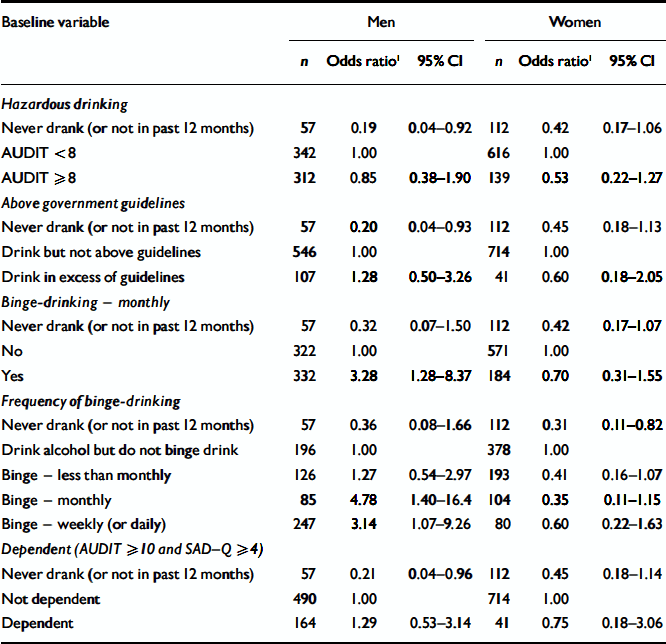
Stratifying by gender showed some differences (Table 4). Men who binged at least once per month had a threefold increased risk of anxiety and depression at follow-up after adjustment for confounders. In contrast, no excess was observed for female binge drinkers. However, a test for interaction did not provide statistical support (P=0.30).
Gender-specific associations: alcohol consumption and anxiety and depression at follow-up
| Baseline variable | Men | Women | ||||
|---|---|---|---|---|---|---|
| n | Odds ratio1 | 95% CI | n | Odds ratio1 | 95% CI | |
| Hazardous drinking | ||||||
| Never drank (or not in past 12 months) | 57 | 0.19 | 0.04–0.92 | 112 | 0.42 | 0.17–1.06 |
| AUDIT <8 | 342 | 1.00 | 616 | 1.00 | ||
| AUDIT ≥8 | 312 | 0.85 | 0.38–1.90 | 139 | 0.53 | 0.22–1.27 |
| Above government guidelines | ||||||
| Never drank (or not in past 12 months) | 57 | 0.20 | 0.04–0.93 | 112 | 0.45 | 0.18–1.13 |
| Drink but not above guidelines | 546 | 1.00 | 714 | 1.00 | ||
| Drink in excess of guidelines | 107 | 1.28 | 0.50–3.26 | 41 | 0.60 | 0.18–2.05 |
| Binge-drinking – monthly | ||||||
| Never drank (or not in past 12 months) | 57 | 0.32 | 0.07–1.50 | 112 | 0.42 | 0.17–1.07 |
| No | 322 | 1.00 | 571 | 1.00 | ||
| Yes | 332 | 3.28 | 1.28–8.37 | 184 | 0.70 | 0.31–1.55 |
| Frequency of binge-drinking | ||||||
| Never drank (or not in past 12 months) | 57 | 0.36 | 0.08–1.66 | 112 | 0.31 | 0.11–0.82 |
| Drink alcohol but do not binge drink | 196 | 1.00 | 378 | 1.00 | ||
| Binge – less than monthly | 126 | 1.27 | 0.54–2.97 | 193 | 0.41 | 0.16–1.07 |
| Binge – monthly | 85 | 4.78 | 1.40–16.4 | 104 | 0.35 | 0.11–1.15 |
| Binge – weekly (or daily) | 247 | 3.14 | 1.07–9.26 | 80 | 0.60 | 0.22–1.63 |
| Dependent (AUDIT ≥10 and SAD–Q ≥4) | ||||||
| Never drank (or not in past 12 months) | 57 | 0.21 | 0.04–0.96 | 112 | 0.45 | 0.18–1.14 |
| Not dependent | 490 | 1.00 | 714 | 1.00 | ||
| Dependent | 164 | 1.29 | 0.53–3.14 | 41 | 0.75 | 0.18–3.06 |
Associations between baseline anxiety and depression and alcohol consumption at follow-up
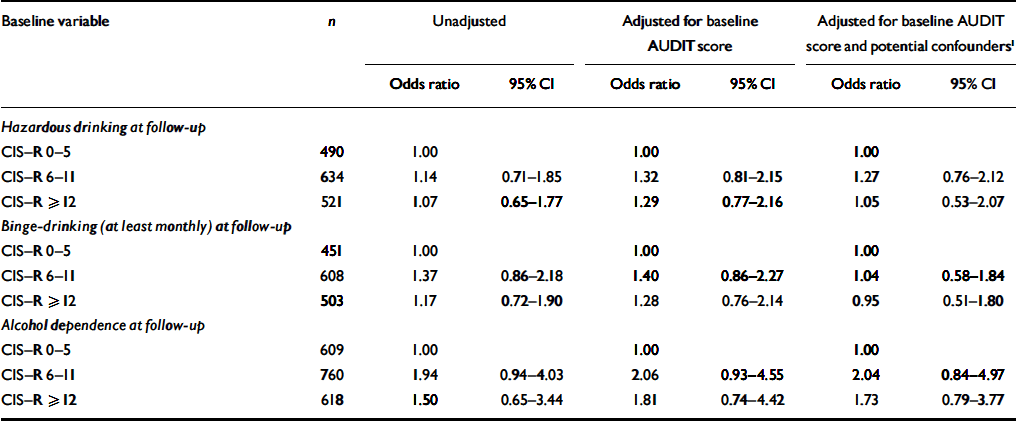
There was no excess of monthly binge-drinking at follow-up in those with sub-threshold symptoms (CIS–R score 6–11) or anxiety and depression (CIS–R score ≥12) at baseline (adjusted odds ratio=1.04, 95% CI 0.58–1.84 and 0.95, 0.51–1.80, respectively; Table 5), nor was there an excess of hazardous drinking in these groups (adjusted odds ratio=1.27, 95% CI 0.76–2.12 and 1.05, 0.53–2.07, respectively). However, those with CIS–R scores above 5 were almost twice as likely to develop alcohol dependence at followup as those with lower scores (CIS–R score 0–5), although this failed to reach statistical significance (Table 5).
Associations between anxiety and depression and alcohol use at follow-up
| Baseline variable | n | Unadjusted | Adjusted for baseline AUDIT score | Adjusted for baseline AUDIT score and potential confounders1 | |||
|---|---|---|---|---|---|---|---|
| Odds ratio | 95% CI | Odds ratio | 95% CI | Odds ratio | 95% CI | ||
| Hazardous drinking at follow-up | |||||||
| CIS–R 0–5 | 490 | 1.00 | 1.00 | 1.00 | |||
| CIS–R 6–11 | 634 | 1.14 | 0.71–1.85 | 1.32 | 0.81–2.15 | 1.27 | 0.76–2.12 |
| CIS–R ≥12 | 521 | 1.07 | 0.65–1.77 | 1.29 | 0.77–2.16 | 1.05 | 0.53–2.07 |
| Binge-drinking (at least monthly) at follow-up | |||||||
| CIS–R 0–5 | 451 | 1.00 | 1.00 | 1.00 | |||
| CIS–R 6–11 | 608 | 1.37 | 0.86–2.18 | 1.40 | 0.86–2.27 | 1.04 | 0.58–1.84 |
| CIS–R ≥12 | 503 | 1.17 | 0.72–1.90 | 1.28 | 0.76–2.14 | 0.95 | 0.51–1.80 |
| Alcohol dependence at follow-up | |||||||
| CIS–R 0–5 | 609 | 1.00 | 1.00 | 1.00 | |||
| CIS–R 6–11 | 760 | 1.94 | 0.94–4.03 | 2.06 | 0.93–4.55 | 2.04 | 0.84–4.97 |
| CIS–R ≥12 | 618 | 1.50 | 0.65–3.44 | 1.81 | 0.74–4.42 | 1.73 | 0.79–3.77 |
Again, stratification by gender showed some differences (Table 6). Men with sub-threshold symptoms or anxiety and depression at baseline had approximately a twofold increased odds of binge-drinking at follow-up. In contrast, women with anxiety and depression had a reduced odds of binge-drinking at follow-up. However, this interaction was not statistically significant (P=0.23). There was evidence that men with anxiety and depression and women with sub-threshold symptoms at baseline had an increased odds of alcohol dependence at follow-up. This bordered on statistical significance (P=0.07).
Gender-specific associations: anxiety and depression and alcohol consumption at follow-up

| Baseline variable | Men | Women | ||||
|---|---|---|---|---|---|---|
| n | Odds ratio1 | 95% CI | n | Odds ratio1 | 95% CI | |
| Hazardous drinking at follow-up | ||||||
| CIS–R 0–5 | 204 | 1.00 | 286 | 1.00 | ||
| CIS–R 6–11 | 195 | 1.29 | 0.57–2.91 | 439 | 1.42 | 0.73–2.76 |
| CIS–R ≥ 12 | 163 | 1.69 | 0.56–5.05 | 358 | 0.94 | 0.38–2.34 |
| Binge-drinking (at least monthly) at follow-up | ||||||
| CIS–R 0–5 | 204 | 1.00 | 286 | 1.00 | ||
| CIS–R 6–11 | 195 | 1.93 | 0.85–4.35 | 439 | 0.75 | 0.35–1.62 |
| CIS–R ≥ 12 | 163 | 2.83 | 1.15–6.94 | 358 | 0.49 | 0.21–1.16 |
| Alcohol dependence at follow-up | ||||||
| CIS–R 0–5 | 204 | 1.00 | 286 | 1.00 | ||
| CIS–R 6–11 | 195 | 0.49 | 0.10–2.47 | 439 | 5.06 | 1.56–16.3 |
| CIS–R ≥ 12 | 163 | 1.97 | 0.73–5.32 | 358 | 1.06 | 0.19–5.77 |
DISCUSSION
This study aimed to determine whether excessive alcohol consumption, and abnormal patterns of alcohol use were risk factors for ‘incident’ anxiety and depression. Data were analysed from the longitudinal follow-up of participants in the Psychiatric Morbidity Among Adults Living in Private Households, 2000 survey (Reference Singleton and LewisSingleton & Lewis, 2003).
Findings
Hazardous drinking, as defined by an AUDIT score of 8 or greater, was not associated with incident anxiety and depression at follow-up. Binge-drinking (on at least a monthly basis) was associated with an excess of anxiety and depression, but this did not reach statistical significance. After adjustment for confounders, there was no association between dependent drinking (AUDIT score ≥10 and SAD–Q ≥4) and onset of anxiety and depression at followup. Those who had not consumed alcohol within the previous 12 months consistently had a reduced odds of developing anxiety and depression.
Analyses stratified by gender suggested that men who binge drank (on at least a monthly basis) had a threefold increased odds of anxiety and depression at followup compared with men who did not binge drink. No such association was observed for women.
The reverse analysis did not demonstrate an excess of hazardous or binge-drinking at follow-up in those with anxiety and depression at baseline. There was some evidence that men with sub-threshold symptoms or anxiety and depression at baseline had an increased odds of binge-drinking at follow-up, although this gender differential was not statistically significant. Those with sub-threshold symptoms or anxiety and depression at baseline had a twofold increased odds of reporting alcohol dependence at follow-up. This was of borderline significance. Stratification by gender demonstrated that men with anxiety and depression at baseline had a twofold increased odds of alcohol dependence at follow-up, whereas women with sub-threshold symptoms had a fivefold increased odds of dependence. The test of interaction bordered on statistical significance.
Comparison with previous longitudinal studies
Our findings are in direct contrast to an early meta-analysis (Reference Hartka, Johnstone and LeinoHartka et al, 1991) that reported a significant correlation between baseline consumption of alcohol and depression at follow-up based on data from eight longitudinal studies. However, in this analysis control of confounders was limited to age, gender and interval between measurements.
Our findings are also in direct contrast to those of Gilman & Abraham (Reference Gilman and Abraham2001) who observed that after adjustment for confounders, including baseline depression score, age, socio-economic status, ethnicity, and site, women (odds ratio=3.52) and men (odds ratio=1.77) who were dependent on alcohol at baseline had a significantly increased odds of major depression according to DSM–IV criteria (American Psychiatric Association, 1994) after 1 year of followup. The odds ratio for men falls within the 95% CI calculated for the present study, although that for women does not.
Overall, our findings were consistent with those of Wang & Patten (Reference Wang and Patten2001) who analysed a longitudinal cohort of the Canadian National Population Health Survey, numbering 11 000. Taking DSM–IV major depression as an end-point, rather than the criteria used in our study, they observed no excess morbidity among those who drank daily, those who drank in binges (more than five drinks), those who had more than one drink daily, and among drinkers in general. Alcohol dependence was not considered. Similarly, in a randomly selected community cohort with follow-up at 3 and 7 years, Moscato et al (Reference Moscato, Russell and Zielezny1997) found no excess incidence of depressive symptoms among those with ‘alcohol problems’ (defined as a DSM–IV diagnosis of alcohol dependence or abuse or drinking more than five drinks a day on one or more occasions per week).
Wang & Patten (Reference Wang and Patten2001) reported an excess of major depression in binge-drinking women compared with non-binge drinkers. This contrasts with our finding that men who binge drank had an increased odds of anxiety and depression at followup. These gender-specific differences are difficult to interpret given the differences in definitions of alcohol consumption and psychiatric morbidity.
Moscato et al (Reference Moscato, Russell and Zielezny1997) also performed the reverse comparison and noted that depressive symptoms were associated with incident alcohol ‘problems’ in women but not in men. After adjustment for confounders, this effect among women was noted to be stronger in the short (3 years) rather than longer term (7 years). In our study, subclinical anxiety and depression (CIS–R 6–11) was associated with an increased odds of alcohol dependence at followup, with evidence that this effect was stronger among women, although confidence intervals were wide. For this reason, interpretation of the gender-specific estimates must be viewed with caution.
Our findings are partially consistent with those of Lipton (Reference Lipton1994). Data from the Los Angeles Epidemiological Catchment Area study showed evidence for a U-shaped relationship between alcohol use at time 1 and depressive symptomatology 1 year later, in the presence of financial strain and negative life events; heavy drinking, when compared with light–moderate or moderate drinking, was associated with a 50% increase in depressive symptom score. However, a similar increase in depressive symptom score was observed when abstinent or light drinking was compared with light–moderate or moderate drinking. This effect was attenuated in the absence of negative events or financial strain. This association was only observed in the sub-group analysis; when all participants were included in the analysis, a suggestion of a U-shaped relationship remained, but with confidence intervals that did not support a difference between drinking groups. Their finding of increased risk among non-drinkers is at odds with the consistent finding in the present study of reduced risk among non-drinkers. The difference in findings may be because the present study considered more possible confounding variables, including those relating to previous mental illness and ongoing psychotropic therapy. Without consideration of such variables the estimate of the association might have been biased by non-drinkers who were abstinent owing to previous mental illness and were at risk of relapse, therefore giving a false impression of the risk/benefits associated with abstinence.
Existing cross-sectional and longitudinal studies have considered a diverse array of patterns of abnormal alcohol consumption, including DSM alcohol dependence (Reference Swendsen, Merikangas and CaninoSwendsen et al, 1998; Reference Gilman and AbrahamGilman & Abraham, 2001), DSM alcohol abuse (Reference Swendsen, Merikangas and CaninoSwendsen et al, 1998), alcohol problems (Reference Moscato, Russell and ZieleznyMoscato et al, 1997), direct measures of consumption (Reference Wang and PattenWang & Patten, 2001) and measures of binge-drinking (Reference Wang and PattenWang & Patten, 2001). Different patterns of alcohol consumption may be implicated with different psychiatric sequelae, and therefore explain inconsistencies between studies.
Strengths and limitations
By using national population data, we have avoided the selection and referral biases inherent in studies of clinic-based patients. Observer bias was eliminated by the participants themselves entering data directly onto a laptop computer. The study design reduced the chance of recall bias, as might be found in a retrospective case–control study. In addition, well validated tools were used to measure alcohol consumption (AUDIT and SAD–Q; Reference Stockwell, Murphy and HodgsonStockwell et al, 1983; Reference Saunders, Aasland and BaborSaunders et al, 1993) and anxiety and depression (CIS–R; Reference Lewis, Pelosi and ArayaLewis et al, 1992).
The definition of drinking above government guidelines was calculated using two items from the AUDIT. A direct measure of the quantity of alcohol consumed was lacking and it is probable that our figures are an underestimate. Indeed, prior community surveys have estimated that 27% of men and 15% of women drink above government guidelines (http://www.performance.doh.gov.uk/hpsss/tbl_a9.htm), which is substantially higher than our estimates (9 and 3%, respectively). Asking participants to recall the amount of alcohol consumed over a shorter period (for example 1 week) would provide a more accurate estimate of the alcohol consumed, although the representativeness of such data may be questioned.
Although a comparatively large number of individuals were surveyed in this study, the power to detect associations for alcohol dependence, in particular, was limited. The possibility of a type II error remains. Others have also commented on their limited ability to detect associations for particular patterns of drinking (Reference Wang and PattenWang & Paten, 2001).
There is a high probability of random misclassification, owing to the true incidence over the follow-up period not being obtained, but rather a snap-shot picture of mental health for the week prior to follow-up. It is therefore possible that cases of anxiety and depression might have emerged and subsequently recovered, and therefore might not be counted. This random misclassification would affect all participants, but would make a statistically significant result less likely.
This study (as others; Reference Wang and PattenWang & Patten, 2001) has a relatively short follow-up period (18 months). A longer period of follow-up might have resulted in significantly more at-risk drinkers developing anxiety and depression. This is particularly relevant, as the analysis adjusted for baseline CIS–R and AUDIT scores. The association between baseline alcohol consumption and onset of anxiety and depression, and vice versa, might have been underestimated by correcting for baseline CIS–R and AUDIT scores, which as measures of subclinical disease may be on the causal pathway. However, unadjusted data showed little evidence of a significant association, and therefore it is unlikely that overadjustment is the sole explanation for the lack of association.
Anxiety and depression and alcohol consumption
In summary, hazardous drinkers did not have increased odds of anxiety and depression at follow-up; there was a suggestion that binge-drinking and dependence are risk factors for anxiety and depression, but sample size was insufficient for firm conclusions. However, those who abstained from alcohol had a reduced risk. Participants with sub-threshold symptoms or anxiety and depression at baseline had increased odds of reporting alcohol dependence at 18 months; this bordered on statistical significance.
Public health implications
The protective effect of abstinence compared with an ‘acceptable’ drinking pattern is most notable. This suggests that a ‘safe’ level of drinking (in terms of the prevention of anxiety and depression) may be lower than previously recognised. The recent publication of the Alcohol Harm Reduction Strategy for England (Prime Minister's Strategy Unit, 2004) sets out more conservative guidelines for drinking: 3–4 units per day for men and 2–3 units per day for women, but such guidelines were devised to reduce both the social and physical problems associated with excessive alcohol consumption, not only the risk of anxiety and depression. Further work is therefore required to examine the effect of drinking at a lower threshold on the risk of anxiety and depression before guidance can be provided.
Clinical Implications and Limitations
CLINICAL IMPLICATIONS
-
▪ Abstinence protects against the development of anxiety and depression.
-
▪ Binge-drinking might be a modifiable risk factor for anxiety and depression, especially among men.
-
▪ Subclinical anxiety and depression is suggested as a risk factor for the development of alcohol dependence.
LIMITATIONS
-
▪ The sample size of 2400 might have led to a type II error, especially when considering alcohol dependence.
-
▪ Time to follow-up was short (18 months).
-
▪ Cases of anxiety and depression that developed and resolved during follow-up would not have been identified.
Acknowledgements
We thank the staff of the Office for National Statistics who were involved in the fieldwork and data preparation of the Psychiatric Morbidity Among Adults Living in Private Households, 2000 survey. The data collection was funded by the Department of Health and the Scottish Executive Health Department. However, the views expressed in this paper are those of the authors alone and not necessarily those of the Department of Health or Scottish Executive.




eLetters
No eLetters have been published for this article.