Introduction
Neurocognitive dysfunction has long been recognized as a core feature of schizophrenia (Bleuler, Reference Bleuler1950; Elvevåg & Goldberg, Reference Elvevåg and Goldberg2000) and is the focus of numerous studies. In contrast, the importance of cognitive problems in mood disorders has only recently been recognized, with the initial publications emerging in the late 1990s (Burdick et al. Reference Burdick, Russo, Frangou, Mahon, Braga and Shanahan2014). These reports have promoted a growing awareness that, like schizophrenia, mood disorders may be associated with a distinct pattern of cognitive impairment (Austin et al. Reference Austin, Mitchell and Goodwin2001). Recently, numerous studies on neurocognitive function in mood disorders have been subject to several reviews and meta-analyses (Glahn et al. Reference Glahn, Bearden, Niendam and Escamilla2004; Bora et al. Reference Bora, Harrison, Yucel and Pantelis2013; Snyder, Reference Snyder2013; Burdick et al. Reference Burdick, Russo, Frangou, Mahon, Braga and Shanahan2014; Keefe et al. Reference Keefe, Mcclintock, Roth, Doraiswamy, Tiger and Madhoo2014b; Rock et al. Reference Rock, Roiser, Riedel and Blackwell2014; Porter et al. Reference Porter, Robinson, Malhi and Gallagher2015; Ahern & Semkovska, Reference Ahern and Semkovska2017).
For example, a previous study reported that 84% of patients with schizophrenia, 58.3% of patients with psychotic major depression, and 57.7% of patients with psychotic bipolar disease are cognitively impaired [1 standard deviation (s.d.) below healthy controls (HCs) in at least two cognitive domains] (Reichenberg et al. Reference Reichenberg, Harvey, Bowie, Mojtabai, Rabinowitz and Heaton2009). Neurocognitive impairments are also common among patients with the major depressive disorder (MDD) without psychotic features (Fava et al. Reference Fava, Graves, Benazzi, Scalia, Iosifescu and Alpert2006; Murrough et al. Reference Murrough, Iacoviello, Neumeister, Charney and Iosifescu2011; Lee et al. Reference Lee, Hermens, Porter and Redoblado-Hodge2012; Millan et al. Reference Millan, Agid, Brüne, Bullmore, Carter and Clayton2012; Wagner et al. Reference Wagner, Doering, Helmreich, Lieb and Tadić2012), although the true prevalence has not been clarified. It has been documented that up to 50% of individuals with MDD exhibit cognitive deficits of at least 1 s.d. below the mean on at least one domain, while half of those presenting with these deficits have scores 2 s.d. below the mean (Gualtieri & Morgan, Reference Gualtieri and Morgan2008; McIntyre et al. Reference Mcintyre, Cha, Soczynska, Woldeyohannes, Gallaugher and Kudlow2013). Indeed, patients with MDD often present with cognitive dysfunction in domains such as attention, executive function, information processing, working memory, and psychomotor speed (Taylor Tavares et al. Reference Taylor Tavares, Clark, Cannon, Erickson, Drevets and Sahakian2007; Keilp et al. Reference Keilp, Gorlyn, Oquendo, Burke and Mann2008; Simons et al. Reference Simons, Jacobs, Derom, Thiery, Jolles and van Os2009; Castaneda et al. Reference Castaneda, Marttunen, Suvisaari, Perälä, Saarni and Aalto-Setälä2010; Clark et al. Reference Clark, DiBenedetti and Perez2016). These deficits have been traditionally considered secondary to affective symptoms.
Currently, however, this traditional view is changing, as cognitive dysfunction has proven to be a central and lasting feature of MDD (Bartfai et al. Reference Bartfai, Asberg, Mårtensson and Gustavsson1991; Hammar et al. Reference Hammar, Sørensen, Ardal, Oedegaard, Kroken and Roness2010), similar to that observed in patients with schizophrenia or those with bipolar disorder (BPD) (Martinez-Aran et al. Reference Martinez-Aran, Penadés, Vieta, Colom, Reinares and Benabarre2002). Schizophrenia, BPD, and MDD are distinct diagnostic categories in current psychiatric nosology, yet there is increasing evidence in support of shared clinical and biological features in these disorders (Chang et al. Reference Chang, Womer, Edmiston, Bai, Zhou and Jiang2018). Previous neuroimaging studies have demonstrated commonalities in structural and functional neural abnormalities among schizophrenia, BPD, and MDD (Barch & Sheffield, Reference Barch and Sheffield2014; Goodkind et al. Reference Goodkind, Eickhoff, Oathes, Jiang, Chang and Jones-Hagata2015; Chang et al. Reference Chang, Womer, Edmiston, Bai, Zhou and Jiang2018). Recently, using a dimensional approach, Sheffield et al. (Reference Sheffield, Kandala, Tamminga, Pearlson, Keshavan and Sweeney2017) found that generalized cognitive deficit is associated with a reduced cingulo-opercular network (CON) and subcortical network efficiency across psychotic disorders. Reduced efficiency of information transfer within the CON is a shared vulnerability across multiple psychotic disorders and represents a common mechanism that contributes to a generalized cognitive deficit (Sheffield et al. Reference Sheffield, Kandala, Tamminga, Pearlson, Keshavan and Sweeney2017).
It is also apparent that, while cognitive dysfunction in MDD may improve with treatment and resolution of depressive symptoms, cognitive deficits may be detected even in periods of symptom remission (Lam et al. Reference Lam, Kennedy, Mclntyre and Khullar2014). Moreover, it should be stressed that these deficits are not uniformly present in all patients with depression, as some abnormalities have been reported only in specific MDD subgroups (Withall et al. Reference Withall, Harris and Cumming2010; Caldieraro et al. Reference Caldieraro, Baeza, Pinheiro, Ribeiro, Parker and Fleck2013; Lin et al. Reference Lin, Xu, Lu, Ouyang, Dang and Lorenzo-Seva2014; Day et al. Reference Day, Gatt, Etkin, DeBattista, Schatzberg and Williams2015; Darcet et al. Reference Darcet, Gardier, Gaillard, David and Guilloux2016).
Neurocognitive impairment in MDD has become a topic of recent interest, as the field has increasingly recognized that these deficits impede functional recovery and are independent of emotional disturbances (Jaeger et al. Reference Jaeger, Berns, Uzelac and Davis-Conway2006; Marazziti et al. Reference Marazziti, Consoli, Picchetti, Carlini and Faravelli2010). This is particularly troubling because these cognitive dysfunctions frequently persist after remission of depressive episodes (Marcos et al. Reference Marcos, Salamero, Gutiérrez, Catalán, Gasto and Lázaro1994; Clark et al. Reference Clark, Sarna and Goodwin2005; Paelecke-Habermann et al. Reference Paelecke-Habermann, Pohl and Leplow2005; Airaksinen et al. Reference Airaksinen, Wahlin, Larsson and Forsell2006; Hammar et al. Reference Hammar, Sørensen, Ardal, Oedegaard, Kroken and Roness2010; Herrera-Guzmán et al. Reference Herrera-Guzmán, Gudayol-Ferré, Herrera-Abarca, Herrera-Guzmán, Montelongo-Pedraza and Padrós Blázquez2010; Ardal & Hammar, Reference Ardal and Hammar2011; Hasselbalch et al. Reference Hasselbalch, Knorr and Kessing2011). Overall, cognitive dysfunction, work, and psychosocial limitations are prevalent in patients with current and remitted depression (Conradi et al. Reference Conradi, Ormel and de Jonge2011). Moreover, as has been repeatedly shown in BPD (Martinez-Aran et al. Reference Martinez-Aran, Vieta, Torrent, Sanchez-Moreno, Goikolea and Salamero2007; Bowie et al. Reference Bowie, Depp, McGrath, Wolyniec, Mausbach and Thornquist2010; Depp et al. Reference Depp, Mausbach, Harmell, Savla, Bowie and Harvey2012; Sanchez-Moreno et al. Reference Sanchez-Moreno, Martinez-Aran and Vieta2017), these cognitive deficits contribute significantly to functional disability in MDD (Godard et al. Reference Godard, Grondin, Baruch and Lafleur2011; Lam et al. Reference Lam, Kennedy, Mclntyre and Khullar2014). Cognitive impairment is also likely to be a key factor affecting the patient's ability to function occupationally and hence, the timing of his or her return to work (Austin et al. Reference Austin, Mitchell and Goodwin2001). These data strongly support the importance of neurocognitive problems on quality of life in MDD and highlight the need for treatment and prevention efforts targeting neurocognition (Greer et al. Reference Greer, Kurian and Trivedi2010; Herrera-Guzmán et al. Reference Herrera-Guzmán, Gudayol-Ferré, Herrera-Abarca, Herrera-Guzmán, Montelongo-Pedraza and Padrós Blázquez2010; Trivedi & Greer, Reference Trivedi and Greer2014; Wagner et al. Reference Wagner, Doering, Helmreich, Lieb and Tadić2012; Madhukar et al. 2014). However, relatively little is known about the structure and causes of these deficits.
It is widely recognized that psychiatric illnesses, such as schizophrenia or BPD, are heterogeneous clinical entities. Previous studies have subdivided patients with schizophrenia according to cognitive impairments into four general subtypes using cluster analyses, with two extreme subtypes (near normative and profound global impairments) and two intermediate subtypes (Goldstein et al. Reference Goldstein, Allen and Seaton1998; Seaton et al. Reference Seaton, Allen, Goldstein, Kelley and van Kammen1999; Hill et al. Reference Hill, Ragland, Gur and Gur2002). Recent hierarchical cluster analyses (Burdick et al. Reference Burdick, Russo, Frangou, Mahon, Braga and Shanahan2014; Jensen et al. Reference Jensen, Knorr, Vinberg, Kessing and Miskowiak2016; Russo et al. Reference Russo, Van Rheenen, Shanahan, Mahon, Perez-Rodriguez and Cuesta-Diaz2017) have provided evidence for three distinct, cognitively homogeneous, neurocognitive subgroups in patients with BPD. Specifically, there were two extreme subtypes (near normative and profound global impairments) and one intermediate subtype (Burdick et al. Reference Burdick, Russo, Frangou, Mahon, Braga and Shanahan2014; Jensen et al. Reference Jensen, Knorr, Vinberg, Kessing and Miskowiak2016; Russo et al. Reference Russo, Van Rheenen, Shanahan, Mahon, Perez-Rodriguez and Cuesta-Diaz2017). The subtype involving profound global impairments manifested deficits comparable with those in schizophrenia (Burdick et al. Reference Burdick, Russo, Frangou, Mahon, Braga and Shanahan2014). While these studies show cognitive heterogeneity in schizophrenia and BPD, relatively little is known about the heterogeneity of cognitive functioning in patients with MDD.
When analyzed at the group level, neurocognitive deficits are present in patients with euthymic MDD, but are significantly less severe than those reported in patients with schizophrenia or BPD (Terachi et al. Reference Terachi, Yamada, Pu, Yokoyama, Matsumura and Kaneko2017). These data suggest that the existence of a gradation of severity in neurocognitive function deficits in schizophrenia, BPD, and MDD. However, it is not yet known whether there are qualitatively distinct subgroups within MDD, as in schizophrenia and BPD, and whether some of the subgroups overlap with those in schizophrenia or BPD. This is a critical issue in understanding the etiology of neurocognitive dysfunction in MDD, yet very little is currently known about why some patients with MDD develop significant neurocognitive deficits, while others remain neurocognitively intact.
If we are to harness developments in genetics and neuroscience to understand disease mechanisms and develop new treatments, we need new approaches for patient stratification that recognize the complexity and continuous nature of psychiatric traits, and that are not constrained by current categorical approaches (Owen, Reference Owen2014). For example, these might select cases that share specific clinical symptoms or risk factors but who have different categorical diagnoses or select those who form a subgroup of a current diagnostic category, as defined by particular features (Owen, Reference Owen2014). Research domain criteria (RDoC) supports research to explicate fundamental biobehavioral dimensions that cut across current heterogeneous disorder categories (Cuthbert & Insel, Reference Cuthbert and Insel2013) The RDoC approach has the potential both to address diagnostic heterogeneity, and to enable the construction of models with coherently linked elements that take into consideration a diagnostic group's phenomenological homogeneity (Fonagy & Luyten, Reference Fonagy and Luyten2017).
Several clinical factors (e.g. age at onset, MDD subtype, and history of psychosis) appear to increase the likelihood of significant cognitive impairment. For example, cognitive deficits seem to be more severe in patients with recurrent episodes, in elderly patients with late-onset disease (onset after 50–65 years of age), and among patients who have melancholic or psychotic features (Austin et al. Reference Austin, Mitchell, Wilhelm, Parker, Hickie and Brodaty1999; Fleming et al. Reference Fleming, Blasey and Schatzberg2004; Herrmann et al. Reference Herrmann, Goodwin and Ebmeier2007; Bora et al. Reference Bora, Yucel and Pantelis2010). Recently, Lin et al. (Reference Lin, Xu, Lu, Ouyang, Dang and Lorenzo-Seva2014) found that patients with melancholic and atypical depressive symptoms may have cognitive deficits in the domains of processing speed and verbal fluency with different severities. Some studies indicate that patients with psychotic MDD may be more impaired than those with non-psychotic MDD (Kim et al. Reference Kim, Kim, Sohn, Lim, Na and Paik1999). However, others argue that these two groups of patients are similarly impaired (Nelson et al. Reference Nelson, Sax and Strakowski1998; Schatzberg et al. Reference Schatzberg, Posener, DeBattista, Kalehzan, Rothschild and Shear2000; Fleming et al. Reference Fleming, Blasey and Schatzberg2004; Politis et al. Reference Politis, Lykouras, Mourtzouchou and Christodoulou2004). In addition, previous studies suggest that longer length of illness, chronicity, and recurrence of affective episodes are associated with poorer neurocognitive performance (Fossati et al. Reference Fossati, Harvey, Le Bastard, Ergis, Jouvent and Allilaire2004).
We hypothesized that there would be discrete neurocognitive subgroups in non-psychotic MDD based on neurocognitive profiles. We were specifically interested in empirically determining: (1) whether specific neurocognitive subgroups exist; (2) the optimal number of neurocognitive subgroups that explain the heterogeneity; (3) the qualitative neurocognitive profiles associated with these subgroups; and (4) the clinical and functional correlates associated with each neurocognitive subgroup.
Methods
Participants
Written informed consent was obtained from each participant after the study procedures were explained. This study was approved by the ethics committee of the National Center of Neurology and Psychiatry (approval no. A2011-037), and the investigation was conducted in accordance with the tenets of the latest version of the Declaration of Helsinki (2013).
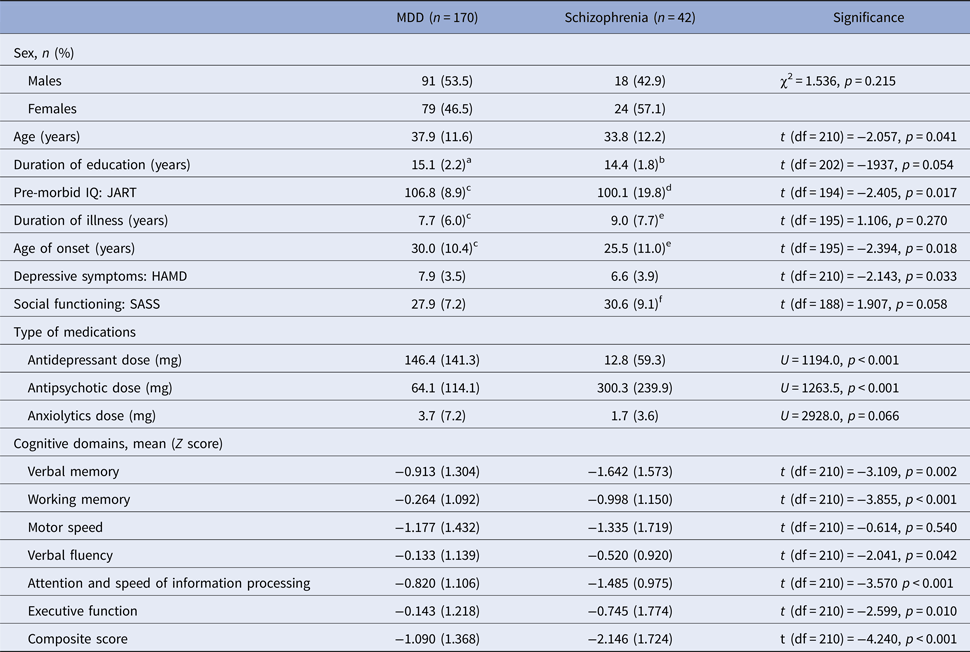
One-hundred and seventy patients with non-psychotic MDD who were outpatients of the National Center of Neurology and Psychiatry Hospital in Tokyo, Japan, between January 2010 and December 2016, participated in the study (Table 1). The inclusion criteria were as follows: (1) diagnosis of MDD, (2) age of 18–65 years, and (3) current affective stability [scores of ⩽13 on the Hamilton Rating Scale for Depression (HAMD; Hamilton, Reference Hamilton1960)]. The exclusion criteria were as follows: (1) history of central nervous system trauma, neurological disorder, or comorbid Axis I psychiatric disorders and (2) diagnosis of recent substance abuse/dependence (past 3 months).
Demographics and clinical characteristics of participants

Data are given as mean (s.d.).
MDD, Major depressive disorder; IQ, intelligence quotient; JART, Japanese version of the National Adult Reading Test; HAMD, Hamilton Rating Scale for Depression; SASS, Social Adaptation Self-evaluation Scale.
a n = 164.
b n = 39.
c n = 159.
d n = 37.
e n = 38.
f n = 18.
Patients were diagnosed in accordance with the Structured Clinical Interview for Diagnostic and Statistical Manual of Mental Disorders, Fourth Edition, Axis I Disorders (SCID-I), by experienced psychiatrists or trained mental health professional. The mean age at the time of the assessment was 38.0 (s.d. = 11.6) years, and 46.5% of the patients (n = 80) were women. The mean pre-morbid intelligence quotient (IQ) [Japanese version of the National Adult Reading Test (JART) Matsuoka et al. Reference Matsuoka, Uno, Kasai, Koyama and Kim2006] was 106.9 (s.d. = 8.9). The mean HAMD score (current depression) was 7.7 (s.d. = 6.0), which was indicative of effective stability.
Each clinical rater achieved a median Intraclass Correlation Coefficient of 0.857 or higher across all HAMD items and SCID.
Among the included patients, 150 were medicated with one or more agents (antidepressants, antipsychotics, and/or anxiolytics), while 20 patients were drug-free. Daily doses of all antidepressants were converted to an equivalent dose of imipramine (Inagaki & Inada, Reference Inagaki and Inada2006), those of antipsychotics were converted to that of chlorpromazine (Inagaki & Inada, Reference Inagaki and Inada2006), and doses of anxiolytics were converted to that of diazepam (Inagaki & Inada, Reference Inagaki and Inada2006).
To use the severity of cognitive impairment observed in patients with schizophrenia as a reference, we included data from a sample of 42 patients with schizophrenia diagnosed at the National Center of Neurology and Psychiatry Hospital using the same recruitment procedures as those used for the MDD sample. The mean age at the time of the assessment was 33.8 years (s.d. = 12.2) and the mean age at onset was 25.5 years (s.d. = 11.0). On average, the patients with schizophrenia had 14.4 years (s.d. = 1.8) of education. Nineteen of the subjects (42.9%) were women. The mean pre-morbid IQ (JART) was 100.1 (s.d. = 19.8) and the mean depressive symptoms score (as measured by the HAMD) was 6.6 (s.d. = 3.9) (see online Supplementary Table S1).
Measurements of neurocognitive functioning
The brief assessment of cognition in schizophrenia (BACS) (Keefe et al. Reference Keefe, Goldberg, Harvey, Gold, Poe and Coughenour2004; Kaneda et al. Reference Kaneda, Sumiyoshi, Keefe, Ishimoto, Numata and Ohmori2007; Reference Kaneda, Sumiyoshi, Nakagome, Ikezawa, Ohmori and Furukori2013) was used to measure neurocognitive functioning. The BACS was originally developed for use in clinical trials targeting cognition in schizophrenia. However, recent studies have demonstrated its suitability for effectively capturing neurocognitive deficits in patients with MDD (Hidese et al. Reference Hidese, Ota, Wakabayashi, Noda, Ozawa and Okubo2017; Terachi et al. Reference Terachi, Yamada, Pu, Yokoyama, Matsumura and Kaneko2017). The BACS is composed of several individual tests that give rise to six cognitive domains:
(1) Verbal memory (List Learning Test);
(2) Working memory (Digit Sequencing Task);
(3) Motor speed (Token Motor Task);
(4) Verbal fluency (Category Instances Test and Controlled Oral Word Association Test);
(5) Attention and speed of information processing (Symbol Coding);
(6) Executive function (Tower of London Test).
The battery of tests was completed in a single session of about 30 min. Patients with MDD were administered the BACS and raw subtest scores were standardized by creating age- and sex-corrected z-scores (Kaneda et al. Reference Kaneda, Sumiyoshi, Nakagome, Ikezawa, Ohmori and Furukori2013). Composite scores were calculated by averaging the z-scores of all six subtests, with higher scores reflecting higher cognitive performance.
Measurements of clinical features and functional disability
Current symptoms, history of psychosis, number of major depressive episodes, and history of substance use disorders were collected using the SCID interview and standardized mood ratings. A social functioning evaluation was performed using the Social Adaptation Self-evaluation Scale (SASS). The SASS is a 21-item scale developed by Bosc et al. (Reference Bosc, Dubini and Polin1997) for the evaluation of patients’ social motivation and behavior during the depression. Previous studies used principal component analysis to demonstrate that 21 SASS items could be summarized into three categories: interpersonal relations, interest and motivation, and self-perception (Goto et al. Reference Goto, Ueda, Yoshimura, Kihara, Kaji and Yamada2005).
Statistical analysis
Statistical analyses were performed using SPSS 22.0 software (Tokyo, Japan). Statistical significance was defined as p < 0.05.
To identify homogeneous subgroups of patients with MDD based on their neurocognitive performance, we conducted a hierarchical cluster analysis. Similarities between cases were computed using the squared Euclidian distance, while the Ward linkage was used for agglomeration. The dendrogram (see online Supplementary Fig. S1) was visually inspected to detect the optimal number of clusters explaining the cognitive variance. Cluster membership was used as a grouping variable. To test the clusters’ validity, and better understand the relationship between cognition and cluster allocation of patients with MDD, we conducted a discriminant function analysis (DFA) that explored the predictive power of each of the six BACS domains in classifying subjects into the discrete neurocognitive subgroups obtained from the hierarchical cluster analysis. We compared cognitive performance among the subgroups of patients with MDD, using analysis of variance (ANOVA).
Moreover, to begin to understand the clinical and functional correlates of cluster membership, descriptive analyses [ANOVA and chi-square (χ2) tests applied as appropriate] were carried out to investigate differences in demographic characteristics, clinical features, and functional disability between the identified MDD subgroups.
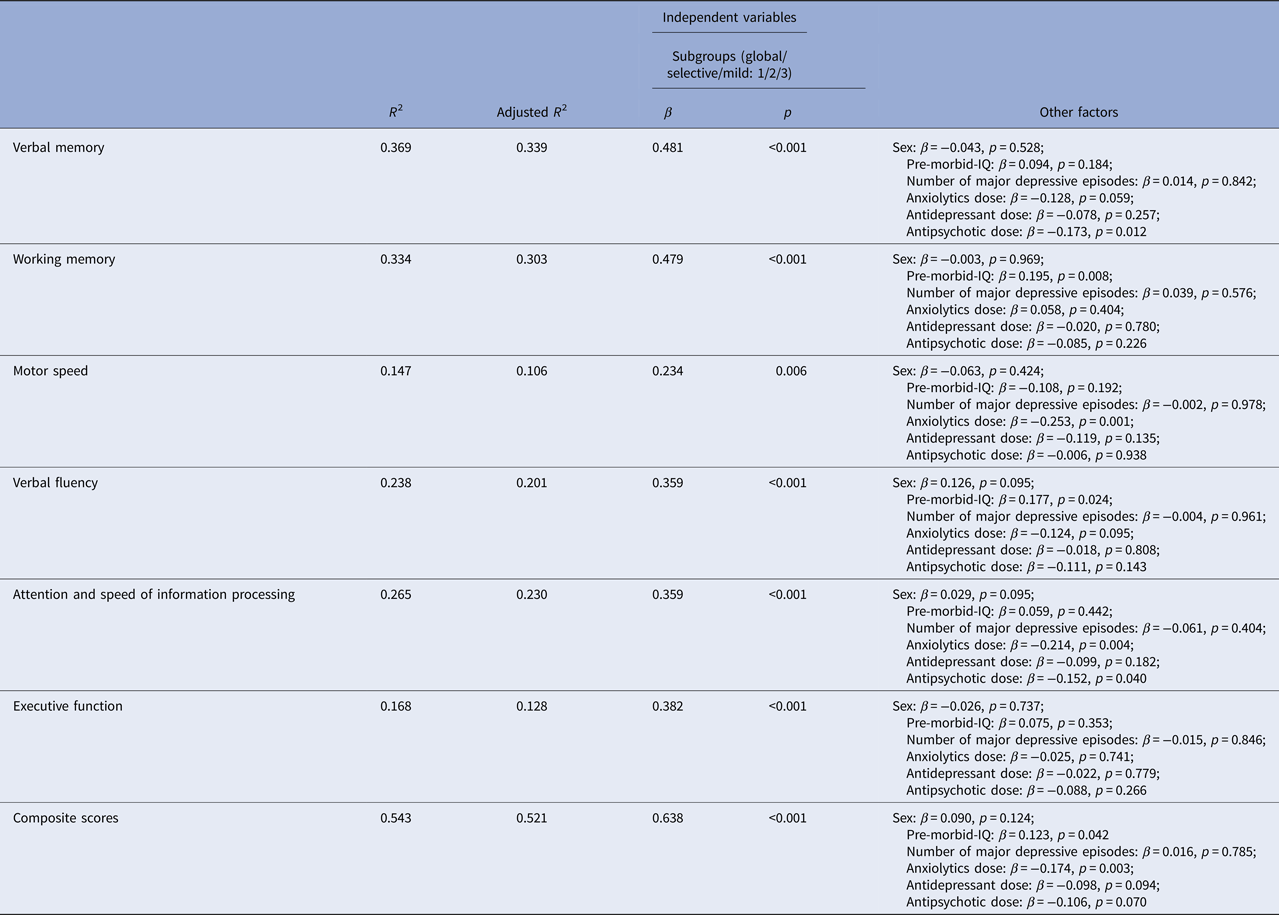
Finally, we conducted forced entry multivariate regression analyses for each set of BACS subscale scores and composite scores using ‘subgroups’ (global/selective/mild: 1/2/3) and other variables that showed difference among the subgroups to test the effect on cognitive heterogeneity among these subgroups.
Results
The demographic characteristics of the patients with MDD and schizophrenia are summarized in Table 1.
Clustering of patients with MDD
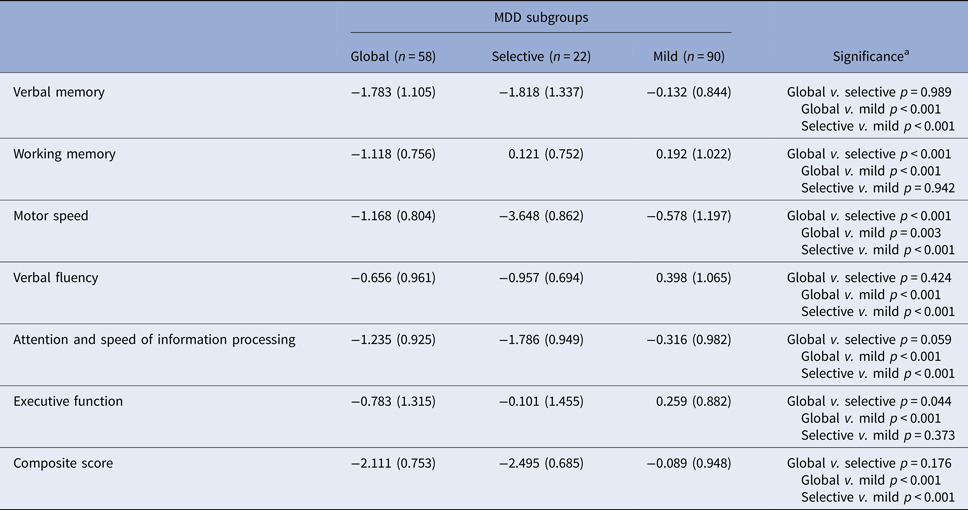
The hierarchical cluster analysis showed that the 170 patients with MDD were optimally clustered (according to BACS performance) into three discrete subgroups (Table 2). The subgroups were labeled as follows based on the level of cognitive impairment:
• Patients in the global impairment subgroup (58 subjects, 34.12%) presented with moderate to severe neurocognitive dysfunction, with performances falling between 1.0 and 2.0 s.d. below the HC mean.
• Patients in the selective impairment subgroup (22 subjects, 12.94%) presented with moderate deficits in specific domains, with performances ranging from normal to approximately 3.5 s.d. below the HC mean. Patients in the selective impairment subgroup exhibited preserved working memory and executive function but had moderate to severe deficits in verbal memory, motor speed, verbal fluency, and attention/information processing speed.
• Patients in the mild impairment subgroup (90 subjects, 52.94%) presented with near-normative performance and mild dysfunction in motor speed.
Comparison between the three neurocognitive MDD subgroups across cognitive domains (Z scores)

Data are given as mean (s.d.).
MDD, Major depressive disorder.
a All p values are adjusted for multiple comparisons with Tukey-HSD (honestly significant difference) correction.
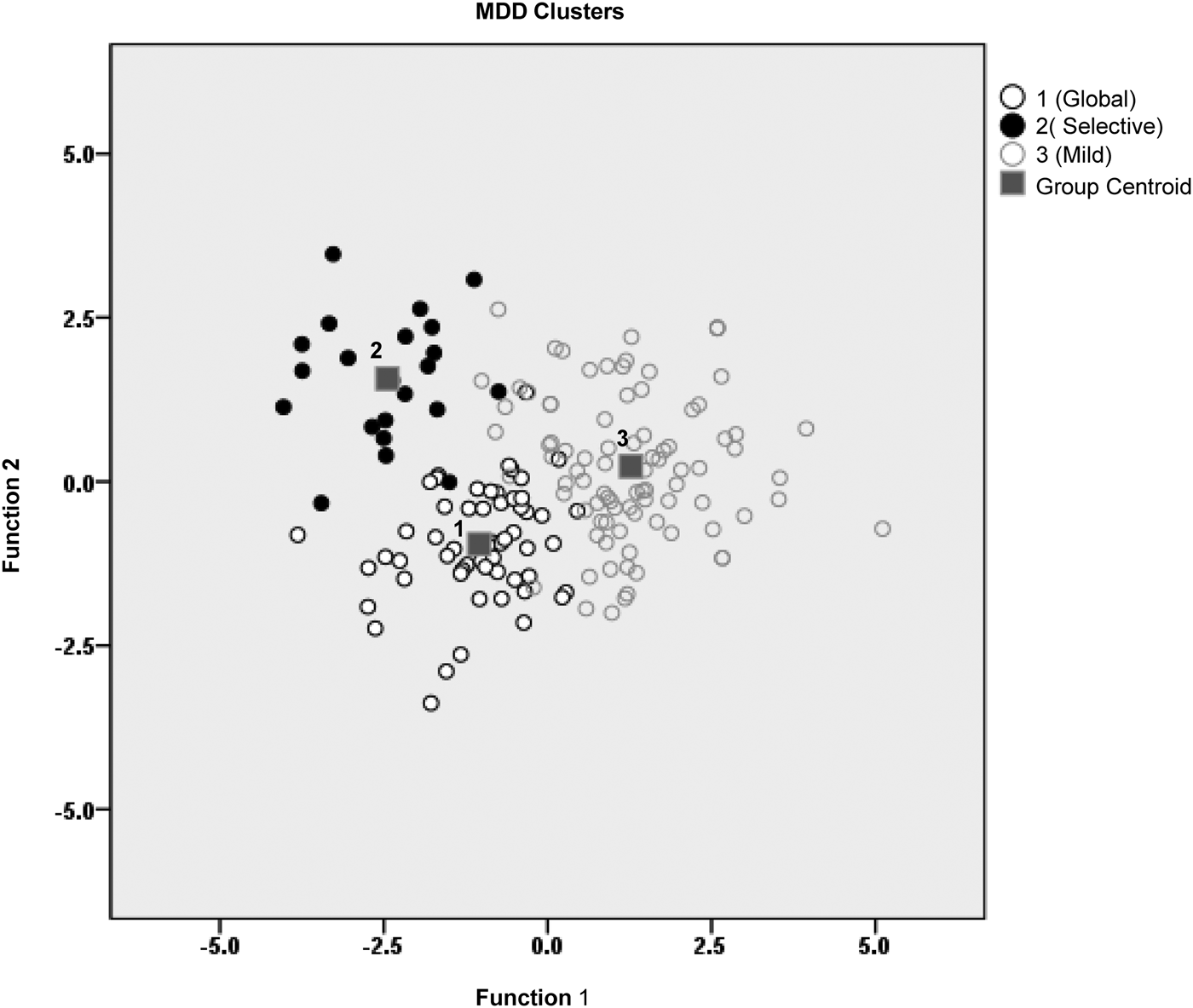
Using these three clusters, DFA revealed the presence of two discriminant functions explaining 75.2% and 24.8% of the variance, respectively (Wilks’ λ = 0.20,  ${\rm \chi} _{12}^2 $ = 267.10, p < 0.001; after removal of the first function: Wilk's λ = 0.60,
 ${\rm \chi} _5^2 $ = 84.40, p < 0.001). Subject groupings into the three neurocognitive clusters are shown in Fig. 1.
Graphical agglomeration of patients with major depressive disorder (MDD) using discriminant function analysis. The figure represents the agglomeration of subjects using the three clusters that emerged from the hierarchical cluster analysis. The centroids (■) are the mean score for each cluster. Clusters 1 is the global impairment subgroup, cluster 2 is the selective impairment subgroup, and cluster 3 is the mild impairment subgroup.

Comparisons of neurocognitive functioning among MDD clusters
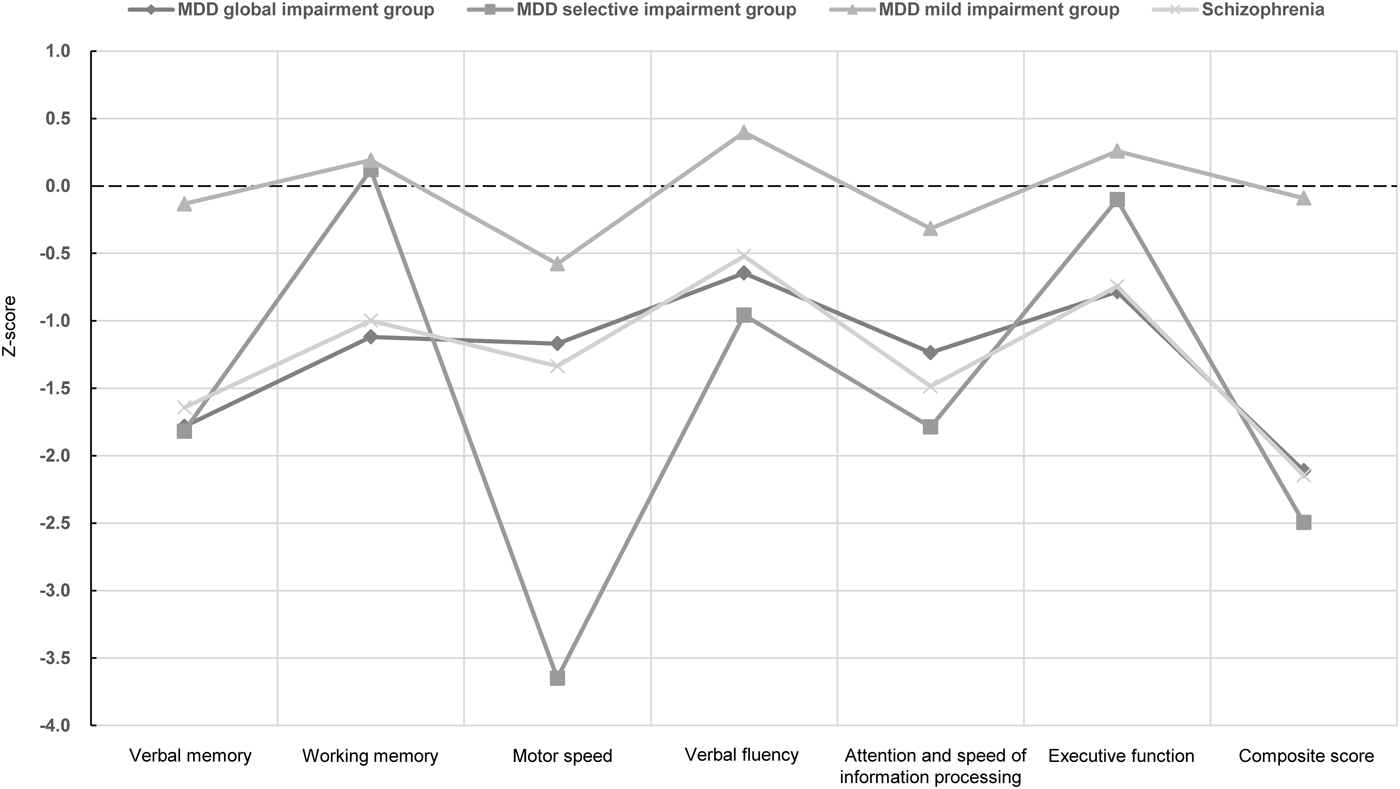
Figure 2 illustrates the cognitive profiles of the three MDD clusters and the schizophrenia sample. Comparisons of neurocognitive functioning among subgroups are summarized in Table 2. The global impairment subgroup scored significantly lower than the mild impairment subgroup in all domains, whereas the selective impairment subgroup scored significantly lower than the mild impairment subgroup in domains such as verbal memory, motor speed, verbal fluency, and attention and speed of information processing. In addition, the selective subgroup scored significantly better than the global impairment subgroup in working memory and executive function, but worse in motor speed.
Neurocognitive profiles of major depressive disorder (MDD) and the schizophrenia sample. The X-axis indicates the brief assessment of cognition in schizophrenia (BACS) domains. The Y-axis depicts a Z-score with a mean of 0 and a s.d. of 1. Participants are divided into lines based on scoring for each cognitive domain.

A comparison of the patients in the global impairment subgroup to the patients with schizophrenia revealed no differences in any of the cognitive domains. In addition, the two groups did not differ in their BACS composite scores (see online Supplementary Table S2).
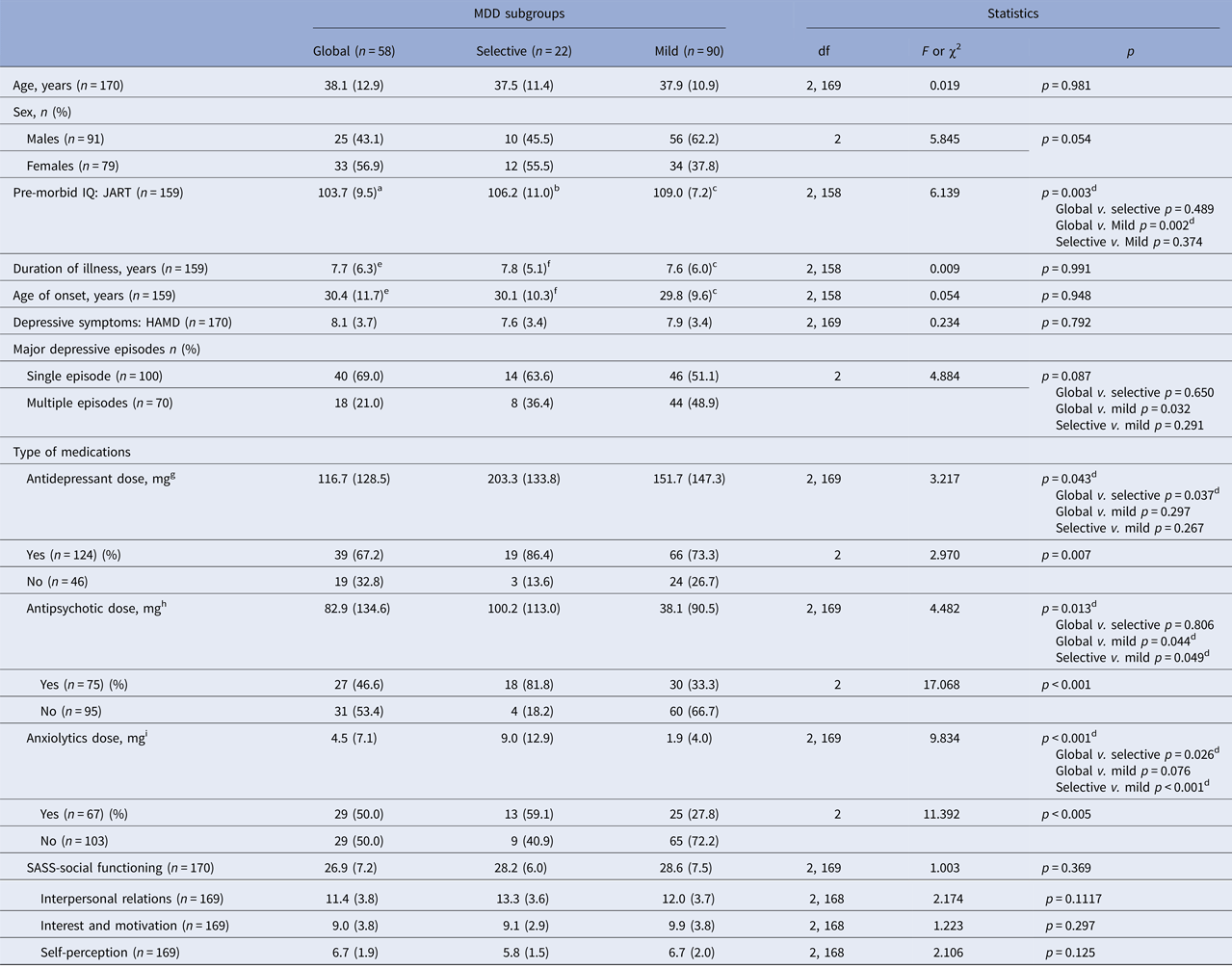
Non-cognitive characteristics of the three MDD subgroups
There was a trend level difference among the three MDD subgroups in sex (χ2 = 5.845, p = 0.054) (Table 3). The three MDD subgroups did not differ in age, duration of illness, or age of onset, current levels of depressive symptoms or social functioning; however, there were significant group differences for pre-morbid-IQ (F 2,158 = 6.14, p = 0.003), with post-hoc tests indicating significant group differences between the global impairment and mild impairment subgroups (p = 0.002). There was no difference between the selective impairment subgroup and each of the other two subgroups. As might be expected, subjects in the global impairment subgroup had the lowest pre-morbid IQ.
Demographics and clinical characteristics of MDD clusters

Data are given as mean (s.d.).
MDD, Major depressive disorder; df, degrees of freedom; IQ, intelligence quotient; JART, Japanese version of the National Adult Reading Test; HAMD, Hamilton Rating Scale for Depression; SASS, Social Adaptation Self-evaluation Scale.
a n = 53.
b n = 22.
c n = 84.
d All p values are adjusted for multiple comparisons with Tukey-HSD (honest significant difference) correction.
e n = 54.
f n = 21.
g Imipramine-equivalent dose.
h Chlorpromazine-equivalent dose.
i Diazepam-equivalent dose.
There was a trend level difference among the three MDD subgroups in the number of major depressive episodes (χ2 = 4.884, p = 0.087); χ2 tests indicated significant differences between the global and mild impairment subgroups (χ2 = 4.619, p = 0.032). There was no difference between the selective impairment subgroup and each of the other two subgroups.
A significant difference among groups was observed in antidepressant dose (p = 0.043), antipsychotic dose (p = 0.013) and anxiolytic dose (p < 0.001), with significant post-hoc differences between the following subgroups: the selective impairment subgroup and the global impairment subgroup for antidepressant dose (p = 0.037); the mild impairment subgroup and each of the other two subgroups for antipsychotic dose (mild v. global: p = 0.044; mild v. selective: p = 0.049); and the selective impairment subgroup and each of the other two subgroups for anxiolytic dose (selective v. global: p = 0.010; selective v. mild: p < 0.001).
Table 4 reports the multivariate associations between cognitive function (BACS subscale scores and composite scores) and ‘subgroups’, ‘premorbid IQ’, ‘sex’, ‘number of major depressive episodes’, and each treatment drug. The significant predictors of composite scores (r 2 = 0.543, adjusted r 2 = 0.521) were categorization in the ‘subgroups’ (β = 0.638, p < 0.001), anxiolytic dose (β = −0.174, p = 0.003), and pre-morbid-IQ (β = 0.123, p = 0.042). The significant predictors of verbal memory (r 2 = 0.369, adjusted r 2 = 0.339) were categorization in the ‘subgroups’ (β = 0.481, p < 0.001), antipsychotic dose (β = −0.173, p = 0.012). The significant predictors of working memory (r 2 = 0.334, adjusted r 2 = 0.303) were categorization in the ‘subgroups’ (β = 0.479, p < 0.001), and pre-morbid-IQ (β = 0.195, p = 0.008). The significant predictors of motor speed (r 2 = 0.147, adjusted r 2 = 0.106) were categorization in the ‘subgroups’ (β = 0.234, p = 0.006), anxiolytic dose (β = −0.253, p = 0.001). The significant predictors of verbal fluency (r 2 = 0.238, adjusted r 2 = 0.201) were categorization in the ‘subgroups’ (β = 0.359, p < 0.001), and pre-morbid-IQ (β = 0.177, p = 0.024). The significant predictors of attention and speed of information processing (r 2 = 0.265, adjusted r 2 = 0.230) were categorization in the ‘subgroups’ (β = 0.359, p < 0.001), anxiolytic dose (β = −0.214, p = 0.004), and antipsychotic dose (β = −0.152, p = 0.040). Finally, the significant predictor for executive function (r 2 = 0.168, adjusted r 2 = 0.128) was categorization in the ‘subgroups’ (β = 0.382, p < 0.001) (Table 4).
Multiple regression predicting the cognitive function from subgroups and potential confounding variablesa

IQ, intelligence quotient.
a Subgroups (global/selective/mild: 1/2/3), sex, pre-morbid-IQ, number of major depressive episodes, and antidepressant, antipsychotic, and anxiolytic dose levels were included in the multiple linear regression analysis.
Discussion
A convergence of anecdotal and clinically based evidence suggests that there is substantial heterogeneity in neurocognitive function in patients with MDD. In this study, we provided empirical support for statistically discrete neurocognitive subgroups in non-psychotic MDD and characterized this heterogeneity.
A meta-analysis of 13 studies in 644 symptomatic patients with first-episode depression v. 570 HCs revealed significant impairments in psychomotor speed, attention, and most aspects of executive function (i.e. attentional switching, verbal fluency, and cognitive flexibility) with small to moderate effect sizes in the patients with depression (Lee et al. Reference Lee, Hermens, Porter and Redoblado-Hodge2012). Impairments in executive function and attention may persist after the affective symptoms are fully mitigated (Rock et al. Reference Rock, Roiser, Riedel and Blackwell2014). Previous studies have consistently shown that, as a group, patients with MDD are impaired by about 0.5–1 s.d. when compared with HCs, particularly in psychomotor speed and executive functioning (Wagner et al. Reference Wagner, Doering, Helmreich, Lieb and Tadić2012). While this level of impairment is considered modest, particularly considering the appreciably more severe deficits in schizophrenia, these data fail to account for the substantial neurocognitive heterogeneity in MDD. Early data suggest that only a small proportion of patients with schizophrenia are considered ‘neuropsychologically normal’ (Wilk et al. Reference Wilk, Gold, McMahon, Humber, Iannone and Buchanan2005; Kremen et al. Reference Kremen, Seidman, Faraone and Tsuang2008), while nearly half of all patients with MDD function within the normal range (Reichenberg et al. Reference Reichenberg, Harvey, Bowie, Mojtabai, Rabinowitz and Heaton2009). Thus, prior group-based analyses comparing these two samples may have failed to capture the extent of the impairment that is present in a specific neurocognitive subgroup of patients with MDD. Indeed, our data strongly support this notion.
Using hierarchical cluster analyses, we found evidence for three distinct cognitively homogeneous subgroups in an unselected sample of 170 patients with non-psychotic MDD. Specifically, we found: (1) a cluster of patients with MDD with normal cognitive functioning (mild impairment subgroup, 52.94% of the sample); (2) a cluster of patients with MDD whose cognitive profiles were consistent with selective impairment (selective impairment subgroup, 12.94% of the sample), with moderate to severe deficits in only a subset of the six cognitive domains; and (3) a cluster of patients with MDD (global impairment subgroup, 34.12% of the sample) with moderate to severe impairment across all neurocognitive domains.
The emergence of a mild impairment subgroup is consistent with prior reports using a −1 s.d. the cut-off to define clinically significant impairment. These studies indicate that approximately 40% of patients with MDD are unimpaired (Reichenberg et al. Reference Reichenberg, Harvey, Bowie, Mojtabai, Rabinowitz and Heaton2009). Our data expand upon this finding and show that there is a specific subgroup that not only fails to meet this threshold of impairment but indeed does not differ from HCs on any of the BACS cognitive domains. The existence of such a group of patients with MDD may have important implications for the efforts to understand the underlying brain mechanisms of the disorder. While studying the physiological mechanisms of persons with MDD who have impaired neurocognitive functions has the potential to elucidate mechanisms associated with poor performance, studying persons with MDD with normal neurocognitive functioning has the potential to identify unaffected or protective neural functions, justifying further research in this area.
Subjects who were clustered into the selective impairment subgroup were characterized by profiles somewhat similar to those commonly found in MDD group-level data. Deficits were noted in the neurocognitive domains including verbal memory, motor speed, verbal fluency, and attention/information processing speed, which at least in part matches those in the previous studies (i.e. psychomotor speed) but not all (i.e. executive functioning). One of the characteristics of this subgroup was that the patients were taking more antipsychotic and anxiolytic medications than those in the other two subgroups. Considering the abundant evidence of the deteriorating effect of anxiolytics on cognitive functioning (Stein & Strickland, Reference Stein and Strickland1998; Kishi et al. Reference Kishi, Moriwaki, Kawashima, Okochi, Fukuo and Kitajima2010; Griffin et al. Reference Griffin, Kaye, Bueno and Kaye2013), the effect of medication cannot be ignored in this subgroup. However, multiple regression analysis of the subgroups revealed no significant correlations between motor speed and medication – antidepressants or antipsychotic, suggesting that the relationship between motor slowing and medication is more complex.
Deficits in the global impairment subgroup were moderate-to-severe and ranged from 1 to 2 s.d. below the mean performance of HCs. These deficits were directly comparable to the impairment in our schizophrenia sample (see Fig. 2) and that in other samples of patients with schizophrenia (Heinrichs & Zakzanis, Reference Heinrichs and Zakzanis1998; Kaneda et al. Reference Kaneda, Sumiyoshi, Keefe, Ishimoto, Numata and Ohmori2007). This overlapping profile is of critical importance when considering data supporting shared molecular genetic risk factors for MDD and schizophrenia (Tsuang et al. Reference Tsuang, Taylor and Faraone2004; Domschke, Reference Domschke2013). As illustrated in Fig. 2, the global measure of cognition (BACS composite scores) would suggest a continuum of severity across the full range of major psychiatric disease such that all patients, regardless of diagnosis, could be characterized by mild, moderate, or severe impairment. The overlap between the global impairment MDD subgroup and patients with schizophrenia argues that patients with MDD do not simply lie in the intermediate range between HCs and patients with schizophrenia on this cognitive continuum. Moreover, when considering performance in specific domains, the presence of qualitative differences across the three MDD clusters supports the existence of meaningfully unique subgroups within the illness.
The extant literature describing cognitive dysfunction in MDD has provided mixed results reflective of the heterogeneity in sample composition (e.g. severity, subtypes, age, and co-morbid medical conditions), as well as treatment status. The three MDD clusters did not differ with regard to age, the age of onset, or current depressive symptoms; however, pre-morbid IQ estimates were significantly different by subgroup. The global impairment subgroup had the lowest pre-morbid IQ. Although it was still considered to be within the normal range, it was significantly lower than the mild impairment subgroup. This suggests that lower IQ prior to the onset of MDD might place a patient at increased risk for developing more severe and generalized neurocognitive deficits in the context of the illness. This is consistent with mild pre-morbid deficits seen in patients with BPD (Burdick et al. Reference Burdick, Russo, Frangou, Mahon, Braga and Shanahan2014) or schizophrenia (Woodberry et al. Reference Woodberry, Giuliano and Seidman2008) and could be conceptualized in reference to the cognitive reserve theory, where higher cognitive capacity could be protective against cognitive decline (Stern, Reference Stern2012). From another perspective, the relatively low pre-morbid IQ in the global impairment subgroup compared to other subgroups may indicate a neurodevelopmental disorder in the global impairment MDD subgroup, which suggests a disease progress similar to that in schizophrenia rather than neurodegenerative progress typically proposed for mood disorders (Shioya et al. Reference Shioya, Saito, Arima, Kakuta, Yuzuriha and Tanaka2015). However, this view may be dubious considering that the pre-morbid IQ is still higher than 100 in this subgroup. Longitudinal studies are warranted to address this hypothesis.
Prior evidence suggests that diagnostic subtypes within MDD may influence the extent of neurocognitive dysfunction; however, our data did not support this finding. The distribution of a single depressive episode v. multiple depressive episodes showed a trend level of difference among subgroups; however, multivariate regression analysis revealed that the dichotomy did not contribute significantly to any domain of neurocognition. The lack of significant contribution in our sample could be due to limited statistical power but it also speaks to the inconsistencies reported in previous studies (Nelson et al. Reference Nelson, Sax and Strakowski1998; Schatzberg et al. Reference Schatzberg, Posener, DeBattista, Kalehzan, Rothschild and Shear2000; Fleming et al. Reference Fleming, Blasey and Schatzberg2004) and the relative paucity of data on neurocognitive functioning across the entire MDD. Consistent with recent meta-analysis studies (Bora et al. Reference Bora, Harrison, Yucel and Pantelis2013), most of the tested clinical variables were not associated with neuropsychological performance in patients with MDD.
Previous evidence also suggests that neurocognitive impairment is an important predictor of functional disability across many psychiatric disorders (Bowie et al. Reference Bowie, Depp, McGrath, Wolyniec, Mausbach and Thornquist2010) including MDD (Gorwood et al. Reference Gorwood, Corruble, Falissard and Goodwin2008; Godard et al. Reference Godard, Grondin, Baruch and Lafleur2011; Lam et al. Reference Lam, Kennedy, Mclntyre and Khullar2014); however, our data did not support this finding. We utilized the SASS to assess social functioning, which is based on self-reports. It is noteworthy, though, that our findings are compromised by the limitations inherent to self-report scales (e.g. Schwarz, Reference Schwarz1999). Schizophrenia patients exhibited relatively better scores compared to patients with MDD, which was clearly against the consistent objective findings that suggest worse functional ability in schizophrenia than in MDD (Bottlender et al. Reference Bottlender, Strauss and Möller2010). The lack of similar studies in the existing literature also prevents us from making direct comparisons and drawing firmer conclusions regarding these findings. We must await further studies using objective measures to reach a conclusion as to whether functional ability may differ among these subgroups.
As the BACS was initially designed to assess cognition in patients with schizophrenia, the use of a more comprehensive neurocognitive battery for patients with affective disorders (e.g. Keefe et al. Reference Keefe, Fox, Davis, Kennel, Walker and Burdick2014a) may have resulted in the emergence of different subgroups. Future studies including larger numbers of tasks and measures of affective processing will be important in establishing and refining these profiles. In addition, the patients with MDD were all non-psychotic, and we did not have accurate information regarding their history of melancholic features and atypical depression. The effect of these clinical indicators on subtyping MDD should be addressed in future studies.
Impairments in cognitive functions are cardinal neuropsychological symptoms in mental illness (schizophrenia, BPD, and MDD), and cognitive remediation therapy has been applied to patients with various psychiatric diseases (Medalia & Choi, Reference Medalia and Choi2009; Lee et al. Reference Lee, Redoblado-Hodge, Naismith, Hermens, Porter and Hickie2013). A meta-analysis of nine randomized trials applying cognitive remediation therapy to patients with MDD found moderate–large effects for attention, working memory, and global functioning (Motter et al. Reference Motter, Pimontel, Rindskopf, Devanand, Doraiswamy and Sneed2016). Another meta-analysis of cognitive rehabilitation in patients with various diagnoses also suggested that cognitive rehabilitation may have a role in patients with MDD (Anaya et al. Reference Anaya, Martinez Aran, Ayuso-Mateos, Wykes, Vieta and Scott2012).
This is the first study describing the presence of empirically derived neurocognitive subgroups in non-psychotic MDD. The potential downstream implications of our findings are twofold. By subgrouping patients with non-psychotic MDD based on neurocognitive profiles, we can reduce the heterogeneity of the phenotype to allow for a more targeted assessment of clinical and biological predictors of cognitive impairment in non-psychotic MDD. The identification of specific biomarkers that are associated with specific neurocognitive profiles will allow for the tailoring of treatments to correct the cognitive dysfunction in non-psychotic MDD. Preventative and early intervention strategies might also be suggested based upon future studies utilizing this approach.
Supplementary material
The supplementary material for this article can be found at https://doi.org/10.1017/S003329171800034X
Acknowledgements
The authors thank all the participants in this study. This research was supported by an Intramural Research Grant for Neurological and Psychiatric Disorders from the NCNP (National Center of Neurology and Psychiatry) (No. 23-10, 26-3, and 27-1 to T.N.) and by support from the Ministry of Health, Labor and Welfare (Health and Labor Sciences Research Grants, Comprehensive Research on Disability, Health and Welfare, No. H23-Seishin-Ippan-002 to T.N.).
Declaration of Interest
None.
Ethical Standards
The authors assert that all procedures contributing to this work comply with the ethical standards of the relevant national and institutional committees on human experimentation and with the Helsinki Declaration of 1975, as revised in 2008.