1. Introduction
Satellite systems and the myriad types of data transmitted over them have become an integral and ubiquitous element of the twenty-first century civilian arena, as well as the military battlefield.Footnote 1 The dramatic increase in their utilisation by both state and non-state actors for civilian, military and dual use purposes over the past decade engages and challenges the existing normative frameworks applicable to both the jus ad bellum and the jus in bello regarding satellite transmissions.Footnote 2
In a rapidly developing international arena, the ramifications of ad bellum legal regimes for IHL is an issue that has engaged international lawyers, regarding which some have observed the difficulty of drawing clear lines between a state of peace and a state of war, or even situational consistency within a war zone.Footnote 3 Beyond questions of status mixtus, the substantive nature of IHL regarding particular topics such as human rights and refugee law may be influenced by the emergence of new human needs of protection. The development of treaty and customary law is, by nature, an ongoing process that reflects new needs such as these and, together with general principles of law and opinio juris, eventually impacts upon and alters IHL.Footnote 4 In the present context, we argue that the dramatic changes in the nature of interstate communications over the past few decades and vastly increased dependence upon communications infrastructures and networks, including satellite systems, call for a re-examination of the presently applicable aspects of relevant IHL. The analysis herein will endeavour to draw out a number of underlying principles that govern peacetime satellite communications, in order to reflect upon the development of IHL in the light of these new communications contexts.
1.1 Background
Since the launch in 1957 of the world's first artificial satellite, Sputnik 1, by the USSR, thousands of satellites have been launched and placed into orbit on behalf of states, international organisations and private consortia by utilising the capabilities of a ‘space club’ of states that have the technological capabilities to launch satellites unilaterally.Footnote 5 Currently, several hundred satellites are operational in various types of orbit around the earth and other planetary bodies.Footnote 6 In addition, thousands of unused satellites and satellite fragments remain in the earth's orbits, collectively known as space debris.Footnote 7
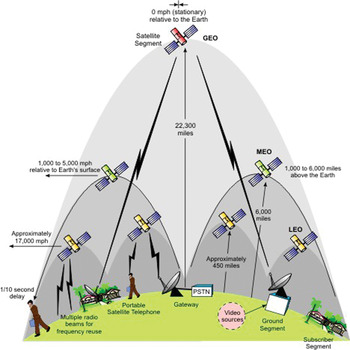
Satellite system operations combine two elements: the physical, corporeal elements of the actual satellite launched into space and its corresponding ground stations, and the element of wireless transmissions that utilise the electromagnetic spectrum in connecting these physical components (see Figure 1). For the purposes of the present legal analysis, the electromagnetic waves carrying satellite communications are considered ‘virtual’ and, as a rule, cause no kinetic, physical impact on the satellites they connect.Footnote 8 As with other computerised systems used for civilian and military applications around the globe, major questions of the vulnerability of satellites to computer network operations (CNOs) arise regarding the utilisation of these systems.Footnote 9 Specifically, the use of the electromagnetic spectrum to disrupt satellite transmissions raises core questions around the interpretation of the term ‘the threat or use of force’ in UN Charter Article 2(4). Moreover, measures undertaken by a state in anticipation of hostile anti-satellite activity (ASAT) by another state or by a non-state actor are liable to challenge the permitted parameters of self-defence under Article 51.Footnote 10
Physical and virtual elements of satellite communications systems (Source: wirelessdictionary.com)

1.2 Clarification of Legal Issues
Some of the legal questions that arise in the context of satellite disruptions can be treated in the context of electronic warfare, which has been part of nations' military arsenals for decades.Footnote 11 Yet there are two differences between transmission disruption and electronic warfare that give rise to distinctions as to the applicable regime. First, satellite transmissions in outer space are subject to the specific regime applicable to space and celestial objects – a different one from that applicable to electronic warfare that largely takes place in a terrestrial context.Footnote 12 Secondly, disruption of satellite transmissions may be caused by physical events that are unrelated to the electromagnetic spectrum, such as the bombing of a ground station. The concept of electronic warfare is thus not broad enough to cover the range of possible disruptions to satellite transmissions.
In addition, it is important to note the (as yet) unresolved and compelling issue of whether a non-physical attack on a satellite system is in fact an armed attack – a relevant legal dilemma for an increasing number of states. More and more, international actors need to know the scope of circumstances in which hostile disruption of a satellite transmission constitutes an act that justifies self-defence, and what the parameters of legitimate response to such an act are.Footnote 13 This important issue is beyond the scope of the present analysis; nevertheless the legal regime that is evolving around these issues will significantly impact on the three regimes reviewed herein.Footnote 14
We will focus here first on the principles underlying the law that applies to transmissions in peacetime in order to better understand present developments and dilemmas, and then on an analysis of the normative regime under IHL.Footnote 15 Analyses of the legal regimes applicable to satellites and satellite communications at the normative level have largely taken as their point of departure either space law or the regulatory regime of the International Telecommunication Union (ITU) for the coordination among states of the utilisation of the electromagnetic spectrum and certain orbital slots. This article aims to integrate both points of departure and to bring into the analysis a third body of law, the underlying international customary regime applicable to transborder communication. This approach views all elements of satellite systems, including the space segment (that is, the satellite in orbit), the ground segment (the transmission and reception facilities on earth) and the electromagnetic transmissions among them (uplinks, downlinks and intra-satellite signals) as a unified communications system.
The present situation, whereby an attack on a ground station is treated by one legal approach that does not account for loss of transmission signal on the uplink nor intra-satellite transmissions in outer space, lacks coherence. Similarly, the law governing disruption of transmissions in the space segment does not, at present, take into account damage to critical systems on earth that rely upon seamless satellite communications, such as GPS, cellular communications and financial data systems. We propose that the unique convergence of the three applicable normative frameworks around satellite system operations, and the perception of these operations as an integrated whole, mandate the recognition of a lex specialis for satellite communications, which in turn should be reflected in the applicable IHL regime.
In concert with this approach, this article will first analyse the normative frameworks regarding the disruption of transmissions in peacetime, and then under IHL, as follows. Section 2 below will address the types of disruption to transmissions, both physical and virtual; Section 3 will analyse the three peacetime normative regimes which come into play as a result of disruption; and Section 4 will examine selected IHL issues. In concluding, we propose that new normative paradigms under IHL regarding satellite transmissions are needed in order to appropriately address the rapid pace of change in satellite-related technologies that provide a constantly expanding capacity for disruption of transmissions.
2. Developing a Taxonomy of Disruptions to Satellite Transmissions in Light of Potential Threats
2.1 The Dual Nature of Potential Threats to Satellite Systems
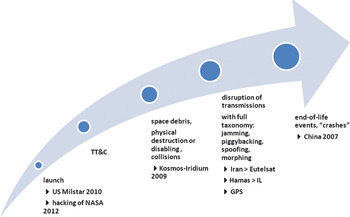
As stated above, satellite systems combine both physical apparatus and virtual data transfers. Thus, disruptions may either be physical, caused by impact with the satellite or the ground station; or virtual, interfering with the electromagnetic communications systems of the satellite on the earth and to and from space.Footnote 16 Satellites rely upon computer networks and the electromagnetic spectrum for the full range of their operations, from the launch stage to stabilisation in orbit, for telemetry, tracking and command (TTC) broadcast, narrowcast and point-to-point communications; intra-satellite communications, and eventual shutdown. For present purposes, the hostile disruption of transmissions, both physically and virtually, will be treated as relevant throughout the full range of the satellite's lifespan, which can at present extend to about 20 years.Footnote 17 Types of hostile disruption are shown below in Figure 2.
Points of possible disruption and selected examples

Because of the varied and technologically evolving nature of hostile disruptions, it is important to develop a taxonomy of their impact on transmissions and on the satellites themselves in the event of physical disruption, of their timing within the satellite's lifespan, and of the collateral damage that they may cause. The legal and policy context for such an initiative (to be treated elsewhere) is the growing threat to international stability posed by potential disruptions, widely acknowledged at the international level.Footnote 18 Specifically, threats to satellite transmissions as a result of increased use of outer space may be categorised into a taxonomy of disruptions, such as satellite collision, harm caused by space debris, and damage to ground stations; as well as jamming, laser blinding, morphing and piggybacking of signals, and interference with the satellite's computer systems housed in ground stations.Footnote 19 The outcome of disruption at the level of physical impact may be harm which goes beyond the physical damage caused to the satellite, also impairing electromagnetic communications. This dual threat introduces new vulnerabilities:Footnote 20
Space systems, however, are now vulnerable to a variety of new forms of attack. Broadly speaking, these emerging threats take two forms: non-kinetic, cyber-enabled attacks made possible by connecting satellite communications systems to the Internet; and kinetic, satellite-to-satellite attacks enabled by the proliferation of inexpensive nanosatellites that are easy to launch and hard to detect, particularly in high orbits.
Yet, as we shall see below, the present legal approaches to these two types of damage are not identical. Physical threats to satellite systems are governed by one regime, and disruption of transmissions, or ‘harmful interference’ in the terminology of the ITU, by another.
At the virtual level of electromagnetic communications, disrupted signals can pose a fundamental threat to states when the satellite communications are also part of the control systems of critical national infrastructures such as banking and financial systems, air traffic control, electricity grids, early-warning weather systems and mass media.Footnote 21 Military communications and data transfer are also highly dependent on satellite communications, often utilising commercial satellites.Footnote 22 USAF Major Christopher Petras, writing in 2002, cites the US Commission to Assess US National Security Space Management and Organization in noting the dependence of national security operations on commercial satellites. He observes ‘the unprecedented convergence of U.S. military and commercial space activities that has taken place over the past decade and is indeed likely to continue’.Footnote 23 This pattern is shared with other states and organisations, despite the clear prohibition on the militarisation of outer space under the current legal regime.Footnote 24
2.2 Physical Threats to Satellite Systems
The dangers posed by physical threats to satellite systems were brought to the fore by the destruction by the US in 1985 of its own P78-1 satellite by missile,Footnote 25 the January 2007 destruction by China of one of its own satellites, a similar initiative on the part of the US in February 2008,Footnote 26 and other, less publicised ASAT events.Footnote 27 Elimination of one of its own satellites by a country constitutes, in effect, a public declaration that the satellites of rival nations are feasible targets. Thus, the prevention of physical destruction of the space segment of satellite systems is now part of the strategic and tactical planning of state actors. The 2009 military doctrine of the US Joint Forces on space operations focuses specifically on this vulnerability of satellite systems, and on the need to anticipate hostile actions against civilian, military and dual-use satellites that may trigger acts of retaliation and self-defence:Footnote 28
Military, civil and commercial sectors … are increasingly dependent on space capabilities, and this dependence is a potential vulnerability. The US will view purposeful interference…with any element of its space systems (ground, communications or orbital) as an infringement on its rights. … Commanders must anticipate hostile actions from state and non-state actors intended to deny friendly forces access to, or use of, space capabilities. They should also anticipate the proliferation and increasing sophistication of space capabilities and products with military utility that could be used by any adversary for hostile purposes.
This doctrine has been recently reiterated and sharpened to specifically (and controversially) include hostile actions in cyberspace which pose a threat to the US in the economic sphere, conceivably such as serious acts against banking systems or the stock market.Footnote 29 Similarly, the Council of the European Union has identified the protection of satellite systems, including transmissions, as a security priority in its 2008 proposed Code of Conduct governing outer space activities.Footnote 30 Russia and China have included provisions regarding satellites in their 2008 proposed treaty on space demilitarisation, the Draft Treaty on the Prevention of the Placement of Weapons in Outer Space.Footnote 31 Nevertheless, there is no sign that ASAT activities on the part of space club nations is abating, and the physical threat that they pose to satellite systems, including through the space debris that they create, is an ongoing source of global concern.Footnote 32
2.3 The Threat of Virtual Disruption: ‘Harmful Interference’ to Satellite Transmissions
All transmissions operate via line-of-sight connections with ground stations, and each satellite is accorded transmission frequencies for operations in accordance with the inter-governmental regulatory regime developed by the ITU,Footnote 33 as well as slots on the geostationary orbit, when relevant. These uplinks and downlinks prevent mutual blockage of the electromagnetic waves carrying the transmissions and minimise ‘harmful interference’, the ITU's term for virtual disruption of transmissions.Footnote 34 The prohibition on harmful interference is a primary underlying reciprocity principle of the ITU regime. The core normative prescription in this respect states:Footnote 35
All [communications] stations, whatever their purpose, must be established and operated in such a manner as not to cause harmful interference to the radio services or communications of other Member States or of recognized operating agencies.
Hostile harmful interference has been considered a type of electronic warfareFootnote 36 or information warfare,Footnote 37 and is likely eventually to be categorised as a specific type of CNO.Footnote 38
2.4 Present Gaps in Enforcement Against Virtual and Physical Threats
There are dozens of known instances of intentional harmful interference to satellite transmissions in recent years, including Russian jamming of Chechen satellite telephones in 1994–95; Cuban disruption of Iranian broadcasts in 2009; Hamas disruption of Israeli satellite broadcasts during Operation Cast Lead the same year;Footnote 39 Iranian disruption of Eutelsat transmissions since 2009, the subject of formal protest to the ITU;Footnote 40 Brazilian hackers' disruption of US Navy FLTSAT-8 in 2010; Jordanian jamming of Al-Jazeera transmissions in 2011; and China's blocking of BBC transmissions in 2012.Footnote 41
States may negotiate mitigation of interference bilaterally, or turn to the ITU, which is the designated arbiter of interference disputes when its member states require the assistance of a third party. The Radio Regulations contain mechanisms for dispute resolution among the 193 member states, and an Optional Protocol for the Compulsory Settlement of Disputes has been signed by 64 members.Footnote 42 Yet the ITU has acknowledged in recent years both the increasing number of incidents of harmful interference and the inadequacy of its existing dispute resolution mechanisms, which depend largely on the good will of member states in coordinating frequency use.Footnote 43 At the World Radiocommunication Conference that took place in early 2012, an amendment to the Regulations was passed with the intent of improving the process for addressing harmful interference issues,Footnote 44 and the ITU has publicly committed to re-examine the existing dispute resolution mechanisms.
Thus, despite the existing normative guidelines, there are at present gaps in the effectiveness of the ITU's procedures aimed at mitigating harmful interference. Current remedies are limited to notification and complaint of hostile disruptions to the ITU Secretary-General (as occurred in the case of the Iranian disruption of Eutelsat transmissions);Footnote 45 claims for compensation under commercial contracts with satellite service suppliers; and, for physical damage, claims under the 1972 Convention on International Liability for Damage Caused by Space Objects.Footnote 46 Nonetheless, these options have rarely been exercised by states. In part, this is because of the absence of a clear taxonomy of the types of disruption, and a cohesive understanding of the threats they present and the legal and practical ramifications of disruption at each stage. The resulting ambiguity has impacted upon the effectiveness of enforcement measures. For example, even though Canada invoked the Liability Convention in its 1978 claim against Russia for damages in the wake of the crash of RORSAT Cosmos 954 over Canadian territory, the final payment of damages mentioned neither the Convention itself nor the head of damage defined by it.Footnote 47
One approach to remedying part of this ambiguity is to combine the above-mentioned taxonomy of disruptions with a results test, or gradient, of the damage caused to communications and the de facto effects of disruption. Another, narrower, approach could focus on the particular stage of transmission: disruption of the terrestrial element of the satellite system being perceived less severely than a disruption in deep space, where there is less capacity for supervision and damage assessment on the part of the harmed state. A third basis for taxonomy might be the reversibility of the effects of disruption. A comprehensive approach to this challenge is currently being researched separately in the context of the development of the lex specialis for satellite systems (discussed in Section 6 below).
In wartime, as we shall see below, there is even less certainty as to the parameters of permissible activity under IHL, as is evidenced by lacunae in treaty, custom and in the contemporary writings of scholars. Legal analysis has so far occurred in a near vacuum, as state practices regarding cases of wartime disruption of satellite communications are few and far between, unknown to the general public, or non-controversial.Footnote 48
A new paradigm is needed to address the needs of the international community based on the intersecting normative regimes, and to accommodate the new technologies and vulnerabilities of state and non-state actors. In the following section, the three relevant regimes that apply to hostile disruption of satellite transmissions in time of peace will be reviewed, followed by an analysis of their importance for developing IHL norms that will be more closely applicable to satellite transmissions.
3. Three Intersecting Normative Regimes
Satellite transmissions are subject to three separate yet intersecting normative constructs: (i) transborder freedom of information; (ii) ITU regulation of access to satellite infrastructures via the electromagnetic spectrum; and (iii) space law.
3.1 Freedom of Transborder Information Flow and its Limitations
Transborder freedom of information is defined and recognised as a human right in Article 19 of the Universal Declaration of Human Rights:Footnote 49
Everyone has the right to freedom of opinion and expression; this right includes freedom to hold opinions without interference and to seek, receive and impart information and ideas through any media and regardless of frontiers.
Freedom of information is specifically defined as being independent of the transmitting media. The customary law embodied in Article 19 – the article of the same number in the 1966 International Covenant on Civil and Political Rights – and similar provisions in regional human rights treatiesFootnote 50 has an interesting history beginning in nineteenth century concepts of democracy and freedom of expression.Footnote 51 While acknowledging that freedom of information emerged as a legal concept on the international level only in the second half of the twentieth century, Malanczuk notes that:Footnote 52
From the very beginning, individual liberal constitutions have attached particular importance to freedom of opinion and expression, freedom of the press, and freedom of information of the individual in the sense of the right to receive, impart and seek information and ideas regardless of frontiers.
The scope of freedom of information, particularly in the context of wireless transmissions, has waxed and waned in accordance with both technological developments (from radio broadcasting in the early twentieth century through to present satellite transmissions) and state practice. There is still debate among scholars over whether Article 19 embodies a customary norm of international law,Footnote 53 although the question of derivation of this right from international treaty law or customary law may, in the event, be moot, given the widespread accession of states to treaties containing an ‘Article 19’ provision and the body of domestic and international jurisprudence surrounding it.Footnote 54
Following the development of widespread public radio broadcasting in the first decades of the twentieth century, an early effort to restrict the right to exclude hostile propaganda and incitement to war was evident in the 1936 International Convention Concerning the Use of Broadcasting in the Cause of Peace. The Convention attempted to remedy the lack of norms regarding the propaganda transmissions over public radio during the First World War.Footnote 55 Throughout that War, during the 1947 Nuremberg Trials and for the duration of the Cold War, the question whether states may jam media broadcasts from hostile states was debated, including (in the post-Second World War period) in the context of dozens of UN and UN specialised agency decisions and resolutions.Footnote 56 The legal debate was further carried over during the 1970s into the realm of direct broadcast satellite transmissions, characterised by the ‘free flow versus prior consent’ question raised at the UN,Footnote 57 in the EU and the OECD, until commercial considerations and digital encoding brought it to resolution.Footnote 58
In this context, it is interesting to note the October 2011 anti-jamming position of the Council of the European Union in the context of its call to Iran to end serious human rights violations. The Council imposed an assets freeze and a visa ban on Iranians responsible for human rights violations in that country, and called upon authorities ‘to lift restrictions on communications, including internet censorship, and put an immediate end to jamming of satellite broadcasting’.Footnote 59
Metzl evaluates the customary law regarding freedom of transborder communication in a 1997 article reviewing the legality of 1994 radio broadcasts by the Rwandan Radio Télévision Libre des Mille Collines (RTLM) that incited against Tutsi, moderate Hutu and UN personnel. These ‘hate broadcasts’ were eventually determined by the International Criminal Tribunal for Rwanda to constitute incitement to genocide of the Tutsi, amounting to a violation of jus cogens by the Hutu RTLM personnel.Footnote 60 Metzl writes, with regard to the possibility of a customary law justification for jamming such broadcasts:Footnote 61
stripped of its Cold War overtones, the international law regarding radio jamming is not nearly as uniform and absolute as it may once have seemed, even if the strong presumption toward the free flow of information and against jamming continues to fulfill a valuable international role.
Here, Metzl argues that the ‘strong presumption’ in international law supporting the international right to communicate may have limitations in such extreme circumstances. The Rwanda broadcasts inciting to genocide may have been jammed legitimately by other states, and Metzl posits that there may even be a duty to jam broadcasts that violate jus cogens, or where jamming can mitigate a humanitarian crisis. The option of jamming is also available under UN Charter Article 41, which permits the Security Council to call upon member states to interrupt ‘postal, telegraphic, radio and other means of communication’ as a response to a threat to peace, danger to peace or aggression.Footnote 62 Also, Article 41(2) of the ILC's Draft Articles on Responsibility of States for Internationally Wrongful Acts would support such a response.Footnote 63
Extending the analysis above into the context of satellite transmissions, freedom of information is established as a technology-neutral right, applicable to satellite transmissions, and supporting their continuity while prohibiting their disruption by either physical or virtual means. Whether international treaty law or customary law obtains in a particular case, there may be specific limitations on the scope of the content protected. In particular, freedom of information via satellite transmissions, as with other types of transborder communication, may be limited by the international community for jus cogens considerations, such as the prevention of incitement to genocide.
3.2 ITU Regulation of Access to Communications Infrastructures
As noted above, the ITU is the UN specialised agency charged with the global regulation of telecommunications,Footnote 64 defined broadly as ‘[a]ny transmission, emission or reception of signs, signals, writing, images and sounds or intelligence of any nature by wire, radio, optical or other electromagnetic systems’.Footnote 65 In accordance with this broad definition, the ITU regulatory regime applies to satellite transmissions in their entirety. Within the ITU, the Radiocommunication Sector (RS) is responsible for the assignment of orbital slots and uplinks to and downlinks from satellites.Footnote 66
In implementing satellite registrations and regulating use, the ITU Constitution sets out several principles that govern the global use of telecommunications infrastructures and resources, including the spectrum and the geostationary orbit.Footnote 67 The first is embodied in its Article 33, and echoes the international freedom of information reviewed in the section above:Footnote 68
Member States recognize the right of the public to correspond by means of the international service of public correspondence. The services, the charges and the safeguards shall be the same for all users in each category of correspondence without any priority or preference.
This prescription of non-discriminatory use of communications infrastructure among the ITU's 193 members may be limited by the authority of states under Articles 34 and 35, which permit states to suspend ingoing and outgoing communications with respect to their own national territory. This authority, stemming from a state's capacity as a sovereign to control the flow of information domestically, does not extend beyond the state's borders,Footnote 69 and is conditional upon public notification.Footnote 70 Three additional provisions in the ITU Constitution are relevant to the ITU regime in the context of satellite transmissions:
• Article 44 provides that the global spectrum resource and satellite orbits are limited natural resources that must be used ‘rationally, efficiently and economically’; and that ‘countries or groups of countries [must] have equitable access to those orbits and frequencies’.Footnote 71
• Article 45 specifically prohibits the disruption of all wireless communications, including satellite transmissions, among member states (‘harmful interference’), as reviewed above.
• Emergency communications are given special protection by the subsequent Article 46, and receive ‘absolute priority’Footnote 72 over other types of communication.
The partial exemption of military installations from the above normative provisions in Article 48 of the Constitution has had a complicated evolution and application, especially given the overwhelming dual nature of contemporary satellite infrastructure.Footnote 73 It will be expanded upon in Section 4 below.
The ITU management scheme for satellites and their communications frequencies is found in the Radio Regulations, which are binding international instruments for member states,Footnote 74 and are the subject of regular revision at the biennial World Radiocommunication Conferences (WRC). Article 5, for instance, sets out the procedure for registration of access frequencies, and Annex 2 lists characteristics of satellite networks, earth stations and radio astronomy stations that must be supplied by the launching state to the ITU for coordination purposes.Footnote 75 The Master International Frequency Register (MIFR) serves as the global register of frequencies and orbital slots that have undergone full coordination procedures. Legally and administratively, the MIFR is intended to provide international recognition for the state's exclusive use of the pre-coordinated frequencies, and to provide protection from harmful interference.Footnote 76
In sum, the ITU regulatory regime provides a strong normative backbone for ensuring open and uninterrupted satellite communications. The regime aims at optimal transparency for state and non-state entities utilising all elements of the satellite infrastructure, including uplinks and downlinks. The partial exemption in respect of military communications satellites is a challenge to the transparency of the ITU satellite regime, somewhat mitigated by the preponderance of dual-use satellites referred to above. These provisions of the ITU Constitution stem from a solid and relatively longstanding customary law base that has developed over the course of the evolution of wireless communications since their invention in the mid-nineteenth century to the present.Footnote 77 Nonetheless, the enforcement issues reviewed in Section 2.4 above pose an ongoing challenge for this regime.
3.3 Space Law
Space law has developed more recently than the two regimes reviewed above in the context of space exploration since the end of the twentieth century.Footnote 78 The leading treaty in force is the 1967 Outer Space Treaty.Footnote 79 It establishes that space is free for peaceful exploitation and for use by all states as part of the common heritage of mankind; and that it is subject to general international law, and specifically the UN Charter.Footnote 80 Claims of sovereignty may not be made in space or on moons or planets,Footnote 81 yet states retain sovereignty and control over satellites and other space objects that they launch into space. The treaty also establishes state responsibility and international liability for any damage caused by such an object.Footnote 82
Thus, states are responsible for actions by satellites launched and operated under their jurisdiction.Footnote 83 Specifically, the Liability Convention, which elucidates and elaborates Article VII, establishes absolute liability for payment of compensation ‘for damage caused by its space object on the surface of the earth or to aircraft in flight’;Footnote 84 in other areas, such as outer space itself, liability needs to be established under the provisions of Articles II and IV. For the purposes of this Convention, ‘damage’ is defined in Article 1 as follows:Footnote 85
[the] loss of life, personal injury or other impairment of health; or loss of or damage to property of States or of persons, natural or juridical, or property of international intergovernmental organizations.
In the case of damage caused by a satellite on earth, the launching state has absolute liability; for damage caused in space, fault must be established. Despite several cases in which its provisions appeared to have been relevant to the settlement of disputes over damage caused under one or both heads of claim, the Liability Convention has yet to be formally applied.Footnote 86
Nonetheless, future application of the Convention may raise the issue of interpretation of the scope of Article 1. Does harmful interference with satellite transmissions caused by another satellite (or its debris) constitute ‘damage’ under the Convention, initiating the enforcement mechanisms within it? The required element of ‘loss or damage to property’ necessitates an understanding of transmissions and the data they carry as the property of a state or private entity in this context. It is argued that the application of the Liability Convention to satellite transmissions is not unreasonable,Footnote 87 given that in other international legal contexts, such as the application of the WIPO Convention, satellite transmissions are viewed as property and are the subject of proprietary rights thereunder.Footnote 88
Whatever the scope eventually accorded to Article 1, the present body of space law regarding liability for damages has been subject to scholarly critique for substantive lacunae, lack of clarity, and difficulty in applying it to the increasingly acute problems caused by space debris.Footnote 89 In addition, the OECD has called for clarification of liability scenarios under the international space law regime, given the ‘substantial potential’ of space applications to bring significant benefits to society at large, as well as the desirability of establishing a predictable and stable environment for space activities.Footnote 90
Satellite conventions in force among commercial operators and satellite consortia, such as the International Maritime Satellite Organization (IMSO) and Intelsat, provide their own compensatory regimes when client transmissions are interrupted, distorted or otherwise damaged.Footnote 91 These private law arrangements, although beyond the scope of the present analysis, require further elucidation and inquiry, and may hold insights for the remedy of lacunae in the public international law.Footnote 92
In summary, although space and space bodies cannot be treated as the sovereign territory of nation states, satellites remain under the sovereign control and responsibility of the launching state or states, and general international law remains applicable in outer space. Regarding liability for physical damage to satellites, the Outer Space Treaty and the Liability Convention establish state liability for damage caused by satellites and their components, where ‘damage’ is broadly construed in Article 1 of the Liability Convention. Although the Liability Convention has yet to be applied de jure, a flexible interpretation of the term ‘property’ under the Convention may require compensation under its provisions when satellite transmissions are harmed by other satellites or their debris.
The three legal regimes reviewed in this section inform the normative regime regarding disruption of satellite transmissions under IHL, although, as stated above, the application of the latter is at present largely theoretical. As state practice develops, the degree of implementation of each of these regimes will be crucial to the integrity of the evolving IHL regime and its connection to the relevant public international law ad bellum.
4. Disruption of Satellite Transmissions under IHL
4.1 The Legal and Policy Challenges
We have briefly reviewed above the underlying principles of jus ad bellum with regard to satellite transmissions that are likely to influence the developing body of IHL.Footnote 93 Moreover, the jus in bello will be influenced by the principle embodied in the Martens Clause contained in the Preamble to the Hague Convention and reworded in Article 1(2) of Additional Protocol I. The clause specifies that, in wartime, civilians and combatants remain under the protection of international law derived from custom, from the principles of humanity and from the dictates of public conscience.Footnote 94 On this basis, we shall now review the existing IHL with regard to several aspects of satellite and other communications, and examine some of the relevant ‘principles’ that were analysed in Section 3 above, and their possible attenuation in time of war.
While the logical shift in applying Hague and Geneva norms that evolved in the context of terrestrial warfare into a mixed terrestrial space setting is not a trivial one, it is at present driven by the practical necessities of contemporary armed conflict. In this regard, Maogoto and Freeland write:Footnote 95
Without wishing to appear melodramatic, the prospect of a celestial war can no longer be regarded as mere fantasy. Just as States have already been undertaking what might be termed ‘passive’ military activities in outer space since the advent of space technology, outer space is increasingly being used as part of active engagement in the conduct of armed conflict. Not only is information gathered from outer space – through, for example, the use of remote satellite technology and communications satellites – used to plan military engagement on earth, space assets are now used to direct military activity and represent an integral part of the military hardware of the major powers. It is now within the realms of reality to imagine outer space as an emerging theatre of warfare.
In an October 2011 report that addresses the application of IHL to new forms of armed conflict, the ICRC states its position that IHL continues to apply to ‘new technological developments’ as well:Footnote 96
There can be no doubt that IHL applies to new weaponry and to the employment in warfare of new technological developments, as recognized, inter alia, in article 36 of Additional Protocol I. Nonetheless, applying pre-existing legal rules to a new technology raises the question of whether the rules are sufficiently clear in light of the technology's specific characteristics, as well as with regard to the foreseeable humanitarian impact it may have.
The same report concludes that individual and state responsibility for conformity with IHL has not been altered by the use of new technologies. Both physical and virtual disruption of satellite transmissions are undoubtedly to be considered in this category.Footnote 97
Specifically with regard to ASAT activities, the application of IHL to these measures on the part of states has yet to become a concrete challenge to the international community. De facto wars have not yet taken place in space. De jure, the international community has mandated by means of treaty law that outer space be utilised exclusively for peaceful uses, as reviewed in Section 3.3 above.Footnote 98 Nonetheless, Article III of the Outer Space Treaty requires that space activities take place in conformity with international law, including the UN Charter provisions regarding collective security and self-defence, anticipating future conflicts that may take place either wholly or partially in outer space.
Beard also has emphasised the new challenges to IHL presented by virtual activities in cyberspace that are an integral part of contemporary warfare, writing that ‘[v]irtual weapons systems are poised to transform the conditions of future battlefields for humans and change law, war and military institutions in profound, far reaching ways’.Footnote 99 These new possibilities may be unexpected and, in fact, may have the potential to reduce the cost of military actions in terms of human lives. Dunlap, quoted in the Naval War College's International Law and the Changing Character of War, gives an illustrative example:Footnote 100
[J]ust prior to the first Gulf War, the United States purchased satellite imagery of coalition forces from multiple commercial companies, thereby denying that intelligence information to Iraq and obviating the need for military action to keep Iraq from obtaining the imagery.
A review of three particular regimes follows, with a summary of their potential application regarding satellite communications.
4.2 Three Issues: Distinction, Ruses of War and Communication Infrastructures under Occupation
The technical and substantive protections given to wireless communications and to communications installations by the ad bellum three legal regimes reviewed above are mitigated in a number of ways during wartime.
It is interesting to note at the outset the Hague rules regarding wireless telegraphy from 1923, codified by a Commission of Jurists between 1922 and 1923.Footnote 101 Wireless communications were relatively new to warfare, although the forerunner organisations of the ITUFootnote 102 had begun to regulate both wireless and wired (that is, telephone and telegraph) communications at the turn of the century. Article 1 of the 1923 Rules succinctly states the norm for wireless telegraphy in time of war, in a manner that also establishes the general trend in IHL for satellite transmissions:Footnote 103
In time of war, the operation of wireless stations continues to be organized, so far as possible, in a manner as not to interfere with the service of other wireless stations. This rule does not apply to the wireless stations of the enemy.
Thus, enemy wireless radio stations are specifically exempted from the requirement to avoid harmful interference. This concept is echoed in Article 48 of the ITU Constitution, which provides that ‘Member States retain their entire freedom with regard to military radio installations’ even during peacetime, although they are bound to uphold, to the extent possible, provisions regarding distress messages and the avoidance of harmful interference.Footnote 104 Moreover, in a 1956 list of categories of legitimate military objectives, the ICRC included ‘[t]he installations of broadcasting and television stations; telephone and telegraph exchanges of fundamental military importance’.Footnote 105 Both physical and virtual damage to transmissions, including to terrestrial parts of satellite networks, is at least partially permitted during war.Footnote 106
The analysis herein will focus on issues relating to the disruption of satellite transmissions during wartime and under occupation that are treated under the Hague ConventionFootnote 107 and Additional Protocol I:Footnote 108 the issue of distinction of combatants and targets; ruses of war and perfidy; and protection of communication infrastructures under the law of occupation.
4.2.1 Distinction of Combatants and Targets
Non-combatants merit protection under IHL in accordance with Article 48 of Additional Protocol I, which states:Footnote 109
In order to ensure respect for and protection of the civilian population and civilian objects, the Parties to the conflict shall at all times distinguish between the civilian population and combatants and between civilian objects and military objectives, and accordingly shall direct their operations only against military objectives.
Civilians who in fact take part in hostilities lose their civilian status for the time they are so engaged, according to Article 51(3).Footnote 110
In the context of wartime disruption of satellite transmissions, real difficulties of distinction of combatants are posed. Systems operators may or may not be military personnel or located in a military venue at the time that they program or initiate a disruption, and distinction becomes unfeasible in circumstances in which a programmer may have acted a significant time and distance away from the actual disruptive event.Footnote 111 Two examples of the difficulties in identifying military or civilian identities of the attackers are relevant here. The first is the interference in 2007 and 2008 with two US government satellites, Landsat 7 and Terra AM, caused by computer hackers who are suspected of having operated on behalf of the Chinese military.Footnote 112 The second is the success of a group of hackers who attacked a British Defence Ministry satellite in 1999, ‘triggering a security advisory and immediate response from British intelligence and defence organizations’.Footnote 113 Some countries have announced public recruitment campaigns for civilians who can be called upon to engage in hacking computer systems, including those guiding satellite systems, in situations determined by either military or political leadership, on the presumption that civilian computer skills are an increasingly important national strategic asset.Footnote 114
The ICRC has addressed the issue of ‘direct participation’ of civilians in present military conflict, especially those characterised by new technologies, as referring to specific hostile acts ‘carried out by individuals as part of the conduct of hostilities between parties to an armed conflict’.Footnote 115 In reviewing the ICRC's 2009 attempt to clarify ‘direct participation’ in its controversial Interpretive Guidance on the Notion of Direct Participation in Hostilities under International Humanitarian Law,Footnote 116 Garraway notes that, in several IHL contexts, the law of distinction between combatants and non-combatants is presently in flux. Particularly in the realm of satellite system activities, which are carried out over an extended period of time throughout the lifetime of the satellite and require expertise in managing the computerised elements of the satellite system that is not always to be found within military organisations, distinction will probably prove to be an abiding challenge.Footnote 117
Distinction of military targets is no less of a difficulty, as dual-use satellites become an increasingly integral part of national military arsenals. The extensive utilisation by military forces of civilian and commercial satellites, as well as dual-use communications channels, creates new challenges in distinguishing between military and non-military targets with necessary accuracy.Footnote 118
In summary, the rules of IHL reviewed in this section have relevance to the determination of the legality of disruption of satellite transmissions during wartime. By and large, the existing body of the IHL rules on distinction constitutes a basis for addressing the challenges raised by this new element of warfare, although new thinking on the utilisation of civilians to implement disruptions and the utilisation of dual-use satellites still require important clarification.Footnote 119
4.2.2 Ruses of War and Perfidy
Under IHL the principle of chivalry determines that dishonourable and treacherous means of combat are forbidden. In the interaction that takes place between belligerent forces, Article 23 of the Hague Regulations prohibits a specific type of military communication, later defined in Article 37(1) of Additional Protocol I, as perfidious, or the ‘false flag’ phenomenon. Article 37(1) states:Footnote 120
It is prohibited to kill, injure or capture an adversary by resort to perfidy. Acts inviting the confidence of an adversary to lead him to believe that he is entitled to, or is obliged to accord, protection under the rules of international law applicable in armed conflict, with intent to betray that confidence, shall constitute perfidy.
Thus, ‘to make improper use of a flag of truce, of the national flag or of the military insignia and uniform of the enemy, as well as the distinctive badges of the Geneva Convention’ in a way that would cause death, injury or captivity constitutes perfidy, since such use would be liable to cause an adversary to change his or her perception of the IHL protections given to such symbols. It would be treacherous, and thus prohibited under IHL.Footnote 121 On the other hand, ruses of war that stop short of perfidy are permitted. Article 24 of the Hague Regulations states that ‘[r]uses of war and the employment of measures necessary for obtaining information about the enemy and the country are considered permissible’.Footnote 122 This is an especially interesting determination in the context of military satellite observation and monitoring.Footnote 123 Article 37(2) of Additional Protocol I elaborates:Footnote 124
Ruses of war are not prohibited. Such ruses are acts which are intended to mislead an adversary or to induce him to act recklessly but which infringe no rule of international law applicable in armed conflict and which are not perfidious because they do not invite the confidence of an adversary with respect to protection under that law. The following are examples of such ruses: the use of camouflage, decoys, mock operations and misinformation.
Disruptions to satellite transmissions between belligerents that substitute, piggyback, or morph transmissions in order to convey false information during wartime will be considered legitimate ruses of war if they conform to these requirements, and do not cross the line into prohibited perfidy by changing combatants' perception of their own protected status. Thus, a morphed satellite broadcast showing the enemy's military leadership announcing a surrender of forces as immediately effective; or a military communication via satellite falsely identifying a vehicle or personnel as protected medical units would both be perfidious. On the other hand, morphing of satellite communications, piggybacking on signals and spoofingFootnote 125 that remain within the boundaries of ruses of war – such as substitution of enemy weapons coordinates or the provision of false satellite transmissions regarding troop movements – would be legitimate ‘misinformation’ under Article 37(2). In accordance with Article 37(1), these examples would be subject to a determination that such acts ‘improperly’ cause death, injury or captivity.
4.2.3 Special Protection of Communications Infrastructures under the Law of Occupation
Communications infrastructures, including satellite systems, hold a particular status under the law of occupation. In principle, when enemy territory is occupied as a result of war, the occupying army is permitted to utilise existing resources under the laws of occupation. Specifically, Articles 53 and 54 of the Hague Regulations address the authority of the occupying army to take possession of state and private property during hostilities, provided that particular types of said property (specifically communications and transport facilities and equipment) are restored and compensation is paid when peace is made.Footnote 126 This protection is given specifically to ‘[a]ll appliances, whether on land, at sea, or in the air, adapted for the transmission of news’ and to submarine communications cables connecting enemy territory with that of a neutral power (emphasis added).
Updating this provision to encompass contemporary technologies, the Coalition Provisional Authority (CPA) in Iraq issued an Order in 2003 relying on ‘the extensive specific authority granted to the CPA under the laws and usages of war for the control of all appliances, whether on land, at sea, or in the air, adapted for the transmission of information, whether state or privately owned’.Footnote 127
Thus, communications infrastructures, along with some other specified property, are held to have a special status requiring restitution at the conclusion of occupation.Footnote 128 The original motivation for this protection is not transparent in the literature, but may well have reflected the contemporary understanding that communications infrastructures were an inherent element of state sovereignty, and, in addition, required considerable public investment in order to become and remain operative.
State practice on this provision is similarly not transparent, although one example is the NATO bombing of the RTS broadcast station in Belgrade in 1999, which cost the lives of between 10 and 17 civilians.Footnote 129 Although the NATO action did not take place in occupied territory but in a situation of war, the incident is illustrative of the targeting of a communications infrastructure in wartime.
In that case, NATO officials reported to Amnesty International in press conferences in April 1999 that the RTS facilities constituted a highly sophisticated dual-use transmission station, which included satellite transmissions, and were being used ‘as radio relay stations and transmitters to support the activities of the [Federal Republic of Yugoslavia (FRY)] military and special police forces, and therefore they represent legitimate military targets’.Footnote 130 The relevance of this determination becomes clear in the context of Article 52(2) of Additional Protocol I:
Attacks shall be limited strictly to military objectives. In so far as objects are concerned, military objectives are limited to those objects which by their nature, location, purpose or use make an effective contribution to military action and whose total or partial destruction, capture or neutralization, in the circumstances ruling at the time, offers a definite military advantage.
Beyond the targeting of the military communications of the FRY, the bombing was also justified as an anti-propaganda attack. NATO claimed that the communications system, including its satellite components, constituted an integral part of the FRY military campaign:Footnote 131
[We need to] directly strike at the very central nerve system of Milosovic's regime. [These] of course are those assets which are used to plan and direct and to create the political environment of tolerance in Yugoslavia in which these brutalities can not only be accepted but even condoned. … Strikes against TV transmitters and broadcast facilities are part of our campaign to dismantle the FRY propaganda machinery which is a vital part of President Milosevic's control mechanism.
Significantly for the future implications of both physical and virtual disruption of satellite transmissions, the targeted broadcasts were reinstated by the FRY from other broadcasting stations within hours of NATO's strike. This ability to technically duplicate broadcast and other wireless transmission infrastructures in a short period of time illustrates another challenge for the developing IHL in this area.
5. A Final Observation: Satellite Transmissions and Computer Network Operations
As discussed briefly in Section 1 above, the hostile disruption of satellite transmissions through harmful interference with the electromagnetic spectrum represents a type of CNO, which is a much discussed development in the fifth domain of warfare (after land, sea, air and space).Footnote 132 Since transmissions utilise the electromagnetic spectrum and computer systems for the uplink, downlink and intra-satellite segments, an attack on the satellite earth station, the satellite itself, and the communications links between the two, as described above, conforms fully to this definition as a particular type of CNO. Although its analysis is beyond the scope of this article, the present efforts by the international legal system to address the issue of CNOs and to develop normative frameworks around it that conform to IHL constraints – such as the current Tallinn Manual project under the aegis of NATOFootnote 133 – will apply to satellite systems as well.Footnote 134 The special nature of the law applying to satellite transmissions, reviewed above, will determine a lex specialis regarding hostile disruption of transmissions within the more general framework of the eventual CNO regime that will apply in future war situations.
6. Conclusions
The implications for IHL of the relatively new phenomenon of hostile disruption to satellite transmissions require a fresh approach to the analysis of three intersecting normative regimes: the substantive law regarding freedom of transborder communication; ITU regulation of international telecommunications; and space law. In the present analysis, each of these three regimes has been shown to contribute to an overarching normative framework regarding both physical and virtual types of disruption of satellite transmissions. To better address the growing vulnerability of state and non-state entities to the threat of hostile transmission disruption, the convergence of the three, around the operation of both the ground and the space segments of satellite systems, should be applied as a lex specialis. Moreover, there is a critical need for better enforcement of existing mechanisms to compensate those harmed by disruption to the full taxonomy of satellite transmissions, whether the disruption is physical or virtual.
The law applicable to disruptions under IHL will benefit by reflecting these developments also, in order to be optimally effective on the physical and virtual modern battlefields. Vermeer has noted that the usual course of events is for the appropriate developments in IHL to follow occurrences, rather than to precede them. Thus,Footnote 135
A law of armed conflict in space or jus in bello spatial is … unlikely to emerge in the near future; the law of armed conflict is inherently shaped after a conflict rather than before.
Yet, given the present accelerating pace of development in satellite technology and space utilisation, the time is at hand for an intergovernmental evaluation of the convergence of the three normative regimes and their enforcement. The legal elements of this lex specialis already exist at the normative level and need only to be re-examined, refined and taken into careful consideration as part of the broader development of the relevant IHL.