Introduction
The empirical literature on the democratic peace confidently contends that democracies rarely, if ever, go to war against or find themselves embroiled in militarised disputes with other democracies.Footnote 1 There is less agreement, however, on the question of why democracies maintain peaceful relations among each other.
There are two dominant strands of theoretical explanations of the alleged democratic peace: institutional (structural) and normative theories. Institutional or structural theory argues that institutional traits in democracies – such as free elections and a separation of powers – work to constrain the political leaders’ scope of action, thereby acting as a check on any adventurous foreign-policy endeavours by the leadership.Footnote 2 Normative theory, for its part, claims that citizens in well-established (liberal) democracies harbour ‘democratic-pacifistic’ values and norms. These norms, in turn, are externalised to foreign affairs, reducing the likelihood that state goals will be pursued by violent means.Footnote 3 Both these purported mechanisms are particularly held to be valid in relations among democracies. A dyadic democratic peace arises not least because the mutual trust between democracies ameliorates the security dilemma and the escalation potential in interstate conflicts and crises.
Given the presumed direct or indirect influence of the citizenry on foreign policy, it is somewhat unfortunate that there is a dearth of studies exploring the public’s preferences and values directly. Although valuable exceptions do exist, primarily in the form of experimental studies,Footnote 4 the bulk of empirical research investigates the relationship between regime type and states’ participation in war or militarised disputes at a high level of aggregation. The present article also uses regime type as its main independent variable. Our dependent variable, though, which is extracted from the World Values Survey, measures citizens’ preferences and attitudes towards participation in war. We employ a comprehensive multilevel research design and statistical analysis, using data at the individual as well as the country-year and country level for the period 1981–2008. This enables us to test – more directly and in a novel way – one of the theoretical mainstays of the democratic peace thesis, viz., that regime type per se helps shape individuals’ attitudes towards war-fighting.
Our results indicate that it does: Citizens of democracies are significantly more pacifistic than citizens of non-democracies. This result upholds when we rigorously control for other relevant factors, including specific characteristics of individuals and variables linked to rival theoretical explanations, notably realism and economic or commercial peace theory. Democracies, qua democracies, are really more peaceful than non-democracies, and this democratic peace seems to be rooted first and foremost in the norms and values of the democratic citizen.
Our article is structured as follows. The next section reviews the main empirical findings and theoretical arguments of the democratic peace literature, and it examines criticisms of the thesis. The subsequent section presents methods and data. Thereafter we exhibit and analyse the empirical evidence, while in the last section we discuss the results and conclude.
Democratic peace: the literature
Immanuel Kant’s 1795 essay Perpetual Peace is still rightfully regarded as the fundamental text of the democratic peace literature.Footnote 5 His ideas about the democratic or liberal peaceFootnote 6 were explicitly resurrected some three decades ago, particularly by Michael Doyle.Footnote 7 The latter’s theoretical studies followed Dean Babst,Footnote 8 who (without citing Kant) emphatically highlighted the peacefulness of democratic regimes. Subsequent literature on the democratic peace has truly been voluminous.Footnote 9 This is especially so in terms of empirical studies, which are relatively conclusive that a dyadic democratic peace exists.Footnote 10 The monadic version of the democratic peace thesis, though, has received much less empirical support.Footnote 11
Democratic peace: Normative theory
Normative explanations of the democratic peace typically centre on two interlinked arguments:Footnote 12 (1) Democratic states are culturally saturated by liberal or democratic norms and values, which helps create a domestic sphere in which political and social conflicts of interest are resolved peacefully, and where individual freedoms are thoroughly respected; (2) These norms of behaviour are normally externalised to the realm of foreign affairs. This imbues relationships between and among democracies with a level of reciprocal trust and respect – and a mutual belief that the use or threat of force is not on the agenda for either party even in times of crisis – that is not present in any other ideal-type dyad. A dyadic democratic peace thereby arises.
There is some divergence within the literature concerning what liberal or democratic norms really entail. Some hold that such norms both reflect and help cause the socialisation of the democratic public and the democratic elites into appreciating that all domestic conflicts should and must be resolved peacefully.Footnote 13 Democratic citizens and leaders alike inhabit a state whose domestic culture is based on regularised and peaceful sociopolitical competition. Negotiations, compromise, and a fundamental respect for opposing political viewpoints substitute for intransigence, force, and coercion as legitimate tools of conflict resolution. This should especially be the case in mature democracies.Footnote 14
Others put more emphasis on the essential role played by liberal norms.Footnote 15 These typically include ‘individual freedom, political participation, private property, and equality of opportunity’.Footnote 16 At its root, liberalist thought highlights the fundamentality of the individual itself. A belief in the moral freedom of individuals logically extends into the argument that all humans enjoy the right to be treated – and have an obligation to treat others – as ends and not as mere means. The use of violence and coercion against others negates their fundamental rights, and these are therefore to be considered illiberal tools.
The second leg of the normative school extends the argument about the conflict-mitigating role of democratic norms and claims its validity at the foreign-policy arena as well. Yet, there is purportedly a dual logic at play here. Outcomes of peace, militarization, and war critically hinge on whether a dyad in question is like (that is, containing two democracies) or unlike (that is, containing one democracy and one non-democracy).Footnote 17 This dual logic, moreover, may satisfactorily account for why the dyadic democratic peace thesis enjoys more empirical credence than the monadic one.Footnote 18
In like (democratic) dyads, the same normatively-founded practices of peaceful conflict resolution that are present domestically ostensibly also operate in foreign affairs. This creates a basis for mutual trust and respect that is built on the common knowledge that both states’ foreign policies renounce the use of violence to settle disputes.Footnote 19 What emerges, then, is a reciprocal belief that the age-old wisdom about war being the ultimate arbiter does not apply in democratic dyads. Inasmuch as this is true, one of the most commonly-cited basic causes of interstate war and militarised conflict – the security dilemma and its related spiral effects – is simply removed as a relevant factor in such dyads.
On the other hand, a similar mutual trust does not apply to unlike dyads, and therefore the security dilemma and spiral dynamics persist in relations between democracies and non-democracies. It is exactly the democracy’s expectation – or, in any case, fear – that the non-democracy will consider the use or threat of military force as a bargaining tool which spurs the democracy to make the same considerations. In this view, the escalatory potential in a conflict between a democracy and a non-democracy has no obvious stopping point short of war; hence, a literal externalisation of democratic-pacifistic norms by the democracy might be self-defeating and potentially catastrophic.
Democratic peace: Institutional theory
Institutional or structural arguments make up the second main strand of democratic peace theory. Two primary claims are made.Footnote 20 Firstly, the separation of powers that characterises democracies circumscribes the scope of action of political leaders, effectively acting as a check on any decision to move the country along the path to war. Secondly, the democratic public is loath to carry the human and material costs of war; it will therefore punish belligerent leaders at the ballot box or through other democratic mechanisms.
It is noteworthy that these arguments are associated with both a monadic and a dyadic logic. At the dyadic level, the reasoning closely resembles that of normative theory (but for the difference in assumptions about root causes): The security dilemma – and with it, the likelihood of escalation and war – in democratic dyads is significantly mitigated considering that both parties understand and trust that the decision-making process of the other is also subject to institutional constraints.
As for the monadic level, the checks and balances operating in democracies should work to block decisions to go to war irrespective of the nature of the adversary’s regime.Footnote 21 This is so not least considering that the underlying logic of the institutional arguments centres critically on the costs of war. Following KantFootnote 22 – who emphasised the public’s unwillingness to ‘fight in their own persons’, to ‘supply the costs of war’, to ‘repair [its] devastation’ and to take on the resulting ‘burden of debt’ – there is only a fine line separating parts of the institutional logic from the reasoning underpinning economic or commercial peace theory,Footnote 23 which is intimately related to a broader Kantian peace.
The monadic democratic peace thesis receives scant empirical support, however.Footnote 24 Attempts to unravel this conundrum have taken three basic forms. Firstly, as explicated above, the dyadic logic may trump the monadic one bearing in mind the unforgiving nature of the security dilemma (in non-democratic dyads) and the perpetuity of the basic state goals of security and survival. Secondly, empirical research indicates that democracies tend to ‘select’ the wars they do fight, opting in particular to shun costly battles against other ‘powerful pacifist’ democracies.Footnote 25 Thirdly, a number of studies indicate that the attitudes of public opinion in the United States towards the use of armed force by the US are shaped in large part by considerations of the purpose of the war.Footnote 26 Presumably, the democratic public is more inclined, ceteris paribus, to regard wars against autocracies as more purposeful and virtuous than wars against other democracies. A handful of experimental studies indeed suggest as much; recent empirical findings by, among others, Michael Tomz and Jessica Weeks and Robert Johns and Graeme Davies show that a lack of commonalities between cultures and regimes heightens citizens’ perceived levels of threat, ultimately bolstering justifications for war.Footnote 27
Critique of the democratic peace
The democratic peace thesis has received a fair amount of criticism. Empirically, question marks have been raised with regard to the quantitative research designs and coding practices typically employed by scholars.Footnote 28 Others – that is, adherents of economic or commercial peace theory – believe that democratic peace is really a spurious artifact of, or at least significantly conditioned by, economic variables.Footnote 29 This is so, they say, considering that democracies typically also tend to be wealthy capitalist countries that are deeply integrated into the world economy through sophisticated trade and investment ties.
Furthermore, International Relations realists typically emphasise the consequential impact of relative power with regards to questions of war and peace. Christopher Layne’sFootnote 30 oft-cited study is usefully representative. His analysis of four famous cases of severe democratic-dyadic crises that never escalated into war proper ends in the conclusion that democracy per se had little or no bearing on any of the outcomes; according to Layne, perceptions of relative power – and the associated estimations of the likelihood of victory – ultimately determined that peace in the end prevailed.
A second, related line of reasoning accentuates the importance of the relative distribution of capabilities globally. Specifically, US hegemony or near-hegemony since the Second World War has witnessed one superpower, and a starkly liberal-democratic one to boot, dominating the security affairs in several vital regions, notably the Americas and Western Europe. Reflecting ideas associated with hegemonic stability theory – in particular its security-centred versionFootnote 31 – the argument is that it is in the self-interest of the liberal hegemon to ensure that key regions are peaceful, stable, and devoid of any serious security competition.Footnote 32
Methods and data
Multilevel analysis
In the next main section, we present and analyse results from a multilevel logistic regression analysis spanning 72 countries for the period of 1981–2008.Footnote 33 For such modelling, transformations from logit to probability follow the same rules as in ordinary logit regression. The multilevel technique entails that the statistical models are constructed in a hierarchical fashion where some of the units constitute a subgroup of other units.Footnote 34 The objective of multilevel analyses – which are sometimes called hierarchical linear models, random effects models, or random coefficient models – is to account for variance in a dependent variable measured at the lowest level, by investigating information from all levels of analysis.Footnote 35 This yields some substantial advantages especially given this article’s main theoretical argument, which presumes that regime type per se helps shape individuals’ attitudes toward war-fighting. In such instances, multilevel models are particularly helpful, as they take into account the varying (country- and regional-level) contexts of the individuals under study, which other statistical approaches normally cannot do.Footnote 36
The analysis merges data from three different levels: individual, country-year, and country.Footnote 37 The first level (Level 1) consists of individual characteristics that we expect condition considerable parts of each respondent’s willingness to fight for his or her country. All individual-level data – including the dependent variable – are extracted from the World Values Survey (WVS), a global research project that assembles and maps out the values and attitudes of representative samples of (adult) citizens from a broad range of countries, using rigorous sampling procedures that do not vary between countries or over time.Footnote 38 The WVS data are based on face-to-face interviews of citizens from, if we consider all survey waves, close to 100 countries, which together account for nearly 90 per cent of the world’s population. The inclusion of countries is primarily based on the availability of funding. This, of course, leads to a less-than-perfect country sample. Still, the World Values Survey constitutes by far the most comprehensive global survey sample in existence. Notably, recent WVS waves include particularly heterogeneous samples of countries with respect to, inter alia, regime type, level of development, conflict-proneness, and region.Footnote 39
The WVS data come in five waves:Footnote 40 (1) 1981–1984; (2) 1989–1993; (3) 1994–1999; (4) 1999–2004; (5) 2005–2008. The number of units at Level 1 ranges between 116,254–131,797 (depending on the model). The second level (Level 2) consists of country-year data (N ranges here between 144–166).Footnote 41 The third level (Level 3) controls the effect of theoretically relevant country-level factors that are temporally static. Here, N ranges between 70–72.Footnote 42 All variables at Level 2 are lagged one year.
In the next main section we present 16 models. A fairly high number of specifications is required for three reasons. Firstly, democratic peace theory contains several nuances that warrant testing. Secondly, ‘rival’ theories need to be accounted for. Thirdly, the multilevel research design places constraints on the number of Level 2 (and Level 3) variables that can be included in each model. On the other hand, a low N at Levels 2 and 3 substantially increases our confidence in the robustness of any significant statistical results at these levels.
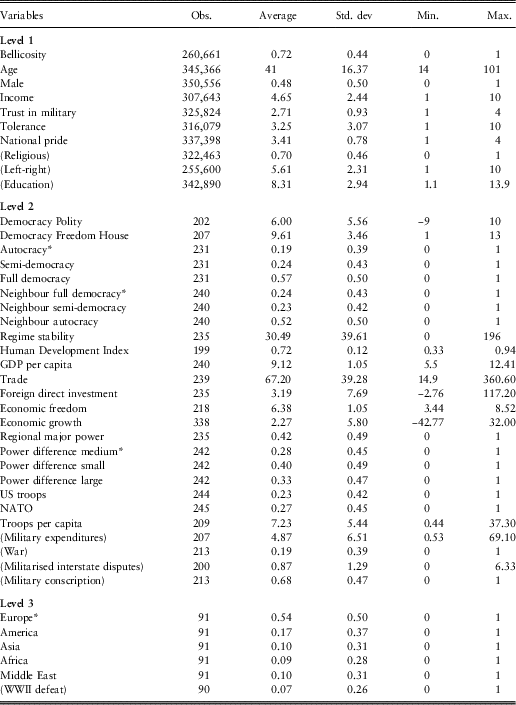
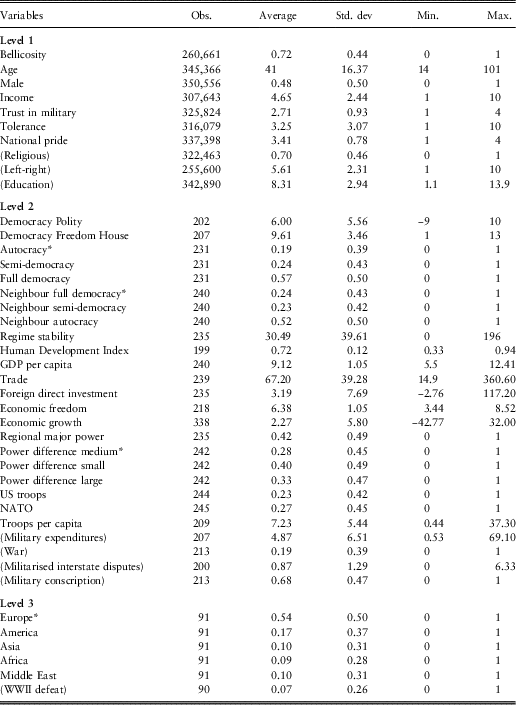
A case can be made for limiting the number of country-level or country-year-level variables in statistical analyses in general. Some argue that the problem of ‘omitted-variable bias’ is often greatly exaggerated and that the problem of confounding or confusing results – especially if spuriousness is a concern – can best be alleviated by constructing statistical models in an incremental fashion and paying particular heed to the importance of theory for the identification of control variables.Footnote 43 Others are less inclined to place limits on the number of independents in single models so long as sound theory guides the choice of variables.Footnote 44 While we do not take any strong stand in this debate, the nature of our data induces us to follow, in large part, the ‘incremental’ approach with regards to Level 2 variables. We thus proceed to construct an appropriate base model. In the reported models, we thereafter systematically test if the relationship between regime type and citizens’ bellicosity changes with the orderly inclusion (and removal) of one or a few other potential causal factors at a time (for descriptive statistics, see Appendix).Footnote 45 In other, unreported models, we expand the selection of variables (at the country-year level) in each individual model; these results are described in the sensitivity-analysis section.
Dependent variable
The dichotomous dependent variable – Bellicosity – is based on the following WVS survey question: Of course, we all hope that there will not be another war, but if it were to come to that, would you be willing to fight for your country? (yes=1; no=0). Presuming that country-specific factors – in particular regime type – help shape willingness to fight, our hypothesis is that pacifistic norms and values are more prevalent in democratic polities than in non-democratic ones.
Bellicosity is, as far as we know, the most suitable – and indeed only – existing measure that allows for such a comprehensive, multilevel investigation of normative democratic peace. Still, the breadth and scope of the question posed to respondents present some challenges. Firstly, criticism has been raised with regard to the prelude to the question (‘Of course, we all hope …’);Footnote 46 the normative tint to these words may direct respondents into answering in the negative. However, the wording of the question does not differ between countries (all questions are translated to the local language of relevance), so we do not have reason to believe that such a bias affects scores more in some countries than in others. Besides, any general bias does not seem to be that great; the overall sample mean is high (0.72).Footnote 47 In addition, even if the extent to which an individual is predisposed to answering ‘no’, such a predisposition likely rests on other individual characteristics, which we duly control for in the empirical analysis.
Secondly, the question does not specify whether this is about defensive or offensive war. Of course, it is reasonable to assume that even those individuals who harbour ‘pacifistic’ values could be just as willing to fight for their country as less pacifistic individuals would be, if self-defence can help ensure state survival. These concerns about validity should nonetheless be substantially mitigated given that we also control for ‘national pride’ (please see variable description below). As it is, social psychologists distinguish between ‘nationalism’ and ‘patriotism’.Footnote 48 The former concept depicts ‘love for the home country’, the latter ‘hostility toward others’.Footnote 49 The variable National pride, considering how the survey question is formulated,Footnote 50 therefore presumably reflects the less aggressive notion of ‘nationalism’; thus it usefully controls for much of the dimension of Bellicosity that concerns the willingness to fight for one’s country in self-defence. We are therefore reasonably confident that any eventual correlation between regime type and Bellicosity by and large reflects individuals’ attitudes towards other types of war scenarios, which would strengthen our belief that our dependent variable is truly a measure of pacifism.
A third possible concern is that Bellicosity might in part proxy the state’s or regime’s legitimacy among the populace. Hence, results for some of the non-democratic regimes on Bellicosity might turn out lower than those which can be deemed ‘real’ values in an exclusive normative perspective, since we have reason to assume that democratic regimes enjoy a higher level of legitimacy among its people than do autocratic ones. On the other hand, our study should remain relatively unaffected by this considering that we expect that non-democratic regimes will exhibit higher scores than democratic ones on Bellicosity.
Independent variables, Level 2: Normative democratic peace
Following the majority of quantitative studies on democratic peace, our main independent variable is a measure of democracy extracted from the Polity IV Project (Democracy Polity).Footnote 51 The Polity Index stretches from -10 (fully institutionalised autocracy) to +10 (fully institutionalised democracy). Drawing on Epstein et al.,Footnote 52 we also constructed three regime categories: Full democracy (+8 to +10), Semi-democracy (+1 to +7), and Autocracy (−10 to 0). This categorisation allows us more easily to perform a number of additional tests that require the inclusion of relevant interaction variables and whose results can more readily be interpreted when dummy variables for regime type are used. However, the continuous version of the Polity Index (Democracy Polity) forms the backbone of the empirical study. For purposes of robustness, one of the models includes instead Freedom House’s combined Index of Political and Civil Liberties (Democracy Freedom House).Footnote 53
Empirical studies have found that the majority of wars and militarised crises involve disputes over territory between neighbouring countries.Footnote 54 Therefore, and in order to investigate the dyadic democratic peace thesis more closely, we constructed variables that test if Bellicosity depends on the regime type of neighbouring states. Two interaction variables form the root of such a test, namely Full demo*Neighb. semi-demo and Full demo*Neighb. auto. The second element of these two variables is based on the construction of three dummy variables: Neighbour autocracy (coded 1 if a country borders one or more autocracies); Neighbour semi-democracy (coded 1 if at least one of the neighbouring countries is a semi-democracy and none is an autocracy); and Neighbour full democracy (reference category, coded 1 if all neighbours are full democracies). Neighbouring countries are defined and coded according to the Correlates of War Direct Contiguity Data, contiguity levels 1–5.Footnote 55
Furthermore, following Zeev Maoz and Bruce Russett’sFootnote 56 contention that the prevalence of democratic norms hinges on the longevity of the democratic regime, we created three interaction variables: Full demo*Regime stability, Semi-demo*Regime stability, and Autocracy*Regime stability (reference category). These are based on the three regime dummies and a variable from the Polity IV project that measures the number of years since the last regime change (Regime stability).Footnote 57 Lastly, to ensure that any eventual relationship between regime type and Bellicosity is not a spurious effect of differences in the general quality of life between regime categories, we include in one of the models the Human Development Index (Human Development Index). Data are from the United Nations Development Programme.Footnote 58
Independent variables, Level 2: Institutional democratic peace, economic peace, and realism
We must account for economic or commercial peace theory, which in important respects reflects dimensions inherent in institutional democratic peace theory as well. We therefore control five economic variables at Level 2. The first four of these we expect to be negatively correlated with the dependent variable. GDP per capita (based on constant 2000 US$ and logarithmically transformed) proxies level of development. Data are from the World Bank’s World Development Indicators (WDI).Footnote 59 To test the peace-through-interdependence thesis, we also control level of trade integration (Trade, which is the sum of exports and imports relative to GDP) and inward foreign direct investment as a share of GDP (Foreign direct investment). Data are from the WDI. The fourth variable is Economic freedom, which usefully accounts for the capitalist peace thesis. This index is based on several indicators measuring the level of domestic economic liberalisation.Footnote 60 The fifth variable – Economic growth – measures the yearly growth rate of the national economy (data are from the WDI).
Variables linked to key arguments of the realist paradigm must also be controlled. Firstly, we include a dummy variable that distinguishes between (regional) major and non-major powers. Realist scholars typically see international politics as a story ‘written in terms of the great powers of an era’.Footnote 61 Following in particular John Mearsheimer’sFootnote 62 argument about the centrality of regional balances of power, the dummy variable Regional major power recalculates from the global to the regional level the Composite Index of National Capability (CINC), the standard measure of relative aggregate power.Footnote 63 Country-years accounting for at least 5 per cent of total material capabilities in their own region obtain the value 1 on Regional major power.Footnote 64
The second set of measures of the balance of power reflects the argument that neighbouring countries represent more prominent threats than distant ones, ceteris paribus. More or less following the operationalisation of Stuart BremerFootnote 65 – thus suspecting that relative power might be related to Bellicosity in a non-linear way – we chose to construct three dummy variables that classify nations according to their relative power vis-à-vis their most powerful neighbor. These are based on data from the Correlates of War project (Direct Contiguity Data and CINC). A power ratio of less than or equal to 3 is regarded as a small power difference (such countries receive the score of 1 on Power difference small); a power ratio between 3 and 10 yields the score of 1 on Power difference medium (reference category); while a ratio of over 10 is judged to be large (Power difference large).
Alliances, security guarantees, extended deterrence, and the overseas deployment of troops could certainly also impact citizens’ willingness to fight, and they might also account for a substantial portion of the purported relationship between regime type and war.Footnote 66 In particular, US troops deployment could – through free-riding, buck-passing, or trip-wire mechanisms – reduce the incentives of host-country citizens to fight for their own country.Footnote 67 In the base model we therefore include a dummy variable that is coded 1 for country-years that host at least 1,000 US troops (US troops). Data are from the Heritage Foundation.Footnote 68 We also include, in one of the models, a dummy variable that takes on the value 1 if a country is a member of the North Atlantic Treaty Organization (NATO). Finally, we include a variable that should effectively control for the degree to which a country is ‘militarised’. Troops per capita measures the relative size of the army, with data from the WDI. This variable should also be a potent control for any possible effects of national conscription on Bellicosity.
Independent variables – Levels 3 and 1
At Level 3 – the country level – we control for temporally static factors. We constructed five regional dummy variables: America, Asia, Africa, Middle East, and the reference category Europe (please see footnote 64 above for definitions of the regions). The assumption here is that the average values on Bellicosity might be significantly shaped by the regional security environment,Footnote 69 which in turn should be shaped by the (regional) distribution of power.Footnote 70
Lastly, we also control for six individual-level variables – extracted from WVS – that the specialised literature on political behaviour informs us are theoretically advisable to include.Footnote 71 Age is a continuous variable believed to be negatively associated with Bellicosity. Also included is a dummy variable controlling for gender (Male); a four-category variable measuring the extent to which the individual has faith in the country’s military (Trust in military); a variable measuring respondents’ tolerance of societal diversity (Tolerance); and a control for personal income (Income), which is measured on a 10-point scale.
Lastly, we control for National pride, a four-category variable that measures the emotional ties between citizens and their country. Others have shown this to be strongly related to our dependent variable.Footnote 72 As we have argued above, National pride will vitally function as a control for the dimension of Bellicosity that concerns willingness to fight for one’s country in self-defence. In addition, and in order to check if democratic citizens are less susceptible to embrace belligerent hyper-nationalism, instead opting to express national pride in other, more peaceful ways, we also include two interaction variables in one of our models (Full demo*National pride and Semi-demo*National pride, with Auto*National pride being the reference category).
Empirical analysis
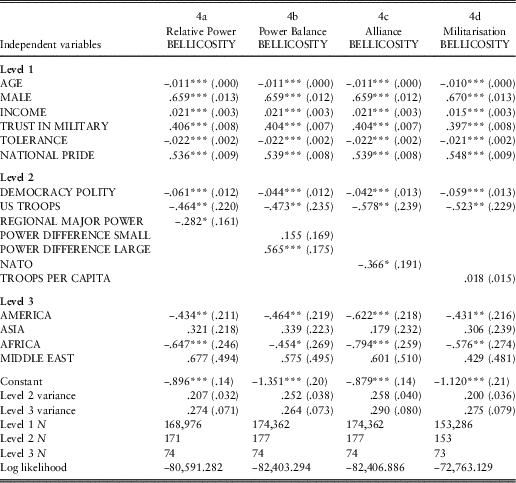
Tables 1–4 present 16 multilevel logistic regression models that are divided into four main categories each of which corresponds to one table. Tables 1 and 2 focus specifically on variables connected to democratic peace theory, especially in its normative version. Tables 3 and 4 control for variables connected to economic peace theory and realism, respectively. The sets of variables at Levels 1 and 3 are the same in all 16 models.
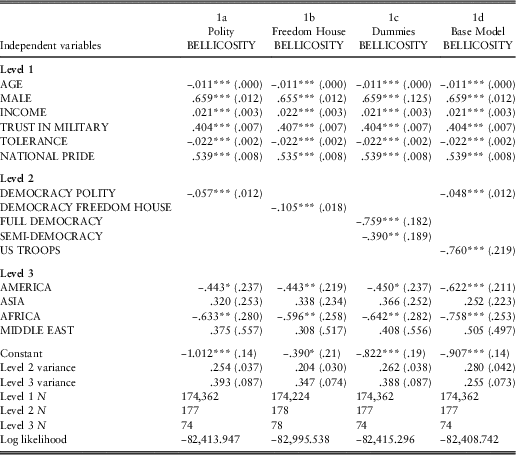
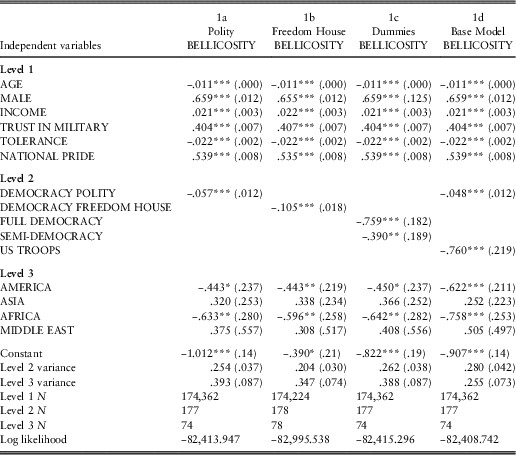
Democratic peace I: Multilevel regression analysis of the relationship between regime type and citizens’ bellicosity, 1981–2008.
Notes: standard errors in parentheses; * significant at 10 per cent; ** significant at 5 per cent; *** significant at 1 per cent; Level 2 variables are lagged one year; see text for complete variable description.
Democratic peace: Base models
Table 1, model 1a, presents a first cut at exploring the normative democratic peace. Only the regime variable is included at Level 2. Results are as expected: Democracy Polity is highly negatively and significantly related to Bellicosity. Differences between regimes with respect to the dependent variable are noticeable: The predicted average value on Bellicosity for people living in our sample’s most autocratic country (scoring −9 on Democracy Polity) is 84.7 per cent; for those at the sample average (+6) it is 74.3 per cent; for fully institutionalised democracies (+10) it is 70.4 per cent. Preliminary results, thus, indicate that citizens of democracies really harbour pacifistic values.
We do not place much emphasis on the results for the control variables at Level 1, primarily because most of these are of little theoretical interest given the focus of our study. In terms of direction, most results are as expected. The one distinct exception is Income, whose coefficient is positive, contradicting the supposition that citizens are particularly sensitive to the (opportunity) costs of war.
Moving on to Level 3, the regional dummies show an interesting albeit more or less expected pattern. As the realism-affiliated hegemonic stability theory would suggest, America is negative and significant – and often highly so – in all of the 16 models. Also note that Africa generally obtains the strongest negative impact of all regional dummies. This, we surmise, likely reflect persistent challenges with state-building in sub-Saharan African countries, the bulk of which are highly ethnically fractionalised. Neither Asia nor Middle East differ significantly from the reference category Europe.
Model 1b substitutes Freedom House’s democracy index for Democracy Policy, without any alterations to the results. In model 1c the regime dummies are included. Results are as expected: Full democracy is strongly linked with Bellicosity. A somewhat weaker, but still significant (at the .05 level) result obtains for Semi-democracy, further suggesting a linear relationship between regime type and willingness to fight.
In model 1d we proceed to include US troops as a control. We keep this variable in all subsequent models. We do this in part because preliminary analyses showed a strong and consistent relationship between US troops deployment and Bellicosity. This can be down to several reasons. US military presence and attendant security guarantees should contribute to decreasing host-country citizens’ incentives to fight for their country, ceteris paribus. In addition, Japan and Germany are both hosts to a large number of US military bases, and these two countries’ Second World War experiences have most likely affected the general level of pacifism for generations.Footnote 73 Considering also that states with a substantial US military presence have a high average level of democracy, the inclusion of US troops is vital as a check for spuriousness between regime type and Bellicosity. As model 1d shows, the coefficient of US troops is negative and highly significant. This substantiates the story told by the regional dummy America, suggesting in particular that citizens of countries whose basic defence and security needs are ‘outsourced’ to the US hegemon are imbued with a high level of pacifism, all else being equal. More importantly for the purposes of this article, however, the inclusion of US troops does not change the impact of Democracy Polity. So far, then, the empirical analysis has lent support to key arguments of normative democratic peace theory: The more democratic the regime, the more pervasive are pacifistic attitudes and values among the citizenry.
Democratic peace: Additional tests and interactions
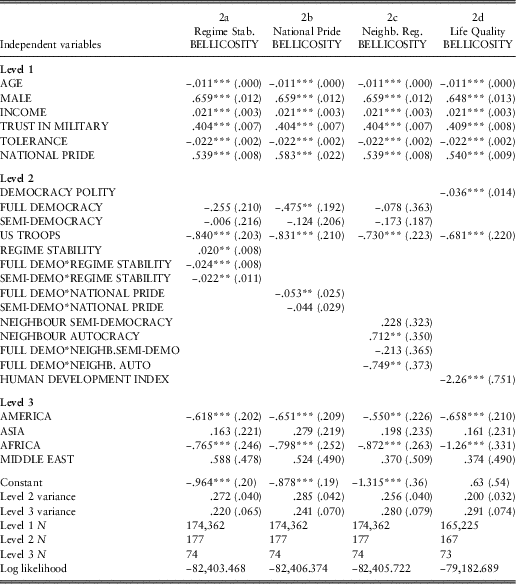
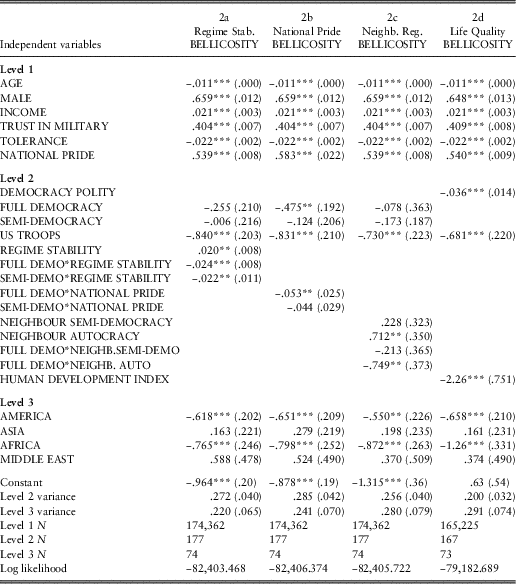
Table 2 exhibits additional tests of democratic peace theory, using the regime dummies in the first three models. Firstly, the longevity of the democratic regime might affect the degree to which democratic-pacifistic norms and values are internalised among citizens.Footnote 74 This contention does not receive support here, however. If we jointly consider the coefficients for Regime stability and the interaction variable Full demo*Regime stability, as we must, it is clear that Bellicosity is more or less unaffected by the maturity of democracy (whereas bellicosity increases with the longevity of autocracies). This does not automatically mean that we need to refute the claims made by Maoz and Russett, though. Perhaps this instead reflects the strictness of criteria associated with the label ‘full democracy’. Once a country has reached the level where it is included in this category, it may very well already have gotten to a point where democratic-pacifistic values are so entrenched as to make them virtually unmovable – at least for as long as the democracy itself upholds.
Democratic peace II: Multilevel regression analysis of the relationship between regime type and citizens’ bellicosity, 1981–2008.
Notes: standard errors in parentheses; * significant at 10 per cent; ** significant at 5 per cent; *** significant at 1 per cent; Level 2 variables are lagged one year; see text for complete variable description.
Model 2b includes a test of possible interaction effects between regime type and National pride. The first interaction variable – Full demo*National pride – differs significantly (at the .05 level) from the reference category, whereas the second one – Semi-demo*National pride – does not. However, the very large N associated with National pride renders significant a difference (between democracies and autocracies) that in reality is close to negligible. Thus, these results show that the regression slope of democracies approximates that of non-democracies. This boosts our confidence that National pride – the way it is measured – does not encompass an ‘aggressive’ component of any note; if it had, we would have expected the regression slope of autocracies to be much steeper than that of democracies, reflecting a dearth of other, alternative outlets for any ‘hyper-nationalism’ among non-democratic citizens.
Model 2c attempts to test the dyadic democratic peace thesis more concretely. It includes four additional Level 2 variables, namely two dummies capturing the nature of the least democratic neighbouring regime and two attendant interaction variables. Results do indicate that willingness to fight depends on the neighbourhood being fully democratic or not; having an autocratic neighbour does indeed increase overall willingness to fight for one’s country. But this conclusion is only valid for semi-democracies and, in particular, for autocracies; for democracies there is no such effect. It is still debatable whether we should place too much emphasis on these results. There are three problems in this respect. Firstly, tolerance tests revealed that multicollinearity might render somewhat difficult the interpretation of those models that include interaction effects (for tolerance scores, please see footnote 45 above). Secondly, coding did not allow for considerations of relative power (it certainly makes a difference whether your neighbour is autocratic Brunei or autocratic Russia). Thirdly, these variables may also suffer from a lack of variation considering that democracies – in particular those included in the WVS data – tend to cluster together in purported ‘zones of peace’. In sum, as tests of the democratic peace, we are inclined to place far more faith in the basic regime variables.
Model 2d returns to such a more basic outlook. There, we include a measure of human development to check if quality of life can account for the positive relationship between democracy and the dependent variable. But although Human Development Index is negative and significant, as expected, the strength of regime type upholds. In sum, therefore, and although the significance level of Full democracy is suppressed in models 2a and 2c, presumably because that variable is also included in the interaction terms, Table 2 ought to give us increased confidence in the empirical validity of normative democratic peace theory.
Democratic peace vs economic peace and realism
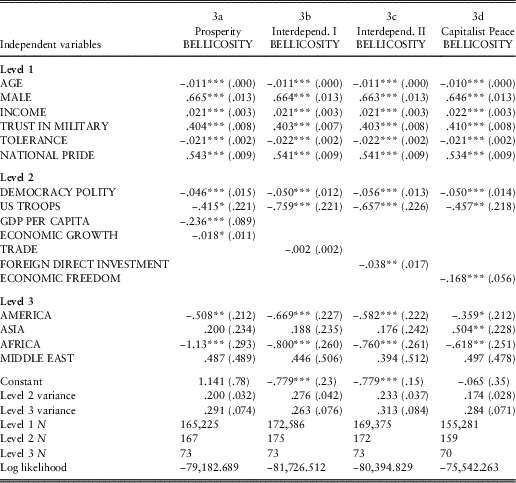
Previous models have shown that personal income is positively associated with Bellicosity. Table 3 provides further tests of whether results on normative democratic peace uphold when economic factors are controlled. And they do. Full democracy is consistently and negatively related to the dependent variable, at a high level of significance, even when we include measures of national income and economic growth (model 3a); trade integration (3b); foreign direct investment (3c); and economic freedom (3d). There is nothing in our results to indicate, therefore, that the relationship between democracy and pacifism is a spurious artefact of economic variables. On the other hand, most economic variables do seem to have an independent effect on willingness to fight; in particular, GDP per capita, Foreign direct investment, and Economic freedom are all highly significantly associated with Bellicosity, with the expected signs. This indicates (albeit with Income representing an individual-level caveat in that its direction is unexpected) that economic prosperity and inter-state linkages also lower the propensity for violence. A democratic peace, in other words, does not rule out an attendant commercial peace, as the second leg of Kant’s tripod would suggest.
Democratic peace vs economic peace: Multilevel regression analysis of the relationship between regime type and citizens’ bellicosity, 1981–2008.
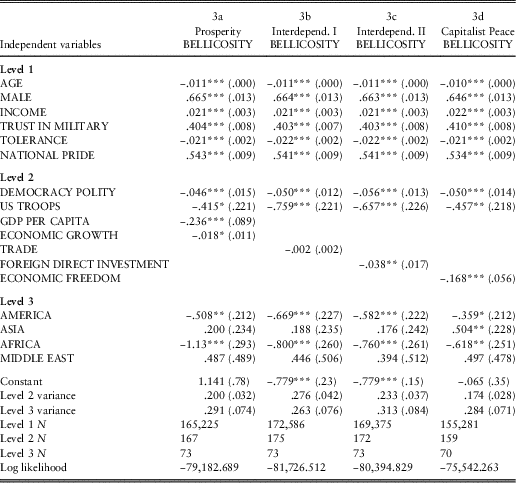
Notes: standard errors in parentheses; * significant at 10 per cent; ** significant at 5 per cent; *** significant at 1 per cent; Level 2 variables are lagged one year; see text for complete variable description.
The last set of models, depicted in Table 4, includes controls related to the realist paradigm. Yet again results suggest that the findings on normative democratic peace are robust. Firstly, as shown in model 4a, Regional major power is negatively related to the dependent measure (although only weakly so). Perhaps this result comes about because major powers hardly need to be concerned about survival, which is the fundamental goal of any state. Model 4b includes measures of relative power, but this does not alter the effect of Democracy Polity. It is noteworthy that power differences vis-à-vis one’s strongest neighbour are linked to the dependent variable in a non-linear way; coefficients of both Power difference small and Power difference large are positive, with the latter being highly significant. Presumably, considering how these variables are coded, this reflects that the states in the middle category do not normally have to fear for their survival (their inferiority is evident yet still somewhat limited), and neither is the power gap so small as to spur any ‘natural’ regional rivalry. Model 4c follows the same logic as that which applies for US troops. That NATO is significant at a low level (.10), while US troops remains significant (at the .05 level), is not surprising given that the physical presence of the US hegemon represents a particularly credible, trip wire-like signal to the host country that its security is tightly connected to Washington’s. Lastly, model 4d includes a measure of ‘militarisation’. Troops per capita, which should also capture eventual effects of conscription on Bellicosity, is not significant, however. Again, the strong result on Democracy Polity upholds.
Democratic peace vs realism: Multilevel regression analysis of the relationship between regime type and citizens’ bellicosity, 1981–2008.
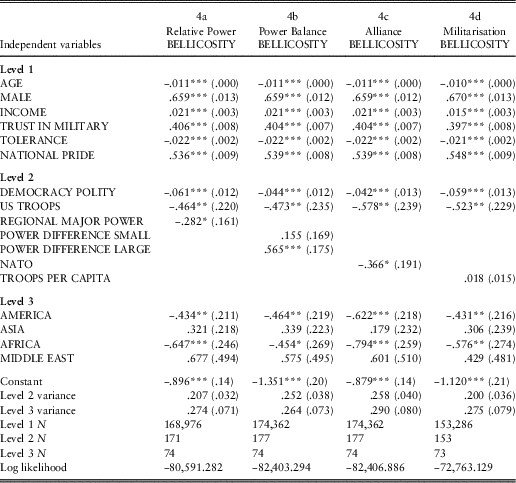
Notes: standard errors in parentheses; * significant at 10 per cent; ** significant at 5 per cent; *** significant at 1 per cent; Level 2 variables are lagged one year; see text for complete variable description.
Sensitivity analysis
To further ensure the robustness of our results, we performed a number of additional tests, not least including variables that could possibly account for some of the observed relationship between Democracy Polity and Bellicosity. Firstly, we ran all our models using robust standard errors instead of multilevel modelling, which did not change any of the results. Secondly, we checked whether the inclusion of some possible important variables at the individual level mattered for the main results. However, adding measures (extracted from the World Values Survey) of educational attainment, religiosity, and self-placement on the left-right axis did not alter anything. Neither did the inclusion of a Level 3 measure of Second World War experienceFootnote 75 – which turned out to be insignificant – change results. The inclusion of alternative variables at the country-year level also rendered results unaltered. These variables include level of military spending as a percentage of GDP;Footnote 76 a dummy for the presence of military conscription;Footnote 77 and two variables measuring, respectively, whether a country had recently experienced war or militarised interstate disputes.Footnote 78 Of all these, only the conscription variable was significant (with the expected positive sign).
Lastly, we expanded all our main models, exploring the effects of including several Level 2 variables simultaneously in a variety of different combinations, also adding a temporal control (which was insignificant). Interestingly, expanding the models did alter some of the results. In particular, nearly all effects of the economic peace variables disappeared. The ‘realist’ variables – notably US troops and the power-differences variables – were left unaltered. The same was true for the regime variables – both in their continuous and dummy versions – which have proven to be consistently and negatively linked to Bellicosity.
Conclusion
The empirical analysis, as a whole, lends considerable support to normative democratic peace arguments. The more democratic a regime, the more prevalent are pacifistic values and attitudes among the citizenry. This finding upholds through a series of different models where both supplementary and contending theoretical arguments are controlled.
Firstly, the analysis corroborates key arguments of the realist paradigm, while at the same time rendering results on the regime variables unaltered. Local balances of power (the dummies for power differences), regional balances of power (regional dummies) and security and defence guarantees by the US hegemon (proxied by overseas deployment of US troops and a NATO membership dummy) all significantly impact the willingness of citizens to fight for their country.
Secondly, economic variables seem to matter, but the overall evidence suggests that we cannot make any definitive conclusions about commercial peace theory. What we can say with some confidence, however, is that the effect of regime type on Bellicosity does not hinge on whether or not one controls for personal income, national income, trade and investment links or economic freedom; moreover, especially considering the sensitivity tests, none of these turn out to be highly convincing predictors of war willingness. This also has some implications for the institutional brand of democratic peace theory (though we cannot test all of its facets), which to some extent is saturated by an economic logic.
Thirdly, our results work to bolster normative democratic peace arguments: The empirical evidence suggests that individual attitudes towards the use of armed force are significantly shaped by the nature of the regime under which one lives. Of course, in the statistical models we cannot investigate if respondents’ values on the dependent variable vary as a function of the regime type of any (hypothetical) adversary. This means, in turn, that our results cannot directly be deemed as supportive of the dyadic democratic peace thesis. Still, seen in light of the gist of existing empirical research, which is quite confident in the empirical existence of a dyadic democratic peace, our study does lend indirect support of some substance to the normative dimension of the dyadic thesis: Citizens of democratic regimes are thoroughly more pacifistic than non-democratic citizens. To the extent that these norms and values are externalised into the realm of foreign policy, as the normative democratic peace literature in our view convincingly contends, a critical foundation for mutual trust exists in democratic dyads. This should markedly contribute to taming security dilemmas, spiral mechanisms and the escalation potential in interstate conflicts and crises. Hence, a norm-based dyadic democratic peace results.
But why is it that the existence of ‘democratic-pacifistic’ norms fails to produce a monadic democratic peace as well? The answer might lie in differences in the types of wars fought by democracies and non-democracies, respectively. The logic of the normative argument, as it is, only applies in a clear-cut way in certain areas. Most obviously, it pertains to serious interstate crises or conflicts where the security dilemma is modified due to both (or all) parties to the dispute being democracies. When a democracy is embroiled in a dispute with an autocracy, on the other hand, the former will likely act in a distrustful manner. Failure to do so might imply a renunciation of the crisis-bargaining initiative vis-à-vis a purportedly less constrained adversary. This is something that a state can ill afford – as Kant himself surely acknowledged.Footnote 79
The right of democracies to fight defensive wars – ‘to protect themselves … from external attacks’ – was certainly also recognised by Kant.Footnote 80 There is one additional category of wars, though, that in some respects is harder to judge. In the post-imperialist world, at least, democracies only very rarely, if ever, consider conducting ‘pure’ wars of conquest. On the other hand, and although democracies ‘might intervene in a different pattern than militaristic authoritarian ones’,Footnote 81 the dividing line between conquest and liberal-interventionist war is not always clear-cut, at least not when the latter result in (temporary) occupation, such as was the case in Afghanistan and Iraq. These wars essentially also involve the ‘externalisation’ of liberal, democratic, and indeed also ‘pacifistic’ values – even if in a somewhat peculiar way. The justification of such endeavours is clearly constructed on the basis of the logic of liberal theory in general, and sometimes democratic peace theory in particular: One prominent effect of helping other people rid themselves of autocrats is, ostensibly, the creation of a more peaceful world. Thus, the logic here indicates that the occurrence of such wars does not necessarily contradict the empirical results herein, as they – in the minds of the interventionists – are wars whose objectives are liberal and therefore benevolent. Studies of US public opinion, for example, have found such wars to enjoy substantial support among the democratic public,Footnote 82 which also affects the proclivity of political leaders to undertake them.Footnote 83
Wars come in different shapes and forms, which should help explain the empirical mismatch between the dyadic and the monadic versions of democratic peace theory. Future research, we believe, should attend more systematically to the attitudes of citizens and elites towards different types of militarised conflicts. This could usefully be done either through case studies, by broadening the scope of the highly promising experimental research designs or by utilising steadily growing amounts of survey data. Key here, in any case, is arguably to investigate more thoroughly the preferences and norms of individuals – both in democracies and in non-democracies – pertaining to issues of war and peace.
This study, for its part, has shown that there is a distinct connection between regime type and pacifism. Norms and values regarding the use of armed force are not only shaped by individual backgrounds and characteristics; country-specific traits, including not least level of democracy, also play a significant role. The democratic peace is perhaps not an ‘empirical law’, and it does not exist unconditionally. But democratic citizens do harbour pacifistic values and attitudes, just as normative democratic peace theory tells us.
Acknowledgments
The authors would like to thank Zan Strabac, Gunhild Hoogensen Gjørv, Michael W. Doyle and two anonymous RIS reviewers for valuable suggestions. Any remaining errors are the sole responsibility of the authors.
Appendix
Descriptive statistics.