Theories of language acquisition seek to explain the early phases of lexical growth with varying emphasis on maturation, linguistic input, pattern recognition, domain specificity and social-cognitive abilities (e.g. Golinkoff et al., Reference Golinkoff, Hirsh-Pasek, Bloom, Smith, Woodward, Akhtar, Tomasello and Hollich2000 for a review). Some hold that, at least at the start of word learning, infants simply associate the words that they hear with the objects or the events that currently hold their attention, whereas others assert that infants actively seek a person's referential intent from the earliest phases of vocabulary development (Baldwin, Reference Baldwin, Moore and Dunham1995; Bruner, Reference Bruner1983; Carpenter, Nagell & Tomasello, Reference Carpenter, Nagell and Tomasello1998; Hollich, Hirsh-Pasek & Golinkoff, Reference Hollich, Hirsh-Pasek and Golinkoff2000). One key issue is the extent to which infants rely on social-cognitive abilities to support their acquisition of language.
In adult–child conversations, adults often talk about perceptually present objects and events (Tomasello, Reference Tomasello2003). In many, but certainly not all cases, parents label the objects they are looking at, so their gaze is a good cue to infants about word meaning. Young word learners could disambiguate the speaker's referential intent by checking for the speaker's gaze direction (Baldwin, Reference Baldwin1991; Carpenter et al., Reference Carpenter, Nagell and Tomasello1998; Hollich et al., Reference Hollich, Hirsh-Pasek and Golinkoff2000).
Several empirical studies have explored the potential relationship between infant joint attention and language development. To date, most have investigated infants' following of multimodal cues similar to those used in naturally occurring interactions (Carpenter et al., Reference Carpenter, Nagell and Tomasello1998; Morales, Mundy, Delgado, Yale, Neal & Schwartz, Reference Morales, Mundy, Delgado, Yale, Neal and Schwartz2000; Mundy et al., Reference Mundy, Block, Delgado, Pomares, Van Hecke and Parlade2007). However, that makes it difficult to determine the influence of gaze following per se, because the adult's points and vocalizations simultaneously accompany the adult's looking behavior toward the target. The correlations between infants' responding to such multimodal cues and word learning may stem from a linguistic sensitivity to the adult's vocalizations during the adult's gaze and point. Despite a postulated developmental relationship between infants' gaze following and language acquisition (e.g. Baldwin, Reference Baldwin, Moore and Dunham1995; Bruner, Reference Bruner1983; Tomasello, Reference Tomasello2003), no previous study has examined whether following another's gaze per se (in the absence of adult linguistic support) predicts later productive vocabulary development.
The goal of this paper was to assess whether gaze following predicts rates of productive vocabulary growth in a longitudinal study from the ages of 0 ; 10 to 2 ; 0. The laboratory procedure used – in which an adult looked at a distal target without vocal or gestural cues – was a stricter measure of gaze following than used in past studies examining language, but similar to much experimental gaze-following work (e.g. Brooks & Meltzoff, Reference Brooks and Meltzoff2002; Corkum & Moore, Reference Corkum and Moore1998). We assessed gaze following at 0 ; 10 to 0 ; 11 because we wanted to capture infants who had just begun to gaze follow. Previous research indicates that testing infants ‘on the cusp’ of acquiring an ability is often more discriminative than at later ages. Developmental studies have established a change in infants' gaze following at ages 0 ; 10 to 0 ; 11 when infants begin to take into account the status of the adult's eyes. Brooks & Meltzoff (Reference Brooks and Meltzoff2005) showed that at age 0 ; 10 infants gaze follow when an adult has open eyes but they refrain from following when she has closed eyes. In contrast, at 0 ; 9 infants fail to make this distinction and follow the adult's head orientation in both conditions. Thus, the following of eye gaze per se (rather than just head direction) seems to emerge after age 0 ; 9. Because infants can use an adult's gaze to disambiguate reference in word learning contexts, we expected that infants who are better gaze followers would more rapidly accumulate words in their spoken vocabularies.
Infant pointing has also been associated with later language skills (Bates, Benigni, Bretherton, Camaioni & Volterra, Reference Bates, Benigni, Bretherton, Camaioni and Volterra1979; Carpenter et al., Reference Carpenter, Nagell and Tomasello1998). In our laboratory experiment the adult did not model or try to elicit pointing, but we recorded spontaneous pointing by the infants during the session. As a control for socioeconomic factors associated with early language (Hoff, Reference Hoff2006), we also took into account maternal education. In sum, this study provided a rigorous test of whether gaze following alone and in conjunction with infant pointing in the first year predicts subsequent vocabulary growth from ages 0 ; 10 to 2 ; 0.
METHOD
Participants
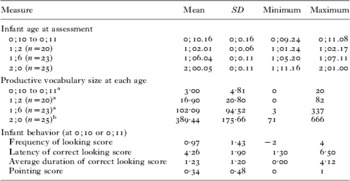
There were 32 infants (16 boys, 16 girls) who were tested for gaze following at ages 0 ; 10 or 0 ; 11 and were followed longitudinally with language assessments at ages 0 ; 10 or 0 ; 11, 1 ; 2, 1 ; 6 and 2 ; 0 (Table 1). All 32 children's data were included but some children contributed more assessments to the analysis than others: 14 children had data at all 4 ages, 10 had data at 3 ages, 6 had data at 2 ages, and 2 had data at the first age only. The infants were originally recruited from primarily English-speaking families who were on the university's volunteer list. Infants were healthy with no known developmental delays and were born full-term (37–43 weeks) with normal birth weights (2·9–4·2 kg). Mothers' median education was a college degree with a range from high school to advanced degrees, which are higher levels than the general US population. Each family received a small gift each time they participated.
Gaze following and pointing (at 0 ; 10 to 0 ; 11) and language scores (through 2 ; 0)

note: N=32 except as noted.
a Maximum score for the CDI Words and Gestures form is 396 words.
b Maximum score for the CDI Words and Sentences form is 680 words.
Procedure
During the lab visit assessing gaze following (Brooks & Meltzoff, Reference Brooks and Meltzoff2005), infants sat on their parent's lap while playing across a table from an experimenter. After warm-up play, the session started when the experimenter placed two identical targets on either side of the infant (left vs. right side counterbalanced for first placement, each 75° from infant midline). For each trial's initiation, the experimenter made eye contact with the infant to ensure that each infant was at midline and could see the experimenter's face. Then, the experimenter turned her head and eyes to look at one of two targets. The experimenter turned silently without any emotional expression or gesture and remained looking at the target until 6·5 s elapsed, as signaled by a silent, tactile timer (similar to Brooks & Meltzoff, Reference Brooks and Meltzoff2002; Corkum & Moore, Reference Corkum and Moore1998). The video-recorded test session lasted about 10 minutes (M=8·43 minutes, SD=1·63 minutes), allowing for play at the table between each of the four test trials. This gave us ample opportunity to observe infant pointing within the test session (see ‘Scoring’ below). Four trials were always presented but infrequently one of the trials was excluded from the analysis (4 mistrials in 128 trials) because of infant movement during trial onset.
Parents completed the MacArthur-Bates Communicative Developmental Inventories (CDI) using the 396-word checklist, ‘Words and Gestures’ form, for ages 0 ; 10 to 1 ; 6 and the 680-word checklist, ‘Words and Sentences’ form, after 1 ; 6 (Fenson, Marchman, Thal, Dale, Bates & Reznick, Reference Fenson, Marchman, Thal, Dale, Bates and Reznick2007). Parents received the first CDI at their lab visit and new forms before their child turned a target age. Productive vocabulary size was the total number of words marked as produced on each completed form (Table 1).
Behavioral measures and scoring
The observer, who was uninformed about the infants' language scores and the experimenter's head turn direction, watched video-recordings of infants' face and upper body. For gaze-following behavior, the observer scored individual test trials and recorded the onset and offset of an infant's first look at the target (a look was defined as the infant's eyes fixated on a target for at least 0·33 s, as in Brooks & Meltzoff, Reference Brooks and Meltzoff2002). Such looks were categorized as ‘correct looks’ (if aligned with the same target as the adult) or ‘incorrect looks’ (if opposite target). As is common in the gaze-following literature (e.g. Brooks & Meltzoff, Reference Brooks and Meltzoff2002; Corkum & Moore, Reference Corkum and Moore1998; Morales et al., Reference Morales, Mundy, Delgado, Yale, Neal and Schwartz2000), infant's looks were scored in terms of a ‘frequency of looking’ score (frequency correct minus incorrect; 0 assigned in the absence of any target look). In addition, we calculated an ‘average duration of correct looking’ score (total duration of the correct looks divided by number correct; 0 assigned when no correct looks) and a ‘latency of correct looking’ score (total latency of correct looks divided by the number correct; 6·5 seconds was assigned as the latency if the infants made no correct looks because this was the maximum trial length; results did not change if infants with no correct looks were excluded from the analysis). For pointing, the scorer identified whether or not each infant pointed (either an index finger or all fingers) with arm extension at the experimenter or the distal targets. Because pointing is just emerging and low in frequency at this age (Bates et al., Reference Bates, Benigni, Bretherton, Camaioni and Volterra1979; Camaioni, Perucchini, Bellagamba & Colonnesi, Reference Camaioni, Perucchini, Bellagamba and Colonnesi2004), we created a dichotomous score (yes/no) as to whether each infant pointed at all during the course of the test session (‘pointing’ score).
Inter-observer agreement was evaluated by reviewing a random sample of 25% of the infants. The secondary observer was also uninformed of the experimenter's head turn direction and the children's language scores. Using Cohen's kappa, the inter-rater agreement was excellent for all scores, ranging from 0·95 to 1·00.
RESULTS
Infant behaviors at the first assessment
As expected from the gaze-following literature, infants produced more correct looks (M=1·28; SD=1·14) than incorrect looks (M=0·31; SD=0·59). (There was a mean of 2·28 trials with non-looks, e.g. looking down, and 0·13 trials excluded as mistrials, see ‘Method’.) Taking into account both correct and incorrect looks, as standard in the literature (see ‘Scoring’), the frequency of looking score (M=0·97) was significantly greater than 0, indicating that infants looked significantly more often at the correct target than the incorrect one (t(31)=3·85, p=0·0006) (Table 1). This pattern was significant even in the first trial alone, showing that it was not because of any practice effects during the study ((n=13 correct, n=1 incorrect), z=3·21, p=0·002 (binomial test)). Thus the infants in this sample demonstrated significant gaze following.
Infant pointing at distal locations was documented in 34% of the test sessions; according to the CDI parent report, 72% had pointed at some time at home. The documented pointing in the laboratory correlated significantly with parental report of pointing (CDI item; r Φ=0·45, p=0·01). None of the gaze-following measures correlated with the reported or observed pointing scores (rs from −0·10 to 0·27, ps>0·10). As expected, the frequency of looking score and the average duration of correct looking score were positively correlated (r=0·53, p=0·002), whereas the latency of correct looking score was negatively correlated with the other two gaze-following measures (r=−0·63 and −0·49, respectively, ps<0·005).
Models of productive vocabulary growth
Extensive past work has demonstrated that productive vocabulary increases rapidly between the ages of 1 ; 2 to 2 ; 0 (Fenson et al., Reference Fenson, Marchman, Thal, Dale, Bates and Reznick2007), and this was also seen in the current sample (Table 1). Growth curve models with a quadratic curve are well suited to approximate accelerated growth in vocabulary and can accommodate missing language assessments (Raudenbush & Bryk, Reference Raudenbush and Bryk2002). This model (SAS Proc Mixed with the full maximum likelihood method) allows for an examination of predictors – such as gaze-following behavior and pointing – on individual differences in vocabulary growth.
As prescribed for longitudinal growth curve analyses (Singer & Willett, Reference Singer and Willett2003), in the first stage, we evaluated the trajectory of vocabulary growth with age (fixed effects), while allowing individual growth to vary (random effects); this is similar to an average slope for growth with variations for individual patterns. Accelerating vocabulary growth was modeled with a quadratic curve with parameters for an intercept, linear age and quadratic age. As follows from the growth curve procedures, age was centered at a particular age (in this case 1 ; 0, i.e. age in months minus 12). The model estimates the average number of words produced at the centered age (the intercept) and compares that value to 0. Our preliminary analyses revealed that the intercept was not significantly different from 0, confirming that infants produced few words on average at 1 ; 0. The linear term (i.e. instantaneous growth) also was not significantly different from 0, indicating that average instantaneous growth was slow at age 1 ; 0, and was therefore constrained to be equal to 0 in the model (Raudenbush & Bryk, Reference Raudenbush and Bryk2002).
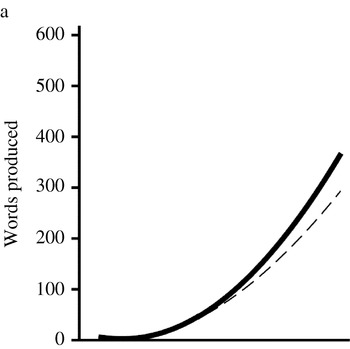
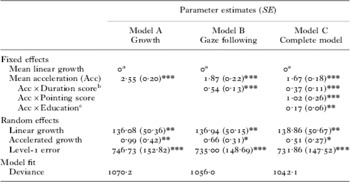
The best fitting growth model (Table 2, Model A) had a significant fixed effect for accelerated growth (i.e. quadratic age, expressed as months2) with a rate of 2·55 words per month2 (p<0·0001) and significant linear and quadratic random effects (ps<0·01). This corresponds to an average rate of 10·2 words per month at age 1 ; 2, 30·6 words per month at age 1 ; 6, and 61·2 words per month at age 2 ; 0. As illustrated in Figure 1a, an average child in our sample would have a 367-word vocabulary at age 2 ; 0 and a growth trajectory well within the normal range (Fenson et al., Reference Fenson, Marchman, Thal, Dale, Bates and Reznick2007).
Growth curve model of language development using infant age alone (Model A). The thick, solid line represents the average trajectory of productive vocabulary growth (based on quadratic curve, month2). The dashed line is the 50th percentile from recent norms of the MacArthur-Bates Communicative Developmental Inventories (CDI).

Gaze following and point production predict accelerated growth in productive vocabulary

note: Covariances among the random effects were included in the models but none were statistically significant and are not reported here.
a The fixed effect for linear growth was constrained to be equal to 0.
b Duration score=Average duration of correct looking score.
c Education=Maternal education (in years) centered at mean.
* p<0·05. ** p<0·01. *** p<0·001.
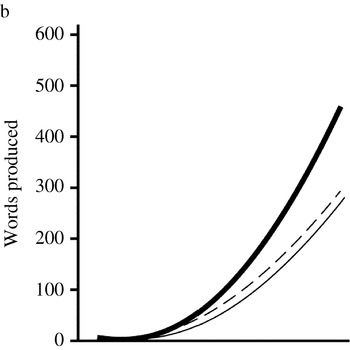
The second stage was to test what aspects of infant gaze-following behavior at ages 0 ; 10 to 0 ; 11 predicted productive vocabulary growth. Neither the frequency measure nor the latency measure predicted accelerated growth (ps>0·25). However, we found significant effects when we analyzed the average duration of correct looking score, a measure of how long infants inspected the target of the adult's gaze. With this measure of gaze following, there was a significant improvement to the statistical model beyond age alone (χ2=14·2, df=1, p<0·001; deviance statistic of Model B less than A), explaining 33·1% more of the variance in accelerated growth than age alone. This is shown as Model B (Table 2). For Model B, the average accelerated growth was 1·87 words/month2 (p<0·0001). For each 1-second increment in the average duration of correct looking score, accelerated growth was 0·54 words/month2 faster (p<0·0001). Thus, the growth curve analyses showed that gaze-following infants who engaged in longer visual inspection of the target of the adult's gaze had faster vocabulary growth.
These statistical effects can be illustrated by considering the language growth of the average or prototypical child in this sample (Singer & Willett, Reference Singer and Willett2003). By age 2 ; 0 a prototypical child with very long looks to the correct target (+1 SD) would have a rapidly accelerating growth curve, resulting in an estimated 458-word vocabulary. A prototypical child with short looks to the correct target (−1 SD) would have a slower acceleration in growth, yielding 272 words by age 2 ; 0 as shown in Figure 1b. Not only do these trajectories and two-year outcomes differ statistically from each other, but also they tell a similar story in comparison to the Fenson et al. (Reference Fenson, Marchman, Thal, Dale, Bates and Reznick2007) data. The infants in our sample with long looks to the correct target (+1 SD) were consistently above the 50th percentile of the norms for the CDI (Fenson et al., Reference Fenson, Marchman, Thal, Dale, Bates and Reznick2007), and the ones with short looks to the correct target (−1 SD) were consistently below the 50th percentile (Figure 1b). A 2 (above vs. below 50th percentile of the CDI)×2 (above vs. below the sample mean on the duration score) chi-square test for vocabulary at age 2 ; 0 confirmed that more infants (12 of 13) from the long duration group had vocabulary scores above the Fenson et al. 50th percentile than from the short duration group (4 of 12 infants; χ2=9·42, df=1, p=0·003; Fisher's exact test).
Growth curve model of language development using infant age and gaze following (Model B). The thick, solid line represents the trajectory for infants who show prolonged visual inspection of the target looked at by the adult (+1 SD average duration of correct looking). The thin, solid line represents the trajectory for infants with −1 SD on the same measure. The dashed line is the 50th percentile of the CDI.

Although parental report of pointing did not predict vocabulary growth, our empirical observations of pointing during the test session were a significant predictor of vocabulary growth. The pointing score significantly improved the model beyond age alone (deviance statistic of 1061·7 less than Model A; χ2=8·50, df=1, p<0·01), explaining 4·0% more of the variance in accelerated growth than age alone. After accounting for significant accelerated growth (average rate of 2·16 words/month2, p<0·0001), the pointing score yielded a significant gain of 1·16 words/month2 (p=0·002). This would translate into a 167-word advantage (478 vs. 311 words) by age 2 ; 0 for an infant who pointed at a distal location compared to an infant who did not. When pointing was added to the previous gaze-following model, it significantly improved the model beyond gaze following and age (deviance statistic of 1048·4 less than Model B; χ2=7·6, df=1, p<0·01), explaining 0·7% more of the variance in accelerated growth than the Model B with age and gaze following.
In Model C (Table 2), we examined whether gaze following and pointing remained significant predictors with maternal education in the model. As expected, when maternal education was included it significantly improved the statistical model beyond gaze following, pointing and age (deviance statistic of Model C less than 1048·4 of previous model; χ2=6·3, df=1, p<0·05), explaining 22·8% more of the variance in accelerated growth than the previous model with pointing, gaze following and age. After accounting for significant average accelerated growth (1·67 words/month2, p<0·0001), maternal education yielded a significant rate of 0·17 words/month2 faster per year of education (p=0·009), indicating that mothers with more education had infants with greater vocabulary improvement. In Model C, controlling for pointing and maternal education, average duration of correct looking remained significant (p=0·0009); controlling for average duration of correct looking and maternal education, infants who pointed also showed significantly accelerated growth (p=0·0003). Overall, Model C with average duration of correct looking and pointing scores as well as maternal education was the best model tested to predict vocabulary growth, explaining 48·7% more of the variance in accelerated growth relative to age alone (Model A).
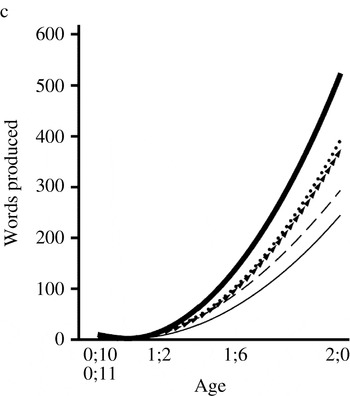
The complete growth curve model (Model C) is illustrated in Figure 1c. The trajectories show the effects of the social-cognitive factors (average duration of correct looking and pointing scores) at ages 0 ; 10 to 0 ; 11 on vocabulary growth through age 2 ; 0 when statistically controlling for maternal education. For a pattern of very long looks to the correct target (+1 SD) and pointing (i.e. pointed during the session), the prototypical trajectory had a rapid acceleration, well above the 50th percentile of the Fenson et al. (Reference Fenson, Marchman, Thal, Dale, Bates and Reznick2007) data, resulting in an estimated 517 words at age 2 ; 0. For short looks to the correct target (−1 SD) without pointing, the trajectory had the slowest acceleration, remaining consistently below the 50th percentile across age and resulting in an estimated 243-word vocabulary at 2 ; 0. Even with maternal education controlled, these trajectories illustrate that both average duration of correct looking and pointing scores significantly predicted patterns of acceleration in vocabulary growth from ages 0 ; 10 through 2 ; 0.
Growth curve model of language development using infant age, gaze following and pointing with control for maternal education (Model C). The thick, solid line represents the trajectory for infants who show prolonged visual inspection (+1 SD) of the target looked at by the adult (long lookers) and who also point. The dotted line represents short lookers (−1 SD) who also point. The triangle line represents long lookers (+1 SD) who do not point. The thin, solid line represents short lookers (−1 SD) who do not point. The dashed line is the 50th percentile of the CDI.

DISCUSSION
As expected, productive vocabulary grew rapidly after age 1 ; 2. The new finding is that infants' gaze-following behavior at ages 0 ; 10 to 0 ; 11 significantly predicted accelerated growth through 2 ; 0 even after controlling for the effects of age and maternal education. This is the first study showing that sensitivity to adult's looking per se (rather than a multimodal combination of adult vocalizing, pointing and looking) in an experimental setting relates to faster vocabulary growth. We found that infants' average duration of correct looking score at ages 0 ; 10 to 0 ; 11 predicted accelerated (quadratic) growth. By two years, there was a striking and statistically significant advantage for the infants who followed the adult's gaze to the correct target and visually inspected it for a prolonged period (+1 SD above the mean); they had an estimated vocabulary of 186 more words than infants who looked at the correct target for a short time (−1 SD below the mean; 458 vs. 272 words, respectively).
Another finding was that average duration of correct looking at the target and pointing scores each separately and significantly predicted lexical development. As reported in some (e.g. Mundy et al., Reference Mundy, Block, Delgado, Pomares, Van Hecke and Parlade2007) but not all previous work (Carpenter et al., Reference Carpenter, Nagell and Tomasello1998), gaze following and pointing did not significantly correlate. The current work adds to the evidence that for young infants the two measures tap differentiable skills, although it is not clear whether this rests on: (a) the way the skills were assessed in the study; (b) differences in manual versus visual responses; or (c) underlying differences between infants initiating action (spontaneous pointing) versus following the adult's lead (following an adult's look; see Mundy et al. (Reference Mundy, Block, Delgado, Pomares, Van Hecke and Parlade2007) for discussion). Regardless, infants who both pointed and looked longer at the correct target had the fastest vocabulary growth; we found that this latter pattern was associated with a vocabulary size of 517 words at age 2 ; 0, which is above the 80th percentile of the CDI norms (Fenson et al., Reference Fenson, Marchman, Thal, Dale, Bates and Reznick2007).
It is worth considering the potential meaning of these separate predictors. All of the infants had visual access to the two identical targets, which did not move or make sound. Yet, some infants extended their visual inspection of a target when an adult was looking at it. One possibility is that infants who did this had better domain-general processing, such as an increased attention span. However, previous work showed that infants were highly selective and looked more often at a target and visually inspected it longer when the adult could see the target than when she could not see it (Brooks & Meltzoff, Reference Brooks and Meltzoff2002). It is as though the target acquires a special valence from the adult's look: infants are drawn to examine an object more when the adult looks at it than when the adult makes an identical head movement but cannot see it (for example, if the adult turns to the target with eyes closed, as in Brooks & Meltzoff's (Reference Brooks and Meltzoff2002) control). This is compatible with suggestions, based on both action measures (Brooks & Meltzoff, Reference Brooks and Meltzoff2005; Meltzoff & Brooks, Reference Meltzoff, Brooks, Flom, Lee and Muir2007) and habituation methods (Woodward, Reference Woodward2003), that by age 1 ; 0 gaze-following infants encode a link from the looker to the distal object. Thus we do not think that the current results reduce simply to ‘general attentional factors,' but rather involve infants’ specific interpretations of adult looking. Infants interpret adult looking as an object-directed act – as being ‘about’ the distal target. This psychological construal could provide a useful background framework for infants when adults label objects in everyday interaction – the label is also ‘about’ the target object that is in the adults' line of regard.
Only a subset of the infants (34%) spontaneously pointed to distal objects. It is important to note that the adult did not model this act nor encourage or elicit it. Nonetheless, infants' pointing in the laboratory was predictive of larger vocabulary growth. In a review of the video-recordings, we found that infants usually looked at the adult before pointing. This combination of eye contact and pointing has been called ‘communicative pointing’ and has been linked to later language development (Bates et al., Reference Bates, Benigni, Bretherton, Camaioni and Volterra1979). Such infant pointing may also be considered ‘protodeclarative pointing’ (Camaioni et al., Reference Camaioni, Perucchini, Bellagamba and Colonnesi2004; Carpenter et al., Reference Carpenter, Nagell and Tomasello1998). The benefit to vocabulary growth may be that infants' pointing promotes increased word learning opportunities. An infant's point is an invitation for a word: parents label what infants point at. Thus infants who point may create the conditions for their own word learning.
Infant gaze following and pointing are not the only factors that influence lexical development, of course. Individual differences in speech processing in infancy predict aspects of later language learning (Kuhl, Conboy, Padden, Nelson & Pruitt, Reference Kuhl, Conboy, Padden, Nelson and Pruitt2005; Newman, Ratner, Jusczyk, Jusczyk & Dow, Reference Newman, Ratner, Jusczyk, Jusczyk and Dow2006). Other sources of influence come from infants' cognitive abilities (Colombo, Shaddy, Richman, Maikranz & Blaga, Reference Colombo, Shaddy, Richman, Maikranz and Blaga2004; Gopnik & Meltzoff, Reference Gopnik and Meltzoff1987) and family characteristics, such as maternal education and socioeconomic status (Hoff, Reference Hoff2006). The current growth curve modeling adds to the literature by showing that the social-cognitive skills of gaze following and spontaneous pointing are both powerful non-verbal predictors of variations in lexical development through age 2 ; 0, even after controlling for maternal education.
The current work suggests that poor gaze-following and pointing skills relate to slower language learning. In comparison to the CDI norms, infants who devoted a short time to looking at the adult's target and who did not point (thin line trajectory, Figure 1c) had vocabulary sizes below the 50th percentile across ages (but within the normal range; Fenson et al., Reference Fenson, Marchman, Thal, Dale, Bates and Reznick2007). Infants in this group still improved their vocabularies with age, but more slowly than their peers with at least one of the non-verbal skills (Figure 1c). Future research should examine whether infants who had poorer gaze-following and pointing abilities improve to match their peers' language development by ages 3 ; 0 to 4 ; 0, and similarly, whether those infants with top-level gaze-following and pointing (who were above the 80th percentile for vocabulary at age 2 ; 0) maintain their advantage in language development at older ages (e.g. Dale, Price, Bishop & Plomin, Reference Dale, Price, Bishop and Plomin2003).
Another consideration is that infants who are advanced in gaze following and pointing may simply have generally more advanced social skills across the board. Developmentalists have debated whether gaze following and pointing are two manifestations of the same underlying capacity or whether they have different origins – and, if so, how to characterize those differences (see Carpenter et al., Reference Carpenter, Nagell and Tomasello1998; Mundy et al., Reference Mundy, Block, Delgado, Pomares, Van Hecke and Parlade2007; Tomasello, Reference Tomasello2003). Apart from this debate, however, a ‘general social advantage’ does not completely match the current findings, because our gaze-following and pointing measures did not correlate with each other at 0 ; 10 to 0 ; 11 and not all gaze-following behaviors in this study were related to subsequent language development (see also Mundy et al. (Reference Mundy, Block, Delgado, Pomares, Van Hecke and Parlade2007) for similar findings). For example, the latency to look at the correct target did not predict lexical growth; infants who turned with a short latency to follow the adult's gaze were at no advantage for language growth. Evidently, the speed of following is not the same as the tendency/motivation to thoroughly inspect the object of the adult's attention. This provides some clues about possible developmental mechanisms that may be involved in linking gaze following, pointing and word learning.
We suggest a bidirectional, functional account of the role that gaze following and pointing serve for the infant and caretaker. In addition to being a marker of social cognition, gaze following and pointing play roles in everyday interactions that may specifically facilitate infants' word learning. Infants' pointing plays a communicative function with caretakers by inviting labeling from them. Directional gaze following helps an infant disambiguate the adult's referent in the case of object labels. The increased duration of correct looks serves multiple functions for the dyad all at once – communicative (longer inspection of the object specified by the adult's gaze may elicit labeling from the adult), referential (infants are following the adult's gaze to the correct target in space) and information pickup (infants can more fully inspect the adult's target and process the linguistic input).
In sum, the findings support earlier theoretical and empirical work that joint attention relates to subsequent language development (e.g. Baldwin, Reference Baldwin1991, Reference Baldwin, Moore and Dunham1995; Bruner, Reference Bruner1983; Tomasello, Reference Tomasello2003). Although past work has shown the comprehension of multimodal cues (e.g. combination of vocalizing, pointing and looking at an object) positively correlates with infants' language development, the current experimental work shows that gaze-following behavior is important in its own right. The ability and motivation to follow another's line of regard and to point by age 0 ; 10 to 0 ; 11 gives infants an advantage in the word learning game that has measurable effects through their second year.