I. INTRODUCTION
In modern communication systems, solid-state power amplifiers (SSPAs) are one of the most critical components for consideration as they consume a large portion of DC. Because of this, accurate amplifier behavioral models are needed in order to establish accurate link budget estimates used in system optimization. An efficient “black-box” model must be able to accurately determine the nonlinear dispersive effects (memory effects) without requiring massive amounts of computational resources.
Several approaches have been taken to accomplish the tasks at hand. A first and reasonable approach focuses on the memory-effect impact on amplifier bandwidth. Parallel and/or series associations of linear filters and memoryless nonlinearities were reported in [Reference Saleh1–Reference Silva, Moulthrop and Muha4]. The principle drawback of such models is that they cannot take into account the long-term memory effects caused by self-heating and low-frequency transient phenomena. Such effects occur in the bias circuitry when the injected RF signal is modulated. Furthermore, the extraction of such models may require a cumbersome optimization procedure where uniqueness of the solution is questionable. Alternatively, SSPA behavioral models, based on direct Volterra series expansion and digital filter representation adopted in [Reference Pedro, Carvalho and Lavrador5–Reference Zhu, Wren and Brazil7], often lead to complex model architecture and optimization procedures. The combination of first-order modified Volterra series expansions reported in [Reference Filicori, Vannini and Monaco8–Reference Le Gallou, Ngoya, Buret, Barataud and Nebus10] enable a relatively straightforward extraction methodology with a good prediction of short- and long-term memory effects.
X-parametersTM, Agilent Technologies' commercialization of the poly-harmonic distortion (PHD) nonlinear behavioral model [Reference Verspecht and Root11, Reference Horn, Verspecht, Gunyan, Betts, Root and Eriksson12] can be interpreted as the natural extension of S-parameters to nonlinear operating conditions. In general terms, X-parameters involve the linearization of a dynamic spectral map dealing with the large signal operating conditions determined by both DC and RF spectral lines. The capabilities of X-parameter models applied to the simulation of cascaded nonlinear systems has been demonstrated in [Reference Verspecht and Root11] for low-mismatched conditions. In [Reference Soury and Ngoya13] authors present an enhanced method of including long-term memory effects inside the X-parameter behavioral model in order to allow fast and precise simulation of narrow-band applications.
In this paper, an extension of the MHV (multi-harmonic Volterra) model presented in [Reference Demenitroux, Maziere, Gasseling, Gustavsen, Campovecchio and Quere14] is proposed. The extended MHV model combines the advantages of both the modified Volterra series and X-parameters models into a first order dynamic spectral map. The objective is to predict the influence of memory effects using in-band signals without losing harmonic content. Each nonlinear parameter of [Reference Verspecht and Root11] is defined as a first order Volterra kernel. Compared with [Reference Soury and Ngoya13], the target is to model the coupling effect of long- and short-term dynamics in order to achieve a good prediction of performance in wideband applications. The extraction procedure is directly based on X-parameters methodology, using measurement post-processing or simulated data. The model equation is presented, as well as the extraction methodology. Simulation results which highlight the validity of the model are shown and compared with experimental data.
II. MODEL TOPOLOGY
Consider a nonlinear device which suffers from memory effects, with the incident and scattered waves a i(t), b i(t) corresponding to the incident and reflected power waves on port numbers i = 1,2.
The output wave b i(t) can be expressed as a sum of fundamental and harmonic modulated tones (1):
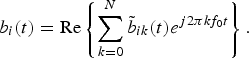 $$b_i \lpar t\rpar ={\mathop{\rm Re}\nolimits} \left\{{\sum\limits_{k=0}^N {\tilde b_{ik} \lpar t\rpar e^{j2\pi kf_0 t} } } \right\}.$$
The general equation of a nonlinear system without memory maps the entire set of incident waves in envelope domain as (2)
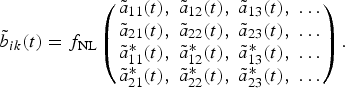 $$\tilde b_{ik} \lpar t\rpar =f_{{\rm NL}} \left(\matrix{\tilde a_{11} \lpar t\rpar \comma \; \tilde a_{12} \lpar t\rpar \comma \; \tilde a_{13} \lpar t\rpar \comma \; \ldots \cr \tilde a_{21} \lpar t\rpar \comma \; \tilde a_{22} \lpar t\rpar \comma \; \tilde a_{23} \lpar t\rpar \comma \; \ldots \cr \tilde a_{11}^\ast \lpar t\rpar \comma \; \tilde a_{12}^\ast \lpar t\rpar \comma \; \tilde a_{13}^\ast \lpar t\rpar \comma \; \ldots \cr \tilde a_{21}^\ast \lpar t\rpar \comma \; \tilde a_{22}^\ast \lpar t\rpar \comma \; \tilde a_{23}^\ast \lpar t\rpar \comma \; \ldots } \right).$$
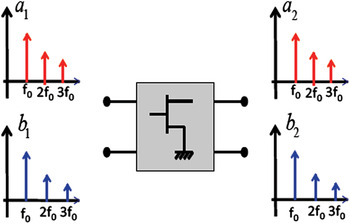
Assuming that the main nonlinearity is driven by the incident power wave a 11(t) at the fundamental frequency, harmonic superposition can be applied to (2), resulting in a relationship governing two-port nonlinear systems (Fig. 1):
 $$\eqalign{\tilde b_{ik}^{ST} \lpar t\rpar & =\sum\limits_{jl} S_{ik\comma jl} \left(\left\vert \tilde a_{11} \lpar t\rpar \right\vert \right)P^{k - l} \tilde a_{jl} \lpar t\rpar +\sum\limits_{jl} T_{ik\comma jl} \left(\left\vert \tilde a_{11} \lpar t\rpar \right\vert \right)P^{k+l} \tilde a_{jl}^\ast \lpar t\rpar \cr {\rm with}\; P= & e^{j\varphi _{\tilde a_{11} } \lpar t\rpar } .} $$
Harmonic superposition principle.

However, the terms S ik,jl and T ik,jl are described by the incident wave a 11 under steady-state conditions not taking into account memory effects. By using a discrete description with memory duration  $T_m=M\Delta t$.
( $\Delta t$ corresponds to the sampling step), equation (3) can be rewritten as
 $$\tilde b_{ik} \lpar t\rpar =f_{{\rm NL}} \left(\matrix{\tilde a_{11} \lpar t_{n - M} \rpar \comma \; \tilde a_{12} \lpar t_{n - M} \rpar \comma \; \tilde a_{13} \lpar t_{n - M} \rpar \comma \; \ldots \cr \tilde a_{21} \lpar t_{n - M} \rpar \comma \; \tilde a_{22} \lpar t_{n - M} \rpar \comma \; \tilde a_{23} \lpar t_{n - M} \rpar \comma \; \ldots \cr \tilde a_{11}^\ast \lpar t_{n - M} \rpar \comma \; \tilde a_{12}^\ast \lpar t_{n - M} \rpar \comma \; \tilde a_{13}^\ast \lpar t_{n - M} \rpar \comma \; \ldots \cr \tilde a_{21}^\ast \lpar t_{n - M} \rpar \comma \; \tilde a_{22}^\ast \lpar t_{n - M} \rpar \comma \; \tilde a_{23}^\ast \lpar t_{n - M} \rpar \comma \; \ldots } \right).$$
In order to formalize the general equation (4), a dynamic Volterra-series expansion of the S ik,jl and T ik,jl terms of (3) is performed and results in
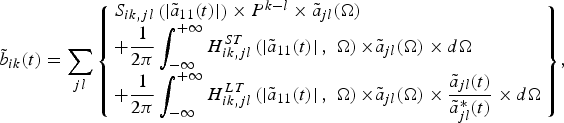 $$\tilde b_{ik} \lpar t\rpar =\sum\limits_{jl} {\left\{\matrix{S_{ik\comma jl} \left({\left\vert {\tilde a_{11} \lpar t\rpar } \right\vert } \right)\times P^{k - l} \times \tilde a_{jl} \lpar \Omega \rpar \cr+\displaystyle{1 \over {2\pi }}\int_{ - \infty }^{+\infty } {H_{ik\comma jl}^{ST} \left({\left\vert {\tilde a_{11} \lpar t\rpar } \right\vert \comma \; \Omega } \right)\times } \tilde a_{jl} \lpar \Omega \rpar \times d\Omega \cr+\displaystyle{1 \over {2\pi }}\int_{ - \infty }^{+\infty } {H_{ik\comma jl}^{LT} \left({\left\vert {\tilde a_{11} \lpar t\rpar } \right\vert \comma \; \Omega } \right)\times } \tilde a_{jl} \lpar \Omega \rpar \times \displaystyle{{\tilde a_{jl} \lpar t\rpar } \over {\tilde a^ \ast _{jl} \lpar t\rpar }} \times d\Omega } \right\}}\comma \; $$
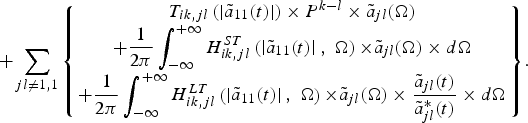 $$\displaylines{+\sum\limits_{jl \ne 1\comma 1} {\left\{\matrix{T_{ik\comma jl} \left({\left\vert {\tilde a_{11} \lpar t\rpar } \right\vert } \right)\times P^{k - l} \times \tilde a_{jl} \lpar \Omega \rpar \cr+\displaystyle{1 \over {2\pi }}\int_{ - \infty }^{+\infty } {H_{ik\comma jl}^{ST} \left({\left\vert {\tilde a_{11} \lpar t\rpar } \right\vert \comma \; \Omega } \right)\times } \tilde a_{jl} \lpar \Omega \rpar \times d\Omega \cr+\displaystyle{1 \over {2\pi }}\int_{ - \infty }^{+\infty } {H_{ik\comma jl}^{LT} \left({\left\vert {\tilde a_{11} \lpar t\rpar } \right\vert \comma \; \Omega } \right)\times } \tilde a_{jl} \lpar \Omega \rpar \times \displaystyle{{\tilde a_{jl} \lpar t\rpar } \over {\tilde a^ \ast _{jl} \lpar t\rpar }} \times d\Omega } \right\}}.}$$
with  $P=e^{j\left({\tilde a_{11} \lpar t\rpar } \right)} $.
As a first iteration, the model is simplified to take into account only short-term memory effects. The kernel  $H_{ik\comma jl}^{LT} $ is removed from the expression as it describes low-frequency memory effects. The expression of MHV model is described in [Reference Demenitroux, Maziere, Gasseling, Gustavsen, Campovecchio and Quere14] as (6)
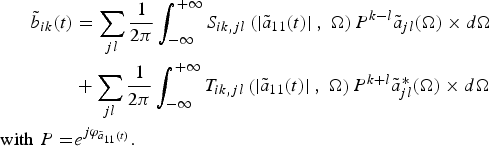 $$\eqalign{\tilde b_{ik} \lpar t\rpar & =\sum\limits_{jl} {\displaystyle{1 \over {2\pi }}\int_{ - \infty }^{+\infty } {S_{ik\comma jl} \left({\left\vert {\tilde a_{11} \lpar t\rpar } \right\vert \comma \; \Omega } \right)P^{k - l} } \tilde a_{jl} \lpar \Omega \rpar \times d\Omega } \cr &+\sum\limits_{jl} {\displaystyle{1 \over {2\pi }}\int_{ - \infty }^{+\infty } {T_{ik\comma jl} \left({\left\vert {\tilde a_{11} \lpar t\rpar } \right\vert \comma \; \Omega } \right)P^{k+l} } \tilde a_{jl}^\ast \lpar \Omega \rpar \times d\Omega } \cr {\rm with}\; P= & e^{j\varphi _{\tilde a_{11} \lpar t\rpar } } .} $$
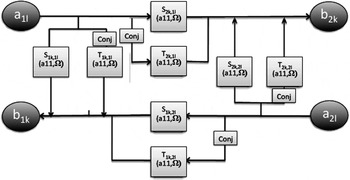
The topology of the model is described in Fig. 2.
Topology of the multi-harmonic Volterra model.

The authors of [Reference Maziere, Soury, Ngoya and Nebus15] present an improved model which considers the coupled effects of short- and long-term memory within the pass-band region. According to (6), the  $\tilde b_{21} \lpar t\rpar $ wave is linked to the contributions of
 $\tilde a_{1l} \lpar t\rpar $ and
 $\tilde a_{2l} \lpar t\rpar $, but for simplicity it is reduced to represent the overriding influence of
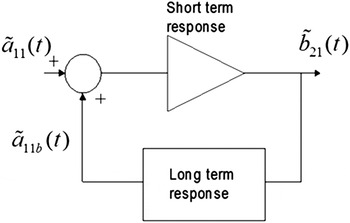
 $\tilde a_{11} \lpar t\rpar $. The resulting principle is represented by the feedback loop shown in Fig. 3.
Feedback loop principle.

The feedback loop consists of two basic nonlinear dynamics with widely separated time constants. The stronger of the nonlinear dynamics is the short-term response, responsible for the amplification and band-pass filtering effects of the amplifier (i.e., transistor transit time and matching network immittance profile). The weaker nonlinear dynamic is the long-term response; when a variable envelope signal traverses the feed-forward block, a portion of the output signal is fed back to the input. This long-term dynamic can be seen as slow modulation of the DC quiescent point of the amplifier resulting from the amplifier's thermal effects, trapping effects, and bias network low-pass filtering. We can extract the closed-loop equation (7) from Fig. 3, from which the approximation (8) is derived assuming the long-term contribution,  $f_{LT} \left({\left\vert {\tilde a_{11} \lpar t\rpar } \right\vert \comma \; t} \right)$ is reasonably small.
 $$\tilde b_{21} \lpar t\rpar =\displaystyle{{f_{ST} \left({\left\vert {\tilde a_{11} \lpar t\rpar } \right\vert \comma \; t} \right)\times \tilde a_{11} \lpar t\rpar } \over {1 - f_{LT} \left({\left\vert {\tilde a_{11} \lpar t\rpar } \right\vert \comma \; t} \right)\times f_{ST} \left({\left\vert {\tilde a_{11} \lpar t\rpar } \right\vert \comma \; t} \right)}}\comma \; $$
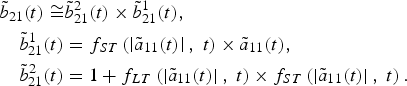 $$\eqalign{\tilde b_{21} \lpar t\rpar \cong & \tilde b^2 _{21} \lpar t\rpar \times \tilde b^1 _{21} \lpar t\rpar \comma \; \cr \tilde b^1 _{21} \lpar t\rpar & =f_{ST} \left({\left\vert {\tilde a_{11} \lpar t\rpar } \right\vert \comma \; t} \right)\times \tilde a_{11} \lpar t\rpar \comma \; \cr \tilde b^2 _{21} \lpar t\rpar & =1+f_{LT} \left({\left\vert {\tilde a_{11} \lpar t\rpar } \right\vert \comma \; t} \right)\times f_{ST} \left({\left\vert {\tilde a_{11} \lpar t\rpar } \right\vert \comma \; t} \right).} $$
Equation (8) defines the SSPA output  $\tilde b_{21} \lpar t\rpar $ as the combination of
 $\tilde b^1 _{21} \lpar t\rpar $and
 $\tilde b^2 _{21} \lpar t\rpar $, where
 $\tilde b^1 _{21} \lpar t\rpar $ is the amplifier's short-term response described by equation (6) and
 $\tilde b^2 _{21} \lpar t\rpar $ is a modulating component containing both short-term and long-term dynamics. Because
 $\tilde b^2 _{21} \lpar t\rpar $ depends only on the magnitude of the complex envelope signal and not on its phase, we can effectively describe it using the nonlinear impulse response model proposed in reference [Reference Bennadji, Layec, Soury, Mallet, Ngoya and Quere16]; the response can be considered independent of the instantaneous frequency and written as
 $$\tilde b^2 _{21} \lpar t\rpar =1+\int_0^\infty {\tilde h_{FB} \left({\left\vert {\tilde a_{11} \lpar t - \tau \rpar } \right\vert \comma \; \tau } \right)} \left\vert {\tilde a_{11} \lpar t - \tau \rpar } \right\vert d\tau .$$
Because of the index  $j\comma \; l=1\comma \; 1$ the T term can be removed from the general expressions (5) and (6) of
 $\tilde b^1 _{21} \lpar t\rpar $. Finally, from (6, 8, and 9), we reformulate the SSPA output as
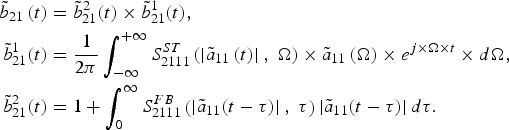 $$\eqalign{\tilde b_{21} \left(t \right)& =\tilde b^2 _{21} \lpar t\rpar \times \tilde b^1 _{21} \lpar t\rpar \comma \; \cr \tilde b^1 _{21} \lpar t\rpar & =\displaystyle{1 \over {2\pi }}\int_{ - \infty }^{+\infty } {S_{2111}^{ST} \left({\left\vert {\tilde a_{11} \left(t \right)} \right\vert \comma \; \Omega } \right)\times \tilde a_{11} \left(\Omega \right)\times e^{j \times \Omega \times t} \times d\Omega }\comma \; \cr \tilde b_{21}^2 \lpar t\rpar & =1+\int_0^\infty {S_{2111}^{FB} \left({\left\vert {\tilde a_{11} \lpar t - \tau \rpar } \right\vert \comma \; \tau } \right)} \left\vert {\tilde a_{11} \lpar t - \tau \rpar } \right\vert d\tau .} $$
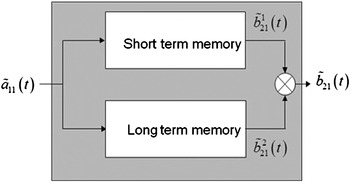
From equation (10), the proposed model can be represented as the simple feed forward structure shown in Fig. 4. This diagram is similar to the one previously adopted in [Reference Bosch and Gatti17–Reference Draxler, Langmore, Hung and Asbeck19]; however, the novelty lies in the equations used to describe the two branches. These equations lead to a kernel extraction process which does not require an optimization process and thus guaranties solution uniqueness.
New kernel topology.

With regard to the multi-harmonic behavior of a nonlinear device, the model can be generalized as
 $$\tilde b_{ik} \left(t \right)=\tilde b^{ST} _{ik} \lpar t\rpar \times \tilde b^{FB} _{ik} \lpar t\rpar \comma \;$$
 $$\tilde b_{ik}^{ST} \lpar t\rpar =\sum\limits_{jl} {\left\{\matrix{\displaystyle{1 \over {2\pi }}\int_{ - \infty }^{+\infty } {S_{ik\comma jl}^{ST} \left({\left\vert {\tilde a_{11} \lpar t\rpar } \right\vert \comma \; \Omega } \right)\times } \tilde a_{jl} \lpar \Omega \rpar \times d\Omega \cr+\displaystyle{1 \over {2\pi }}\int_{ - \infty }^{+\infty } {T_{ik\comma jl}^{ST} \left({\left\vert {\tilde a_{11} \lpar t\rpar } \right\vert \comma \; \Omega } \right)\times } \tilde a_{jl} \lpar \Omega \rpar \times \displaystyle{{\tilde a_{jl} \lpar t\rpar } \over {\tilde a^ \ast _{jl} \lpar t\rpar }} \times d\Omega } \right\}}\comma \; $$
 $$\tilde b_{ik}^{FB} \lpar t\rpar =\sum\limits_{jl} {1+\int_0^\infty {S_{ik\comma jl}^{FB} \left({\left\vert {\tilde a_{11} \lpar t - \tau \rpar } \right\vert \comma \; \tau } \right)} \left\vert {\tilde a_{jl} \lpar t - \tau \rpar } \right\vert d\tau } .$$
III. EXTRACTION METHOD
A) Extraction method of short-term kernels
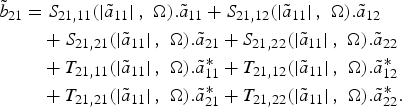
First, the short-term kernel  $S_{2111}^{ST} \lpar \vert \tilde a_{11} \lpar t\rpar \vert \comma \; \Omega \rpar $ is unambiguously identified by driving the amplifier with a single tone signal where the component
 $\tilde b^{LT} _{ik} \lpar t\rpar $ = 1,
 $\left\vert {\tilde a_{11} \lpar t\rpar } \right\vert $ being time independent. To better understand the model extraction methodology, the equation of b 21 for a two-harmonic model example is described as
 $$\eqalign{\tilde b_{21}& =S_{21\comma 11} \lpar \left\vert {\tilde a_{11} } \right\vert \comma \; \Omega \rpar .\tilde a_{11}+S_{21\comma 12} \lpar \left\vert {\tilde a_{11} } \right\vert \comma \; \Omega \rpar .\tilde a_{12} \cr & \quad +S_{21\comma 21} \lpar \left\vert {\tilde a_{11} } \right\vert \comma \; \Omega \rpar .\tilde a_{21}+S_{21\comma 22} \lpar \left\vert {\tilde a_{11} } \right\vert \comma \; \Omega \rpar .\tilde a_{22} \cr & \quad +T_{21\comma 11} \lpar \left\vert {\tilde a_{11} } \right\vert \comma \; \Omega \rpar .\tilde a^\ast _{11}+T_{21\comma 12} \lpar \left\vert {\tilde a_{11} } \right\vert \comma \; \Omega \rpar .\tilde a^\ast _{12} \cr & \quad +T_{21\comma 21} \lpar \left\vert {\tilde a_{11} } \right\vert \comma \; \Omega \rpar .\tilde a^\ast _{21}+T_{21\comma 22} \lpar \left\vert {\tilde a_{11} } \right\vert \comma \; \Omega \rpar .\tilde a^\ast _{22} .} $$
The extraction of each pair of S and T parameters can be achieved by using one of the two methods. The first method is provided by AGILENT using the PNA-X in order to extract the X-parametersTM of the amplifier. It consists of adding a “tickle tone” to the large-signal tone at all harmonic frequencies. As described in [Reference Verspecht and Root11], the theorem of harmonic superposition is used to solve the system. Moreover, it is important to note that both the power and the envelope frequency (Ω) are swept.
The second method involves setting the a-waves to zero, as done with S-parameter measurements, so that only a single pair of S and T terms will remain. In a two-harmonic example, only the b 2 wave is considered, while a 21, a 12 and a 22 are set to zero in order to extract the S 21,11 and T 21,11 terms. Harmonic load pull can be used to control impedances at both fundamentals and harmonic frequencies thereby setting the a-waves to zero in accordance with the reference impedance. This method is well suited for high-power amplifier or transistor characterization.
B) Extraction method of feedback kernels
The feedback kernels  $S_{ik\comma jl}^{FB} \lpar \vert \tilde X\vert \comma \; t\rpar $ are determined by driving the amplifier with a unit-step envelope at the center frequency of the amplifier bandwidth. Dividing the amplifier output by the short-term response results in a signal
 $b_{ik\comma jl}^2 \lpar t\rpar $ from which the impulse response
 $S_{ik\comma jl}^{FB} \lpar \vert \tilde X\vert \comma \; t\rpar $ is easily extracted. It is important to note that the driving signal
 $S_{ik\comma jl}^{FB} \lpar \vert \tilde X\vert \comma \; t\rpar $ corresponds directly to the time derivative of the output
 $\tilde b_{ik\comma jl}^2 \lpar t\rpar $.
Pulse profiling is performed at the center frequency of the amplifier bandwidth for each load impedance state. This method assumes that identifying the short- and long-term coupling effects at the center frequency is sufficient for proper representation of the behavior of the device without the need for larger sets of data.
C) Model implementation
Vector FitTM software is used to extract the frequency dependencies of all S and T parameters, and an iterative process is used to identify the minimum set of poles and residues. This description uses separate variables and is convenient for model implementation in commercial software. The relationship can be written as:
 $$S_{ik\comma jl} \left({\left\vert {\tilde a_{11} } \right\vert \comma \; \Omega } \right)=\sum\limits_{n=1}^N {\displaystyle{{r_{ik\comma jl}^n \lpar \vert \tilde a_{11} \vert \comma \; \Omega \rpar } \over {j\Omega - p_{ik\comma jl}^n }}} .$$
The user-compiled model, along with the R and C discrete elements, are introduced into ADS, where simulation can be carried out using both harmonic balance and envelope transient methodologies.
IV. MEASUREMENT AND SIMULATION RESULTS
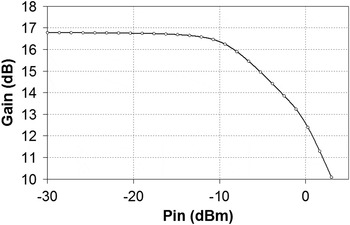
Consider a Bipolar-Complementary Metal Oxide Semiconductor (BiCMOS) Low-Noise Amplifier (LNA) operating at 1.96 GHz containing an automatic gain control (AGC) loop, making it very sensitive to long-term memory effects. The CW gain compression plot of the LNA at the center frequency 1.96 GHz is given in Fig. 5.
CW gain compression versus input power.

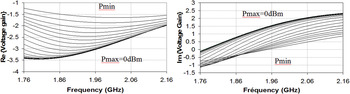
Figure 6 shows the real and imaginary parts of the short-term kernel  $S_{21\comma 11}^{ST} \lpar \vert \tilde a_{11} \lpar t\rpar \vert \comma \; \Omega \rpar $ over a 400 MHz bandwidth.
Transfer function  $S_{21\comma 11}^{ST} \left({\left\vert {\tilde a_{11} \left(t \right)} \right\vert \comma \; \Omega } \right)$.

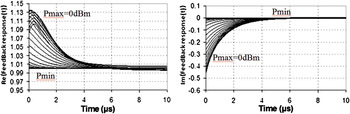
Figure 7 shows the real and imaginary parts of the feedback kernel  $1+\int_0^\infty {S_{21\comma 11}^{FB} \left({\left\vert {\tilde a_{11} \lpar t - \tau \rpar } \right\vert \comma \; \tau } \right)} $. A long transient duration of about 10 µs is observed.
Extraction results of feedback kernel.

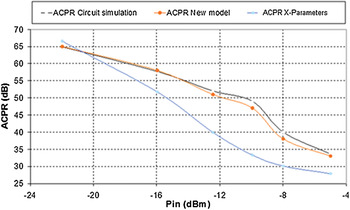
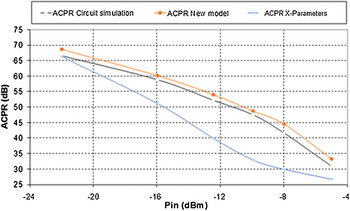
The extracted model was tested with a 16-Quadrature amplitude modulation (QAM) modulated signal with 2 MB/s and 40 MB/s bit rates. Figures 8 and 9 compare the model predictions with the results obtained from a transistor-level simulation.
ACPR = f(Pin) 16-QAM at 2 MB/s.

ACPR = f(Pin) 16-QAM at 40 MB/s.

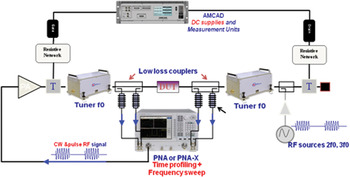
The agreement between the models and the circuit simulations are quite good, generally within a few dB. In comparison, the classical X-parameter model deviated by as much as 15 dB. It is important to remark that the main advantage of the MHV model compared with [Reference Soury and Ngoya13] is its ability to provide good predictions at high modulation rates due to the integration of the short-term memory. Additionally, it is important to note that the model simulation time is only several minutes, while the circuit simulation required several hours. Consider a three-stage Heterostructure Field Effect Transistor (HFET) power amplifier operating at 1.6 GHz. Using the second extraction method described in Section III.1, harmonic load pull was used to control impedances at both fundamentals and harmonic frequencies, thereby setting the a-waves to zero. The PNA-X NVNA measured the  $\tilde a_{jl} $ and
 $\tilde b_{ik} $ parameters for varying
 $\tilde a_{jl} $. Figure 10 shows the setup used in the model extraction.
AMCAD setup for behavioral model extraction.

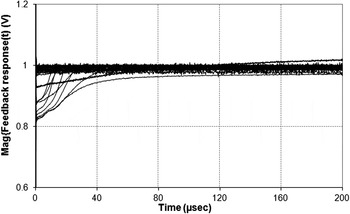
The nonlinear long-term time constant of about 200 µs is highlighted by the plot of the extracted feedback kernel  $1+\int_0^\infty {S_{2111}^{FB} \left({\left\vert {\tilde a_{11} \lpar t - \tau \rpar } \right\vert \comma \; \tau } \right)} $, Fig. 11.
Extraction results of feedback kernel.

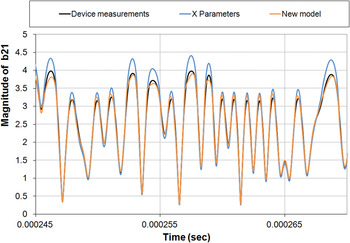
The extracted model was tested with a 16-QAM modulated signal and 10 MB/s bit rate. Figure 12 compares the waveforms of measured  $\tilde b_{21} $, the MHV modeling approach and classical X-parameters. The corresponding values of EVM are 2.3% (measurements) 3.0% (MHV model simulation), and 7.2% (classical X-parameters). These results were obtained at a fixed fundamental load impedance of 65 Ω while 2f0 and 3f0 were set to 50 Ω.
Time-domain envelope.

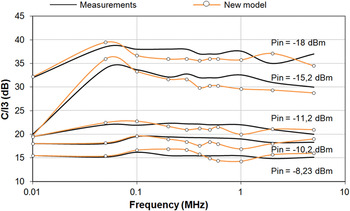
Additionally, C/I measurements were performed using a narrow bandwidth signal (from 10 kHz to 5 MHz) in order to verify the model's long-term memory-effect prediction capabilities.
The new model provides a significant accuracy improvement compared with a classical memoryless model, which does not take into account frequency spacing of two-tone signals. Using this new model, C/I3 can be predicted with an error <2 dB across power and tone spacing (Fig. 13).
C/I3 measurements versus simulation.

IV. CONCLUSION
An efficient new dynamic mapping technique based on Volterra expansion has been proposed. It has been successfully proven that this model can accurately reproduce the nonlinear envelope distortions under low mismatched conditions. The proposed model extraction is straightforward for both circuit-level simulation and time-domain envelope measurements. The extraction principle does not require a parameter optimization process. The model can be extended to predict DC consumption, which is a critical parameter for power amplifiers and system link budgets.
ACKNOWLEDGEMENTS
AMCAD Engineering would like to thank Mr. Gustavsen for providing Vector-Fit software, as well as Agilent Technologies for the latest Agilent ADS software. AMCAD Engineering would like also to thank the Catrene project 101 “PANAMA” for the support and Steve Dudkiewicz for the reviewing.
 Christophe Mazière was born in Limoges, France, in 1977. He received the M.S. and Ph.D. degrees in electrical engineering from the University of Limoges, respectively, in 2001 and 2004. His research work deals with behavioral modeling of nonlinear devices. In 2006, he joined AMCAD Engineering where he works on the development of advanced test benches for high power devices' characterization. Since 2009, he developed the activity of behavioral modeling with multi-harmonics models.
 Emmanuel Gatard received the electronics and telecommunications engineering degree from ENSIL, Limoges, France and the Ph.D. degree in electrical engineering from the University of Limoges, in 2006. His research interests at the XLIM research laboratory was electrothermal modeling of power semiconductor devices dedicated to circuit simulations, physics-based electron device simulations, and nonlinear thermal modeling. Since 2008, he joined AMCAD engineering where he is in charge of development of advanced test benches for high power devices' characterization. He also works on envelope tracking amplifiers and MEMS switches modeling.
 Cédric Enguehard received his Ph.D. degree in 2011. The subject of his research was the study of differential structures for RF low noise amplifiers at XLIM laboratory in Limoges. During his Ph.D. he was involved in MMIC design of Low Noise Differential Amplifier, MMIC Si devices, and RF advanced measurements. He joined AMCAD engineering in 2012 and is currently in charge of RF and microwave measurement.
 Bjørn Gustavsen received the Dr. Ing. degree in electrical engineering from the Norwegian Institute of Technology (NTH) in Trondheim, Norway, in 1993. Since 1994 he has been working at SINTEF Energy Research where he is the Chief Research Scientist. His interests include simulation of electromagnetic transients and modeling of frequency-dependent effects. He spent 1996 as a Visiting Researcher at the University of Toronto, Canada. He was a Marie Curie Fellow at the University of Stuttgart, Germany, between August 2001 and August 2002.