Introduction
Since the beginning of the twenty-first century, the global has been at the centre of the most important challenges for art history, with a widespread awareness of the need to decentre and renew the discipline’s objects and methods. Is art history global? The question has generated intense debate, all the more so because authors have not necessarily agreed about the nature of the issues at stake. When art historians ask ‘is art history global?’, some often mean ‘is art history researched and written globally?’; others mean ‘is art history able to address all artistic production from all over the world?’; still others mean ‘is art history open to non-Western ways of thinking?’ – and sometimes it is not clear which of these interpretations of the question they are choosing. Footnote 1 In the course of such discussions, some authors have identified a ‘global shift’ in the discipline, whose origins they have traced to the ‘decolonial turn’ of the 1980s. Footnote 2 However, this periodization is not based on a longue durée examination, which pushes back the origins of globalized art history to a more distant past.
With this in mind, this article reconsiders global and postcolonial art history’s chronology in the light of historical, sociological, and institutional approaches. It seeks to show that global approaches were present in art history long before the 1980s, with attempts to widen the range of the discipline’s objects of study, to borrow from other disciplines to better understand other cultures, and to develop comparisons on a global scale. These approaches were gradually put aside, however, in the process of building art history as a discipline, and this article will try to explain why. This may be the reason why art historians’ postcolonial and decolonial awareness came only much later, at a time when new methodologies such as visual and cultural studies had renewed a discipline that had effectively focused on the fine arts and European artefacts, and that had favoured connoisseurship methodologies. The turn toward the global among art historians was more influenced by the globalization of the contemporary art scene than by the adoption of a decolonial theoretical framework.
Questioning the ‘global turn’ in art history
In 2007, the art historian James Elkins denounced art history as being anything but global: here was a discipline that was neither globalized nor open to non-Western approaches. By way of example, he observed that ‘the basics of Western art history, such as formal analysis, periodization and iconography’, along with Chinese translations of Wölfflin, Panofsky, and Gombrich, were being taught in art academies in Beijing, Hangzhou, and Nanjing, where they were applied to both Chinese and non-Chinese art.Footnote 3 Yet Elkins neglected the possibility that (Western) art historians might have globalized their discipline with a renewed interest in foreign cultures and in transnational objects, and that ‘global art history’ may have another meaning beyond that of a ‘globalized discipline’ or that of a ‘non-Western approach’. Reducing the question ‘Is art history global?’ to ‘Is art history practised all over the world?’ in the book’s introduction, Elkins did not recognize that the contributors to the volume most often interpreted his question as referring to the issue of inclusion, namely of global coverage by the Western discipline of art history, and not to the issue of academic cosmopolitism. And yet, no art historians contradicted Elkins at that time. To denounce the history of art’s Westernism was considered normal. Art historians were recognizing their own inability to work on non-Western arts and, even more, the incapacity of their discipline to account for the logic of globalization. A strong decolonial bad conscience had imposed itself among art historians. This bad conscience was nonetheless fruitful. Ten years later, some have come forward to claim that art history has since effected a global shift. They have developed a genealogy that locates this global shift in the 1980s, or even in the 1970s, with the reception of postcolonial literary critique.Footnote 4
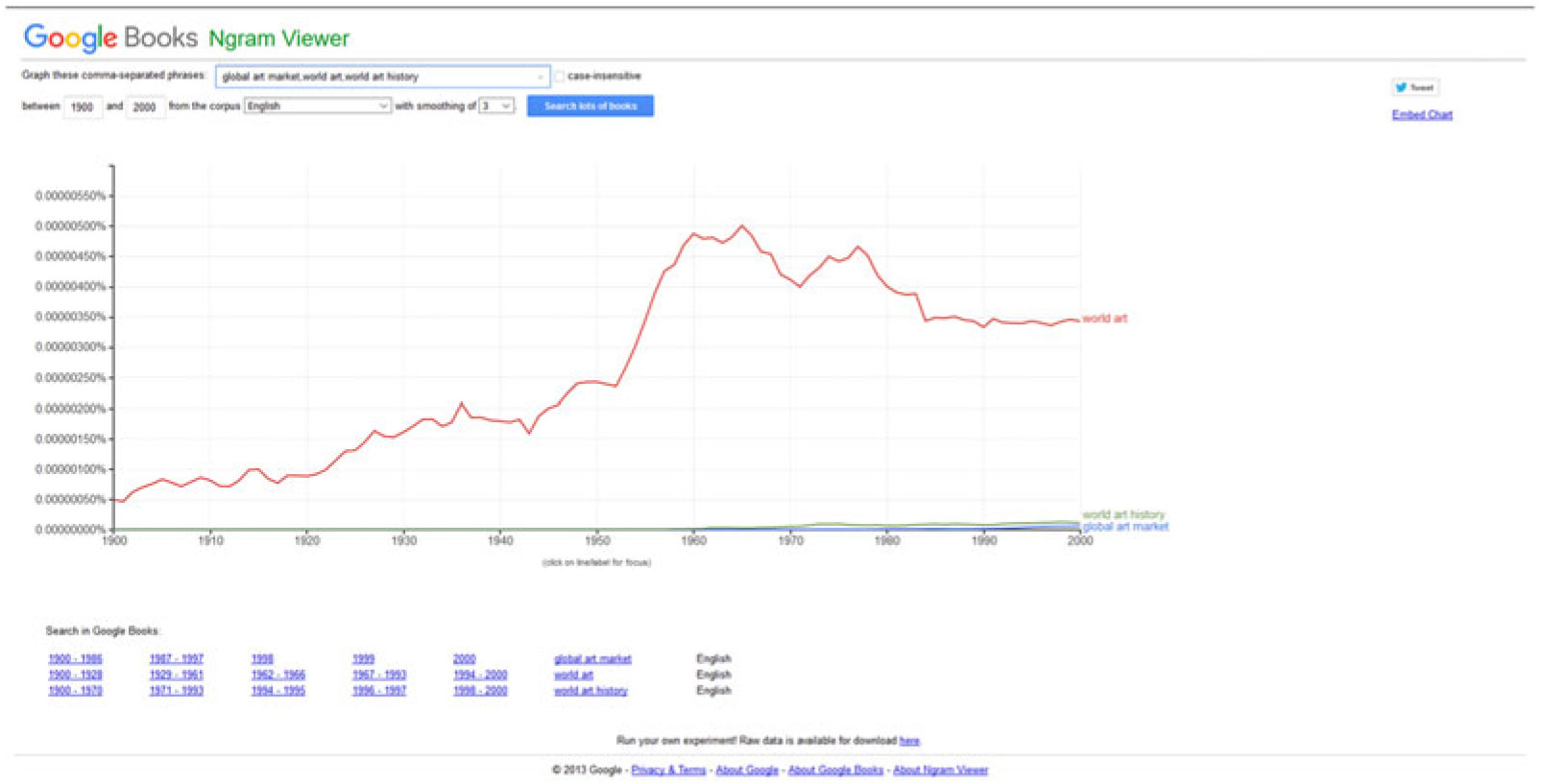
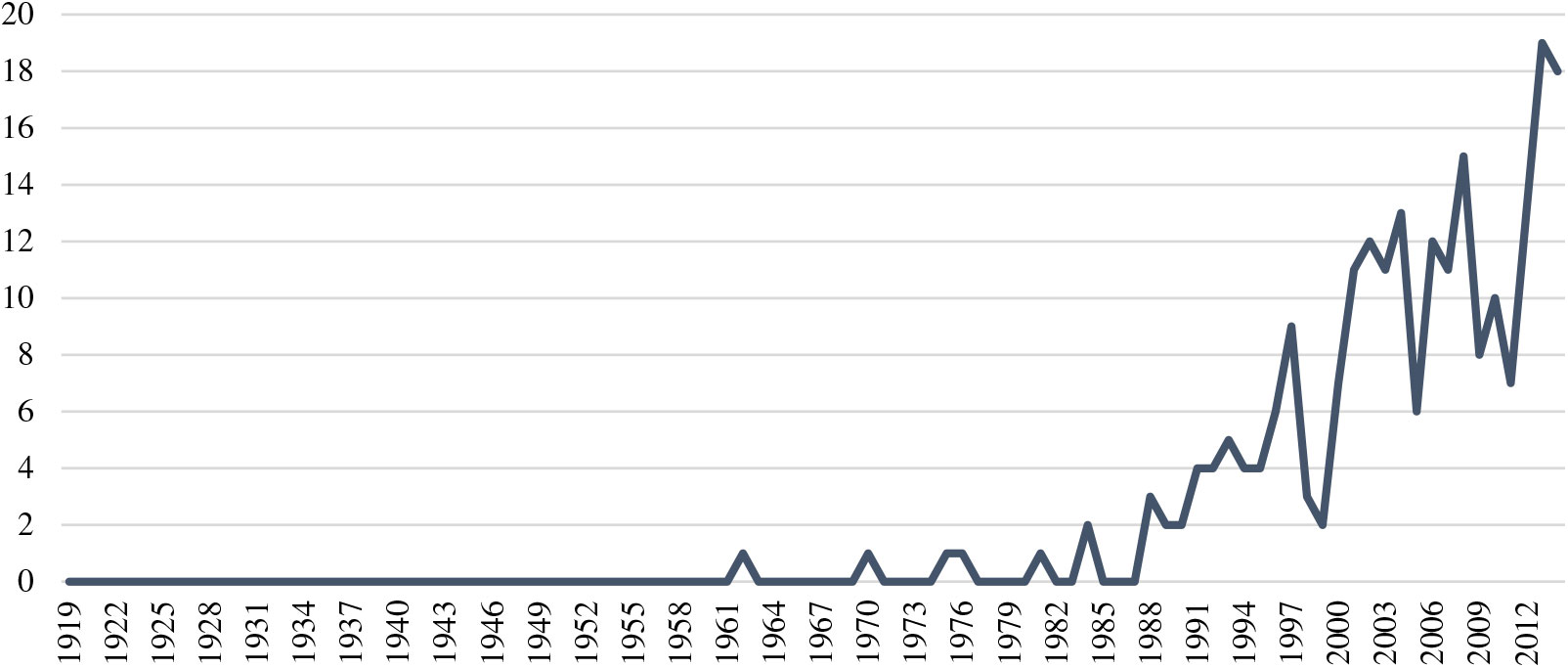
A longue durée approach questions such historiographical reconstructions, however, and suggests that global interests in art history are older than the 1980s, although postcolonial awareness is much younger – an awareness that triggered the idea of a global art history and helped develop a specific vocabulary that had not been used before.Footnote 5 A few quick bibliographic surveys over a long timescale support these alternative chronologies. In Worldcat, the global database that integrates the print collections of libraries all over the world, the number of catalogued items containing the phrase ‘art history’ that also refer to ‘global art history’ or ‘world art history’ in any domain name is in general extremely low for publications until the middle of the first decade of the twenty-first century, when its frequency increases suddenly (see figure 1). Reciprocally, a Google Books ngram shows the long presence of the term ‘world art’ among the English Google books corpus, with an upsurge in the 1960s, about the time that ‘world art market’ and ‘global art history’ first emerged as terms (see figure 2). Looking in more detail, a Google Books ngram shows that ‘world art history’ first peaked in the 1970s, but became even more common in the 1990s, paralleling the rise in the term ‘global art market’ (see figure 3).
Occurrence of items in Worldcat containing ‘world art history’ and ‘global art history’ as a percentage of items containing ‘art history’.

Google Books ngram of the term ‘world art’, 1900–2000.

Google Books ngram of the terms ‘world art history’ and ‘global art market’, 1900–2000.

A more detailed disciplinary survey can be carried out on art historical journals. In the academic English-speaking field of art history, the Art Bulletin shows a similar increase in the frequency of these terms (see figure 4). This journal is representative of US and English historiography, and since the 1980s has also included articles by authors from Germany, Switzerland, and the Netherlands. Further studies could be carried out for Italian, French, and German-speaking historiographies, such as in the Revue de l’art or the Zeitschrift für Kunstgeschichte, although a quick analysis of the Revue de l’Art suggests that global approaches are still lacking in 2018.
Number of articles published in the Art Bulletin containing the terms ‘global’ and ‘world’ from 1919 to 2014.

A search for other indicators corroborates the belated chronology of consciously global approaches in art history. For example, with the exception of the very first programme in world art studies/world art history, founded in 1992 at the University of East Anglia, UK, it was only after 2003 that major European universities instituted courses and posts in world art studies or in transnational or global art history: in Leiden, at the École Normale Supérieure in Paris, at the Freie Universität Berlin, and at the universities of Sussex, Copenhagen, and Heidelberg. Footnote 6 Non-university institutions in Europe dedicated to art history also gradually opened up to global issues around this time. The Kunsthistorisches Institut in Florence, the Forum Transregionale Studien in Berlin, the Institut National d’Histoire de l’Art in Paris, and the Royal Institute for Art History (RKD) in The Hague began hosting guest researchers or research programmes. Footnote 7 As a result, the thirty-second International Congress in the History of Art (CIHA 2008) showed a greater global awareness than had previous conferences: its chosen theme was ‘Crossing cultures: conflict, migration and convergence’, while one panel was dedicated to ‘The idea of world art history’. Footnote 8 Private or semi-private research institutions, such as the Clark Art Institute, the Getty Research Institute, the Terra Foundation for American Art, the College Art Association in the USA, and the German Centre for Art History in Paris also turned to global issues in the late 2000s. The International Committee on Art History gradually expanded the scope of its congresses, and the World Congress of Art History was first held in Asia in 2016.
These recent developments appear to be in opposition to the fate of early tendencies toward intercultural comparisons in art history, which seemed to be marginalized, as we shall see, at the time when art history consolidated as a discipline. All this encourages us to better interrogate how art history opened up or closed itself to global issues. It incites us to study which global approaches expanded or failed to expand over time, how different trends gradually intensified, merged, or petered out to give rise to what is considered today as ‘global art history’, and what type of scholarship this term signifies.
The old and multidisciplinary roots of world art history
If we look at the very first art historians, such as Giorgio Vasari (1511–74), we can already discover a project for a discipline that would be able to encompass all visual and material creations by humans, whatever their geographical or historical origins. Footnote 9 Although we cannot talk about transdisciplinarity for this period, we must note that early scholars were very open, borrowing as much from philosophy and history as from what could be described as spontaneous ethnography, and from what would later be considered as art history, with its detailed knowledge of objects, and interest in their material and visual specificities.
Interest in the study of the arts was born with collecting and curiosity cabinets, around the time of the Renaissance in Europe. Footnote 10 These demonstrated the aristocratic taste for the exotic, and were nourished by new objects and images brought back from the first voyages to America and Asia. They raised awareness of cultural and visual otherness. At the same time, in the first art history book, Le Vite (1560–70), Vasari took the hypothesis of distinct geographical schools seriously. The attention he paid to foreign artistic production raised the question of similarities between cultures, and encouraged art historians to postulate hierarchies between cultures through the study of their arts and artefacts.
At the end of the eighteenth century, the Enlightenment and the development of Weltgeschichte (world history), especially in Germany, gave a philosophical dimension to the study of artistic production from all over the world. What would come to be called Universalgeschichte (universal history) sought to espouse the idea of a single oikumene (inhabited world). This notion underpinned most of the approaches to the arts in Europe. It inspired the creation of ‘universal’ museums dedicated to exhibiting works without distinction of origin, period, medium, or school, such as the Louvre and the British Museum. Footnote 11
This approach was further encouraged by archaeological excavations in Greece, Egypt, North Africa, and the Middle East. These ventures and their study aroused a passionate interest in ancient non-European cultures at the beginning of the nineteenth century, whether they were considered as the source of Western culture – Johann Joachim Winckelmann (1717–68) idealized Greek art on this basis – or as being endowed with a disturbing otherness.
The universalism of a Weltgeschichte or Weltkunstgeschichte (world art history) was not necessarily ethnocentrism. Footnote 12 It was in Germany that orientalism developed, initially as an academic approach to the East that broke with the hitherto univocal interest in Greece. First appearing in the field of languages (particularly in Göttingen after the 1820s), before gaining traction as the archaeological exploits of the 1850s and 1880s brought the East to the attention of a wider audience, academic orientalism aroused a new interest in non-European cultures that was shared by art historians and museums. Footnote 13 Added to this was the pressure for a reform of the German education system and a rejection of antiquity as it was taught in high schools. Orientalistik (orientalist studies) lent weight to one side of this struggle between generations and between academic positions. What Raymond Schwab calls the ‘oriental Renaissance’ lasted until the 1880s, and led to extensive and well-documented research on non-European arts. Footnote 14
Nationalism and interest in the outside world
As it concerned ancient cultures and arts rather than contemporary cultures, nineteenth-century art historians’ interest in the East and the wider world was not incompatible with nationalist and racist historiographical models. At that time, art history helped to provide arguments for the construction of national identities – whether against one empire (against the French, more often than not) or in the service of another, such as the Germanic or Austro-Hungarian empires. The arts were used as an effective means of differentiating societies and civilizations. The definition of ‘national schools’, advanced in particular by Franz Kugler (1808–58) in his Handbuch der Kunstgeschichte (Manual of art history; 1842) sorted European art into national styles and practices to facilitate its study. Considering art as a product of peoples rather than of political organizations also represented a resistance to imperial domination.
After the 1850s, in the wake of the universal exhibitions and thanks to improving transport, the circulation of artists and works of art accelerated, as did the serial reproduction of images. Two paradoxical conceptions of the arts emerged: a national art on the one hand and a cosmopolitan art on the other. Beginning in Paris in 1855, works of art were included in universal exhibitions, and organized by nation. Footnote 15 Yet, national art, like folklore, was the offspring of internationalization: the more people travelled and the more foreign cultures they encountered, the more they looked to categorize these cultures according to national or ethnic criteria. Footnote 16
The founding of new art magazines contributed to this phenomenon, as well as to a professionalization of art history. In London, the Art Journal, founded in 1849, published illustrated guides to international exhibitions. Footnote 17 Die Dioskuren, a ‘German art journal’ founded in Berlin in 1856, engaged in dialogue with the outside world. In 1859 in Brussels, Adolphe Siret founded the Journal des beaux-arts et de la littérature; the same year in Paris, Charles Blanc began to publish the Gazette des beaux-arts to keep ‘France informed of what is happening abroad and abroad of what is happening in France’. Footnote 18 These art critics were also historians. They travelled and began to compare the arts and their histories according to a ‘cosmopolitanism of the national’ that was shaped and broadcast by the cultural press and by their own publications. Footnote 19
Gradually, teaching positions in art history were created across Europe. Footnote 20 Initially, they tended to be occupied by specialists in European art, but they were soon extended to specialists of other parts of the world. Founded in 1882, the École du Louvre developed a strong archaeology programme and looked beyond European art, with an emphasis on the history of Egyptian, Islamic, Indian, Chinese, and Indigenous American art. Footnote 21 At the Collège de France, an American antiquities chair was created in July 1903. In his inaugural speech, the first holder of this chair, Léon Lejeal, cited similar initiatives in Germany and the United States. Footnote 22
At a time when chairs in art history were scarce, a global approach to the arts represented a potentially advantageous route for historians. The intellectual climate of unified Germany after 1870 and the new imperial and colonial power among the concert of nations inspired the development of anthropological and psychological theories on artefacts on a global scale. A lack of textual sources on the ‘other arts’ favoured such approaches: practices of connoisseurship would be difficult, biographical focus impossible, and chronological precision challenging. At the end of the nineteenth century, the most important historiographical developments in Germany were to be found in the work of historians who focused on visual sources. German-speaking historiography soon exhibited a collective interest in a Weltkunst, a ‘world art’ that transcended cultural and geographical borders. Footnote 23 Admittedly, this opening up to art from the rest of the world was concentrated not in the field of art history proper but mainly in that of Kunstwissenschaft – the science of art, practised by scholars trained as historians who wanted history to be scientific. Art history itself continued to focus more on Western art. Footnote 24 This disciplinary division of labour solidified gradually with the academic institutionalization of art history in Germany: ‘the art of others’ was considered as the infancy of art rather than as art in the noble sense, that is, as the valid object of art history.
The majority of art historians therefore focused on works or artists from canonical periods and places, with a view to a socially connoted aristocratic connoisseurship, and a documentalist or conservative approach necessary for the functioning of public collections. These hegemonic approaches were also socially hegemonic: the ‘mandarins’ co-opted their students into following their paths. Footnote 25 Despite increasing debate around the methods of art history and the necessity of a scientific shift, Kunstgeschichte, more focused on Europe and the ‘fine arts’, finally prevailed over Kunstwissenschaft, which was put aside in Germany, while in France other transdisciplinary experiments in histoire sociale de l’art remained isolated. Footnote 26 Some art historians nonetheless realized the advantages offered by visual methods, and of wide, global scopes over monographic approaches. For example, the concept of Styl coined by Gottfried Semper (1803–79) or Alois Riegl’s (1858–1905) notion of Kunstwollen (which some suggest translating as ‘will to art’) successfully subsumed ‘the art of others’ into the pre-existing understanding of art.Footnote 27
A clarification: racism, nationalism, universalism
Why have art historians forgotten so much about their predecessors’ interest in world cultures? Because this interest was inseparable from nationalist and racist approaches that the discipline has strongly rejected in the last several decades, and because our time has difficulty accepting the idea that historians could be nationalist, racist, and open to the world at the same time. As Romain Lecler also convincingly shows in this issue for sociology, dominant theories of globalization in the 1990s relied on the idea of a transition from a national to a global era, which implied that people could imagine that the period before was not interested in globalized phenomena, and was instead dominated by nationalism. Footnote 28
The role of art history in the construction of national unity across Europe has been well documented since the 1990s. Footnote 29 Historians have focused a good deal of attention on the racial – and racist – scope of this movement, particularly with regard to German- and French-speaking regions, while in literature some specialists have strongly criticized methodological nationalism. Footnote 30 This nationalist strain has been considered antinomic to any global approach. Footnote 31
Racist and nationalist terms were indeed part of the prevailing discourse. They can be found in the writings of Johann J. Winckelmann, Heinrich Wöllflin, Alois Riegl, Karl Lamprecht and Josef Strzygowski, as well as in those of Eugène Viollet-le-Duc and Louis Courajod. Footnote 32 The focus on the nationalism and racism of art history has tended to overshadow these authors’ production of knowledge about non-Western arts, and the fact that they conceived the arts as the result of cultural mixing, migration, and circulation through time and space. For instance, recent scholarship has shown how the French art historian Viollet-le-Duc was accused rather too quickly of having drawn his inspiration exclusively from Arthur de Gobineau’s racism and eurocentrism. Footnote 33 Viollet-le-Duc wrote about Greek (1861), Mexican (1863), and Russian art (1877). In 1863–64, his lessons at the École des Beaux-Arts invoked references beyond Roman classicism, drawing on the origins of art in India, Egypt, and Greece, as well as the art of the Roman empire. He was an heir to the French liberal historiography of the 1830s that was determined to fight against Italian and Catholic influences and the domination of classical references, and hence promoted the study of other civilizations. If Viollet-le-Duc seems to have adhered to Gobineau’s position in his Essai sur l’inégalité des races humaines, he did not attribute styles to a particular race; on the contrary, styles were for him the result of migrations of populations and techniques that fertilized new regions.
The defence of a national art against Italo-centric academism was a cause taken up by the next generation in France, often represented by Louis Courajod, who held a chair in the history of sculpture at the École du Louvre from 1887 to 1896. Footnote 34 Their approach to the history of art was rooted in a disdain for academism, but not necessarily in the conventional ‘theory of races’, as some authors have since suggested. Footnote 35 The importance given to notions of race and to social, religious, political, and cultural organization, as well as to geomorphological and climatic conditions, was part of the positivist spirit of the times, which lay between an idealism that presupposed certain principles (including race and nation) through which to name and organize the world, and a deterministic materialism. The notion of race made it possible to understand phenomena beyond the local and national level, thus addressing issues that today we would call ‘global’ and allowing for cultural mixing. Even in the 1920s, evocations of the notion of race were considered relatively uncontroversial. Footnote 36 A similar or comparable analysis could be carried out for German- and English-language historiography.
Art historians between imperialisms
Reciprocally, the few non-nationalist approaches to art history that did exist in the nineteenth and early twentieth centuries, such as that of the Vienna School, were not necessarily immune to political domination. This may explain why they, too, have not been identified by art historians looking for legitimate roots for global art history.
In Austro-Hungary, the Austrian Historical Research Institute was founded as part of the project that aimed at the cultural legitimization of the Habsburg empire and its transnational heritage. It was in this context that the Vienna School developed. Footnote 37 The school’s work sought to justify the predominance of a certain cosmopolitan elite in the Austro-Hungarian empire – a natural intellectual tendency for a group whose members came from the senior civil service and from mobile social milieus that circulated throughout the empire. Alois Riegl’s father had worked in the Austrian tobacco administration, from Austria and Bohemia to Galicia, where the young Riegl completed his secondary education in Polish. Footnote 38 After studying philosophy and history, Riegl trained in connoisseurship with Moritz Thausing, the son of an official of the castle of Čížkovice in Bohemia. Spread between Vienna, Prague, Budapest, Zagreb, and Krakow, the intellectual elite of the empire had every interest in promoting mixing and hybridity, and denigrating local styles. This class of art historian drew inspiration from the analytical methods of the Italian art connoisseur Giovanni Morelli (1816–91), and constituted the kind of cosmopolitan elite that was characteristic of the European aristocracy.
The sociological profile of the nationalist enemies of the Vienna School was more popular and less cosmopolitan. Josef Strzygowski (1862–1941), who was active at the universities of Munich and Vienna at the end of the nineteenth century, offers one such example. He published a controversial work, Orient oder Rom. Beiträge zur Geschichte der spätantiken und frühchristlichen Kunst (The Orient or Rome: contributions to the history of late antique and early Christian art; 1901). He used a study of the arts of Egypt, Palmyra, and Anatolia, including textiles, sculptures, sarcophagi, and ivories, to defend the racist thesis that linked the decline of late antiquity to ‘Eastern’ and ‘Semitic’ influences. He would deploy a similar thesis to Germanize Gothic art, whose origins had hitherto been considered Indo-Germanic. Strzygowski was the son of a manufacturer; he eventually succeeded his rival Franz Wickhof (1853–1909) at the University of Vienna in 1909. Dagobert Frey (1883–1962), who studied architecture in Vienna at the Technische Hochschule – a more technical and less socially prestigious trajectory – joined the populist movements then promoting racial politics. With the advent of Nazism, his career accelerated. Frey participated in the looting of artworks by the SS in Poland. He justified this theft through his writings on art in Poland, which he presented as German while minimizing the presence of Jewish and Polish cultures. Footnote 39
Western colleagues were not alarmed by these developments, with no visible dissent at the XIII International Congress of Art History held in Stockholm in 1933. In the meantime, intellectuals from the new countries formed by the dismantling of empires after 1918 also argued for exclusive national identities, whether in Armenia, Romania, Turkey, or Poland, seeking to stake various territorial claims (Hungarians vs. Germans or Slovaks and Croats, Austro-Hungarians vs. Czechs and Slovaks). Footnote 40 Some Italian art historians were committed to interpreting the provinces claimed from Austria-Hungary as Italian and fought to nationalize their history. In France, art history was similarly used to justify the recovery of Alsace and Lorraine. As Katja Naumann shows in this issue, a world perspective also lost its plausibility among historians in the 1930s, with most scholars subsequently adopting a national approach. Footnote 41
The emigration to England or to America of German art historians with a more denationalized, globalized approach, such as Aby Warburg, failed to further legitimize their perspectives. Warburg’s work in Kulturwissenschaft had expressly taken up a position against the ‘border guards’ prohibiting the passage between disciplines and national traditions. His immense researcher’s library, free of any institutional agenda, sought to illustrate a transcultural, transnational, global vision of the science of culture. Warburg also expressed interest in cultural and stylistic exchanges and their ‘vehicles’ of transmission. His institute, which emigrated with him after 1933, never truly integrated into the British institutional and academic context. Reception of his work has focused on very different aspects of his work over the past twenty years or so. Footnote 42
Despite this, interest in non-European cultural regions was growing and becoming institutionalized in democratic countries in the opening decades of the twentieth century. In France, the creation in 1922 of permanent courses on Latin America at the Collège Libre des Sciences Sociales won the patronage of the ambassadors of Brazil, Uruguay, and Bolivia. Footnote 43 Latin American countries were diversifying their alliances, while France was seeking to expand its markets in Latin America. The French Ministry of Colonies created the Institut d’Ethnologie in 1925, led by the anthropologists Marcel Mauss (1872–1950) and Lucien Lévy-Bruhl (1857–1939), together with the permanent secretary Paul Rivet (1876–1958). The institute offered courses on American civilizations (especially Indigenous American and Pre-Columbian civilizations), with an emphasis on the study of the arts. Footnote 44 At the same time, under the leadership of the League of Nations, the International Institute of Intellectual Cooperation was already advocating a European understanding of art, literature, and culture that transcended considerations of the state and the nation. Footnote 45
In the USA, imperial and geopolitical concerns seemed to similarly point towards the development of new directions in research and teaching, though private interests were more prominent in these movements than on the other side of the Atlantic. The University of Florida opened the first centre for Latin American studies in the United States in the 1930s, and the study of pre-Columbian and Latin American art began at Yale in 1938. Footnote 46 The Museum of Modern Art (MoMA) and the Metropolitan Museum of Art had been interested in pre-Columbian and Mexican art since the beginning in 1927–28 of what would later be called the American ‘Good Neighbor Policy’, following the Rockefeller Foundation, which aimed to improve its brand image in Mexico through involvement in culture, and the encouragement of the US ambassador in Mexico. Footnote 47 Islamic art also developed as a discipline, with university-sponsored archaeological excavations (Princeton) in the 1930s alongside the growing interest of North Atlantic powers in the rich petrol and gas reserves of the Middle East. Footnote 48
All this goes against the idea that art history’s interest in world phenomena and in new methodologies to study them appeared only in the 1980s, and that art history before that time was only nationalist and ethnocentric. Global approaches were not necessarily untainted by nationalist or imperialist stances, while traditional approaches that dealt in the concept of race could nonetheless be open to global questions. The level of homogeneity was not such that we can speak of a ‘Western canon’ of art history that supposedly dominated even in non-Western countries, a notion perpetuated by too many art historians. For example, the publication in 1913 of R. D. Bhandarkar’s Vaisnavism, Saivism and minor religious systems, and the following year of the many volumes of T. A. Gopinatha Rao’s Elements of Hindu iconography, were central to the establishment of art history in India. Footnote 49 This work of cataloguing and iconographically analysing Indian sculpture had nothing to do with the Eurocentric and imperialist discourse of Western art history that is usually perceived as having dominated art history departments from their very beginnings. Footnote 50 In the 1920s, Stella Kramrisch (1896–1993), an art historian of Austrian-Czech origin and a well-travelled specialist in Indian art, helped to challenge prevailing discourses on Indian art, particularly in her work with Ananda K. Coomaraswamy, a Sri Lankan aesthete and member of the international Arts and Crafts movement. Footnote 51
However, this type of decentred approach only managed to find its place in the institutions of the North Atlantic when it suited broader geopolitical interests. In 1954, South Asian art entered the University of Pennsylvania thanks to Kramrisch’s efforts. This development occurred in a context in which the US was seeking to take advantage of France’s withdrawal from Indochina/Vietnam, and was applying the lessons gleaned from the American defeat in the Korean peninsula. Asia was the arena for the US’s struggle against Russian and Chinese influences, as well as a potential new market for US manufacturers. These countries had to be studied, understood, and even seduced through academic research. The significant level of funding made available by the Rockefeller Foundation for the study of Asian arts in the 1950s comes as no surprise in this context. Footnote 52
The expansion of US academic interest in African art similarly coincided with the introduction in the 1950s of the so-called ‘Green Revolution’ to the continent by way of development aid and the application of the strategies of the Midwestern agro-industry and its chemical industry partners. African studies, which first appeared in area studies and then in art history departments, were foremost the preserve of the universities most closely involved in the ‘Green Revolution’ and its associated industries. Thus, the first doctorate in African art history was awarded at the University of Iowa in 1957; the laureate was recruited seven years later as an associate professor at Indiana University. Footnote 53
The adoption of the modern universalist project
A profound ideological shift occurred in the critical and art historical circles active after 1945 in the North Atlantic region, which saw the adoption of a value system that favoured the universal over the national as the Cold War developed after 1947. The democratic West systematically disparaged socialist realism and promoted abstraction, associating abstract art with universalism, peace, equality between nations, and plastic languages. Of course, not all art historians subscribed to this approach. The Austrian Hans Sedlmayer (1896–1984), for example, was very critical of modern art. However, on the whole the discipline re-evaluated the history of recent modernity through a reading that was favourable to the avant-gardes persecuted by totalitarianism. Art historians began to search for – and find – the intellectual roots of a formalist, internationalist, universal, and anti-totalitarian approach in the pre-war years and in abstract movements in particular. Salons, Biennials, and other official exhibitions honoured the abstract generations of the 1930s – Bauhaus, Art Concret, and De Stijl – and their internationalist approach to art. They also took a retrospective look at the aesthetic currents that had favoured early African and Indigenous American arts, such as surrealism, whose bibliography suddenly developed after 1945. European markets and museums pushed the work of abstract artists working in a register considered primitive, capable of speaking a spiritual language intelligible to all. Footnote 54
In West Germany, international abstraction countered the Sonderweg theory, and offered evidence that German culture had not been intrinsically oriented towards nationalism and totalitarianism. Footnote 55 For contemporary art, abstraction was also seen as a way out of the quarrels raised by socialist realism. Footnote 56 At the same time, the discourse on abstraction as a universal and democratic language became almost official in the United States, with the support lent by liberal elites to abstract expressionism. Footnote 57
Before the late 1950s, art historical universalism and artistic universalism had never cohabited so closely as they would within UNESCO and its affiliated institutions, the International Council for Museums (ICOM) and the International Association for Art Critics (Association Internationale des Critiques d’Art, AICA). UNESCO defended abstraction, which was supposed to represent intimate landscapes, regardless of the artist’s culture and continent. Footnote 58 Considered visually as progressive, apolitical, and universal, abstraction was also associated with modern industrial countries enjoying constant growth. The UNESCO Collection of World Art, founded in 1954 by the New York Graphic Society and UNESCO, with the support of UNESCO member governments, was to illustrate the proximity of peoples through the arts. It disseminated high-quality reproductions in affordable albums throughout the world.
In France, the culture minister André Malraux (1901–76) presented ‘world art’ as a means of salvation for ‘world culture’. Footnote 59 He offered a synthetic conception of a notion also widespread in literary circles, according to which Weltlitteratur (world literature) crystallized the possibility of a free humanity. As Jérôme David has shown, this ideal inherited from the spirit of the Enlightenment took on its full scope during this period. Footnote 60 It became a key notion in literary studies, a slogan that was humanistic – perhaps even revolutionary. On North American campuses it was the centre of an educational project that aimed to emancipate the working classes and to cultivate a spirit of openness among students.
A weak echo of world history until the early twenty-first century
Paradoxically, while global and what Franco Moretti has termed ‘distant’ approaches were developing in history in both the United States and Europe prior to the first decade of the twenty-first century, art history underwent little methodological change. Footnote 61 In France, the discipline lagged behind the École des Annales, a historiographical school at the forefront of a shared ambition for a globalized history. Footnote 62 The Revue de l’Art offers an example of the slowness with which art history adopted more globalized methods. Footnote 63 In France it was rather the heritage of Erwin Panofsky (1892–1968) that interested art historians. Panofsky’s method of iconology justified the predominance of imaginative thinking over discursive thinking. By identifying the visual semantics and referential significance of the works, art historians could claim that they were reconstructing ways of seeing, thinking, and feeling: art history took precedence over history. This project failed to generate new studies of art on a global scale, and did not encourage the study of non-Western art, since any iconological study requires highly specialized knowledge of the references present in works and their contexts. The movement shared some ground with the approaches of the École des Annales, but had none of its concern for exhaustiveness, representativeness, or the transnational. Footnote 64
Whatever the country, methodologically national and ethnic approaches to art continued to dominate in art history collections until the first decade of the present century, circumscribing ‘Flemish’, ‘English’, ‘Italian’, ‘Austrian’, ‘French’, or ‘German’ art and the ostensibly specific characteristics of each. Footnote 65 In Germany, the revolt of young art historians against a university establishment wedded to connoisseurship, artistic philology, and a mandarinate led some to adopt a relatively globalized ‘historical image anthropology’. Footnote 66 But Martin Warnke (b. 1937) deplored the failure of this project as early as the early 1990s. The renewal brought about by cultural, social, Marxist, and psychoanalytical approaches was strictly limited to the study of European art, with no attempts to broaden the geographical scope or account for transnational developments. In France, art historians became more passionate after 1992 about the ‘art crisis’, which seemed to be once again pitting ‘Les Anciens’ against ‘Les Modernes’. Footnote 67 In North America, art history opened up gradually to ‘visual and cultural studies’ and to semiotics. Footnote 68
The 1990s: a collective assault on the national in Europe
A sea change occurred in the late 1990s, in particular as art historians gradually distanced themselves from the methodological nationalism that had long characterized their discipline. The dismantling of the Soviet empire, German reunification, and the resurgence of ethnic conflict in Africa and the former Yugoslavia pointed both to the national ambitions of contemporary peoples and to the deadly implications of ethnic nationalism. Footnote 69 The works of historians such as Ernst Gellner (1925–95) and Benedict Anderson (1936–2015) convincingly showed that the nation was a construct and not a given, and that no ethnic or geographic definition of art could hold firm. Footnote 70 There was a sudden proliferation of studies on the ways in which the arts, like literature, had been invoked from the 1740s onwards to ‘create national identities’ Footnote 71 and to represent what Benedict Anderson terms ‘imagined communities’. The period saw the publication of studies on the national dimension of the creation of museums in the nineteenth century, on universal exhibitions, and on the emulation that often characterized the arts after 1855. Footnote 72 The late 1990s also saw an all-out assault by art historians on the ‘racism’ of their predecessors, as discussed above.
Scholars’ interest in the national function of the arts was coupled with controversies about the permanence of national conceptions of art history, especially in Europe. Several figures emerged in their respective national fields to rise up against national art and its implications. Giovanni Previtali (1934–88), a professor who long worked without a university chair, took a stand against the notion of ‘Italian art’ prior to Italian unification. In 1990, William Vaughan, who had recently been elected as a professor at Birkbeck College, University of London, refuted ‘the Englishness of English Art’. Footnote 73 In his 1992 work Die Deutschen und ihre Kunst (The Germans and their art), Hans Belting protested against the permanence of nationalism. Footnote 74 In recent years, some American authors have similarly claimed that, with the end of the Cold War, the history of art in America freed itself from the nationalist pressure that had long dominated the field and its critical discourses. Footnote 75 This is far from a unanimous view, however, and other historians see things in a wholly different light. Footnote 76
Global approaches to art history in Europe were the main beneficiaries of this assault on the national, even as the impact of postcolonial theory remained slight. The study and rejection of nationalisms was logically followed by an interest in confrontations and encounters, and later in artistic exchanges. Footnote 77 The 1992 International Congress on Art History in Berlin focused on this latter issue. Footnote 78 In German and French historiography, reception studies also proliferated, from the reception of English art in France, to the reception of French art in Germany and of German art in France, to give just a few examples. Footnote 79 In France, the first exhibitions of the Centre Pompidou had fêted Paris’s international relationships with New York, Berlin, and Moscow. Footnote 80 The heritage of these exhibitions now promoted a taste for the transnational. Footnote 81 Other young scholars outside the art historical field were inspired by the method of cultural transfers developed in Germanic studies by Michel Espagne and Michael Werner, Footnote 82 and by social history, as in the research of Savoy and Joyeux-Prunel. Footnote 83
The question of transfers now made its way into European art historiography. Research on Franco-German exchanges was the most dynamic, thanks to the German Centre for Art History and its director, Thomas W. Gaehtgens (b. 1940). Footnote 84 It contributed to an understanding of Franco-German relationships and thus benefited from private backers, at a time when university positions were still reserved for specialists in national art or individual artists. Since 2005, there has been an increase in the number of studies of artistic and cultural transfers, such as those between France and Spain, Footnote 85 and between the United States and Europe, the latter with funding from the Terra Foundation for American Art. More recently, unpublished work has extended to the issue of multilateral artistic transfers: France–Belgium–Germany, France–Germany–Russia, Latin America–France–Great Britain–Sweden, to name but a few. The transnational orientation of European art history has mainly focused on Western art in the contemporary period, however, and remains rather hermetic to postcolonial issues.
A late and confused echo of postcolonial issues
It is clearly necessary, then, to nuance the discourse that today sees world art history as the result of a disciplinary decolonization that supposedly began in the 1980s. Certainly, one has to underline the importance of postcolonial considerations in opening the discipline up to global approaches. Footnote 86 And yet, solid analyses demonstrate that the interest in the transnational on the one hand, and the globalization of the art market, on the other, played a greater role than postcolonial theory in encouraging art historians to account for the need for a globalized approach. Only later did postcolonial and decolonial references inspire the discipline. Footnote 87
In the 1990s, global approaches were still rare, and their diffusion in academic debates an exception; the field remained a universalist one, far removed from postcolonial debates. In Norwich, the School of World Art Studies and Museology, opened in 1992 by John Onians (b. 1942), a professor at the University of East Anglia, endorsed the need for a global and multidisciplinary approach, though it insisted on a non-politicized perspective. World art history found its global methodologies in comparative neuroscience, in anthropology, and in philosophy. Some authors from marginal regions were beginning to contradict the ethnocentrism of modern and contemporary art, beginning with British studies of Indian art. Footnote 88 However, the reception of such studies came relatively late in English publications: the Art Bulletin published one article on Indian art in 1999, Footnote 89 with several articles coming only after 2008, in the wake of Partha Mitter’s (b. 1938) manifesto to ‘decentralize modernism’. Footnote 90 Until the end of the first decade of the new century, transnational approaches were used to challenge the national rather than to address flagrant geopolitical imbalances. Footnote 91 In Europe, postcolonial theoretical views were only expressed in the academy at the end of that decade, suggesting that the anti-national paradigm was being abandoned in favour of postcolonial theoretical justifications because of the debates animating contemporary art. It is not clear whether these views were expressed any earlier in US and Canadian universities.
Postcolonial theoretical production had undoubtedly been read, discussed, and received since the 1970s, particularly in some artistic circles in the US and the UK that were open to debates in literary studies. Footnote 92 The study of the impact of colonization on culture had been initiated outside art history, in literary studies in particular, with the works of Frantz Fanon (1925–61) and Edward Said (1936–2003), and later those of Homi Bhabha (b. 1949) and Gayatri Chakravorty Spivak (b. 1942), and in sociology those of Stuart Hall (1932–2014). Footnote 93 Art history was more sensitive to calls to make room for Marxism, for psychoanalysis, and for women than to those questioning its Western-centrism. Footnote 94 To date the postcolonial moment in art history to the 1980s would be to overestimate the impact on art historians of the likes of Third Text, a new journal founded in Britain in 1987. With Third Text, the artist and performer Rasheed Araeen (b. 1935) opened an arena for passionate discussions on multicultural policy, race and identity politics, artistic practice in the Global South, and revolutionary aesthetics. But in art history, its initial reception was limited, if not non-existent.
In 1974 in the United States, an important exhibition was organized by Robert Farris Thompson, Professor of Art History at Yale University, entitled African art in motion: icon and act in the collection of Katherine Coryton White, at the University of California in Los Angeles and at the National Gallery in Washington, DC. This exhibition and Thompson’s book Flash of the spirit: African and Afro-American art (1983) are considered important precursors to the globalization of American art history. Footnote 95 Their theoretical references and their concrete reception have yet to be explored, however. Thompson showed a vigorous African art, as intellectually sophisticated as the Western canon and able to explore the body in singular ways. He pushed for the adoption of broad criteria for art history such as cultural issues, kinesthetics, and varied media. But the theoretical framework was not so much postcolonial as modernist: it was based on a canonical admiration for ‘primitivism’, on a privilege granted by Dadaist and surrealist decentrings which had won over the art market since the 1920s and MoMA since the 1930s. The exhibition Primitivism in 20th century art (New York, MoMA, 1984) likewise aimed to show the affinities between modern art and tribal art. Footnote 96 It was criticized for its presentation of tribal art as the source of a triumphant modernity: as such, this exhibition perpetuated a point of view whose ultimate goal and underlying value was modernism. Footnote 97 Criticism also came from ethnologists, as treating tribal objects as works of art amounted to losing interest in their cultural, religious, and political contexts. Footnote 98
In France, the exhibition Magiciens de la Terre (Paris, 1989) is generally celebrated as the beginning of an opening up to postcoloniality. Footnote 99 Yet, like the North American exhibitions of 1974 and 1984, its perspective was closer to the surrealist taste for voodoo arts than to a genuine postcolonial engagement. Footnote 100 If the curator, Jean-Hubert Martin (b. 1944), intelligently avoided stereotypes, his approach did not reduce the inequalities between ‘the West and the Rest’. Footnote 101 Moreover, the reception of Magiciens was not as strong as recent (at times self-congratulatory) commemorations would have us believe. The exhibition had very little impact in French museum institutions, and even less so in the academy. Footnote 102 In France, Magiciens did not provoke any real questioning of or reflections on colonial heritage until the 2010s. Abroad, its reception was rather negative. It served as a counter-example that offered a caricature of non-Western arts, a modernist reappropriation and a formalism that were no longer acceptable. Footnote 103
However, the repercussions of these exhibitions of African and ‘magical’ arts did affect the market. Dealers and collectors were increasingly interested in artists from distant countries, in works that were as ethnically marked as possible, attached to a continent and its problems (the artist Romuald Hazoumé (b. 1962) would be quite a representative example). As early as the start of the 1990s, ‘post-ethnic’ became a current notion in the contemporary art market, and the arrival of ‘Third World’ artists attracted the interest of contemporary art galleries and foundations. By extension, it was logical that art historians should follow this path ten years later.
Global perspectives in the 2010s
The attacks of 9/11 and the ‘end of innocence’ that they marked in the North Atlantic world may have had an impact on the postcolonial turn of art history. On the international contemporary art scene, the number of events with global claims increased after 2001. Curators specializing in postcolonial discourses on globalization emerged. Kassel’s documenta11 in 2002 – one of the most important regular overviews of contemporary art – was entrusted for the first time to a non-European American curator, Okwui Enwezor (1967–2019). Born in Nigeria, Enwezor had earned his degree in art history from New Jersey City University. He had made a name for himself as a specialist in African art, first by publishing a journal, Nka: Journal of Contemporary African Art, from 1993, and then by organizing exhibitions of contemporary African art, whose market value was rising. Responsible for the second Johannesburg Biennale in 1996–97, he was appointed assistant curator at the Art Institute of Chicago in 1998. Documenta11 marked his breakthrough outside North American African art institutions. It enabled him and Nka’s team – notably Chica Okeke-Agulu (b. 1966) and Salah Hassan (b. 1964) – to continue the project of emancipating African arts from the system of ‘The West and the Rest’. New curatorial projects set up important collective work to create meeting spaces for previously unheard voices. They promoted alternative perspectives and methodologies and launched new editorial platforms. Footnote 104
The subsequent years saw the most important academic debates to date as to the possibility of a world art history and its scope and methods. Footnote 105 Historians also envisaged the globalization of a discipline traditionally focused on the national, the individual, and particular case studies. Footnote 106
The rapid deployment of the internet empowered ambitious projects to make global resources available online. Footnote 107 New research groups were able to multiply global points of view and disseminate their results. Some have become real spaces for debate on artistic globalization. Footnote 108 Certain groups have made a clear political commitment, expressed in real or digital exhibitions and invitations to artists involved in anti-imperialist struggles. Others have made rich content available online for a wide community: journals, conference proceedings, and digitally organized primary sources. ARTMargins, ‘a triquarterly print journal devoted to contemporary art in a global context’ founded in 2008, sees in globalization a duty to study not only Africa and Asia but also eastern Europe, South America, and the South in the North. Footnote 109 It regularly publishes English translations of critical texts from the non-English-speaking world. Artl@s Bulletin, founded in 2012, has focused on transnational, spatial, and digital approaches to artistic globalization. Footnote 110 It regularly welcomes and translates researchers and critics from non-US and non-European communities. The Artl@s database of exhibition catalogues gives open access to data from throughout the world and over a period of two centuries, allowing users to create cartographies at all scales.
The introduction of the global into the history of art came later still for museums. It emerged in the 2010s, 2010 being the year in which an ‘art and globalization’ programme was opened at the Centre Georges Pompidou. New exhibitions and displays placed non-Western artistic production in a central position: Modernités plurielles (Centre Georges Pompidou, Paris, 2013), After year zero: geographies of collaboration (Haus der Kulturen der Welt, Berlin, and Warsaw Modern Art Museum, 2015), and Postwar art: art between the Pacific and the Atlantic (Haus der Kunst, Munich, 2016–17). The L’Internationale project has meanwhile drawn together a group of European art centres in a network. Footnote 111 The Haus der Kunst in Munich, the Museo Reina Sofia in Madrid, and the Tate in London have recently organized conferences bringing together international researchers to discuss art in the Cold War from a global perspective. These institutions have adopted clear, postcolonial editorial guidelines and have published numerous works around these issues.
New challenges, new methodologies
The interest shown in artistic production hitherto considered ‘marginal’ has enabled a number of art historians to work on such production and to find funding for their research. It has enabled researchers from geographical areas considered peripheral to introduce their interpretations, readings, methodologies, and even theoretical corpora into the Western academic sphere. We have seen the redesign of the programmes of art museums and anthropology museums, with a significant shift towards the contemporary, with recent work often included even in exhibitions of ancient art. Footnote 112 Cross-fertilization, world markets, institutional reform, museum policies and their evolution, artistic migrations, legacies, and plural heritages are the subject of numerous theses that have opened the horizons of the art historical discipline that is now aware of the need to break with its monocentrism. Museums’ collection strategies have also been renewed. A new vocabulary has become widespread, preferring the plural to the singular: art worlds rather than art world, modernities rather than modernity.
Nevertheless, several challenges remain to be addressed, which could also explain why the debates on ‘global art history’ and its possibilities are not closed. The most heated concern the identity of those who make global art history, and their authority to do so, and these debates are similar to those in feminist studies or the study of ‘black arts’. Footnote 113 Debates persist perhaps because they maintain rivalries of position that have to be envisaged sociologically. The political and ethical power in the profession of postcolonial and decolonial theories intensifies the struggle to appropriate the definition of what ‘global art history’ might be. In art history, it is rewarding to adopt sophisticated theoretical postures that ‘deconstruct’ the logics of power at work and claim to subvert established institutional dominations. This ethics, inherited from the acritical adoption by the art historical discipline of the values of modernism and the avant-garde, produces a process comparable to the ‘triple game’ of contemporary art described by the sociologist Nathalie Heinich. Footnote 114 A theory appears that criticizes the discipline, arming itself with texts and authors located outside the field – if possible in another country, another language, and another discipline. Footnote 115 The discipline then adopts this critique as quickly as possible, and ends up integrating it into its curricula. Oppositional postures generally arise in peripheral institutions (art schools, small universities, colleges) against the methods used by the actors of central academic institutions (Princeton, Yale, the Sorbonne, the University of Vienna, and so on).
The global and the decolonial can also serve as strong political arguments to justify spending public money. In what has become a globalized and extremely competitive field, researchers vying for funding have to outdo other disciplines. Because this social system feeds intellectual innovation, ethical points will not be distributed to some more than to others.
However, if decolonial arguments spread too quickly, how can art history achieve the diversification of its models of thought, in addition to ensuring that its researchers come from a diversity of backgrounds? The ideas developed by the collective modernity/coloniality project (decolonial theories) have perpetuated the idea that the frameworks, the search for sources, and the construction and interpretation of narratives in art history reflect an unconscious imperialism that constantly refers to the measure of the West. Footnote 116 The mere definition of what is meant by ‘art’ can be problematic, with some considering art as a Western intellectual construct, which by definition can only be a local phenomenon. Footnote 117 Moreover, to the extent that most ‘global historians’ are trained in so-called Western cultures, we might consider that the decolonial challenge is an insurmountable one. As long as the methods that are all the rage in North America and Europe – iconography, ultra-monography, pseudo-deconstruction, conservative connoisseurship incompatible with non-canonical production – retain their hegemony, decolonial criticism of art history will retain its relevance. The challenge also concerns the ways in which curators, trained in North Atlantic institutions, treat tribal objects. Exhibitions organized in Western countries have continued to highlight the cultural specificity and ‘exotic’ aspects of non-Western cultures. Footnote 118 It remains to be proved that there are other viable approaches, especially when audiences are Westernized and globalized, with the members of African and Latin American communities observing the disappearance of old means of self-expression. Footnote 119
Paradoxically, progress in the globalization and decolonization of the work of art historians has led to new inequalities. The new power of ‘peripheral’ curators and their growing authority in the debate on globalization since 2002 has imposed a postcolonial approach to globalization that does not necessarily correspond to the contexts of Latin America – decolonized over 200 years ago – and is even less well adapted to central Europe. In Okwui Enwezor’s perspective, for instance, the current artistic context is a constellation centred ‘around the norms of the postcolonial based on the discontinuous, aleatory forms, creolization, hybridization, etc.’. Footnote 120 The eastern half of Europe is lost from view here, and post-Soviet art is likewise excluded. Postcolonial theories are not applicable, or can at best be applied only very selectively, to the study of the post-socialist world, whose art requires a reading that takes into account the cultural and mental gap created by decades of totalitarian rule.
Another effect of this postcolonial paradigm is that the global approach project has become decoupled from the anti-national project. It is significant that a strengthening of the national paradigm in the countries that emerged from the dismantling of the Soviet empire has taken place since the first decade of the century, at exactly the same time that the globalization of art history has gained ground. Footnote 121 Over the past ten years, alter-globalist or postcolonial claims have justified nationalist and at times conservative postures. In the Baltic countries, in Poland, and in Hungary, the development of national narratives to replace the official communist narrative and to formulate a post-communist cultural identity has been inspired by these calls. Whereas the late art historian Piotr Piotrowski (1952–2015) had carefully articulated horizontality as an imperative for art history, his colleagues and many eastern European artists turned to postcolonial references which seem to be more relevant to art historians and North Atlantic curators, as well as to the contemporary art market. Footnote 122
The introduction of new perspectives on art and globalization to wider audiences remains a challenge. While some exhibitions occasionally promote arts ‘from elsewhere’, museums have made little progress towards globalizing their permanent collections. The ‘global’ display of the Centre Pompidou collections unveiled in 2013 actually focused on the Parisian periods of artists from other horizons – whose works had been purchased, by chance, for public collections – and ultimately foregrounded Parisian ‘crossings’ and encounters, rather than ‘globalization’ proper. A successful reflection of artistic globalization in museums would need more funding and more expertise; with this in mind, the recent recruitment by major Anglo-European museums of curators specializing in Arab regions, the Gulf, Latin America, and Asia is a welcome development.
A final challenge lies in the absence of convincing alternative narratives with which to challenge the canon. Broad syntheses are lacking, as arts continue to be treated separately by region or nation or ethnicity, leaving the canon’s strength intact. Modern art history is a story of successive innovations happening in one centre, minimizing the past and obfuscating peripheries that are always relegated to the past; a story of subversion and resistance to material, political, economic, and social logics. This fairy tale wherein the marginal (who in reality operate in the centre) always end up triumphant is strongly imprinted in people’s minds. Because of this, the ‘global’ trends that have worked best in museum experiments and cultural spheres have generally been those that have integrated new heroes into the existing canonical narrative. Footnote 123
Will we succeed in articulating narratives that are global, emancipated from the hierarchies specific to the canon (ancient/modern, fine arts/decoration, kitsch/classical), and that also eschew the other hierarchies from which even the postcolonial narrative has failed to disengage (dominant/dominated)? Can we articulate narratives that function as stories, and thus are effective and convincing? A few attempts are gradually emerging. Footnote 124 Art history would benefit from the decentred perspective of connected stories. Footnote 125 Another perspective, distant and digital, can help to identify actors and circulations that the canon has so far masked. Footnote 126 It can help rebalance uneven knowledge, while highlighting the mass and the marginal rather than consecrating a few individuals in the centres. Footnote 127 Complementary to this distant approach, a detailed art history tracing circulations and connections makes it possible to avoid producing a proliferation of ‘global’ panoramas that renounce any attempts at coherent and explanatory narrative. Connected approaches also enrich the disciplinary questions of art history with those of anthropology and sociology. They encourage us to study the motivations and actions of actors, as well as the agency of works and images in circulation. Footnote 128
Conclusion
The challenge of opening up to the world has shaken art history as a discipline, and has shaken, too, the enormous institutional complex that underpins the art historical field: universities, museums, foundations, galleries, contemporary art fairs, international exhibitions (biennials and documenta), web platforms, and research and action collectives. For the discipline, the global is now becoming a categorical imperative. It has forced a permanent series of interrogations and at times raised delicate questions, especially when the theories that support these calls are based on a theology whose salvation seems out of reach for the majority of researchers, namely those coming from so-called Western institutions and cultures. This collective pressure can shed light on the retrospective re-readings and reconstructions that trace the global turn of art history back to the 1980s and forget the old interest of the discipline for global issues, and which interpret as successful postcolonial exercises exhibitions that in reality prolonged modernism’s fixation with the primitive.
This pressure to globalize has undoubtedly had many positive effects, including a concern to account for the artistic creation of all countries, without hierarchies, and to restore the rights of abandoned areas, and a deep interest in artistic productions of so-called ‘non-Western’ cultures (Africa, Oceania, India, and so on), reflected in universities by students learning extra-European languages. There are also signs of a slow return to ‘universal stories’ that will ultimately offer alternatives to canonical art history. Above all, these changes have promoted an openness to others, and a renewed interest in transdisciplinary methodologies, all valuable developments that would be too easy to dismiss. If the problem of the global has undeniably introduced many quarrels and polemics into art history, it has also planted the seeds of a certain humility. The arts represent one of the most important challenges for the project of a world history, as Sanjay Subrahmanyam has pointed out. Footnote 129 Questions surrounding art may even provide world history with some of the most fertile terrain for the reinvention of its methods.
Béatrice Joyeux-Prunel was Associate Professor (Maître de Conférences) in modern and contemporary art at the École Normale Supérieure in Paris (ENS, PSL) from 2007 to 2019. Since September 2019 she has been Professor in Digital Humanities at the University of Geneva. She works on global history of the avant-gardes, the visual culture of petroleum, and the digital turn in the humanities.