Some complex congenital cardiac conditions, for example tetralogy of Fallot, require lifelong medical surveillance to minimise disease morbidity. A significant proportion (10–15%) of tetralogy of Fallot patients will require some form of surgical re-intervention over the course of their lifetime.Reference Coskun, Coskun and Popov1–Reference Oechslin, Harrison, Connelly, Webb and Siu3 Current expert consensus guidelines recommend that adult tetralogy of Fallot patients be examined by a sub-specialist congenital cardiologist every 2 years.Reference Therrien, Gatzoulis and Graham4, 5 There are a number of models of providing ongoing care for these patients, including a paediatric model in which patients are followed up by paediatric cardiologists,Reference Mott, Fraser and McKenzie6 an adult model in which patients are transitioned to an adult congenital cardiac clinic and followed up by adult cardiologists with training in congenital cardiac disease,Reference Fleming, Carter and Gillibrand7 or a blended model.Reference Mott, Fraser and McKenzie6 Through most of North America and Europe, patients with congenital cardiac disease are followed up by sub-specialists at large, tertiary centres, often associated with specialised paediatric and teaching hospitals.Reference Niwa, Perloff and Webb8, Reference Toyoda, Tateno and Kawasoe9 In Japan, a recent survey found that, although most hospitals provided follow-up for adults with congenital cardiac disease, only 3% of hospitals had follow-up programmes staffed by specialised physicians, and the majority of patients were being followed by physicians without sufficient training in congenital cardiac disease.Reference Moons, Miejboom, Baumgartner, Trindade, Huyghe and Kaemmerer10 Although there is limited information about the success of these various models, it is estimated that a majority of adult patients are lost to follow-up by these programmes.Reference Niwa, Perloff and Webb8, Reference Toyoda, Tateno and Kawasoe9
Atlantic Canada has a unique system of follow-up for patients with complex congenital cardiac disease. It consists of tertiary congenital sub-speciality clinics and satellite paediatric cardiology clinics for patients unable to attend these centralised tertiary clinics. Under usual circumstances, children with any complex congenital anomaly are followed up regularly by paediatric cardiologists in a paediatric hospital until they reach 16–18 years of life, after which they transition to adult clinics.
The satellite clinic programme was developed in order to optimise paediatric congenital cardiac patient follow-up. It comprises 23 separate clinics held in eight small communities. In addition to their paediatric mandate, the clinics also support follow-up care of adolescent and young adult patients with complex congenital cardiac disease, who experience barriers to transition to the centralised tertiary clinics. This model of satellite clinics spanning child-to-adult care is unique, and allows for provision of timely care of patients in geographically remote areas with sparse population and unique socio-economic considerations. Currently, there are no studies in the literature examining the effectiveness of the use of a tertiary care centre in combination with satellite clinics in health-care delivery for congenital cardiac disease.
Our primary objective in this study was to determine the effectiveness of this unique model of health-care delivery by comparing subjective health status measures in a subset of patients. We used patients with tetralogy of Fallot as index cases, representative of patients with other complex congenital cardiac defects, who require regular follow-up.
Methods
Research ethics board approval was obtained for this study at both the Izaak Walton Killam Health Centre and the Capital District Health Authority. We identified 268 patients undergoing surgery for the diagnosis of tetralogy of Fallot using the Children's Heart Centre (Halifax, Nova Scotia) cardiology and perfusion databases. The Izaak Walton Killam Health Centre is the sole paediatric cardiac surgical centre in Atlantic Canada. Inclusion criteria were the diagnosis of pulmonary valve stenosis with ventricular septal defect, right ventricular outflow tract obstruction with ventricular septal defect, or tetralogy of Fallot requiring surgical repair at our centre between 1 November, 1972 and 31 May, 2002. Exclusion criteria included patients who had surgery before 1 November, 1972 or after 31 May, 2002, those who had their reparative surgery outside our centre, or those with diagnoses other than the ones listed in the inclusion criteria. Patients were classified as being followed up at a tertiary congenital sub-speciality clinic if they were routinely seen at any of the following sub-speciality cardiology clinics: children followed up at either the Izaak Walton Killam Children's Heart Centre in Nova Scotia or the Janeway Health Sciences Centre in Newfoundland; adult patients followed up at the Queen Elizabeth II Adult Congenital Heart Disease Clinic. A small number of patients were followed up at other tertiary centres across Canada. Patients were classified as being followed up at satellite clinics if they were seen by paediatric cardiologists in clinics at one of the eight localities (see Appendix 1). Appropriate transition from the paediatric to the adult clinic was defined as a patient being discharged from the paediatric cardiologists’ follow-up and transferred to the adult clinic.
Subjective health status was assessed with the SF-36 for patients who are at least 14 years old (Quality Metric®) and SF-10 for patients 5–14 years of age (Quality Metric®). Questionnaires were distributed on the basis of patient age at the time of mailing. This divided patients into two cohorts: the older cohort comprises patients age 14 years and above and the younger cohort comprises the age group of 5–14 years. Both questionnaires measure eight physical and mental health scales, including physical functioning, role-physical, bodily pain, general health, vitality, social functioning, role-emotional, and mental health. A separate questionnaire containing an additional 11 questions regarding current medications, school and/or employment status, and barriers to follow-up was included in the package distributed to study patients (Appendix 2). Eligible patients were mailed a consent form and the age-appropriate questionnaire. Patients were telephoned within 6 months of the original mail-out to address any difficulties with the questionnaires. Data were collected between May, 2005 and September, 2006.
SF-36v2® software (QualityMetric Incorporated, 2002) was used to calculate individual raw and normative-based scoring for the eight health areas for each patient, and to calculate the summary component scores – physical component score and mental component score – for each patient in the older cohort. SF-10 questionnaires, from patients in the younger cohort, were used to generate two summary component scores: the physical summary score and the psychosocial summary score, as per the guidelines provided by the software manufacturing company (QualityMetric Incorporated, 2003). The means of proportions were compared using t-test. We compared the means of normally distributed continuous variables using ANOVA for multiple comparisons, and the Kruskal–Wallis test for the means of the non-normally distributed continuous variables. A p value less than or equal to 0.05 was considered to be statistically significant.
Results
Demographics
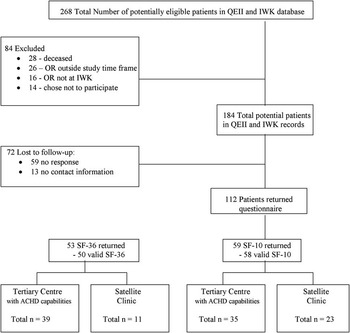
Of the 268 patients sampled, 84 were ineligible (Fig 1). Of the remaining 184 patients, 72 (39%) were lost to follow-up; that is, there was no response or contact information. Of the “lost to follow-up” patients, 14 patients had no contact information available despite multiple efforts to locate them, and 58 patients did not respond to the questionnaire after verification that they had received it. The 112 respondents represent a 61% response rate of eligible patients.
Patient selection (ACHD = adult congenital heart disease; IWK = Izaak Walton Killam Health Centre; OR = operating room; QEII = Queen Elizabeth II Health Centre; SF-10 = younger cohort survey; SF-36 = older cohort survey).

Lost to follow-up
Of the 72 patients lost to follow-up, 42 were male and 30 were female (p = 0.16). The average age of the 58 non-responders was 20.3 years with a range from 8.0 to 40.5, which is significantly older than the average age of responders, which is 17.3 years with a range from 6.8 to 39.6 (p = 0.003). The non-responder cohort comprised 34 male patients (58.6%) and 24 female patients (41.4%) with a similar mean age regardless of gender (21.1 years versus 19.1, p = 0.324).
Younger cohort versus older cohort
The mean age of patients in the younger cohort (SF-10 responders, 59 patients) was 11.8 years old with a range from 7 to 16.4. The mean age of patients in the older cohort (SF-36 responders, 53 patients) was 23.4 years old with a range from 15 to 39.6. The average ages were similar in the younger cohort regardless of the site of follow-up: satellite 11.9 years with a range from 6.8 to 16.4 versus tertiary 11.7 years with a range from 7.5 to 16.4 (p = 0.78). In the older cohort, the satellite patients were younger than those followed up at a tertiary center: satellite 20.3 years with a range from 15.2 to 30.4 versus tertiary 24.3 years with a range from 16.2 to 39.6 (p = 0.02).
Site of follow-up
In all, 76 patients were followed up at tertiary clinics, and 36 were followed up at satellite clinics. Men and women were seen in similar frequency at the satellite clinics – female 14 out of 55 versus male 22 out of 57 (p = 0.2). For the entire cohort, the average age of patients seen at satellite clinics was younger – 14.6 years old with a range from 6.8 to 30.4 – than those followed up at tertiary clinics – 18.7 years old with a range from 7.5 to 39.6 (p = 0.02). Of the tertiary clinic patients, 34 out of 76 (45%) were seen at the paediatric clinic, and 26 out of 76 (34.2%) were followed up at the adult clinic.
Interval of follow-up
Of the locatable patients, 101 out of 112 (90%) were followed up within the recommended interval of 2 years. If all the “lost to follow-up” patients are included in the denominator, then the ratio of the recommended follow-up interval drops to 101 out of 184 (55%). Of the patients surveyed, 110 patients responded to questions regarding the type of specialist they were followed up by; 42 patients had seen a cardiac specialist within the past 6 months, 42 patients within the last year, 18 patients within the past 2 years, and 8 patients between 2 and 5 years ago. In all, 45 out of 53 (85%) older cohort patients and 56 out of 59 (95%, p value <0.0001) younger cohort patients were followed up at recommended intervals. Patients were equally likely to be followed within the recommended intervals, regardless of whether they were seen in follow-up at satellite or tertiary clinics (p = 1.00).
Impact of the site of follow-up
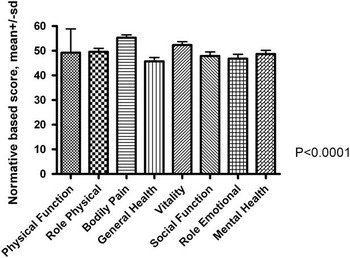
The physical and mental health of patients in the entire older cohort was comparable to a normative-based population, although there were significant differences between the individual eight health domain scores within this patient population (Fig 2). When comparing the eight domains of health, calculated using the SF-36 surveys from patients followed up at either satellite or tertiary clinics, the average scores were similar regardless of the site of follow-up in every domain except physical function, in which the average score for satellite clinic patients was significantly lower than the average score for tertiary clinic patients with a mean of 43.9, standard deviation of 4.3 versus a mean of 50.7 and standard deviation of 1.2 (p = 0.04). The physical component summary scores of patients in the older cohort were significantly lower in patients seen in satellite clinics, with a mean of 45.7 and a standard deviation of 11.1, compared with patients seen in tertiary clinics with a mean of 52.6 and standard deviation of 7.7 (p = 0.02), although compared with normative-based populations these values are not significantly below normal. In the older cohort, the mental component summary scores were not significantly different for patients seen in satellite clinics compared with patients seen in tertiary clinics, with a mean of 43.4 and a standard deviation of 13.1 versus a mean of 49.0 and a standard deviation of 11.3 (p = 0.22).
Normative-based SF-36 component scores from the entire older cohort.

In the younger cohort, patients who were seen in follow-up at satellite clinics had physical, with a mean of 50.8 and a standard deviation of 9.6, and psychosocial, with a mean of 50.1 and a standard deviation of 12.9, summary scores to those followed in tertiary clinics, with a mean physical summary score of 46.7 and standard deviation of 14.3 (p = 0.23) versus satellite clinics with a mean psychosocial summary score of 48.6 and a standard deviation of 12.5 (p = 0.64) versus satellite clinics.
Impact of interval of follow-up
The physical and mental component scores were not significantly different among the older cohort patients who were followed up at recommended intervals (45 out of 53) compared with those who were followed up at intervals greater than 2 years (8 out of 53) with mean physical component scores of 50.9 and standard deviation of 9.1 versus a mean of 51.9 and a standard deviation of 8.3 (p = 0.762); mean mental component scores of 48.3 and a standard deviation of 11.5 versus a mean of 45.0 and a standard deviation of 13.8 (p = 0.54). In addition, even in the younger cohort there were no significant differences in physical or psychosocial summary scores for patients followed up at recommended intervals (56 out of 59) compared with those who were followed up at intervals greater than 2 years (3 out of 59) with a mean physical summary score of 47.8 and a standard deviation of 13.5 versus a mean of 47.6 and a standard deviation of 10.8 (p = 0.98); a mean psychosocial summary score of 48.89 and a standard deviation of 13.6 versus a mean of 43.2 and a standard deviation of 8.9 (p = 0.38).
Interaction of the site of follow-up and interval of follow-up
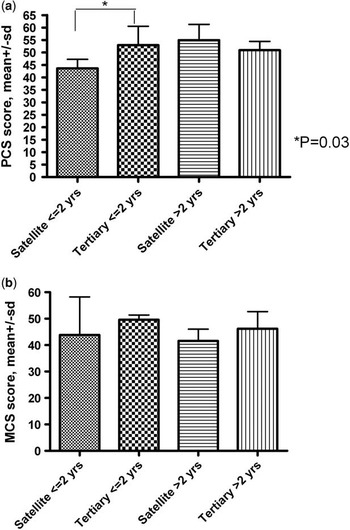
When site of follow-up and interval of follow-up were combined, the physical component score for the older cohort patients followed up at recommended intervals was significantly lower in the satellite clinic patients versus tertiary clinic patients (p = 0.03), whereas there was no significant difference in the physical component scores between satellite and tertiary patients followed up at an interval of more than 2 years (p = 0.6; Fig 3a). There were no significant differences in mental component scores for patients in the older cohort, who were followed up at satellite or tertiary clinics, irrespective of the interval of follow-up (Fig 3b).
(a) Older cohort SF-36 physical component summary (PCS) scores by site and interval of follow-up. (b) Older cohort SF-36 mental component summary (MCS) scores by site and interval of follow-up.

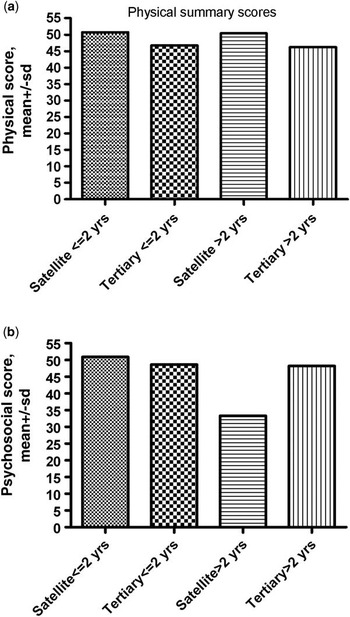
For patients in the younger cohort who were followed up at recommended intervals, there was no difference in the physical summary scores from patients seen at satellite versus tertiary clinics, with a mean of 50.8 and a standard deviation of 9.9 versus a mean of 46.7 and a standard deviation of 14.5 (p = 0.22). In the same group, there was no difference in the psychosocial summary scores when comparing scores from patients seen in satellite versus tertiary clinics, with a mean of 50.9 and a standard deviation of 12.7 versus a mean of 48.6 and a standard deviation of 12.9 (p = 0.51; Fig 4a). Patients in the younger cohort who were followed up at intervals greater than 2 years had similar physical summary scores – that is, 50.4 for satellite clinic (single observation), with a mean of 46.2 and a standard deviation of 14.8 for tertiary clinic, and psychosocial summary scores – that is, 33.3 for satellite clinic (single observation), with a mean of 48.2 and a standard deviation of 3.2 for tertiary clinic, regardless of the site of follow-up (Fig 4b). However, statistical analysis was not possible because only 3 patients in the younger cohort received follow-up at an interval greater than 2 years.
(a) Younger cohort SF-10 physical summary scores by site and interval of follow-up. (b) Younger cohort SF-10 psychosocial summary scores by site and interval of follow-up.

Sub-specialist follow-up
The majority of patients were followed up by a paediatric cardiologist (53 patients) or adult cardiologist (25 patients). Some patients relied on a family physician (6 patients), a paediatrician (3 patients), or a combination thereof for follow-up. There were 25 respondents who did not respond to the question addressing specialist follow-up.
Health transition score
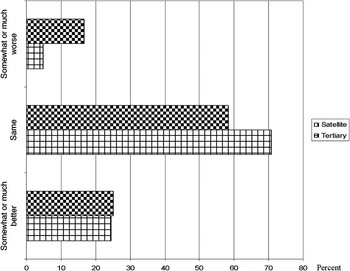
The majority of patients in the older cohort had a subjective health status that was essentially the same in the current year as compared to the prior year, regardless of the site of follow-up. Of the patients followed up at a tertiary clinic, 95% felt subjectively the same or better in the current year compared to the prior year, versus 81% in the satellite group (p = 0.39). Similar proportions patients followed up at satellite and tertiary clinics perceived that they had somewhat or much worse health (17% versus 5%, p = 0.46; Fig 5). Health transition score was not assessed in the younger cohort because the SF-10 survey does not include questions related to health transition.
Older cohort health transition. Perception of health in current year compared with 1 year before.

Barriers to follow-up
All patients were asked a battery of questions in addition to the quality of life surveys, to identify barriers to follow-up (Appendix 2). Of these patients, 97% indicated that they had been instructed by their physician to have speciality follow-up at less than 2-year intervals, although a total of 101 patients reported follow-up within the guidelines of every 2 years. Of the 15 patients who were told to be seen at an interval of greater than 2 years, only 12 patients did and 3 did not respond to the question.
Of the 11 patients who were not followed up at recommended intervals, eight respondents offered the following reasons: “I was not told I had to see a doctor in the last 2 years” (2 patients); “I am waiting for an appointment” (2 patients); “The cardiologist increased the interval to more than 2 years between visits” (2 patients); “I did not think it was necessary” (1 patient); and “I have no doctor” (1 patient). Approximately half of the patients who were followed up at intervals greater than 2 years (6 out of 11) indicated that they had been instructed by their caregivers to increase the interval of follow-up or had not been instructed on an appropriate follow-up interval. Only (2 out of 11) patients who were “out of window” for appropriate follow-up were booked and awaiting clinic appointments because of prolonged wait lists.
Discussion
The subjective health status of patients followed up at a satellite clinic is very similar to that of patients followed up at a tertiary clinic, suggesting that the satellite model of follow-up is associated with preservation of patients’ perceived quality of life. Although the average age of patients followed up in satellite clinics was younger than that of patients followed up in tertiary clinics, the age factor is removed when comparing scores by site of follow-up within the younger cohort versus the older cohort. In the younger cohort, there were no differences in physical or psychosocial scores regardless of the site of follow-up. In the older cohort, there was a reduced physical health domain score, which was principally responsible for a reduced physical summary score in the satellite clinic patients, although this did not reach significance when compared to an age-matched normative-based population. The reason for the difference in physical scores between satellite and tertiary sites of follow-up in the older cohort is not clear, as there were similar rates of follow-up in both satellite and tertiary clinic population. It is possible that patients with more significant health restrictions are more likely to wish to be cared for close to home, and thus opt for care in a satellite clinic setting, rather than travelling to a tertiary clinic.
Follow-up occurred within recommended intervals in the vast majority of respondents; however, when considering the entire group of patients operated for tetralogy of Fallot, including those “lost to follow-up”, only a slim majority was followed up at the recommended interval, that is, at least every 2 years, by tertiary specialists.
The “lost to follow-up” cohort is in keeping with the literature that reports that only a minority of patients are successfully followed up at the time of transition.Reference Moons, Hilderson and Van Deyk11 Like Mackie et al,Reference Mackie, Ionescu-Ittu, Therrien, Pilote, Abrahamowicz and Marelli12 we found that the patients who were lost to follow-up were older than those receiving follow-up at recommended intervals. However, in contradistinction to Mackie, who reported greater loss of follow-up in patients followed up outside a university setting using administrative database source information,Reference Mackie, Ionescu-Ittu, Therrien, Pilote, Abrahamowicz and Marelli12 we found no differences in rates of appropriate follow-up in patients seen at satellite clinics in a non-university setting, compared with patients seen in tertiary clinics in a university hospital setting. Patients with lapsed follow-up have been reported to be more likely, by a factor of 3, to present requiring urgent or emergent interventions,Reference Yeung, Kay, Roosevelt, Brandon and Yetman13 and for this reason it is important to maintain regular follow-up in these complex patients. To further improve this system of follow-up, it will be important to focus future research on these “lost to follow-up” patients and determine the barriers they face in accessing appropriate cardiology follow-up.
The barriers to follow-up are under-reported by patients in this study, and principally revolve around patient and family understanding. No patient or patient's family reported that financial resources were a limiting factor in attending clinic visits. It is possible that the satellite model of follow-up may remove some of the barriers to patient follow-up, which have lead to such a high rate of patients “lost to follow-up”, and thus enhance the well-being of patients with complex congenital cardiac disease.
Limitations
These findings are limited by the large number of patients who were lost to follow-up. Our rate of follow-up (61%) is similar to other literature reports of survey follow-up. Multiple attempts were made to contact these patients, but they could not be located. It is possible that this group would report different quality of life outcomes that would alter our findings. Our findings are also limited by the relatively small number of older adults included in this study. Although significant differences were not observed to be related to age, it is possible that older patients would also report a different quality of life. Finally, the paper is limited statistically by the many comparisons made within the data. Although efforts were made to minimise these, it is possible that some of the statistical differences seen represent type 2 errors.
Conclusions
In an era of increased wait times and a growing adult congenital patient cohort, we need to be vigilant about our rate and interval of follow-up in patients with complex congenital cardiac disease to optimise the medical management and patient outcomes in these cohorts. Satellite clinics may be one form of delivering timely follow-up care that can expand the sub-speciality services of tertiary centres to patients in the periphery.
Acknowledgements
The authors gratefully acknowledge the assistance of Ms. Trudy Hennigar in data audit and manuscript preparation. The authors also acknowledge financial support from the IWK in the form of a Category A operating Grant. Dr David Liu held a DMRF/Faculty of Medicine summer studentship with funding provided by the DMRF Leo Alexander Summer Studentship for Cardiovascular Research.
Appendix 1
Drs Georges Dumont Hospital, Moncton, NB
The Moncton Hospital, Moncton, NB
St. John Regional Hospital, St. John, NB
Chaleur Regional Hospital, Bathurst, NB
Dr Everett Chalmers Hospital, Fredericton, NB
Queen Elizabeth Hospital, Charlottetown, PEI
Cape Breton Health Care Complex, Sydney, Cape Breton, NS
Yarmouth Regional Health Centre, Yarmouth, NS
Appendix 2