Introduction
Continuing care retirement community (CCRC) or life-long community is a long-term care (LTC) alternative available to independent older adults. Given the high fees associated with living in a CCRC, it usually caters to individuals of higher socioeconomic status. One of the main characteristics of the CCRC concerns the independence it fosters among older adults (Kapp and Wilson, Reference Kapp and Wilson1995; Sherwood et al., Reference Sherwood, Rucklin, Sherwood and Morris1997; Doron and Lightman, Reference Doron and Lightman2003); most of the services provided by the CCRC are available based on residents' requests, but are not imposed by the setting. For instance, residents are able to attend classes, social activities, or the gym if they wish to, but are not obligated to do so. The same approach is applied also in relation to food or laundry services, which are available upon extra payment.
In Israel, the number of CCRCs is on the rise, with an estimated increase of 8% in 2006 alone (Mirovsky, Reference Mirovsky2008). Between 1990 and 2004, the number of CCRCs has increased by 140% and the number of units has more than tripled. In 2009, there were 67 privately owned units with 12,145 units. As of 2012, CCRCs, in Israel, have experienced higher levels of regulations and are now expected to provide certain services, such as healthcare services or emergency services. CCRCs of more than 250 residents are also expected to have a nursing unit (NU) within their premises (Tal-Sapiro, Reference Tal-Sapiro2013). This setting is also quite prevalent in other Western societies, such as Australia (Stimson, Reference Stimson2002; Gardner et al., Reference Gardner, Browning and Kendig2005), the United States (Zarem, Reference Zarem2010), and the United Kingdom (Evans, Reference Evans2009).
Even though residents enter the CCRC when they are functionally independent, many lose their functional or cognitive independence with time and require higher levels of care (Shippee, Reference Shippee2009). In fact, past research has shown that one of the incentives for the transition to a CCRC is the wish to age and die in place (Hays et al., Reference Hays, Galanos, Palmer, McQuoid and Flint2001). As a result, many CCRCs now offer residents the possibility to move to higher levels of care within the same setting (Shippee, Reference Shippee2009; Roth et al., Reference Roth, Eckert and Morgan2015). This was recently termed as “aging in places,” as older adults are expected to move to higher levels of care, within the same overall setting, but in different units and social environments (Roth et al., Reference Roth, Eckert and Morgan2015).
Past research has documented tremendous resistance concerning the move to higher levels of care (Shippee, Reference Shippee2009). In a way, the move represents the opposite of what older adults had hoped for, as it forces them to age in different settings. The wish not to move to higher levels of care was primarily attributed to concerns about losing one's autonomy and to the negative stigma attached to functional decline among CCRC residents (Shippee, Reference Shippee2009; Roth et al., Reference Roth, Eckert and Morgan2015).
Ageism as manifested by fears of one's own aging and future decline (Nelson, Reference Nelson2005) was identified as a main reason for disengaging from individuals in higher levels of care (Dobbs et al., Reference Dobbs2008; Shippee, Reference Shippee2009; Roth et al., Reference Roth, Eckert and Morgan2015). Two related theories that have been used to explain the occurrence of ageism in past research could potentially account for the reluctance of older CCRC residents to maintain contact with individuals in higher levels of care. The terror management theory argues that individuals detach themselves from reminders of their own impending death. One such reminder could potentially be the presence of disability and decline in one's social surrounding (Greenberg et al., Reference Greenberg, Schimel, Martens and Nelson2002). A second theory is the social identity theory. This theory argues that individuals strive to identify with those who possess high status in society, as one's personal identity is also a function of one's group identity. To boost their self-esteem, individuals attempt to disassociate themselves from those of lower status (Tajfel and Turner, Reference Tajfel and Turner1979; Kite et al., Reference Kite, Wagner, Nelson and Nelson2002). As a result, older CCRC residents may attempt to socialize with better functioning individuals in order to enhance their social status.
Although the issues of stigma, ageism, and concerns about relocating to higher levels of care in the CCRC have been examined in the past (Dobbs et al., Reference Dobbs2008; Shippee, Reference Shippee2009; Roth et al., Reference Roth, Eckert and Morgan2015), these studies mostly originated in North America and likely stem from values of youth and independence that are highly prevalent in that culture (Lamb, Reference Lamb2014). Israel, in contrast, is a country that vacillates between modern values of independence and autonomy (Fogiel-Bijaoui, Reference Fogiel-Bijaoui2002) and traditional values of interdependence and respect for the elderly (Lavee and Katz, Reference Lavee and Katz2003; Lowenstein and Daatland, Reference Lowenstein and Daatland2006). Researchers have suggested that in Eastern culture, harmonious aging, which accepts functional decline and interdependence is valued and might be more appropriate to describe desirable forms of aging (Liang and Luo, Reference Liang and Luo2012).
In light of these differences in perspectives across cultures and the unique position of Israeli society, the present study aimed to examine residents and their adult children's perspectives concerning higher levels of care in the CCRC. The study placed a particular focus on views about the NU, in light of the fact that this is currently, the most readily accessible option available to older CCRC residents who require assistance in Israeli CCRCs. Nonetheless, during interviews and analysis, we remained open to alternative options for higher levels of care, as discussed by respondents. The focus on adult children in addition to older residents stems from research conducted in Israel that has documented the interdependence between the generations, even following a transition to a CCRC (Ayalon, Reference Ayalon2015). Hence, it is assumed that in order to more fully comprehend the experiences of older adults in the CCRC, one has to also address their children's perspective. It is important to note that the primary goal of the overall research project was to understand the adjustment process of CCRC residents. The present paper was constructed in light of changes that occurred in older adults’ and adult children's perceptions over time and the realization of the research team that the topic of higher levels of care in general and the NU in particular deserve more attention.
Methods
Sample
The study was partially funded by the Israel Science Foundation and approved by the Helsinki committee of Maccabi Healthcare Fund and by the ethics committee of the principal investigator's university. Participants received detailed information about the study and signed an informed consent prior to participation.
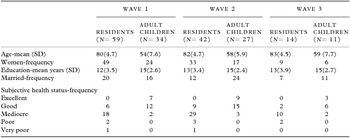
Older adults, who transitioned to a CCRC within the past year, were cognitively intact, as assessed by the CCRC staff and spoke Hebrew or English, were eligible to participate in the study. Older adults were also asked to identify an adult child for an interview, as the initial focus of the study was on intergenerational relations (Ayalon, Reference Ayalon2015). Interviews started in 2010. Currently, the third wave of interviews with the 2010 group and the second wave of interviews with the 2014 group are being collected. Table 1 outlines the characteristics of the sample. A total of 187 interviews with older adults and their adult children were conducted between six months and six years to their transition to the CCRC. Table 2 presents the characteristics of the CCRCs. CCRCs were purposely sampled to reach maximum variations (Patton, Reference Patton1990). CCRCs were geographically (North, South, and Center of Israel) and socioeconomically diverse, as indicated by their annual fees. CCRCs also varied in size and in terms of the services they offered.
Sample characteristics

Characteristics of the continuing care retirement communities (N = 12)

1 Not including nursing department rooms.
2 In ILS, not including initial deposit. $1 is roughly 4 ILS.
NPO=Non-profit organizations operate for the public service rather than to obtain financial profit.
Chain refers to organizations which run more than a single CCRC.
Interview Guide

The questions that were present in all first wave interviews are italicized. Additional questions were developed based on early interviews.
Interviews
Most interviews occurred in the CCRC with an explicit attempt to interview each respondent separately. All interviews were tape-recorded and transcribed verbatim. Interviews lasted on average, between 1 and 1.5 hours. Interviews were conducted by five different graduate students in the social sciences. Interviewers received training in qualitative interviewing, conducted mock interviews, and received ongoing supervision and mentoring.
Interviews followed a funnel approach. Broader questions were subsequently followed by more specific questions related to the transition. The interview guide included descriptive questions, such as “tell me your life story,” “tell me about your family ties;” comparative questions, such as “how is life in the CCRC different from life in the community?”; and interpretive questions, such as “what has helped you adjust to the transition to the CCRC?” Analysis of interview data was ongoing. Therefore, after several interviews were conducted and analyzed, some questions were modified to obtain a broader perspective about one's life story. In subsequent interview waves, additional questions were included to address changes that have taken place in the lives of participants and to bring the focus to particular issues that received only limited attention during earlier waves of interviews, but deemed of potential relevance. Because the NU was hardly discussed spontaneously during the first interview and in light of existing literature on the topic (Roth et al., Reference Roth, Eckert and Morgan2015) and its very clear physical presence as well as concealment in the CCRC, we decided to query about this issue directly during subsequent interviews. See the Appendix for an interview guide. In addition to the qualitative interview, a short sociodemographic survey was administered. Respondents completed questions about their age, gender, and education. They were also asked to rate their subjective health status on a five-point scale, with a higher score, indicating better subjective health.
Analysis
Our analysis followed several stages. First, a line-by-line, open-coding analysis was employed (Strauss and Corbin, Reference Strauss and Corbin1998). Analysis did not use pre-conceived codes, but instead allowed themes to emerge directly from the text (Creswell, Reference Creswell1998). Open-coding analysis of the first wave of interviews was separately conducted by a graduate student in social work and by another researcher. Two other graduate students in social work analyzed selected interviews for the purpose of triangulation. Discussions concerning the creation of open coding occurred and disagreements in the construction of codes at this stage were resolved through a consensus. However, no inter-rated reliability was calculated. At this stage, open codes were quite diverse and included various themes, such as the financial cost of the CCRC, a perspective on life full of transitions, and attempts to distinguish between one's own life and one's parents’ life. Subsequently, codes were merged to represent more comprehensive and cohesive thematic categories using constant comparisons within each interview and across interviews (i.e. axial coding) (Strauss and Corbin, Reference Strauss and Corbin1998). Analysis accounted for the longitudinal design, which allowed for the integration and exploration of prospective and retrospective understandings of transitions, stability, and change over time, and provided opportunities to compare and move between time perspectives (Neale and Flowerdew, Reference Neale and Flowerdew2003). The longitudinal analysis relied on constant comparisons within and across individuals over time, focusing on cross-sectional and temporal analyses of the data (Thomson and Holland, Reference Thomson and Holland2003). Reports made by older adults and adult children were analyzed separately and then compared and contrasted. Differences and similarities across these two groups were noted. Next, selective coding was employed to represent a coherent story-line. This stage was done by the PI. At this stage, I specifically attempted to identify themes related to the NU and higher levels of care. Other themes that were identified during analysis are discussed in detail elsewhere (Ayalon and Green, Reference Ayalon and Green2012, Reference Ayalon and Green2013, Reference Ayalon and Green2015; Ayalon, Reference Ayalon2015; Ayalon and Green Reference Ayalon and Green2015; Ayalon, Reference Ayalon2016). ATLAS.ti was used for the purpose of data management and assisted in the initial stage of the creation of open codes (Friese, Reference Friese2012).
Findings
Three major themes emerged from the interview data. The first one concerned the view of the NU as a different universe that should be avoided at all costs. Participants attempted not to think, talk, or see anything that reminded them of the NU or its residents. Related to this, they have made every attempt not to be in such a unit or to associate with NU residents. Two major reasons for these attempts to avoid the NU were provided: (1) the association of NUs with one's impending decline and dependence and (2) beliefs about substandard care in these units. Because the latter two themes address potential explanations for the first theme (e.g. a wish to avoid the NU at all costs), there is some overlap across themes. Below is a detailed description of the three themes accompanied by quotes provided by CCRC residents and their adult children.
A different universe: do not hear, see, or speak
During the first wave of this study, the issue of the NU was brought up spontaneously by very few respondents. The few who had brought it up stated that upon entering the CCRC, they had considered the NU as a potential long-term option, given the almost inevitable decline that occurs in old age. With their face to the future, they checked the availability and quality of the NU in addition to that of the independent unit. This discussion was mainly characteristic of adult children, whereas the older residents were less likely to discuss the topic spontaneously.
The following quote by a 53-year-old daughter of one of the residents illustrates this. Interestingly, this resident elected to compare the NU to a restroom in a fancy restaurant, implicitly expressing her repel from this unit:
What was really important for mom because of the process that dad had gone through, was what would happen if she had reached the NU. So, when I checked out CCRCs, I first went to the NU, just like when you go to a restaurant, you first check the restroom.
A statement by a 78-year-old resident illustrates the importance assigned to the NU as a potential savior at times of need:
If my health deteriorates and I have to go to a NU or nursing care, or a hospital. In the hospital, they won't know what to do with me, they will send me back and they know that downstairs in the NU, there are physicians, nurses, they will know how to care for me, I am in good hands, they (family) can sleep soundly at home. This was my only motive for moving into a CCRC.
This response was unusual; however, as the most common response was to completely ignore the topic during the interview and not to raise it spontaneously. Therefore, we explicitly raised the topic on waves two and three. This decision was fueled by the limited spontaneous discussion of the NU, in light of its unspoken presence in the CCRC and the growing body of literature on this topic. Although, in general, respondents had agreed to discuss the issue once queried, they usually concluded that it should not be discussed and acknowledged their active attempts to ignore it: “it (NU) is not an issue at all. We will worry about it when the time comes. We will check when we need to and when the time comes, we will find the best solutions,” said a son of one of the residents.
Attempts to avoid the NU and its residents at all costs were not only made mentally during the interview, but also in real-life, as vividly described by residents. The following is a complaint made by one of the residents concerning the fact that NU residents were not separated from independent residents and that he was forced to constantly acknowledge disability in his environment:
There are many CCRCs that do not have a NU. We have it here. There are many people in the NU here so when you know a person, I suppose even in a CCRC and this person becomes sick, he or she leaves the system. Here, they all stay and it is not very nice, but this is the reality. A 78 year-old divorced man.
A different resident stated the same thing:
I thought that I moved into a fun retirement village, I thought I could speak with the people here, but this is not a CCRC, this is a hospital. There are about 30 people who are actually severely dependent. They shouldn't be here. According to the CCRC's rules it says that disabled people should not be here. In their homes, I don't care, locked. But when you walk around and all you see is wheelchairs, it pulls you down. It makes you feel like you don't belong. These people should be in a locked place. They (management) should give them all the treatment they need. Here, we (independent residents) don't receive enough attention. We just disturb them (management) from putting everyone to sleep.
Denial of the existence of the NU is illustrated by the following conversation. Even though, one could argue that this is merely a descriptive response regarding the location of the NU within the CCRC, it was clear from the tone of the conversation that the resident was attempting to convince himself and the interviewer that the NU was not really part of the CCRC:
Interviewer: I saw that at the entrance, there is a NU?
Interviewee: The NU is completely separate. A separate entrance. And everything that belongs to the NU is on the first floor. Not the ground floor, the first floor. Our elevators do not stop over there. There is a completely different elevator on the outside.
Interviewer: Is there any connection between the residents?
Interviewee: no. no. no. There is no way through. The door is locked.
Even among those who were forced to “see” and acknowledge the NU, there was an explicit attempt to portray it as a totally different universe. The following is a quote of a wife, who moved to a CCRC following her husband's need for a more intensive level of care. Her husband lived in the NU, while she lived in the independent section of the CCRC. She visited her husband on a daily basis, but still viewed the NU as a different universe and felt a strong relief to close the door behind her and go back to her life when her visit with her husband was over: “I come to him every afternoon for an hour and a half and I feed him, make sure everything is okay, that life is not over. I can't express this. I close the door over there (leave the NU) and I start my life. I allow myself to live.”
Fears of the NU were so high that people attempted to hide their decline in order not to enter higher levels of care. At times, this left them without the assistance they required. The following is a statement by a son who tried to hide his mother's condition: “She broke her back and I was really afraid that they (management) would not let her enter (the CCRC), so I hid her real situation.”
Even among those who had spontaneously raised the issue of a NU during the first interview, there was an attempt to disregard it during subsequent interviews. The following statement was made by a resident who explicitly attributed his transition to a CCRC as being fueled by future planning and preparation for an inevitable decline: “in the end of the day, you do not live forever. We might need physicians, physiotherapists. All the things that are here. There is medical care and a NU.” During the second interview, however, this person explicitly stated that he preferred not to think about this issue and of course not to need the NU: “I pray we won't have to go to a NU. We even made our daughter sign a statement saying, we will not end up in a NU.” This illustrates the shift in perception of the NU as one of the reasons to move to a CCRC versus something one avoids at all costs.
NU is something to avoid because it pulls you down
The main reason for not wanting any physical or emotional contact with the NU was the view of the NU as providing constant reminders to one's impending decline and subsequent death. The presence of a NU had forced residents to disconnect from the image of a “retirement club” so adamantly promoted by the sales persons that advertised the CCRC and to acknowledge death and decline:
The people here (CCRC). They remained here. They stayed to live here, but their health has declined. We have turned from a retirement village to a NU. I saw somewhere that they called this place, ‘Bat Yam nursing home.’ This is not a nursing home. I am here for a retirement village for a place of independent residents. I had to go through a selection committee. They had asked me if I was independent and they had asked me to present my medical chart to prove that I was healthy. It is true that everyone in my age and at any age is not really 100%, but the truth is that the atmosphere here is really poor. The atmosphere is bad because you see many wheelchairs and it makes you depressed. A 75 year-old woman resident.
Interviewees attempted to avoid not only dependency and disease, but also old age in general, which was viewed as depressing. Old people were seen as “no fun” to be with and as something one has to avoid because it “pulled you down.” The following statement by a daughter of one of the residents illustrates this:
I was under the thought that she (mother) would be only with older adults that half of them are demented and the remaining half are. . .When there is this atmosphere that there are older adults around then she grows old too. The day she moved to the nursing home (CCRC), I cried. A 64 year-old woman.
A similar argument was provided by a different daughter: “It is difficult for me because this (CCRC) is a homogenous environment. It has only old people and I am having a hard time with this. I believe she (mother) is having a hard time with this too.”
Although both adult children and older residents expressed negative attitudes toward being around people who require higher levels of care, adult children were often more explicit about this and discussed their negative stigma explicitly.
It is important to acknowledge that other more positive voices about old people were also expressed and many residents and adult children were able to articulate the benefits associated with being in an age homogenous environment which was seen as providing residents with more social opportunities and a sense of safety that were not available in the general community.
Some interviewees made a distinction between age and disability stating that they preferred to be around very old, but functioning individuals and not next to much younger, but physically or cognitively impaired older adults. The following statement by a 79-year-old woman resident illustrates this:
Yesterday, we met and someone I haven't seen in a long time came over. She is a woman who plays Bridge every day other than Sunday and Friday. And she said that it was her birthday. She was 90 years old. She looks great, drives, really pretty. I was shocked they told me she was 90. And there are some, who are 50, 60 who look as if they were 90 years old. Each person has his own genes.
Similar comments were made by another 84-year-old woman resident: “I want to be around people who are older than me but are still functioning. I am afraid of those who are my age or younger, but are already dependent.”
The same idea was confirmed by a son of one of the residents: “There are women older than her, in better health than her, more active, more independent than her, so it motivates her. (she tells herself): ‘I have to hold on.’”
NU is something to avoid because of poor treatment
As already noted, most residents attempted to avoid the issue of the NU. When specifically asked about their own plans, the majority stated that they preferred to die early, without requiring the assistance of the NU. The following, is a statement made by a daughter of one of the residents: “I hope they (parents) will continue to age gracefully and that we won't need the NU, because the NU is not nice.”
The NU was viewed as a place that provided poor treatment and as such should be avoided at all costs: “the NU is a depressing thing. I once came and all the older people, all the disabled people were outside with their face to the wall. It was really shocking. Really shocking.” A 78 year-old woman resident.
The few that agreed to think about potential plans in case of increased needs for help reported a preference towards home care assistance rather than a NU, following the assumption that home care assistance would provide them with more personalized care. The following is a statement made by a daughter of one of the residents:
Because I am a little knowledgeable in the world of older adults, I wanted a couch that could turn into a bed for a Filipino (home care worker) at some point. And she (mother) refused this, saying that she didn't need a Filipino. Even today, she doesn't need one. But, I prefer that she dies with a Filipino in her house and not in bed in the NU, if I have to choose between the two.
It is interesting to note that in their earlier days, CCRCs did not allow residents to rely on home care assistance. The rationale was that wheelchairs and home care workers in the CCRC are in discordant with the celebration of “healthy active aging.” However, with increasing demands, most CCRCs allow such an option nowadays. It is also interesting to note that even though home care assistance was the preferred option reported by older adults and their family members, it was highly criticized as demoralizing by many of the interviewees. The following is a statement made by a 76-year-old woman, which clearly attests to her ambivalence about the availability of home care services in the CCRC:
There is a high percentage of foreign home care workers here. People get older, but sometimes they accept people who are not in a good shape and we see that they are not in a good shape, so it annoys us, but there is nothing we can do. We want to have active people here. Not people who end their lives immediately. Those who are here are declining gradually. It reminds me that in the beginning they (management) had said that they did not accept people with a walking cane. What do they think to themselves? That everyone who enters this place is that young? But in any case, you have to try (to stay independent) a little harder.
Even though most residents did not want any contact with the NU and its residents, when evaluating the quality of the NU, a physical and professional connection between the independent section of the CCRC and the NU was viewed as a plus. Hence, qualities that were seen as undesirable among physically independent respondents were viewed as an advantage from the side of a prospective consumer.
I started (reviewing NUs). I didn't introduce myself or anything, I entered the NU and I found a huge gap between the hotel (CCRC) with the lectures, swimming pool and classes, which turns older adults into 12 year-olds, and the NU, which is at the bottom and many times, there is no relationship between the two, they let other providers run the NU. A 54 year-old daughter.
These statements are in a sharp contrast to the view of many of the residents, who simply wished to disconnect from the NU:
There are many people who came here 25 years ago and they are nice and everything, but they become dependent and their kids don't understand that they don't need to stay secluded at home all the time, but when they get out (they shouldn't be around). . .Today, I went to the post office and there was a woman who pushed her key in every keyhole. . .When you come to a place and think that you are building a new life, in a special place, but then when it turns into a NU, it is not nice and it is not fun.
To ease their concerns about the NU, some residents emphasized its reversible nature. However, by emphasizing and reemphasizing this, it was clear that this was actually one of their main concerns. The following statement demonstrates this:
I haven't seen anything bad about with the NU; on the contrary, if someone is really sick here, they bring him to the NU for a few days. Then, they get the food in bed, there are doctors over there.
Discussion
The present study evaluated the attitudes and perceptions of older CCRC residents and their adult children concerning the NU in particular and the provision of higher levels of care in the CCRC in general. This is important given current design which specifically encourages the reliance on different levels of care within the CCRC, given the realization that the aging process is often accompanied by deteriorated physical and cognitive functioning (Roth et al., Reference Roth, Eckert and Morgan2015).
Consistent with past research (Shippee, Reference Shippee2009; Roth et al., Reference Roth, Eckert and Morgan2015), the present study found a strong reluctance to think, discuss, or see higher levels of care in the CCRC. The issue was hardly raised spontaneously during interviews and if raised, it was viewed negatively. When we raised the topic during subsequent interviews, residents attempted to minimize the issue. In general, both residents and their adult children expressed a strong preference toward disconnecting themselves from the NU both mentally and physically. Similar to past research (Shippee, Reference Shippee2009; Roth et al., Reference Roth, Eckert and Morgan2015), residents and adult children wished not to see, hear, or associate with residents in the NU. When contact occurred, it was most often portrayed as awkward, inadequate, and undesirable. This clearly attests to the ambivalence about higher levels of care within the CCRC. On the one hand, residents and their adult children wish for higher levels of care to be readily available and accessible in case they need them, but on the other hand, they do not want to have any association with these services as long as they are healthy. This places LTC administrators in an awkward position as they are expected to provide within the CCRC higher levels of care to those in need, but also to hide these services from those who do not need them.
Consistent with past research (Dobbs et al., Reference Dobbs2008; Shippee, Reference Shippee2009; Roth et al., Reference Roth, Eckert and Morgan2015), the respondents conveyed high stigma and ageism toward individuals who require higher levels of care. The most common reason for this can be termed as “fears of our aging selves” (Nelson, Reference Nelson2005). Older adults are particularly vulnerable to experiencing such stigma given the inevitable susceptibility to decline that occurs in old age. To better adjust to such fears, older adults are said to devalue others in worse conditions and to associate themselves with younger, better functioning groups (Bodner, Reference Bodner2009). This is consistent with the social identity theory (Tajfel and Turner, Reference Tajfel and Turner1979), which argues that individuals actively attempt to maintain their self-worth by devaluing out-group members, and enhancing the value of their own group. It is important to note, however, that such stigma is not unique to older adults. In fact, younger adults, as well, tend to be highly stigmatized toward older adults in general, and even more so, toward older adults with disability or sickness (O'Connor and McFadden, Reference O'Connor and McFadden2012; John, Reference John2013).
Although Israeli society vacillates between traditional and modern values concerning older adults and family relations (Lavee and Katz, Reference Lavee and Katz2003; Lowenstein and Daatland, Reference Lowenstein and Daatland2006), it is clear that most views reported in the present study are highly consistent with the views advocated by other modern western societies. These views tend to stigmatize functional decline among older adults (Dobbs et al., Reference Dobbs2008; Shippee, Reference Shippee2009; Roth et al., Reference Roth, Eckert and Morgan2015). The one difference concerns the view of home care services as preferred to NU services at times of need and as a feasible alternative available to dependent older adults. Israel has a relatively generous LTC law which provides financial support to older adults with functional decline (Iecovich, Reference Iecovich2012). Enacted in 1988, the law allows older adults to choose among a variety of subsidized services, including adult day care centers, home care services, incontinence services, laundry services, or an emergency button. Indeed, this law is highly effective in maintaining the majority of older Israelis in the community (Brodsky et al., Reference Brodsky, Snoor and Beer2011), with most LTC recipients relying on home care services as their only funded service (National Insurance Institute of Israel, 2011). Past research conducted among social workers in charge of this caregiving arrangement, care recipients, and family members has revealed very positive opinions concerning home care services especially when provided by migrant home care workers from East Europe and the Far East (Ayalon et al., Reference Ayalon, Kaniel and Rosenberg2008; Ayalon, Reference Ayalon2014; Ayalon and Green, Reference Ayalon and Green2015). Apparently, even among older adults who relocated to a CCRC, a preference toward personalized home care is highly prevalent.
Aging in place is an option preferred by most older adults, globally (Wu and Chuang, Reference Wu and Chuang2001). To some degree, the CCRC represents an alternative which supposedly helps to meet this preference (Hays et al., Reference Hays, Galanos, Palmer, McQuoid and Flint2001). However, researchers have argued that the CCRC is more likely to represent an option for aging in multiple places, rather than in a single place (Shippee, Reference Shippee2009; Roth et al., Reference Roth, Eckert and Morgan2015). The integration of NU residents with the independent residents was advocated as a method to ease the stigma assigned to the NU (Shippee, Reference Shippee2009). The present findings, however, suggest that even in CCRCs that allow for such integration, stigma exists and independent older adults feel very resentful toward those older adults who present with needs for higher levels care.
The present study has several limitations that should be addressed. The study makes no attempt to represent the general population or to bring “facts” about CCRC residents, but rather to represent experiences and perceptions. To overcome some of the limitations of qualitative research and analysis, several individuals coded selected interviews. The reliance on two sources of information: older adults and adult children is a form of triangulation, which provides support to the findings. In addition, a thick description (Creswell and Miller, Reference Creswell and Miller2000) of the interviews was provided to allow the reader to judge the plausibility of the findings. It is also important to note that even though the present study relied on three waves of data collection, it was difficult to compare responses regarding the NU or higher levels of care over time because the topics were hardly ever discussed spontaneously during interviews. Only in later waves, were these topics addressed as part of the interview guide. The language of the unsayable refers to topics which are unsaid and perhaps even unsayable during the interview because of their emotional valence (Sheinberg, Reference Sheinberg1999). It is, thus, possible that even though the topics were not discussed spontaneously, they were still present in the lives of the interviewees even during earlier interviews. However, given the negative emotional valence of these topics, they were hardly ever brought up spontaneously.
Despite its limitations, the study provides important insights about the challenges faced by CCRC residents and their adults children in viewing the NU as part of the CCRC and in accepting older adults with functional and cognitive decline as part of their social environment. Our findings point to the high ambivalence expressed by older adults and their adult children concerning the wish to have higher levels of care within the CCRC at times of need, but at the same time, to completely disregard these higher levels of care as long as they can possibly do so. The findings also suggest that given the availability and accessibility of home care services, this remains the preferred alternative even among CCRC residents who specifically located to a CCRC in order to age in place.
Conflict of interest
None.