Introduction
Since newcomers (employees who are within the first 6 months of joining their current company) are unfamiliar with their new jobs and surrounding work environments (Jokisaari & Nurmi, Reference Jokisaari and Nurmi2009; Morrison, Reference Morrison1993b, Reference Morrison2002), they are prone to seeking information from other experienced employees (De Vos & Freese, Reference De Vos and Freese2011). Supervisors are important information sources for newcomers, because supervisors not only assign the tasks, but also provide performance feedback that is essential for newcomers' career development (Miller & Jablin, Reference Miller and Jablin1991). Newcomers' information seeking from supervisor refers to the behavior that newcomers seek information about their job or work (e.g., role expectations, performance, and organizational issues) from supervisor. The purpose of such behavior is to reduce uncertainty, engage in sense-making, or strengthen the linkage between themselves and their supervisors (Miller & Jablin, Reference Miller and Jablin1991; Morrison, Reference Morrison1993a, Reference Morrison1993b). During the past few decades, information seeking from supervisor has garnered considerable scholarly attention, and its positive impacts on newcomer adjustment have been indicated (Morrison, Reference Morrison1993b, Reference Morrison2002).
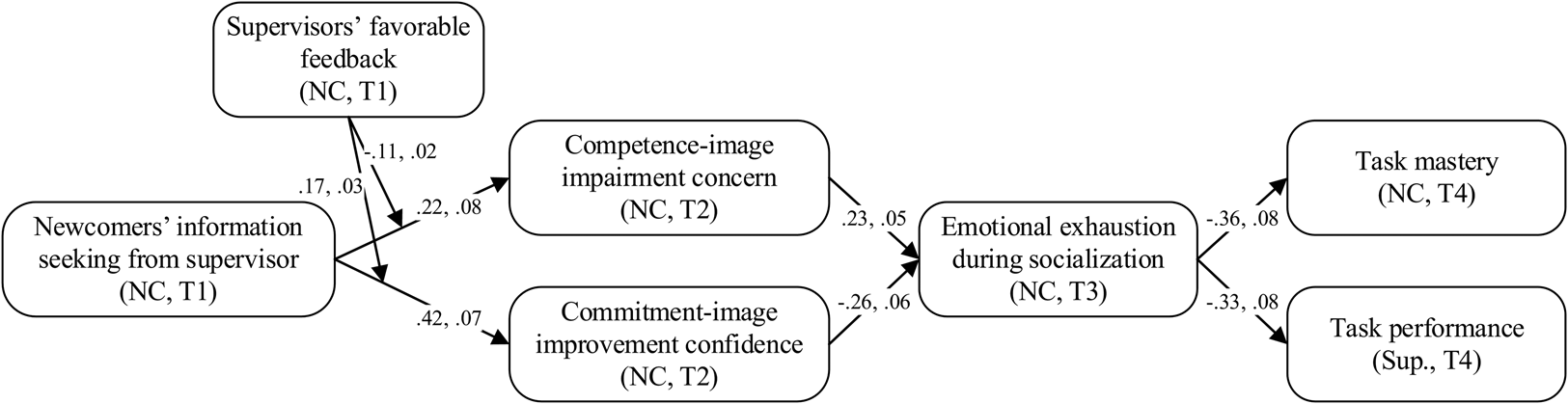
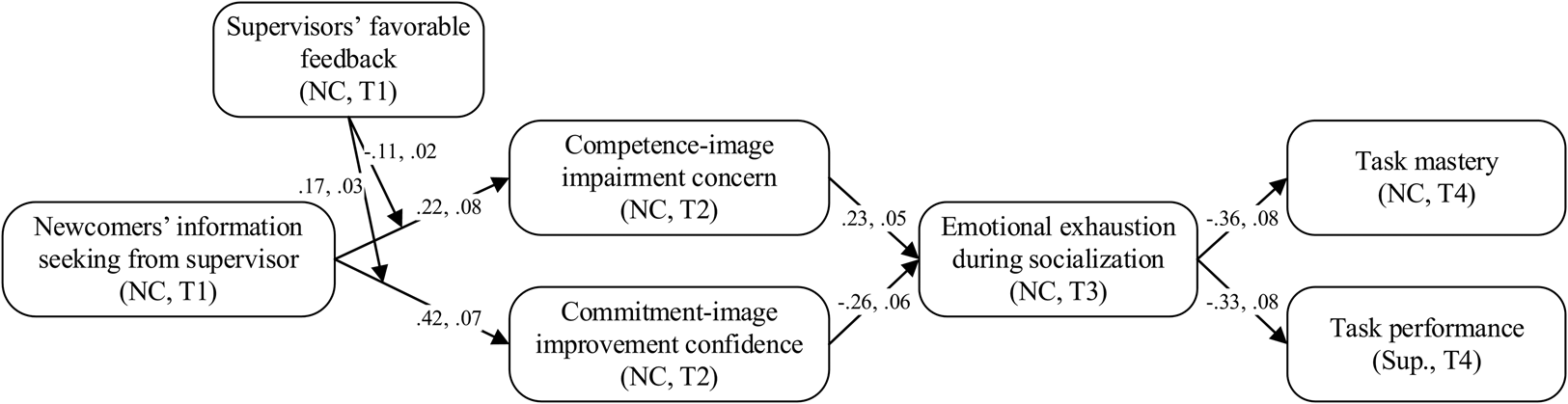
In particular, a large body of research has shown that information seeking from supervisor has positive associations with newcomer adjustment outcomes, such as task mastery (Chan & Schmitt, Reference Chan and Schmitt2000; Morrison, Reference Morrison1993a; Nifadkar & Bauer, Reference Nifadkar and Bauer2016), social integration (Chan & Schmitt, Reference Chan and Schmitt2000; Ellis, Nifadkar, Bauer, & Erdogan, Reference Ellis, Nifadkar, Bauer and Erdogan2017), work engagement (Cooper-Thomas, Paterson, Stadler, & Saks, Reference Cooper-Thomas, Paterson, Stadler and Saks2014), and affective organizational commitment (Zou, Tian, & Liu, Reference Zou, Tian and Liu2015). Although some of those empirical studies have investigated the beneficial effects of information seeking from supervisor on newcomers' work-related performance, other evidence demonstrates that information seeking does not always go well for newcomers. For instance, Ashford and Taylor (Reference Ashford and Taylor1990) noted that newcomers who seek information may experience ‘the social costs of learning’ (p. 16). And Miller (Reference Miller1996) also pointed out that seeking information may incur ‘high social costs (e.g., being seen as bothersome or lacking in necessary job knowledge)’ for new hires (p. 4). Therefore, it is conceivable that information seeking from supervisor may have complex impacts on newcomers' task-related outcomes (i.e., task mastery and task performance). To date, it is still not clear how and when such complex effects may occur. Thus, by integrating the literature on information seeking and newcomer adjustment, under the frameworks of the conservation of resources (COR) theory and professional image construction theory, our study sought to clarify the complex mechanisms between information seeking from supervisor and newcomers' task-related outcomes (Hobfoll, Reference Hobfoll1989). The theoretical model of this research is shown in Figure 1.
Theoretical model.
Note. ‘T1,’ ‘T2,’ ‘T3,’ and ‘T4’ refer to the four data collection waves. ‘NC’ and ‘Sup.’ indicate data collected from newcomers and their supervisors, respectively. We control for newcomers' gender, age, education, working experience before entering the current organization, supervisors' information providing, newcomers' proactive personality, newcomers' anxiety, and information adequacy in the analysis.
According to COR theory, information seeking from supervisor can be regarded as a type of resource investment, because it requires newcomers to invest available resources in order to acquire other in-demand resources (Hobfoll & Shirom, Reference Hobfoll, Shirom and Golembiewski2001; Lim, Tai, Bamberger, & Morrison, Reference Lim, Tai, Bamberger and Morrison2020). Following theory on professional image construction, newcomers' information-seeking behavior has been found to affect supervisors' evaluation of their ability and attitude at work (Morrison, Reference Morrison1993b, Reference Morrison2002), and those personal qualities are related to the professional image, a form of conditions resources (Hobfoll, Reference Hobfoll1989) that newcomers want to portray (Roberts, Reference Roberts2005). Specifically, information seeking from supervisor may provoke newcomers to examine the appropriateness of this behavior and focus on whether it influences the supervisor's appraisal of them. After frequent information seeking, newcomers may feel threatened by the failed resource investment because it exposes their inadequate capabilities in front of the supervisor and leads to the possible loss of competence-image resources. In this vein, information seeking may elicit newcomers' negative perceptions of competence-image construction at work. Correspondingly, this behavior may also stimulate newcomers to positively perceive their commitment-image construction as it well exhibits their proactive work engagement and help them obtain more commitment-image resources. Still relying on COR theory's tenets, conditions resources loss or gain can affect individuals' self-resource reservoirs, and thus consume or boost individuals' depletable psychological resources (Chen, Westman, & Hobfoll, Reference Chen, Westman and Hobfoll2015; Hobfoll, Reference Hobfoll1989), primarily in the form of exacerbating or mitigating emotional exhaustion (Lee & Ashforth, Reference Lee and Ashforth1996). Since newcomers need to exert much effort to encounter high role ambiguity, uncertainty, and anxiety in the new environment, they are strongly susceptible to depletion and fatigue in such transition period, that is, emotional exhaustion during socialization (Chi & Wang, Reference Chi and Wang2018; Ellis, Bauer, Mansfield, Erdogan, Truxillo, & Simon, Reference Ellis, Bauer, Mansfield, Erdogan, Truxillo and Simon2015; Lapointe & Vandenberghe, Reference Lapointe and Vandenberghe2018). Moreover, numerous studies have indicated that emotional exhaustion is a focal construct in predicting employee attitudes and behaviors at work within the framework of COR theory (Liu, Greenbaum, Allen, & Zhang, Reference Liu, Greenbaum, Allen and Zhang2022; Shantz, Arevshatian, Alfes, & Bailey, Reference Shantz, Arevshatian, Alfes and Bailey2016; Yi, Kwong Kwan, Hu, & Chen, Reference Yi, Kwong Kwan, Hu and Chen2017). We therefore focus on emotional exhaustion during socialization as a further transmission mechanism converting the effects of newcomers' multiple perceptions of professional image on their task-related outcomes. Furthermore, supervisors' favorable feedback is defined as employees' perceived appreciation and recognition from their supervisors for their job performance and behavior (Steelman, Levy, & Snell, Reference Steelman, Levy and Snell2004). Following COR theory, such feedback can be regarded as a job resource (Borden, Levy, & Silverman, Reference Borden, Levy and Silverman2018), which can replenish newcomers' self-resources and impact their subsequent reactions to the change of conditions resources (Hobfoll & Shirom, Reference Hobfoll, Shirom and Golembiewski2001). Therefore, we included supervisors' favorable feedback as a boundary condition in our theoretical model.
Our study makes several contributions to the literature. First, we extend information-seeking literature by revealing the mechanism that underlies newcomers' information seeking from supervisor and their task-related outcomes. Although decades of research have emphasized the beneficial effects of information seeking from supervisor on newcomers' task-related outcomes (e.g., Chan & Schmitt, Reference Chan and Schmitt2000; Ellis et al., Reference Ellis, Nifadkar, Bauer and Erdogan2017; Nifadkar & Bauer, Reference Nifadkar and Bauer2016), to date, relatively little attention has been paid to clarify the behavior's complex mechanisms and explain when and how such behavior elevates or degrades newcomers' task-related outcomes. Thus, from the perspective of multiple perceptions of their professional image in the context of newcomer adjustment, we investigated such relationships by elucidating the mechanisms that link newcomers' information seeking from supervisor and their task mastery and task performance.
Second, by uncovering the complex impacts of newcomers' information seeking, our research interpreted the newcomers' professional image construction in terms of competence and commitment. Past findings in the literature on professional image have examined its role as a whole but have paid little attention to investigating how employee behaviors differentially impact the diverse dimensions of their professional image in others' eyes (Roberts, Reference Roberts2005). To address this limitation, in accordance with theory on professional image construction, our study introduced two novel concepts – competence image and commitment image – and examined the roles that newcomers' competence-image impairment concern and commitment-image improvement confidence played in the relationship between information seeking from supervisor and task-related outcomes.
Third, by drawing on COR theory, our study introduced a new theoretical lens into the information-seeking literature. Although there is a consensus that the target's attitude toward newcomers' information seeking is crucial for newcomer adjustment (Ellis et al., Reference Ellis, Nifadkar, Bauer and Erdogan2017; Nifadkar & Bauer, Reference Nifadkar and Bauer2016), newcomers' reflections on their behavior and subsequent loss or gain of their self-resources have not been given sufficient research attention. Thus, following the basic rationales of resource loss and resource gain postulated by COR theory, we are grounded in a distinct lens and propose two unique paths. To be specific, the competence-image impairment path indicates that information seeking from supervisor may trigger newcomers' negative perceptions of their professional image in supervisor's eyes and could generate the threat of losing their competence-image resources, whereas another commitment-image improvement path proposes that information seeking from supervisor may increase newcomers' positive perceptions of their professional image and thus contribute to the gains in their commitment-image resources. Our study also extended COR theory by exploring that both resource loss and resource gain may co-occur (Halbesleben, Neveu, Paustian-Underdahl, & Westman, Reference Halbesleben, Neveu, Paustian-Underdahl and Westman2014; Lin, Poulton, Tu, & Xu, Reference Lin, Poulton, Tu and Xu2022).
Literature review and hypotheses development
Newcomers' information seeking and COR theory
As noted previously, in order to acquire adequate information about new jobs as well as accelerate being socialized, newcomers tend to seek information from supervisor (Morrison, Reference Morrison1993b). Thus far, this behavior has been investigated from diverse perspectives, such as the types and sources of information that newcomers seek (Ellis et al., Reference Ellis, Nifadkar, Bauer and Erdogan2017; Morrison, Reference Morrison1993b), the tactics that newcomers adopt (Cooper-Thomas & Stadler, Reference Cooper-Thomas and Stadler2015; Miller, Reference Miller1996; Morrison, Reference Morrison1993b), and the frequency at which newcomers seek information from various sources (Chan & Schmitt, Reference Chan and Schmitt2000; De Vos & Freese, Reference De Vos and Freese2011). In addition, a handful of studies have examined the significant impacts of newcomers' information seeking on their adjustment, including enhancing their mastery of work and social integration, positive attitudes toward work, and high performance (Chan & Schmitt, Reference Chan and Schmitt2000; Ellis et al., Reference Ellis, Nifadkar, Bauer and Erdogan2017; Morrison, Reference Morrison1993a; Nifadkar & Bauer, Reference Nifadkar and Bauer2016; Zou, Tian, & Liu, Reference Zou, Tian and Liu2015). Although these findings have confirmed the important role of information seeking, a consideration of whether such behaviors may also have negative influences on newcomers is crucial. As Brooks, Gino, and Schweitzer (Reference Brooks, Gino and Schweitzer2015) suggested, seeking information ‘signals an inability to complete task independently’ for newcomers (p. 1423). Thus, a primary focus of this study is to explore the dilemmas that information-seekers may be caught in after engaging in this behavior.
We further speculate that COR theory provides a reasonable theoretical framework for explaining the complex relationship between newcomers' information seeking from supervisor and their task-related outcomes. More specifically, the central argument of COR theory is that people strive to obtain, retain, foster, and protect valuable resources, including objects, conditions, personal characteristics, and energies (Hobfoll, Reference Hobfoll1989, Reference Hobfoll2001). In this context, newcomers' information seeking from supervisor can be viewed as a risky investment of resources (e.g., time, energy) in order to acquire other valued resources (e.g., job instructions, working skills, professional image) (Lim et al., Reference Lim, Tai, Bamberger and Morrison2020). The success or failure of this resource investment is closely related to newcomers' professional image resources gains or losses, as it can not only show their willingness to integrate into the organization and underscore their positive commitment-image, but also expose their deficiencies and damage competence-image construction. Furthermore, the loss and acquisition of newcomers' professional image resources in the early stages may affect their self-resources reserves, which in turn exacerbate or alleviate their psychological resources depletion during socialization in the later stages and ultimately influence their task-related outcomes (Hobfoll, Reference Hobfoll2011; Hobfoll & Shirom, Reference Hobfoll, Shirom and Golembiewski2001).
Newcomers' information seeking from supervisor and multiple perceptions of professional image
Professional image refers to an individual's perception of how others view him or her, rather than how the individual perceives himself or herself (Ibarra, Reference Ibarra1999; Roberts, Reference Roberts2005; Tice & Wallace, Reference Tice, Wallace, Leary and Tangney2003). The professional image of newcomers depends primarily on their competence and commitment to taking on new roles and jobs (Fernandez & Vecchio, Reference Fernandez and Vecchio1997). Specifically, newcomers' competence image is defined as the evaluation of their knowledge, experience, and skills that are essential for performing a job, whereas newcomers' commitment image is defined as the assessment of their psychological involvement and willingness to engage in their work and the organization (Fernandez & Vecchio, Reference Fernandez and Vecchio1997; Roberts, Reference Roberts2005). Extant research on professional image has verified that building a viable professional image has meaningful implications for employees' careers and lives (Bourgoin & Harvey, Reference Bourgoin and Harvey2018; Chênevert, Jourdain, & Vandenberghe, Reference Chênevert, Jourdain and Vandenberghe2016; Little, Major, Hinojosa, & Nelson, Reference Little, Major, Hinojosa and Nelson2015; Rosenfeld, Giacalone, & Riordan, Reference Rosenfeld, Giacalone and Riordan2001). According to COR theory, resources that signal promise and meaning for employee's future work and life can be regarded as conditions resources. Thus, newcomers' professional image, including competence image and commitment image, can be deemed to be conditions resources because it has a positive impact on their future careers.
Past research on help seeking indicated that because help-seekers don't know whether seeking will be of overall negative or positive utility in advance, they are often trapped in the dilemma described as the tension between the benefits and costs of this behavior (Bamberger, Reference Bamberger, Martocchio and Liao2009). As one particular type of help seeking (Puustinen & Rouet, Reference Puustinen and Rouet2009), information seeking may also lead to a similar dilemma because the information-seeker may achieve great returns but also incur significant costs (Morrison, Reference Morrison1993b). This is consistent with the rationale of COR theory, which states that seeking information is risky for newcomers, insofar as it is a form of resource investment (Lim et al., Reference Lim, Tai, Bamberger and Morrison2020). As such, although previous research has demonstrated the positive impact of information seeking on reducing newcomers' uncertainty, we suggest that frequent or unseemly information seeking may also stimulate newcomers to worry about if it might be detrimental to their competence-image construction at work. In particular, after investing time and energy in seeking information from supervisor to obtain other valuable resources, newcomers may be exposed to the risk of investment failure. That is, frequent information seeking may incur the supervisor to doubt newcomers' work ability and expose their incompetence (Tidwell & Sias, Reference Tidwell and Sias2005), which may be harmful for newcomers to shape a good competence image in front of the supervisor and cause the potential conditions resources loss. Aligned with COR theory's key argument that individuals regard potential losses of self-resources as threats (Hobfoll, Reference Hobfoll1989), newcomers thus may feel threatened by losses of their competence-image resources after seeking information from supervisor. As a result, this threat may provoke newcomers to generate the concern that their competence image will be impaired. In addition, newcomers are unfamiliar with their working roles and are generally sensitive (Griffeth & Horn, Reference Griffeth and Horn2001). The insecurity may trigger their adverse reactions, such as paying excessive attention to others' appraisals (Jokisaari & Nurmi, Reference Jokisaari and Nurmi2009). Therefore, after seeking information from supervisor, they are more likely to perceive that their supervisors will negatively evaluate their capabilities and concern about competence image being tarnished. Those arguments lead to the following hypothesis:
Hypothesis 1a: Newcomers' information seeking from supervisor is positively associated with competence-image impairment concern.
Moreover, relying on information-seeking literature, we argue that information seeking from supervisors may also generate significant returns to newcomers, such as commitment-image resources, which is conducive to their commitment image construction. Specifically, as typical proactive behavior, newcomers who take the initiative to seek information can impress upon the supervisor their commitment to integrating into the current organization (De Vos & Freese, Reference De Vos and Freese2011; Zou, Tian, & Liu, Reference Zou, Tian and Liu2015). In this case, newcomers may view this behavior as a successful resource investment, such that they not only obtain relevant information that they want, but also gain more conditions resources such as a positive commitment image in front of the supervisor. Thus, proactively seeking information from supervisor may help newcomers gain more commitment-image resources and then spur them to generate confidence in building a favorable commitment image. Additionally, people's past behavior can signal to themselves what type of person they are (Bem, Reference Bem1972), and thereby can affect how they see themselves (Brunstein, Reference Brunstein1993; Taylor & Brown, Reference Taylor and Brown1988; Van der Werff, Steg, & Keizer, Reference Van der Werff, Steg and Keizer2014). In the context of our study, if newcomers perceive their information-seeking behavior to be necessary and seemly, they may form a positive self-image perception and improve their identity through their commitment image. In fact, this assumption is also in line with the study by Li, Harris, Boswell, and Xie (Reference Li, Harris, Boswell and Xie2011), which found that supervisors tend to show appreciation to newcomers who ask questions and seek information because such behaviors show the workers' positive work engagement. Accordingly, seeking information from supervisor is likely to develop newcomers' confidence that their commitment image can be improved. We summarize the above arguments in the following hypothesis:
Hypothesis 1b: Newcomers' information seeking from supervisor is positively associated with commitment-image improvement confidence.
Multiple perceptions of professional image and emotional exhaustion during socialization
Emotional exhaustion during socialization reflects newcomers' fatigued psychological state and depletion of psychological resources resulting from the effort to be socialized in the new environment (Ellis et al., Reference Ellis, Bauer, Mansfield, Erdogan, Truxillo and Simon2015; Wright & Cropanzano, Reference Wright and Cropanzano1998). Previous research has demonstrated that newcomers are particularly susceptible to high levels of emotional exhaustion, as the socialization process they are involved is rife with high levels of ambiguity, uncertainty, and anxiety (Ellis et al., Reference Ellis, Bauer, Mansfield, Erdogan, Truxillo and Simon2015; Fernet, Lavigne, Vallerand, & Austin, Reference Fernet, Lavigne, Vallerand and Austin2014). In relation to our study, as noted earlier, newcomers' competence-image impairment concern and commitment-image improvement confidence correspond to the key tenets of resource loss and resource gain, respectively. According to COR theory, newcomers losing or acquiring resources will be further caught in resource depletion or resource replenishment (Hobfoll, Reference Hobfoll1989). Thus, we expect newcomers to respond to paradoxical perceptions of professional image by experiencing or relieving emotional exhaustion during socialization subsequently.
In particular, newcomers' concerns about impairment of their competence image may deplete psychological resources and cause them to be emotionally exhausted for the following main reasons. First, to cope with the negative emotional experience of feeling concerned about competence-image impairment, newcomers need to consume their limited psychological resources (Sheng, Yang, Han, & Jou, Reference Sheng, Yang, Han and Jou2023), which may result in emotional exhaustion during socialization (Hobfoll, Reference Hobfoll2001; Hobfoll, Halbesleben, Neveu, & Westman, Reference Hobfoll, Halbesleben, Neveu and Westman2018). Second, newcomers who are worried about their competence-image impairment are exposed to the conditions resources loss. Thus, not only do they have to invest resources to relieve this negative emotion, but they also need to allocate substantial psychological resources pondering how to repair their impaired competence image and reestablish that image in the eyes of their supervisors (Zhang, Feick, & Mittal, Reference Zhang, Feick and Mittal2014), thus causing additional resources loss. That continuous consumption of conditions and psychological resources may in turn put newcomers into a spiral of resource loss, thereby aggravating their emotional exhaustion during socialization (Hobfoll et al., Reference Hobfoll, Halbesleben, Neveu and Westman2018). Moreover, existing research on emotional exhaustion in the context of newcomer also provides evidence for this relationship. For example, Liu et al. (Reference Liu, Greenbaum, Allen and Zhang2022) stated that uncertain and disturbing factors in the new environment, such as concerns about whether competence-image has been impaired in our study, can incur newcomers to feel emotionally exhausted. Taken together, we hypothesize:
Hypothesis 2a: Newcomers' competence-image impairment concern is positively associated with their emotional exhaustion during socialization.
Hypothesis 3a: The relationship between newcomers' information seeking from supervisor and emotional exhaustion during socialization is mediated by newcomers' competence-image impairment concern.
Conversely, newcomers' confidence in their commitment-image improvement in the organization may relieve their emotional exhaustion during socialization by replenishing their self-resources. Specifically, when newcomers perceive that their commitment image can be enhanced, that positive emotional experience may compensate for psychological resources they previously consumed in the workplace (Hall & Hall, Reference Hall and Hall1974; Hobfoll, Reference Hobfoll1989), thus relieving their emotional exhaustion during socialization. Moreover, from the perspective of COR theory, the more confidence newcomers have in improving their commitment image, the more conditions resources, such as a positive commitment image, they can acquire. As a result, newcomers may benefit by forming an upward spiral of resource gains, and in so doing can relieve the emotional exhaustion caused by successive losses of their conditions and psychological resources (Hobfoll et al., Reference Hobfoll, Halbesleben, Neveu and Westman2018). Therefore, we hypothesize:
Hypothesis 2b: Newcomers' commitment-image improvement confidence is negatively associated with their emotional exhaustion during socialization.
Hypothesis 3b: The relationship between newcomers' information seeking from supervisor and emotional exhaustion during socialization is mediated by newcomers' commitment-image improvement confidence.
Emotional exhaustion during socialization and task-related outcomes
According to COR theory, our study further speculates that newcomers' emotional exhaustion during socialization may be associated with their task-related outcomes (i.e., self-evaluated task mastery and supervisor-evaluated task performance). Task mastery is conceptualized as employee's ability to meet job requirements (Kammeyer-Mueller & Wanberg, Reference Kammeyer-Mueller and Wanberg2003). And task performance refers to employee's performance in completing job tasks (Nifadkar & Bauer, Reference Nifadkar and Bauer2016).
COR theory indicates that individuals who experience emotional exhaustion tend to adopt defensive self-protective tactics, such as not expending effort and energy, in an attempt to preserve their remaining resources (Halbesleben et al., Reference Halbesleben, Neveu, Paustian-Underdahl and Westman2014; Hobfoll, Reference Hobfoll1989, Reference Hobfoll2001). In the context of organizational socialization, newcomers who lack self-resources are thus likely to feel, a pressing need to conserve self-resources. As such, they are prone to engage in high avoidance strategies to protect their remaining resources from further loss (Halbesleben et al., Reference Halbesleben, Neveu, Paustian-Underdahl and Westman2014; Lapointe & Vandenberghe, Reference Lapointe and Vandenberghe2018). Given that demotivation can provide a buffer time in which newcomers recover their consumed emotional resources (Hobfoll et al., Reference Hobfoll, Halbesleben, Neveu and Westman2018; Hobfoll & Shirom, Reference Hobfoll, Shirom and Golembiewski2001), newcomers who feel emotionally exhausted may cope with job tasks in a passive and inactive manner so as to gain a short recovery period (Ozcelik, Reference Ozcelik2017), which is detrimental to their task mastery and task performance.
Furthermore, considerable research has demonstrated that employees who suffer from emotional exhaustion have difficulty in controlling themselves effectively, obtaining work-related skills, and complying with work protocols, because those activities require them to invest extra resources (Bolton, Harvey, Grawitch, & Barber, Reference Bolton, Harvey, Grawitch and Barber2012; Chen & Li, Reference Chen and Li2020; Lam, Walter, & Huang, Reference Lam, Walter and Huang2017). As a result, with insufficient mental and psychological energy, emotionally exhausted newcomers may have trouble mastering necessary task skills to meet work demands and achieving high task performance (Ju, Qin, Xu, & Direnzo, Reference Ju, Qin, Xu and Direnzo2016). In fact, previous research also has shown that emotionally exhausted employees may lack sufficient emotional energy to cope with the task requirements of their jobs, which may do harm to their task-related outcomes (Hur, Kim, & Park, Reference Hur, Kim and Park2015). Combining those arguments, we propose:
Hypothesis 4a: Newcomers' emotional exhaustion during socialization is negatively associated with their task mastery.
Hypothesis 4b: Newcomers' emotional exhaustion during socialization is negatively associated with their task performance.
Hypothesis 5: The relationships between newcomers' information seeking from supervisor and task mastery (5a) and task performance (5b) are mediated by newcomers' competence-image impairment concern and emotional exhaustion during socialization.
Hypothesis 6: The relationships between newcomers' information seeking from supervisor and task mastery (6a) and task performance (6b) are mediated by newcomers' commitment-image improvement confidence and emotional exhaustion during socialization.
Moderating role of supervisors' favorable feedback
In the organizations, favorable feedback refers to employees perceived the frequency of positive feedback such as expressions of compliments and recognition from other team members regarding their performance (Steelman, Levy, & Snell, Reference Steelman, Levy and Snell2004). Research has identified the positive influences of favorable feedback in predicting employees' role clarity (Peng & Chiu, Reference Peng and Chiu2010), affective organizational commitment (Norris-Watts & Levy, Reference Norris-Watts and Levy2004), and job satisfaction (Anseel & Lievens, Reference Anseel and Lievens2007). In addition, supervisors may provide different levels of favorable feedback according to employees' behavioral characteristics and contextual factors. Employees who receive higher levels of favorable feedback tend to report more satisfaction with supervisors or organizations and are more likely to respond positively (Peng & Chiu, Reference Peng and Chiu2010; Steelman, Levy, & Snell, Reference Steelman, Levy and Snell2004). Thus, we argue that supervisors' favorable feedback should be important for affecting their perceptions of professional image after seeking information.
According to COR theory, supervisors' favorable feedback can be deemed as a valuable job resource for employees (Ashford & Cummings, Reference Ashford and Cummings1983; Borden, Levy, & Silverman, Reference Borden, Levy and Silverman2018; Hobfoll & Shirom, Reference Hobfoll, Shirom and Golembiewski2001). After seeking information, newcomers who have received supervisors' favorable feedback may acquire job resources replenishment and therefore have more resources in reserve than their counterparts do (Borden, Levy, & Silverman, Reference Borden, Levy and Silverman2018; Peng & Chiu, Reference Peng and Chiu2010). Thus, we postulate that even if those newcomers perceive information seeking as damaging to their competence image construction and thus causing potential conditions resources loss, they are less likely to be threatened by such resource losses and generate concerns about their competence image. In addition, previous studies also indicated that individuals are prone to react positively to more favorable feedback (Shrauger, Reference Shrauger1975; Woo, Sims, Rupp, & Gibbons, Reference Woo, Sims, Rupp and Gibbons2008). Therefore, in the context of information seeking, we argue that newcomers who have received more favorable feedback from supervisors are inclined to feel positive about their professional image construction (Woo et al., Reference Woo, Sims, Rupp and Gibbons2008), which might alleviate concerns about its damage to competence image. Thus, we hypothesize:
Hypothesis 7a: Supervisors' favorable feedback moderates the positive relationship between newcomers' information seeking from supervisor and competence-image impairment concern, such that this positive relationship is weaker when supervisors' favorable feedback is high.
Meanwhile, in accordance with COR theory, favorable feedback from supervisors can replenish newcomers' self-resources and further strengthen their ability to obtain additional resources (Ashford & Cummings, Reference Ashford and Cummings1983; Hobfoll & Shirom, Reference Hobfoll, Shirom and Golembiewski2001). Thus, we speculate that newcomers who receive more favorable feedback from supervisors are likely to gain more conditions resources in resources investment via information seeking. Specifically, supervisors' favorable feedback on information seeking may be interpreted by newcomers as a signal of supervisors' approval and praise for such behavior (Peng & Chiu, Reference Peng and Chiu2010; Steelman, Levy, & Snell, Reference Steelman, Levy and Snell2004), which contributes to conditions resources gain and then elevates their confidence in establishing a viable professional image. Furthermore, as we mentioned above, favorable feedback from supervisors can improve newcomers' feeling about themselves (Woo et al., Reference Woo, Sims, Rupp and Gibbons2008). Thus, we expect that newcomers who received highly favorable feedback from their supervisors are prone to generate positive perceptions of their commitment image construction after seeking information, which motivates them to elevate confidence in professional image improvement. In summary, we argue that newcomers who perceived a high level of supervisors' favorable feedback after seeking information are more likely to generate confidence in improving their commitment images. Therefore, we hypothesize:
Hypothesis 7b: Supervisors' favorable feedback moderates the positive relationship between newcomers' information seeking from supervisor and commitment-image improvement confidence, such that this positive relationship is stronger when supervisors' favorable feedback is high.
Method
Sample and procedures
We gathered data from newcomers and their supervisors at a manufacturing company located in northeast China. Assisted by the human resources department, we randomly chose 682 newcomers and their direct supervisors, and then matched each of them with a four-digit code. Before the formal survey began, we introduced them to the purpose and procedures of the survey and assured them of the confidentiality of their responses. Besides gift incentives for each wave of participants, we also prepared an extra bonus for newcomers who completed all surveys.
In order to minimize common method deviation and reduce respondent fatigue, a 1-month interval was maintained between each wave of the survey (Podsakoff, MacKenzie, Lee, & Podsakoff, Reference Podsakoff, MacKenzie, Lee and Podsakoff2003). Specifically, at time 1, newcomers reported their information seeking from supervisor, supervisors' favorable feedback, and demographic information. At time 2, we collected newcomers' self-evaluated data regarding their competence-image impairment concern, commitment-image improvement confidence. At time 3, newcomers reported their emotional exhaustion during socialization. At time 4, newcomers reported their task mastery, and their supervisors evaluated the newcomers' task performance, with each supervisor evaluating an average of three to five newcomers.
At time 1, we distributed 682 questionnaires to newcomers who had joined the company less than 6 months prior to the study, and we received 560 responses (for a response rate of 82.11%). At time 2, we sent a second survey to the newcomers who had participated at time 1, and 472 of them completed the survey (for a response rate of 84.29%). At time 3, 430 of the time 2 newcomers responded to the survey, yielding a response rate of 91.10%. At time 4, 403 of the time 3 newcomers and 114 supervisors finished the questionnaires (for a 93.72% response rate). After matching the data, we eventually arrived at 394 newcomers and 111 supervisors as our final sample (57.77% of the initial sample). In our final sample, the newcomers were an average of 27.86 years old, 44.40% were male, 72.10% had a junior college degree or above, and their average working experience before the entry was 1.68 years.
Measures
All variables involved in our study were measured on a 7-point Likert scale (1 = strongly disagree, 7 = strongly agree) unless otherwise specified. Following the standard translation and back-translation procedures recommended by Brislin (Reference Brislin1970), all items were translated independently and subsequently were checked by three management professors.
Newcomers' information seeking from supervisor
We used a 5-item scale developed by Vandewalle, Ganesan, Challagalla, and Brown (Reference Vandewalle, Ganesan, Challagalla and Brown2000) to measure the frequency of each newcomer's information seeking from supervisor, ranging from 1 (almost never) to 7 (very frequently). Example items include ‘How frequently do you ask your supervisor for information about technical aspects of your job?’ and ‘How frequently do you ask your supervisor for information about social behaviors?’ (α = .91).
Competence-image impairment concern and commitment-image improvement confidence
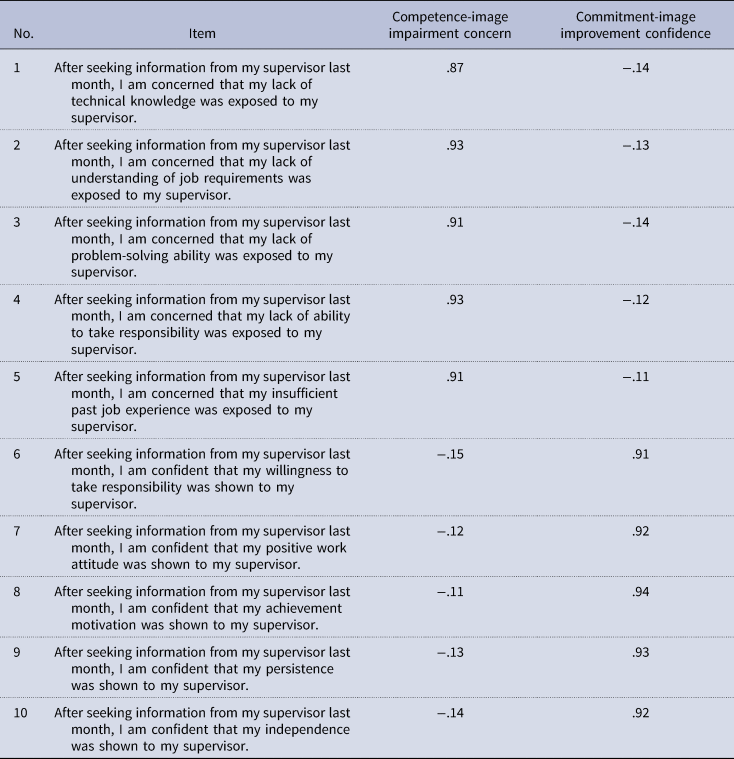
After conducting the creation and validation procedures recommended by Hinkin (Reference Hinkin1998), we created measures to evaluate each newcomer's competence-image impairment concern and that person's commitment-image improvement confidence. Specifically, we first revised the 10-item Employee Competence and Commitment Scale developed by Hambleton, Blanchard, and Hersey (Reference Hambleton, Blanchard and Hersey1977) and Thompson (Reference Thompson2009) to match the definitions of the constructs. Next, we distributed questionnaires to 460 newcomers from a high-tech company in China to rate the extent to which the survey items were consistent with the definition of competence-image impairment concern and with the definition of commitment-image improvement confidence using a 7-point scale. Then, we collected 391 completed and valid questionnaires, with an 85% response rate. Finally, we conducted exploratory factor analysis using varimax rotation (Table 1). The results showed that the 10 items loaded onto two factors, as we expected. The factor loadings were above .70 and had no cross loadings. The two factors explained 88.49% of the variance, and there was a negative and moderate correlation (r = −.21, p < .001). As a result, we confirmed that the factor structure was acceptable. In the formal study, both of them had high reliabilities (α = .91 for newcomer's competence-image impairment concern and α = .96 for commitment-image improvement confidence).
Exploratory factor analysis
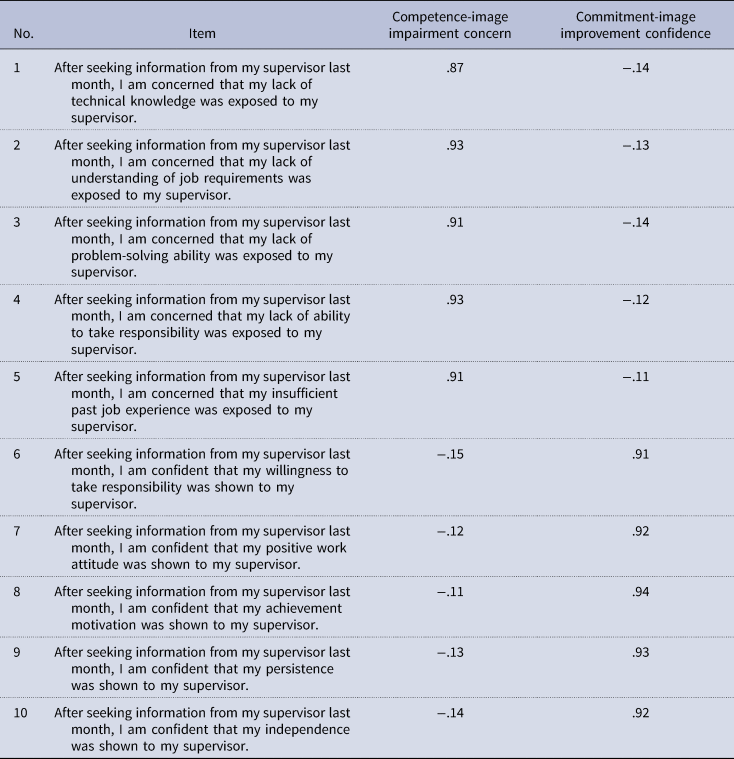
Note. N = 391.
Emotional exhaustion during socialization
We adapted the 9-item scale from Maslach and Jackson (Reference Maslach and Jackson1981) to assess the newcomers' emotional exhaustion during socialization. Example items included ‘I feel used up during socialization as the newcomer’ and ‘I feel frustrated by my job during socialization’ (α = .94).
Task mastery
Following Nifadkar and Bauer (Reference Nifadkar and Bauer2016), we used a 5-item Performance Proficiency Scale developed by Chao, O'Leary-Kelly, Wolf, Klein, and Gardner (Reference Chao, O'Leary-Kelly, Wolf, Klein and Gardner1994) to measure newcomers' self-evaluated task mastery. Example items included ‘I understand what all the duties of my job entail’ (α = .95).
Task performance
Following Li et al. (Reference Li, Harris, Boswell and Xie2011), we adopted a 3-item In-Role Behavior Scale (Williams & Anderson, Reference Williams and Anderson1991) to measure each newcomer's task performance, and submitted it to the participating supervisors. Example items included ‘This newcomer fulfills the responsibilities specified in his/her job description’ and ‘This newcomer meets performance expectations’ (α = .92).
Supervisors' favorable feedback
A 4-item scale from Steelman, Levy, and Snell (Reference Steelman, Levy and Snell2004) tapped supervisors' favorable feedback. The newcomers indicated the extent to which they agreed with the statements about their supervisors' response to their behaviors, such as ‘When I seek information from my supervisor, I frequently receive positive feedback from him/her’ (α = .91).
Control variables
Because our model focused on the aftereffect of newcomers' information seeking, we collected data on supervisors' information providing (α = .92) at time 1 using a 5-item scale adapted from Vandewalle et al. (Reference Vandewalle, Ganesan, Challagalla and Brown2000) to tease out the influence of supervisors' support for such behavior in the process, and included it as control. Considering that information seeking is a typical proactive behavior of newcomers, we included their proactive personality (α = .95) at time 1 as control variable using 10-item scale developed by Seibert, Crant, and Kraimer (Reference Seibert, Crant and Kraimer1999). Furthermore, given that newcomers' anxiety may provide alternative explanation between their information seeking and following psychological states, we included newcomers' anxiety (α = .92) at time 2 as control variable using Harmon-Jones, Bastian, and Harmon-Jones's (Reference Harmon-Jones, Bastian and Harmon-Jones2016) 4-item scale. We also included information adequacy (α = .95) at time 2 using Nifadkar and Bauer's (Reference Nifadkar and Bauer2016) 6-item scale as control variable to pick out the impact of information as key job resources in this process.
Finally, we included newcomers' gender, age, education, and working experience before entering the current organization as control variables that may potentially influence newcomers' reactions to the socialization process (De Vos & Freese, Reference De Vos and Freese2011; Kammeyer-Mueller & Wanberg, Reference Kammeyer-Mueller and Wanberg2003; Nifadkar & Bauer, Reference Nifadkar and Bauer2016). Notably, with and without any control variables, we reached the consistent conclusion.
Analytical strategy
Given that each employee was nested in supervisors, we followed the ‘sandwich estimator’ approach to conduct path analyses in Mplus 8.0 (Muthén & Muthén, Reference Muthén and Muthén1998–2018) using the ‘CLUSTER’ and ‘TYPE = COMPLEX’ options. We grand-mean centered the predictor variable (i.e., newcomers' information seeking from supervisor), the moderator (i.e., supervisors' favorable feedback), and gender, age, education, working experience before the entry, supervisors' information providing, and newcomers' proactive personality (Cohen, Cohen, West, & Aiken, Reference Cohen, Cohen, West and Aiken2003).
Results
Preliminary analysis
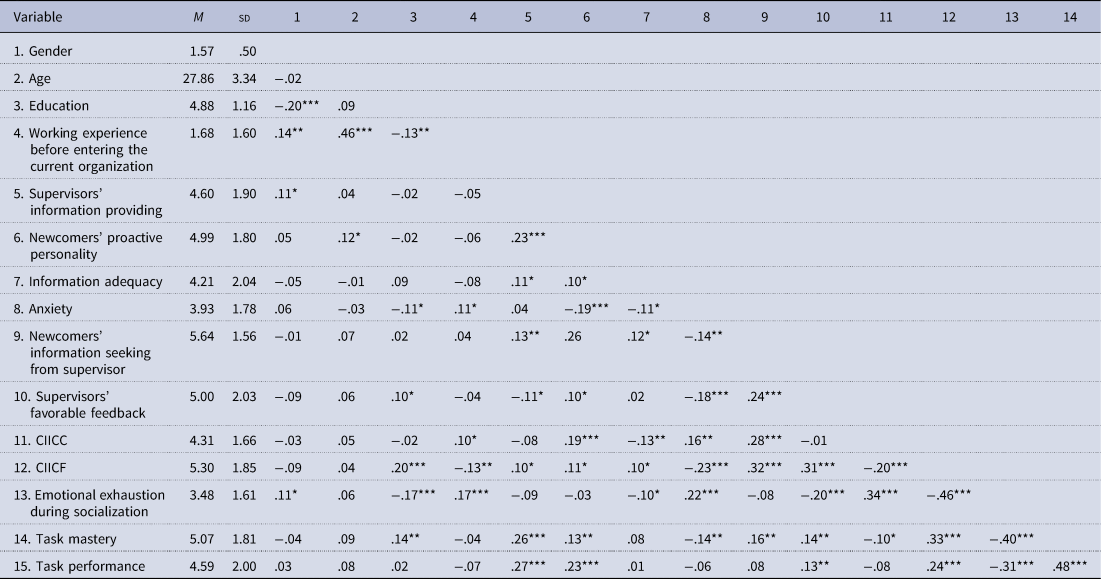
Table 2 presents the descriptive statistics from the study, including the means, standard deviations, and correlations of the focal variables.
Descriptive statistics and correlations among the variables
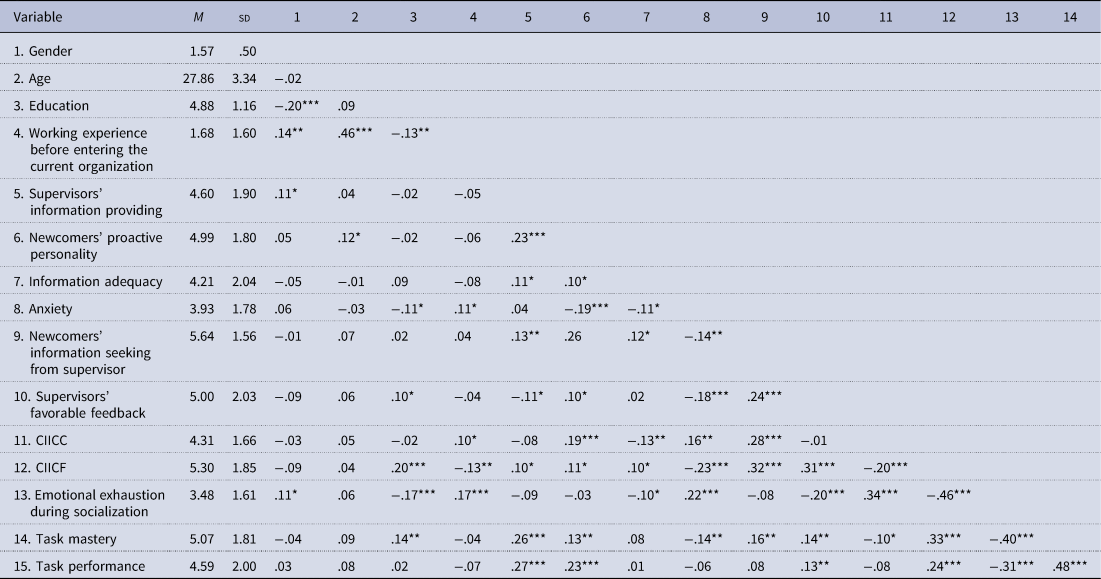
Note. N = 394; gender: 1 = male, 2 = female; education: 4 = junior college, 5 = bachelor's degree, 6 = master's degree. Working experience before entering the current organization was measured by years.
CIICC, competence-image impairment concern; CIICF, commitment-image improvement confidence.
*p < .05; **p < .01; ***p < .001 (two-tailed test).
Confirmatory factor analyses
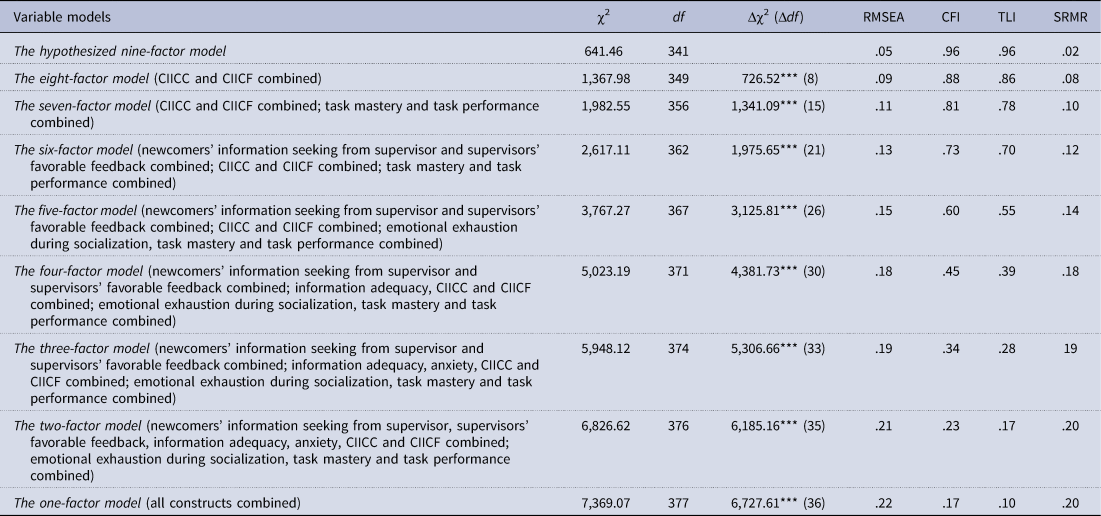
Because the ratio of the number of items to the sample size would influence overall model fit, scholars suggest using item parceling strategies (Little, Rhemtulla, Gibson, & Schoemann, Reference Little, Rhemtulla, Gibson and Schoemann2013). In this study, due to the total number of items and our sample size (46/394), we parceled newcomers' information seeking from supervisor, information adequacy, competence-image impairment concern, commitment-image improvement confidence, emotional exhaustion during socialization, and task mastery with the largest numbers of items into three items, respectively, using a factorial algorithm (Rogers & Schmitt, Reference Rogers and Schmitt2004). Then, we conducted confirmatory factor analyses (CFAs) of the focal variables. The results indicated that the hypothesized 9-factor model [χ2(341) = 641.46, p < .001; RMSEA = .05, CFI = .96, TLI = .96, SRMR = .02] fit the data well. More importantly, this model fits the data significantly better than did the alternative models (see Table 3). Thus, the findings demonstrated discriminant validity for our variables.
Model fit results for CFAs
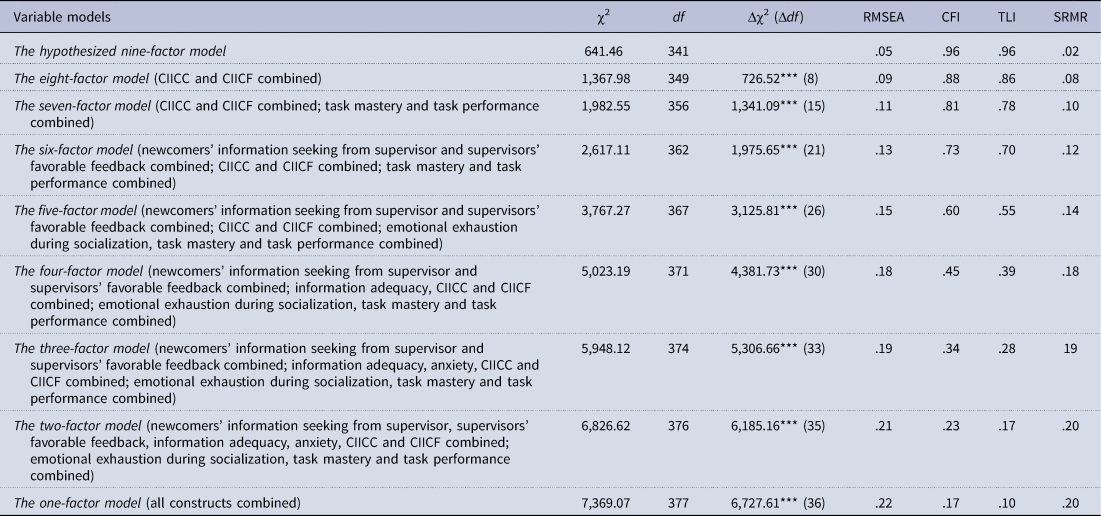
Note. N = 394.
CIICC, competence-image impairment concern; CIICF, commitment-image improvement confidence.
***p < .001 (two-tailed test).
Hypotheses tests
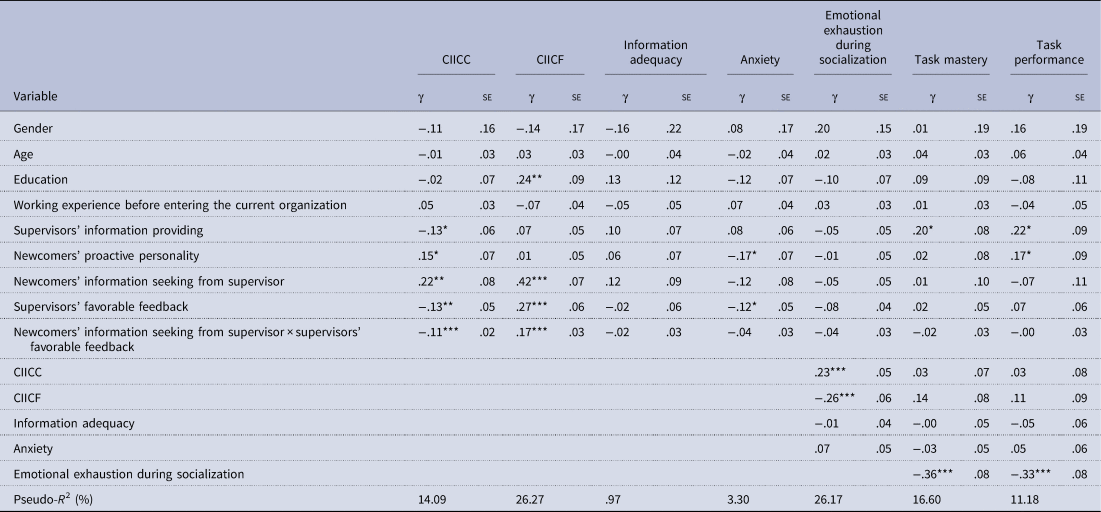
Hypotheses 1a and 1b proposed that newcomers' information seeking from supervisor would be positively related to competence-image impairment concern and commitment-image improvement confidence, respectively. In respective support of hypotheses 1a and 1b, our results (Table 4) demonstrated positive and significant relationships between newcomers' information seeking from supervisor and competence-image impairment concern (γ = .22, se = .08, p < .01) and between their information seeking from supervisor and their commitment-image improvement confidence (γ = .42, se = .07, p < .001).
Results of path analyses
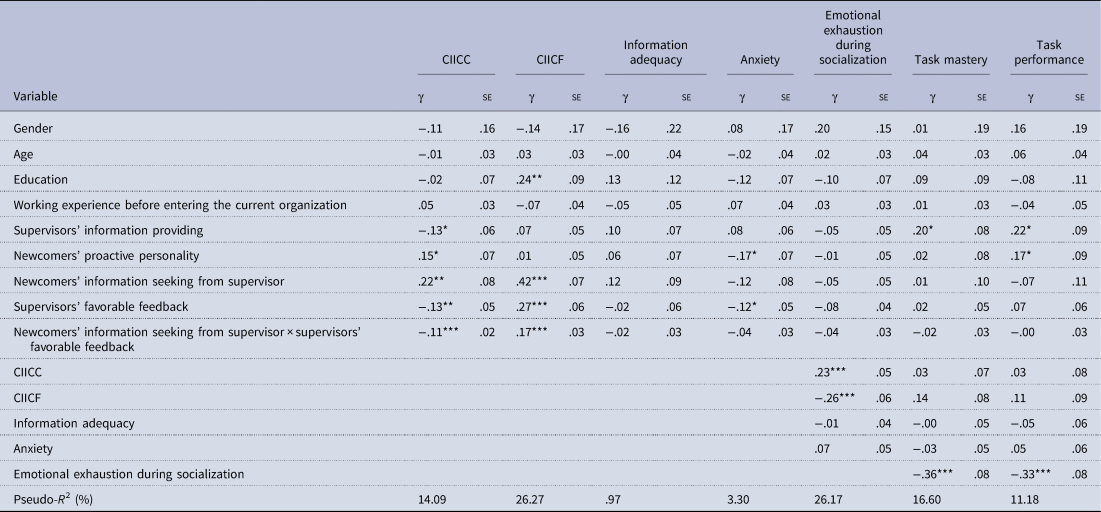
Note. N = 394.
CIICC, competence-image impairment concern; CIICF, commitment-image improvement confidence.
*p < .05; **p < .01; ***p < .001 (two-tailed test).
Hypotheses 2a and 2b suggested, respectively, that newcomers' competence-image impairment concern would be positively related to their emotional exhaustion during socialization, and that their commitment-image improvement confidence would be negatively related to their emotional exhaustion during socialization. The results showed that competence-image impairment concern was positively and significantly associated with their emotional exhaustion during socialization (γ = .23, se = .05, p < .001), and commitment-image improvement confidence was negatively and significantly associated with their emotional exhaustion during socialization (γ = −.26, se = .06, p < .001). Hence, hypotheses 2a and 2b were supported.
Hypotheses 3a and 3b proposed two indirect effects. We found that the indirect effect of newcomers' information seeking from supervisor on emotional exhaustion during socialization via newcomers' competence-image impairment concern was significant (indirect effect = .05, se = .02, p = .012). The indirect effect of newcomers' information seeking from supervisor on emotional exhaustion during socialization via newcomers' commitment-image improvement confidence was significant (indirect effect = −.11, se = .03, p < .001). Hypotheses 3a and 3b were supported.
Furthermore, hypotheses 4a and 4b proposed that emotional exhaustion during socialization would be negatively related to task mastery and task performance. In support of the hypotheses, we found significant negative relationships between emotional exhaustion during socialization and task mastery (γ = −.36, se = .08, p < .001) and task performance (γ = −.33, se = .08, p < .001).
We also found that the serial indirect effect of newcomers' information seeking from supervisor on task mastery (γ = −.02, se = .01, p = .037) and task performance (γ = −.02, se = .01, p = .043) via newcomers' competence-image impairment concern and emotional exhaustion during socialization was significant. The serial indirect effect of newcomers' information seeking from supervisor on task mastery (γ = .04, se = .02, p = .009) and task performance (γ = .04, se = .02, p = .013) via newcomers' commitment-image improvement confidence and emotional exhaustion during socialization was significant. Thus, hypotheses 5 and 6 were supported.
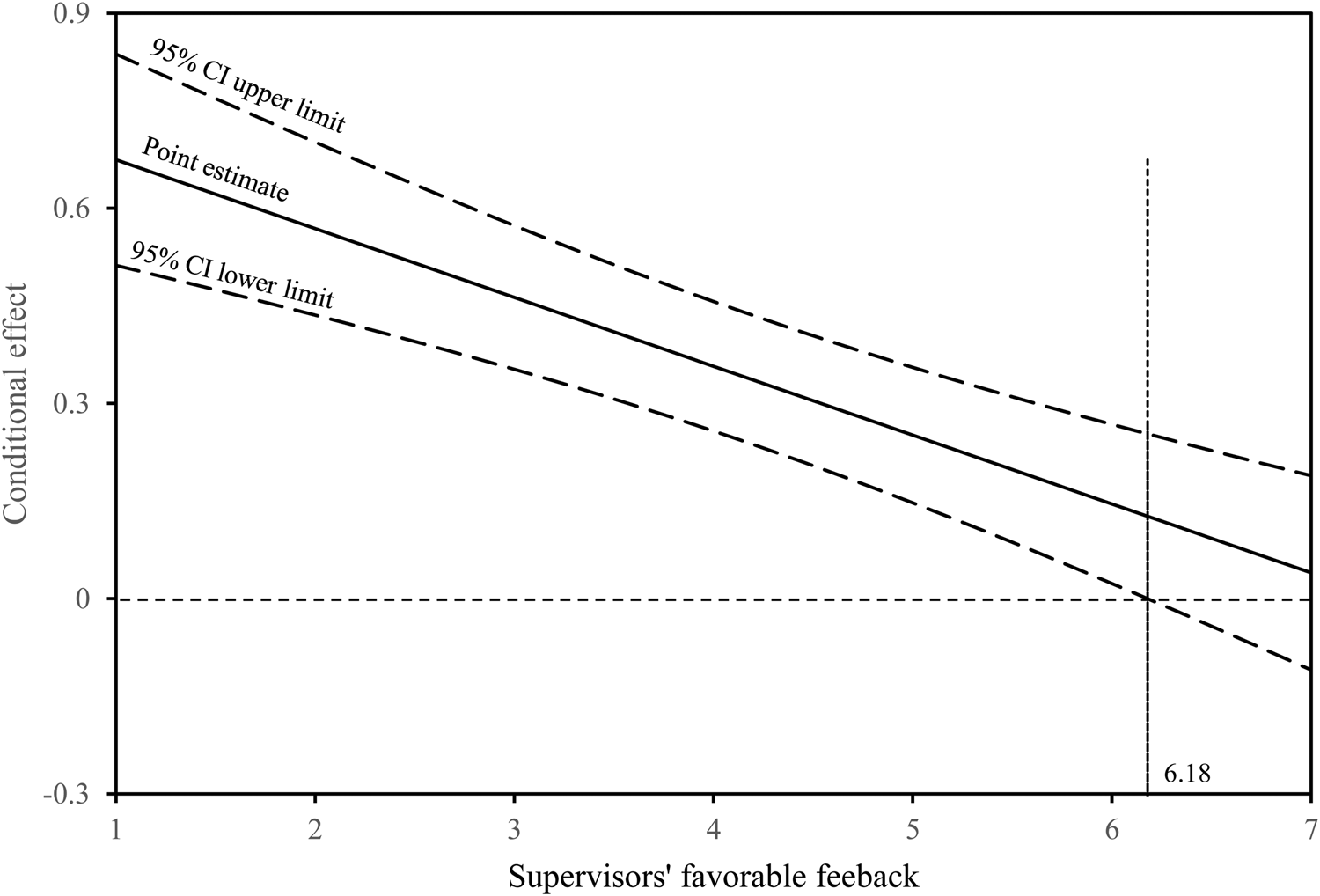
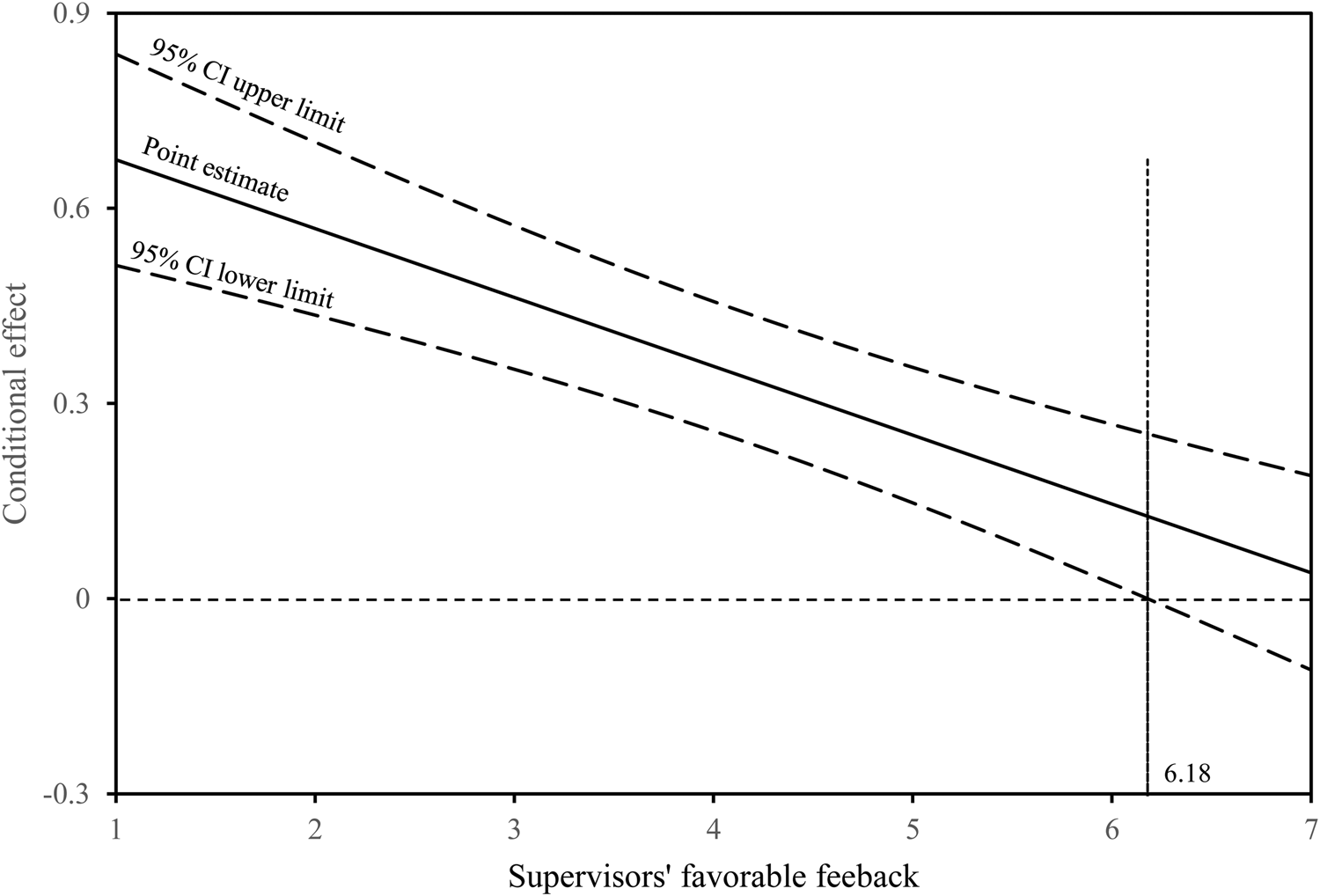
Hypothesis 7a proposed that supervisors' favorable feedback would moderate the positive relationship between newcomers' information seeking from supervisor and competence-image impairment concern, and our results confirmed that moderating effect of supervisors' favorable feedback on this relationship (γ = −.11, se = .02, p < .001). Following the recommendations of Hayes (Reference Hayes2022), we then interpreted the conditional effect of newcomers' information seeking from supervisor on competence-image impairment concern at the 16th, 50th, and 84th percentiles of the distribution of supervisors' favorable feedback. As predicted, when supervisors' favorable feedback was low (16th percentile: effect = .56, se = .07, p < .001) or moderate (50th percentile: effect = .15, se = .06, p < .05), the relationship between their information seeking from supervisor and competence-image impairment concern was significantly positive. In contrast, when supervisors' favorable feedback was high (84th percentile), that relationship became nonsignificant (effect = .04, se = .08, p = .610). Interpreting the Johnson–Neyman region of significance, values of supervisors' favorable feedback below 6.18 yielded a significant effect of newcomers' information seeking from supervisor on competence-image impairment concern, with 67.26% of the sample falling within that region (see Figure 2). Thus, hypothesis 7a was supported.
Conditional effect of newcomers' information seeking from supervisor on competence-image impairment concern as a function of supervisors' favorable feedback.
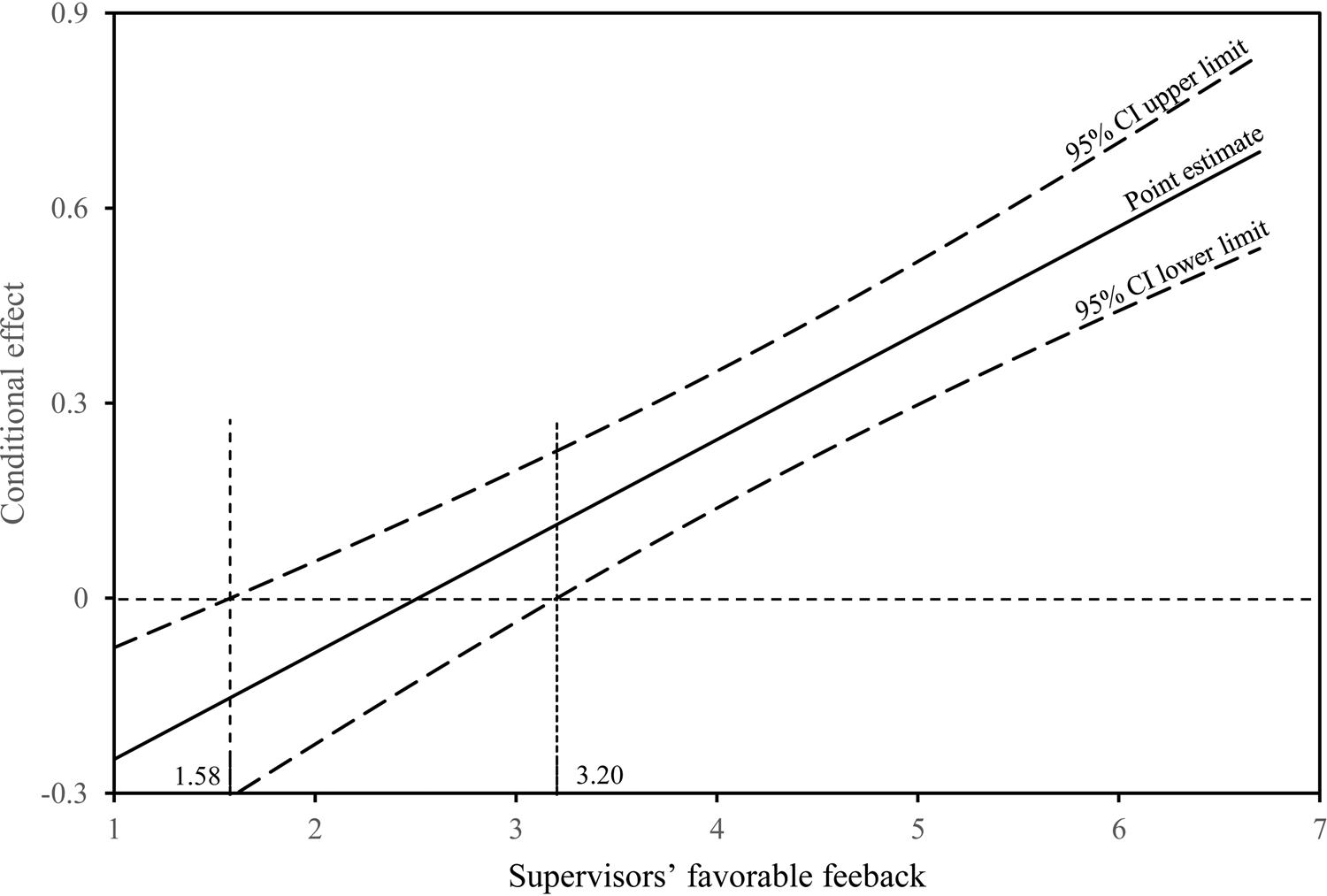
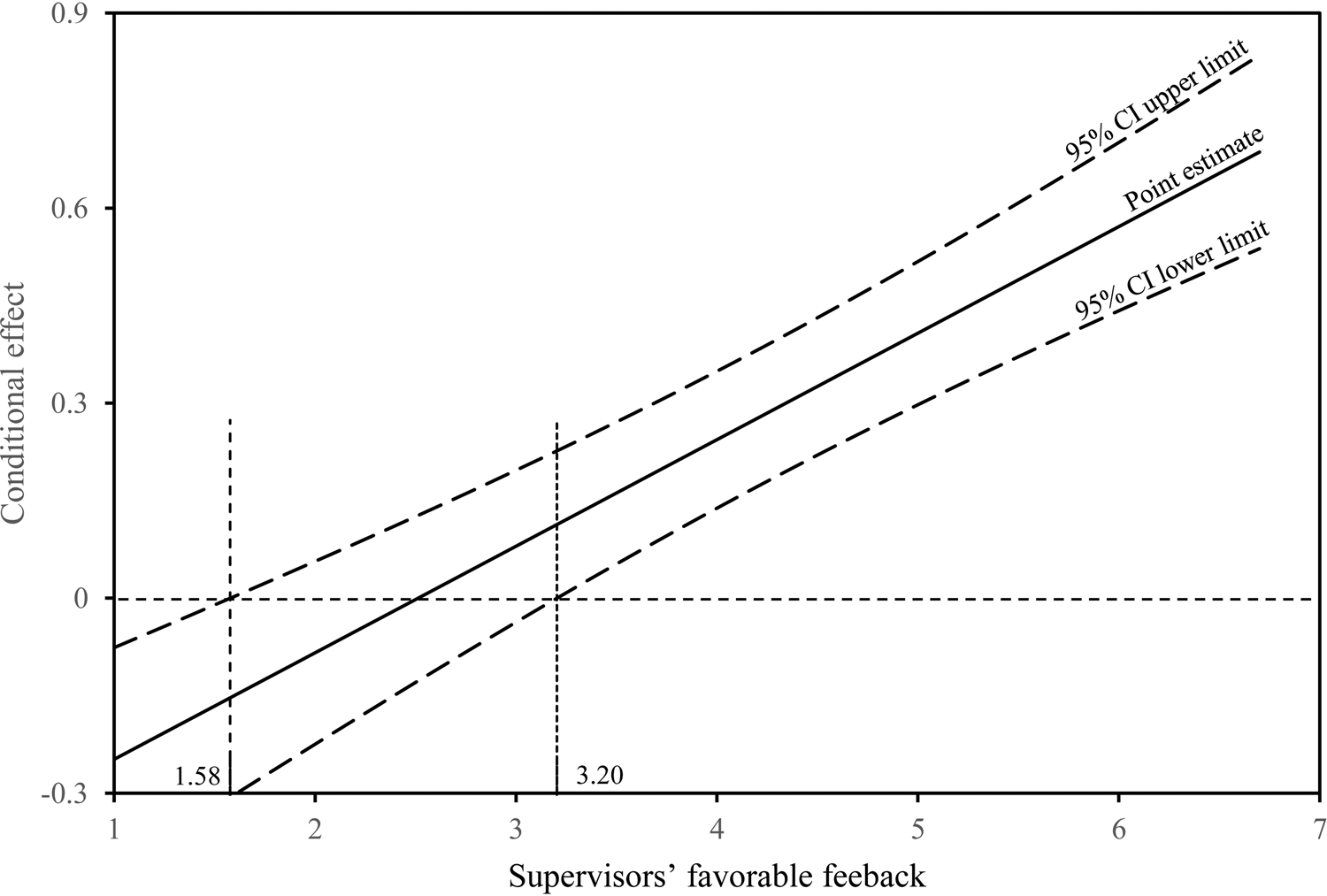
Hypothesis 7b proposed that supervisors' favorable feedback would moderate the positive relationship between newcomers' information seeking from supervisor and commitment-image improvement confidence, and our results verified that moderating effect of supervisors' favorable feedback on this relationship (γ = .17, se = .03, p < .001). Similarly, when supervisors' favorable feedback was low (16th percentile), the relationship between their information seeking from supervisor and competence-image impairment concern was nonsignificant (effect = −.08, se = .07, p = .286), whereas supervisors' favorable feedback was moderate (50th percentile: effect = .57, se = .07, p < .001) or high (84th percentile: effect = .74, se = .08, p < .001), that relationship was significant. Figure 3 indicates that values of supervisors' favorable feedback below 1.58 or above 3.20 yielded a significant effect of newcomers' information seeking from supervisor on competence-image impairment concern, with 10.91 or 78.43% of the sample falling within that region, respectively. Thus, hypothesis 7b was supported.
Conditional effect of newcomers' information seeking from supervisor on commitment-image improvement confidence as a function of supervisors' favorable feedback.
Discussion
Drawing on COR theory and professional image construction theory, our study illustrates the complex mechanisms that link newcomers' information seeking from supervisor and task-related outcomes. Our results showed that such information seeking from supervisor not only can trigger newcomers' concerns about competence-image impairment, which can make them emotionally exhausted, but it also can contribute to their confidence in commitment-image improvement, which can relieve their emotional exhaustion during socialization. Newcomers' emotional exhaustion during socialization further has negative impacts on their task mastery and task performance. We also found that supervisors' favorable feedback can moderate the relationship between newcomers' information seeking and their perceptions of professional image. Specifically, for newcomers who receive more favorable feedback from the supervisor, the positive relationship between information seeking and competence-image impairment concern is weaker, whereas the linkage between information seeking and commitment-image improvement confidence is stronger.
Theoretical implications
Our findings make several contributions to the current literature. First, by elucidating the mechanisms that underlie information seeking and newcomers' task-related outcomes, our study enriches the information-seeking literature. In reality, the majority of existing research has emphasized the positive effects of newcomers' information seeking (e.g., Ellis et al., Reference Ellis, Nifadkar, Bauer and Erdogan2017; Nifadkar & Bauer, Reference Nifadkar and Bauer2016), and only a few studies have mentioned the potential negative effects of such behavior (Brooks, Gino, & Schweitzer, Reference Brooks, Gino and Schweitzer2015). Empirical and theoretical arguments for elucidating the intricate relationships between information seeking and task-related outcomes are scarce. Thus, our study expands the previous research by identifying newcomers' competence-image impairment concern and commitment-image improvement confidence as mediators and specifying the existence of the complex psychological mechanisms between newcomers' information seeking from supervisor and task-related outcomes. This study also responds to the call by Cooper-Thomas and Burke (Reference Cooper-Thomas, Burke and Wanberg2012) and Cooper-Thomas and Stadler (Reference Cooper-Thomas and Stadler2015) for opening the black box regarding the negative impacts of information seeking on newcomer adjustment.
In addition, based on professional image construction theory, our results extend the professional image literature by dividing newcomers' professional image into competence image and commitment image, and combining them with the consequences of information seeking from supervisor. Although prior research had emphasized the importance of employees maintaining a viable professional image (Little et al., Reference Little, Major, Hinojosa and Nelson2015; Roberts, Reference Roberts2005), the commonality of those studies is that they regarded professional image as a whole and only considered its single-dimensional impact. However, few studies have focused on the various effects that the image-management tactics adopted by employees exert on the diverse dimensions of professional image construction. Because newcomers are required to create a viable professional image when they enter an organization, we examined the different impacts of information seeking from supervisor on their competence image and commitment image, and we developed the corresponding measurement tools in this study.
More broadly, most prior research on newcomers' information seeking and their adjustment outcomes focused on the roles of targets' (i.e., supervisors, colleagues) reactions toward newcomers' information seeking (Ellis et al., Reference Ellis, Nifadkar, Bauer and Erdogan2017; Nifadkar & Bauer, Reference Nifadkar and Bauer2016). Building from COR theory (Hobfoll, Reference Hobfoll2001), our study extends the literature on information seeking from the perspective of changes in newcomers' personal resources after their information seeking. This perspective evolved from our decision to cast newcomers' information seeking, competence-image impairment concern, and commitment-image improvement confidence as relating respectively to Hobfoll's (Reference Hobfoll2001) resource investment, resource loss, and resource gain mechanisms. From that perspective, the mediators of newcomers' multiple perceptions of their professional image have implications for how newcomers can prudently conserve and invest their personal resources, and thus our findings contribute to a more comprehensive understanding of the relationship between newcomers' information seeking and task-related outcomes. Additionally, by demonstrating these primary mechanisms simultaneously, our findings provide a rich test of COR theory's propositions in newcomers context (Baer, Dhensa-Kahlon, Colquitt, Rodell, Outlaw, & Long, Reference Baer, Dhensa-Kahlon, Colquitt, Rodell, Outlaw and Long2015; Halbesleben et al., Reference Halbesleben, Neveu, Paustian-Underdahl and Westman2014).
Managerial implications
Our study clearly demonstrated that newcomers' information seeking from supervisor can lead to adverse psychological and work outcomes. In contrast, previous studies have suggested that information seeking plays a vital role in the process of newcomer adjustment, and emphasized its positive impacts but ignored its negative sides. Differing from prior major research, our findings suggest that organizations should not motivate newcomers to unilaterally and automatically seek information from supervisor in the workplace. Specifically, newcomers instead should be encouraged to prudently prejudge the appropriateness of the information they are seeking, before taking action. In particular, newcomers are advised to avoid directly inquiring of their supervisors about some questions that might display their incompetence and tarnish their professional image in the organization. Meanwhile, supervisors should be encouraged to reply to newcomers' information seeking in a clear and timely manner, so as to avoid causing unnecessary concerns for newcomers.
Our findings show that the negative impact of newcomers' information seeking has resulted primarily from their negative psychological state after information-seeking behavior. This suggests that supervisors should pay more attention to newcomers' psychological state, in order to decrease their concerns if possible. Thus, we suggest that supervisors should build an interpersonal atmosphere of mutual trust and understanding within the team and provide social support for newcomers, which is conducive to improving newcomers' psychological safety. Furthermore, organizations can regularly invite psychotherapists to conduct psychological counseling and can provide leisure activities to dispel employees' negative emotions and replenish their depleted emotional resources, and thus can help them work energetically.
Our study also highlighted the critical role of supervisors' favorable feedback played in amplifying the effectiveness of newcomers' information seeking on their following perceptions of professional image. Accordingly, to avoid the potential adverse effects of information seeking, managers are encouraged to develop favorable feedback environment in the organizations. For instance, when responding to newcomers proactively seeking information, supervisors should purposively highlight the favorable aspects of newcomers' attitudes and behaviors, and be genuine in recognizing their efforts and values in integrating into the current organization (Budworth, Latham, & Manroop, Reference Budworth, Latham and Manroop2015; Jiang & Qu, Reference Jiang and Qu2022). Within such an atmosphere, newcomers will be motivated to develop positive perceptions of their professional image construction. Moreover, previous research indicated that providing high-quality and favorability feedback in a tactful and considerate manner can motivate employees to rate the feedback as being more favorable (Borden, Levy, & Silverman, Reference Borden, Levy and Silverman2018; Steelman, Levy, & Snell, Reference Steelman, Levy and Snell2004). We thus recommend that supervisors should also pay attention to the manner of feedback to amplify its positive effects.
Limitations and future research
Future research should respond to several potential limitations of our study and extend our findings through further investigation of newcomers' information seeking. First, although our research data were collected from multiple sources in multi-wave investigations, we still cannot avoid the causality or the directionality of relationships because of the correlational design. In addition, although we incorporated several elements of individual and information differences into our model and analyses, other alternative paths may exist between newcomers' information seeking and their task-related outcomes. Thus, future researchers should adopt longitudinal or experimental designs to render the results sturdier.
Second, our study employed a self-report measure of newcomers' information seeking from supervisor, which may not accurately capture their actual information-seeking behavior. For instance, newcomers' various perceptions of professional image constructions may lead to leniency or harshness bias in the evaluation of their information seeking. Although this approach is consistent with previous information-seeking research (De Vos & Freese, Reference De Vos and Freese2011; Ellis et al., Reference Ellis, Nifadkar, Bauer and Erdogan2017; Tan, Au, Cooper-Thomas, & Aw, Reference Tan, Au, Cooper-Thomas and Aw2016), using relatively independent judges to evaluate this behavior would provide a more objective way to examine its complex effects.
Third, although we investigated the crucial role that supervisors' favorable feedback played in newcomers' perceptions of professional image construction after seeking information, such perceptions could also be influenced by other variables. For instance, newcomers with strong psychological safety can help them alleviate concerns that information seeking would make them look incompetent and elevate confidence in projecting proactive images to others via such behavior. Additionally, apart from supervisors' favorable feedback, the role of supervisors' social support cannot be ignored, which may also facilitate newcomers to develop positive self-perceptions. Thus, an interesting effort by future researchers would be to explore the boundary roles of alternative explanations that combine the research scenario of newcomers' information seeking.
Fourth, our research collected data from a company in China and neglected the impact of the cultural context in which the study was conducted. A Chinese proverb says, ‘Self-introspection should be practiced on a daily basis.’ Therefore, because subordinates in China are influenced by their traditional culture, they may be more likely to reflect on their behaviors within the organization than the Western counterparts are. Thus, they may tend to be sensitive and concerned about the consequences of their daily information seeking from supervisors on their professional image. Because cultural characteristics played an obvious part in our study, we are not sure whether the negative effect of newcomers' information seeking from supervisor that we proposed in this study will also hold in other cultural contexts. Thus, future research should seek to verify our hypotheses using data from multiple countries and regions with different cultural characteristics.
Acknowledgements
We acknowledge the helpful comments from Ali Intezari (the associate editor) and three anonymous reviewers. We also express sincere gratitude to Wen Wu (Beijing Jiaotong University) and Mingyu Zhang (Beijing Jiaotong University) for their insightful comments on an earlier version of the paper and helpful assistance in our investigation. Our study was supported by the Fundamental Research Funds for the Central Universities (2021YJS064) and the Beijing Publicity and Culture High-level Talent Training Grant Program ‘Zhang Mingyu's Studio’.
Conflict of interest
The authors declare that they have no known competing financial interests or personal relationships that could have appeared to influence the work reported in this paper.