There was a strength of spirit evidenced in us as humans. . . . . . .seen, felt and heard. There were commonalities and also distinctions shared that have the potential to grow (Canadian-born Settler, Canada, speaking about the Summit process).
Today, many Indigenous peoples are intimately involved in the resurgence of place-based consciousness, culture, language, and traditional social economies. Epistemologically grounded in the exercise of relational responsibilities to human and other than human life, these actions are intended to ensure the ‘collective continuance’ of their societies (Corntassel, Reference Corntassel2012; Whyte, Reference Whyte2014). Strategies to advance these goals by Indigenous peoples and their allies include the formalisation of Indigenous studies and education as distinct disciplines, alongside the formation of transnational alliances and solidarities (Muehlebach, Reference Muehlebach2003; Bunda, Reference Bunda2014).
In recent decades, new colonialisms consisting of an increasingly aggressive ‘economics of extraction’ driven by growing global corporate power and Western scientific materialism have resulted in unprecedented human and environmental degradation (Hancock, Spady, & Soskolne, Reference Hancock, Spady and Soskolne2015), including exponential rupture from traditional lands and cultures of Indigenous peoples and accompanying human and interspecies dislocation and trauma (Williams, Roberts, & McIntosh, Reference Williams, Roberts and McIntosh2016). Unaccounted for in recent estimates by the United Nations High Commission for Refugees (UNHCR, 2016) of 65.3 million forcibly displaced persons throughout the world (this includes internationally displaced Indigenous and traditional peoples), are large numbers of internally displaced Indigenous peoples in the ‘modern’ nation states which contextualise this paper (see, e.g., Pilger, Reference Pilger2015). At broader levels, modernity has ultimately resulted in the ‘colonisation’ of perception and consciousness, and a corresponding overemphasis on materialism, previously unimagined (Cajete, Reference Cajete2000). This cauterisation of relationality, is now widespread in our systems of education and scientific inquiry (Williams et al., Reference Williams, Roberts and McIntosh2016).
Countering these developments are calls from a wider ranging number of disciplines for strategies — including the incorporation of Indigenous ontologies and knowledge systems — which fundamentally challenge and transform our current global economic-cultural order (Stewart-Harawira, Reference Stewart-Harawira2005; Tuck & Yang, Reference Tuck and Yang2012). Among the most radical — that is, getting to the root of — of proposals is Māori Indigenous education scholar Makere Stewart-Harawira's assertion of the urgency of effecting ‘transformation of the ontological underpinnings . . . .[of] the world order’ (Reference Stewart-Harawira2005, pp.3) as this is conceived and articulated through societal discourses and structures. Critical to realising Stewart-Harawira's vision are strategies ensuring epistemic sovereignty remains at the heart of Indigenous studies and education (Mahuika, Reference Mahuika2008; Santos, Reference Santos2012); maintaining the integrity of each in their application to societal issues requiring interdisciplinary analysis and action.
It is these twinned concepts of Indigenous resurgence and the interdisciplinary application of Indigenous knowledge systems to issues — in this case, social–ecological resilience (the harmonious co-evolution of human and ecological systems) — that are of concern to the International Resilience Network (IRN). Comprised of Indigenous peoples and those no longer Indigenous to place,Footnote i IRN's 5–7 year vision is an established community of practice which through Indigenous, intercultural, and intergenerational approaches, collectively impacts human–ecological resilience (IRN, 2016). While the realities and leadership of Indigenous peoples are central, we argue that realising IRN's goals and Stewart-Harawira's (Reference Stewart-Harawira2005) vision is a collective endeavour, which regardless of one's social–historical and contemporary social positioning, requires an agentic and authentic sense of identity grounded in people and place.
Held on the territory of the Tsawout Nation, British Columbia, IRN's inaugural summit ‘The Resilient People's – Resilient Places: Elders’ Voices Summit’ (hereafter called Elders’ Voices Summit) was a 4-day Indigenous-led sustainability education forum attended by over 100 people aged between 17 and 80 years from Canada, Aotearoa, Australia, and Scotland (Williams & Turner, Reference Williams and Turner2015). Common to the Indigenous peoples whose territories lie within each modern nation state is a history of British colonial domination authorised through powerful racialised discourses of Anglo–Saxon exceptionalism (Edmonds, Reference Edmonds, Dubinsky, Perry and Yu2015; Mackinnon, Reference MacKinnon2017). In part as a counter to these histories, the Summit's key theme was intergenerational resilience. This refers to knowledge transmission between humans (specifically Elders and youth), and between humans and our other than human relatives (Cajete, Reference Cajete2000; Fixico, Reference Fixico2003). Framed by the broader aims of IRN — (1) restoring intergenerational knowledge transmission and relationships between people, and between people and nature, and (2) integrating these perspectives within innovations intended to heal and restore fragmented human-ecological system — the 4-day programme progressed sequentially (although not linearly) through four topics. These were (1) Preparing the Ground, (2) Indigenous Knowledge and Resilience; (3) Holistic Learning Approaches; and (4) Innovations of Indigenous and Inter-people's Resilience.
A significant departure of IRN's work from the majority of decolonising and sustainability initiatives are our efforts to dig underneath the Indigenous–non-Indigenous binary and associated identity politics, to fundamental issues of ontology and epistemology. Ultimately, this work is about the recovery of our larger experience of the animate and interconnected Life-World (Williams, Reference Williams, Williams, Roberts and McIntosh2016, p.93) we inhabit. It takes account of Indigenous peoples’ varying connections to territory and culture and the severing of the deep empathic links to the land for many settler–migrant peoples whose ancestors were once Indigenous to place (O'Hara, Reference O'Hara2006). All peoples develop from ecological origins. Ecology is the animating force — derived neither from political or theological ideology — that teaches us how to be human (Battiste, Bell, Findlay, Findlay, & Henderson, Reference Battiste, Bell, Findlay, Findlay and Henderson2005).
The rationale for IRN's emerging approach is further elucidated by considering the diverse range of summit participants comprising three broad groupings which given our often complex identities and sometimes contradictory social locations are not neat categories: (1) Indigenous peoples colonised within their own territories; (2) peoples who are the primary benefactors of Euro-Western consciousness and society (often Euro-settlers), whose ancestors may have been colonised in their own homelands preemigration, and were and/or are subsequently to varying degrees complicit in the colonisation of others postmigration; and (3) more recent (often racialised) migrant peoples who are often either Indigenous to their birth place or from traditional societies, and are in some form or another disenfranchised from their homelands.
The statement by the Summit participant at the beginning of the paper simultaneously speaks to two key aims of the Summit. First, it speaks to the recultivation of the human spirit in ways that are life giving in the collective sense. Second, it alludes to the common ground and differences which must be negotiated between culturally diverse collectives coming together, whom while sharing an innate capacity for indigenous connection to, and a common concern for the earth, have different colonial histories, relationships to territory, and often immediate aspirations. Accordingly, this paper addresses two key questions which while latently held, were significant in shaping summit programing:
• What are the pedagogical practices/nature of the learning community that will enable reconnection to place and people?
• What are the kinds of practices that will facilitate the alchemical potential of the collective — enabling epistemological, relational, and creative solidarities to emerge?
In addressing the first question, we articulate the Summit's pedagogical approaches, including the ‘reproduction of culture in place’ (Sommerville, Reference Sommerville2010) as a praxis of decolonisation designed to deepen relationality towards shared ontological experiences (convergences) between culturally diverse collectives. In addressing the second question, we focus on the ontological–epistemological ruptures (the divergence or incongruence between shared understandings of the nature of being, and subsequent actions by different cultural collectives) that began to show themselves at the Summit and what this might mean for future IRN developments and pedagogical approaches.
Learning Place and Transnational Indigenous Identities
Tsawout Territory: The Bedrock of Learning Community
The Tsawout territory provided the bedrock for our deeply transformative time together of being, doing, and learning. Tsawout is one of five bands comprising the Saanich peoples (or in their SENĆOŦEN language, the WSÁNEĆ Nation), who over thousands of years have continuously occupied the Saanich Peninsula on Southern Vancouver Island and the surrounding Gulf Islands and San Juan Islands of the Salish sea in the region now known as Southwest British Columbia and Washington State on the North American continent. Relying on the lands and waters of their territory to sustain their language, culture, and traditions, The WSÁNEĆ are known as the ‘Salt Water People’. They are also known as the ‘Emerging People’ after their sacred mountain ȽÁU,WEL,ṈEW, (The Place of Refuge) emerged following the great flood. Tsawout means ‘houses on the hill’ a name it derives from the way its villages appeared to paddlers entering Saanichton Bay (Horne, Reference Horne2012).
The Cordova Spit (which in the SENĆOŦEN language is called TIXEN) is a sparsely vegetated spit which lies at the water's edge about 2 km from the main village of Tsawout. A place of physical, emotional, and spiritual sustenance, TIXEN is the provider of traditional foods, medicines, and the site of sacred burial grounds. In the WSÁNEĆ world, there is the worldview known as TŦE SKÁLS ȽTE, which is a phrase that describes the law/belief where the WSÁNEĆ peoples view many things (trees, fish, animals) as relatives. Relatedly, the WSÁNEĆ concept of SKÁU ȽŦE expresses the inseparability of learning, teaching, language, beliefs, ways of being, and laws from the land. As a place for spiritual reflection and traditional teaching, TIXEN was our place of learning for our day-long gathering on the land, while the community gym and band headquarters in the main village provided the ‘thinking place’ for most of the rest of the Summit. This resilience of the land and its peoples has persisted despite colonial imposition — including confiscation of lands and decimation of the centre of the WSÁNEĆ’s people's social–spiritual economy, the traditional ReefNet fishing method — from the 1840s onwards. At the time of the Summit, the Tsawout Nation were preparing a major submission against the building of a major oil pipeline through their territory; an initiative which is predicted to have many negative impacts on the wellbeing of the Tsawout territory and its people. It is this complex, rich, and difficult history together with the resilience of the territory and its peoples that formed the bedrock of ‘thinking place’ (Battiste et al., Reference Battiste, Bell, Findlay, Findlay and Henderson2005) during our time together at the Summit.
Transnational Indigenous Identities and Place
A key IRN activity is biannual summits in different Indigenous contexts which draw on Indigenous Education, land-based learning and other holistic pedagogies. As a collective undertaking, both organising and being together at the Summit implicitly involves the negotiation of transnational Indigenous identities and the reproduction of culture in place (Muehlebach, Reference Muehlebach2003; Sommerville, Reference Sommerville2010). This was the case both with the process of summit organising as well as the unfolding of the Summit programming over 4 days.
Williams’ standpoint as IRN initiator, and key summit organiser is a White, Indigenous, migrant woman who embodies Indigenous (Ngāi Te Rangi tribe) and settler (Celtic) origins. Her practice and scholarship focuses on Indigenous resurgence and intercultural approaches to human-planetary wellbeing. Schooled in Western systems of formal education, and reconnecting with her tribal roots as an adult, hers is a story (Williams et al., Reference Williams, Roberts and McIntosh2016) which narrates the entanglement and movement of epistemology, identity, and place providing possibilities of epistemological change over time (Kovach, Reference Kovach2009). These experiences were key in informing the pedagogy of the Summit.
Bunda as a Goori woman acknowledges identification to Ngugi/Wakka Wakka peoples of the colony Australia. This author, as both summit contributor and participant acknowledges the forever troubling space of being in and with colonial governmentalities. Her work in higher education has sought to push back onto dominant and assimilative intent found in the university to create space for liberatory practice through Indigenous ways of knowing being and doing.
Claxton is a member of the Tsawout Community of the WSÁNEĆ Nation. As IRN Co-Director, and a part of the Summit Organizing Committee, he was a vital link between to the Tsawout Community. Nick's work on the revitalisation of the WSÁNEĆ Reef Net Fishery embodies the IRN and the Summit.
MacKinnon grew up conceiving of himself as ‘Scottish’, but his historical research has led him to realise his core colonised (and therefore, he presumes, Indigenous) identity as a Gael, a people whose life-ways, life-world, and identity have been marginalised and subalternised within the country they have always called Alba. Over the last 1000 years, the states of Scotland and Britain, and the British Empire have been formed in and over Alba. His work seeks to understand colonial processes in the formations of these states (processes interwoven with the overseas imperial colonialism in which Gaels, Scottish, and British engaged), and to recover and foreground precolonial Indigenous knowledge and ways of being in order to contribute to the transformation of prevailing ontological underpinnings of local and world orders.
While our respective learnings and positionings shape each of us, and the ways in which we might engage in a global decolonial praxis of sustainability, we suggest that the bedrock of experience is always place, and the ways in which place engages with our being, and subsequently shapes learning. These ideas are expressed within Indigenous and sustainability education (Battiste et al., Reference Battiste, Bell, Findlay, Findlay and Henderson2005; Watts, Reference Watts2013; Lange, Reference Lange, Corcoran, Weakland and Wals2017). For example, Aninshnabe and Haudenosaunee scholar Vanessa Watts, articulates this as ‘Place Thought’, a distinctive space which recognises the interconnectedness between thoughts and place, based on the premise ‘that the land is alive and thinking and that humans and non-humans derive agency through the extensions of these thoughts’ (Watts, Reference Watts2013, p.23). It is these onto-epistemological framings brought to life by the sentience of the land and the prayers sung to it and the ancestors, by the Elders that formed the basis of our thinking place for the Summit.
Theoretical Framework and Key Concepts
A key goal of IRN's work is place situated ‘ethical relationality’. This simultaneously centres Indigenous philosophies, ethics, and ways of knowing while seeking to engage mutual understanding of relative positionings, perspectives, and knowledge systems as constituted by different colonial histories (Donald, Reference Donald2009). Theoretically significant to our work is the concept of reconciliation, which with the exception of Scotland, has been present in each country (in its polyvalent forms) for some time with various degrees of effectiveness (Gunstone, Reference Gunstone2009; TRC, 2015; Edmonds, Reference Edmonds2016; Hanson, Reference Hanson2016). As articulated here, reconciliation goes well beyond truth-telling forums often accompanying political change (Short, Reference Short2005) or initiatives based on individual compensation hearings for past colonial wrongs (Hanson, Reference Hanson2016), to forms requiring ecological justice (Behrendt, Reference Behendt2003; TRC, 2015) and reconciliation at epistemological, relational, and material levels. This more radical form of reconciliation reestablishes previous emphasis on reconciliation as ‘Indigenous claims against the State’ to questions regarding how ‘colonizing peoples might legitimately settle and establish their own sovereignty?’ (Tully in Short, Reference Short2005, pp. 277).
We are also interested in how the kinds of transformative learning experiences that our intercultural, participatory, and experiential approach can create might go beyond the affective states associated with reconciliation (Altman & Hinkinson, Reference Altman and Hinkson2007; Edmonds, Reference Edmonds2016). If deliberative processes to deepen Indigenous and non-Indigenous connections serve to create awareness among participants of shared human experiences beyond their different cultural and historical stories, and, through this new understanding of what is common to their different human contexts, an awareness emerges among the culturally diverse participants that they live in a shared and a deeply interconnected reality, can this new awareness itself constitute a common epistemology or way of knowing that can be translated into effective forms of action? (In the sense that epistemology is about ‘how we come to know’, our usage of the word in this context entails a tight coupling between what we know (ontology) and how we live and therefore come to know (epistemology). Onto-epistemology is the reflexive and bidirectional relationship between what we know about reality and action. For differently historically and socially positioned peoples, this inevitably brings into playing various perspectives and priorities.
Our pedagogical approach to the Summit was underscored by the intersections between Indigenous Environmental Education (Battiste et al., Reference Battiste, Bell, Findlay, Findlay and Henderson2005; Calderon, Reference Calderon2014) and Critical and Participatory genres of Transformative Education (O'Sullivan, Reference O'Sullivan2008; Brookfield, Reference Brookfield, Taylor and Cranston2012). Both sets of pedagogical practices — while broad in scope — share similar ontological positions of connectivity (Rose & Robin, Reference Rose and Robin2004) known as Indigenous (Broadhead & Howard, Reference Broadhead and Howard2011) and participatory (Fessenden, Reference Fessenden2007) paradigms, respectively.
Both paradigms conceptualise agency to be a human and more than human attribute — all life forms, even those that are in the Western sense considered to be inanimate, have life-force, varying degrees of consciousness, receptivity, and initiative (Broadhead & Howard, Reference Broadhead and Howard2011). This inclusive notion of kinship recognises the existential value of nature independently of its utilitarian value to humanity. While Indigenous worldviews are particular to place and peoples, they share some similar epistemological roots and principals with participatory paradigms which include the interconnectedness of all of life, that every element or life form has its own life-force, that matter is imbued with spirit, and the inherent reciprocity between life forms (Stewart-Harawira, Reference Stewart-Harawira2005). Pedagogically speaking both schools of thought disrupt Euro-Western normative understandings of place and people; underscoring the primary pedagogical assumption of the Summit — the bedrock of experience is always place, and the ways in which place engages with our being and subsequently shapes learning. The overlaps and divergences between these two worldviews, which we bring into our analysis later in the article, may have significant implications for pedagogical practices intended to assist diverse cultural collectives engage in social–ecological resilience work.
The ‘reproduction of culture in place’ (Sommerville, Reference Sommerville2010) refers to the recovering of Indigenous cultural ecologies, knowledge systems and ways of being in ways that significantly remap dominant understanding of the cultural ecology of place. Drawing on previous scholarship in critical Indigenous studies and social geography (Kraidy, Reference Kraidy2002; Fredericks, Reference Fredericks2013), we applied this concept in two key ways: (1) the remapping of sociohistorical narratives that involves the disruption of dominant white-settler colonial narratives of the ecology of culture and place through resurfacing and repositioning Indigenous narratives of country, culture, and kin; and (2) the remapping of ontology and epistemology in an embodied sense upon the human psyche through ceremony, stories, arts-based approaches, and simply being one with country. Within an Indigenous Life-World perspective, these embodied and discursive forms of cultural remapping are both important: consciousness is embedded in the nature of all things, learning is holistic and relational, involving ‘human beings, animals, plants, the natural environment, and the metaphysical world of visions and dreams’ (Fixico, Reference Fixico2003, p. 2). From an Indigenous worldview, it is the body's knowing or perceiving that informs other levels of consciousness (Cajete Reference Cajete2000; Broadhead and Howard, Reference Broadhead and Howard2011): a perspective also articulated previously within Western scholarship on relational consciousness (Merleau-Ponty, Reference Merleau-Ponty1964; Abram Reference Abram1996).
We are aware that efforts to build epistemological and relational solidarities across culturally diverse groups (Gaztambide-Fernandez, Reference Gaztambide-Fernandez2012; Williams & Hall, Reference Williams and Hall2014) can at times require us to hold paradoxical and nuanced understandings of seemingly competing cultural power locations. Indeed Gaztambide-Fernandez (Reference Gaztambide-Fernandez2012) argues that decolonisation work in globalised contexts requires the constant negotiation of boundaries in ways which recognise the complex and sometimes contradictory locations and histories of people. However, as in their well-known work ‘Decolonization is not a Metaphor’, Tuck and Yang (Reference Tuck and Yang2012) assert, decolonisation work must ultimately be articulated in practical ways involving redistributive forms of justice. We agree with their observation, that while neo-colonial and global forces constitute and displace colonial subjects — whether through external forms (e.g., forced migration) or internal forms (for example, racialisation) — these same groups still none-the-less still occupy and settle stolen Indigenous land. Accordingly, we also draw theoretically (although not exclusively) on Tuck and Yang's (Reference Tuck and Yang2012) concept of ‘incommensurability’ suggesting the collective work of decolonisation is often an ‘uneasy, reserved, and unsettled matter’ (2012, p.3).
One way that incommensurability may manifest itself has to do with the rupture between ontology and epistemology, where through the kinds of affective activities described in the later section ‘Deepening Relationality’, participants experience a kind of ontological convergence, which may then over time shift to experiences of epistemological divergence. This appears to be the case in one of the following results sections ‘Facilitating Solidarities’ as they rediscover their different agency imperatives from one another. Research by Canadian Indigenous scholars on the different lived meanings of citizenship pertaining to Indigenous peoples and non-Indigenous peoples suggests the relational responsibilities of Indigenous peoples to human and other than human life contrast from human rights discourses derived from state centric forums premised on capitalist and Eurocentric norms of humanities’ precedence over nature (which are the lived realities of the majority) (Corntassel, Reference Corntassel2012).
Recent research (Williams & Hall, Reference Williams and Hall2014) with Indigenous and racialised migrant women in Canada and Aotearoa tentatively demonstrates the ontological–epistemological rupture foregrounded by Cornstassel's contrasting conceptualisations of citizenship above. This study found that for some migrant woman who hold participatory worldviews but in reality live in urban areas disconnected from land, wellbeing is often primarily rooted in social relationships, while for Indigenous women still occupying traditional places, health and resilience is rooted in kinship relations inclusive of the land and other life forms (Williams & Hall, Reference Williams and Hall2014). Other scholarship supports this, differentiating between processes of attachment and identification with place that form through repetitive practices and memories that form over time — (Heinamaki, Reference Heinamaki2009; De Certeau in Fredericks, Reference Fredericks2013) on the part of migrant communities, and epistemological rootedness in place (being of country) that is more often the case for Indigenous peoples.
Pedagogical and Methdological Approach
The Summit's preparation was supported by a local organising committee and IRN's International Advisory Group; each consisting of university, not-for-profit and government partners. In the year prior to the Summit, our local organising committee worked closely with WSÁNEĆ Elders and Tsawout representatives to support the inclusion of Tsawout community members, and ensure Tsawout protocol was followed for the Summit. The spiritual foundation provided through the land and the WSÁNEĆ Elders was essential in enabling such a diverse group of people to come together and create a space of trust, and emotional and analytical depth. This notion of holding relational space was also (implicitly) extended to the land, waterways, and kinship relations within this.
Cultural remapping was interwoven throughout summit activities. While some days tended to emphasise more cultural remapping in narrative (e.g., Indigenous knowledge) or epistemological terms (e.g., holistic, land-based learning) both elements were present on each day. We did not set out to research the effectiveness of pedagogical approaches to intergenerational resilience directly. Rather the idea of the article emerged as a result of being in role as a ‘participant observer’ (Davis & Craven, Reference Davis and Craven2016). This was particularly the case for Williams as she worked with co-author Claxton and the Tsawout community to develop the programme in the year leading up to the Summit, and for all authors as they participated in and observed the impacts of the Summit on themselves and others. (For Example, MacKinnon led a delegation of youth from Scotland, some of whom continued to reflect together on the Summit and subsequently offered these reflections back to the Network's directors.)
Data is drawn from the programming notes, summit evaluations (20% response rate), facebook posts spontaneously posted by summit participants during and shortly after the Summit, and from videos taken during the Summit (IRNa). Findings were then coded into key thematic areas, some of which can be found in the Summit Evaluation Report (Williams & Turner, Reference Williams and Turner2015). The development of these themes was guided both by the pedagogical objectives (posed as Questions One and Two in the introduction), which underpinned the Summit and through multiple readings of the data. Occasionally, missing words are inserted in direct quotes of participants for the purpose of making grammatical sense. Given our discussion of agency imperatives and the ways in which these may be linked to the different subject positions (such as the cultural, social, and place-based locations of people), the quotes in the following sections include information pertaining to summit participants’ subject positions.
Results: Pedagogical Practices for Life-Giving Futures
Deepening Relationality
Hearing the First Nations language as spoken by the native speakers was very powerful, be it sung, spoken or in prayer. It allowed us to hear in the Scottish Gaelic sounds a profoundly ancient earthiness that bridged skin colors through Indigenous connection (Settler of Gael lineage, Aotearoa).
Our learning community or ‘Life-World’ literally and metaphorically provided the ground underneath our learning and being. The powers and enormous spiritual depth inherent in Tsawout territory, the ceremony performed, Indigenous languages and music, imagery and dialogue all formed the ‘thinking place’ (Battiste et al., Reference Battiste, Bell, Findlay, Findlay and Henderson2005; Watts, Reference Watts2013) giving rise to experiences of ontological convergence — a deeply shared way of experiencing and being together. This was expressed in a variety of ways such as an ‘experience of unity. . . . .in a safe and co-created space’ and the ‘analytical depths reached’.
Given the disparate colonial histories of summit participants, our first day ‘Preparing the Ground’ was intended to make more visible Indigenous ecologies, histories, and colonial traumas through various cultural excavation activities. In essence, we wished to remap the terrain in ways which challenge dominant cultural power dynamics and reassert Indigenous realities. These activities consisted of the ‘Colonial Reality Tour’ (a tour of culturally significant sites for the Lekwungen peoples), ‘Elders Time on the Land’ (revealing Indigenous ecologies), Youth Dialogue Circles (on meanings of resilience), and our opening event, ‘The Whole of Human Relations’ (arts-based contributions featuring the Child Taken Arts Partnership Project (CTAPP), and Common Ground: Māori and Celtic understandings of Land. The CTAPP (Shantz, Reference Shantz2015) is a collaboration between the Saskatoon Tribal Council and the University of Saskatchewan profiling in the form of portraits, students’ understandings, and impressions of the experiences of Indian Residential School Survivors and intergenerational resilience. Common Ground (Gunn, Reference Gunn2015) is an audio-visual display portraying powerful imagery and narratives of Celtic and Māori understandings of land forging new understandings of commonalities and Indigeneity. Supporting previous scholarship on the potency of art as a form of resistance to colonial domination that facilitates solidarities between colonial subjects (Todd, Reference Todd2015), both these contributions proved powerful in this way. For example, speaking of the CTAPP, one participant said:
The Child Taken Arts Partnership Project was so powerful. The 9 artistic representations of Elders experiences of Indian Residential Schools and resilience certainly brought huge awareness through art, to the history of Indian Residential School and the resilience of Aboriginal Peoples despite the intergenerational effects of these schools (Indigenous Elder, Canada).
The third day primarily focused on holistic land-based learning and was held at TIXEN spit, the sacred food gathering, burial, and ceremonial grounds of the Tsawout people. This day started before dawn with preparations for a traditional earth oven for the purposes of the pit cook. Traditional food preparation methods were taught with stories of the land and traditional teachings given while the food cooked. The sentience of TIXEN spit was powerful in its effects on summit participants. As one summit participant expressed, to hold the Summit on traditional territory was ‘powerful medicine’.
Thinking Place and the notion of holistic relational space, whether through sound, imagery, prayer, ritual, Indigenous language, were also (implicitly) extended to the land, waterways, and kinship relations within this. In this respect, as conveyed by summit participant, conversations with the ‘More than Human’ were an implicit part of our Summit — the bedrock of embodied knowing and our learning community over those 4 days:
I want to express my endless gratitude to the Tsawout First Nations People. I felt the synergies of their land and water flow through me. I know that I will return to that place again (Indigenous Person, Aotearoa).
Facilitating Solidarities — Intergenerational and Interpeople's Resilience
This section focuses more on human-discursive parts of the Summit and the related theme of epistemological divergence — the spaces where subsequent aspirations or actions of individuals or cultural collectives begin to ‘rub up’ against one another. Both activities described however contain elements of both — ontological convergence and epistemological divergence.
The panel on intergenerational resilience between Elders and youth was comprised of nine Indigenous and non-Indigenous Elders and youth from Canada, Aotearoa, and Scotland. This story-telling process constituted a powerful form of cultural remapping across generations and place. While the theme of human to human intergenerational resilience remained foremost, the transmission of knowledge between species was very present as an underpinning theme: ‘We learn from all our kin – not just human, but from all the other species and parts of our world as well. . . . . . . . .so if we think of intergenerational learning and knowledge transmission we have to think of the entire eco-system around us’. The same speaker also went on to articulate the embodied nature of this learning in talking about her experience of learning about medicinal preparation with Indigenous Elders:
In order to prepare this medicine we had to get the barks from 10 different trees. . . .to taste that medicine and internalize that knowledge. . . . . .I can only say it was like drinking the forest. . .it was the most amazing complex taste and felt very healing (Euro-settler, Canada).
Loss of these practices as well as their regeneration in the face of colonisation was a key theme described by Indigenous Elders and youth. One Haida Elder described how her nation were reduced from 30,000 at the time of colonial contact to 600 people by 1936. Talking about the resulting loss of traditional knowledge, she likened this to having a massive fire in a library, and then having to try and put all the knowledge back together again. In particular, she emphasised the intergenerational responsibility that everyone has to donate their own book, (traditional, cultural, and other relevant teachings) to the collective knowledge base.
Generative practices of intergenerational resilience included one Māori Kuia (Elder) speaking of the traditional teachings she provides on the Marae (Māori gathering place) to women in terms of cultural practices and traditions aimed at maintaining the spiritual, cultural, and relational integrity of the fabric of Māori society. A young Māori man performed poetry contextualising intergenerational resilience in the importance of standing up to the racism and poverty affecting many Māori, while a women who is Indigenous to Ethiopia sang a traditional song and described practices of intergenerational resilience as a migrant to Aotearoa. This panel also enabled learnings across the international contexts of Aotearoa, Canada, and Scotland of processes of internal colonisation (Short, Reference Short2005; MacKinnon, Reference MacKinnon2017). One Canadian Indigenous community leader alluded to her feelings of reassurance regarding intergenerational resilience and knowledge transmission: ‘I loved hearing the youth speak. It was good hearing them say they feel responsible for carrying information to the next generations. This is critical’.
However, the Summit itself, and data from the Summit also demonstrates a kind of divergence regarding the everyday realities and agency imperatives of some Elders and youth. For example, while one younger Gaelic man talked about ‘the wisdom of the Elders that he felt was slipping from [their] grasp’ and other younger adults talked about the ‘power of the youth resilience circles particularly in terms of fleshing out what resilience means and sharing parallels across Indigenous cultures’, the younger adults also want to see their voices more strongly articulated alongside Elders within IRN. They see intergenerational knowledge transmission as a two-way process and that they also have experiences and knowledge from their particular generational contexts that they would like to share with the Elders. However, the view was also expressed by an Elder that the youth appeared impatient to do their thing, without really understanding how the Elders had worked so hard to make future generations’ paths easier. Summarising in part some of these tensions, one young Indigenous woman remarked:
How are the Elders and youth connecting in meaningful ways to ensure that those knowledges are maintained and passed onto the next generation and so on. . . . . . . . .How do we keep these connections alive in the face of growing colonial encroachment? (Indigenous Person, Canada).
While present throughout the entirety of the Summit, the theme of interpeople's resilience — possibilities for Indigenous and settler–migrant communities forming alliances to increase social–ecological resilience — became more of a focus on the final summit day when Indigenous and migrant women from Canada and Aotearoa spoke of their experiences of the Women, Migration and Well-being Project (WMWP). Held in Aotearoa and Canada during 2011–2013, the WMWP brought Indigenous and racialised immigrant women (often either Indigenous to their homelands or with elements of indigeneity within their cultures) together to draw out common understandings of wellbeing and land and explore the ways mental health policies and programming might be reframed (from dominant Western, anthropocentric discourses) to holistic, land-based approaches, simultaneously addressing human and ecological wellbeing (Williams & Hall, Reference Williams and Hall2014).
This panel proved to be powerful and unsettling for people highlighting both tensions and potential in efforts to build relational and epistemological solidarities across cultural groups (Gaztambide-Fernandez, Reference Gaztambide-Fernandez2012; Williams & Hall, Reference Williams and Hall2014). Themes emphasised by racialised migrant panelists included the parallels of racism, displacement, and cultural dispossession experienced by themselves and Indigenous peoples, alongside acknowledgement of the distinct differences between them; in particular, Māori's status as tangata whenua (literally People of the Land or First Peoples of Aotearoa), and the obligations of the Crown to Māori under Te Tiriti o Waitangi (The Treaty of Waitangi).Footnote ii In contrast, one of the Māori's participants on this panel noted Māori's negative experience of (colonising) settlers and accordingly the tendency to view all migrants ‘with suspicion’. Emphasising the balance between compassion and the importance of continued efforts to reassert Māori self-determination, she said:
[Our] treaty settlement is still not ratified in parliament. . . . . . . .yet the expectation is that we should be welcoming to newcomers. . . . . .we haven't learn to do that because we don't know what that means. . . . . . . .if it is about women with children, mothers, family leaders coming together to prevent dysfunction. . . . . . . . .we can do that (Indigenous person, Aotearoa).
A key observation from summit finding to date — which we regard as till tentative — is that those who primary identities were settler–migrant identities commonly remarked on the ‘learning that had to be done to catch up with Indigenous peoples’ and /or were interested in connecting more to the Indigenous part of their own cultural identities. However, for some Indigenous summit participants, a key priority was action strategies to combat continuing forms of colonialism and incursion on their lands. For example, when reflecting on the Summit, one Indigenous participant said:
While I appreciated the warmth and love that came out of the discussions, I would have liked to hear more about strategy and tactics for resilience. . .maybe more of the tools and methods people are using to protect and promote their cultures.
Discussion: Towards a Global Decolonial Praxis of Sustainability
We return to Stewart-Harawira's (Reference Stewart-Harawira2005) vision of transforming the ontological underpinnings of society and our related pedagogical questions posed in the introduction concerning deepening relationality (Question One) and facilitating the achemical potential of the collective (Question Two). Reordering on the magnitude and scale proposed by Stewart-Harawira, undoubtedly requires creative alliances between peoples and power structures — epistemologically, relationally, and materially. A place of potential for these types of solidarities to form lies in the intersectionality of communities and sectors who hold Indigenous and participatory worldviews: a critical interface where experiences of being, everyday realities and agency imperatives appear to show considerable overlap.
A key outcome for many attending, both Indigenous and settler–migrant was a deepening of relationships — both with human and other than human kin (Question One). Pedagogically, it appears that our two pronged approach to cultural remapping in both an embodied and discursive sense, as this incorporated being on the land, arts-based approaches, and dialogical experiences was very effective in deepening relationality for participants; each supported by the living presences enfolded within Tsawout traditional territory. Within an Indigenous Life-World (Cajete, Reference Cajete2000; Williams et al., Reference Williams, Roberts and McIntosh2016) perspective, this deeply interconnected thinking place of mutual sentience and spiritual power is the primary learning platform. Western relational consciousness similarly articulates this process as the body's structures of perceptual consciousness providing the first route of access to being and truth (Merleau-Ponty, Reference Merleau-Ponty1964). Pedagogically, these affective methodologies provided a vital complement to the discursive elements of cultural remapping which told of Indigenous realities, many of these also viscerally grounded in our immediate learning community.
In terms of facilitating the alchemical potential of the collective (Question Two), it is evident that exposure to other perspectives such as having ‘learnt a lot from the immigrants who were there and how they felt about being part of the different countries in which they lived’ (Indigenous participant) or ‘having realized the enormous learning curve that must be experienced to catch up with Indigenous peoples and their thinking’ (settler participant) were beneficial in terms of building understanding and relationships across diverse realities. However, it is also clear that for some participants still Indigenous to place, is the fairly immediate imperative of strategies and tactics for safeguarding Indigenous lands and cultures, while for those who experience a disconnection from their Indigenous roots, particularly settler–migrant peoples, a priority is to find ways of connecting to these. While this did not present as being problematic at the Summit, these and possibly other diverging agency imperatives will likely need to be addressed by IRN as its work unfolds.
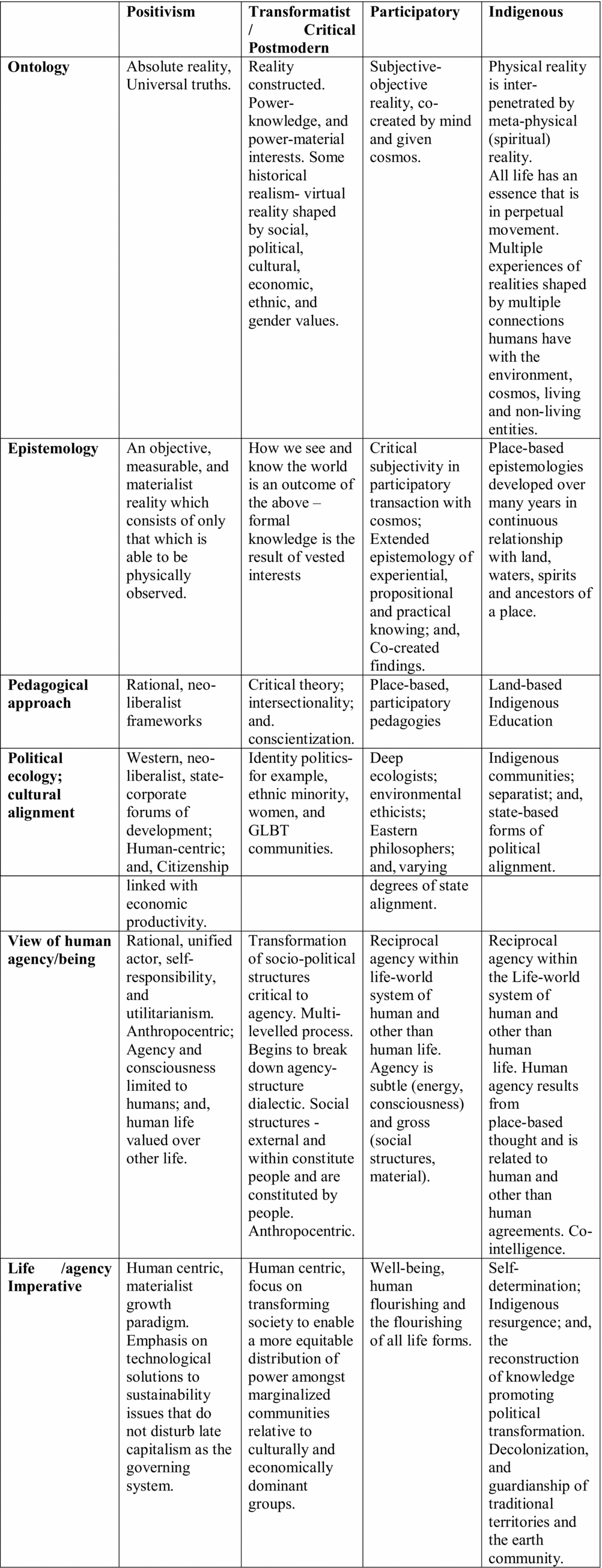
One means of addressing this potential impasse pedagogically, is by mapping various onto-epistemological perspectives and associated cultural, social, and historical circumstances along with the agency imperatives — reason for acting — in which each tend to be grounded. Figure 1 potentially provides the basis for such mapping. It summarises and contrasts Positivist, Transformative/Critical Postmodern,Footnote iii participatory and Indigenous pedagogical approaches to sustainability education. The paradigms in the three right-hand columns transcend and include positivism's ontological underpinnings. Both participatory and Indigenous paradigms include elements of column two — that is, an emphasis on the transformation of human-social structures towards the goal of social–ecological resilience.
Four pedagogical paradigms for sustainability education (Adapted from four empowerment paradigms and the socio-ecological basis of health, Williams (2016a), pp. 9).

The agency imperatives of Indigenous and participatory paradigms are framed within a reciprocal participatory exchange which situates human rights and wellbeing within the earth's carrying capacity — that is, the mutual flourishing of all life forms. The sociopolitical levels of development tend to differentially shape the agency imperatives of Indigenous and settler–immigrant communities. As the previously cited research and emergent summit findings suggest, while at the ontological levels, both groups may subscribe to attributing equal ontological priority to the metaphysical, material, and intersubjective aspects of reality and agency, the agency imperatives of these groups regarding human-ecological wellbeing, often — but not exclusively — diverge because of the ways they are differently positioned within the wider political ecology (Williams, Reference Williams2016a). For example, the traditional state-centric notions of human rights and responsibilities subscribed to by most people, contrast considerably with Indigenous relational notions of citizenship comprising environmental relationality, reciprocity, and responsibility. Making such tendencies more visible and thus conscious through providing opportunities for participants to map cultural, political, and geographical ecologies and associated power relations, using the kinds of template provided in Figure 1 may increase the likelihood of building sustainable epistemological and relational solidarities across culturally diverse groups: a capacity which is critical to increasing social–ecological resilience.
Conclusion
Based on a philosophy of extractionism, the prevailing development paradigm has relied heavily on supressing Indigenous ways of knowing and being, both through deliberate acts of racial, cultural and epistemic genocide and through deeply ingrained and less consciousness patterns carried in the collective psyche. It may well be that realising visions such as Stewart-Harawira's (Reference Stewart-Harawira2005) and IRNs (2016) requires holding considerable paradox — holding the collective space that simultaneously honours the innate capacity of all humans for an empathic and Indigenous connection to the earth as a living being, while recognising divergent contextual social locations and in particular the different daily realities and ecological leadership of First Peoples who have historical continuity with place. Put simply, we will have a better chance of honouring reached and shared ontological–epistemological understandings (the nature of reality and how we come to know it and enact it), both interculturally and intergenerationally, if we are able to be conscious of and bring reflexivity to the diverse cultural, political and geographical terrains and related agency imperatives in which we are daily anchored. In this way, we may be able to move beyond often unconscious and outmoded (recolonising) epistemological violences ensuring the collective continuance of human and other than human life in ways which emphasise the significance of our actual ‘lived epistemologies’ alongside our respective colonial histories and contemporary positionings within cultural and social structures.
Acknowledgements
We gratefully acknowledge the WSÁNEĆ and the Lekwungen Peoples, and the living presences whose traditional territory the Summit was held on, together with the unwavering support of the Elders who enveloped our time together with their prayers. This research was supported by a Connections Grant from the Social Sciences and Humanities Council of Canada.
About the Authors
Lewis Williams is of Ngai Te Rāngi and Celtic lineage, and is the Founding Director of the International Resilience Network. She has an extensive background in interdisciplinary approaches to Indigenous and intercultural development.
Tracey Bunda is a Goori woman acknowledges identification to Ngugi/Wakka Wakka. She has had many leadership roles in Aboriginal and Torres Strait Islander Higher Education and is the Head, College for Indigenous Studies, Education and Research at the University of Southern Queensland, Australia.
Nick Claxton is an Assistant Teaching Professor of Indigenous education in the Faculty of Education, University of Victoria. He is a member of the Tsawout Community of the WSÁNEĆ Nation where his work on the revitalisation of the WSÁNEĆ Reef Net Fishery is becoming more widely known.
Iain MacKinnon is a researcher into the Governance of Land and Natural Resources at the Centre for Agroecology, Water and Resilience at Coventry University. He is a Scottish Gael and his historical work examines the Highlands and Islands of Scotland as a site of colonisation. He also studies traditional knowledge systems of the Gaels.