Introduction
Tanzania experiences a wide variation in climatic conditions some of which are favourable for the production of vegetable crops such as onion (Allium cepa) and tomato (Solanum lycopersicum). Onion and tomato have become key horticultural foodstuffs in urban areas and cash crops for rural families. Both vegetables are beneficial to human health, as they supply vitamins, minerals, carbohydrates, proteins and bioactive compounds that help to fight several diseases (Manach et al., Reference Manach, Scalbert, Morand, Rémésy and Jiménez2004; Barakade et al., Reference Barakade, Lokhande and Todkari2011; Corzo-Martínez and Villamiel, Reference Corzo-Martínez, Villamiel, Aguirre and Jaramillo2012).
Onion production increased significantly in Tanzania from 36,000 tonnes to 214,000 tonnes during 2003–2014 (FAO, 2017). Average onion yields increased from 2.9 t/ha to 10.3 t/ha during the same period, though this new yield is only about half of the world's average yield of 16.7 t/ha (FAO, 2017). Many biotic and abiotic factors severely hamper onion production in Tanzania. Amongst the biotic factors, arthropod pests (such as cutworms, armyworm, thrips and mites) and pathogens (such as fungi and tospoviruses) are the major production constraints (Mamiro et al., Reference Mamiro, Maerere, Sibuga, Ebaugh, Miller, Mtui, Mgembe, Msuya-Bengesi and Aloyce2014).
Thrips tabaci (Lindeman) (Thysanoptera: Thripidae) is the most damaging insect pest of onion throughout the onion growing areas of the world (Lewis, Reference Lewis1997). Thrips larvae and adults suck sap off the onion foliage, leading to reduced weight and size of bulbs (Rueda et al., Reference Rueda, Badenes-Perez and Shelton2007). In addition, they transmit the Iris yellow spot virus (IYSV), an emerging pathogen of alliums worldwide (Gent et al., Reference Gent, du Toit, Fichtner, Krishna Mohan, Pappu and Schwartz2006) including East Africa (Birithia et al., Reference Birithia, Subramanian, Pappu, Sseruwagi, Muthomi and Narla2011, Reference Birithia, Subramanian, Pappu, Muthomi and Narla2013). Heavy damage to onion occurs in warm and dry conditions where thrips populations grow rapidly and can cause yield losses of up to 59% in severe infestations (Waiganjo et al., Reference Waiganjo, Mueke and Gitonga2008). When the impact of the thrips vector is combined with IYSV, they may cause up to 100% yield loss (Pozzer et al., Reference Pozzer, Bezerra, Kormelink, Prins, Peters, Resende, de and de Ávila1999). The Tomato spotted wilt virus (TSWV) is one of the most common tospoviruses reported in Tanzania (EPPO, 1999). Since a complex of thrips vectors transmit TSWV, it is imperative to understand the major thrips species occurring on tomato in onion-growing regions of Tanzania.
Onion growers predominantly rely on the use of synthetic insecticides to control thrips. However, most insecticides are ineffective due to thrips’ cryptic feeding behaviour, overlapping generations and insecticide resistance (Martin et al., Reference Martin, Workman and Butler2003; Morse and Hoddle, Reference Morse and Hoddle2006). Therefore, an integrated approach is needed to manage the thrips vectors and the viruses that they transmit. Host-plant resistance offers a sustainable approach to the management of insect pests, including thrips (Hamilton et al., Reference Hamilton, Pike, Sparks, Bender, Jones, Candeia and de Franca1999; Alimousavi et al., Reference Alimousavi, Hassandokht and Moharramipour2007; Diaz-Montano et al., Reference Diaz-Montano, Fuchs, Nault and Shelton2010, Birithia et al., Reference Birithia, Subramanian, Muthomi and Narla2014). Host plant resistance appears to be species specific; hence, it is important to confirm the identity of thrips species infesting onions and tomato in Tanzania to aid in screening for resistance. A major constraint in studying the interactions between thrips vectors and tospovirus incidences is accurate diagnostics of the thrips vectors. Classical morphological identification of thrips is tedious and has limitations. Molecular markers could provide rapid and reliable means of thrips species identification (Kadirvel et al., Reference Kadirvel, Srinivasan, Hsu, Su and de la Peña2013).
The objectives of this study were to: (i) investigate the genetic diversity of thrips that occurs in onion- and tomato-producing regions of Tanzania; (ii) screen Allium spp. entries for resistance to T. tabaci; and (iii) characterize the biophysical and biochemical bases of thrips resistance that lead to antixenosis and antibiosis.
Materials and methods
Genetic diversity of thrips populations in onion- and tomato-producing regions of Tanzania
Thrips sampling
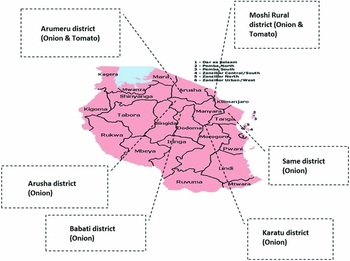
Thrips were collected in six districts in the northern highlands of Tanzania (Fig. 1). These districts represent the major onion- and tomato-producing regions of the country. All thrips samples were collected under field conditions. At least 100 insects per population were collected from different fields in each location during the third quarter of 2013. The insects were preserved in glass vials containing 95% ethanol.
Thrips sampling sites in the northern highlands of Tanzania.

DNA extraction
DNA was extracted from a single insect. Ten morphologically similar individuals were used for each thrips population. The insects were placed in a 1.5 ml Eppendorf tube containing 50 µl of UniversAll™ Extraction buffer (Yeastern Biotech, Taipei, Taiwan) and carefully crushed using a plastic pestle. The ground samples were centrifuged for 3 sec and incubated in a water bath at 95 °C for 10 min. The solution was vortexed for 1 sec and centrifuged for 2–3 sec. The extracted DNA was diluted in a 1:10 ratio using deionised water and stored at −20 °C.
Molecular characterization and phylogenetic analysis
The primer pair (LCO1490: GGTCAACAAATCATAAAGATATTGG and HCO2198: TAAACTTCAGGGTGACCAAAAAATCA) (Folmer et al., Reference Folmer, Black, Hoeh, Lutz and Vrijenhoek1994) was used to amplify the partial sequence of the mitochondrial cytochrome c oxidase subunit I (coxI) gene of single thrips from different crops and locations. PCR was performed in 30 µl reactions containing 5 µl of genomic DNA, 15 μl O'in 1 DNA Polymerase Premix (Yeastern Biotech Co., Ltd., Taiwan), 1.2 μl LCO1490 and 1.2 μl HCO2198. The PCR was performed in an MJ Research Thermocycler (PTC200 DNA Engine Cycler, Bio-Rad Laboratories, Inc.) following the profile: 95 °C for 5 min (initial denaturation step) followed by 40 cycles of 95 °C for 30 sec (denaturation step), 50 °C for 45 sec (annealing step), 72 °C for 1 min (extension step) with the final extension at 72 °C for 7 min. The amplified PCR products were run on a 2% agarose gel containing ethidium bromide. Bands were revealed and photographed under ultraviolet light. Direct sequencing of the PCR products was carried out using the ABI 3730XL systems at the Genomics Biotechnology Company Limited, Taiwan. The coxI sequences were aligned and edited using ClustalX2 software. The FASTA formatted coxI sequences were imported into the MEGA 5 software package sequence alignment application and a multiple sequence alignment was performed with the ClustalW algorithm using default parameters (Tamura et al., Reference Tamura, Peterson, Peterson, Stecher, Nei and Kumar2011). coxI sequences of Thrips tabaci (KP871417, KP871446 and AB277237), T. hawaiiensis (AB277226), T. palmi (AB277231), Frankliniella intonsa (AB277214), F. schultzei (AB277220), F. occidentalis (GU148128), Scirtothrips dorsalis (EU100987), Megalurothrips distalis (HQ540406), M. usitatus (KF015513) and Ceratothripoides brunneus (KF778754) retrieved from NCBI GenBank were used as reference sequences.
The phylogenetic analysis of Tanzanian thrips samples was inferred using the Maximum Likelihood (ML) method. The appropriate model of sequence evolution, including model parameters, was calculated using the corrected Akaike Information Criterion (AICc value) with MEGA 5, and resulted in K2P (Kimura 2– parameter model) as the best model (Kimura, Reference Kimura1980). Initial tree(s) for the heuristic search were obtained by applying the Neighbour-Joining method to a matrix of pairwise distances estimated using the Maximum Composite Likelihood approach. A discrete Gamma distribution was used to model evolutionary rate differences among sites [two categories (+8G, parameter = 0.7654)]. The clustering probability of resulting phylogenetic tree node was statistically tested by a bootstrap method consisting of 1000 replicates. The tree was rooted by the outgroup Haplothrips tenuipennis (KP871274). The number of variable nucleotide sites, number of haplotypes and haplotype diversity were calculated for investigating the coxI sequence diversity using DnaSP 5.10 software (Librado and Rozas, Reference Librado and Rozas2009).
Morphological identification
Morphological identification of the thrips specimens was undertaken at the International Centre of Insect Physiology and Ecology (icipe), Nairobi, Kenya. The specimens were cleared, dehydrated and mounted on slides with Canada balsam as outlined by Moritz et al. (Reference Moritz, Brandt, Triapitsyn and Subramanian2013). Slide-mounted thrips specimens were identified morphologically with a Leica DM LB® microscope (Leica Microsystems, Switzerland) using the taxonomic keys developed by Moritz et al. (Reference Moritz, Brandt, Triapitsyn and Subramanian2013). The slide-mounted voucher specimens of the thrips are stored in the Biosystematic Unit, icipe.
Germplasm screening
Preliminary screening of onion entries
Onion germplasm used in this study was sourced from the World Vegetable Center's Bulb Allium Breeding Unit and Genetic Resources and Seed Unit, Taiwan. Three local varieties grown in Tanzania was also included. Preliminary screening was conducted in replicated trials from November 2011 to March 2012 (104 entries) and November 2012 to March 2013 (59 entries) at the WorldVeg HQ in Shanhua, Taiwan (11 masl, 23°08'29″N, 120°19'15″E). Normal cultural practices for onion production were followed. The trials were exposed to natural thrips infestation. Thrips damage was scored at weekly intervals starting from two to three weeks after transplanting. Ten plants of each entry were randomly selected and scored for thrips damage using the following rating scale: 0 = no damage; 1 = 0.1 to 20% leaf area damaged; 2 = 20.1 to 40% leaf area damaged; 3 = 40.1 to 60% leaf area damaged; 4 = 60.1 to 80% leaf area damaged and 5 = 80.1 to 100% leaf area damaged.
Advanced screening of onion entries
The resistant entries from the preliminary screening trials were advanced in Madira Experimental Research farm, World Vegetable Center, Regional Center for Eastern and Southern Africa, Arusha, Tanzania (1290 masl, 3.4 °S and 36.8 °E) during September–November 2013. This advanced trial was conducted in a randomized block design with four replications. Of the 21 entries (18 resistant entries selected from WorldVeg HQ and three local varieties) sown, only 13 entries germinated and established a good field stand. These 13 entries were scored for resistance/susceptibility to thrips damage using the same scale as in preliminary screening trials. Five plants were randomly selected per entry and replication and scored for thrips damage, thrips population, number of leaves and leaf length.
Evaluation of selected onion entries for thrips resistance and yield
One highly resistant (VI038552) and two resistant (VI038512 and AVON1067) entries from the advanced trial were evaluated along with three local varieties (Red Bombay, Red Creole and Texas) in a confirmatory trial for their resistance to thrips and yield during May–July 2014 in Arusha. Each entry was planted in four replications. Crop maintenance and data collection were similar to previous trials. At harvesting, the marketable bulb weight per plant was recorded.
Biophysical and biochemical bases of resistance
Biochemical analyses
The following biochemical parameters were estimated in onion leaves of 13 selected entries and a local cultivar, F1806. The 13 entries included three entries: VI037360 (highly resistant), VI038524 (resistant) and VI037355 (resistant). The plants were grown in a controlled environment without insect infestation. Onion leaves of similar age were collected and freeze dried for seven days prior to being ground in an electric blender. For the analysis of phenols, fresh leaf samples were used. The samples were replicated three times.
Total sugars. Total leaf sugar content was spectrophotometrically determined using 100 mg of dried powder and the Anthrone reagent (Dreywood, Reference Dreywood1946). Anthrone reagent reacts specifically with carbohydrates in a concentrated sulphuric acid solution to produce a blue green colour at 630 nm. The results were expressed as sucrose equivalents.
Total amino acids. Total amino acid content in the leaves was determined by the formaldehyde titration method (Sorensen, Reference Sorensen1907). Amino acids were extracted from a powder sample of 1 g per replication.
Total phenols. The colorimetric method of Folin–Denis, as described by Swain and Hillis (Reference Swain and Hillis1959), was employed to determine the phenolic compounds in the leaves. The procedure consists of grinding 10 g fresh leaf samples per replication.
Total foliar epicuticular wax content. The total foliar epicuticular wax content was estimated by washing the leaves in formalin for 15 sec. The formalin extracts were dried in a fume chamber as described by O'Neal et al. (Reference O'Neal, Landis and Isaacs2002) and Trdan et al. (Reference Trdan, Žnidarčič, Zlatić and Jerman2004). The arrangement of wax particles in each entry was also observed through Cryo-Scanning electron microscopy under the JEOL JSM-6330F field emission scanning electron microscope (JEOL, Tokyo, Japan) as described in Rakha et al. (Reference Rakha, Hanson and Ramasamy2017).
Biophysical basis
The physical basis of resistance, namely leaf angle and toughness, was examined in the onion entries. The leaf angle was measured using a protractor. Leaf pieces (measuring about 1 cm2) were collected from each entry and mounted on a gram gauge to evaluate leaf toughness. A 0.52-mm-diameter blunt probe was used to measure the force required to puncture leaf tissues. The gram gauge was designed by modifying a scale balance using a method described by Wheeler and Center (Reference Wheeler and Center1997). Measurements of leaf toughness and leaf angle were recorded in three replications for each entry.
Statistical analysis
The mean thrips damage score for each entry was computed. The mean thrips damage was subjected to a statistical analysis based on mean (m) and standard deviation (sd) (AVRDC, 1979). The entries were rated as follows: the entries that had a mean damage score (n) less than m−2sd were considered highly resistant; between m−1sd and m−2sd as resistant; between m and m−1sd as moderately resistant; between m and m + 1sd as moderately susceptible; between m + 1sd and m + 2sd as susceptible; and more than m + 2sd as highly susceptible.
The scored data from each entry in the advanced screening trial were expressed as the area under the infestation pressure curve (AUIPC), and calculated using the following formula modified from Shaner and Finney (Reference Shaner and Finney1977):
 $$\begin{equation*}
\sum\nolimits_{i = 1}^{n - 1} {\frac{{\left( {{Y_i} + {Y_{i + 1}}} \right)}}{2}\left( {{t_{i + 1}} - {t_i}} \right)}
\end{equation*}$$
n: number of assessment times
Y: number of insects at time t
Data obtained from experiments on the basis of resistance were subjected to analysis of variance with the Proc GLM procedure of SAS, version 9.1.3 (SAS Institute, Cary, NC, USA). Least significant difference test was used to separate the means at 5% significance level of probability. The Pearson correlation was done between thrips damage and thrips number and biophysical and biochemical traits.
Results
Diversity of thrips populations in onion- and tomato-producing regions of Tanzania
Molecular identification
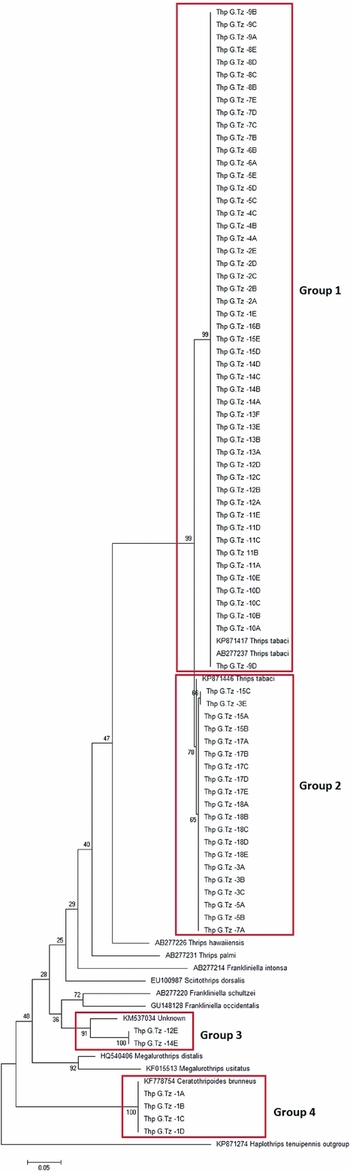
The coxI gene-specific primer pairs, LCO-1490 and HCO-2198, amplified a PCR product of approximately 709 bp size. The sequence alignment and editing resulted in a consensus sequence of 603 bp being generated from the thrips samples. The interspecific phylogenetic relationships based on the coxI sequences of thrips are shown in Fig. 2. Phylogenetic analysis based on partial coxI sequences was used to classify thrips collected from onion and tomato in different locations of Tanzania to species level. According to the ML phylogenetic tree in the current study, the thrips populations from target areas of Tanzania were categorized into four groups. Interestingly, T. tabaci itself formed two groups, whereas an unknown species, possibly Frankliniella sp. formed the third group. Ceratothripoides brunneus Bagnall constituted the fourth group. Thus, the most prevalent thrips species (92%) was the onion thrips, T. tabaci on both onion and tomato. Ceratothripoides brunneus constituted 5% of the samples, whereas the unknown species accounted for about 3%. The intraspecific variation in T. tabaci, which led to the formation of two separate groups is due to the presence of 11 mutations between purines (AG) and six mutations between pyrimidines (CT) in the partial coxI sequences of thrips species used in this study.
Phylogenetic relationship among thrips species infesting onion and tomato in Tanzania based upon a 603 bp mitochondrial coxI gene fragments using Maximum Likelihood (ML) method. The samples bearing the code ‘Tz’ are the thrips individuals collected from Tanzania in the current study.

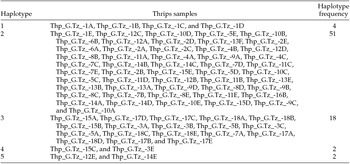
In total, 5 coxI haplotypes were identified in 77 thrips individuals used in the current study based on sequence similarity (Table 1). The largest haplotype (Haplotype 2) contains 51 thrips individuals, of which all samples were T. tabaci (group 1). Haplotypes 3 (18 thrips individuals) and Haplotype 4 (2 thrips individuals) constituted the second clade of T. tabaci (group 2). Haplotype 5 with two thrips individuals formed the unknown group, which is group 3 in the phylogenetic tree. The remaining four thrips individuals under Haplotype 1 aligned with C. brunneus (group 4). The haplotype diversity is a measure of the uniqueness of a particular haplotype in a given population (Nei and Tajima, Reference Nei and Tajima1981). The total haplotype diversity value of all thrips populations from sampled locations in Tanzania was 0.509.
List of thrips samples, haplotypes and haplotypes frequency

Morphological identification
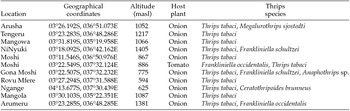
The results of morphological identification are similar to those of molecular identification. The most common thrips species on onion was onion thrips, T. tabaci (Table 2). Besides T. tabaci, other species detected on onion were Megalurothrips sjostedti Trybom, Ceratothripoides brunneus, Frankliniella schultzei Trybom and suspected Anaphothrips sp. Frankliniella occidentalis (Pergande) was the major species on tomato, followed by T. tabaci. Unfortunately, the phylogenetic analysis failed to group F. occidentalis individuals in the current study with the reference sequence from NCBI.
Major thrips species identified from onion and tomato in Tanzania using morphological characters

Germplasm screening
Preliminary screening of onion entries
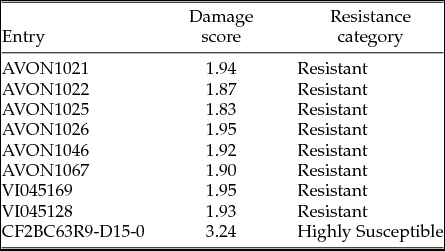
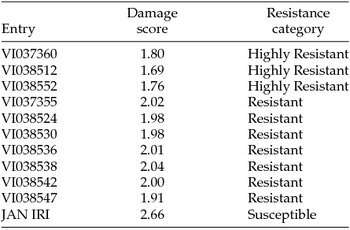
We identified eight onion entries as resistant to thrips in the preliminary screening trial of 2011/2012 (Table 3). In the second preliminary screening trial of 2012/2013, three entries were identified as highly resistant, whereas seven entries were identified as resistant (Table 4).
Resistance reaction of selected onion entries to thrips (November 2011–March 2012)

Resistance reaction of selected onion entries to thrips (November 2012–March 2013)

Advanced screening of onion entries
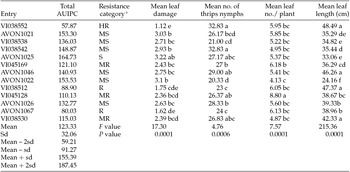
Only one onion entry (VI038552) was highly resistant, while two other entries (VI038512 and AVON1067) were resistant to thrips in the advanced screening trial of September to November 2013 (Table 5). The mean number of thrips (nymph and adults) per plant was low in the early stages of plant growth, but progressively increased towards physiological maturity. The thrips population on different onion entries was significantly different (F = 4.76; P = 0.0006). However, their population was unrelated to the resistant or susceptible reaction of the entries. For instance, the highly resistant entry (VI038552) and one of the moderately susceptible entries, VI038542 had the highest thrips populations (Table 5). The two resistant entries (VI038512 and AVON 1067) had a lower thrips population than the highly resistant VI038552. Interestingly, the thrips population on the susceptible entry (AVON1025) was on a par with the highly resistant and resistant onion entries.
Resistance reaction of selected onion entries to thrips (September–November 2013)

Means with the same letter in a column are not significantly different at P < 0.05 by Tukey's HSD; +HR = Highly Resistant; R = Resistant; MR = Moderately Resistant; MS = Moderately Susceptible; S = Susceptible.
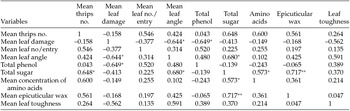
Thrips damage also differed significantly among the onion entries (F = 17.30; P = 0.0001), and it was due to the resistant or susceptible reaction of the entries to thrips (Table 5). Although VI038552 had the highest thrips population, it suffered the least damage, followed by the two resistant entries. However, damage was not significantly different among the moderately resistant, moderately susceptible and susceptible entries. There were non-significant and weak negative relationships between thrips number and mean leaf damage (r = −0.158) in different onion entries (Table 6). Although leaf number (F = 7.57; P = 0.0001) and length (F = 215.36; P = 0.0001) differed significantly among the entries (Table 5), they failed to influence the resistant or susceptible reaction of the onion entries to thrips. For instance, the highly resistant (VI038552), resistant (VI038512), moderately resistant (VI038530) and moderately susceptible (AVON1046) entries possess similar leaf number and length.
Resistance reaction and bulb weight of selected onion entries to thrips (May–July 2014)

+ HR = Highly Resistant; R = Resistant; MR = Moderately Resistant; MS = Moderately Susceptible; S = Susceptible.
Evaluation of selected onion entries for thrips resistance and yield
Resistance of different onion entries due to thrips infestation in non-sprayed condition
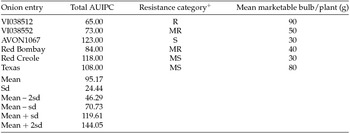
Results from the confirmatory trial during May–July 2014 in Arusha, Tanzania showed that only VI038512 consistently recorded a resistant reaction to thrips, whereas VI038552 was only moderately resistant (Table 6). Besides thrips resistance, the bulb size of VI038512 was also equivalent to one of the commercial varieties, Texas.
Yield of different onion entries due to thrips infestation in non-sprayed condition
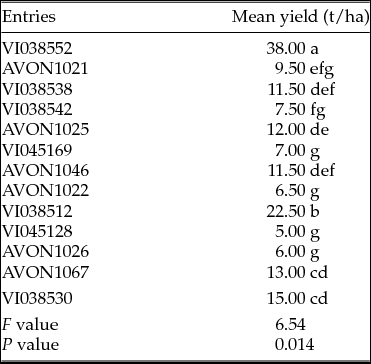
The yield of various onion entries under non-sprayed conditions differed significantly (F = 6.54; P = 0.014) (Table 7). The highly resistant entry VI038552 recorded the highest yield, followed by the resistant entry, VI038512.
Marketable yield of different onion entries in non-sprayed conditions

Means with the same letter(s) in the column are not significantly different at P < 0.05 by Tukey's HSD
Biophysical and biochemical bases of resistance
Biophysical bases of resistance
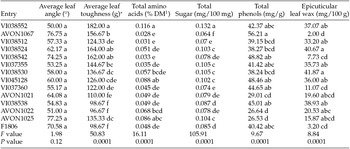
The plant architectural components that were assessed in this study were leaf angle and leaf toughness. Leaf angle did not differ significantly among the entries (F = 1.98; P = 0.12) (Table 8). However, there was a significant negative correlation between leaf angle and thrips damage (r = −0.644) (Table 9). Leaf toughness was significantly higher in the highly resistant entry (VI038552), followed by the resistant entry (AVON 1067) (F = 50.83; P = 0.0001). The leaf toughness values for VI038524 (resistant) and VI038542 (moderately susceptible) were intermediate and similar to either of the extremes (Table 8). There was a significant negative relationship (r = −0.562) between leaf toughness and thrips damage (Table 9).
Analysis of biophysical and biochemical bases of resistance in different onion entries

*Values represent the force (g) needed to puncture the leaf.
1 DM = Dry matter.
Means with the same letter(s) in a column are not significantly different at P < 0.05 by Tukey's HSD.
The relationship between different biophysical and biochemical variables with thrips damage using Pearson correlation

*Significant; **highly significant.
Total foliar epicuticular wax. The total epicuticular leaf wax content significantly differed among the selected onion entries (F = 8.84; P = 0.0001). It was significantly higher in VI038530 (moderately resistant) and VI038524 (resistant) followed by the entries VI038538 (moderately susceptible to resistant), VI038552 (highly resistant), VI045128 (moderately resistant), VI037355 (resistant) and VI038512 (resistant) (Table 8). Interestingly, one of the resistant entries (AVON1067) recorded the lowest wax content. Thus, Pearson's correlation analysis showed that there was a weak and non-significant negative relationship (r = −0.168) between total epicuticular wax content and thrips damage (Table 9).
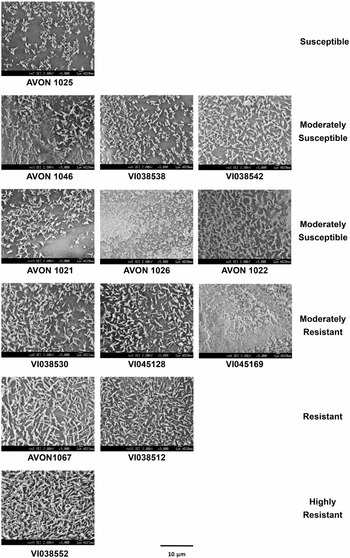
The scanning electron microscopic pictures (x5000) of the wax particle arrangement in different onion entries are shown in Fig. 3. Results showed that the microscopic wax crystals occurred as filaments, rods, platelets, tubes and complex dendritic structures. The wax particles were densely arranged in resistant or moderately resistant entries, while loose and thinly arranged in the moderately susceptible or susceptible onion entries.
Scanning electron microscopic pictures of epicuticular leaf wax particles in different onion entries.

Biochemical bases of resistance
Total foliar phenolic contents
The total foliar phenol content significantly differed among the selected onion entries (F = 9.67; P = 0.0001) (Table 8). It was significantly higher in the resistant entry AVON1067, followed by VI038542 (moderately susceptible), VI045128 (moderately resistant), VI038538 (moderately susceptible), VI037360 (highly resistant), VI038552 (highly resistant) and VI037355 (resistant). Pearson's correlation also showed that there was significant negative relationship (r = −0.649) between total phenol content and thrips damage (Table 9).
Total foliar amino acid
There was a significant difference in total amino acids among different onion entries (F = 16.11; P = 0.0001). Significantly lower amino acid content was recorded in the resistant entries AVON1067 and VI038512, as well as the moderately susceptible entry, VI038542. They were followed by VI037355 (resistant), VI037360 (highly resistant), AVON 1021 (moderately susceptible), VI038538 (moderately susceptible) and VI038524 (resistant) entries (Table 8). Interestingly, one of the highly resistant entries, VI038552, recorded the highest amino acid content. Pearson's correlation analysis showed that there was a significant positive relationship (r = 0.60) between total foliar amino acids and thrips number (Table 9). However, the relationship between total foliar amino acids and thrips damage was inversely correlated (r = −0.149) and non-significant.
Foliar total sugar
There was a significant difference in total sugars among different onion entries (F = 105.91; P = 0.0001). Significantly lower sugar content was recorded in the resistant entry, AVON1067, followed by VI038512 (resistant) and VI037360 (highly resistant). The sugar content for the moderately susceptible entries VI038542, AVON1021 and AVON1022 was intermediate and similar to either of the extremes (Table 8). Like amino acid content, one of the highly resistant entries, VI038552 recorded the highest sugar content, as well. Pearson's correlation analysis showed that there was a significant positive relationship (r = 0.648) between total sugar content and thrips number (Table 9), while the relationship between total sugar content and thrips damage was inversely correlated (r = −0.413) and non-significant.
Discussion
Thrips tabaci is the predominant thrips species infesting onion in Tanzania. However, phylogenetic analysis differentiated T. tabaci samples collected from Tanzania into two different groups. The first T. tabaci group aligned with the reference sample KP871417, whereas the second T. tabaci group aligned with the reference sample KP871446 in NCBI GenBank. Interestingly, Iftikhar et al. (Reference Iftikhar, Ashfaq, Rasool and Hebert2016) deposited these two reference thrips sequences from Pakistan. They found that T. tabaci showed deep intraspecific divergences, thus providing evidence that it is a cryptic species complex within Pakistan. Since our T. tabaci populations also diverged into two different clades, it is possible that T. tabaci in Tanzania is a cryptic species complex. Thrips tabaci is present in more than 115 countries, including 21 in Africa (Mortiz et al., Reference Moritz, Brandt, Triapitsyn and Subramanian2013; CABI, 2016). Thrips tabaci is a polyphagous species, causing severe damage to several cultivated plants, especially Alliaceae (Lu and Lee, Reference Lu and Lee1985) and Brassicaceae (Shelton et al., Reference Shelton, Wilsey and Schmaedick1998). In Kenya, it has been reported to cause about 60% yield loss in onions (Maniania et al., Reference Maniania, Sithanantham, Ekesi, Ampong-Nyarko, Baumgärtner, Löhr and Matoka2003; Waiganjo et al., Reference Waiganjo, Mueke and Gitonga2008). Hence, it is imperative to develop integrated pest management strategies to reduce the incidence of thrips on onions. Since host plant resistance offers a viable alternative to reducing the use of chemical pesticides, we attempted to identify onion entries with appreciable levels of thrips resistance and desirable horticultural traits, including higher yield, in the current study.
The field experiments were conducted from September, which is the summer season in Tanzania with an average temperature of 23 °C in the morning, 31 °C in the afternoon and 25 °C in the evening. The conducive environment for thrips multiplication could be attributed to the high thrips population in different entries during the study period (Waiganjo et al., Reference Waiganjo, Mueke and Gitonga2008). Earlier studies also confirmed that onion thrips multiply rapidly during the hot dry season and cause severe yield losses (AVRDC, 1998, 2000).
Our study revealed the presence of thrips-resistant onion entries in the World Vegetable Center's gene bank. Although the gene bank has 483 onion entries, only 88 entries are available for sharing. In addition, another 75 entries were obtained from the Bulb Allium Breeding Unit at the World Vegetable Center. With these limited genetic resources, we could identify two thrips-resistant onion entries (VI038512 and VI038552). VI038512 is an entry that was collected from the United States of America in 1993 as the cultivar Rio Bonita, a yellow-coloured hybrid with medium storage life from Rio Colorado Seed Company. VI038552 is a brown onion with very long storage life. It originated from Hazera Seed Company in Israel who marketed it as ‘Ben Shemen’. The World Vegetable Center also acquired this entry into its gene bank in 1993. Since the entries are commercial cultivars/hybrids, it is not surprising that their bulb size and yield are superior to other entries or local cultivars used in this study. Because these cultivars/hybrids may not exist in the market since they were acquired for the World Vegetable Center's gene bank almost 25 years ago, the thrips resistance from these entries should be incorporated into other elite varieties. In addition, the resistance or tolerance of these entries against IYSV disease should also be investigated prior to resistance breeding. Because of the bulb size and yield potential, VI038512 could be considered for multilocation trials in Tanzania and other East African countries in the future.
Earlier studies have also confirmed the presence of thrips resistance in A. cepa entries such as TA 189, TA 243 and TA 385 (AVRDC, 1996, 1997). Hamilton et al. (Reference Hamilton, Pike, Sparks, Bender, Jones, Candeia and de Franca1999) also reported that IPA-3, a red, open-pollinated cultivar developed in Brazil showed resistance to thrips. Alimousavi et al. (Reference Alimousavi, Hassandokht and Moharramipour2007) found that Iranian onion genotypes (such as Meshkan, Sefid-e-Kurdistan, Sefid-e-Qom and Eghlid) were resistant to thrips; hence, it is possible to identify thrips-resistant onion entries. If the resistant entries possess desirable horticultural traits including yield, they can be introduced for cultivation. Otherwise, they have to be incorporated into the resistance-breeding programme, to develop new cultivars. But the heritability of thrips resistance may be low depending on the complexities of the resistance traits. Hence, greater genetic gains for thrips resistance in onion can be achieved by selection on a family basis rather than using single plant selection, as suggested by Hamilton et al. (Reference Hamilton, Pike, Sparks, Bender, Jones, Candeia and de Franca1999).
Various biophysical and biochemical bases influence thrips resistance in onion. For instance, leaf angle and toughness affected the thrips damage in the current study. An earlier study by Alimousavi et al. (Reference Alimousavi, Hassandokht and Moharramipour2007) also confirmed that the wide angle between the two innermost emerged leaves, especially in the young plant, help to restrict the thrips population by reducing the protective environment to a minimum. Few studies have revealed that the wider angle between the central leaves enhances onion resistance to thrips (Pawar et al., Reference Pawar, Mote, Kale and Ajri1987; Patil et al., Reference Patil, Nawale, Ajri and Moholkar1988; Hudák and Pénzes, Reference Hudák and Pénzes2004; Loges et al., Reference Loges, Lemos, Resende, Menezes, Candeia and Santos2004a , Reference Loges, Lemos, Resende, Menezes, Candeia and Santos2004b; Birithia et al., Reference Birithia, Subramanian, Muthomi and Narla2014). Usually, onion thrips concentrate in the central whorl area of the plant; hence, they shelter in the narrow leaf angle and the resulting erect leaves protect them from natural mortality factors. Because thrips avoid onion entries with semi-erect leaves with wider angles, these entries can be considered as the resistant entries.
Besides leaf angle, leaf toughness was also found to have an inverse relationship with thrips damage in the current study. Although studies on leaf toughness in relation to thrips resistance are scanty, even fewer studies are available for other crops. For instance, Voorrips et al. (Reference Voorrips, Steenhuis-Broers, Tiemens-Hulscher, Lammerts van Bueren, Neuhoff, Halberg, Alfldi, Lockeretz, Thommen, Rasmussen, Hermansen, Vaarst, Lck, Carporali, Jensen, Migliorini and Willer2008) found that leaf thickness has no clear relationship with T. tabaci damage in cabbage. Bálint et al. (Reference Bálint, Burghardt, Höhn, Pénzes and Fail2013) also found that the epidermal thickness of head-forming leaves of cabbage is uncorrelated with resistance to T. tabaci. However Raza et al. (Reference Raza, Afzal, Sarfraz, Bashir, Gogi and Sarwar2000) reported that the thickness of leaf lamina is negatively correlated with T. tabaci population in cotton, while Khalil et al. (Reference Khalil, Raza, Afzal, Aqueel, Khalil and Mansoor2015) reported a positive correlation between leaf lamina thickness and T. tabaci infestation in cotton. In general, higher leaf toughness can reduce consumption, prolong developmental time and diminish the survival of phytophagous insects (Johnson and Gregory, Reference Johnson and Gregory2006); hence, it is possible that increased leaf toughness can reduce thrips damage as evidenced in the current study.
Wax content in onion foliage seems to have some influence on the resistance or susceptible reaction of onion entries to thrips. In the current study, most of the resistant or moderately resistant entries had higher wax content than the susceptible or moderately susceptible entries. Alimousavi et al. (Reference Alimousavi, Hassandokht and Moharramipour2007) also confirmed that onion genotypes with glossy foliage were resistant to thrips and the leaf wax of these genotypes was lower than susceptible ones. These glossy genotypes had lower thrips number than the non-glossy (dark green foliage) genotypes. A few other studies also indicated that thrips resistant onion populations had lower leaf wax content (Hemmati and Benedictus, Reference Hemmati and Benedictus2000; Nouri Moghaddam et al., Reference Nouri Moghaddam, Jaliani, Habibi and Ali Akbar2004). In our study, a high number of thrips was present on entries having higher epicuticular wax content. However, most of these entries with higher wax content are resistant or moderately resistant to thrips. Our study was consistent with the findings of da Silva et al. (Reference da Silva, Bettoni, Bona and Foerster2015), who reported that a larger amount of epicuticular waxes contributed for T. tabaci resistance in the cultivar Alfa São Francisco-RT. This implies that the wax content alone cannot be correlated with thrips resistance. Rather, the arrangement of wax particles should also be considered in imparting resistance to thrips, as evidenced by the electronmicrograph in the current study. Although the thrips population tends to be higher on entries with higher wax content, they failed to cause significant feeding damage, which may be due to the arrangement of wax particles. For instance, resistant or moderately resistant onion entries have densely arranged rodlets and complex dendritic structures, whereas the susceptible or moderately susceptible entries possess loosely arranged filaments or platelets. In addition to the arrangement of the wax particles, their location within a leaf should also be investigated in detail. The thrips population is mostly concentrated in the whorl region, but the wax load seems to be usually lower in the base of the leaf. In leeks, little wax content was detected from the base of the leaf to approximately 7 cm above the leaf base, and there was a dramatic increase (more than 30-fold) in the wax load at 7–9 cm (Rhee et al., Reference Rhee, Hlousek-Radojcic, Ponsamuel, Liu and Post-Beittenmiller1998). Hence, more detailed behavioural and feeding studies are needed, although our study has ascertained a weak link between the wax content and thrips damage in resistant onion germplasm.
Leaf colour has been advocated as an influential factor in determining thrips resistance in onion (Diaz-Montano et al., Reference Diaz-Montano, Fuchs, Nault and Shelton2010; Birithia et al., Reference Birithia, Subramanian, Muthomi and Narla2014). Thrips-resistant onion cultivars had yellow-green coloured foliage compared with the susceptible cultivars, which had blue-green foliage (Diaz-Montano et al., Reference Diaz-Montano, Fuchs, Nault, Fail and Shelton2011; Birithia et al., Reference Birithia, Subramanian, Muthomi and Narla2014). The non-bulb forming Welsh onion (Allium fistulosum) and leek (Allium porrum) entries remained distinctly green without thrips damage even when T. tabaci population was high enough to destroy neighbouring bulb-forming A. cepa entries in earlier trials at the World Vegetable Center (AVRDC, 2000).
Among the biochemical factors, total phenol content significantly reduced thrips damage in this study. This finding is in congruence with earlier studies. For example, thrips are more attracted to onion plants at bulbing stage, when the plants are low in total phenols and high in reducing sugars as well as free amino acids (Srinivas et al., Reference Srinivas, Qureshi and Lawande2008). Akhtari et al. (Reference Akhtari, Dashti, Madadi and Rondon2014) confirmed that there is a significant negative correlation between total phenols and thrips damage on Persian leek (Allium ampeloprasum). Kandakoor et al. (Reference Kandakoor, Khan, Chakravarthy, Kumar and Venkataravana2014) and Chandrayudu et al. (Reference Chandrayudu, Vemena, Naik, Prathyusha, Peshin, Dhawan, Bano and Risam2016) also demonstrated that there is a significant negative correlation between total phenols and thrips damage on peanut. Thus, higher amounts of total phenols may reduce the susceptibility of onion entries to thrips infestation. However, thrips feeding can also induce the build-up of total phenol content in onion, as documented by Srinivas et al. (Reference Srinivas, Qureshi and Lawande2008). In a recent study, Abang et al. (Reference Abang, Srinivasan, Kekeunou, Yeboah, Hanna, Lin, Tenkouano and Bilong Bilong2016) also found that aphid (Aphis gossypii) feeding on okra entries induced an increase in phenols. Hence, it is unclear whether the higher total phenol content in the current study is a constitutive expression or an induced effect of thrips feeding. We recommend detailed investigations on constitutive and induced expression of total phenols in different onion entries in future.
The total sugars and amino acid content in the current study were shown to have a positive correlation with thrips number on onion entries, although they had a non-significant inverse relationship with damage. Though we could not find any evidence from onions, other studies have documented similar results for other thrips species on different crops. The degree of resistance to Frankliniella occidentalis is associated with a low concentration of total amino acids in the leaves of Japanese chrysanthemum (Ohta, Reference Ohta2002). Similarly, the total sugars and amino acids showed a positive relationship with number of thrips on peanut (Kandakoor et al., Reference Kandakoor, Khan, Chakravarthy, Kumar and Venkataravana2014; Chandrayudu et al., Reference Chandrayudu, Vemena, Naik, Prathyusha, Peshin, Dhawan, Bano and Risam2016). Because total sugars and amino acids may provide the favourable nutritional support for the proliferation of thrips on host plants, these compounds could potentially influence the resistance or susceptibility of onion entries to thrips.
Conclusion
Majority of thrips species collected from onion in Tanzania were identified as T. tabaci using molecular and morphological characterization tools. Out of 163 onion entries, only three T. tabaci resistant entries (VI038512, VI038552 and AVON 1067) were identified. The total amino acids, total sugars and total phenols influenced the resistance reaction of the onion entries. Total phenol content has significant adverse effects on T. tabaci damage. For physical parameters, leaf angle and leaf toughness have significant negative relationship with T. tabaci infestation among the onion entries. The epicuticular wax content also adversely affected thrips damage in resistant onion entries. Since the selected thrips-resistant onion entries have good horticultural traits (including bulb size and yield), they can be introduced for cultivation in Tanzania and also be used in onion breeding programmes for thrips resistance. The breeders should use onion entries with appreciable levels of thrips resistance, to avoid serious infestations in improved varieties.
Acknowledgement
This study was funded by BMZ (The German Federal Ministry for Economic Cooperation and Development) through the GIZ (Deutsche Gesellschaft für Internationale Zusammenarbeit) funded project entitled ‘Implementation of integrated thrips and tospovirus management strategies in small-holder vegetable cropping systems of Eastern Africa’ (Project no.11.7860.7-001.00, contract no. 81141840).