Introduction
Communication through sex pheromones plays important roles in animal reproduction. In insects, reception of sex pheromones by conspecific males is highly sensitive and species-specific (Roelofs, Reference Roelofs1995). Soluble pheromone-binding proteins (PBPs), which belong to odorant-binding proteins (OBPs), are believed to solubilize and transport hydrophobic sex pheromones across the sensillum lymph to membrane associated pheromone receptors located on the olfactory receptor neurons (Vogt, Reference Vogt, Prestwich and Blomquist1987; Pelosi & Maida, Reference Pelosi and Maida1990; Prestwich et al., Reference Prestwich, Du and LaForest1995), thus PBPs play important roles in pheromone reception processes (Vogt et al., Reference Vogt, Riddiford and Prestwich1985; Leal et al., Reference Leal, Chen, Ishida, Chiang, Erickson, Morgan and Tsuruda2005). In situ hybridization and immunocytochemical localization analyses showed that PBPs exclusively or predominantly localized in the lymph of long and short sensilla trichodea (Zhang et al., Reference Zhang, Maida and Steinbrecht2001; Grobe-Wilde et al., Reference Grobe-Wilde, Gohl, Bouché, Breer and Krieger2007; Forstner et al., Reference Forstner, Breer and Krieger2009), and long trichoid sensilla are thought to be pheromone sensitive and specialized for pheromone detection (Schneider, Reference Schneider1964; Visser, Reference Visser1986). Thus far, three different PBPs have been reported in at least seven moth species (Picimbon & Gadenne, Reference Picimbon and Gadenne2002; Abraham et al., Reference Abraham, Löfstedt and Picimbon2005; Jin et al., Reference Jin, Li, Zhang, Liu and Dong2014), while more than three PBPs have been reported in Bombyx mori (Gong et al., Reference Gong, Zhang, Zhao, Xia and Xiang2009a ) and Ostrinia furnacalis (Allen & Wanner, Reference Allen and Wanner2011). The existence of multiple PBPs in a single species strongly implies functional differences among PBPs, possibly in binding selectivity of different components of female sex pheromone (Steinbrecht, Reference Steinbrecht1998; Abraham et al., Reference Abraham, Löfstedt and Picimbon2005; Watanabe et al., Reference Watanabe, Tabunoki, Miura, Matsui, Sato and Ando2009; Weng et al., Reference Weng, Fu, Jiang, Zhuang and Li2015). Considering the nature of moth multiple sex pheromone components, it has been hypothesized that each PBP might recognize a specific component of the sex pheromone (Mohl et al., Reference Mohl, Breer and Krieger2002). However, this hypothesis was not supported by other studies (Willett & Harrison, Reference Willett and Harrison1999; Guo et al., Reference Guo, Huang, Pelosi and Wang2012). In Mamestra brassicae, MbraPBP1 strongly bound all three sex pheromones Z11-16:Ald, Z11-16:OH and Z11-16:Ac (Campanacci et al., Reference Campanacci, Krieger, Bette, Sturgis, Lartigue, Cambillau, Breer and Tegoni2001), and no obvious binding selectivity was observed in B. mori (Grater et al., Reference Grater, Xu, Leal and Grubmuller2006), Plutella xyllotella (Sun et al., Reference Sun, Liu and Wang2013a ), Helicoverpa armigera and Helicoverpa assulta (Guo et al., Reference Guo, Huang, Pelosi and Wang2012) and Spodoptera litura (Liu et al., Reference Liu, He and Dong2012). Whether PBPs are specific to pheromone ligands is a long-standing question.
Based on their amino acid sequence similarities, lepidopteran OBPs can be divided into PBPs (Vogt & Riddiford, Reference Vogt and Riddiford1981), general odorant-binding proteins (GOBP1 and GOBP2) (Vogt et al., Reference Vogt, Prestwich and Lerner1991) and antennal binding proteins (Krieger et al., Reference Krieger, von Nickisch-Rosenegk, Mameli, Pelosi and Breer1996). The PBPs with GOBPs belong to a closely related gene cluster and share one common ancestral gene that diverged by gene duplication events after specialization (Vogt et al., Reference Vogt, Rogers, Franco and Sun2002; Gong et al., Reference Gong, Zhou, Yu, Mao, Zhang, Cheng and Zhu2009b ). The homologous relationship in evolution means a similar function in olfactory reception. GOBPs were thought to participate in the recognition of general odorants, thus, we wondered whether the PBPs could contribute to the recognition of host plant odorants in the environment. Up to now, there are not many concrete information regarding the plant odorants reception of PBPs is available.
The rice leaffolder, Cnaphalocrocis medinalis (Guenee) (Lepidoptera: Pyralidae), which is an important leaf-feeding insect pest to rice, is distributed throughout humid tropical to temperate zones (Khan et al., Reference Khan, Barrion, Litsinger, Castilla and Joshi1988; Kawazu et al., Reference Kawazu, Setokuchi, Kohno, Takahashi, Yoshiyasu and Tatsuki2001). Recently, it has become widespread throughout the major rice-growing regions of Asia, especially in South China (Inoue et al., Reference Inoue, Kamiwada and Fukamachi2004). Due to the cryptic feeding habit of C. medinalis larvae, which damage plants by folding the leaves (Nathan et al., Reference Nathan, Chung and Murugan2004), effective control strategies should be based on controlling or killing adults. Previously, we identified three PBP genes from C. medinalis antennal libraries and eight morphological sensilla types were identified in both sexes of C. medinalis (Sun et al., Reference Sun, Wang and Zhang2011). PBP genes seemed to be antenna-specific (Zeng et al., Reference Zeng, Sun, Dong and Wang2013). To answer the question if PBPs could participate in recognizing pheromones and host plant odorants, we focused on CmedPBP4, which was expressed more highly in male antennae, carrying out immunocytochemistry to localize CmedBPB4 in specific olfactory sensilla. Furthermore, fluorescence binding assays of CmedPBP4 with 41 chemicals, including four main sex pheromones and 37 host plant volatiles, were performed. The results showed that trichoid sensilla might be play an important role in the detection of sex pheromones and host odorants for the C. medinalis moth. Our systematic studies provide further detailed evidence for the function of trichoid sensilla in insect semiochemical perception.
Materials and methods
Insects
The rice leaffolder C. medinalis larvae or pupae were collected in Wuxue, China (115°45′E; 30°00′N) and reared on corn plants in a greenhouse at 28 ± 2°C, 16 h light: 8 h dark cycle, 60–80% relative humidity in Huazhong Agricultural University, Wuhan, China. Sexed pupae were kept inside glass tubes until moths emerged. Immediately after emergence, female and male adults were provided with a 10% sucrose solution. To obtain mated females, newly emerged (0 day) male and female moths were paired in plastic-screen cages (20 × 20 × 10 cm3).
Synthetic compounds
All chemicals used fall into two categories: four pheromone components, including (Z)-11-hexadecenyl acetate (Z11-16:Ac), (Z)-13-octadecenyl acetate (Z13-18:Ac), (Z)-11-hexadecenal (Z11-16:Al) and (Z)-13-octadecenol (Z13-18:OH), which were gifted from Dr Aijun Zhang, Invasive Insect Biocontrol and Behavior Laboratory, USDA-ARS-Plant Sciences Institute, Baltimore Ave, Beltsville, USA; and 37 rice volatiles belonging to different chemical classes, including alkanes [octane, tetradecane, hexadecane, heptadecane, octadecane, nonadecane, eicosane, henicosane], alcohols [cyclohexanol, linalool, nerolidol, cedrol, α-terpineol, 3-pentanol, (Z)-3-hexenol, (E)-2-hexenol, heptanol, octen-3-ol, terpinene-4-ol], alkenes [(−)-α-cedrene, (Z)-farnesene, α-terpinene, β-myrcene, sabinene, (−)-(E)-caryophyllene, γ-terpinene, r-(+)-limonene, (−)-limonene, (+)-3-carene], carbonyls [dodecanal, benzaldehyde, hexanal, ionone, 2-heptanone, 2-tridecanone], aromatics [p-cymene, methyl benzoate], which were purchased from commercial sources (Sigma-Aldrich Inc.). All of the chemicals were dissolved in spectrophotometric grade methanol to make stock solutions.
Cloning and sequencing
Total RNA was isolated by TRIzol reagent (Invitrogen, Carlsbad, CA, USA), the integrity was then checked by 1.1% agarose electrophoresis and the concentration was quantified by spectrophotometry at optical density (OD) at 260 nm. First-strand cDNA was synthesized with a first strand synthesis kit using reverse transcriptase X L (AMV) and an oligo dT 18 primer (TaKaRa, Dalian, China). The polymerase chain reactions (PCR) were carried out with 300 ng male antennal cDNAs with two pairs of primers (CmedPBP4-F: CCGGAATTCATGGAAGTAGAAATGTTACCA; CmedPBP4-R: CCGCTCGAGTCACACGTCAGCAATGAT), which were based on the cloned full-length of CmedPBPs (Zeng et al., Reference Zeng, Sun, Dong and Wang2013). The reaction mixture contained 0.1 mM dNTPs, 0.5 mM of each primer and 0.5 U of Ex Taq DNA polymerase (TaKaRa, Dalian, China). The PCR cycling conditions were: initial denaturation at 95°C for 3 min; then 30 cycles of 94°C for 1 min, 59°C for 45 s, 72°C for 1 min, and final extension at 72°C for 10 min. The PCR products were gel-purified and subcloned into a pMD 18-T simple vector (TaKaRa, China).
Prokaryotic expression and purification of CmedPBP4 protein
The PCR products were first subcloned into pMD-18T easy vector (TaKaRa, Dalian, China) and then into the bacterial expression vector pET-22b (+) (Novagen, Madison, WI, USA) between the EcoR I and Xhol I restriction sites, and verified by sequencing. Plasmids containing the correct insert were transformed into Escherichia coli BL21 (DE3) PLySs competent cells. When the culture OD600 reached 0.6, the protein expression was induced at 37°C for 3 h with 0.1 mM isopropyl-β-D-thiogalactopryranoside. The bacterial cells were harvested by centrifugation (8000 g , 10 min), resuspended in lysis buffer (50 mM Tris–HCl, 1 mM ethylene diamine tetraacetic acid, pH 7.4) by sonication (10 s, five passes) on ice and centrifuged again (12,000 g , at 4°C for 60 min). The expression of CmedPBP4 was checked by sodium dodecyl sulfate polyacrylamide gel electrophoresis (SDS–PAGE).
Preparation of antisera
Antisera were obtained by injecting an adult rabbit subcutaneously and intramuscularly with 500 mg of recombinant protein, followed by two additional injections of 300 mg after 15 and 30 days. The protein was emulsified with an equal volume of Freund's complete adjuvant for the first injection and incomplete adjuvant for further injections. Animals were bled 10 days after the last injection and the serum was used without further purification. Rabbits were individually housed in large cages, at constant temperature, and all operations were performed according to ethical guidelines in order to minimize pain and discomfort to animals (Jin et al., Reference Jin, Brandazza, Navarrini, Ban, Zhang, Steinbrecht, Zhang and Pelosi2005). The antisera of anti-CmedPBP4 were used in this study produced against the recombinant CmedPBP4.
Western blot analysis
The adults C. medinalis were anesthetized on ice. Antennae were dissected under the microscope using forceps and immediately transferred into a 1.5 ml microcentrifuge tube that was immersed in liquid nitrogen, and then stored at –80°C. Total protein was extracted by Protein Extraction Kit (Promega, Beijing, China). Protein concentration was quantified by BCA Protein Assay Kit (Sigma-Aldrich). Total proteins from male and female, and from different tissues of the adult, including abdomen, thorax, leg and antennae, were extracted and standardized to 5 mg ml−1 per sample. After electrophoretic separation, protein bands were transferred from an 18% SDS–PAGE to an Immun-Blot PVDF membrane (Liuyi, Beijing, China). After being treated with 5% Difco skim milk (Promega, Beijing, China) in PBST overnight, the PVDF membrane was then incubated with the primary antiserum obtained previously at a dilution of 1:3000. Horseradish peroxidase labeled goat anti-rabbit immunoglobulin G (IgG, diluted 1: 4000) was used as the secondary antibody. Immunoreactions were visualized by an Efficient Chemiluminescent kit (Gen-View Scientific, Inc., El Monte, CA, USA).
Immunolocalization
Antennae were chemically fixed in a mixture of paraformaldehyde (4%) and glutaraldehyde (2%) in 0.1 M phosphate-buffered saline (PBS, pH 7.4), dehydrated in an ethanol series and embedded in LR white resin with polymerization at 60°C. Ultrathin sections (60–80 nm) were cut with a diamond knife on ultramicrotome Leica EM UC6 (Leica, Hamburg, Germany). For immunocytochemistry, the grids were subsequently floated on 30 ml droplets of the following solutions: PBS (containing 50 mM glycine), and then PBGT (PBS containing 0.2% gelatin, 1% bovine serum albumin and 0.02% Tween-20), and after primary antiserum diluted with PBGT. After washing six times with PBGT, secondary antibody diluted with PBGT, PBS glycine, PBS and water, respectively. The sample was observed in a transmission electron microscope. The primary antisera were examined at a dilution ranging from 1: 1200 for CmedPBP4, and incubated at 4°C overnight. As a negative control, the serum supernatant from an uninjected healthy rabbit at the same dilution rate was used as the primary antiserum. The secondary antibody, anti-rabbit IgG (whole molecule)-Gold (Sigma, St. Louis, MO, USA), was diluted 1:30 and then incubated at room temperature for 120–150 min. Immunocytochemical labeling was carried out on sections of ten adults from each sex.
Fluorescence competitive binding assays
Fluorescence competitive binding assays were performed to determine the binding affinity of the CmedPBP4 protein for various volatile ligands using N-phenyl-1-naphthylamine (1-NPN) as a fluorescent probe with 2 µM of protein. Fluorescence of 1-NPN was excited at 337 nm and emission was recorded between 100 and 1000 nm during a high-speed scan using an RF-5301pc fluorescence spectrophotometer (Shimadzu, Kyoto, Japan), a 1 cm light path and a quartz cuvette. Spectra were recorded with a scan speed of 240 nm min−1 and three accumulations. The slit width used for excitation and emission was 3 nm.
To measure the affinity of the fluorescent ligands 1-NPN to CmedPBP4, a 2 µM solution of protein in 30 mM Tris–HCl, at pH 7.4 and 5.5, respectively, was titrated with aliquots of 1 mM ligand solution in methanol to a final concentration of 1–20 µM. Binding of all chemicals to recombinant CmedPBP4 was measured by competitive fluorescence assays, using 1-NPN as the fluorescent probe following the described protocol. Binding data were collected as three independent measurements.
The saturation curve of the binding of 1-NPN by CmedPBP4 protein was constructed and the dissociation constant (K d) of the binding reaction was calculated by performing a Scatchard analysis of the data using GraphPad Prism 5 software (GraphPad, La Jolla, CA, USA). The binding analyses were performed based on the assumption that the protein was completely active and the stoichiometry of binding was 1:1 at saturation. Competition assays were performed to estimate the binding affinity of CmedPBP4 for various volatile ligands. Aliquots of a competitor ligand were added to a sample containing 2 µM recombinant CmedPBP4 and a standard concentration of 1-NPN. A reduction in the relative fluorescence intensity indicated that the competitor displaced 1-NPN from the binding site of the CmedPBP4 protein. The binding data were collected during three independent high-speed scans. The K i, which represents the K d of the competitor, was determined based on the concentration of the competitor that displaced 50% of the bound 1-NPN at the standard total 1-NPN concentration (bound plus free) at equilibrium. The K i was calculated according to the following equation: K i = [IC50]/1 + [1-NPN]/K1-NPN, where [1-NPN] is the free concentration of 1-NPN and K1-NPN is the K d of the 1-NPN-CmedPBP4-binding reaction determined in the Scatchard analysis (Campanacci et al., Reference Campanacci, Krieger, Bette, Sturgis, Lartigue, Cambillau, Breer and Tegoni2001).
Results
Recombinant protein expression and purification
SDS–PAGE analysis showed that CmedPBP4 was present mainly in the inclusion body. The inclusion bodies were sequentially washed with buffered 1% Triton X-100 and 30 mM Tris–HCl (pH 7.4). After centrifuged and suspended, inclusion bodies were treated with 15 ml of 8 M urea, and incubated for 30 min at room temperature. Then 0.5 ml dithiothreitol and 0.2 ml 100 mM cystine were added. Lastly, they were treated with 15 ml of 5 mM cysteine and centrifuged for 60 min. The denatured proteins in the supernate were refolded by dialysis at 4°C against 1 liter of 30 mM Tris–HCl (pH 8.0). The supernatant was loaded on a HiPrepTM QFF column (GE Healthcare Biosciences, Beijing, China) and HiPrepTM DEAE column (GE Healthcare Biosciences) and separated with a linear gradient of 0–500 mM NaCl in Tris–HCl (pH 8.0). The identity and integrity of the recombinant proteins were confirmed by SDS–PAGE (fig. 1).
Expression and purification of CmedPBP4. The crude bacterial extracts before (lane 1) and after (lane 2) induction with 0.1 mM IPTG, and the purified fractions of recombinant proteins (lane 3–9). M: Protein molecular mass marker of 97, 66, 44, 29, 20 and 14 kDa.

Immunolocalization of CmedPBP4 on antennal sensilla
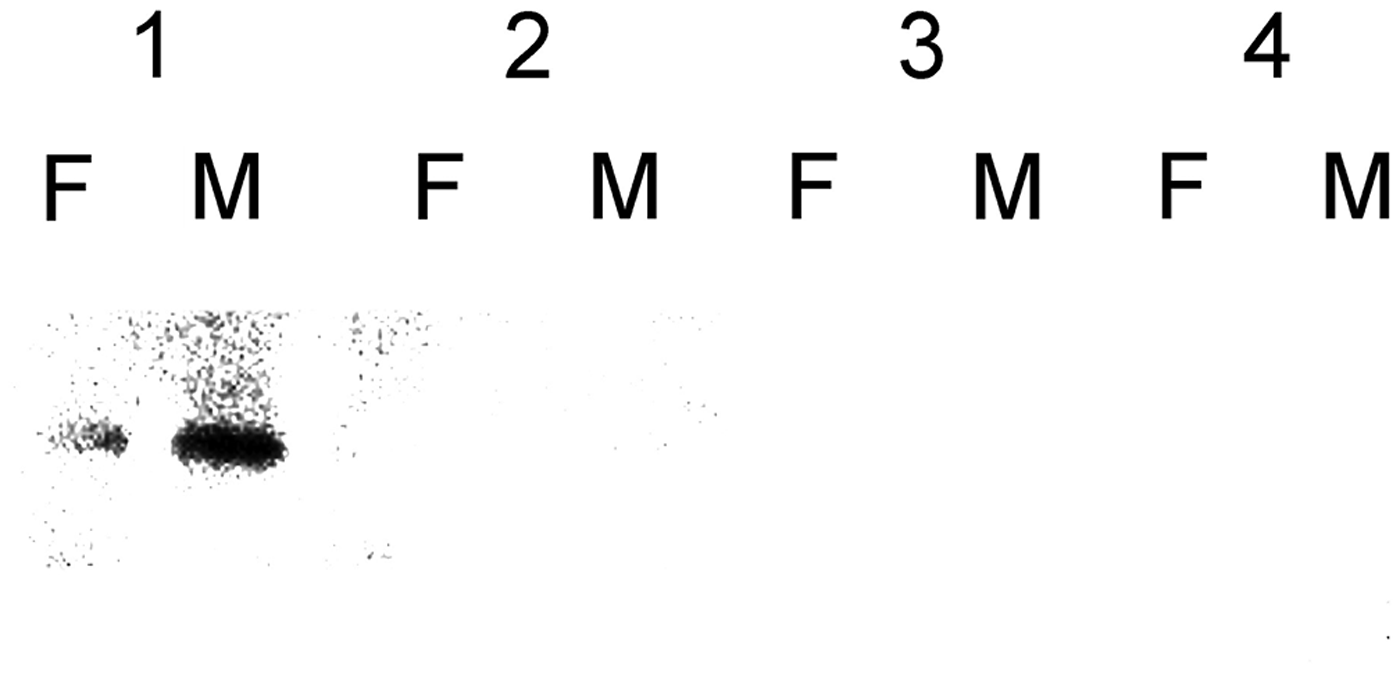
To characterize the specificity of antibodies among different tissues of C. medinalis, we carried out Western blot examinations with the CmedPBP4 antibodies against each of the total protein of antennae, thorax, abdomen and legs in females and males. The results clearly revealed that the expression of CmedPBP4 is antenna-specific in both sexes, and the expression level in male is higher than in female (fig. 2).
Western blot of total protein extracts of male and female of C. medinalis. 1. Antennae, 2. Thorax, 3. Abdomen, 4. Leg, F. Female, M. Male. The results clearly showed that the expression of CmedPBP4 is antenna- specific in the both sexes and the expression level in male is higher than in female.

Polyclonal antisera made from purified CmedPBP4 was used for the cellular localization of CmedPBP4 in C. medinalis antennal sensilla, the results indicated that the trichoid sensilla was strongly labeled by anti-PBP4 antisera, while other kinds of sensilla such as basiconic sensilla and coeloconic sensilla were not labeled by the anti-PBP4 antisera in both sexes (fig. 3).
Immunocytochemical localization of CmedPBP4 proteins in the olfactory sensilla of C. medinalis moth antennae. The sensillum lymph in the trichoid sensilla was heavily labeled by anti-PBP4 antisera (the cross sections a–c), while the sensillum basiconic sensilla and sensilla coeloconica were not labeled (the cross-sections d–h). CW, cuticle wall; P, pore; D, dendrites; SL, sensillum lymph.

Ligand-binding of CmedPBP4
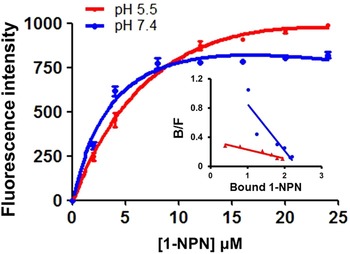
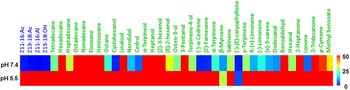
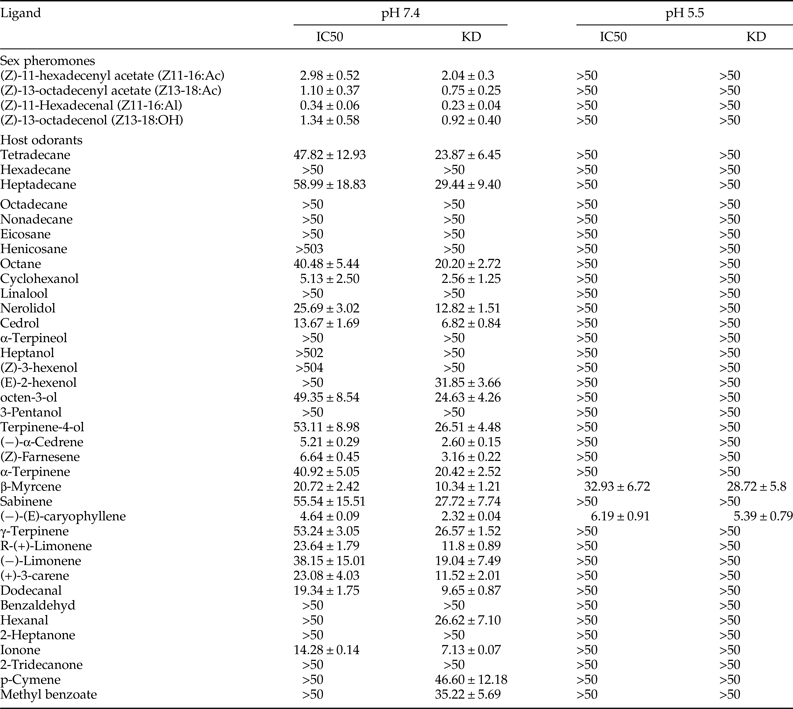
In order to evaluate the binding abilities of CmedPBP4 with sex pheromones and host odorants of C. medinalis, the recombinant CmedPBP4 protein was expressed and purified. Fluorescent competitive binding assays were conducted using a fluorescence probe (1-NPN. The binding plots for CmedPBP4 indicated that the binding of 1-NPN was saturable and consistent with a single population of binding sites, with no apparent allosteric effect (fig. 4), which was used to calculate the K i of sex pheromones and host odorants in the competitive binding assay. Based on the competitive binding curves and the K i values, the K d for four main sex pheromones (Kawazu et al., Reference Kawazu, Hasegawa, Honda, Ishikawa, Wakamura, Sugie, Kamiwada, Kamimuro, Yoshiyasu and Tatsuki2000; Kawazu & Tatsuki, Reference Kawazu and Tatsuki2002; Cho et al., Reference Cho, Choi, Park, Lee, Yum, Jung, Seo and Lee2013) and 37 host odorants (Lou et al., Reference Lou, Ma and Cheng2005; Wechgama et al., Reference Wechgama, Laopaiboom and Laopaiboon2008; Sun et al., Reference Sun, Zhou, Liu, Zhang, Ai, Zhou, Zhou and Wang2013b , Reference Sun, Liu, Zhang, Dong, Zeng, Pan, Wang and Wang2014) with different structures were calculated (table 1). The binding results indicated that CmedPBP4 displayed high binding affinity to three sex pheromone components (Z)-11-hexadecenyl acetate (Z11-16:Ac), (Z)-13-octadecenyl acetate (Z13-18:Ac) and (Z)-13-octadecenol (Z13-18:OH) with IC50 values of 2.98 ± 0.52, 1.10 ± 0.37 and 1.34 ± 0.58 mM, respectively. To explore the binding specificities of CmedPBP4 to host odorants, we measured the affinities of the CmedPBP4 to 37 host odorants (fig. 5). The results suggested that the CmedPBP4 had strong affinities to cyclohexanol, nerolidol, cedrol, dodecanal, lonone, (−)-α-cedrene, (Z)-farnesene, β-myrcene, R-(+)-limonene, (−)-limonene and (+)-3-carene.
Binding curves and Scatchard plots of the fluorescence probe 1-NPN to CmedPBP4 in pH 7.4 and 5.5. The binding curve and the relative Scathard plot indicate the binding constants of CmedPBP4/1-NPN complex were 0.997 ± 0.137 and 6.83 ± 1.52 mM for pH 7.4 and 5.5, respectively.

Comparisons of the binding specificity of CmedPBP4 at pH 7.4 and 5.0. Heat map summarizing the mean binding affinities of CmedPBP4 to four sex pheromones (blue) and 37 host odorants (green). Binding affinities are color-coded according to the scale on the right.

Binding data of the recombinant CmedPBP4 with different chemicals at pH 5.5 and 7.4.

Effects of pH on binding affinity of CmedPBP4
Although CmedPBP4 exhibited an overall similar pH-dependent change in 1-NPN fluorescence, the CmedPBP4 was very different in sensitivity to pH variation for sex pheromones and host odorants. As a result, CmedPBP4 had no binding affinities to sex pheromones at pH 5.5. Interestingly, CmedPBP4 only bound (−)-(E)-caryophyllene with relatively high affinity at pH 5.5, but with weak or no binding affinities to the other host odorants (fig. 5).
Discussion
Insects mainly rely on various hair-like sensilla located on the antennae to detect plant volatiles or pheromones from the environment (Pelosi, Reference Pelosi1994; Gu et al., Reference Gu, Wang, Zhang, Wu, Guo, Zhou and Zhang2011). Eight morphological types of olfactory sensilla were recorded in both sexes on the C. medinalis moth antennae and four types of trichoid sensilla were observed by scanning electron microscopy (SEM) and transmission electron microscopy (TEM) (Sun et al., Reference Sun, Wang and Zhang2011). It is commonly accepted that basiconic sensilla is pheromone sensitive and specialized for pheromone detection, while long trichoid sensilla are generally odorant sensitive and believed to serve as general olfactory sense organs (Schneider, Reference Schneider1964; Visser, Reference Visser1986; Vogt et al., Reference Vogt, Prestwich and Lerner1991; Prestwich et al., Reference Prestwich, Du and LaForest1995). PBPs are suspected to play an indispensable role in pheromone perception (Vogt et al., Reference Vogt, Riddiford and Prestwich1985; Krieger & Breer, Reference Krieger and Breer1999; Leal, Reference Leal, Blomquist and Vogt2003). Tissue expression patterns could provide functional information for CmedPBP4. The results showed that the expression of CmedPBP4 was antenna-specific, suggesting that it was involved in chemical signal detection. Furthermore, the higher expression levels in male antenna indicated that CmedPBP4 might play roles in the detection of female sex pheromones. The lower expression in female antenna suggested that females might also perceive their own or male pheromone components, or other volatiles. Similar expression patterns of PBPs have been previously reported in multiple lepidopteran insects (Groot et al., Reference Groot, Gemeno, Brownie, Gould and Schal2005; Grobe-Wilde et al., Reference Grobe-Wilde, Gohl, Bouché, Breer and Krieger2007; Hillier & Vickers, Reference Hillier and Vickers2011; Zhang et al., Reference Zhang, Gu, Wu, Zhang and Guo2011). Our immunocytochemistry results showed the high expression intensity of CmedPBP4 in the sensillum lymph of the trichoid sensilla. SEM revealed trichoid sensilla are the most widespread and numerous sensilla on the antennae of both sexes of C. medinalis, and these sensilla are covered with longitudinal grooves or orderly patterns of squamas. TEM of their cross-sections reveal that they have thick cuticular wall surrounding an inner lumen innervated by up to dendritic branches (Sun et al., Reference Sun, Wang and Zhang2011). The trichoid sensilla, which was the only sensilla that expressed CmedPBP4 in the C. medinalis moth, might be involved in binding and transporting sex pheromones.
It has been hypothesized that PBPs may play roles in pheromone recognition, with each PBP being a specific component of the sex pheromone blend (Mohl et al., Reference Mohl, Breer and Krieger2002; Maida et al., Reference Maida, Ziegelberger and Kaissling2003; Grosse-Wilde et al., Reference Grosse-Wilde, Svatos and Krieger2006), or each PBP detecting different types of sex pheromones (Campanacci et al., Reference Campanacci, Krieger, Bette, Sturgis, Lartigue, Cambillau, Breer and Tegoni2001; Guo et al., Reference Guo, Huang, Pelosi and Wang2012). In our fluorescence-binding assay, CmedPBP4 showed higher binding ability to three major sex pheromones (Z13-18:Ac, Z11-16:Al and Z13-18:OH) of C. medinalis. This result is in agreement with those reporting that PBPs might bind the components of sex pheromone with different affinities (Maida et al., Reference Maida, Ziegelberger and Kaissling2003; Hooper et al., Reference Hooper, Dufour, He, Muck, Zhou, Almeida, Field, Svatoš and Pickett2009; Liu et al., Reference Liu, He and Dong2012). Perhaps the specificity of pheromone reception may be involved in pheromone receptors. Furthermore, CmedPBP4 could not only carry sex pheromones but also selectively bind and transport host odorants, such as cyclohexanol, nerolidol, cedrol, dodecanal, lonone, (−)-α-cedrene, (Z)-farnesene, β-myrcene, R-(+)-limonene, (−)-limonene and (+)-3-carene. Previous results revealed that none of the plant odorants had any affinity to AipsPBP1-3 of Agrotis ipsilon (Gu et al., Reference Gu, Zhou, Wang, Zhang and Guo2013). It has been reported that the expression pattern of CmedPBP4 was similar to CmedGOBP2 (Zeng et al., Reference Zeng, Sun, Dong and Wang2013). CmedPBP4 showed high binding affinity to three sex pheromones and eleven host odorants, indicating that CmedPBP4 could be able to selectively discriminate and recognize sex pheromones and host odorants. Previously, a pH-dependent conformational change was postulated to be involved in binding and releasing (Horst et al., Reference Horst, Damberger, Luginbuhl, Guntert, Peng, Nikonova, Leal and Wuthrich2001; Leal et al., Reference Leal, Chen, Ishida, Chiang, Erickson, Morgan and Tsuruda2005; Michel et al., Reference Michel, Damberger, Ishida, Fiorito, Lee, Leal and Wuthrich2011). Our results showed that pH has an obvious effect on the binding affinity of CmedPBP4, which displayed a higher affinity for competitors at pH 7.4 than those at pH 5.5. It is suggested that CmedPBP4 may exhibit a pH-changed mechanism in sex pheromone and host odorant perception. And together with the result of immunocytochemistry, our results support the notion that the trichoid sensilla is not only involved in the binding and transporting of sex pheromones, but also in host plant volatiles of the C. medinalis moth, providing further evidence for the function of the trichoid sensilla in lepidopteran moth olfaction.
In conclusion, CmedPBP4 showed obvious antenna-specific expression patterns in female and male antennae. Moreover, it exhibited different expression levels between sexes, making a clearly different sex-biased expression. Binding assays further revealed that CmedPBP4 could selectively recognize sex pheromones and host odorants, and the CmedPBP4 detection of sex pheromones and host odorants was pH-dependent. The results of immunocytochemical labeling revealed that CmedPBP4 showed specific expression in the trichoid sensilla. Our results, for the first time, provide evidence that trichoid sensilla might play an important role in detecting sex pheromones and host plant volatiles in the C. medinalis moth. The CmedPBP4 gene identified in the current study may serve as a valuable new target for interrupting and monitoring pest populations of the C. medinalis moth in integrated pest management programs. Functional characterization of CmedPBP4 in C. medinalis pheromone and host odorant reception could provide further evidence to find new environmentally friendly alternative pest control strategies.
Acknowledgements
This study was supported and funded by the National High Technology Research and Development Program of China (863 Program) (Grant no. 2014AA10A605), China Agriculture Research System (Grant no. CARS-01-17) and Fundamental Research Funds for the Central Universities (Grant no. 2013PY046).