


Since the industrial revolution first brought workers to politics and politics to workers, the strike has been a key tool not only of industrial conflict but also of political struggle. Strikes are used to influence the “who gets what” of everyday politics, from wages and salaries to public expenditures and taxation. In addition, strikes reflect and shape patterns of economic and political power and can tell us a lot about insiders and outsiders in systems of interest representation (Korpi and Shalev 1980). Strikes also matter for broader political stability. Indeed, one of the central findings of the comparative literature on regime change is that strike waves frequently bring down governments and regimes (Collier 1999), and, along with other forms of protest, are inextricably related to processes of both democratization and de-democratization (Berman 2007; Tilly 2004).
It is not surprising, then, that there has been considerable theoretical and empirical work across the social sciences on the causes and effects of strikes and labor protest in advanced industrial economies and in democratizing countries with large vibrant labor movements, like Poland or Brazil. However, we know much less about patterns of labor protest in nondemocracies that lack well-organized and autonomous labor unions. This omission is important because strikes are particularly consequential for politics in these regimes, and governments often go to considerable lengths to prevent or quell labor unrest, outlawing or repressing independent unions, and establishing official unions to co-opt labor. Moreover, most current theories of labor protest rely heavily on the existence of independent organizations to represent workers and, consequently, provide little guidance where workers are either not organized at all or are in unions intended to subordinate and control, not represent them. This paper is an attempt to understand strike patterns in these contexts.
This is an important question for political scientists working in a number of areas. First, understanding strikes in the presence of state-dominated unions, I argue, adds a new dimension to one of the fastest growing literatures in comparative politics: the debate about so-called “hybrid” regimes. With the end of the Cold War, and the preeminence of democracy as a regime-legitimation strategy, the number of regimes that are no longer explicit or closed authoritarian regimes, but neither are full-blown liberal democracies, has increased dramatically. Unlike closed authoritarian regimes, these regimes exhibit elements of open political competition. However, unlike liberal democracies, this competition is heavily skewed by authoritarian social relations, the rule of law is often very weak, and the independent organizational and civic infrastructure we normally associate with liberal democracy is absent. Such political systems are given various names in the literature: hybrid, competitive authoritarian, electoral authoritarian, or partially liberalized regimes. Whatever we call them, such “mixed” regimes have proliferated to the extent that a growing proportion of states, perhaps up to one third of the total number, fit uncomfortably within established conceptual schemes in political science that tend to divide the world into democracies and the rest (Diamond 2002; Levitsky and Way 2002).
Though research on hybrid regimes is booming, most of this work, unsurprisingly, focuses on electoral politics and the ways in which elites continue to influence elections (Hale 2003; Schedler 2006). As a result we still understand little about how the combination of open political competition and authoritarian social relations affects politics outside of elections themselves. In this regard, the behavior of organizations nominally representing labor is of particular interest because hierarchical unions are a frequent inheritance from authoritarian regimes. Whether and how such unions survive the introduction of electoral politics is an important question for understanding the politics of interest representation in the postauthoritarian context. Furthermore, hierarchical unions are also often a key part of the organizational apparatus used by ruling groups to manage opposition, preempt potential threats, and prevent the emergence of challenges from below that might strain ruling coalitions and provoke elite defections. Consequently, looking at organizations like unions is also crucial for understanding regime dynamics and developing a systematic approach to the question of whether (and which) hybrid regimes are likely to prove stable in the medium term.
Moreover, as I show, in hybrid regimes, patterns of strikes cannot simply be taken at face value as a function of the resources, organization, or perceptions of workers themselves, but depend also on elite incentives to mobilize protest. To understand patterns of labor protest, therefore, we need to look at the intersection between labor representation/nonrepresentation and elite politics. Strike patterns reflect elite political strategies both in intraelite bargaining games and in terms of how elites seek to manage pressures from “below.” If protest patterns cannot simply be read off from a desire to protest or from an interest in protesting, then we should be cautious about analyses of the political economy of democratization that model behavior simply as a function of interests without grappling with questions of organization and representation (Acemoglu and Robinson 2006; Boix 2003).
The behavior of hierarchical unions should also be of interest to scholars of globalization. Many countries that are far from liberal democracies are signatories of basic International Labor Organization (ILO) conventions, including the 1998 Declaration on Fundamental Principles and Rights at Work that guarantees freedom of association and the right to collective bargaining. ILO conventions are supposed to be binding on all of its 177 member states. However, many countries sign on without any intention of making good on their commitments. Other countries such as Malaysia have bowed to international condemnation of anti-union legislation and allowed the formation of unions in order to preserve access to international markets. In such cases, the unions that are created are not intended as genuinely independent or representative organizations; rather, like state-sponsored unions in authoritarian regimes, they are intended to control and manage the workforce. Despite the prevalence of such unions, work on globalization and labor tends to look at formal legal rights, treating all unions as if they were representative and largely ignoring the effects of hierarchical or company unions on patterns of labor mobilization and labor rights (Mosley and Uno 2007).
The theoretical question of patterns of labor protest in the absence of strong independent unions is pursued through an empirical puzzle: how to explain dramatic variation in the extent of strikes in a country, post-Communist Russia, where the vast majority of workers are either unrepresented or in unions designed for hierarchical control. As a large, nuclear armed power with considerable regional influence, Russian experience is interesting in and of itself. However, Russia is also a prominent case of a hybrid regime and so provides an excellent context in which to look closer at the organizational ecology of such regimes.
This paper also contributes new theory, data, and empirical findings to debates among scholars of Russia and the wider post-Communist world. Understanding patterns of protest, and, in particular, labor protest, in post-Communism has been a central challenge in the political economy of reform in the region. Adam Przeworski (1991) set the tone for much of the subsequent study of the historic changes in the post-Communist world by predicting that simultaneous political and economic reform would lead to popular protest, which would derail the transition and generate cycles of reform and retrenchment. This did not happen, and there has been considerable effort expended since in an attempt to explain why. Scholars have predominantly focused on trying to explain the apparent lack of protest (Ashwin 1999, Greskovits 1998) or have explained strike patterns in terms of national political cultures (Ekiert and Kubik 1998). Yet none of these theories is consistent with marked regional or temporal variation. By contrast, I present new data that contradict conventional wisdom (Richter 2006) and show that whereas many regions of Russia have indeed been passive, some have been very highly mobilized indeed, and levels of protest have also varied considerably over time.
WORKING CLASS PROTEST IN HYBRID REGIMES
Industrial conflict and strike patterns have received considerable attention across the social sciences. Economists have developed sophisticated models that build on Hicks's insight that, since both parties to a dispute would gain from avoiding work stoppages, asymmetric information and signaling must be key elements of strikes (1932).1
On incomplete information, see Ashenfelter and Johnson 1969 and Kennan and Wilson 1989. On environmental variation see Cousineau and Lacroix 1986; on the effects of institutions and public policies see Card 1988 and Gunderson and Melino 1990. For a review of the strike literature in advanced industrial economies see Franzosi 1989 and 1995.
However, these theories about organization and strikes all assume that workers' organizations are independent and representative; but what does working class protest look like if workers do not have organizations that represent them? The problem comes in two versions: workers who are in hierarchical unions intended for control rather than representation, and workers who are not organized at all. I consider these in turn, though in practice they are likely to coexist.
It is often recognized that the interests of union leadership and the interests of workers might not always be aligned (Golden 1997; Michels 1911; Murillo 2001). However, in many contexts in today's world, particularly outside long-standing democracies, problems of representation are much more severe. It is not simply that officials have a tendency to develop institutional priorities that differ from those of the rank and file. Instead, in much of the world, the unions that supposedly represent workers are not intended for that purpose at all but instead are instruments of control. In this context, the problem of analyzing union strategies and protest takes on a quite different character.
The extreme case is “authoritarian corporatism” in which unions are compulsory, noncompetitive, hierarchically ordered, and functionally differentiated with the purpose of ensuring state control over labor (Schmitter 1974). Examples are the Leninist “transmission belt” labor unions of the USSR and China, and authoritarian corporatist unions, such as the Organizacion Sindical Española in Franco's Spain. Such unions have little or no independence from the authoritarian regimes in question and were created with a view to imposing hierarchical control over workers' organization.
In this paper I focus on the less extreme case of regimes that have given up on overt authoritarian corporatism, but where democratization of labor unions lags behind liberalization in other spheres of the polity. Despite the introduction of competitive elections for national office, in hybrid regimes political machines or corporatist forms of labor incorporation can survive relatively intact. However, with the departure of an explicitly authoritarian political system, official unions no longer have a monopoly but have to compete for survival, relying either on elites and the state or reaching out to their membership base. This creates the possibility for now openly competing elites to use the existing union apparatus to influence the extent to which the public is mobilized around a political issue. Examples of such unions include Russia's largest union confederation, the Federation of Independent Trade Unions of Russia (FNPR), and Mexico's Confederacion de Trabajadores de Mexico (CTM; Bensusán 2000).
A slightly different version common in hybrid regimes is where employers, usually with the blessing of the state, take the initiative in organizing company unions designed to ensure labor discipline and prevent the emergence of representative and potentially troublesome unions. This is the case with the official unions in Malaysia's electronics sector, and with the so-called sindicatos de protección in Mexico. In both instances workers struggle to overcome substantial obstacles to collective action as they face the combined weight and coercive potential of employers, the state and, often, organized crime.
Organizational and institutional conditions in this type of regime are likely to give rise to patterns of strikes that are quite different from those in long-standing democracies. Elite politics plays a major role in determining who strikes and who does not. Consequently, to understand strike patterns in hybrid regimes we need a theory of elite conflict and the interaction of that conflict with top-down unions. Strikes patterns, I argue, depend on how bargaining over the distribution of resources is conducted. Under certain conditions, namely, when regional elites are relatively unified, strike patterns will depend on the political and economic resources of the region. Regions that have poor political relations with the center, and few other bargaining resources, will seek to mobilize workers to pressure the center for transfers. In these regions, the level of strikes will be high. Other regions will generally prefer “quiet” bargaining strategies, and strike intensity will be much lower.
The other case of nonrepresentation is where workers are not organized at all. This too is common, especially in service industries and in the informal economy, and is often associated with neoliberal economic policies (Kurtz 2004). There is relatively little theoretical work on strikes by unorganized workers. Shorter and Tilly (1971) show that unorganized workers rarely strike, and when they do, strikes tend to be longer and smaller. More directly, there is a small literature on so-called “wildcat strikes,” that is, strikes organized either against officially recognized unions or in their absence. In his seminal work on wildcat strikes, Gouldner emphasizes the moral and emotional dimension of wildcat strikes (1954, 53–64). From the workers' perspective, such strikes are a largely spontaneous response to situations in which conditions deteriorate to the point where workers sense that a moral, and not just an economic, boundary has been crossed. In a rather different vein, Brett and Goldberg (1979) find that patterns of wildcat strikes in coal mines are not a function of such things as working conditions and age profiles of the workforce; rather they depend on management style and the atmosphere of relationships between workers and management. Zetka (1992) finds that it is the specifics not just of industry but of labor processes and their effects on group solidarity that matter. Looking at the post-World War II U.S. auto industry, a context in which strikes were outlawed and heavily repressed, Zetka finds strikes were more likely where the work process itself required workers to coordinate their moment-by-moment activities. The likelihood of wildcat strikes, therefore, depends heavily on the details of work organization at the shop-floor level.
In what follows, I lack sufficiently detailed data to test theories that depend on shop-floor level variation. However, I am able to get some insight into the leverage offered by Gouldner's (1954) account in which wildcat strikes are more likely to occur when workers experience unusual levels of economic hardship, combined with a sense that the hardship is morally unjust. Such arguments recall an older line of thinking about protest grounded in theories of deprivation (Gurr 1970). Although such thinking has largely been superseded in the strike literature by institutional and bargaining power approaches, where institutions do little to reflect the interests of workers, or where workers lack organizations to bargain on their behalf, relative or unjust hardship is likely to be strongly associated with success in overcoming obstacles to collective action.
RESEARCH DESIGN: RUSSIAN LESSONS AND HYBRID REGIMES
In the remainder of the paper I focus on one hybrid regime, Russia, where both forms of labor “non-representation” are prevalent. I use an analysis of Russian regions as a plausibility probe to develop and test a theory of labor mobilization in which authoritarian corporatist legacies interact with open elite political competition. Russian experience is particularly interesting when thinking about hybrid regimes because Russia offers a clear example of strong institutional continuities to the former regime coexisting with liberalization of political competition. Though the “transmission belt” role of labor unions is no longer espoused officially and central control at the national level is much weaker, at the regional level there remain strong elements of authoritarian corporatism. This combines with open competition between regional elites and the center, and among different regional elites. The result has been tremendous variation in protest levels across different regions.
Looking at variation at the regional level in a large and diverse state like Russia is also useful in that it provides empirical leverage, controlling for such things as cultural repertoires or past national experience (Ekiert and Kubik 1998), while still having variation on important dimensions such as economic performance, the degree of political competition, ethnic polarization and so forth.
There has been quite a cottage industry of studies looking at protest patterns and politics in post-Communism generally, and in Russia in particular. Although workers played a major role in the Soviet collapse (Crowley 1997), the academic conventional wisdom has been that there has been no protest of note in post-Communist Russia. Mandel asks “Why is there no revolt?” (2000). Ashwin's analyzes “The Anatomy of Patience” (1999), Kubicek examines the “worker passivity in the face of severe economic crisis” (2002, 618), and Richter note “the absence of any sustained protest movement” (2006, 134).
However, the conventional wisdom is misleading. In fact, Russians at times and in certain places have been very highly mobilized. Even according to conservative official statistics, Russia had 111 working days per 1,000 workers lost to strikes in 1997, and 56.1 in 1998. This compares with 13.4 and 11.3, respectively, in Mexico, and 3 and 4, respectively, in what Ekiert and Kubik (2001) call “rebellious Poland” (ILO). Mobilization, as it usually does, has come in waves, with periods of high mobilization alternating with periods of passivity. Comparing peaks of mobilization cycles, Russia experienced 13,213 “protest days” (number of events × event duration) in 1997, and 16,652 in 1998, compared to 3,529 in 1992 and 4,382 in 1993 at the peak of protest in Poland (Ekiert and Kubik, 113).2
The data were compiled by the author from daily reports of Interior Ministry (MVD) departments in each of the localities of the Russian Federation. See below for further details.

Working Days Lost to Strikes in the Russian Federation 1997–2000
The empirical analysis in this paper uses data from 1997 to 2000, covering most of Boris Yeltsin's second term and the period in which the new Putin administration was establishing itself. This is a key time-frame to look at because these years were the period of greatest political competition in the post-Communist era in Russia. As such, these years provide a good environment for looking at the interaction of open political competition with authoritarian labor institutions. I consider the implications of the time period used to test the theory in more detail later.
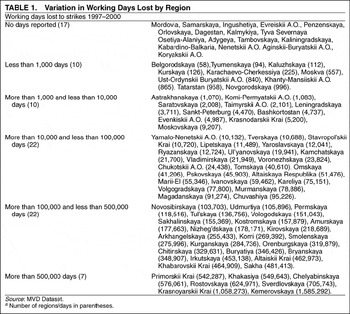
The conventional wisdom is not only misleading in terms of understanding Russia but also theoretically constricting, for it blinds us to variation that can be useful in the development and testing of theory. Part of the reason that scholars have missed the extent of protest in post-Communist Russia is that the national picture presented in Figure 1 masks enormous Russia regional variation. Table 1 shows the variation in the extent of one subset of protest: strikes. At the top end, we find seven regions, spread from Russia's far east, across Siberia, through the Ural mountains, to southern European Russia, with more than 500,000 working days lost to strikes over 4 years. In the Republic of Khakasiya, 809 working days per 1,000 employees were lost in 1997 and 890 in 1998. Primorski Krai lost 384 working days per 1,000 employees in 1998, and Kemerovo Oblast lost 959 in 1997. But these regions are unusual. Nearly half of the regions (37/88) reported-fewer than 10,000 working days lost in total over the 4 years.3
It is unlikely that regions reporting zero strikes are reporting accurately, but it is safe to assume that the level of strikes in these regions is very low. No data were available for Chechnya.

EXPLAINING POST-COMMUNIST PROTEST
What explains variation in strike patterns in post-Communist Russia? I first consider the existing literature on protest politics in post-Communism. Though this literature pays little attention to variation, it does provide two key insights: that strikes are more common where leadership is provided by trade unions, and that the unions tend to follow instructions from above in organizing protest. I then analyze some of the key elements of relationships among workers, unions, and political power, and show a number of direct and indirect ways in which regional governors are able to influence protest levels.
A range of cultural and ideological theories, from an aging population to the lack of an ideological alternative to the market, have been offered to explain the supposed lack of protest (Christensen 1999; Greskovits 1998). However, because the factors these theories emphasize vary little across regions, or over time, they are unhelpful in understanding variation. For this task, theories that focus on institutional and informational barriers to collective action are more helpful.
Javeline (2003) finds that, although workers in Russia in this period generally had great difficulty in allocating blame for their problems, those who were more successful in ascribing blame to someone were more likely to participate in protest actions. Success in blame attribution is in part a function of clarity of enterprise ownership, but also a matter of involvement with political organizations. Moreover, she shows that those who had been solicited by a trade union or other organization to participate in a protest action were more likely to join in than those who had not. In other words, individuals are more likely to participate in a protest action if one has been organized for them to go to, than if they have somehow to organize it themselves. Yet this does not tell us why an event is organized in the first place. To understand this means looking at the institutional and organizational level to discover why events are more often organized in some places than in others. This is turn depends on the nature of Russian labor unions.
With the exception of a few specialized branches, such as miners, dockers, and air-traffic controllers, independent unions have failed to establish a strong presence in Russia, and by 2000 at most 5% of union members were in alternative unions (Ashwin and Clarke 2003, 1). By contrast, the former official unions, renamed the Federation of Independent Unions of Russia (FNPR), have had considerable success in continuing to dominate the representation of workers. The lack of legitimacy and the inadequacies of labor unions in Russia as representative institutions are well documented (Ashwin; Clarke; Davis 2001). Nevertheless, these unions have a presence in every workplace that existed at the time of the collapse of the USSR, some 38 million members, and a 1% check-off from the salaries of members.4
FNPR leaders often cite maintaining their apparatus as the greatest achievement of the post-Communist era. Author interviews with G. A. Vinokurov, Deputy President Novosibirsk Federation of Independent Trade Unions, August 2000, and with Y. A. Siderov, Head of International Relations, Federation of Independent Trade Unions, November 2000.
Workers' subordination makes the unions a valuable partner for the state. To capitalize on this relationship, a set of institutions known by the general term “social partnership” has been created to preserve the role of former official unions and to enhance their near-monopoly of representation of workers. Social partnership consists of a huge bureaucratic effort to produce thousands of largely meaningless agreements among unions, employers, and the state, preserving a modified version of Soviet labor institutions in which unions are the junior partner in managing enterprises.5
Institute for Comparative Labour Relations Research (ISITO), V. Bizyukova, “Dinamika Regional'nogo Sotsial'nogo Partnerstva (Sravnitel'nyi Analiz)” (The Dynamics of Regional Social Partnership: A Comparative Analysis). See http://www.warwick.ac.uk/fac/soc/complabstuds/russia/publications.htm Also Ashwin 1999; Clarke 2003. On labor unions under Communism see Kahan and Ruble 1979.
However, if workers are in a subordinate position with respect to the unions, so the unions find themselves in a relationship of dependency with regional authorities. Unions are financially weak and depend on employers or the regional government for administrative resources and for a role in continuing to fulfill social welfare functions inherited from the Soviet era, and, due to their very limited legitimacy at the grassroots, for protecting the unions from encroachment by upstart independent unions. As a result, there is little protest without official sanction. As one union official put it, “In general all protests are held on the initiative of the powers that be: regional governors, directors of enterprises” (Ashwin 1999, 14).
The converse of union weakness is the political strength of regional governors. In most regions, gubernatorial influence extends to the disbursement of state funds, the ownership and profitability of banks and other enterprises, and a vast array of regulatory and administrative powers, creating the potential for powerful political machines (Hale 2003). The influence of governors on patterns of protest is felt in many ways. In most cases influence over protest levels is indirect, less a matter of directly organizing protests, so much as one of deciding when to permit them and when to prevent them. To give one example, during the 1997 railroad blockade launched by submarine repair workers in the Far Eastern town of Bol'shoi Kamen', then Primorskii Krai governor Yevgenii Nazdratenko provided buses to transport protesters the considerable distance to the railroad, and ensured that the police did not act to prevent the illegal blockade. Instead, police provided security for protestors. In the opinion of a highly respected regional commentator, there were no real civil society organizations capable of putting an event like this together, only the labor union in association with the regional administration could have organized it.6
Interviews in Vladivostok, June 2003.
In some cases, the use of administrative resources is more direct. In another interview in Vladivostok, one journalist suggested that in many cases “participants in protest actions were actors involved to create the impression of mass participation.” These “actors” were paid by the regional administration. Considerable effort is also put into controlling media coverage of protests and Nazdratenko reportedly paid Moscow-based television companies to cover protest events in his region. Although this may (or may not) be unusual, Russian labor law sets out very complex procedures for strikes (Maksimov 2004, 123), creating an opportunity for strikers to be punished with legal action. Without independent courts, such decisions are subject to close political control on the part of regional officials, ensuring that most strikes that take place are politically acceptable to the regional political leadership.
Given the weakness of the unions, the strength of the regional governors, and the elaborate institutional apparatus for coordination between them, the key players here are regional governors. Consequently, we would expect protest patterns to reflect their interests, taking place where protest is rational from the governor's perspective and not where not.
AN ELITE BARGAINING THEORY OF PROTEST
When would this be? The point of departure is to think about distributive politics and the potential bargaining strategies available to governors in a state divided into different regions or territorial political units that lobby the capital for money and other resources. Broadly, governors have a choice between quiet and noisy strategies, analogous to “loyalty” and “voice” in Hirschman 1970. Quiet strategies are defined as intraelite bargaining, whether through formal federal institutions or more informal political bargaining. Noisy strategies are defined as those that involve public political pressure, usually in the form of protest actions such as demonstrations, pickets, and strikes. All things being equal, governors prefer quiet strategies because the relative lack of public attention gives them greater flexibility in disbursing monies that are transferred from the center. By contrast, noisy strategies widen the circle of players, bringing into the picture mass actors who are likely to be in a stronger position to demand a share of the resources generated. Moreover, quiet strategies are less risky than noisy ones, in terms of intraregional politics. Noisy strategies create potential for unforeseen political or social instability and train participants in collective action that may make them more independent later.
However, not all governors will be successful in obtaining resources from the center using only quiet strategies. In fact, governors who have bad political relations with the center and who are weak in bargaining will systematically resort more often to public pressure, including the organizing of strikes and protests.
The reason for this turns on the nature of bargaining over transfers. In any bargaining situation between regions and the center, the key issue faced by the center is to prevent the regions from coordinating their strategies. Without coordination, the center can play the regions off against each other, buying off the most powerful regions, neglecting the others. Whether this is possible depends on the nature of the issue. On the question of transfers and payments, preventing coordination is relatively straightforward. Assuming some sort of budget constraint, central funds are clearly rival in consumption; what is transferred to one region cannot also be transferred to another. This is different from issues such as sovereignty and autonomy where a grant to one region is likely to increase the chances of concessions to another. In the autonomy case we are likely to see regional bandwagons. In the case of fiscal transfers bandwagoning is unlikely. Without a credible threat of interregional coordination, the center will be primarily concerned with the needs of the most powerful governors, leaving weak governors to exert what pressure they can through the use of noisy strategies. To implement this set of strategies governors will, of course, rely on the cooperation of other important players in regional politics; convincing these actors to go along will depend both on the interests of the players themselves and on the political strength of the governor. I first discuss the interests of each of the relevant players independent of the governor, and then consider factors that affect a governor's capacity to influence them.
The relevant players are workers, unions, and employers. Workers can be expected to participate in protests given that participation has few costs, particularly when action is backed by the regional administration and when there is the potential that noisy pressure might bring some concrete benefits. These incentives for workers to participate will be stronger the greater the economic hardship they face, especially where that hardship is considered to be unjust. Moreover, the greater the hardship, or the perception of injustice, the more likely there is to be wildcat action, that is protest activity beyond the framework of the official unions. Where deprivation is worse, official efforts to prevent protest are less likely to be successful. Hence we would expect workers to cooperate with governors promoting strikes, but to cooperate less when economic hardship is high and governors want to demobilize strikes.
As far as unions are concerned, I have outlined earlier the nature of the unions' dependency on the political support of governors. Consequently, union support will not tend to be particularly problematic. However, it does depend in part on the extent that independent unions have influence in the region. In cases where independent unions represent a real threat to successor unions, experience elsewhere suggests that successor unions will tend be more militant (Murillo 2001; Robertson 2004). This means more willingness to cooperate in noisy strategies and less in demobilization.
What about employers? In the case of demobilizing protest, the interest of employers seems clear, but why would they be willing to participate in noisy strategies involving strikes? In brief, of course, not all will. In particular, employers in small enterprises and new post-Communist start-ups are not likely to play along. However, given that these types of companies are both far more likely to be economically profitable, and almost entirely nonunionized, such employers are not likely to be called on. Outside of small enterprises and new start-ups, however, the distinction between employers and the state is often hard to make in practice. In some cases, teachers and healthcare workers prominent among them, the employer is the state. In other cases, formal legal privatization may have taken place, but especially for larger enterprises that were formerly (or still currently) state owned or that relied in part or whole on state orders, the economic environment in the 1990s was at most semimarketized. The combination of a political interest in employment preservation with massive nonpayment of obligations among enterprises and between enterprises and the state helped to maintain the soft budget constraints of the Soviet era. Hence to the extent that regions look for subventions from the center, rely on state employment, and/or face a weakly marketized economy, employers are likely to be more willing participants in regional bargaining coalitions.
Of course, governors have important levers of influence over these three sets of actors, as noted previously, and cooperating with governors will seem more reasonable when the governor is politically dominant in her region. Political dominance will depend on several factors, but most importantly on players' expectations about the likelihood that the governor will stay in power to see the deal through. When elections are far off and/or when governors do not face a strong challenger in their bid to gain reelection, governors are likely to have greater capacity to ensure cooperation from workers and regional elites.
ELITE BARGAINING AND PROTEST: HYPOTHESES AND MEASURES
Political Power
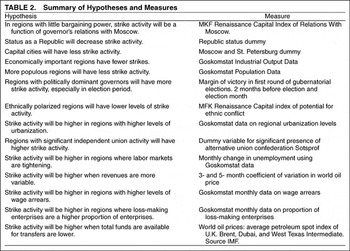
In this section, I develop specific hypotheses about the correlates of mobilization, based on the theory outlined previously. I argued that due to the nature of the bargaining game, powerful regions pursue quiet strategies and so have fewer strikes. The question of course is what “powerful” means. I focus on two sources of power and the interaction between them: political connections and resources.
Political connections and alliances are crucial everywhere, but are particularly important in a context like Russia where power is heavily concentrated in a largely unchecked executive, where the party system is weak, and where politics is more about patronage than about programs. Breslauer uses the term “patrimonial” politics to capture the personalistic nature of political interaction in post-Communist Russia (1999, 2001). In such an environment, having good political connections to the center is of vital importance in getting what you want. In terms of bargaining strategies, governors with good connections to the center get direct political access, and so are much more likely to do better in quiet, intra-elite bargaining than their counterparts without such connections. Governors with poor political relations, by contrast, are more likely find the doors of the Kremlin shut and instead resort to public campaigns and pressure. Hence we should expect poor political relations to mean more protest.
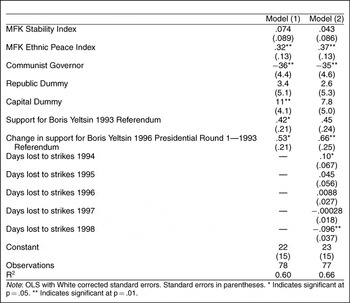
The quality of political relations between the president and 88 regional governors is, of course, not directly observable. Although it is easy to think of a range of governors in Russia who had particularly difficult relations with Boris Yeltsin's Kremlin, factors of this type are difficult to integrate into large-n studies. This is particularly the case in the absence of strong, durable, and distinctive political party labels. Moreover, political relations cannot simply be reduced to measures of policy, because bitter political opponents might very often pursue the same policies. Instead we need a measure that combines two elements: general perceptions in the Kremlin of the political orientation of the governors, and private networks of connections, political, financial, and other, that governors can draw on among important players in the Kremlin. I use a set of assessments of the regional governors for 1998 prepared by a Russian investment bank, MFK Renaissance, that covers both these elements: Governors are placed “by the judgements [sic] of Russian experts and [MFK] analysts” on a 0 to 100 scale according to both their general level of “reformism” and “a direct assessment of the relationship of regional authorities to the center” (MFK 1998, 58). This index reflects precisely the sort of perceptions of political orientation that matter in the patriarchal politics of Russia as determinants of relations. Appendix 2 presents evidence that the MFK indices are indeed a good measure of pure political relations between the Kremlin and the regional governors, as opposed to being a measure of policy or a function of post-1997 strike levels. The main determinants of the MFK indicators are purely political: Communist Party membership and the change in support for Yeltsin between the referendum in 1993 and the presidential election in 1996.
The principal alternative to this measure is to simply code all “Communist” governors as opponents of the Kremlin (Gimpelson and Treisman 2002), but this approach is inferior for a number of reasons. The MFK index provides an individual evaluation for all regions, whatever the political affiliation of the governor. By contrast, all “Communist” governors are treated equally when dummies are used, despite the fact that some Communists had very good relations with Yeltsin, whereas some non-Communists had very bad relations. Moreover, the dummy-variable approach provides essentially no information for the non-Communists, who are an even more heterogeneous group. Furthermore, the approach of using a Communist dummy assumes that Russian politics is organized on partisan lines. The extent to which this is true at the national level is questionable, and party penetration of the regions is extremely limited (Stoner-Weiss 2001). As a practical matter, it is often difficult to be clear about who belongs on what side of the dichotomy, because many different parties and groups seek to back the most likely winner in gubernatorial races regardless of ideology. Therefore, the Communist dummy approach is weaker both in the sense of ignoring much contextual information and in that it selects a decision rule that has limited theoretical leverage and is hard to apply in the Russian context.
However, there is more to political bargaining than the relations among players. Economic and political resources matter too, and well-endowed governors are more likely than others to have their demands met by the center without resorting to public pressure. What constitutes a resource, of course, varies from one situation to another, but we might think of resources schematically as follows: strategic, economic, and electoral.
First, strategically the support of some regions is more valuable than that of others. At a minimum, unrest is more costly where it threatens the state itself, or its territorial integrity. This gives leaders of politically sensitive regions more leverage. Consequently we would expect to observe capital cities and regions with special ethnic or autonomy status having lower protest levels.
Second, power also comes from the ability to put economic pressure on the center. Thus governors of the most economically productive regions are likely to be more influential, and so these regions will have lower levels of protest.
Third, where elections play a role in determining the national leadership, the electoral resources available to a region matter too. In general, the number of voters in a region might be expected to be related to the electoral value of a region to the center. In particular, in places like Russia, where presidents are elected on the basis of a single national constituency, more populous regions will see lower levels of protest.
Note that we should expect an interaction between political power measured in terms of resources on the one hand and political relations on the other. Although political connections might matter in general, they are likely to be of much greater consequence for regions that lack other resources. Weak regions with good relations are much more likely than weak regions with bad relations to have their needs met by the center without resorting to public protest. Hence we should see much lower protest in weak regions with good relations than in weak regions with bad relations. By contrast, there might not be much observable difference between strong regions with good relations and strong regions with bad, since strategically, economically, and electorally strong regions matter to the center regardless of political connections.
Capacity
As noted earlier, the capacity of regional governors to bend elites, employers, and labor unions to their interests is not likely to be uniform across all regions in all cases. Instead it will depend in part on the extent to which a particular governor is able to dominate his region politically. Less politically dominant governors will have less capacity to get others to cooperate in either preventing or supporting protest. In principle there are at least three aspects of elite competition at the regional level that might affect a sitting governor's capacity to resort to the tactic of strikes (or other mass protest actions) to influence negotiations with the center: political competition, electoral cycles, and polarization.
Most directly, governors who face strong political competition are less likely to have the capacity to influence strike levels as part of a negotiating strategy. Moreover, a governor's capacity to influence other actors in the region is likely to vary with the electoral cycle. As elections near, governors in more competitive regions will face a greater chance of losing office, and so will have less ability to leverage in other actors. As a result we would expect governors facing more political competition to have less capacity to use strikes as part of a bargaining process, and for this difference to be especially marked in election periods. In these instances the expectation is that strike activity will be lower.
A third aspect of political competition at the regional level that is likely to affect the ability and willingness of governors to use protest as a bargaining tool is the degree of polarization of the regional political environment. The extent to which a given polity is polarized is likely to have major implications for both policy and politics (Frye 2002). In particular, polarization increases the costs of losing and so makes politicians more risk-averse. Hence we would expect to see lower strike levels in highly polarized regions.
Unfortunately, polarization is generally not directly observable. Given data limitations, I measure only one form: ethnic polarization. Although this is but one of many forms of polarization (ideological, personal, religious), it is one of the most common and divisive. I use the MFK Renaissance Capital assessment of the potential for ethnic conflict in each region, which has the advantage of assessing the extent to which ethnic divisions are actually politically salient and the degree to which this salience holds the threat of actual conflict, rather than relying on measures of ethnic diversity that may or may not reflect politically relevant cleavages. The index is a 0 to 100 scale, with 100 representing no perceived threat of ethnic conflict.
Hardship and Perceptions of Hardship
Economic hardship might be expected to affect protest levels in at least two ways. First there is the effect of hardship itself. One view holds that the greater the hardship experienced, the more strikes we should see. Second, theories of wildcat strikes, that is, protest without the sanction of officially recognized labor unions, suggest that such action is more likely when hardship provokes a sense of moral outrage or injustice. Without individual level data this is hard to test. However, there is a useful proxy. By far the dominant issue affecting the living standards of Russian workers in the 1990s was the issue of unpaid wages. In fact, wage arrears were figuring in more than 98% of strikes. This had both a direct economic effect on living standards, as well as creating a strong sense of injustice among those who had worked but not been paid. Hence I use total wage arrears per capita as a measure of hardship that also taps the dimension that protest is more likely when expectations are disappointed or when people's sense of their moral desserts is offended.
For budget sector workers in particular, and others whose salaries are, at least theoretically, to be paid from local budgets, the tax base of a given region also ought to be an important determinant of mobilization. I measure the tax base of a region by looking at the proportion of enterprises that are lossmaking. Strike activity should be higher in regions with more loss-makers. The availability of resources to the central budget is also important. Where resources are scarce, competition is likely to be more intense, so governors are more likely to resort to their full arsenal of weapons. I use oil prices to proxy public knowledge of coming changes in government resources, given the enormous contribution of oil revenues to the Russian budget.
ORGANIZATION, BUSINESS CYCLES, AND INFORMATION: HYPOTHESES AND MEASURES
I now turn to alternative explanations. Existing theories of strike patterns are primarily concerned with factors that influence relative bargaining power (independent organization and business cycles) or the information environment. In this section I briefly set out some hypotheses designed to test these theories.
The essential insight of bargaining power theories is that we should expect to see more mobilization in regions where workers' capacity to self-organize is high (Cohn and Eaton 1989; Snyder 1977), due both to the effect of independent organizing itself and to the galvanizing effect on Communist successor unions. Capturing capacity for self-organization of workers is tremendously difficult. Standard approaches using union density are useless where workers are passive members of former official unions. I have made a first cut at solving this problem by constructing a list of regions in which one of the leading independent trade unions, Sotsprof, has managed to establish a real organizational presence. Sotsprof is one of the largest alternative union confederations, with many small independent union affiliates in a range of sectors. Sotsprof tends to confederate existing local alternative unions rather than organize itself, so it provides a reasonable guide to regions where independent unions are present. I used official lists of Sotsprof branches and, on the basis of interviews with Sotsprof officials in Moscow, eliminated regions where organizations existed only on paper.
Bargaining power, of course, is also related to business cycles. In advanced industrial economies the expectation is that the best time to strike is when labor markets are tightening; that is unemployment is falling, and so workers are in shorter supply, and so are relatively stronger (Ashenfelter and Johnson 1969).
Turning to theories about factors that are likely to affect the information environment, uncertainty over the amount of money available for transfers (and so uncertainty over the center's capacity to make concessions) ought to increase the level of strikes. Hence, to the extent that the budgetary position of the central government is unclear, mistakes are more likely, and strikes should be more frequent. To proxy difficulties parties might have in estimating what the upcoming budgetary situation might be, I use the coefficient of variation in oil prices over three months. Table 2 summarizes hypotheses and measures.

STRIKE DATA
Strike data in this paper are drawn from a new protest dataset covering 88 regions of the Russian Federation for 4 years, from January 1997 to December 2000. The data were compiled by the author from unpublished daily text reports of the Interior Ministry. The reports are prepared at MVD offices in each settlement in the Russian Federation, and sent to Moscow to be compiled into summary reports, or svodki. Each daily report lists new, continuing, and ending strikes; the number of participants on a given day; the location; economic sector of the strike; and the demands made.
The new data are a considerable improvement on published strikes statistics that rely on self-reporting by enterprises. Moreover, only strikes that are legal and officially endorsed by the unions are recorded in official statistics. Both of these factors lead to significant undercounting. In an interview with the author, the President of Sotsprof, one of the new “independent” unions, estimated that 80% of the strikes organized by his union were ruled illegal. By contrast, the MVD reports are primarily used for national security purposes, and so officials are responsible for actively monitoring levels of actual, as opposed to only de jure, disruption in the areas under their supervision. Comparisons between the MVD data and official sources show the same macro-trends over time while suggesting higher levels of activity than published sources. The MVD reports are also an improvement on data available from nationally representative surveys. Although, as I have shown, strikes are concentrated in a relatively small number of regions, nationally representative samples that do not take this nonrandom variation explicitly into account are not likely to give an accurate picture of strike levels.
Obviously the new data do not solve all of the problems with the compilation of statistics on strikes and protests. Many of these problems, ranging from the social and technical definition of a strike, through to establishing the number of workers involved and the amount of time lost, arise every time labor statistics are discussed (Knowles 1952). Moreover, the MVD data are also subject to concerns about the political incentives and bureaucratic habits of that organization. It is a well-known regularity that police estimates of the numbers of participants in protest events are almost always conservative and are certainly below the numbers estimated by protest organizers, and usually below those of media observers too. Predictably, a comparison of the MVD police reports with opposition and scholarly reports of particular incidents (the Vyborg Cellulose Plant conflict and Astrakhan Gazprom blockade) suggest that the MVD is slow to report the beginning of the most conflictual events and understates participation when events are underway. On the other hand, under-reporting is less of a problem with this source than official sources or media sources. Nevertheless, in terms of absolute numbers, it is clear that this source should be treated as a conservative guide to the underlying phenomena.
Access to the underlying source for the data was, given its nature, limited to 1997 to 2000. Nevertheless, this is a particularly appropriate period for looking at the theoretical questions of interest. This period provides significant variation on the dependent variable, as well as on economic independent variables. Strikes and protests increased through 1998 when the balance of unpaid wages to Russian workers reached a peak of some R56 billion, and then declined through 1999 and remained low in 2000. The period also saw the August 1998 crash of the Russian stock market and currency, the most serious economic crisis that Russia had seen since the stabilization of 1992 to 1993. Following the crash and the concomitant currency devaluation, the Russian economy began to experience its strongest economic performance since the mid- 1980s.
There is also great variation in the political context: 1997 through 1999 was a period of acute elite conflict in the run up to the 1999 parliamentary elections and 2000 presidential elections, when the question of the succession to Yeltsin was being decided. By December 1999, it was clear that a new leader, Vladimir Putin was in place, and elites scrambled to pledge allegiance as a more vigorous regime established itself in the Kremlin. This provides an excellent opportunity to assess the tools and tactics of center-region competition and of competition for supremacy among local elites in a period in which that competition was most open. The principal limitation of the data is that we have a relatively limited view of the Putin era, only 10 months, and so we have less insight into patterns of behavior when elites are more afraid of openly criticizing the center. This limits the extent to which the analysis applies to strongly authoritarian contexts. On the other hand, we do begin to see in these 10 months the effect of the political consolidation of the Putin era as the authoritarian elements of the Russian political system reestablished themselves over the competitive elements.
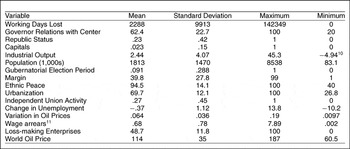
Appendix 1 presents descriptive statistics. I use data from all sectors except mining. Miners' strikes are concentrated in coal producing regions. Moreover, the miners' movement is seen as quite different from the rest of labor politics in Russia (Borisov 1997; Maksimov 2004).
There are various ways of measuring strikes. I follow the classic treatment (Knowles 1952) in making the dependent variable the “'composition of the strike movement” or the “severity” of strikes (total number of working days lost): given by magnitude (workers per strike), duration (working days lost per worker), and frequency (number of strikes). An alternative to working days lost would have been to measure “strikes” as a count of events. This approach is inferior in this case for a number of reasons. Most importantly there are major conceptual difficulties in determining whether a number of events in different places are one strike or many. To do so presupposes an underlying theory of the organizational process behind the events: are they on the same issue, are they organized together, is there more than one legal establishment involved, and so forth. None of these issues are resolvable on the basis of the MVD reports.
MODELS AND RESULTS
The test treats the dependent variable as a time-series cross-section of monthly counts, modeled using a negative binomial distribution. Despite the large size of some of the counts, the negative binomial count model is preferred to account for the discrete, non-negative nature of the dependent variable, and because it models directly over-dispersion (contagion) in the observed counts (Hausman et al. 1984, 911).7
An alternative is to use the ARPOIS routine in STATA that estimates a log-linear autoregressive Poisson model allowing for over-dispersion. All models in this paper were also run using ARPOIS as a robustness check and the main theoretical claims of this paper were confirmed.
The models presented here include two-period lagged dependent variables. There are two main reasons why it is important to include a lagged dependent variable. First, strikes in reality occur continuously rather than in separate observations. Consequently, strike counts in a given month are directly affected by continuing strikes from the previous month. Second, due to event-level contagion, strikes in one period will also causally affect strikes in later periods. Thus the number of working days lost to strikes at the beginning of each month will tend to be influenced by previous strike patterns. The two lag model was decided on by adding additional lags and using likelihood ratio tests to identify the best model specification. Changing the number of lags does not affect the main results. In addition, I control for the fact that there are no teachers' strikes in summer.
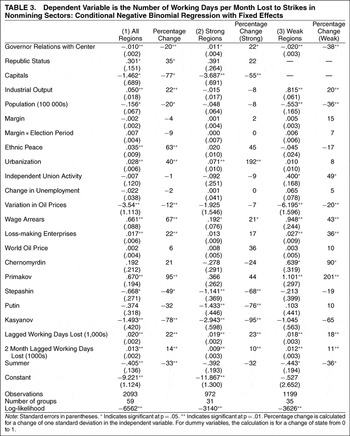
The results of the analysis are presented in Table 3. The discussion is organized in terms of the broad theoretical perspectives outlined earlier: elite bargaining, hardship, independent organization, business cycles, and information.

To recap, the elite bargaining theory has two main elements: political relations and bargaining resources. Strikes patterns are politically driven and are a function of political relations between regions and the center. But politics is not just about political relations; “real” resources matter too, and the effect of political relations will be more marked in weak or resource-poor regions.
Looking at Model 1, the quality of a governor's political relations with Moscow is, as predicted, negatively related to the number of working days lost to strikes. Governors who do not enjoy close political relations with the Kremlin authorities are, controlling for economic and social factors and the political status of the region, likely to preside over regions with more days lost to strikes than governors who enjoy better relations. Moreover, the size of this effect is substantively quite large; holding other factors constant, an improvement in relations by one standard deviation reduces the number of days lost to strikes by 20%. To illustrate this, compare one Communist and one independent region: Orel and Primorskii Krai. MFK rate relations between Moscow and the Communist governor of Orel, Yegor Stroev, at 72, and relations with independent Primorskii governor Yevgenii Nazdratenko at 36. Though Stroev was a Communist, he was also the speaker of the upper house of the Russian parliament and a close ally of Yeltsin. By contrast, Nazdratenko, a non-Communist, was an arch-enemy of Yeltsin in the period under consideration. The model suggests that if Primorskii had been governed by Stroev (assuming that Stroev maintained his relationship with the Kremlin) then the number of working days lost per month to strikes in Primorskii would have been fully 30% lower. This example also illustrates the superiority of using the MFK measure of relations over simply equating KPRF membership with opposition to the Kremlin.
However, this result assumes the effect of political relations to be the same in all regions. Our theory suggested otherwise; political relations matter most where governors lack other forms of power. To test this, I separate the regions into two groups: strong regions and weak regions. Following the theory of bargaining resources there are two sources of “strength”: strategic political importance and economic clout. Hence, regions with special constitutional status and regions with industrial output above the mean for the year are considered “strong.” All remaining regions were included in the “weak” group.
The results are impressive. Model 3 shows a clear, significant, and substantively important negative relationship between gubernatorial political relations with Moscow and the level of strikes in weak regions. Moreover, the substantive effect is much larger than it appeared when we analyzed weak and strong regions together. Now the effect of a one-standard-deviation improvement in the quality of a governor's relationship with Moscow, while holding all other factors constant, is to reduce the number of working days lost to strikes by 38%. To use our previous example of Orel and Primorskii Krai (both weak regions according to our classification), putting Orel's Yegor Stroev in the place of Primorskii governor Yevgenii Nazdratenko would have reduced the number of working days lost to strikes in Primorskii Krai by 51%. These results are robust to model specification, the range of controls, and variations in the definition of weak and strong.
Strong regions, by contrast, appear to be quite different. The effect of political relations in strong regions appears, if anything, to be in the opposite direction from weak regions, though this effect is not robust to small changes in the definition of weak and strong (e.g., using monthly instead of annual mean industrial output to define the groups or using the median instead of the mean).8
Nor was it robust to using ARPOIS instead of NEGBIN.
The differences between strong and weak regions help us rule out several competing explanations. First, they provide strong evidence that strikes are a function of political relations rather than the reverse. If strikes were a pure product of the socioeconomic independent variables, or if political relations were a function of strikes, we would not expect the regressions to be different in the strong and weak regions. Instead the sample of regions as a whole would be homogeneous. It is not. Second, we can rule out the possibility that the MFK index is actually measuring reform policies that themselves lead to low strike levels. If this were the case, the effect again ought to be the same across all regions and it is not. Weak regions and strong regions behave differently. Third, the evidence shows that the bargaining game is more complex than simply an opposition versus center blame-game (Gimpelson and Treisman 2002; Javeline 2003). The potential costs of noisy strategies mean that not all Kremlin opponents use strikes in bargaining, but only “weak” opponents.
There is also evidence for the importance of strategic and economic bargaining resources. The “capital cities” of St. Petersburg and Moscow have lower levels of strike activity even controlling for other factors. However, status as a Republic is not negatively correlated with strike levels once we control for the potential for ethnic conflict. In fact, once ethnic tensions are controlled for, Model 1 shows a positive relationship between Republic status and strike intensity. This suggests that previous studies may have been confounding status as a Republic with ethnic tensions, which are highly correlated with Republic status (Gimpelson and Treisman 2002). Ethnically polarized regions have lower strike levels, ceteris paribus.9
This effect is no longer significant when the sample is split.
The effects of economic resources, as measured by industrial output, and political resources, as measured by population, are also interesting. Population is negatively correlated with the number of working days lost to strikes, once we control for industrial output. This is as hypothesized in the political bargaining theory, and is striking given that we are using a measure of working days lost that is not normalized by population. By contrast, increasing industrial output is associated with more working days lost to strikes at least at lower levels of industrial output, though the effect disappears in the “strong” group, where all regions have above mean industrial production. The combination of these two results suggest (consistent with the theory) that there are two effects going in opposite directions; a direct size effect which increases the number of working days lost by increasing the number of workers at risk of being on strike in any given day, and a bargaining size effect in which greater size gives you more bargaining power and so less need to resort to strikes.
The performance of measures of capacity is weak. The extent to which a governor dominates his region, as measured by electoral margins, is borderline significant in weak regions, but not in strong ones, and there is little evidence that this influence is affected by election cycles.
In terms of other major theoretical perspectives, I find strong support for theories based on economic hardship. Wage arrears and the proportion of loss-making enterprises are statistically significant and in the expected direction, though less so in strong regions. Despite the doubts that some have expressed (Maksimov 2004, 122), strikes in Russia are indeed closely related to grievances. This supports the argument that protest among unorganized or poorly represented workers will be more responsive to economic hardship per se than protest among organized workers.
Measures of the effect of independent organizational potential are partially supported. Independent union activity is only statistically related to strikes in weak regions. One source of problems with this measure is that the simple hypothesis tested does not take into account strategic behavior on the part of managers who may try to preempt strikes where genuinely independent unions are in place. Like others, I find strong support for the idea that the more urban an area the more working days are lost to strikes (Haimson and Petrusha 1989; Javeline 2003).
In terms of the business cycle, there is no evidence that strikes are related to changes in unemployment. In none of the regressions presented here is the effect of changes in unemployment statistically different from zero. Information theories also fail to explain the variation. Strikes do not increase with greater volatility in the resources available for paying wages, as hypothesized. Volatility does seem to be significant, but in the opposite direction than that predicted by information theories.
I now turn to temporal dynamics. The results strongly confirm the evidence of the cross-regional variation and show a clear connection between strike levels and political conflict at the elite level. To show this, I use a series of dummy variables to divide the period up into the tenures of the different prime ministers holding office. These periods reflect differences in the general political climate in Russia to which they broadly correspond. The reference category is Sergei Kirienko, Prime Minister under Yeltsin from March to August 1998.
The results show that the peak of strike intensity came under Prime Minister Primakov, higher than under either Kirienko or Chernomyrdin. This period was immediately after the collapse of the ruble, and was the period of greatest weakness for the Kremlin. In the aftermath of the collapse, Yeltsin first fired his sitting Prime Minister, Kirienko, and tried to re-appoint former Prime Minister Chernomyrdin. The opposition in the Duma would not stand for this, and, for the first (and only) time, Yeltsin was forced to accept a compromise candidate in the shape of Yevgenii Primakov. This was the period in which competition for control in Russia was at its most sharp and strike activity was at its most intense.
Strike levels fell under Sergei Stepashin, appointed by Yeltsin to replace the dangerously popular Primakov, in part as a result of Primakov's efforts to pay back wage arrears. However, they fell even further when the battle to succeed Yeltsin and replace the ailing President with a man vigorous enough to exercise the vast powers inherent in the Presidency was decided, in favor of Vladimir Putin. Open competition among elites, and especially between the regions and the center, was replaced by a more traditional (for Russia) competition to be the most enthusiastic supporter of the new leadership. The importance of the change in political focus is clear in the sharp decline in protest the regression results show under Putin's first Prime Minister, Mikhail Kasyanov. Part of this decline is surely due to the measures taken by Putin to cow the governors and reassert central control. Among other things, Putin placed governors under the supervision of a system of Presidential Representatives (pol'predy), reorganized the Interior Ministry (MVD) and Federal Security Services (FSB), and cut the privileges of Republics. Governors lost their seats in the Federal Assembly, and with it their immunity from prosecution. New laws were also adopted that would allow the president to remove regional governors deemed to have broken the law. However, the results (and Figure 1) show strikes were already on their way down in 1999, before Putin came into office. Hence Putin alone cannot take credit for reducing protest. Reductions in wage arrears made largely by the postcrisis Primakov government were certainly part of this process. Nevertheless, the fact that no new protest wave arose through the winter of 1999 and the whole of 2000 (a trend that both official strike data and anecdotal evidence suggest has continued) is surely testament to the strong signals that Putin's regime would be different from that of his predecessor.
These findings are in line both with the specific model proposed in this paper and with general expectations of the literature on protest waves and political opportunity (Tarrow 1998). The model depends for its applicability on the existence of open elite competition, and we would expect, controlling for the other factors outlined in the theory, to see greater use of the mobilization resources available to governors at times when that competition is most intense. However, the arrival of a new regime in the Kremlin whose self-declared top priority was to reassert control over politics, introduce a “dictatorship of laws” and a “vertical” structure of authority changed politics dramatically. The rapid and convincing action taken by the Kremlin led governors to bandwagon with the new regime rather than try to compete. There was no longer much to be gained by outright opposition, and potentially much to lose, and this drove competition back behind closed doors, at least for the time being. This process is clearly reflected in the results.
In summary, the results show strong support for the idea that strike patterns in hybrid regimes will be quite different from those in long-standing democracies. Theories based on business cycles, independent organization, and information problems that are very successful in long-standing democracies provide little leverage in the Russian context. Instead there is considerable support for the view that strikes are part of elite bargaining games between the center and regions. In politically and economically weak regions, strike levels are higher where a governor's political relations with the center are worse. Politically sensitive regions such as major cities and more populous regions tend to have lower levels of strikes, other things being equal. There is also considerable support for a direct connection between economic hardship and strikes.
CONCLUSION
I have shown that working-class protest looks different, absent independent organizations representing labor. Protest is much more directly sensitive to economic hardship, and where hierarchical unions exist, is likely to be closely intertwined with elite politics and elite bargaining. In concluding I would like to suggest what these findings mean for future research, both in relation to Russian politics and in terms of the broader applicability of the model to hybrid regimes.
In terms of Russian politics, the model is informative about the distribution of protest when there is open competition among elites. However, as both the theory and the empirical analysis suggest, when competition is squeezed out of the system, as it began to be in 2000, protest declines significantly. Protest decline in general is poorly understood. In fact, as Oliver and Myers (2003, 1) argue “although there are many theories which can account for the rise of a protest cycle, there are very few which adequately account for its decline.” This analysis shows the role that the elimination of political competition among elites can play in protest decline, but leaves open many questions on the details of how this occurred. Understanding better why elites chose to bandwagon rather than compete, and how Putin created the impression that his regime, rather than democracy, was “the only game in town” (Linz and Stepan 1996) is crucial to understanding the authoritarian drift of Russian politics.
Conversely, the preceding analysis also suggests that future elite splits, whether due to an economic downturn, a decline in world oil prices, or competition over the succession in 2008 (if there is a succession), might lead to renewed strikes and protests. Elite conflict and mass mobilization have proven fatal to governments in Georgia, Ukraine, and Kyrgyzstan, and the foregoing analysis suggests one may accompany the other in Russia too.
In terms of broader applicability, the patterns of protest mobilization I analyze are the product of a number of conditions common to many hybrid regimes. Strong independent organizations and institutions that are the mainstay of liberal democracy are rare. By contrast, hierarchical institutions shaped by an authoritarian past and purpose are common. Where this is true, elite politics will play a major role in determining who mobilizes and who does not. In particular, where political machines or traditions of corporatist labor incorporation survive there is institutional support for the manipulation of protest. I have shown how this works in Russia, where Soviet-style institutions of labor incorporation still have a significant presence, but the legacies of authoritarian corporatism are likely to be felt elsewhere.
If this is so, then a key issue for students of regime change is to understand the circumstances in which authoritarian institutions are likely to survive the introduction of more open electoral competition. To the extent that survivor organizations are insulated from competition (or the threat of competition), they are more likely to retain existing relationships rather than seek new constituencies. Where existing relationships are with powerful state officials, the state will act to protect survivor organizations, strengthening them further. It seems likely that we would see greater institutional longevity where the defeat of the old regime is less comprehensive, but there are also likely to be important dynamic issues related to the sequencing of economic and other reforms that merit further investigation.
The elite bargaining theory of strikes also has implications for the relationship between protest and further democratization in hybrid regimes like Russia. As Collier (1999) and others have noted, strikes played a key role in regime change in both historical and modern democratizations. The role of protest in improving the quality of democracy is also well established (Kriesi et al. 1995, Tilly 2004). However, “elite bargaining strikes” are different. Here it is not independent unions or more broadly organized political parties that are driving political strikes, but individual governors pursuing transfers from the center. If my analysis is correct, it is quite possible to witness high levels of protest without much expectation that it is evidence of real pressure from below that will lead to greater democratization. It cannot simply be assumed that the experience of the advanced industrial world will be replicated elsewhere. Apparently popular uprisings, as we are learning in Ukraine and Kyrgyzstan, among other cases, will not necessarily lead to democratic progress. Instead, it is crucial to develop theories of postauthoritarianism that take into account the institutional context in which protest happens.
APPENDIX 1: DESCRIPTIVE STATISTICS

Industrial output is measured in billions of rubles. It is calculated monthly from Goskomstat's (GKS) cumulative monthly data. GKS provides data on output during the year to date, so that January's figures give output in January, and February's figure gives cumulative output for January and February, and so on. Monthly output is calculated by subtracting each month's data from the next, with the result that the net output is negative in a handful of cases.
Wage arrears are measured by the total of outstanding arrears in billions of rubles in a given month.
APPENDIX 2: DEPENDENT VARIABLE IS THE MKF RENAISSANCE INDEX OF GOVERNORS' RELATIONS WITH MOSCOW

The author is grateful to Larry Bartels, Henry Hale, Mark Kesselman, Tom Kenyon, Herbert Kitschelt, Cecilia Martinez-Gallardo, George Rabinowitz, Alfred Stepan, Charles Tilly, Joshua Tucker, Georg Vanberg, Greg Wawro, seminar participants at Columbia, Princeton, UNC-Chapel Hill and Duke, and anonymous reviewers for helpful comments and suggestions. The author would also like to acknowledge the financial support of the NSF (Award Number 0136980), the Institute for Social and Economic Research and Policy at Columbia University, the Center for the Study of Democratic Politics at Princeton University and the Spray-Randleigh Foundation at the University of North Carolina at Chapel Hill.




Comments
No Comments have been published for this article.