Per conoscere il mondo bisogna costruirlo.
Cesare PaveseOn 27 January 1906 – a characteristically cold, foggy winter's day in Milan – the fifth anniversary of Giuseppe Verdi's death was doubly commemorated by the La Scala opera company. In the morning, a funeral mass was performed at the Casa di Riposo per Musicisti, the retirement home for musicians founded by Verdi a decade earlier.Footnote 1 And in the evening, a new production of Verdi's by-then classic opera La traviata was premiered at La Scala – the first production in Italy to use the mid-nineteenth-century setting originally imagined by the composer.
By 1906, such acts of public homage were becoming remarkably common, and would continue to be so in the following decades.Footnote 2 The composer's death in Milan in 1901 had already been marked by a variety of collective acts of remembrance, including the construction of a monument funded by an international consortium of donors.Footnote 3 As the fifth anniversary approached, commemorations such as these were also taking place well beyond the borders of Italy: long-running plans to erect a statue to Verdi in New York were finally coming to fruition, while in the irredentist heartland of Trieste a statue of the composer was unveiled on the day itself.Footnote 4 It was not merely the composer who was honoured by anniversary celebrations, however. The fiftieth anniversary of La traviata's premiere had been marked in February 1903 with a series of performances at Paris's Opéra-Comique starring Mary Garden. This is believed to be the very first production using the 1840s staging intended by Verdi before local censors in 1853 transposed the story back a century and a half to c.1700.Footnote 5
The Parisian performances of La traviata can thus be imagined as a return home for Dumas's Dame aux camélias; but the Opéra-Comique was clearly not alone in staking a special claim to this opera. The 1906 production of La traviata at La Scala similarly set the opera in the 1840s, and was hailed as one of the greatest successes at the theatre in recent years – even Verdi's ‘apotheosis’, in the words of one effusive local critic.Footnote 6 The production was revived for the opening of Milan's Universal Exposition later that spring, a moment of intense national and international media attention, and was again acclaimed as a triumph.Footnote 7 At once a welcome revival of a canonic opera not seen at La Scala for more than a decade, and a striking modernisation of the work's scenic dimensions, this was a Traviata that offered audiences something both old and new: a presentation of the opera as initially imagined – yet never witnessed – by the composer himself.Footnote 8
Explanations for the production's extraordinary success extend beyond the well-established popularity of Verdi's score and the quality of the musical performances, and raise a more topical set of associations. The production at one level bore witness to Milan's long-standing fascination with Paris – the most familiar of operatic reference points by the early twentieth century, as well as the paradigmatic modern city staged in Verdi's opera. At the same time, alternative operatic centres might also account for the production's remarkable contemporary power. Both the production's conductor, Leopoldo Mugnone – a former colleague of Verdi – and its Violetta, Rosina Storchio, were by then renowned for their operatic travels to South America, visits that were documented in the Milanese musical press.Footnote 9 Buenos Aires in particular had become the site of notable triumphs for both conductor and soprano. Mugnone was director of the Circolo Italiano institute there, in which capacity he had helped to arrange Puccini's two-month tour the previous year, when he also premiered the revised version of Edgar in the composer's presence. Storchio, meanwhile, had experienced numerous recent successes in the Argentine capital, especially in the revised version of Madama Butterfly she presented together with Arturo Toscanini shortly after its disastrous premiere at La Scala in 1904.Footnote 10 In addition to being an emerging Italian operatic centre, Buenos Aires had also become the object of intense public interest in Milan and across Italy in recent decades – above all as the destination for millions of migrants departing from the Italian peninsula following a series of economic and agricultural crises, especially in the south.Footnote 11 This situation had raised grave questions about the Italian nation's broader political project of cultural and economic unity, while facilitating the circulation of diverse conceptions of italianità far beyond Italy.
The 1906 La Scala Traviata might therefore be situated productively within a complex set of wider debates in Milan at this time, debates about the future of Italian opera and its canon, and more generally about the relationship between Italian identity and geography during a period of unprecedented transatlantic mobility and interconnection. The production's premiere shortly before the opening of the Milan Exposition moreover discloses an unusually complex intersection of operatic and urban discourses within the city, at a moment when Italian opera's status as a global signifier of Italian identity was juxtaposed with efforts to present Milan as a globalised urban centre, one especially connected with the Americas. If the 1906 Traviata could appear to offer an unambiguously local, even parochial celebration of a native composer, its performance in the context of the flamboyantly international Exposition invites a more far-reaching assessment of the production's unusual power.
My aim in this article is thus to investigate the relationship between the Traviata production and wider contemporary concerns outlined at the Exposition – partly in order to reconsider the relationship between Milan, Italian opera and Italian identity at this time; and partly to shed new light on the imaginative powers of operatic staging in the early twentieth century.Footnote 12 Examining operatic reception in relation to specific urban environments has become a familiar approach, but my goal here is to expand the usual purview of discussion by considering the transnational networks that shaped Milanese self-representations and civic discourses.Footnote 13 In what follows, I first place the production and its reception within the context of the Universal Exposition that occasioned the revival of La traviata, and that notably also featured a pavilion dedicated to ‘Italians Abroad’. The Traviata production therefore initially remains in the distance, as I situate it within ongoing critical discussion about the consequences of Italian music's global circulation for the musical identity of the Italian nation, and in relation to the changing character of Milan's musical life. But the 1906 Traviata comes back into focus as I address some of the parallels between the Exposition's topography and the production's own particular set of temporal and geographical markers. Such an approach to the 1906 Traviata, I would like to suggest, offers an unusually powerful means of examining the importance of operatic production as a discursive site in early twentieth-century Milan and its scope for negotiating global relations.
‘Italia: Avanti!’Footnote 14
The 1906 Milan Exposition was the first Universal Exposition held in Italy and was on an extraordinary scale.Footnote 15 Running for six and a half months between April and November, it was conceived to celebrate the completion of the Simplon Tunnel connecting Italy and Switzerland through the Alps, and hence – in line with many previous international expositions in Europe and the United States – was explicitly intended to demonstrate the city's technological prowess, as well as its quintessentially modern connections with other urban centres.Footnote 16 These ambitions were closely tied to Milan's recent self-fashioning as the capitale morale of the Italian state.Footnote 17 As Tullio Panteo argued in the theatrical journal Ars et labor, while the 1881 Milan Exhibition had revealed Milan's importance as a commercial and agricultural centre, 1906 signified ‘the solemn intention to compete as the most illustrious city in the whole world; to assert itself as victoriously equal [to other cities] at the very least; to match all [other cities] in skill at the very least’, an ambition received by ‘all the civilised world in an act of homage’.Footnote 18 Other writers were more bellicose, drawing attention to Milan's long history of foreign occupation. One argued, ‘1906 will perhaps be the beginning of a new historical epoch for this city … after centuries of foreign servitude … . Ruined, destroyed by violence, dominated by ambitious egoists, subjugated by French, Spanish, Austrians’ – the city would now finally reveal its independence and strength.Footnote 19 The ambitions of the Exposition's organisers not merely to announce, but actively to perform the nation's entrance into modernity were clear. As the official guide informed readers, their aim was ‘to give a particular solemnity to the great event, to bring new elements of life and progress not only to the city, but to the whole of Italy’, and a deluge of publications issued throughout the year bore witness to the event's importance.Footnote 20
Originally planned to occupy the park of the fifteenth-century Castello Sforzesco, the international event necessitated an expansion into the then-rural Piazza D'Armi, with the two sites connected by an elevated tram (see Fig. 1).Footnote 21 A relic of Milan's noble past was thus connected to a suburban site identified with the city's future, and the two were elegantly fused by the magic of late nineteenth-century industrialisation – even if the trams themselves were chronically overcrowded. The decision to inaugurate the Simplon Tunnel with an international exposition took advantage of the obvious opportunity to advertise both the economic progress Milan had made following Italian unification in 1861 and the changing fortunes of the Italian state more generally.Footnote 22 As with the 1881 Exhibition, however, the Exposition was unsurprisingly susceptible to a wide range of local and national appropriations. Milan could function as a metonym for Italy within the event's international remit, yet the city was also repeatedly presented as exceptional in the local press in light of the focus on industrialisation – Milan claimed to be at the forefront in Italy, and tropes of ‘work’ and ‘progress’ had become central to the city's self-publicity.Footnote 23 Earlier exhibitions in Florence, Genoa, Turin, Naples, Palermo and Milan set a number of important precedents, but Milan offered itself as a model for the nation's future – the city through which international encounters would now inevitably be mediated for Italians and foreigners alike. ‘Milan, the rich industrial Milan, whose name all us Italians from Turin to Trapani pronounce with pride, as the exponent of activity that will renew and raise our country’, intoned the Corriere della sera at the year's opening: a sentiment the Exposition sought to verify for visitors, by cementing the city as the nation's urban centre.Footnote 24
Map of the Exposition, Guida Album di Milano e dell'Esposizione 1906. Author's private collection.

Among the exhibits, those dedicated to specific industrial or agricultural products alternated with national pavilions and highlighted the overlap between locally specific and more globalised products of industrialisation. A specially designed panorama demonstrated the journey from Milan to Paris enabled by the new tunnel, while extensive railway and aeroplane exhibits stressed developments in transcontinental travel. Germany, France and Great Britain – hosts of celebrated earlier expositions – appeared alongside smaller nations and emerging powers, in ways that also hinted at shifting hierarchies between international locales.Footnote 25 The presence of non-European pavilions – in particular from China and Egypt – allowed commentators to indulge in predictably Orientalising fantasies, with the Cairo street scene proving especially popular. At the same time, these exoticised, apparently timeless pavilions helped to situate the Exposition as a space that accommodated a variety of historical stages within itself – the Exposition's celebration of cosmopolitan modernity theatrically played out on the stage of Milan's past and present.Footnote 26
In a recent comparative study of fin-de-siècle imperial expositions in London, Paris and Berlin, historian Alexander Geppert has drawn attention to the ‘complex interplay between nationalism and internationalism in a concrete urban locality’ at such events.Footnote 27 Geppert emphasises the rhetorical trope of expositions as ‘fleeting cities’, highlighting the interdependent relationship between exposition and city. The former invariably incorporated the host nation, while encouraging a perception of the city itself as an urban spectacle extending beyond the temporary duration of the exposition. Drawing on the spatial theories of Henri Lefebvre, Geppert identifies expositions as moments when different aspects of socially produced space were explicitly juxtaposed and interwoven: the ‘representation of space’ (here the exposition itself) is placed alongside the ‘space of representation’ (the permanent city in which the exposition was displayed and observed).Footnote 28 In Milan, a similar dynamic was created between the exposition that sought to represent the globe and the city in which it was staged, with boundaries between the two spaces becoming porous. Milan, for example, had its own pavilion within the Exposition, celebrating the city's recent improvements in drainage and hygiene, alongside its many artistic riches and landmarks.Footnote 29 Most strikingly, the Exposition entrance was a life-size replica of the opening of the Simplon Tunnel, allowing visitors to trace the tunnel's construction through a number of interior displays before entering Milan's own grand reimagining of the fin-de-siècle Exposition.Footnote 30
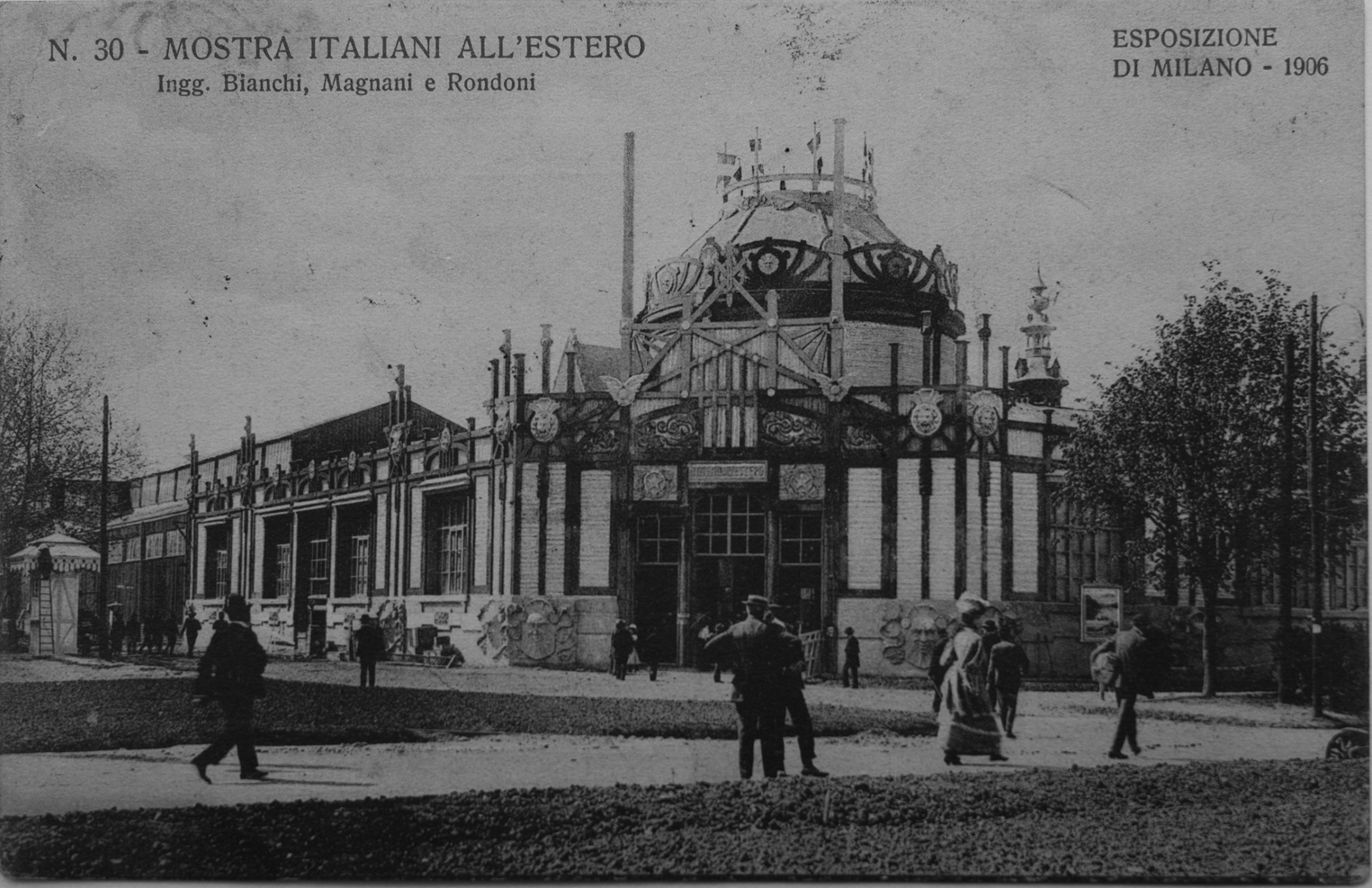
The Exhibition of Italians Abroad became recognised as a highlight among the numerous pavilions (see Fig. 2).Footnote 31 It was initially overlooked in the press, but by the final week a proposal had been put forth to make the pavilion a permanent fixture of the city's cultural landscape.Footnote 32 A feature borrowed from earlier national exhibitions in Genoa and Turin, the pavilion celebrated the achievements of Italian citizens in the Americas and northern Africa, eliding complex discourses about emigration and colonisation to emphasise instead the persistence of Italian cultural practices across a globally dispersed community.Footnote 33 Focusing particularly on displays of Italian-language newspapers, the pavilion also included photographs, statistics and displays by 112 Catholic missions in order to outline the industry and patriotism of Italian citizens living abroad.Footnote 34 Argentina and Eritrea were allowed their own stands within the pavilion, a move that dissolved awkward power distinctions into the more neutral notion of ‘the Italian collective who perform their work outside the confines of Italy’, in the words of the pavilion guide.Footnote 35 As Robert Viscusi has observed, such displays of emigrant activity typically presented Italian emigres in a ‘double optic’: the self-presentation of the diasporic community was balanced with the decisions of various Chambers of Commerce, for whom the exhibition could function as a way to highlight economic opportunities outside Italy for Italian businessmen.Footnote 36 The pavilion at the same time sought to negotiate the delicate balance between the foreign and the diasporic, avoiding exhibits that could be subject to an inconvenient overlap of collective claims – an issue especially important for the awarding of prizes.
Exhibition of Italians Abroad. Author's private collection.

Despite this sensitivity to clear distinctions between national allegiances, however, the achievements of Italian citizens were also prominently on display within a separate South American pavilion that had been specially commissioned by the American consulates in Milan in collaboration with the local government (see Fig. 3).Footnote 37 As Mark Choate has shown, the defeat of Italian military forces at the battle of Adwa in 1896 precipitated renewed calls to develop emigration to the Americas, and (following failed colonial efforts) to develop a ‘new Italy’ (in politician Attilio Brunialti's words) across the Atlantic.Footnote 38 Rhetorical assertions were supported by a complex system of societies, banks, churches, schools and publications that endeavoured to sustain links between Italy and its emigrant populations, contributing to the formation of an Italian identity at times less tarnished by regional rivalries than within Italy itself.Footnote 39 In tune with such ambitions, the official chronicle declared that:
Given the number of Italians who have emigrated and are emigrating (1,500,000 between 1859 and 1905), the Argentinian Republic effectively constitutes a second Italy, more strange and mysterious and about which we know too little and believe we know too much: a second Italy, about which returning compatriots fortunate and unfortunate alike have told things that are too miraculous and too disheartening, because we could understand and judge their basis and truth.Footnote 40
South American Pavilion. Author's private collection.

A recent series of articles by journalist Luigi Barzini in the Milanese Corriere della sera chronicling his visit to Buenos Aires – republished as Argentina vista come è (1902) – had already offered readers a series of deeply contradictory representations of the country, highlighting the poverty and exploitation that existed among Italian emigres alongside the promised riches of the New World. Noting the vast expenditure on public projects and urban expansion, for example, Barzini wryly commented that ‘the important thing is that Buenos Aires maintains its position as the “the second Latin city in the world” – the first, you know, is Paris – and it matters little that finances are ruined, and that debts mount in frightening proportions’.Footnote 41 Elsewhere, Barzini painted a gloomy portrait of life in the immigrant districts of the city, while acknowledging the extraordinary contribution of Italian citizens in developing the infrastructure of an emergent superpower.Footnote 42
Barzini's aim was clearly to demystify Argentina for his Italian readership, and to alert Italians to the hardships that existed in the New World – even if the sheer numbers making the journey across the Atlantic demonstrated the continuing allure of a better life in the Americas. For some Italian emigration officials such a departure of emigrants could even be imagined as a convenient way to regulate the oversaturated Italian labour market, however humiliating the results inevitably were for Italy's international standing.Footnote 43 When parliamentary committees had first met to discuss the issue of emigration in 1888, the Piedmont representative ruefully declared that ‘emigration to America has become a necessity. It is an inevitable evil no one can stop.’Footnote 44 Argentina's ambiguous position as a new Italy across the Atlantic was reinforced elsewhere during the Exposition by sustained news reports on the emigration crisis, a situation that escalated further in the decade leading up to the Great War.Footnote 45 After the Decorative Arts and Architecture pavilions were destroyed by fire on 3 August 1906, Il secolo's coverage of the reconstruction was placed alongside a lead story on the crisis of emigration, ‘the greatest problem of modern Italy’.Footnote 46 Lamenting the many citizens departing the country in order to ‘secure themselves a better fortune in America’, the paper estimated that the total number of emigrants in 1906 alone would be one million – a figure that dwarfed the population of Milan itself, and offered an ironic counterpart to the Exposition's focus on human mobility.Footnote 47
The South American pavilion reinforced the promulgation of a transatlantic Italian identity through numerous parallels with the Exhibition of Italians Abroad. The former featured a statue of Columbus at its entrance in the act of sighting land – a physical reminder of the Italo-centric gaze of the exhibits – while the Argentinian stand in the same pavilion centred around a giant sculpture of Garibaldi on horseback, a monument to the general's time in South America and his involvement in the Uruguayan Civil War. So strong were the parallels, in fact, that in an exchange between La perseveranza and the commissary of the South American pavilion published a few weeks after the opening, the newspaper asserted that ‘many of the exhibits in the Latin American pavilion are Italian, and therefore ought to be displayed in the Italians Abroad pavilion’, concluding that the two pavilions had effectively entered into competition.Footnote 48 Not merely focused on the present and an imagined future, the pavilions traced a shared lineage of Italian mobility and productivity, emphasising a narrative of parallel yet ambiguously hierarchical development. ‘This display, destined to be like the apotheosis of italianità abroad, could not and should not lack a historical part, which recounts past Italian glories: a part dedicated exclusively to the propagation and defence of italianità’, declared the guide.Footnote 49
The tensions inherent in Milan's progressive (and nationally emblematic) self-image were further highlighted in the renaming of prominent thoroughfares during the Exposition's run. Corso Loreto – now one of the city's most prominent shopping streets – was renamed Corso Buenos Aires, while two adjacent squares were renamed Piazza Argentina and Piazza Lima in honour of the nation's relationship with South America. Renowned for its Lazaretto (a quarantine station for travellers), Corso Loreto was associated with movement to and from the city and had become a key part of Milan's popular representation in the final pages of Alessandro Manzoni's novel I promessi sposi (1827). The renaming of the three sites in a ‘South American’ quarter thus recognised the expanded conceptions of travel and cultural interchange that were marking the city by 1906, and did so in a district cut off from the city's medieval centre and already undergoing rapid architectural change.Footnote 50 If the name ‘Corso Buenos Aires’ was a sentimental homage to the millions of emigrants across the Atlantic, the actual choice of location embedded the Americas more immediately in topical notions of the future. As the renaming reminded visitors, the Exposition as a whole was dominated by visual and verbal signifiers of other realities, which nevertheless resided within the more venerable surroundings of the ancient city. Such signifiers drew attention to Milan's position in international cultural, economic and communication networks, while inviting visitors to imagine unseen worlds and hidden realities fleetingly available to them during the Exposition's brief existence.
The Sounds of Milanese Modernity
The musical activities at the Exposition reflected the wider cultural politics of the city during this period. As numerous scholars have noted, Milan's musical life had since the 1870s been marked by the growing internationalism of the operatic repertoire and a sustained emphasis on symphonic music. The civil authorities had sought to expand the range of musical performances presented at La Scala, as part of a wider programme of democratisation and modernisation across Italian theatres precipitated in part by the collapse of public funding.Footnote 51 As Axel Körner has observed, the political power of aristocratic elites after unification was increasingly replaced at a cultural level by that of the educated middle classes, for whom cultural institutions became sites of local self-representation.Footnote 52 As Körner argues, the expansion of the musical (and more specifically operatic) repertoire in theatres across Italy during this period can be seen as part of a wider effort to engage with transnational attitudes towards modernity, ‘by a nation which understood its cosmopolitan orientation as an integral part of its cultural value system, its intellectual ambition and its humanist legacy’.Footnote 53
If the diversification of the repertoire could be construed as a means of participating in a broader European understanding of modernity, however, persistent tropes of crisis – ones that frequently (if problematically) elided Italian operatic decline with post-unification disillusionment – continued to circulate.Footnote 54 Commentary during the years surrounding the Exposition repeatedly returned to ‘the insoluble La Scala question’ – problems that were both economic and artistic, and that continued to reverberate after the temporary closure of the theatre in the 1897–8 season.Footnote 55 The financial pressures of subsidising the theatre, combined with an increasingly militant political atmosphere, which would eventually erupt into workers’ riots in May 1898, had led to the wholesale withdrawal of municipal funding, a situation eventually resolved only by the intervention of private donors. Debates about the future of La Scala in this context circled around several interrelated themes. Questions regarding the vitality of Italy's own operatic tradition, and the appropriate forms of musical modernity, had already rumbled on in the press for several decades, at a time when discussions of musical activity were unavoidably bound up with nationalist rhetoric.Footnote 56 The recent high-profile failure of Madama Butterfly (1904) had cast into doubt Puccini's already faltering position as the most likely heir to Verdi's throne. Economic discussions, meanwhile, exposed uncertainty surrounding La Scala's role in the city's civic politics – as tourist attraction, cultural monument, elite playground or public service.Footnote 57 Even more urgently, perhaps, the dispersion of operatic performers away from La Scala had in recent years brought into question its position as a centre of artistic excellence, and Italy's wider standing as the focus of Italian cultural activity. ‘Those singers, who have turned their minds this way, have found outside of Italy a market that pays them much better … the theatres of America offer – to sing only their favourite operas – what at La Scala you can spend on an entire production’, lamented Il mondo artistico during an ongoing series of articles recounting La Scala's difficulties later in the decade.Footnote 58
In such a context, tours to Latin America had become an especially lucrative activity for impresarios and performers, who could take advantage of the explosion of performance opportunities in cities such as Buenos Aires (compared to the dwindling public funding for opera in Italy) and the differently timed operatic seasons in the southern hemisphere. Such tours could involve the wholesale export of scores, sets and costumes as well as performers, with new productions transferring within months or even weeks. By the 1880s, commentators had already remarked on the ever-growing allure of American fees, which had hastened the decline of Italy's summer and autumn opera seasons. ‘From July or even June well into September, if not halfway through October, the big cities are deserted’, critic Francesco D'Arcais observed. ‘Artists go to Buenos Aires and to Montevideo with the same nonchalance with which they once went from Rome to Bologna or from Milan to Venice.’Footnote 59 Yet Ricordi could still confidently declare in 1885 that his publishing house sat at the centre of a global Italian operatic industry, even if the industry was shadowed by worries of decline.Footnote 60 Nearly two decades later, Ricordi's broadly colonial attitude appeared substantially less assured, as operatic premieres and celebrity performances increasingly took place abroad, and La Scala's own security wavered.Footnote 61 ‘Italian music is a commodity happily exported’, remarked the Corriere della sera in an article covering the re-opening of Buenos Aires's Teatro Colón in March 1908:
If it weren't so, composers, editors and above all our artists would not be able to derive from their virtuosity such great earnings, which reach quite unbelievable heights. This constitutes, it's true, the most beautiful triumph of Italian lyric art, and national pride can feel itself justly satisfied. But every medal has a reverse side, and in this case, it consists of the fact that the stages of the peninsula are being deprived of the best artists, and worse still, real battles will have to be fought, because it's not certain that famous conductors won't also desert the directors’ seats of the best theatres in Italy.Footnote 62
If New York's Metropolitan Opera House offered one obvious rival in an operatic war – one characterised by an alarming ‘inequality … in the arms of battle’ – then Buenos Aires's lavish seasons and spectacular architecture presented another clear and present danger: if things deteriorated any further, ‘the catastrophe of Italian art in its own land would be inevitable’.Footnote 63 Opportunities for Italian singers outside Italy were recorded in regular reprints of foreign reviews and publicity photographs, in ways that had continually highlighted the interconnection of musical centres across Europe and the Atlantic throughout the previous decades.Footnote 64 The earthquake that nearly destroyed San Francisco in April 1906, for example, was widely reported via the figure of tenor Enrico Caruso, then on tour in the city with New York's Metropolitan Opera (rather than participating in the Exposition).Footnote 65 For audiences in Milan, operatic experience was thus inflected to an ever-greater degree by an awareness of Italian opera's global movements, an awareness occurring at unprecedented speed and attuned to Italy's shifting (and uncertain) position within an international hierarchy.
In light of such anxieties, the musical offerings at the Exposition are especially revealing, suggesting the efforts of the city's cultural authorities to position Milan at the forefront of Italian musical modernity, yet in a context that invited a delicate handling of the city's national and transnational affiliations.Footnote 66 A pair of concerts conducted by Richard Strauss at the Exposition was especially widely reported. Precursors to the Italian premiere of Salome in Turin later that year, these concerts featured a selection of Wagner's overtures, works by Weber and Beethoven, and a selection of Strauss's own tone poems; together they were hailed as ‘an artistic event of the first order’.Footnote 67 Strauss's position at the time as a predominantly instrumental composer who had recently gained extraordinary success in the operatic field cast him in an unusual light in the Milanese context: a potential Other through whom Italian musical modernity could be formulated, whose Salome represented an operatic scandal that left older works such as La traviata looking like historical relics.
Yet Strauss's appearances were only the most highly advertised of an extended series of orchestral concerts, organised by the committee overseeing festivities. The most ambitious of these events was the series of weekly concerts directed by Argentinian born Milanese-trained conductor and composer Ettore Panizza in the Exposition's Great Hall, which brought together an orchestra of 100 professors to perform ‘the most difficult works of classical music, with magnificent shading and precise and effective blending’, alongside technical novelties such as a concert for twenty harps.Footnote 68 Panizza's heritage made him an apt choice in light of the Exposition's international purview and its focus on the Italian diaspora: known as both Ettore and Héctor, he was the son of a cellist from Mantua who had trained in Milan before emigrating to Argentina in 1872; he thus embodied a kind of musical homecoming for the Italian emigrant community.Footnote 69 Panizza's Italian-language opera Aurora – set during the Argentinian war of independence – would soon become the first Argentinian opera to be premiered at the Teatro Colón when it reopened, and later became the source of one of Argentina's national anthems.Footnote 70
Alongside all these concerts, choral and military band competitions (both national and international) sought to valorise the ideals of peaceful collective industry that underlay the Exposition's theme, while drawing on a gallimaufry of contemporary operatic hits, from the ‘Ride of the Valkyries’ to Massenet's Esclarmonde.Footnote 71 Yet for some commentators actual Italian music was problematically absent from this celebration of modern musical life: rather than an ‘acoustic signifier of the event's specificity’ – as Annegret Fauser has written of the music at Paris's 1889 Exposition – the soundscape of the Milan Exposition was more an indicator of its interchangeability with other such events, and potentially portended the loss of a specifically Milanese identity.Footnote 72 For La perseveranza:
If one may be allowed to say so, very little, very little indeed, has been done – given the scale and significance of the event – to convey an idea during this great international festival of labour of what there is and what Italy can do under the banner of music, which in our country's history has more immortal pages, which is considered everywhere to be the favourite daughter of this enchanted land, where nature and language are themselves the most exquisite, beguiling melody. What has been done does not lack a certain significance, I do not deny it, but what there is, has always been done elsewhere.Footnote 73
Reflecting the increasingly international focus of Milan's musical life in recent decades, the concert series was thus perceived to have sacrificed local specificity for a more routinely international exposition soundtrack. Overlooking Italy's illustrious past and the innate melody of an ‘enchanted’ land, the Exposition's focus on the present and future had replaced a pastoral fantasy of the nation with an industrial one – a fantasy that risked giving rise to a broader process of national disenchantment. The loss of individuality in commodity culture was evident on a national scale through Italy's participation in an international musical marketplace.Footnote 74
Within the Exposition's pavilions proper, meanwhile, a temporary display of musical objects juxtaposed the latest American innovations in recording technology with prized Italian string instruments. By shifting visitors’ attention from musical performances to musical media, the displays once again highlighted the internationalisation of Milan's musical culture, as well as music's involvement in broader economic and technological networks. Such musical objects existed on the border between the archaeological and the prophetic, as new inventions promised to re-animate the past in ever more precise ways. Paradoxically, however, these objects were frequently left silent, in ways that recall Walter Benjamin's remarks on ‘the enthronement of the commodity in its lustre of distraction’ at Parisian expositions.Footnote 75 More recently, Cristina della Coletta has drawn attention to the prevalence of ‘reality objects’ among the more exotic displays of fin-de-siècle international expositions: items that bore an iconic relationship to realities beyond the boundaries of the Exposition space, encouraging visitors to imagine distant worlds.Footnote 76 Understood in the light of Benjamin's and Coletta's arguments, then, the musical displays seem at one level to underline the intertwining of musical and commercial culture in Milan around the Exposition, and more specifically the mediation of aesthetic experience through capitalist modes of consumption. As Emanuela Scarpellini has suggested, the ‘most majestic architecture created to give dignity and prestige to bourgeois Milan was neither a civil monument … nor a government palace, a museum, nor a traditional work or art, but a shopping arcade’ – the Galleria Vittorio Emanuele II completed in 1877 – indicating that ‘social prestige and economic progress revealed themselves in a commercial form’.Footnote 77 Scarpellini adds that the rhetoric deployed in adverts for the first department stores in Italy frequently drew on the vocabulary of the theatre – sites of social display and sensory discrimination that were already familiar to visitors, and encouraged them to imagine realities far beyond the confines of their immediate physical environment.Footnote 78
If such arguments regarding urban spectacle rehearse observations more typically made in relation to Paris, the overlap between aesthetic and commercial experience in Milan is still more striking in light of the discursive networks that made up Milanese musical life around the Exposition.Footnote 79 As both Giulio Confalonieri and Jutta Toelle have argued, Milan's reputation as an exceptionally musical city was generated at least in part by the transnational circulation of scores and print journalism. But although it was home to Italy's most important musical publishing houses and the site of a uniquely active musical press within Italy, Milan's image of musical vibrancy and La Scala mythology at times concealed its musical deficiencies earlier in the nineteenth century and its financial woes at the beginning of the twentieth.Footnote 80 The constructed nature of its musical identity points towards a specifically Milanese aspect of experience at this time: music as inseparable from discourse about music – or the representation of music as integral to the city's musical identity.Footnote 81 The oft-silent musical displays in the pavilions in some way therefore offered an appropriate counterpart to Milan's wider musical culture: celebrating industrial labour, they invited spectators to imagine sonic worlds unheard or already vanished in time, while also drawing them briefly into an international commodity circuit that shaped contemporary operatic and musical culture.
The freestanding musical displays and the musical exhibits in the Exhibition of Italians Abroad both raised similar critical anxieties, however. Concerns centred on the pavilions’ apparent neglect of Italy's long-standing association with the operatic voice and the global dissemination of Italian musical culture – the ‘memories and documents of our glorious singing in Italy and abroad’.Footnote 82 In a front-page article reviewing the Exhibition of Italians Abroad, for example, Il mondo artistico lamented:
In dealing with something today for the first time at the Milan Exposition that particularly concerns the character of this journal, we find ourselves in an original and strange situation: we must write about something at the exposition which isn't there. … In fact, while they are setting up – or at least so they assure us – a section on musical arts, which we'll review in its own right, we have looked with diligence worthy of Diogenes for the so-called artistic section that forms part of – or perhaps we ought to say should form part of – the Exhibition of Italians Abroad.Footnote 83
As the article goes on to protest, the Exhibition bewilderingly lacked interest in the performing arts. While a small section was devoted to theatre, those displays centred on spoken drama were disappointingly small and often difficult to locate within the pavilion. As Enrico Polese asked in an article published earlier in L'arte drammatica (and cited in Il mondo artistico), ‘if a foreigner succeeded in finding the pavilion (anything can happen in this world!), what would they think of our national theatre?’Footnote 84
Such declarations support Silvana Patriarca's contention that discussions within Italy about national character have been informed to an unusual degree by foreign perceptions of Italian identity.Footnote 85 Yet if spoken theatre was understood as poorly represented at the Exposition, the musical arts fared even worse: ‘“The land of song”, “Italian bel canto”, “the country of sounds”, all the beautiful phrases made to signify Italy, Italy and Italy, do they have an echo in this exposition? No.’Footnote 86 For Il mondo artistico, it was evident that music had been given no role in a pavilion displaying Italy's global triumphs. Indeed, the journal was forced to acknowledge that the Exposition itself could add little to the crown of celebrated Italian performers around the globe, and that the small scale of the artistic exposition was perhaps inevitable. The minor position occupied by the dramatic arts within the Exposition thus aroused conflicting emotions. Music – in this account at least – seems to sit awkwardly within contemporary definitions of Milanese identity: at once integral to the city and nation's self-image, yet irreconcilable with its present-day position in a global order. Particularly revealing, however, is the variety of real and imagined critical voices that the journalist summons up in the article to articulate and contextualise his emotional maelstrom. First of all comes the hypothetical visiting foreigner, for whom the displays would provide a measure of Italy's national theatre; then the presumed intentions of international Italian performers, absent from the Exposition; and later on the imagined foreigner returns in a fantasy of the reactions the musical displays might have aroused:
And yet who better than the singing artist, who has triumphed for years – indeed centuries – abroad wherever they bring the virtuosity of their singing throat, the subtlety of their expression, and their interpretative warmth? And how many interesting memories would have been unable to emerge here, to tell the foreigner once again about our beautiful reputation and to revive in our Italian souls a legitimate pride?Footnote 87
More interesting still are the phrases in quotation marks, intended to express Italy's fundamental relationship with music – phrases that lack an author within the text's polyphony of voices. The union of Italy with music – above all with vocal and theatrical music – hovers uncertainly as a conception between ‘Italian souls’ and visiting foreigners. The idea is nevertheless the site of national self-discovery and self-recollection: an audible lieu de mémoire. This identity, then, is revealed precisely in the encounter with the Other. But what is disclosed at the Exposition is instead an absence, a sonorous vacuum. Without Italian music – that is, music understood as Italian – the Exposition itself was in some sense empty; and as the article concludes, the hope of future musical displays elsewhere can only enable the Milanese ‘to enjoy living again with wishful thinking’, in fantasies paradoxically focused on the reiteration of the past.Footnote 88
Back to the Future
These complaints notwithstanding, the operatic voice was of course not entirely silent around the Exposition. Alongside brief revivals of Manon, Falstaff and Catalani's Loreley, the most contemporary operatic offering in Milan during the Exposition was the premiere of Alberto Franchetti's La figlia di Jorio at La Scala on 29 March 1906. An adaptation of Gabriele D'Annunzio's celebrated play, it was conceived as a union of two of Italy's most prominent artists. Those with an eye for local politics would also have noticed the parallels with the premiere of Franchetti's Cristoforo Colombo, which had featured at the National Exposition in Genoa in 1892 and which re-told the ‘discovery’ of America in honour of its 400th anniversary.Footnote 89 While La figlia di Jorio's plot offered no such concessions to local history, the triumphant premiere of D'Annunzio's play in Milan two years earlier enabled Franchetti's opera to act as a celebration of Milan's theatrical present, and invited commentators from across a wide variety of publications to assess the ease with which Franchetti had responded to the challenge of setting D'Annunzio to music.Footnote 90 Despite the presence of a large international crowd at the premiere, Franchetti's music was largely received as an unnecessary adjunct to the drama. ‘For us the opera has weakened the impression of tragedy’, confessed the Domenica della sera, while later performances elicited only very modest praise.Footnote 91 As an exoticisation of Italy's rural past, D'Annunzio's play offered a glance back at a superstitious, pastoral way of life that the nation (and Milan) was presumed to have long abandoned; yet the opera's negative reception foregrounded the uneasy fit between urban and operatic modernity. The latter increasingly centred on foreign works and the revival of older Italian operas and risked a dissolution of the city's operatic self.
In light of such wide-ranging debates, it is unsurprising that the revival of La traviata at La Scala in early 1906 triggered a number of historical recollections. These shifted between the work and its performance history, memories of Verdi himself, and observations on the changing character of Milan's musical culture.Footnote 92 Verdi's self-fashioning as a musical father figure for the newly founded Italian nation has of course been the subject of much scholarly investigation, and it is an association that was firmly in place by 1906.Footnote 93 Emanuele Senici, Laura Basini and Francesca Vella have recently investigated the (at times fraught) position occupied by Verdi in the Italian national imagination during the final decades of the nineteenth century – a time when efforts to forge national unity and assert imperial might led to widespread disillusionment with the unification project.Footnote 94 As Senici has argued, the mood of national festivity that marked Falstaff's premiere in 1893 was in stark contrast to the opera's muted public reception, a situation that reflected the disconnection between the work's self-consciously modern aesthetic and the nationalistic nostalgia surrounding the event. Both before and immediately after his death, in fact, the popular image of Verdi was inseparable from his relationship with an earlier musical aesthetic – a relationship in which, as Senici writes, ‘Verdi the prophet of the Risorgimento and its last surviving witness stood for an age in which opera was the product of a unified society and a unified culture, an age in which the artist could effortlessly address his fellow artists and the public, Kenner and Liebhaber, at the same time, and aesthetically as well as politically.’Footnote 95 At the Exposition, the privileged status of Verdi's corpus in the national imagination was exemplified by Ricordi's exhibition of a number of his operatic scores alongside those of other Italian masters such as Rossini.Footnote 96 Despite this sacralisation, however, La traviata had not been presented at La Scala since 1893, when three performances had preceded the premiere of Falstaff (the first of which was attended by Verdi himself).Footnote 97 Verdi's equally old Il trovatore (1853) had nonetheless been successfully revived at La Scala in early 1902 under Toscanini's baton, in a controversial effort to dignify an opera by then relegated to the smaller theatres of Milan.Footnote 98 The decision to stage La traviata at La Scala in 1906 was therefore both an act of local remembrance and a more covert one of cultural reconciliation: celebrating not just La traviata but Verdi himself, the performances exhumed an (imagined) earlier age of political and aesthetic unity, while also indirectly trumping Paris's own claims over the figure of Violetta Valéry. In the process, the opera's original premiere in Venice (rather than Milan) was largely passed over; Verdi's earlier compositional aesthetic and his later association with Milan were collapsed into a narrative of unruffled identification of composer with city.
The position of La traviata within the Verdian canon by 1906 was also coloured by more recent operatic developments. Most notably, the giovane scuola's experiments with realist sound and setting had cast Verdi's opera as an unusually prescient precursor, and La traviata had emerged as a persistent reference point for the younger generation of Italian composers.Footnote 99 Stagings of La traviata in Italy and abroad in the previous two decades had also been caught up in this theatrical tide, with a number of productions indulging in nineteenth-century crinolines for Violetta, while maintaining an eighteenth-century outlook for the costumes of the other characters and for the setting.Footnote 100 The decision in 1906 to cast Rosina Storchio in the lead could only heighten the sense that Verdi's opera foreshadowed contemporary operatic developments. Famed as Mimì and Zazà, Storchio was highly familiar in more recent depictions of the underbelly of Paris in Milan and abroad. In January 1902 she had also performed the title role at La Scala in Donizetti's Linda di Chamounix (1842), a work likewise set partly in Paris that offered a precursor to Verdi's later masterpiece. Leopold Mugnone, like Storchio, had not only established himself as a regular fixture in Latin America in recent years, but was also a notable proponent of more recent and self-consciously modern compositions by Mascagni and Leoncavallo as well as Puccini; he had also conducted some of the first performances of Wagner's operas in Latin America. His close friendship with Verdi, and his strong reputation among new Italian composers, at the same time made him a natural choice to conduct the Verdi memorial celebrations – a visible link with the past that also gestured towards possible future paths.Footnote 101
The costumes and staging for the production were designed by Luigi Sapelli, better known as ‘Caramba’. A distinguished Turin costumier, he was later responsible for the majority of La Scala's designs in the 1920s and was initially favoured by Puccini to design the costumes for Turandot; he had also designed the costumes for the 1902 Linda di Chamounix. Sapelli's scenic overhaul of La traviata was widely acknowledged as a break with an earlier tradition, one that sought to confer on the production an unprecedented aesthetic unity (see Fig. 4).Footnote 102 ‘The show pleased everyone in all of its components – a truly new and magnificent show’, declared the Corriere della sera: ‘La traviata has never had a more beautiful or complete scenic staging, nor been performed with greater expressivity or evenness’, while Il secolo more modestly observed that ‘the staging and the wardrobe – costumes not à la Louis XIII as usual, but in the style of around 1845 – was worthy of La Scala’.Footnote 103 Elsewhere, Il mondo artistico expressed relief that the aesthetic inconsistencies of the past had finally been abandoned: ‘That abominable anachronism, decreed by tradition, that performs La traviata with costumes in the style of Louis XIII or of today, or even worse an unrealistic mixture of both, has given way to a wonderful tableau of costumes of the 1840s, which render the drama of Dumas more logical.’Footnote 104 References to ‘the style of today’ suggest that La traviata had occasionally been subject to stagings more overtly influenced by verismo trends; yet if so they had left little trace on Milan's critical community, for whom the opera's staging tradition was firmly wedded to the seventeenth or eighteenth centuries. In drawing the musical and visual components together around a single historical moment, the staging was (for L'arte melodrammatica) ‘a real marvel’: an otherworldly event that almost had the quality of an intercession.Footnote 105
Rosina Storchio as Violetta, Act II; photography by Artico Varischi, 1906. Archivio Storico Ricordi (Archivio Storico Ricordi © Ricordi & C. S.r.l. Milano).

Critical reactions to the production in the Milanese press unanimously declared the performances a glorious memorial to Verdi – in the words of La Lombardia, ‘the last great Italian genius’ – and verbal overlaps between a ‘messa in scena’ and a ‘messa di requiem’ were a recurring thread throughout reviews. For Ars et labor (Ricordi's house organ) the performances were demonstrably a success ‘such as we have not encountered in the glorious annals of the Milanese theatre’; and the historic nature of the occasion – in the sense of actively making history that would be remembered by future generations beyond Italy – emerged in several other accounts.Footnote 106 For La perseveranza, the performance would ‘bring new prestige to the theatre, and add another golden page to the many that constitute the patrimony of our theatre's worldwide fame’.Footnote 107 As Il sole observed, such a performance could only be an object of jealousy for ‘theatres abroad’ – a performance destined to circulate around the globe as part of the theatre's international mythology.Footnote 108Il mondo artistico in turn asserted that the performances had done more than simply celebrate a great composer; they were an act of civic rediscovery:
And we believe the intensity of attention and enthusiasm that alternated during the events of the show the other night demonstrated not only admiration for the opera itself, and the performers, but also an eruption of that Latin spirit that is just below the skin of our public even when they adopt a future-facing attitude. No, our tastes haven't evolved, and we say ‘ours’ because we too are Milanese: they have remained what they were twenty, thirty years ago: they are there still for Linda, for Il trovatore, for Il barbiere di Siviglia, and when we humbly ask for a little Wagner, we do so for reasons of snobbery, and when we enjoy La damnation de Faust, it's in part because of the merits of flying ballerinas or some other no less surprising scenographic trickery.Footnote 109
The production thus revived an earlier historical epoch – one in which Linda and Barbiere had not yet been challenged (even superseded) by international operatic novelties, nor by the symphonic repertoire that would soon dominate the Exposition. References to ‘twenty, thirty years ago’ in turn cast an eye back to the immediate post-unification era – when Milanese (and Italian) identity had seemed more steadily coherent, and could (retrospectively) be imagined as unthreatened by foreign influence. At the same time, critics noted that the performance had in fact confounded the expectations of some audience members by its sheer vitality: as the Corriere della sera argued, many beforehand had feared that the music would seem too old, the style too tired and that the performance was more an act of homage to a fallen master than a living part of Milan's present.Footnote 110 Instead, audiences had been brought back to a vanished era: the production was ‘a return to the past, a return to our youth and to that of our musical art’, as L'illustrazione italiana remarked. ‘The old melodies, that we have sung in our hearts since the first years of our lives, seem reborn, renewed with new charms.’Footnote 111
In the middle of the Verdian festivities, operatic rhetoric unsurprisingly abounded. The event even took on a further quasi-operatic dimension for some visitors, as the production's artistic excellence was mediated through the symbolic position of Verdi himself and the history of Italian opera more broadly. For a reviewer of the second performance, the audience's applause was comparable to a ‘Rossinian crescendo’, slowly but surely increasing in intensity until a final explosion at the curtain calls.Footnote 112 Elsewhere, the overlap between the final act's carnival-time setting and the premiere in late January became the source of journalist speculation: as the critic in La Lombardia suggested, the opera was likely to become the chief attraction of Milan's own carnival celebrations.Footnote 113 Perhaps it was no surprise, therefore, that the only two movements in the opera that were encored were the preludes. As representations of Violetta's illness, the preludes cast the opera as a kind of historical enactment, a nostalgic look back at a beautiful life cut short. At once a theatrical depiction of death and a memorial to a composer, the Traviata production finally locked both into a fantasy of Italian opera in the mid-nineteenth century. For the critic in Il sole, therefore, a performance of La traviata was something that could evoke proud memories of the audience's grandfathers: an event allowing spectators to experience the performance through the gaze of an imagined past.Footnote 114 Rather than being obsolete – a remnant of the past still pointlessly clinging on in the present – the production demonstrated the continued power of Verdi's music to excite Milanese audiences, and the composer's unique relationship with those same audiences; indeed as the Lega Lombardia critic noted, the powerful response of the public was in stark contrast to the poor reception given to recent premieres, which had made La Scala seem a refuge for malcontents.Footnote 115 Only the statues in the entrance, the author asserted, static emblems of Milan's operatic history, had failed to be transformed by the power of the performance.Footnote 116 For Il secolo, audiences left the theatre breathing a sigh of relief – here at last was a durable masterpiece, a work that could transcend time and still move audiences generations after its premiere.Footnote 117
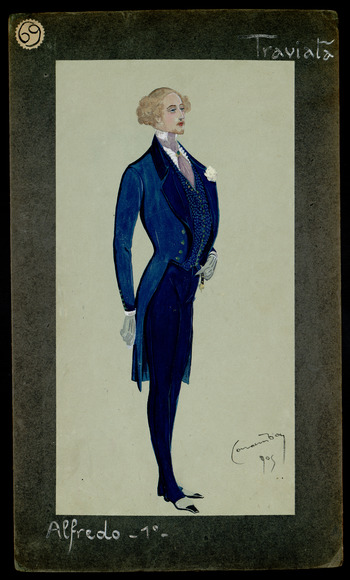
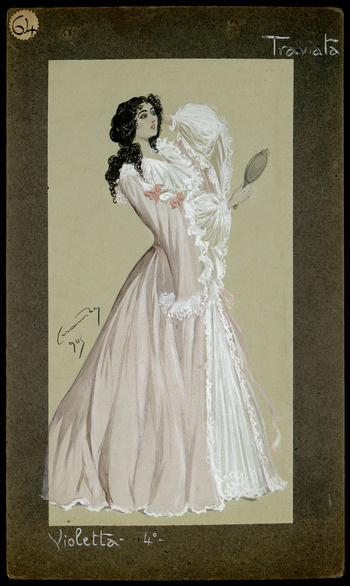
Critical tropes surrounding the production, then, emphasised both the historical importance (and possible critical afterlife) of the production and the varying degrees to which audience members were sutured into the production's fantastical imagination of the operatic past – compelled to participate in a collective memorialisation in ways that at times blurred distinctions between the work and the performance event. Indeed, the historical distance from the opera's premiere also encouraged reflections on the opera's own journey in the intervening years, the ‘path of glory’ that the opera had traversed from its debut in Venice in 1853 to its Milanese revival in 1906.Footnote 118 At the same time, however, the production's reality-effect was also periodically disturbed for some commentators by the traces of present-day performance practice that tore through the dramatic surface. This created a sense that, notwithstanding the production's aims of precise (albeit ersatz) historical re-enactment, both the vocal qualities of the singers and the opulence of the stage designs were in conflict with the imagined modesty of the operatic past. Not merely a museum piece, the work's fluid ontology raised problems for those who could see the trace of the present day all too clearly in the performance. For the Lega Lombardia, for example, the new costumes and scenography could not conceal that both the choice of voice types and the opulence of the stage designs were in conflict with the audience's imagination of the 1840s, to the point of almost invading the ‘homely and modest spirit of our classical work’.Footnote 119 The Gazzetta dei teatri similarly lamented that the staging was excessively opulent and anachronistic, despite the production's outward claims to realism, and notwithstanding its seductive visual beauty.Footnote 120 Surviving sketches of figurines from the production do indicate a surprisingly rich royal blue outfit with neck tie for Alfredo in Act I, and an ostentatious pink and cream dress for Violetta in the impoverished setting of the third act; the Act II gypsies similarly sport outfits more suited to Ottoman royalty, suggesting that efforts at historical accuracy in the production were intertwined with a clear desire for luxury display (see Figs. 5 and 6).Footnote 121 Storchio's performance elsewhere came in for extravagant praise by many journalists; and yet the attention lavished both on the soprano and on the conductor underlined precisely those elements that belonged to the post-Verdian era. If the conducting of Mugnone was enough to prompt one writer to wish that Verdi had been there to attend the performance – ‘to embrace him, he who loves and admires Verdi so much’ – then trends in modern performance were nevertheless obtrusive enough partially to break the spell.
Alfredo, Act I; costume design by Caramba. Archivio Storico Ricordi (Archivio Storico Ricordi © Ricordi & C. S.r.l. Milano).

Violetta, Act III; costume design by Caramba. Archivio Storico Ricordi (Archivio Storico Ricordi © Ricordi & C. S.r.l. Milano).

Revived for the opening of the Exposition later that spring, the 1840s setting of the 1906 Traviata production on one level echoed other historical re-enactments and exotic entertainments found within international expositions more generally: examples of ‘spectacular visual-virtual ersatz realities’ (in Geppert's words), that also sometimes included early period-performance experiments.Footnote 122 Understood in the context of the Exposition's other displays, the overlap between La traviata's tragic narrative and the audience's heightened involvement in the staging – the collective fulfilment of an operatic funeral rite – could seem to offer an enticing parallel to the blurring of spaces associated with the Exposition previously mentioned: the operatic past and the Milanese present interacting in the space of the theatre, with both transformed by the encounter. Rather than maintaining a historical distance, many audience members were instead immersed in an alternative operatic reality, brought headily back to the 1840s and all the associations of an operatic golden age. Interpreted in the context of the Exposition, La traviata would also seem especially appropriate for a meditation on the spectacular dimensions of modern Milanese reality: not merely set in Paris (and preoccupied with the collective social gaze), the opera also continually collapses the divide between interior physical space and urban sound, transforming Violetta's body into a resonant echo chamber for her Parisian milieu.Footnote 123 Understood in those terms, the Traviata production could offer contemporary audiences an operatic revival that functioned as a kind of operatic ‘reality object’ – briefly turning them from detached observers to active participants in a Verdian commemoration through the partial collapse of historical distance.Footnote 124
Yet I would suggest it is precisely the ruptures and breakdowns in the production's verisimilitude, and the audience's awareness of a historical fiction, that are ultimately most revealing. As previously outlined, La traviata's position as a proto-verismo work (and thus a pre-eminently modern opera) could only be enhanced by its updating to the mid-nineteenth century; repeated references to the ‘realism’ of Storchio's performance throughout reviews underline precisely such a mediation of La traviata through later operatic works. The presence of both Storchio and Mugnone was moreover an indelible reminder of the future paths being taken by Italian opera and Italy itself in the New World, ones dramatically – indeed permanently – played out in Milan's urban landscape. While surviving reviews of the Traviata production make little mention of the performers’ other appearances, the exceptionally active theatrical press in Milan – reprinting telegrams on the opening nights of Storchio's performances in Argentina – ensured that international performances were almost as heavily mediated as those in Milan itself; indeed, Storchio's La traviata in Buenos Aires that summer was extensively reported.Footnote 125La traviata itself was furthermore an opera that was at once undeniably Italian (and retrospectively Milanese, through Verdi's history with the city), yet also quintessentially international by virtue of its plot and reception history. If Verdi's opera had once sought to capture the decadence of mid-nineteenth-century Paris, La traviata was now the object of multiple histories and national appropriations – a work whose mobility made it a natural yet also complex, even problematic, work for Milanese celebrations.
It was precisely this paradoxical position occupied by the 1906 staging, I would suggest, that accounted for its impact: its capacity to act as a kind of operatic diorama, one that could shift via the audience's perception between Milan's operatic past, a partial – yet still historically distanced – renovation in the present, and its possible future, international paths, paths that were nevertheless historically bound up with Italy in ways that complicated straightforward notions of progress or ‘renewal’. At once nostalgic and forward-looking, the production simultaneously provided audiences with a variety of possible degrees of historical and imaginative distance. It could be heard both as a brief revival of the Verdian past (something alluring and inescapably alien) and as a distinct break with operatic tradition – a performance that looked and sounded new, that signified Italian opera's future in both its echoes of contemporary works and the American profile of its performers, however much it was founded on the re-invention of the operatic past. It is in this interplay, then, that the production most persuasively offers an analogy with the Exposition's own historical and spatial imagination – not simply through its implication of the Milanese public in the theatrical event, but in the over-layering of different historical and geographical strata within the production itself. It was precisely these different dimensions of the production – the multiple anachronisms that persisted within the production and in relation to its performance space, despite its surface unity – that created a multitude of viewpoints for spectators. Ultimately, the production's success was rooted in its capacity to compress a number of contemporary operatic preoccupations into one aesthetic experience, in a way that was profoundly attuned to the Exposition's theatrical, Milan-centred configuration of time and space. The exposition, the city and the opera house emerge as markedly similar and mutually revealing sites of performance. If the wider musical life of the Exposition offered a problematic image of Milanese modernity for some visitors, this La traviata could offer a site of articulation for these contemporary operatic concerns – the Milanese operatic chronotope in material form.Footnote 126
Viva Verdi
On 11 November 1906, the Exposition finally closed. Despite discussions concerning the future of the Exhibition of Italians Abroad, the Exposition's only permanent legacy within the city was the fish farming pavilion that now houses the city's aquarium. By November, Storchio and Mugnone had returned from their regular tour to Latin America and La Scala was busy preparing its new season with Carmen and the much-anticipated premiere of Salome. La traviata, though, continued to prosper with Caramba's designs, even if the work chosen for Verdi's centenary celebrations at La Scala in 1913 was Nabucco: an opera heavy with Risorgimento mythology and also intimately identified with Milan. Soon the ‘Luigi XIII’ tradition would drift into operatic history, replaced by staging trends never witnessed by Verdi in his lifetime, that nonetheless came to embody a vaguely defined notion of historical authenticity. Removed from its original context, the ‘1840s’ staging became normalised and eventually every bit as familiar as the c.1700 setting had previously been; in an ironic foreshadowing of the Zeitoper movement two decades later, the effort to be retrospectively up to date doomed the production to be stranded in one historical moment.Footnote 127 Yet, as previously outlined, the Traviata production's contemporaneity was already a half century out of step when it was premiered in 1906, positioning the staging in the curious state of the conditional perfect. Whereas the recording technologies and musical instruments on display at the Exposition promised to reproduce sounds in the future, the production instead offered something that had never been – something nevertheless experienced as an extraordinary moment of civic operatic commemoration.
The implications of this, I would contend, are specific to Milan (and ideas of italianità) and yet also more generally revealing of the period. Considered in the context of the Exposition, the 1906 La traviata at one level suggests that preoccupations about the past and the future within Milanese contemporary society and musical culture should be considered more closely through the lens of geography, and the growing importance of the Americas. Questions about the city's identity, and the relationship between Italian identity and music, were continually interrogated by means of the emergence of cities such as Buenos Aires, a new Italy here represented by Mugnone and Storchio. Understood in these terms, the 1906 Traviata production might therefore be considered exemplary of the particular set of spatial preoccupations and associations attached to operatic spectatorship in Milan around the Exposition, and more generally during this period – associations that were here bound up with constructions of italianità and its contemporary circulation across the Atlantic. Only through a more mobile history of early twentieth-century Italian opera, I would argue, can the performance's local impact truly be accounted for.
The success of the Traviata production – and its kinship with the Exposition – thus offers an important reminder to pay greater attention to the importance of geography when considering operatic performances – an attentiveness not just to physical location (and an immediate set of architectural semiotics), but also to the wider cultural and imaginative networks within which performances take place.Footnote 128 On a local level, in other words, the production's success can draw us closer to a more historically and geographically informed understanding of operatic spectatorship in Milan at this time – to the nexus of associations and meanings that constituted operatic experience for audiences, and in particular their relationship with vexed notions of italianità. In a Lefebvrian vein, this set of ideas might even be termed the spatial (or global) imaginary of operatic spectatorship in Milan: a geographical imagination relating to opera in the city, that was here theatrically embodied by the 1906 Traviata, alongside all the historical associations that Verdi and Traviata also triggered. Yet in addition to the specific example of Traviata and Milan, such an attentiveness to geography can alert us to the spatial encounters that individual performances provided for audiences in this period, encounters that extended from the proscenium and stage to the operatic world beyond: the imaginative world constructed by the performance event. The La Scala Traviata can thus encourage us to think more carefully about the specific interventions that opera can make in local and collective understandings of space, and the temporal associations such constructions can prompt. The staging did more than simply tune in to a particularly Milanese operatic Zeitgeist and set of concerns about the operatic future. It implicitly made a claim for opera – and operatic production – in negotiating global relations as a way to calibrate and assess forms of cultural and historical affiliation. And it did so at a moment when the international mobility of the operatic canon made the re-fashionability of operatic works a particularly resonant site for cultural stock-taking.Footnote 129
What is ultimately at stake here is therefore an early instance of operatic ‘glocalisation’: the recreation of globalised commodities in local ways, here by the very nation that first produced the operatic commodity. Yet more interestingly, perhaps – and more specifically theatrical and operatic in dimension – is the emergent sense of opera's power to exemplify particular localities on an experiential level. Like the exposition, the production was an immersive, theatrical event that reflected a particular imagination of time and space within a distinct locale – a production in which perceptions of past and future were bound up with specific geographical ties. Rather than simply reflecting local tastes through the adaptation of costumes or texts, the performances instead created a specifically Milanese imaginative world, in a way profoundly similar to the exposition. Operatic production, within the 1906 Traviata, emerges as a site in which perceptions of historical change and geographical meaning can be embodied in a spectacular form – one implicating the audience in a process of self-discovery and re-invention.
This is not to credit Caramba, Storchio, Mugnone, the La Scala management (or for that matter Verdi himself, beyond the grave) with singular agency or a specific agenda, but rather to locate the production's collective impact precisely in its resonance with local cultural politics. Although the mise en scène was always already out of date, the production was supremely of its time: in its memorialisation of Italy's operatic past and its assertion of Verdi's unique relationship with Milanese cultural identity; in its valorisation of Paris and its efforts at modernisation; and in the American future promised, yet also threatened, by its lead performers. The parallels between the Exposition and the Traviata production are ultimately revealing not because of any explicit forms of authorial intention, but because both events emerged from a distinct local set of preoccupations. Their contiguity sheds light on opera's particular affordances at this historical moment. If expositions functioned as fleeting cities, ones that briefly echoed and transformed the cities in which they were erected, then operatic performances could on occasion act as fleeting expositions – phantasmagoria that fluctuated between past and present, local and global, and that had the potential to reconfigure audiences’ relationships with time and space.
Perhaps attending to a historical moment such as the 1906 Traviata – an event with tantalising if incomplete echoes of more radical latter-day experiments in operatic updating – might also alert us to some of the other less visible yet no less important agents in shaping later operatic developments. To the role of local politics and local preoccupations in shifting theatrical culture; to performers, audiences, journalists and civic authorities as constitutive forces in shaping a discursive framework for a production's novelty; and to the importance of operatic production as a site of urban redefinition and reinscription. Shifts in operatic staging, in other words, might be reconsidered in terms of a new understanding of a globalised operatic repertory and operatic community, in which perceptions of a local musical culture were being rapidly reshaped.Footnote 130 Within Milan, such an interplay of different forces is outlined in a Traviata production that at once memorialised the operatic past, yet also traced possible paths for opera's future, in ways that echoed the Exposition's own Milanese imagination. Above all, attending to such inchoate experimentalism might alert us to opera's scope for textualising or embodying local, national and transnational relations at the fin de siècle, and for operatic production's capacity to reclaim or remake local conceptions of global space. The production's significance ultimately resides in its ambiguous position, caught on the cusp between nostalgia and an orientation towards the future, between a world already passed, and one yet to come.