Implications
Maintaining semen quality characteristics of rabbit bucks throughout heat stress period is required crucially in the subtropics. Particularly, the heat stress period extends >6 months, during which production is affected adversely. Moringa oleifera, the miracle tree, overwhelms several bioactive phytogenic compounds that act biologically as antioxidant, antibacterial, anti-carcinogenic and anti-inflammatory agents. This study aimed to investigate the ability of ethanolic extract of Moringa leaves on maintaining heat tolerance, oxidative status and semen quality of rabbit bucks under subtropical summer season conditions.
Introduction
Good semen quality is required for achieving adequate fertility in mammals (Dalton, Reference Dalton2011). Improper environmental cues lead to decreases in semen quality and fertility of farm animals (Rasooli et al., Reference Rasooli, Jalali, Nouri, Mohammadian and Barati2010). Heat stress is one of the most environmental disruptors to the reproductive functions of male rabbits as inferred by declining conception rate and litter size at birth after mating with males exposed to heat stress during summer season compared with winter season (Marai et al., Reference Marai, Habeb and Gad2008). High ambient temperature stimulates the hypothalamo–pituitary–adrenal axis activity evoking the sympathetic system functions, which increase levels of free radicals and imbalances in the antioxidant-defense system (Agarwal et al., Reference Agarwal, Makker and Sharma2008; Ahmad et al., Reference Ahmad, Rasheed, Gupta, Singh, Siripurapu, Ashraf, Kumar, Chand, Maurya, Banu, Al-Sheeha and Palit2012). Accumulations of the free radicals have been associated with significant decreases in sperm motility and sperm plasma membrane integrity, and significant increases in sperm abnormality and DNA damage leading to infertility (Potts et al., Reference Potts, Notarianni and Jefferies2000). Maintaining semen quality characteristics of rabbit bucks throughout heat stress period is required crucially in the subtropics. Particularly, the heat stress period extends >6 months during which production is affected adversely (Hashem et al., Reference Hashem, AbdEl-Hady and Hassan2013).
For practical, safe and economical application, different natural feed resources have been used to counter negative impacts of heat stress on semen quality of male rabbits (Elnagar, Reference Elnagar2010; Hashem et al., Reference Hashem, AbdEl-Hady and Hassan2013). M. oleifera belonging to the Moringaceae family has been used as a source of plant antioxidants. It contains considerable levels of antioxidant vitamins (β-carotene, vitamin C and vitamin E) and polyphenols. This combination makes their antioxidant activity higher than that of conventional antioxidants such as ascorbic acid (Yang et al., Reference Yang, Tsou, Lee, Chang, Kuo and Lai2006). Ethanolic extract of M. oleifera leaves has been also known to contain growth enhancing principles, antibacterial, anti-carcinogenic and anti-pest agents (Makkar et al., Reference Makkar, Francis and Becker2007). Previous studies showed the ability of M. oleifera ethanolic extract (MLEE) to enhance libido and sperm quality (Prabsattroo et al., Reference Prabsattroo, Wattanathorn, Iamsaard, Muchimapura and Thukhammee2012), and to improve sexual activity and testosterone level in immobilization-stressed male rats (Prabsattroo et al., Reference Prabsattroo, Wattanathorn, Iamsaard, Somsap, Sritragool, Thukhummee and Muchimapura2015). Detection of different phytochemicals in Moringa plant and its possible biological effects are warranted to confirm its importance as a natural supplement for farm animals. Therefore, this study aimed to investigate the efficiency of ethanolic extract of M. oleifera leaves to improve physiological responses and semen quality of rabbit bucks under summer heat stress based on its chemical constituents.
Material and methods
Plant extraction and identification of chemical constituents
Packaged M. oleifera leaves powder was purchased from the National Research Center, Dokki, Egypt. According to the Research Center information, Moringa leaves were collected in September (second cutting) from Northwestern Egypt, dry subtropical climate (31°11′53″N, 29°55′9″E). Leaves were dried naturally until reaching 87% dry matter, and were then milled through 1 mm screen. Each 250 g of the M. oleifera leaves powder was extracted in 1000 ml of 70% hydro-ethanolic solution at 40°C for 72 h. The extract was filtered with Whatman No. 1 filter paper (Camlab, Cambridge, UK). The collected filtrate was evaporated to complete dryness at 45°C. The residues were then stored at −20°C pending use. Chemical constituents of M. oleifera leaves ethanolic extract were determined using gas chromatography/MS (Thermo Scientific TRACE-1300 series GC; Thermo Fisher Scientific Inc., Austin, Texas, USA), fitted with a fused silica DB-5 capillary column (30 m×0.32 mm id, 0.25 μm film thickness; Thermo Fisher Scientific Inc.), and coupled to a Triple Quadrupole Mass (TSQ 8000 Evo; Thermo Fisher Scientific Inc.). Column temperature was 40°C, with 5 min initial hold and then increased to 270°C at 2°C/min, and finally at 270°C for 20 min. Splitless injection mode (0.5 μl of a 1 : 1000 methanol solution) was used. The carrier gas was helium with 1.0 ml/min flow rate. The injector and detector temperatures were 250°C and 290°C, respectively. Mass spectra were scanned in the range 40 to 700 amu, the scan time was 5 scans/s. The constituents were identified by the combination of retention index data and mass spectra data using Mainlib library.
Animals’ management and experimental groups
Rabbits used in this study were of V-line. It is a maternal line originated in 1981 at the Department of Animal Science of the Universidad Politecnica de Valencia, Valencia, Spain. Litter size at weaning was considered as the criterion for selection in this line. A total of 28, 7-month-old, male rabbits, having an average BW of 3.28±0.18 kg were used in the present study. Bucks were individually housed in galvanized wire cage batteries with standard dimensions (40×50×35 cm) in a naturally ventilated and lighted rabbitry. Bucks were fed on a pellet diet containing (g/kg) 180 barley, 250 wheat bran, 60 yellow corn, 180 soybean, 280 alfalfa hay, 30 molasses, 10 CaCo3 and 10 NaCl (18.90% CP and 10.25 MJ/kg digestible energy), covering their daily nutritional requirements according to National Research Council, (1977). Clean tap water was offered ad libitum. Bucks were randomly allocated into four homogenous equal groups (n=7) according to the level of supplemented MLEE. Each buck in the first group (M0) was given orally (per os) 1.5 ml of water (placebo) and served as control, whereas bucks in the other three groups were given orally 1.5 ml of water containing 50 (M50), 100 (M100) and 150 (M150) mg/kg BW MLEE. Treatments were applied every other day for 12 consecutive weeks (from mid-July to mid-October).
Climatic parameters
Ambient temperature and relative humidity were recorded twice (at 0600 and 1400 h) daily during the entire experimental period using a hydrothermograph located in the rabbitry. The values of ambient temperature and relative humidity of each day were used to estimate the daily mean of each parameter. The temperature–humidity index (THI) was calculated using the equation: THI=db°C−[(0.31−0.31(RH)) (db°C−14.4)], where db°C is the dry bulb temperature and RH the relative humidity percentage/100 (Marai et al., Reference Marai, Habeb and Gad2001). Daily photoperiod (daylight length) was obtained from a nearby Meteorological Station.
Physiological parameters and blood serum biochemical analyses
Weekly BW (kg) and feed intake (g/buck) and biweekly rectal temperature (°C) were recorded during the entire experimental period.
Blood samples were collected biweekly with non-heparinized tubes from the ear vein of each buck during the entire experimental period. Serum was obtained by centrifugation at 700×g for 20 min and stored at −20°C. Total protein, albumin, glucose and total lipids were determined in blood serum using colorimetric method by commercial kits (BioSystem S.A., Barcelona, Spain). Globulin concentration was estimated by subtracting albumin values from the corresponding values of total protein. At the end of the experiment, an additional blood sample was collected from each buck and blood serum was immediately analyzed for total antioxidant capacity and glutathione-S-transferase (GST) using commercial kits (Biodiagnostic, Giza, Egypt). The testosterone concentration in blood serum was measured using enzyme immunoassay commercial kit (Monobind Inc., Lake Forest, USA). The lower limit of assay detection was 0.057 ng/ml. The intra- and inter-assay CV were 6.73% and 8.90%, respectively.
Semen collection and evaluation
Semen samples were collected weekly using an artificial vagina and a teaser doe. The reaction time was the time interval from a doe insertion into the cage of buck until complete ejaculation. It was measured in seconds using a stopwatch, and was considered as an indication of libido. The volume of each ejaculate was recorded using a graduated collection tube after removal of the gel mass. Sperm concentration was determined after semen dilution (1 : 100) using the improved Neubauer hemocytometer slide (GmbH+Co., Hamburg, Germany). Assessment of live, dead and abnormal sperm was performed by counting 200 sperm cells using an eosin–nigrosine blue staining mixture. Complete or partial purple-stained sperm cells were considered non-viable, whereas non-stained sperm cells were considered viable. The percentage of motile sperm (% of forward motility) was performed in several microscopic fields for each semen sample by a visual examination under 100× magnification using a light microscope with heated stage and subjectively assessed from 0% to 100%. The percentages of sperm cells with intact acrosome were evaluated in dried semen smears stained with naphthol yellow S and erythrosin B. The presence or absence of the acrosomal cap in 200 sperm cells were recorded and classified to intact and non-intact acrosome sperm cells. The hypoosmotic swelling test was used to evaluate the functional integrity of the sperm plasma cell membrane. The assay was performed by incubating a mixture of 30 µl semen with a 300 µl hypoosmotic solution (0.90 g fructose plus 0.49 g sodium citrate per 100 ml of distilled water; 100 mOsm/kg) at 37°C for 1 h. A total of 200 sperm cells were counted (100× magnification) under light microscope. The percentages of sperm with swollen and curled tails (functional integrated sperm plasma membrane) were recorded.
Seminal plasma was obtained by centrifugation of semen samples at 700×g for 20 min. The samples were stored at −20°C, pending analysis. The initial fructose concentration in seminal plasma was determined immediately after collection using commercial kits (Biodiagnostics). The concentrations of seminal plasma total protein, albumin and total lipids were measured colormetrically (BioSystem S.A.). Seminal plasma globulin concentration was obtained by subtracting the values of albumin from the corresponding values of total protein. Activities of seminal plasma aspartate transaminase (EC 2.6.1.1) and alanine transaminase (ALT) (EC 2.6.1.2) were also determined (BioSystem S.A.).
Statistical analysis
The square root transformation was used to normalize all data expressed as percentages. Biochemical parameters of blood serum and seminal plasma, feed intake, rectal temperature and semen characteristics were analyzed using MIXED procedure for repeated measurements of Statistical Analysis Systems Institute (2001). In the statistical model, treatment, time of sampling or time of data collection and their interactions were introduced as fixed factors, whereas buck individual was introduced as a random factor. GLM was used to determine the effect of treatment on the total antioxidant capacity and GST. Also, orthogonal contrast statements were designed to test linear, quadratic or cubic responses of each depended variable to different levels (0, 50, 100, 150 mg/kg BW) of MLEE. The confidence interval was estimated for each dose-response curve. The least dose of MLEE that resulted in the highest response (improvement or reduction) in the investigated parameter within the confidence interval was considered the recommended dose. Differences among treatment groups were tested by the Duncan’s new multiple range test. All results were expressed as mean (±SEM). The statistical significance was accepted at P<0.05.
Results
Bioactive constituents of plant extract
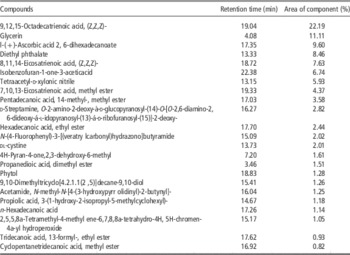
The gas chromatography/MS analysis of MLEE revealed the presence of 23 bioactive phytochemical constituents (Table 1), of which nine compounds representing 45.7% of the total area were fatty acids. The most prevailing major compound was the fatty acid 9,12,15-octadecatrienoic acid, (Z,Z,Z)- (22.19%). Also, glycerin (11.11%); l-(+)-ascorbic acid 2, 6-dihexadecanoate (9.60%); diethyl phthalate (8.46%); 8,11,14-eicosatrienoic acid, (Z,Z,Z)- (7.63%); isobenzofuran-1-one-3-aceticacid (6.74%) and tetraacetyl-d-xylonic nitrile (5.93%) were detected.
Chemical composition of ethanolic extract of Moringa leaves detected by gas chromatography/MS

Climatic parameters
The mean of ambient temperature, relative humidity and THI and daylight length (photoperiod) during the experimental period were 30.43±0.40°C, 75.37±0.83%, 29.16±1.24 and 12.54±0.82 h, respectively (Table 2).
Mean (±SEM) ambient temperature (°C), relative humidity (%), temperature–humidity index (THI) and photoperiod (h) during the experimental period

a,b,c,dMeans within a row with different superscript letters are significantly different (P<0.05).
Effects on body weight, feed intake and rectal temperature
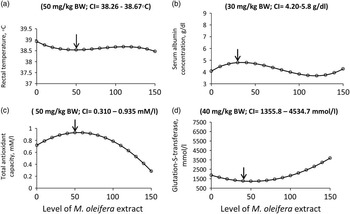
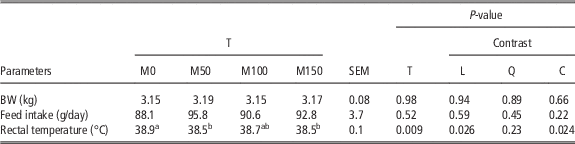
Treatment with different levels of MLEE did not affect the mean BW of bucks or feed intake (Table 3). Mean rectal temperature of rabbit bucks was cubically (P<0.05) affected by the treatment (Table 3 and Figure 1a). The least rectal temperature was observed in the M50 group compared with the other groups.
Dose-response curve and confidence interval (CI) of rectal temperature (°C) (a); serum albumin (g/dl) (b); total antioxidant capacity (mM/l) (c) and glutation-S-transferase (mmol/l) (d) for different levels of Moringa oleifera leaves ethanolic extract. Arrow refers to the optimum level of extract for each parameter.

Effect of different levels of ethanolic extract of Moringa oleifera leaves on BW (kg), feed intake (g/day) and rectal temperature (°C) of rabbit bucks during the experimental period (mean±SEM)

T=treatment; L=linear response; Q=quadratic response; C=cubic response.
M0, M50, M100 and M150=0, 50, 100 and 150 mg/kg BW ethanolic extract of M. oleifera leaves, respectively.
Means of BW and feed intake are average of seven replicates determined weekly during the experimental period (from mid-July to mid-October).
Means of rectal temperature are average of seven replicates measured biweekly during the experimental period (from mid-July to mid-October).
a,bMeans within a row with different superscript letters are significantly different (P<0.05).
Effects on blood serum biochemical attributes
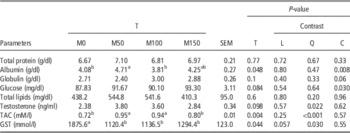
Effects of the treatment on blood serum biochemical constituents, testosterone concentration and antioxidant attributes are shown in Table 4. The treatment did not affect blood serum concentrations of total protein, globulin and total lipids. Concentrations of glucose and testosterone in the blood serum tended to be affected by the treatment (P=0.084 and 0.098, respectively), the greatest concentrations of both parameters were for the M50 group. Blood serum concentration of albumin was affected cubically by the treatment (Figure 1b), the greatest concentration of blood serum albumin was for the M50 group. Concentrations of total antioxidant capacity (TAC) and GST in the blood serum were affected quadratically by the treatment, the greatest concentration of TAC and the least concentration of GST were recorded at 50 and 40 mg/kg BW of MLEE, respectively (Figure 1c and d).
Effect of different levels of ethanolic extract of Moringa oleifera leaves on chemical constitutes of blood serum of rabbit bucks during the experimental period (mean±SEM)

T=treatment; L=linear response; Q=quadratic response; C=cubic response.
TAC=total antioxidant capacity and GST=glutathione-S-transferase.
M0, M50, M100 and M150=0, 50, 100 and 150 mg/kg BW ethanolic extract of M. oleifera leaves, respectively.
Means are average of seven replicates measured biweekly during the experimental period (from mid-July to mid-October).
Concentrations of TAC and GST were determined in seven replicates one time at the end of the treatment.
a,bMeans within a row with different superscripts are significantly different (P<0.05).
Effects on semen quality and seminal plasma biochemical constitutes
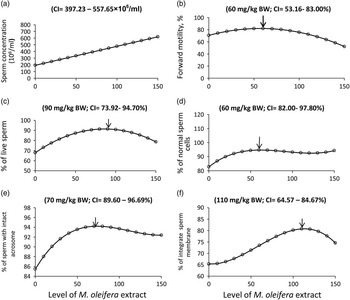
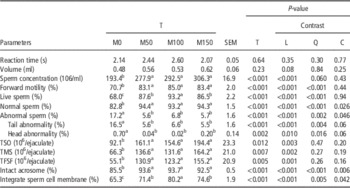
Treatment with MLEE did not affect reaction time or semen volume. Ascending levels of MLEE increased linearly (P<0.01) sperm concentration (Figure 2a), total sperm output, total motile sperm and total functional sperm fraction (Table 5). However, the differences between the three levels of MLEE (50, 100, 150 mg/kg BW) were not significant (Table 5). Forward motility was increased significantly in the three treatment groups compared with the control group; regression analysis showed that the greatest forward motility was at 60 mg/kg BW of MLEE (Figure 2b). The greatest (P<0.05) percentage of live sperm cells was recorded in the M100 group. Percentage of the normal sperm cells was affected cubically by the treatment, the greatest value was observed at 60 mg/kg BW of MLEE (Figure 2d). Percentage of sperm cells with intact acrosome was significantly higher in the three treatment groups compared with the control group (Table 5), regression analysis showed that the greatest value was at 70 mg/kg BW of MLEE (Figure 2e). The greatest (P<0.05) percentage of sperm with integrate cell membrane was observed in the M100 group compared with the M0, M50 and M150 groups (Table 5).
Dose-response curve and confidence interval (CI) of sperm concentration (106/ml) (a); forward motility (%) (b); sperm viability (%) (c); sperm normality (%) (d); intact acrosome sperm cells (%) (e) and integrate sperm membrane (%) (f) for different levels of Moringa oleifera leaves ethanolic extract. Arrow refers to the optimum level of extract for each parameter.

Effect of different levels of ethanolic extract of Moringa oleifera leaves on reaction time and physical parameters of semen of rabbit bucks during the experimental period (mean±SEM)

T=treatment; L=linear response; Q=quadratic response; C=cubic response.
Total sperm output (TSO)=semen ejaculate volume (ml)×semen concentration (106/ml); total motile sperm (TMS)=percentage of motile sperm×total sperm output (106/ejaculate); total function sperm fraction (TFSF)=total sperm output (106/ejaculate)×percentage of forward motility×percentage of normal sperm morphology.
M0, M50, M100 and M150=0, 50, 100 and 150 mg/kg BW ethanolic extract of M. oleifera leaves, respectively.
Means are average of seven replicates determined weekly during the experimental period (from mid-July to mid-October).
a,b,cMeans within a row with different superscript letters are significantly different (P<0.05).
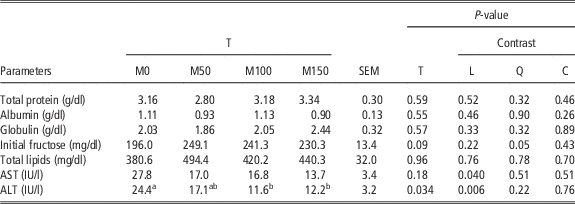
Effects of different levels of MLEE on seminal plasma chemical constituents are shown in Table 6. Supplementing MLEE did not affect concentrations of seminal plasma total protein, albumin, globulin and total lipids. Initial fructose tended (P=0.092) to be higher in the treatment groups than the control group. Concentration of seminal plasma ALT was decreased significantly in M100 and M150 groups compared with the M0 group.
Effect of different levels of ethanolic extract of Moringa oleifera leaves on chemical constitutes of seminal plasma of rabbit bucks during the experimental period (mean±SEM)

T=treatment; L=linear response; Q=quadratic response; C=cubic response. AST=aspartate transaminase and ALT=alanine transaminase.
M0, M50, M100 and M150=0, 50, 100 and 150 mg/kg BW ethanolic extract of M. oleifera leaves, respectively.
Means are average of seven replicates determined biweekly during the experimental period (from mid-July to mid-October).
a,bMeans within a row with different superscript letters are significantly different (P<0.05).
Discussion
Alleviation of heat stress negative impacts on livestock is a major challenge in subtropical regions, particularly when high temperature is combined with high humidity. Temperature–humidity index obtained in the present study indicated that rabbit bucks suffered from severe heat stress (28.9 to <30.0; Marai et al., Reference Marai, Habeb and Gad2001). Rabbits do not have enough functional sweat glands to lose excess produced heat. Thus, the heat stressed rabbits have high rectal temperature. In this study, bucks supplemented with MLEE had lower rectal temperature compared with the non-supplemented bucks. This effect could be related to the ability of MLEE to improve blood serum albumin concentration. Albumin is a small molecular weight blood protein that has large residual negative charge at pH 7.4. These chemical properties enable it to be a very hydrophilic molecule, responsible for 75% to 80% of the vascular colloidal osmotic pressure and an important factor in keeping equilibrium with tissue fluids. Moreover, albumin can retain blood plasma-expansion during heat acclimatization (Hubbard et al., Reference Hubbard, Matthew, Horstman, Francesconi, Mager and Sawka1984). Analysis of MLEE chemical constituents showed that MLEE contained 11.11% glycerin. This coincided with an increase in serum glucose concentration in treated bucks. Glycerol is a main component of glycerin that has a high content of energy, and could be absorbed easily and converted to glucose in the liver. This facilitates the production of energy by animals and provides energy for cellular metabolism without an additional heat production (Swiatkiewicz and Koreleski, Reference Swiatkiewicz and Koreleski2009). It is interesting to note that MLEE contained considerable amount of ascorbic acid (9.60% l-(+)-ascorbic acid 2, 6-dihexadecanoate), an antioxidant vitamin that has been known to alleviate heat load in rabbits (Al-Shanty, Reference Al-Shanty2003) and poultry (In-Surk et al., Reference In-Surk, Ko, Moon and Sohn2014). In addition, other phytogenic compounds with antioxidant, antibacterial and anti-inflammatory properties as tetraacetyl-d-xylonic nitrile, phytol and isobenzofuran-1-one-3-acetic acid (Ezhilan and Neelamegam, Reference Ezhilan and Neelamegam2012; Kadhim et al., Reference Kadhim, Mohammed and Hameed2016) were detected. The presence of these phytochemical compounds may facilitate the ability of animals to maintain their body homeostasis including body temperature by provoking endogenous cellular defense mechanisms to cope with oxidative stress and inflammation induced by heat stress (Akbarian et al., Reference Akbarian, Michiels, Degroote, Majdeddin, Golian and De Smet2016). In context, bucks treated with MLEE had a greater oxidative stability as denoted by increased concentration of serum total antioxidant capacity and decreased concentration of serum GST. Total antioxidant capacity is an indicator for the availability of reducing agents in blood plasma, and thus the ability of plasma to scavenge free radicals produced from oxidation processes (Kambayashi et al., Reference Kambayashi, Binh, Asakura, Hibino, Hitomi, Nakamura and Ogino2009). Also, GST plays a crucial role in xenobiotic detoxification inside cells, however elevating concentration in blood plasma indicates cell injury (Sharma et al., Reference Sharma, Yang, Sharma, Awasthi and Awasthi2004).
It has been reported that exposure to heat stress destroys Leydig cells, decreases serum testosterone and impairs spermatogenesis (Rai et al., Reference Rai, Pandey and Srivastava2004). In this study, MLEE resulted in a significant increase in sperm concentration. This effect could be ascribed to the improvement in testosterone synthesis (hormone required for completion of the spermatogenesis process; Walker, Reference Walker2009) or to the antioxidant activity of MLEE that may protect different stages of spermatocytes from apoptosis, leading to an increase in sperm production. Generally, previous studies showed that natural products with antioxidant activity such as royal jelly (Elnagar, Reference Elnagar2010) and propolis (Hashem et al., Reference Hashem, AbdEl-Hady and Hassan2013) could improve sperm concentration in rabbits under the heat stress conditions.
The other important finding of the present study was that MLEE supplementation improved quality of sperm cells, including sperm motility, sperm viability, sperm morphology and sperm cell membrane integrity. All of these parameters are essential for sperm fertilizability (Dalton, Reference Dalton2011). It has been reported that manipulation of dietary fatty acids can affect fatty acids profile of sperm cell membrane, altering its quality and functionality (Wathes et al., Reference Wathes, Abayasekara and Aitken2007; Alizadeh et al., Reference Alizadeh, Esmaeili, Shahverdi and Rashidi2014). Thus, the improvement in quality of sperm cells observed in the present study could be attributed to the enrichment of MLEE with fatty acids (45.70%). Particularly, polyunsaturated fatty acids represented 34.19% of total detected chemical constituents. The more important finding was that the n-3 fatty acid 9,12,15-Octadecatrienoic acid, (Z,Z,Z), also known as α-linolenic acid (α-LA; C18:3n-3) and the n-6 fatty acid 8,11,14-Eicosatrienoic acid, (Z,Z,Z)-, also known as Dihomo-γ-linolenic acid (DHLA; C20:3n-6) were the two major polyunsaturated fatty acids. Polyunsaturated fatty acids are essential components for all cell plasma membranes including sperm cells. They are important to provide the sperm plasma membrane with fluidity, ion exchange and motility, the processes essential for fertilization. In mammals, the major fatty acids in sperm cell membrane are the long-chain polyunsaturated (⩾20C) of the n-3 series. These fatty acids could be originated efficiently from α-LA in mature rabbits by elongation and desaturation of dietary α-LA (Bernardini et al., Reference Bernardini, Castellini and Dal Bosco1999). Also, docosapentaenoic acid (C22:5n-6) is recognized as a major element in the phospholipids layer of sperm cell membrane of rabbits (Gliozzi et al., Reference Gliozzi, Zaniboni, Maldjian, Luzi, Maertens and Cerolini2009). Such fatty acid could be originated from DHLA by elongation (Lenzi et al., Reference Lenzi, Picardo, Gandini and Donder1996). Moreover, the long-chain polyunsaturated of the n-3 and n-6 series provide the precursors for prostaglandins synthesis and can modulate the metabolism of prostaglandins and steroids (Wathes et al., Reference Wathes, Abayasekara and Aitken2007).The other reason for the enhancements in semen quality observed in this study could be related to the presence of polyunsaturated fatty acids and different antioxidant components in Moringa extract. This natural unique combination has been known to be efficient in maintaining semen quality. This is due to the fact that, however, the polyunsaturated fatty acids are essential components for the plasma membrane of sperm; they are more susceptible to be attacked by free radicals initiating a lipid peroxidation cascade that can damage sperm plasma membrane structure (Castellini et al., Reference Castellini, Lattaioli, Dal Bosco, Minelli and Mugnai2003). So, the presence of antioxidant agents may compromise the negative effects of the free radicals on lipid peroxidation of sperm plasma membrane. These findings are in agreement with those obtained by Attia and Kamel (Reference Attia and Kamel2012) and Castellini et al. (Reference Castellini, Lattaioli, Dal Bosco, Minelli and Mugnai2003) when dietary polyunsaturated fatty acids were combined with antioxidant agents.
Dose-response analysis of the data showed that most of the parameters investigated in this study were improved when the extract was used at a level from 50 to 100 mg/kg BW (Figures 1 and 2). Also, doses higher than this level did not result in additional improvements in rectal temperature, semen quality parameters or biochemical composition of blood serum or seminal plasma. In some cases, high doses of MLEE tended to have negative effects. For example, the concentration of TAC tended to be affected adversely by increasing levels of the MLEE; however MLEE has substantial amounts of antioxidants such as vitamin C. This could be ascribed to the fact that the large amounts of antioxidant nutrients can act as prooxidants by increasing oxidative stress. Instantly, vitamin C has antioxidant activity when it reduces oxidizing substances. However, it can also reduce metal ions leading to the generation of free radicals (Poljsak et al., Reference Poljsak, Šuput and Milisav2013). Moreover, the concentration of blood serum testosterone tended to be low when the extract level reached 150 mg/kg BW. This reduction in testosterone concentration may be due to the presence of diethyl phthalate (8.46%) in the MLEE that has been known to have an antiandrogenic activity (Tavares et al., Reference Tavares, Escada-Rebelo, Correia, Mota and Ramalho-Santos2016).
Conclusion
M. oleifera leaves ethanolic extract has a unique combination of phytochemicals. This product could improve heat tolerance and semen quality traits of rabbit bucks when used at a dose of 50 mg/kg BW, and for a range of ambient temperature between 28°C and 32°C. Further studies on a larger number of bucks should confirm these first results including effects on fertility traits of does.