Introduction
Suicidality is a pressing international health problem; completed suicide is currently one of the main causes of premature mortality worldwide and attempted suicide occurs up to 20 times more frequently than completed suicide (Gunnell & Middleton, Reference Gunnell and Middleton2003; WHO, 2004). Epidemiological estimates for lifetime prevalence of suicide attempts and deliberate self-harm range from 750 to 5930 per 100 000 (Welch, Reference Welch2001). Findings from past studies document significant associations between suicidal ideation, plans and attempts (Kessler et al. Reference Kessler, Borges and Walters1999), underscoring the need for risk studies to address the full spectrum of suicidal phenomena, with passive thoughts of death and completed suicide representing extremes on a spectrum of risk (Bridge et al. Reference Bridge, Goldstein and Brent2006).
Extensive evidence has confirmed that psychopathology is central to the initiation and repetition of suicidal behaviour in adulthood (Fombonne et al. Reference Fombonne, Wostear, Cooper, Harrington and Rutter2001; Fergusson & Woodward, Reference Fergusson and Woodward2002). Depression and substance use disorders carry the best replicated risks. More recently, investigators have reported that anxiety disorders may also be implicated (Sareen et al. Reference Sareen, Cox, Afifi, de Graaf, Asmundson, ten Have and Stein2005; Boden et al. Reference Boden, Fergusson and Horwood2007). Significant associations have been reported between co-morbid psychiatric disorders and suicidal behaviour with evidence of increasing risks of serious suicide attempts associated with increasing number of disorders (Beautrais et al. Reference Beautrais, Joyce, Mulder, Fergusson, Deavoll and Nightingale1996b; Hawton et al. Reference Hawton, Houston, Haw, Townsend and Harriss2003). Personality measures such as neuroticism have also been found to be associated with risk at all points of the suicidal spectrum from ideation to completion (Beautrais et al. Reference Beautrais, Joyce and Mulder1999; Fergusson et al. Reference Fergusson, Woodward and Horwood2000; Brezo et al. Reference Brezo, Paris and Turecki2006).
In addition to these proximal adult risks, long-term longitudinal studies highlight links with more distal risk factors, including psychopathology (Neeleman et al. Reference Neeleman, Wessely and Wadsworth1998; Sourander et al. Reference Sourander, Klomek, Niemela, Haavisto, Gyllenberg, Helenius, Sillanmaki, Ristkari, Kumpulainen, Tamminen, Moilanen, Piha, Almqvist and Gould2009) and poor family functioning in childhood (Fergusson et al. Reference Fergusson, Woodward and Horwood2000; McGee et al. Reference McGee, Williams and Nada-Raja2001), interpersonal difficulties in adolescence (Johnson et al. Reference Johnson, Cohen, Gould, Kasen, Brown and Brook2002) and exposure to childhood physical and sexual abuse (CSA) (Beautrais et al. Reference Beautrais, Joyce and Mulder1996a; Fergusson et al. Reference Fergusson, Lynskey and Horwood1996). These have shown considerable prognostic power, especially among men (Sourander et al. Reference Sourander, Klomek, Niemela, Haavisto, Gyllenberg, Helenius, Sillanmaki, Ristkari, Kumpulainen, Tamminen, Moilanen, Piha, Almqvist and Gould2009). A limitation of many past longitudinal investigations, however, has been the lack of a developmental framework for considering associations among these distal and more proximal risks. It is plausible, for example, that some early adversities pose a direct increase in risk for suicidal behaviour, whereas others function indirectly, influencing exposure to risk or protective factors in adult life. Current evidence suggests that effects of maladaptive parenting may be in the second category, contributing to risk for interpersonal difficulties in adolescence that in their turn play a pivotal role in the development of suicidal behaviour (Johnson et al. Reference Johnson, Cohen, Gould, Kasen, Brown and Brook2002). Personality and temperamental characteristics, by contrast, may both contribute to interpersonal difficulties in adolescence and pose a long-term risk for psychopathology (Caspi, Reference Caspi2000). Indeed, difficult temperament has been shown to predict several proximal mediators of suicidality including depression and stressful events (Windle, Reference Windle2004).
Prospective findings from the Christchurch study showed that whereas effects of early family dysfunction and CSA were largely mediated by mental health problems and exposure to stressful life events in adolescence and early adulthood, personality measures such as neuroticism were independently predictive of suicidality (Fergusson et al. Reference Fergusson, Woodward and Horwood2000). Such findings argue the need for longitudinal investigations to consider the mediating and potentially confounding effects of factors in a range of risk domains in predicting lifetime suicidality.
This paper examines these issues in the Isle of Wight study, a unique epidemiological sample first assessed in the 1960s (Rutter et al. Reference Rutter, Tizard and Whitmore1970) and since followed to midlife. We are able to combine an assessment of psychopathology from age 16 to 45 years with a rich set of both prospectively and retrospectively assessed risks including: (a) childhood adversities; (b) adolescent psychiatric symptoms and disorders; (c) adolescent relationship indicators; (d) temperament and personality characteristics. Childhood adversities include family adversities, physical abuse and CSA. Adolescent disorders include minor depression, anxiety, conduct disorder and teacher-reported hyperactivity. Adolescent relationship indicators include negative relationships with parents and difficulties with siblings and with peers. Finally, temperament and personality characteristics include adolescent worry and irritability and adult neuroticism.
Subjects and method
Sample
Full surveys of a 2-year cohort of Isle of Wight children (all those born between 1 September 1953 and 31 August 1955) were undertaken in 1964–1965 (at ages 9–10 years) and again in 1968–1969, at ages 14–15 years (Rutter et al. Reference Rutter, Tizard, Yule, Graham and Whitmore1976). Eligible children were identified from local education and health authority records. The study cohort included all age-eligible children with home addresses on the island, but excluded the small group who attended private schools (approximately 6% of the child population). With the exclusions shown in Fig. 1, this adolescent sample was the target of a follow-up assessment in midlife (ages 44–45 years). A total of 56 adolescent participants had died by the time of follow-up; of these, 13 were non-natural deaths but only four were recorded as suicide. In this paper, we analyse the adolescent and midlife data from the 2226 participants who survived to midlife.
Cases excluded from follow-up. a Pupils were screened for educational and emotional/behavioural problems. Screen positive also included all adolescents in ‘administrative’ categories at high risk for disorder (attending child guidance clinics, appearing before juvenile court, long-term residential care in previous year); b non-responders and refusals. IOW, Isle of Wight.

The Isle of Wight Study – adolescence (1968–1969)
The adolescent studies used a multi-method two-phase approach combining population questionnaire and administrative data with intensive investigations of selected subsamples. The population screen measures included administrative records (attendance at child guidance clinics, appearance before the juvenile court or placement in long-term residential care during the previous year), parent and teacher behaviour questionnaires (Elander & Rutter, Reference Elander and Rutter1996) and group reading and IQ tests developed by the National Foundation for Educational Research (see Rutter et al. Reference Rutter, Tizard and Whitmore1970 for details) to identify those at high risk for psychiatric and/or educational problems. Response rates were high; teacher and parent behavioural questionnaires were completed for 97% and 83% of the sample respectively and educational test data were available for 92%. All adolescents scoring above selected cut-offs on any screen instrument were selected for intensive study along with a random comparison group (approximately one in 12 of all children in the screen population). Response rates at the intensive phase were 90% of parents/caretakers, 98% of adolescents and 97% of teachers.
The Isle of Wight Midlife Follow-up Study (1998–2000)
The two-phase design of the adolescent studies was repeated in adulthood; the original screen sample was mailed questionnaires while those intensively studied in adolescence were assessed by questionnaire and by in-depth life-course interview. Study members were traced using telephone book, electoral register, family members and other checks. Questionnaires with a reply-paid envelope were forwarded by post, with a covering letter explaining the purpose of the study. We arranged for publicity about the study to appear in the local press at the time of this initial mailing. After the first mail-out, a thank you/reminder letter was sent 10 days later and a second questionnaire was sent some 6 weeks later if study members had not responded. On the island, personal visits were then made to many non-respondents; mainland non-respondents were sent a third questionnaire. Study members in the interview sample were approached by letter.
Follow-up data were obtained from 1426 participants, 71% of those traced and 64% of the surviving target sample. Responders were representative of the full sample in terms of gender, social background and in terms of adolescent psychological adjustment and psychiatric status. Ethical approval for the follow-up was given by the Research Ethics Committee of the Institute of Psychiatry and South London and Maudsley NHS Trust. Written informed consent was obtained from all participants in the interview sample; return of a completed questionnaire was taken to imply consent for members of the questionnaire sample.
Measures
Measures collected in adolescence
Psychopathology
The adolescent studies took place before the development of current research diagnostic interviews, but the methods used foreshadowed current approaches in many ways. In addition to teacher reports, interviews with parents/caretakers and adolescents were conducted by trained psychiatrists or social scientists, blind to the child's screening status. The interviews involved systematic questioning on the frequency, severity and duration of more than 40 specific behaviours and symptoms, focusing in detail on the past year. Diagnoses were based on clinical reviews of the interview protocols by two experienced child psychiatrists, blind to screening status. Severity of individual symptoms and of disorder was rated on 5-point scales, differentiating cases with no abnormality, those with subthreshold symptoms and those with mild, moderate or marked disorder. Inter-rater reliability was high (r=0.89).
Symptom-level data from the adolescent interviews were re-scored at the time of the adult follow-up using current diagnostic criteria to generate DSM-IV equivalent diagnoses of minor depression and conduct disorder (two or more symptoms), scoring symptoms present if reported by either parent or adolescent. Hyperactivity was assessed via teacher questionnaire using an established cut-point to identify clinically significant high scores (Schachar, Reference Schachar1991). The original symptom measures for anxiety mapped less closely on to current criteria. The original clinical diagnosis of anxiety disorder was a combined rating reflecting clinically significant levels of worries, fears or obsessions. For the main body of analyses we included these diagnoses, along with the symptom of worry as a separate item. This could be seen as providing a more focused marker of symptoms comparable with generalized anxiety disorder (GAD). In light of recent evidence that severe mood dysregulation is associated with increased risk for early adult depressive disorders independent of prior depression (Brotman et al. Reference Brotman, Kassem, Reising, Guyer, Dickstein, Rich, Towbin, Pine, McMahon and Leibenluft2007), we also included parent-reported irritability as a separate item in the analyses.
Relationship indicators
Negativity in relationships with parents was assessed from counts of spontaneously expressed criticism of parents made during the course of the adolescent interviews. A binary measure of loneliness in peer/social relationships was formed from the sum of parent and adolescent interview ratings.
Family functioning and parental psychopathology
A count of adverse family experiences was constructed from parent-provided information on divorce, parental discord, repeated (three or more) maternal separations of at least 1 month since birth and being placed in care of the local authority. In addition, the parent interviews included probing of 15 psychiatric symptoms experienced by mothers/main caregivers in the past year. Clinical reviews of these symptoms were used to rate the presence of impairing maternal psychiatric disorder (primarily anxiety and/or depression) in the year prior to the adolescent interviews.
Measures collected in adulthood
Adult interviews were conducted by psychologists, social workers and related professionals who received extensive training in the investigator-based interview protocol and were undertaken blind to adolescent study selection status.
Childhood abuse
Childhood abuse was defined from retrospective reports, using modules based on the approach taken in the Childhood Experience of Care and Abuse Interview (Bifulco et al. Reference Bifulco, Brown and Harris1994). Study members were asked about the degree and frequency of sexual contact and the age and relationship to the study member of the perpetrator. Sexual abuse was rated taking into account these different factors. In particular, incidents were rated as abusive if the sexual contact was age-inappropriate, if sexual contact clearly over-stepped normal boundaries (e.g. genital touching by strangers) or exceptionally in cases of non-contact abuse (e.g. exposure by known persons, being forced to watch sexual activity; in contrast, exhibitionism by strangers was excluded). For the purposes of this study, only repeated, ongoing sexual abuse or isolated but very severe forms of abuse (e.g. rape) were included.
Harsh parenting was rated based on accounts of hard or harsh disciplinary techniques, often involving physical punishment, but also restrictive or prolonged punishment for relatively minor misdemeanours was assessed and a sum-score (0–2) constructed according to whether this was dispensed by none, one or both parents.
Adult psychopathology
Adult psychopathology was assessed using the Schedule for Affective Disorders and Schizophrenia (SADS) – Lifetime version (Harrington et al. Reference Harrington, Hill, Rutter, John, Fudge, Zoccolillo and Weissman1988), revised as appropriate to cover DSM-IV diagnostic criteria (APA, 1994). Specifically, the disorders assessed were major depression (MDD), dysthymia, GAD, panic with and without agoraphobia, social phobias, post-traumatic stress disorder (PTSD), obsessive compulsive disorder, anorexia and bulimia, bipolar disorder, psychosis and alcohol and substance abuse and dependence and included details on the timing, duration and severity of disorder. In addition, an assessment of lifetime suicidal ideation, plans and attempts was made. Suicidal ideation refers to thoughts of harming or killing oneself, while attempted suicide is a non-fatal, self-inflicted destructive act with explicit or inferred intent to die (O'Carroll et al. Reference O'Carroll, Berman, Maris, Moscicki, Tanney and Silverman1996). We created a 5-point suicidality scale (none, thoughts, plans, single attempts and multiple attempts) and a binary indicator contrasting any plans/attempts versus none.
Personality
The 48-item Eysenck Personality Questionnaire (EPQ) was administered (Eysenck & Eysenck, Reference Eysenck and Eysenck1991). We focused on scores for the neuroticism subscale, identifying those scoring ⩾9 points, roughly the top quintile of the distribution. In addition, we examined the single irritability item.
Auxiliary variables for increased power and adjustment for sample attrition
As described in Statistical analysis below, some additional screen level variables were chosen for use as auxiliary variables. Variables strongly associated with risks or outcomes were used to increase the precision of estimates and the power of statistical tests. Variables associated with non-response, both missingness by design and uncontrolled attrition, were chosen in order to account for possible missing data bias in the multiple imputation procedure we used. From the adolescent measures these variables were parental occupation (Registrar General's classification), a set of items and subscale scores from the Rutter A and B scales (Rutter et al. Reference Rutter, Tizard and Whitmore1970) and group IQ and reading test scores. From measures in adulthood we chose the sum-score of psychological items from the Malaise Inventory (Rodgers et al. Reference Rodgers, Pickles, Power, Maughan and Collishaw1999), a retrospective rating of maternal mental health and alcohol problems, and self-ratings of current health and alcohol use.
Statistical analysis
Analysis of two-phase studies is commonly undertaken through simple weighting of complete data cases (Pickles et al. Reference Pickles, Dunn and Vazquez-Barquero1995). However, with multiphase designs this approach is no longer efficient, given techniques now available for capitalizing on information available on non-intensively assessed individuals. Instead, we adopted multiple imputation (MI) by means of iterative chained equations (van Buuren et al. Reference van Buuren, Boshuizen and Knook1999) as implemented in the ice procedure (Royston, Reference Royston2004). MI has been previously applied to two-phase data by Alonzo et al. (Reference Alonzo, Pepe and Lumley2003) and Harel & Zhou (Reference Harel and Zhou2007). To assess the association between two intensive-phase measures, Y1 and Y2, in a way that accounts for the initial over-sampling of children at high risk of psychopathology, we impute values of Y1 and Y2 for all non-intensively studied subjects. In imputing Y1 we must allow for the association with Y2 and with variables that indicated the risk sampling stratum of that individual in the adolescent assessment phase (the missing data by design indicator). We can also include additional questionnaire/screen covariates of interest that are expected to be associated with Y1 and/or with follow-up attrition. Such auxiliary variables were taken from the questionnaire/screen phases and were predictive of Y1 and/or Y2 and help estimate the covariation between Y1 and Y2. For example, we used the adolescent's emotional problem score (rated by parent questionnaire in adolescence and associated strongly with childhood minor depression) and the adult neuroticism score (which associated strongly with MDD in adult life) in order to better estimate the association between childhood depression and adult depression. The procedure also takes account of any selective non-response associated with the auxiliary variables identified in the previous section. Interactions and nonlinear terms can be included in the imputation models and, indeed, should be included if they could be of interest within the subsequent analysis of the data. This last requirement reflects the general need for the imputation model to be at least as large (in terms of variables and the flexibility of the functional form of the relationships assumed) as the analysis model. In our case it also required that we generated different sets of data when suicidality was treated as binary indicator and when as a 5-point scale.
The procedure generated 50 datasets that were ‘complete’ for all risk and outcome variables for all 2226 target participants, regardless of whether they were from the intensive sample or were successfully followed up. Recognition within the analysis of the uncertain nature of these imputed values is achieved in two ways. First, uncertainty in the imputation equations was reflected in the predicted values being generated not from the estimated regression equations directly, but from sampling a suitable set of coefficient values from the distribution of the estimated coefficients (and any error variances). Second, and as a consequence of this, the multiple datasets generated have imputed values, but not known data values, that differ across datasets (the more so the greater the imputation uncertainty). These multiple datasets are then analysed jointly. Following Rubin (Reference Rubin1987), coefficient estimates are averaged across the multiple datasets and their estimated standard errors are a weighted sum of the average standard error from each analysis (each being individually too small since they assume that all data are known) and the variation of the estimated coefficients across datasets (reflecting the uncertainty due to imputation). When applied to a common subset of data, this method yielded similar results to maximum-likelihood estimates from purpose-written programs but proved far more flexible.
While the EPQ scale was imputed using linear regression, and IQ and reading scores using censored linear regression due to the presence of ceiling effects, all other variables were treated as binary or ordinal variables. The one exception was MDD, where the categories of no MDD in adulthood, depressed for <12 months during the follow-up period and depressed for ⩾12 months, were treated as multinomial in order to allow the correlates of chronic or recurrent depression to differ from those of a briefer spell.
The analyses were undertaken in Stata 10.0 (StataCorp., USA). Tests of associations between variables were undertaken using logistic regression analyses for binary outcomes and ordinal logistic regression analyses for ordinal scales. To avoid prematurely ruling out important risk factors, the set of predictors chosen for multiple predictor analyses included all those with bivariate associations significant at p<0.1. The significance of the product of coefficients from risk to potential mediator and potential mediator to suicidal behaviour was obtained using Sobel z tests (Sobel, Reference Sobel and Leinhardt1982). Results are reported in terms of odds ratios (ORs), proportional odds ratios (PORs) and associated 95% confidence intervals (CI).
Results
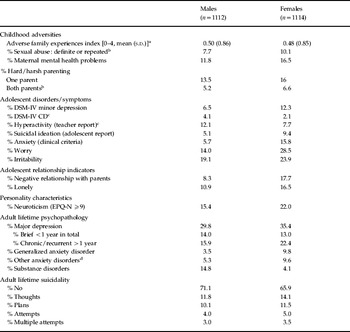
Table 1 gives summary statistic estimates for study variables for men and women in the full sample. Rates of adolescent and adult psychopathology and of childhood and adolescent adversity were consistent with estimates from other epidemiological studies that use investigator-based methods. The adult lifetime rates tended to be higher than those from more closed question retrospective methodology (Kessler et al. Reference Kessler, Berglund, Demler, Jin, Merikangas and Walters2005) but lower than those using repeated prospective assessment (Moffitt et al. Reference Moffitt, Caspi, Taylor, Kokaua, Milne, Polanczyk and Poulton2009). By midlife a substantial proportion of cohort members (29% of men, 34% of women) reported some suicidality. We estimated 8% as reporting attempts (7% men, 9% women) and 18% as reporting plans or attempts (18% men, 20% women). The study did not offer sufficient power to investigate reliably predictors of attempts alone. In the remainder of the analyses, we therefore examined plans and/or attempts as the main outcome measure or treated the levels of reported suicidality as an ordinal scale.
Estimated means and prevalences for Isle of Wight participants alive till midlife

s.d., Standard deviation; EPQ-N, Eysenck Personality Questionnaire-Neuroticism.
a Prospective record of divorce, parental discord, separations from parent and in care.
b Retrospective report.
c Two or more symptoms.
d Social phobia, post-traumatic stress disorder, obsessive compulsive and panic disorders.
We examined the timelines of suicidal thoughts/behaviours and psychiatric disorder as reported in the SADS. There was an overwhelming tendency for suicidality to occur contemporaneously with disorder or to follow first onset of each of the disorders reported. Of the 46 interviewed study members who made plans or attempted suicide, only eight (17%) reported this as outside of an episode of MDD. Of these eight, four reported other contemporaneous chronic psychopathology (phobia, PTSD, schizophrenia), two reported no psychopathology either before or after and in just two cases did suicidal behaviour clearly precede psychopathology. These were when teenage attempts were followed by multiple disorders reported in the early 20s and again in the 30s. Taken together this suggested that an analysis strategy in which reported lifetime psychopathology might mediate the effects of early adversity on lifetime suicidal behaviour would be appropriate. In the few instances where psychopathology followed suicidal behaviour, this strategy would tend to overestimate possible mediation and underestimate residual direct effects.
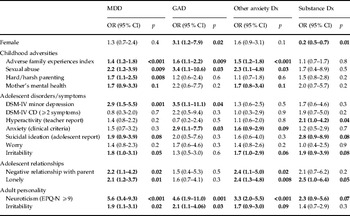
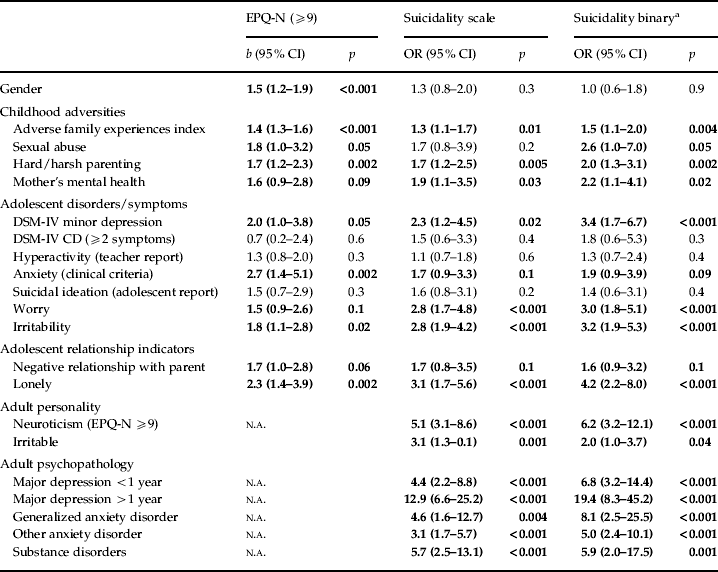
As anticipated, suicidality was strongly associated with adult psychopathology, with rates of lifetime adult MDD increasing from 19% in the no-suicidality category to 90% in the multiple-attempts category, GAD from 3% to 26%, other anxiety from 13% to 46% and substance use from 5% to 35%. Mean EPQ-Neuroticism levels also increased strongly from 4.1 (95% CI 3.8–4.4) to 8.5 (95% CI 7.3–9.7). Tables 2 and 3 therefore show bivariate associations (controlling for gender) of putative risk factors with binary and ordinal suicidality outcomes and with each of these potential mediating forms of pathology. Associations with the childhood and adolescent variables were all in the expected direction. Both adolescent depression and anxiety showed evidence of specific continuity over time; adolescent depression also predicted GAD. Hyperactivity showed evidence of a specific association with substance disorders. Suicidal ideation in adolescence showed a stronger association with potential mediating psychopathology than with adult suicidality itself. The individual symptoms of worry and irritability showed remarkably strong associations with adult suicidality, and adult neuroticism and irritability showed a wide association with adult psychopathology. Negative relationships with parents in adolescence, along with loneliness, were strongly associated with both adult psychopathology and suicidality. Associations appeared somewhat stronger with the binary measure of plans/attempts than with the ordinal suicidality scale (PORs), suggesting that the selected risks might have weaker effects on suicidal thoughts than on more serious suicidal phenomena. In general, however, factors associated with more serious suicidality also predicted risk across the suicidality scale. The OR for suicidality associated with MDD was high, especially for individuals whose cumulative exposure to depression persisted for ⩾1 year. Strong associations with substance disorders and adult anxiety disorders were also evident.
Bivariate associations [odds ratio (OR)] between adolescent measures and adult psychopathology controlling for gender

CI, Confidence interval; MDD, major depression; GAD, generalized anxiety disorder; EPQ-N, Eysenck Personality Questionnaire – Neuroticism.
Bold ORs significant at p⩽0.1.
Bivariate associations with adult neuroticism and adult suicidality controlling for gender
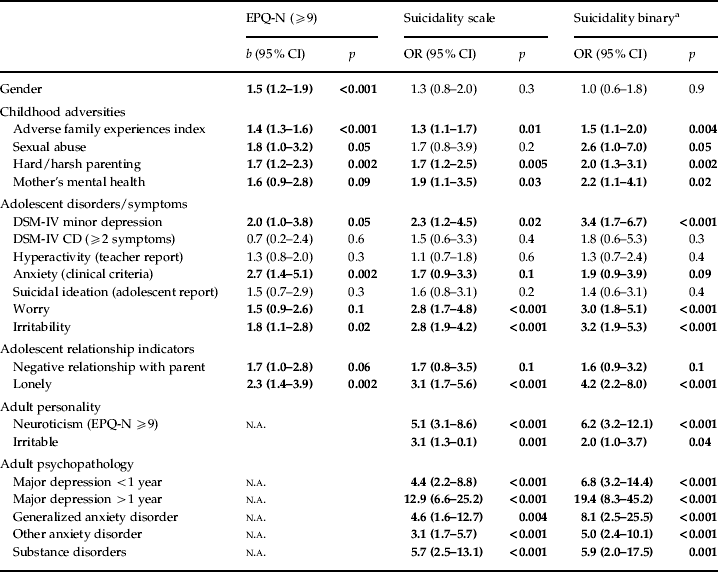
EPQ-N, Eysenck Personality Questionnaire – Neuroticism; OR, odds ratio; CI, confidence interval.
a 0, none and thoughts; 1, plans, attempts, multiple attempts.
Bold ORs significant at p⩽0.1.
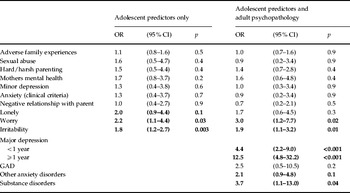
Further analysis was conducted in three steps. Table 4 shows the joint effects of the risk factors with significant (p⩽0.1) bivariate associations with planned or attempted suicide. The results presented in column 1 included adolescent adversities and psychopathology. The second column added the likely mediating adult disorders. Considering the adolescent predictors alone (column 1), significant partial associations remain with worry, irritability and marginally with loneliness, while partial associations with adolescent depression and with the family experience index are substantially reduced from their bivariate values and non-significant. The partial ORs for the other childhood adversities remain little different from their bivariate estimates but are no longer individually significant. The addition of the measures of adult psychopathology (column 2) weakens these partial ORs but the direct effects associated with adolescent worry and irritability persist. Both anxiety and substance disorders in adulthood continued to show associations with suicidality. The partial OR for GAD was higher than for the group of other anxiety disorders but non-significant owing to its lower prevalence. Replacing these two variables by a single combined anxiety variable gave a partial OR of 2.5 (95% CI 1.2–5.3, p=0.02).
Joint effects of predictors that showed bivariate associations (p<0.1) with plans or attempted suicidality

OR, Odds ratio; CI, confidence interval; GAD, generalized anxiety disorder.
Bold ORs significant at p⩽0.1.
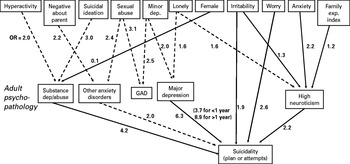
The third step of the analysis, results of which are shown in Fig. 2, added high neuroticism as a binary predictor of suicidality and examined the joint effects of the risk factors found significant (p<0.1) in predicting each of the five mediating variables, namely, adult depression, GAD, other anxiety disorders, substance disorders and neuroticism. Harsh parenting, maternal mental health problems and adolescent conduct disorder showed no independent significant effects and so are omitted from the figure. Adult substance and anxiety disorders as well as neuroticism all showed independent associations with suicidality in addition to effects of adult MDD. Sobel tests (Sobel, Reference Sobel and Leinhardt1982) of indirect paths (the product of coefficients) from models with the direct and indirect effects shown in Fig. 2 suggest that the effects potentially mediated by neuroticism were of marginal significance (family experience index p=0.05, irritability p=0.11 and adolescent anxiety p=0.08).
Direct and potential mediated pathways to adult suicidality.  , significant (p<0.05);
 , significant (p⩽0.1). OR, odds ratio, GAD, generalized anxiety disorder.

To give more confidence to our interpretation, some further additional analyses were undertaken. The final analysis for suicidality was repeated but included only those subjects who did not experience adult MDD or any anxiety disorder (n~1239). The partial ORs associated with adolescent worry (p=0.03) and irritability (p=0.05) remained similar to those estimated on the whole sample. Including self-rated irritability in adulthood as an additional predictor of suicidality also changed the results very little, but self-rated adult irritability was itself only weakly associated with parent-rated adolescent irritability (bivariate p=0.05).
Discussion
Along with just a handful of other epidemiological studies, notably the Dunedin, Christchurch, Finnish 1981 birth cohort and Children in the Community studies, the Isle of Wight Study is able to examine long-term prospective risk for interview-assessed suicidality and psychopathology. Long-term prospective studies often suffer from the ageing of their childhood measures, notably in the out-dating of the clinical diagnostic system used. In the case of the Isle of Wight Study, despite being one of the oldest child mental health cohort studies, the extensive, detailed and multi-informant assessments enabled recoding and recombining of items such that key adolescent measures, for example, for depression, conduct and hyperactivity, could be reconstructed to form diagnostic categories and syndromes that are recognizable within current diagnostic frameworks. An exception was in the area of anxiety, where a durable consensus has proved harder to achieve more generally. These diagnostic measures were supported, however, by the inclusion of ratings of worry and irritability that have remained as key index symptoms and also figure as items in the measurement of temperament and personality. The range of measures of psychosocial adversity collected also spans much of the range of interest today and was complemented by retrospective report. The investigator-based interview technique of the follow-up assessment (in which the interviewer both probes and seeks concrete descriptions) can be expected to mitigate some of the problems of retrospective recall.
In this paper we have examined suicidality across the whole adult follow-up period. We considered that the extended retrospective period of report did not allow questions of sequence and timing to be examined with reliability and rigour. Nonetheless, since serious suicidality appears to be almost entirely restricted to periods of psychopathology, we considered it appropriate to attempt to assess the significance of both indirect and residual direct associations of the adolescent measures with adult suicidality, the indirect associations being those potentially mediated by reported adult pathology and neuroticism.
Reported lifetime rates of suicidality are highly variable, differing with age, assessment method, definition and country. Our follow-up gave estimates of rates of suicidality and of disorders intermediate between those reported by the National Comorbidity Survey using retrospective respondent-based interview methods (Kessler et al. Reference Kessler, Borges and Walters1999, Reference Kessler, Berglund, Demler, Jin, Merikangas and Walters2005) and prospective sequential-concurrent methods (Fergusson et al. Reference Fergusson, Horwood, Ridder and Beautrais2005; Moffitt et al. Reference Moffitt, Caspi, Taylor, Kokaua, Milne, Polanczyk and Poulton2009).
Our findings confirmed the longstanding reports of strong associations of suicidality with adult depression (Fergusson et al. Reference Fergusson, Beautrais and Horwood2003), particularly where chronic or recurrent (Aglan et al. Reference Aglan, Kerfoot and Pickles2007), and with adult substance use (Borges et al. Reference Borges, Walters and Kessler2000; Foley et al. Reference Foley, Goldston, Costello and Angold2006). They also provided further support for the reports of additional effects associated with adult anxiety disorders (Fergusson et al. Reference Fergusson, Woodward and Horwood2000; Foley et al. Reference Foley, Goldston, Costello and Angold2006). We also replicated the association with adult neuroticism and showed how this association appeared to be over and above that due to the confounding effects of reported adult psychopathology (Fergusson et al. Reference Fergusson, Beautrais and Horwood2003). Whereas this suggests a direct independent contribution of neuroticism to suicidal ideation and behaviour, we cannot exclude the possibility that our neuroticism measure captures affective domain psychopathology that our study participants failed to recall at interview.
Our findings extend those of Fergusson et al. (Reference Fergusson, Woodward and Horwood2000) and Sourander et al. (Reference Sourander, Klomek, Niemela, Haavisto, Gyllenberg, Helenius, Sillanmaki, Ristkari, Kumpulainen, Tamminen, Moilanen, Piha, Almqvist and Gould2009) in relation to suicidality in early adulthood by showing that proximal psychopathology mediates a substantial part of the effects of most adolescent factors, both individual and experiential, much further into the life-course. Independent effects on adult affective disorder and neuroticism were found for a range measures reflecting adverse early experiences, adolescent psychopathology and interpersonal problems in adolescence. Adolescent measures could impact on adult suicidality through a variety of mechanisms. The process of kindling (Kendler et al. Reference Kendler, Thornton and Gardner2000), for example, in which the experience of depression increases the risk of subsequent depression, could induce long-term associations even when the effects of adolescent exposures are themselves short-lived. In addition, adversity may itself persist through direct chains of adversity, such as encouraging premature school leaving (Harrington et al. Reference Harrington, Pickles, Aglan, Harrington, Burroughs and Kerfoot2006), risking long-term effects on educational attainment. Effects of adolescent environmental adversity not mediated by any evident contemporaneous disorder could also occur when adaptive responses made in adolescence become maladaptive as role demands change (Harrington et al. Reference Harrington, Pickles, Aglan, Harrington, Burroughs and Kerfoot2006), as when the need to form adult love relationships may be a challenge following CSA (Hill et al. Reference Hill, Pickles, Burnside, Byatt, Rollinson, Davis and Harvey2001, Reference Hill, Pickles, Rollinson, Davies and Byatt2004). Apparently, persisting adolescent adversity could also occur through processes such as passive, active or evocative correlation of behavioural traits with later adverse experiences (Plomin et al. Reference Plomin, DeFries and Loehlin1977; Quinton et al. Reference Quinton, Pickles, Maughan and Rutter1993). Bifulco et al. (Reference Bifulco, Kwon, Jacobs, Moran, Bunn and Beer2006) found evidence for the long-term effects of neglect and abuse on depression to be mediated by adult attachment style.
Of particular interest in the current analyses were the individual items for adolescent irritability and worry, which were not only associated with increases in adult affective problems but also showed additional effects on suicidality independent of reported affective disorders and neuroticism. Although initially collected as symptom measures, these items could also be taken as indices of personality, for which Fergusson et al. (Reference Fergusson, Woodward and Horwood2000) also found evidence for association with suicidality not mediated by reported adult psychopathology. One might have expected continuity of temperamental worry to have been evident through continuity to the measure of adult neuroticism. Although the two measures are indeed strongly associated, the effects on adult suicidality were not fully mediated. In addition, the symptom of worry might be tapping a form of GAD not probed in detail in adolescence and not sufficiently reliably recorded in adulthood. The contribution of anxiety, and rumination and worry in particular, could be to extend the period of depression (which we know increases risk), to interact with depression (Foley et al. Reference Foley, Goldston, Costello and Angold2006), to increase hopelessness, to set up distinctive cognitive schema or behavioural styles or any combination of these.
In childhood, irritability is a symptom of both depression and oppositional defiant disorders. However, Stringaris & Goodman (Reference Stringaris and Goodman2009a, Reference Stringaris and Goodmanb) have shown how irritability/mood lability was linked to a wide range of psychopathology and co-morbidity over and above associations with the individual disorders and also with impairment in absence of disorder. Although allowed as a DSM symptom of MDD in children, it is not included in the criterion set for adults. Fava et al. (Reference Fava, Hwang, Rush, Sampson, Walters and Kessler2009), however, showed that irritability is a common feature of adult MDD, especially MDD with early age of onset, lifetime persistence and co-morbid anxiety and impulse control disorders. Stringaris et al. (Reference Stringaris, Cohen, Pine and Leibenluft2009) also found adolescent irritability to be independently predictive of psychopathology 20 years later. One mechanism for these effects might be simple continuity in temperamental irritability. However, our self-report adult questionnaire item on irritability showed only a modest association with parent-reported in adolescence. But should we expect such continuity from the typical measures of epidemiological studies? Compared with adults, adolescents typically have less control of their environments and thus perhaps less ability to avoid stressful situations. Also, their emotional and behavioural response is less well controlled. It is thus possible that measures in adolescence could provide more reliable indicators of adult responses under duress than, say, measures of behaviour and functioning that apply to an adult in their normal chosen environment (Caspi, Reference Caspi1987).
Other interpretations of the importance of adolescent irritability are, however, possible. Some have argued that irritability in childhood is a precursor to bipolar depression (Skjelstad et al. Reference Skjelstad, Malt and Holte2009), which is associated with exceptionally high levels of suicidal ideation and behaviour (Hawton et al. Reference Hawton, Sutton, Haw, Sinclair and Harriss2005). This is unlikely to be a sufficient explanation in the current study, since among our interviewed subjects there was only a single diagnosed case of bipolar disorder. Instead, such an explanation would need to rely on hypothetical prodromal or subclinical cases or the bipolar ‘broad’ phenotype of severe mood dysregulation (Brotman et al. Reference Brotman, Kassem, Reising, Guyer, Dickstein, Rich, Towbin, Pine, McMahon and Leibenluft2007). However, Perlis et al. (Reference Perlis, Fava, Trivedi, Alpert, Luther, Wisniewski and Rush2009) found no specific association of irritability with bipolar features.
Clinical implications
In addition to depression and substance disorders as known risk factors, anxiety disorder is confirmed as being associated with increased suicidal behaviour. Our findings in relation to adolescent worry and irritability perhaps raise more questions than answers, since a range of interpretations exist as to what they mark in adolescence and the mechanism by which they persist and impact on suicidality later in the life-course. Worry is a common target for cognitive behaviour and pharmacological therapies. Our findings suggest that these and other treatments in adolescence designed to target worry and irritability could have long-term benefits in reducing vulnerability to suicidality.
Acknowledgements
Aspects of this study were supported by a grant from the Nuffield Foundation (98.2) and grant (G9826580) and programme support to B.M. from the Medical Research Council. We thank study members for their time and willingness to participate.
Declaration of Interest
None.