1. INTRODUCTION: SEEING AND MAKING
How as well as what: a style is a manner of doing something, which is chosen from a wider range of ways to achieve the same result. Styles define subgroups of objects that are perceptually similar, such as aircraft tailfins, houses, coffee machines, sweaters, and landscape paintings. (We also recognize other kinds of creations as having styles, such as dance performances or musical compositions, but they are beyond the scope of this paper.)
The perceptual recognition of similarity and subgroup membership is central to our conception of style. However, when we are consciously aware of a style as an organizing principle, it becomes a concept in its own right, which we can apply and reshape in active reasoning. Styles are given labels, and the meanings of these labels are socially negotiated. The perceptual identification of shared features interacts with explanatory reasoning about category membership, which makes human style perception multilayered and subtle. This article explores the cognitive processes involved in visuospatial style perception in order to highlight some of the challenges faced by formal analyses of styles and by research into the role of styles in designing, and point out how formalist and psychological approaches can complement each other.
1.1. Style as implicit and explicit choice
The many meanings of the word “style” share an implied choice from a range of (roughly) functionally equivalent alternatives. (The conceptions of style relevant to this paper are discussed in Section 2. See Knight, 1994, for a history of the notion of style in design and McMahon, 2003, for style concepts in art criticism.) Seeing an artifact as having a style depends on awareness (perhaps fallacious) of the possibility of different alternatives: the designer could have made other choices. However, when designers create, some of their apparent choices are real and guided by stylistic perceptions, others are determined by requirements and constraints, and still others are emergent consequences of their creative procedures.
Style perception depends on our understanding of function and structure, but the relationship is subtle. Our mental models of an artifact (our conceptions of its structure, internal functioning, and behavior), depend on the depth of our knowledge (see Johnson-Laird, 1983; Norman, 1988). These mental models influence the structural features we see in the artifact. Thus, how we interpret an artifact's features as contributing to its style depends on our knowledge. However, we also see emergent visual effects subtly related to structure; and small changes to the definitions of structures can have radical visual effects, for instance, in the stitch structures of knitted garments (Eckert, 2001). Conversely, completely different artifacts can share a perceptual style, such as Art Deco vases and stained glass windows or Moorish mosaics and palaces.
Although we can try to characterize styles in terms of sets of features—an artifact exemplifies a style to the extent that it possesses them (see, e.g., Chan, 2000)—applying this view to human style perception requires an extremely broad and abstract view of what the features might be. Style perception involves the interaction between the preconscious perceptual recognition of style elements and relationships at different scales and levels of abstraction, conscious reasoning about similarities and categories, and explanatory inference to a coherent understanding of the artifact. Style perception can involve knowledge-rich reasoning about contexts and intentions and the identification of very abstract similarities. All of these processes depend on the perceiver's previous experiences and networks of associations in memory. Awareness of visual similarity is tightly coupled to interpretation of structure and meaning.
1.2. Style perception guides creation
In architecture and almost all esthetic designing, and sometimes in engineering, well-understood functional requirements and constraints underspecify the design. Decisions about style serve to constrain the design problem sufficiently to make it tractable. However, stylistic criteria are often a central part of the design problem,invariably in commercial garment design.
In the incremental development of conceptual designs, forms create perceptions of style and perceptions of style create forms.
Analyses of design processes at different levels of detail converge to a view of designing, which was originally formulated by Asimow (1962), as comprising a cyclic process of formulating the problem, making a change to the proposed design, evaluating the new state of the design, reformulating the problem, making another change to the design, and so on. The designer's understanding of the problem coevolves with the solution (see, e.g., Dorst & Cross, 2001), although the problem normally stabilizes over time (see McNeill et al., 1999).
Designers' behavior emerges from the interaction between their tacit procedural knowledge of designing (and other actions) and their current situation—both their mental state and their environment (see Smithers, 1996; Gero, 2002; Gero & Kannengiesser, 2004). The designers' mental actions for evaluation and problem formulation include perceptually appreciating that elements of designs have particular characteristics (Goldschmidt, 1991; Schön & Wiggins, 1992). In some design fields, perceptual evaluations are very tightly coupled with design synthesis actions and play a crucial role in the development of conceptual designs (e.g., Goldschmidt, 1991). Visuospatial designing in esthetic fields depends on the designers' abilities to recognize designs as exemplars of styles, not only as artifacts or finished designs but also as roughly or partially specified mental images or sketches (e.g., Eckert & Stacey, 2001). Emergent perceptual properties are compared with stylistic requirements for particular esthetic effects and visuospatial criteria for style category membership.
Engineering designers make use of stylistic perceptions when functional performance is subtly related to shape, and they need to create preliminary designs before investing time and effort in mathematical analyses, for instance, in the conceptual design of cooling paths for jet engine turbine blades (Bell et al., 2005). In such situations the preliminary design can depend on the perceptual recognition of emergent visuospatial features and similarities, as well as judgments of what designs “ought” to look like and how they are similar or different from other designs.
1.3. Style recognition: Seeing versus analyzing
To see is to see as: I see a Biedermaier armchair, a 1990s sofa in a similar but simpler and more organic style, as well as a laser printer whose lines remind me of the curved-roof style of contemporary public buildings. We see almost everything we encounter as both a unique individual with idiosyncratic detailed features and a member of a known category, embedded in a rich web of connected concepts. If our preconscious object recognition mechanism fails to classify something, we experience it as an attention-grabbing shock. We can see an object as both similar and different from other objects and as a member of several overlapping categories: stylistic categories are often overlays on functional categories.
There is no clear distinction or boundary between the perceptual process of object recognition and the conceptual process of categorization and interpretation that employ stored information about styles and other categories (see Goldstone, 2003; Palmeri & Gauthier, 2004). However, style perception depends on a combination of several complementary and competing mental mechanisms; which ones are dominant depends both on the situation and on the perceiver's prior experiences. Style perception depends on knowledge. People's perceptual capabilities for recognizing the exemplars of styles range from an unanalyzed awareness that an object is similar to a group of others to an actively constructed, consciously articulated, and detailed theory of the defining characteristics of a named category.
Style recognition involves the perception of similarity and difference from other objects, perceptual recognition of category membership, and recognition as an exemplar of a consciously articulated concept. Categorical perception, similarity judgments, and concept formation have been extensively studied by psychologists. The bulk of this article is devoted primarily to discussing the relevance of that research for understanding style perception. However, style judgments cannot be easily classified as any of those things. Although stylistic similarity is perceptual similarity and style categories depend on shared perceptual features, these features can be quite abstract; and their selection depends on the conceptual processes of concept formation.
Studies of perceptual similarity judgments and perceptual categorization under different conditions show that two processes can compete: preconscious information integration, producing an unanalyzable holistic judgment, and learning and applying perceptual decision rules (Section 3).
Mental representations of styles are complex and include associations with exemplars of the style, events when exemplars were encountered, types of activities, emotions, values, other objects, and other styles. The similarities and differences that people recognize vary according to people's conceptual understanding of the objects they are comparing and the purpose of the comparison (Section 4). They can be quite abstract and include similarities in the relationships between differing elements: there is no useful distinction between similarity and analogy (see Gentner & Markman, 1997).
Moreover, the thinking processes through which style concepts are created and used can be complex, involving causal and explanatory reasoning as well as associative thinking (Section 5). Some styles can only be understood in terms of inferences about causes and purposes. This paper argues that the conceptual processes involved in recognizing style membership are best viewed as the creation of a conceptually coherent understanding of the artifact.
The complexity and subtlety of human perception of styles poses a profound challenge to formal and computational approaches to understanding style, such as shape grammars, but this article concludes that these approaches have an important role to play in combination with psychological studies of how style perception works.
2. TYPES OF STYLE CONCEPTS
The word style has a number of distinct meanings with subtle relationships to each other. What a style is, and what unifies it, is a very different question when you look at a range of exemplars of a style from the inside, in terms of how they are made, or from the outside, in terms of what they look like. A full understanding of how style informs design requires both perspectives.
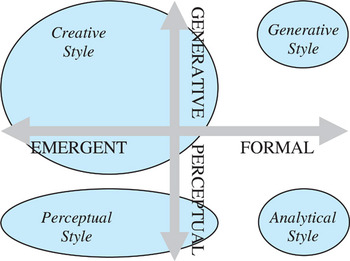
An artifact or a set of artifacts can be ascribed a style in different ways, which differ from each other along two dimensions, generative-perceptual, and emergent-formal (see Fig. 1). There is a dichotomy between views of style as inherent in the artifact itself and seen, or as inherent in the creator's generative procedure. This is well recognized in discussions of the evolution of style as a concept in art and design (see McMahon, 2003). Computational methods for analyzing styles and generating designs in specific styles, and the issues raised in this article, point to another dimension of difference between interpreting styles in terms of sets of clearly defined attributes, or in terms of perceptual judgments.

The types of style concepts. [A color version of this figure can be viewed online at www.journals.cambridge.org]
In order to distinguish the different ways of defining styles with which we are concerned, we now define a number of terms.
Perceptual style is stylistic similarity or difference in the eye of the beholder, which is dependent on visual similarity. Social processes create a high level of agreement about the meanings of style labels. Nevertheless, perceptual style is dependent on an individual's own experiences and understanding of the structure and function of the perceived entity. Our main concern here is how human cognitive processes create awareness of perceptual style. (McMahon, 2003, employs a compatible definition of the perceptual style of artworks and relates perceptual style to other style concepts used in art criticism; she points out that perceptual style is ahistorical as far as the artwork is concerned, but it depends on the history of the viewer.)
Creative style is a designer's propensity to perform particular designing actions in particular ways, and to sequence them in particular ways. This was the essence of the notion of style developed by the Greeks and Romans (Knight, 1994; McMahon, 2003). We can view this more formally as the choice of both design elements and designing actions (Simon, 1975; Chan, 2001). Of course, designers' creative processes, and hence their creative styles, depend on what they see in representations of designs and can include the application of formally described rules. Often a designer's creative style produces artifacts with a characteristic perceptual style (among fashion designers, Zandra Rhodes is a good example), but in many industries perceptual style is primarily determined by external constraints (e.g., commercial knitwear design; Eckert & Stacey, 2003).
Preferential style is a person's propensity to choose objects with particular stylistic characteristics, such as curtains, a dinner service, or a house. The stylistic choices people make as consumers rather than designers are often governed by conscious analysis of fashions and stylistic requirements and influenced by changing experiences (e.g., clothing styles eventually start looking old-fashioned to even the least fashion conscious). However, style preferences can remain stable over decades.
Analytical style is a definition of a style in terms of measurable or computable properties of the artifacts that embody it. The idea that style comprises shared form elements, relationships, and qualities is not new (see, e.g., Edwards, 1945; Schapiro, 1961; Ackerman, 1967). However, computational analysis techniques offer the possibility of more rigorous theorizing. Specifications of analytical styles are produced by applying an analysis technique that makes explicit some interesting similarities among designs. Analytical styles are at the opposite end of the emergent-formal dimension from perceptual styles, to the extent that the stylistic characteristics they identify are computable rather than dependent on human perception. The relationships between analytical styles and either perceptual styles or creative styles may not be obvious. For example, Jupp and Gero (2004, 2006) analyze architectural drawings by detecting particular types of qualitative spatial features.
Generative style is defined intensionally by a procedure for constructing designs that embody that style, such as a shape grammar. Such a procedure constitutes a characterization of a style that is both formal and generative to the extent that executing it does not require human stylistic judgments.
Advocates of formal and computational approaches to analyzing styles face two central questions. What do the formal procedures defining a generative style have to do with how human designers create things in the “same style”? What do analytical style definitions have to do with the human experiences of artifacts that constitute perceptual style? The success of some shape grammars in generating designs to match culturally accepted style categories indicates that the answer is something. However, this relationship has not been adequately considered, so the insights offered by formal approaches remain tantalizingly limited.
Shape grammars can provide astonishingly concise and powerful definitions of the styles of human architects such as Palladio (Stiny & Mitchell, 1978) and Frank Lloyd Wright (Koning & Eizenberg, 1981), as well as the styles that constitute the brand identities of such products as Harley-Davidson motorcycles (Pugliese & Cagan, 2001) and Buick cars (McCormack et al., 2004). Shape grammars also give us a way to explore the development of styles as incremental modifications to the constraints governing the creation of designs, such as meander patterns on ancient Greek vases or the development of Frank Lloyd Wright's Prairie style into his Usonian style (Knight, 1994). The shape grammar approach treats style as constraints on forms and relationships, specified implicitly by rules that say what is possible. It has proved very effective in understanding style and style changes in terms of exploration by mutating procedures. The view that the context for which a particular design is created serves to motivate the selection of options, from a tightly constrained range of possibilities defined by a style, is inherent in the shape grammar approach. The success of that approach to modeling style in architecture indicates that this view captures a significant part of the truth. However, shape grammars make no explicit distinction between elements and parameter values dictated by functional requirements, by context, or by stylistic choices.
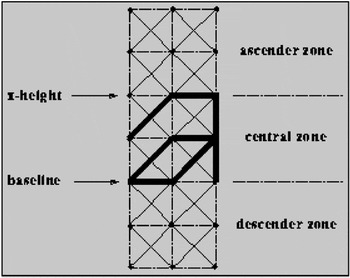
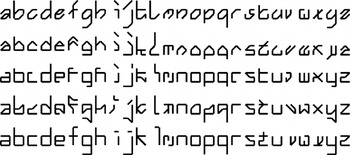
A very different type of generative design system, Letter Spirit, is grounded in a psychological theory of analogical thinking in design (Hofstadter & McGraw, 1995) and empirical research on how humans perceive the artifacts it creates: letters in a gridfont (see Fig. 2). McGraw et al. (1994) found evidence that letter perception depends on the detection of elements (which can have styles) that (more or less well) match roles in abstract, relational letter schemata; Letter Spirit makes the distinction between functional and stylistic features explicit. It creates a set of artifacts that are developed in parallel to have a uniform style, using explicit representations of structural elements and style elements and employing mechanisms for assessing “letter-ness” and discovering stylistic features in candidate letters (McGraw, 1995; Rehling, 2000; Rehling & Hofstadter, 2004). Its creations include the fonts shown in Figure 3.

A gridfont comprises letters made up of different subsets of the 56 possible line segments that connect the 21 points on the grid. Figure courtesy of Gary McGraw. Reprinted with permission.

Gridfonts created by Letter Spirit. From Rehling and Hofstadter (2004). Reprinted with permission.
A number of projects at the Key Centre for Design Computing and Cognition at the University of Sydney have focused on analytical style. Cha and Gero (1998, 1999) described computational methods for representing shape patterns in terms of similarity relations and generative rules linking the elements of complex shapes, and they reported a method for inducing style definitions from shape patterns. Ding and Gero (2001) made a distinction between basic concrete features defining the space of decisions (which they call syntax in analogy to linguistics) and more abstract features defining the space of behaviors (which they call semantics). Using traditional Chinese building facades as an example, they applied a genetic algorithm to change syntax rules governing the choice and combination of concrete features, with fitness evaluated first according to the presence of the abstract features (simple semantics) and then according to the presence of combinations of abstract features (complex semantics). Jupp and Gero (2004, 2006) developed a computational method for developing models of style by extracting multiple levels of qualitative spatial features from architectural drawings, from which stylistic similarities can be computed. Taking a similar approach to the Sydney group, Koile (2006) developed a partial characterization of Frank Lloyd Wright's Prairie house style in terms of experiential features of houses, such as “private” and “visually open,” computed from the relationships between physical features (see also Koile, 2004, for an application of this approach to generating house designs).
This research on analytical style is more psychologically informed than the shape grammar research on generative style, in some cases using style features for computational reasoning that is grounded in psychological theory. Moreover, the importance of recognizing emergent properties and making them explicit is well recognized (Ding & Gero, 2001). However, the power of this approach depends on how the artifact is represented, what features can be derived from this representation, and what higher order features and relationships can be computed from the primary features. The space of possible sets of features and relationships that an artifact can have, according to a system for computing an analytical style, constitutes an implicit theory of the nature of style. This research rests on a priori decisions about what sorts of aspects of a design are of interest. Thus, Koile (2006) started from the premise that achieving particular experiential qualities was central to Frank Lloyd Wright's style and then that these characteristics can be operationalized as particular functions of physical descriptions.
Computational methods for analyzing or generating designs in particular styles give us hypotheses about the intrinsic structures of styles. We can compare these to human perceptions of similarities and differences. However, different types of computational methods offer different insights into human perceptions and procedures. As the work focusing on Frank Lloyd Wright's Prairie houses shows (Koning & Eizenberg, 1981; Knight, 1994; Koile, 2006; among others), exemplars of a style can be distinguished from nonexemplars in many different ways, which may have more or less relevance to human creative or perceptual processes.
3. SEEING STYLISTIC FEATURES: PERCEPTUAL FOUNDATIONS OF STYLE RECOGNITION
Object recognition is preconscious, and it includes recognition of the object's category or several overlapping categories and sometimes similarity or difference from other objects. In addition, the mechanisms that recognize objects provide the raw material for more subtle conceptual interpretations of style. How does object recognition work and how is perceptual skill acquired, for example, for spotting 1920s flapper dresses, American Air Force uniforms, or 1930s Hawker aircraft tailfins? What does this tell us about the perceptual similarities that underlie style categories?
3.1. Seeing by comparing with representations of object categories
Recognizing a letter, a sweater, a coffee cup, or a building as an exemplar of a style and as differing from category standard involves both recognizing perceptual features, some very subtle, as structural and stylistic elements, which activate category concepts, and inferring a coherent understanding of the artifact (see McGraw et al., 1994; Hofstadter & McGraw, 1995). This requires comparing the new percept with stored information about the style category. However, it is not obvious to what extent the stored information used in perception takes the form of mental representations that describe categories and to what extent it takes the form of procedures for transforming new perceptions, because these possibilities are computationally equivalent and not distinguishable empirically (Anderson, 1978; see Tversky, 2005).
Mental representations of the artifacts and designs with which we are concerned here are primarily visuospatial. Visuospatial representations encode shapes, spatial relationships, movements, and viewpoints, although their elements may be tightly bound to propositional information about functions, material properties, and so on. Although visuospatial reasoning employs some of the same mechanisms as visual perception (see Kosslyn, 1994), visuospatial representations can be skeletal and schematic; and visually impaired people can perform some kinds of visuospatial thinking perfectly well (see Tversky, 2005).
Palmeri and Gauthier (2004) considered the question of what form mental representations of visuospatial object categories take. They argued that the evidence does not support the hypothesis that categories comprise single prototypes; instead they appear to comprise a collection of viewpoint-specific memories for exemplars. Reviewing research on visual object recognition, they marshaled evidence that the speed and reliability of recognition depends on similarity to the nearest viewpoint-specific experience with a previous instance, rather than to a single representation that is viewpoint independent or incorporates a standard viewpoint. For unfamiliar objects known from a limited range of viewpoints, time to recognition depends on the angular distance from the nearest familiar viewpoint (Tarr, 1995). Palmeri and Gauthier argued that recording a relatively small number of experiences for each category—“a few score to several score, depending on stimulus complexity and category complexity”—is computationally tractable and can produce nearly the same performance as storing every experience.
Representations of objects' shapes and of particular views may be encoded either independently or in terms of similarities and differences from representations of other, earlier objects (Palmeri et al., 2004). Some visuospatial categories are defined in terms of their own intrinsic properties; others are defined in relation to other similar categories. Goldstone and colleagues (2003) presented evidence that this influences how far exemplars are judged as typical. Style categories can come in both types. For instance, Eckert and Stacey (2001) argued from observations of knitwear designers' discussions of their designs that they possess a network of subtly differentiated style concepts indexed by canonical exemplars (see Section 4.2).
Recognizing complex objects also involves recognizing spatial relationships between configurations of features. As Kosslyn (1994) pointed out, detecting and remembering exact geometric spatial relationships is not enough for recognizing contorted objects and different members of the same category: it requires more abstract, qualitative spatial relationships like “above” or “connected-to.” Even reading words in an unfamiliar font involves identifying qualitative relationships between fairly abstract letter elements (McGraw et al., 1994; Hofstadter & McGraw, 1995). Kosslyn surveyed a large range of experimental evidence that categorical spatial relationships (above/below, connected-to, etc.) and metric spatial relationships are processed by separate subsystems. This ability to employ qualitative relationships and higher order relationships that survive geometrical transformations is essential for interpreting designers' sketches as types of objects and exemplars of styles. These findings suggest that although style perception may be influenced by viewpoint, if an artifact is seen from a very unusual angle, the recognition of qualitative stylistic features and relationships between features will be quite robust under transformations that preserve them.
3.2. Two processes
We can identify members of categories, including exemplars of styles, in two ways: by reasoning about their characteristics and deducing a conclusion, or by seeing an object as a category member. However, this is not a rigid division, as people can move from rule-based inference to perceptual recognition with increasing practice. How people learn to recognize visuospatial object categories has been extensively studied through experiments in which subjects say whether various kinds of visual patterns are or are not exemplars of the category and are told whether they are right or wrong. Many such studies have contrasted situations where the categories correspond to relatively simple rules and situations using very similar stimuli where the decision rule is too complex or subtle to learn.
Normal humans are extremely adept at learning categorizations of visual patterns and can master very subtle distinctions. Amnesiacs can also learn perceptual decision criteria for actions perfectly well without conscious memories of their experiences (Filoteo et al., 2001), as can pigeons (Huber et al., 2000). If the criterion is simple, people learn rules and can describe them. However, if the criterion is at all complex, people learn to recognize category members but remain completely unable to describe how. These situations require the preconscious integration of perceptual information about similarities and differences from the category representation, rather than rule application.
Maddox and Ashby (2004) found evidence from functional magnetic resonance imaging observations of brain function that category learning in the rule-possible case activated different regions of the brain from the information-integration case. They also found that performance was harmed much more in the information-integration situation by delaying feedback for 5 s, whereas performance was harmed much more in the rule-possible case by reducing the time available to process the feedback. Maddox and Ashby argued that there are two competing visual category recognition processes, which rely on the integration of perceptual information and on the active application of decision procedures.
Similar relationships between inference processes and association-strength processes have been observed in studies of similarity judgments (Smith et al., 1998; Markman & Gentner, 2005; see Section 4.3).
3.3. Features and regularities
What we see depends on what we have learned to see (see Goldstone, 1998, for a survey of perceptual learning effects), but our perceptual abilities are built on top of mechanisms that make some perceptual features of objects much more salient than others.
A preattentive perceptual process detects large numbers of features of the visual environment in parallel; attention is focused selectively on the output of this process (see Treisman, 1993). We can spot objects characterized by individual distinctive features that can be detected preattentively without needing to examine individual items (they “pop out”), but finding conjunctions of features requires attention-directed search. Shape-defining features such as orientations and sizes are produced by discontinuities in surface-defining features including colors, orientations, luminance, relative motion, texture, and stereoscopic depth, which we detect preattentively (Cavanagh et al., 1990). We see virtual features in Gestalt closures, such as the orientation of a nonexistent line between two nearby dots. Vertical and horizontal features are more salient, as are primary colors, suggesting that diagonals and intermediate colors might be coded as the ratio between the activity levels in detectors tuned to primary types (Treisman, 1991).
More evidence for the primacy of vertical and horizontal orientations comes from Goldmeier (1936/1972), who studied judgments of the perceived similarity of shapes and found that people mostly pick up on properties he called singularities: special cases in the space of geometric configurations, such as lines being vertical or horizontal or pairs of lines being parallel. They were relatively insensitive to variations in nonsingular properties. Adding or removing a singular property, for example, by making a curved line straight, changes the perceived symbol significantly. Goldmeier also found that similarity judgments changed according to the orientation of figures: subjects treated vertical axes of symmetry as more important than horizontal axes.
With practice, people develop representations of higher level features that are useful for the task in hand: configurations of simple features that are treated as single units. Goldstone (1998, 2003) described processes of differentiation and unitization. If a stimulus part varies independently of other parts or occurs frequently, people may develop a specialized detector for that part (Goldstone, 2003). Features or dimensions that are similar to each other are easy to join together and difficult to isolate (Melara & Marks, 1990), and people can learn some kinds of units much better than others. Conjunctions of shape and color are not recognized better with practice (Treisman & Gelade, 1980) whereas conjunctions of shape and position are (Saiki & Hummel, 1996), as are combinations of line segments (Shiffrin & Lightfoot, 1997). Goldstone (2000) found that the category-diagnostic elements to be unitized (within random squiggles) need not be contiguous; but, if not, the region between them is incorporated into the unit as well.
People doing categorization tasks become more sensitive to small perceptual differences on category-diagnostic dimensions, especially in the regions around category boundaries (Goldstone, 1994a). Objects that are members of the same category are treated as more similar to each other than if they are not categorized; and they are treated as more different if they are categorized as members of different categories, both in similarity judgments and psychophysical discriminations (see Goldstone et al., 2001). Goldstone and colleagues (2001) present evidence that this is partly due to altered perceptions, not just to biases on decision making. These findings indicate that the social processes that influence people's understanding of style categories and their boundaries can influence how people see artifacts: how strongly they are aware of particular perceptual features and how similar or different objects are to each other.
When we are doing other things we are exposed to information that we can later use to form categories and make category-membership decisions, and our perceptual processes make use of this information. Shape recognition is facilitated by previous experiences with the same shape, even when it was not attended to (see Loula et al., 2000). Studies of unsupervised category learning of visual patterns, in which the subjects were not told to form particular categories, demonstrated that we are sensitive to the frequency with which features of visual stimuli co-occur (Edelman et al., 2001). This sensitivity depends on the task (what the subjects were trying to achieve when looking at the stimuli), with better matches to the intrinsic structure of the set of stimuli when the subjects were instructed to form a category, and when they were encouraged to attend to the category-relevant dimension (Love, 2002, 2003). This indicates that although forming an explicit style concept requires attention to a categorization problem, it can draw on perceptual regularities from prior experience. This is significant for understanding how designers develop style concepts and use sources of inspiration (see Eckert & Stacey, 2003). Designers look more or less actively for style features and focus their attention on different stylistic features at different times, but the influence of their experiences is not limited to the focus of their current concerns.
4. STYLE RECOGNITION DEPENDS ON STRUCTURAL UNDERSTANDING
We do not merely see as, but see objects and object elements as having structure related to their causes, purposes, and potential actions, as well as a rich detailed microstructure of shape, color, and texture. Our knowledge of what the structure of the object is, and how emergent visual features relate to causally significant features and relationships, influences how salient visual and conceptual features are and thus how they contribute to conceptions of style. Our knowledge also determines what similarities and differences we see and whether we interpret them as stylistic or as dependent on function. (Of course, we are often aware that smaller scale functional features are determined by larger scale stylistic choices.)
McMahon (2003) argued that awareness of the perceptual style of an artwork is awareness of the form of the mapping from depiction to what is depicted or evoked: the characteristic types of simplifications, distortions, substitutions, and omissions through which the artist exploits the flexibility of our object recognition mechanisms. However, most designs depict nothing but themselves. Awareness of style in design is awareness of the relationship between exact form and the spaces of possibilities afforded by the object's function and structure, although what forms our mental representations of these relationships take remains an open question. Characteristic relationships between form and function often include choices of structural forms (Gothic churches), shapes (Harley-Davidson motorcycles; Pugliese & Cagan, 2001), and proportions (Charles Rennie Mackintosh furniture) but may include more subtle features like the experiential characteristics Koile (2004, 2006) finds in Frank Lloyd Wright's Prairie houses.
4.1. Representations of objects and styles are multifaceted
The visuospatial representations with which we see are tightly bound to the conceptual representations with which we think. Object recognition is facilitated by recent exposure to conceptually related objects, indicating that associations in memory involving conceptual information influence early perceptual mechanisms (Henderson et al., 1989). Thus, we cannot draw any clear boundary between perception and causal thinking in style recognition.
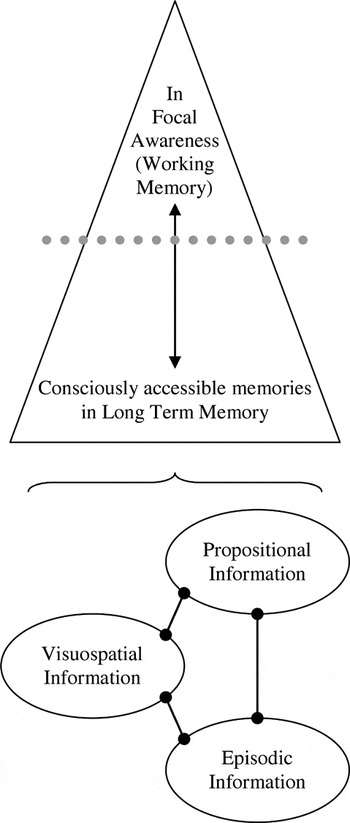
Our consciously accessible memories comprise at least three types of information (see Fig. 4): propositional information comprising symbols in semantic relationships; episodic information that is inherently time dependent about specific events; and visuospatial information in which viewpoints and spatial relationships are intrinsic (Anderson, 1982). Visuospatial information can be qualitative and schematic: a range of studies have shown that people represent complex spatial information such as relative locations of buildings or cities schematically and that this results in systematic distortions (see Tversky, 2005, for a survey). Representations of the exemplars of a style are visuospatial, as are more general representations of style elements and characteristics. However, they are linked to propositional information about the style and its exemplars and episodic information about our encounters with exemplars of the style, as well as related objects and concepts, including other styles. They are also linked to vaguer, more general concepts like “the sea” or “English upper class living” and to emotions; highlighting or creating these links is the function of “moodboards.” When a memory is activated by perceptual input (seeing a Charles Rennie Mackintosh chair), activation levels of related memories increase (propositional information about Mackintosh's career, visuospatial information about his flower paintings, episodic memories of walking past the Glasgow School of Art). If a memory is activated sufficiently it enters working memory, becoming the focus of conscious awareness (cf. Anderson, 1983). Designers' mental representations of designs combine visuospatial and propositional information (see Goldschmidt, 1991), and episodic memory can play a role in envisioning how a design is used (Schön, 1988).

Propositional, visuospatial, and episodic memories activate each other and reach conscious awareness when sufficiently active.
Associative memories are created through the co-occurrence of different items in conscious experience. However, causal knowledge as well as experience of correlations influences the units that are recognized in perception. Research on expertise in architecture (Akın, 1978, 1986), radiology (e.g., Myles-Worsley et al., 1988), chess (e.g., Gobet & Simon, 1998), and electronics (Egan & Schwartz, 1979) indicates that the elements of visuospatial representations are chunked into structures according to categorizations of both structural features and emergent visual features. What these structures are depends on knowledge; for instance, Lesgold et al. (1988) found that expert radiologists were not only better at spotting diseased tissue in chest X-rays but also more likely to describe their observations in terms of a three-dimensional representation of the patient rather than two-dimensional cues such as a shadow on the film. With practice the consciously articulated knowledge used to infer structural characteristics and causal consequences is compiled into automatic single-step associations (Anderson, 1983).
Research on what people recall from memory, and how, indicates that this is best viewed as an active process of constructing coherent mental representations from comparatively sparse and incoherent components, rather than as faithful and passive retrieval (Bartlett, 1932; see Koriat et al., 2000). Recognizing an object or situation as a member of a category (such as being in a restaurant) activates a learned schema for constructing a mental representation of a situation of that type, creating expectations that it will include components with particular characteristics, roles, and behavior (Schank & Abelson, 1977; Schank, 1982). When these expectations are violated the situation is perceived as being different or surprising. Solso (1994) discussed the development and use of schemata for style categories in art that include compositional and subject matter elements as well as representational mappings.
How well individual objects or experiences are remembered depends on their relationship to their categories. For instance, Myles-Worsley et al. (1988) found that retention of abnormal chest X-rays increased with radiological expertise, whereas retention of normal X-rays actually decreased with expertise. Expectations based on category schemata are used in reconstructing a remembered situation. Gobet and Simon (1998), accounting for experimental results on memory for chess positions, argued that experts develop large structures (templates) that have slots that can rapidly be filled in. When people redraw drawings of faces (Wulf, 1922) and retell stories (Bartlett, 1932), unusual features that are perceived as significant are highlighted and exaggerated whereas other unusual features are smoothed toward what is standard for the category (see Koriat et al., 2000). When people are given simple line drawings along with category names, they redraw them from memory biased toward a standard shape for the category, for instance, banana versus kidney bean (Carmichael et al., 1932); but recognizing them from among a set of similar distractors is not biased by verbal labels, suggesting that it is the reconstruction process that employs category information and introduces bias (Prentice, 1954). Shapes that are nearly symmetric are remembered as more symmetric than they actually are, as if people code nearly symmetric objects as symmetric (Freyd & Tversky, 1984). These findings suggest that if an artifact is remembered as being an exemplar of a style, reconstruction from memory will be biased toward style-category standard unless its features are consciously recognized to be deviations from category standard; and what category standard is will depend on the rememberer's prior and subsequent experiences. This is a testable experimental prediction.
Visuospatial representations of designs and styles are used to generate mental images (but images and visuospatial representations are not the same thing, and a lot of spatial reasoning does not require detailed or coherent imagery). Most of the knitwear designers Eckert and Stacey (2000, 2001) talked to said that they see their own designs mentally as detailed, realistic images of garments, similar to photographs. It is quite common for knitwear designers to create, evaluate, and discard designs in their heads, sketching only to communicate (see Eckert, 2001). Moreover, designers in many fields often imagine designs in greater detail than they require for their current activities. How complete and detailed these mental images really are, and how they are related to the original objects, is hard to assess from interview evidence. Images may be of partially defined category prototypes rather than specific designs. Kosslyn (1994) argued that the evidence on image generation indicates that images can be formed by using categorical or geometric spatial relations to arrange components, and images of the individual components can be formed either by allocating attention to making them or by activating visual memories. Research on imagery indicates that details in subjectively rich mental images may often not exist until people focus on a particular area or detail (Kosslyn, 1980).
4.2. Style representations are interrelated
Styles do not exist in isolation. Artifacts are perceived as being variants of both functional categories and alternative or superordinate stylistic categories. Design education and informal experiences equip designers and consumers with a range of style concepts, which are contrasted and explained in relation to one another, as well as concepts for types of artifacts and their functional elements at different levels of abstraction. Design researchers have found that designers in a variety of fields make use of memories of both individual designs and design elements and generalizations into categories (for architecture see Lawson, 2004). Schön (1988) described functional types and references as forms of architectural design knowledge. Drawing on the cognitive theory of dynamic memory proposed by Schank and Abelson (1977; Schank, 1982), Oxman (1990) argued that precedents are used in design as prototypes, through a process of typification in which individual designs, problems, and so forth are used to create and refine more abstract generalizations, and are indexed in memory by these generalizations.
For instance, fashion and knitwear designers see huge numbers of garments (see Eckert & Stacey, 2003) and report being able to remember a large number in vivid detail. Eckert and Stacey (2000) found that knitwear designers typically describe new designs as modifications of other individual designs, which suggests that memories of a wide range of individual garments play an important role in their design thinking. Eckert and Stacey (2000) argued that the shared context of remembered individual designs gives designers a language to communicate design ideas, partly because it is inherently difficult to describe the significant features of garments except in terms of variations from other designs. Knitwear designers have a vocabulary for garment features, but the range of available verbal labels for garment categories is much smaller than the range of possible categories.
Designers' use of reference-based descriptions and their reports of having vivid and detailed memories of large numbers of garments they have seen indicates that designers' mental representations of the space of possible garment designs primarily comprises numerous garment instances serving as exemplars of subtly differentiated subcategories that can only be referred to by their origins. However, some knitwear designers also report thinking in terms of more general stylistic categories that are not directly tied to exemplars, besides functional categories of garment types. They are aware of a variety of superordinate style concepts that cover different subsets of the space of possible garments.
Eckert and Stacey's (2000, 2001) evidence about how knitwear designers discuss their designs indicates that their networks of style concepts appear to function as lattices. Garment types appear to be defined as variants of single previous categories or as combinations of components drawn from more than one other category, such as a cardigan combining shape elements and decorative elements drawn from a pullover in the same range, adapted to fit shape elements from an earlier cardigan. They are linked to design element concepts such as pockets and cables, as well as memories for exemplars and contextual information. Emergent perceptual properties contributing to esthetic effects seem to be integral parts of the garment category representations. How tightly these perceptual properties are bound to structural features, and how detailed and exact the representation of the structure of the garment is, appears to depend on what structural information the designer could extract from a photograph, sketch, or actual garment; this depends on the designers' mental models of the structures of more general garment types.
4.3. Stylistic similarity is multilayered
Recognizing perceptual similarity is central to seeing artifacts as having styles and to forming style concepts. Shared features are crucial to the perception of similarity, and how aware of them people are depends on the situation. Tversky (1977) accounted for a wide range of biases and asymmetries in similarity judgments in terms of factors governing how salient matching and conflicting features are in the comparison process (see Goldstone & Son, 2005, for a review of approaches to modeling similarity). Tversky's famous feature salience theory is still influential in research on design and style (see Chan, 2000).
However, there is more to similarity than that. Markman and Gentner (2005) argued that there are two modes of similarity assessment. One is based on spatial and featural views and provides fast judgments of the similarity of a pair, but it does not take the structure of the representation into account. The other takes structure into account and provides slower, more effortful judgments; it also yields access to the commonalities and differences between a pair. It is useful in cognitive processes that can be carried out over seconds rather than milliseconds. Markman and Gentner (2005) present evidence that similarity identification is spontaneous and ubiquitous, but tasks requiring comparison promote the use of deeper, more coherent matches. Smith et al. (1998) surveyed a range of studies of artificial and natural concepts, showing that categorizations and similarity assessments can be done using similarity to exemplars computations or slower rule-based computations and that differences in instructions or time pressure can determine the strategy used. Several areas of the brain are active for both processes, but more are active rule-based categorization. Some situations require inference from factual knowledge rather than recognition of perceptual similarity, but similarity exerts an influence. For instance, questions like “Is this a fish?” get answered according to factual knowledge, but typicality and similarity to nonmembers influence the time it takes to respond (see Barsalou, 1985; see also Smith & Sloman, 1994). The selection of features for similarity judgments also depends on the comparison process itself (Medin et al., 1993), and the salience of features within an object is influenced by the other objects that are present or remembered (Goldstone et al., 1997).
What this indicates about style perception is, first, that the passive perception of frequent conjunctions of perceptual features can create similarity classes and thus style categories, and, second, that people are likely to be more sensitive to overall emergent perceptual similarity than deeper structural similarity in situations where they have no active reason for wanting to decide whether two objects belong in the same style category or understand why objects belong in particular socially labeled categories. However, the formation of style concepts from seen or remembered exemplars can be an active goal-directed process driven by the conscious recognition of particular features as significant, to the exclusion of others. Eckert and Stacey (2003) found that knitwear designers regularly remember and reinterpret garments as exemplars of new style categories.
Models of similarity based solely on features do not account for similarity judgments about objects (such as buildings or garments) whose similarity depends on the arrangements of their features. Drawing on Gentner's (1983) structure-mapping theory of analogy and Holyoak and Thagard's (1989) view of analogical mapping as constraint satisfaction, Markman and Gentner (1993; see Gentner & Markman, 1997) argued that seeing similarities and seeing analogies are essentially the same process: they involve aligning the features of the two situations so that the relationships between the features correspond. In alignment-based models of similarity, matching features influence similarity more if they belong to parts that are placed in correspondence; and parts tend to be placed in correspondence if they have many features in common and are consistent with other emerging correspondences (Markman & Gentner, 1993; Goldstone, 1994b). Similarity recognition differs from spotting analogies in that the features that are aligned are similar in direct, concrete ways rather than at a more abstract level.
In experiments, aligned feature matches tend to increase similarity more than unaligned feature matches (Goldstone, 1994b); this difference in influence increases with the clarity of the alignments (Goldstone, 1994b) and the processing time (Goldstone & Medin, 1994). Under some circumstances adding a poorly aligned feature match can actually decrease similarity by interfering with the development of proper alignments (Goldstone, 1996). Moreover, alignable differences (Romanesque churches have round arches whereas Gothic churches have pointed arches) influence similarity judgments more than nonalignable differences (Markman & Gentner, 1996), and they are better remembered (Markman & Gentner, 1997). Recognizing alignable differences is central to understanding stylistic differences as variations in particular structural or decorative features.
Structure is crucial: people usually regard shared structure as more important than shared features, typically judging AA as more similar to BB than to AC. However, whereas relations have a salience advantage when comparing two items that are both physically present (Goldstone et al., 1991), object features are more salient than relations in similarity-based memory retrieval; this implies that retrieval employs a computationally simple form of similarity (Gentner et al., 1993). However, Dunbar (2001) pointed out that people are adept at finding analogies in memory in real life, when they know the structure for which they want to find a mapping, but poor at recognizing analogical relationships between candidates presented in psychological experiments. This is what one would expect from a memory system in which the activation of items in long-term memory depends on the similarity of encoding to active memories plus learned associations (see Anderson, 1983). This tells us that people recognizing stylistic similarity and forming style concepts are likely to focus on different aspects when they can perform direct comparisons, rather than relying on their memories. This is likely to influence people's interpretation of socially accepted style labels like Frank Lloyd Wright's Prairie House style, where there are many similarities and people can differ about which are superficial and which are crucial.
Two important conclusions from Gentner and Markman's (1997) analysis of similarity and analog and from research on the role of causal reasoning in judging similarity and category membership are that people employ both surface perceptual features and more abstract conceptual features, and people are strongly influenced by similarities in patterns of relations when they can perceive them, above all when the relations are causal. However, relational information is more salient and influential when items are compared directly rather than from memory.
5. FORMING STYLE CONCEPTS: MAKING SENSE OF STYLE
Although a lot of style awareness comprises recognition of similarity and difference, and awareness of frequency, thinking about style goes much deeper. When we think of the style of an individual artifact or a group of artifacts as a thing, we form a style concept. As we have seen, mental representations of styles are complex and include associations with exemplars of the style, events when exemplars were encountered, types of activities, emotions, values, other objects, and other styles. However, style concepts are more than generalizations or abstractions of representations of artifacts; rather, they are theories of difference or category membership referring to the characteristics of the artifacts themselves. Reasoning explicitly about styles is a significant part of the work of designers in many fields. In addition, using style concepts to interpret buildings, cars, household products, or clothes is part of our everyday experience. Thus, how do style concepts function? What do we learn, and how do we learn it, when we learn to recognize a style by acquiring a style concept?
5.1. Style concept learning is subject to different task demands
Style learning happens in different situations that place different demands on mental processing. Style learning in the street is what psychologists call unsupervised learning; that is, it does not involve doing a task and getting feedback on how well one has done. Awareness of style begins with the conscious awareness of some nonfunctional visuospatial difference between at least two objects; and the formation of a style category requires conscious awareness of some visuospatial similarity between at least two objects, in contrast to other more different objects. Recognizing other objects as category members is then self-reinforcing. Deciding that some individual belongs in a category is fast enough to serve as reinforcement for cognitive processes that require immediate feedback. Reflection on the similarities and differences, if it happens, creates a style concept.
However, style learning is often guided. In many situations where we learn styles, we are prompted to look for similarities; and the exemplars of categories are grouped to highlight their category membership, for instance, in rooms in art galleries devoted to French Impressionists, English Pre-Raphaelites, or the Canadian Group of Seven. In magazines for fashion insiders like Book Moda, grouping to prompt and facilitate category formation is entirely explicit. In these situations we can remember different-looking members of the same superordinate category, but we are not explicitly asked to reject them. In other, less common situations, we are prompted to try to make sense of why a set of objects belong together.
5.2. Concepts are explanatory
How mental representations of object categories work and how they relate to rule-based and similarity-based judgments remain controversial questions (see Lamberts & Shanks, 1997; Medin et al., 2000). Categorizations of artifacts do not rely on essential features, nor are they stable; instead they depend on the demands of the situation (Sloman & Malt, 2003). Numerous studies have shown that different kinds of features are important to natural versus artifact categories (see Medin et al., 2000, for a review): essential physical features are important for biological categories (Ahn et al., 2001), and functional features are more important for artifacts. People look for common causes and common effects when constructing categories; membership of a single causal chain is less significant (Ahn, 1999).
Features contribute to our representations of concepts such as tank and coffee cup in different ways. Central features are not the same as salient features or diagnostic features. Sloman et al. (1998) argued that the centrality of a feature to someone's understanding of a concept depends on its mutability, which is roughly how easy it is to imagine an exemplar of the concept without that feature. The immutability of a feature depends on how much the internal structure of a concept depends on that feature. We appear to recognize features such as the roses on my coffee cup as stylistic by their mutability. They are arbitrary or caused by constraints external to the function of the object. The roses are an immutable and therefore central feature of the Wild Rose pattern concept contributing to my understanding of the coffee cup.
Category concepts behave differently when they serve normative as well as predictive purposes: what a tree, a Buick, or a Georgian house should be if not distorted by extrinsic factors (see Medin et al., 2000). Lynch and colleagues (2000) found that tree experts based judgments of tree typicality on the positive ideal of height and on the absence of undesirable characteristics or negative ideals: central tendency played at most a minor role. For style concepts, the extrinsic factors shifting an artifact away from style typical may be functional needs or another style (a 1990s Buick).
A rapid process of information coordination can be observed in knowledge-driven category formulation. We apply causal reasoning to explain category membership (Ahn, 1999; Ahn et al., 2001; Rehder & Hastie, 2004). For instance, Wisniewski and Medin (1994) found that people learning categories and formulating categorization rules for drawings of people proceeded very differently if they were told that the categories were “drawn by creative and noncreative children,” rather than “Group 1 and Group 2.” In the creative children condition, they focused on more abstract properties and reasoned about why creative children would produce such pictures. When they got negative feedback on their classifications, Wisniewski and Medin's subjects rapidly generated new explanatory hypotheses, which Wisniewski and Medin interpreted as demonstrating a tight coupling of perceptual and conceptual thought processes.
These observations of the nature of concept formation imply that the formation of concepts is driven by explanations of why things are similar and why others choose to group them as a category.
Style concepts are explanations in terms of manner, which are choices of how to do things. An artifact makes sense as embodying a style to the extent that it can be explained in terms of a coherent set of preferences.
Style elements and the choices they embody can be coherent by having some shared purpose, like sports utility vehicles expressing aggression or the elements of a football team's uniform; by having shared associations, such as combinations of blues and wavy lines suggesting the sea; by being tightly linked by socially learned cultural conventions, like the ruffs, puffed sleeves, and codpieces worn by Tudor gentlemen; or the combination of room layout choices and experiential effects characteristic of Frank Lloyd Wright's Prairie houses. We see unusual combinations as incongruous, or we construct more elaborate explanations: a Tudor house with 19th century repairs. Some clothing and architectural styles reference other styles: our coherent explanations of what we see include awareness that mismatches and resemblances to features belonging to other styles are calculated. This suggests that style concepts like tree concepts should be ideals: typicality should depend on the absence of stylistic elements requiring alternative explanations or compromises made for pragmatic reasons (such as 19th century Gothic repairs to a Romanesque church). However, different kinds of style concepts explain design features in terms of different kinds of choices: choices of procedures for making artifacts; choices of elements, shapes, and relationships; choices of emergent effects; and choices of cultural references.
Recognizing an object as an exemplar of a style often depends on the context, especially when we have incomplete or ambiguous information about it, such as a sketch or a fragment of pottery at an archaeological excavation. Recent exposure to related concepts can serve to activate object and style concepts in memory, predisposing the visual object recognition process to recognize an object as an exemplar of contextually likely categories, and potentially ambiguous features are brought into conformity with a coherent interpretation of the situation. This can lead to the misperception of genuinely incongruous features. Mismatched context can lead to the misinterpretation of style information of sketches; this causes communication problems in the knitwear industry (Eckert, 2001).
As we have seen, visuospatial object categories may be defined in relation to other similar categories; when they are, they behave differently. Similarly, the richer style concepts employed by designers may be defined as mutations of earlier or more important concepts (cf. Eckert & Stacey, 2000, 2001). Some style concepts are inherently referential: recognizing an exemplar involves seeing features as being elements of other styles juxtaposed, distorted, or placed in incongruous contexts, for instance, military jackets worn by civilians.
5.3. Meaning and causation in style interpretation
A central part of our human experience of artifacts is inferring meaning from style, in particular, explaining style choices causally, in terms of the chooser's situation and intentions. Interpretations of the cultural meaning of appearances are inescapable, and our perceptions of the style of individual artifacts includes awareness of contrasts and position in a space of possibilities as much as awareness of similarities and group membership.
Artifacts have a dual nature as physical structures and as effectors of purposes (see Kroes, 2002). For clothes especially, the functions they serve include communicating meaning about the user's status, social role, and group membership. Fashion is driven forward by the desire to be seen as distinctive and daring and up to date; it is kept coherent, as fashion rather than unrestrained variety, by the countervailing desire not to be seen as different or weird (see Eckert & Stacey, 2001). Stylistic differences from what is standard for a group convey attitudes and personality characteristics as well as subgroup membership (see, e.g., Lurie, 1981; McCracken, 1988; Kaiser, 1997).
Normally, recognizing the cultural messages of clothes and other designed artifacts is largely a tacit preconscious process, which is performed by memory association processes rather than inference processes. The associations comprise a lot of knowledge of human society as well as visual features. The interpretation of meaning is inseparably embedded in context. Is a man in uniform a policeman or a guest at a fancy dress party? We actively infer interpretations of styles when learned associations in memory are not enough: if the stylistic information is surprising, when we do not fully understand the structure of the current social situation, or if we have a conscious need to develop or extend style concepts.
5.4. Social negotiation of style concepts
Although style perceptions are personal and depend on knowledge and idiosyncratic experiences, people reach a working agreement about the scopes of style categories. Style categories can be learned purely inductively from recurring features, but style concepts are often learned from the explicit association of artifacts with style labels. Accepted artistic and architectural style categories are often taught in some detail and used explicitly in labeling and explanation. Style concepts are also influenced by observations of how others use style terms and by discussions of styles as explicit concepts.
Labeled style categories are not static. The frequency with which one is exposed to artifacts with particular stylistic features, and in which contexts, influences one's perceptions of stylistic categories and substyles within them. These perceptions change with exposure to different artifacts, as well as explicit reasoning about style changes, as do associations of styles with contexts and connotations. This is central to our experience of the styles of clothes. Stylistic categorizations of clothes govern interpretations of what clothes are or are not acceptable in particular situations, and style choices are legitimated by being interpreted as part of current fashion. The central tendencies and boundaries of styles are socially negotiated through the interactions of people wearing different kinds of clothes and behaving according to their interpretations of the cultural meaning of their own and other people's clothes.
Eckert and Stacey (2001, 2003) described the activities through which knitwear designers actively and systematically update their stock of style concepts. By doing fashion research, designers tune the tacit perceptual skills they have developed for recognizing what is and is not fashionable, what cultural connotations a garment will have, and in what way a garment design needs to be modified to conform to fashion, as well as provide themselves with the set of garment type concepts and other memories that they need to create new designs. Eckert and Stacey's interview evidence indicates that designers reason about whether striking features of individual garments are unique or are exemplars of categories forming new trends. They also reason explicitly about the development of the forms, cultural associations, and acceptability of their most general, labeled categories, including the historical styles that may reappear, creating the mental context for imagining new categories as modifications of old ones. They are aware that this is an important part of their job.
The designers follow each other, trying to predict trends and create similar but distinctive garments, and paying little attention to the consumers. By interactively creating the contexts in which they develop style concepts, they collectively create fashion (Eckert & Stacey, 2001). Apart from the couturiers, who do not design for the mass market, all commercial designers perform fashion research in essentially the same way and have access to most of the same sources of information. Designers aim to know what their competitors are doing as well as the companies designing for the next higher segment of the market, whose looks they aim to imitate, so that they can produce garments within the same fashion. Communication between knitwear designers is through impersonal cultural channels: trade magazines and other publications, displays at trade shows, and shops. Magazines display photographs of designs selected and grouped to emphasize their stylistic commonality and facilitate the perceptual learning of style features. Eckert and Stacey's (2001, 2003) interviews indicate that designers also develop style concepts by remembering and reinterpreting previously seen designs.
Designers in other industries use socially negotiated style concepts in somewhat different ways. Although comparable fashion processes can influence graphic designers and product designers, product designers are often concerned with broader, more abstract style concepts that span functionally dissimilar products and with using stylistic features to maintain brand identity (cf. Pugliese & Cagan, 2001; McCormack et al., 2004). Architects are taught about both style categories and precedent buildings that provide socially approved solutions to structural and esthetic problems (see Goldschmidt, 1998).
5.5. Style interpretation is the creation of conceptual coherence
We often create causal explanations of stylistic features extremely quickly as part of the process of seeing. How much of this is reasoning, and how much is the preconscious combination of associations? The rapidity of style interpretation—“That's a Georgian ballgown.”—indicates that preconscious visual object recognition includes the activation and combination of associated information about the object's behavior, function, and purpose, as well as the combination of complementary visuospatial representations.
Thagard (1989) made the case that thinking works by achieving conceptual coherence. We create a coherent representation of an object or situation through a very rapid process of fitting the different elements of the situation to the constraints each component imposes on others. That is, we imagine combinations of objects, actions, and so forth that do not violate our knowledge of the properties of any of them (see Thagard & Verbeurgt, 1998; see also Sloman et al., 1998, for a discussion of object concepts and conceptual coherence; see Johnson-Laird et al., 2004, for another view of consistency).
Studies of memory recall indicate that representations of individual objects are often schematic and skeletal, and details are reconstructed at the time of recall from representations of categories and constraints requiring the object to have particular features to be physically possible or to behave as it does (see Koriat et al., 2000; see Section 4.1). This biases object representations toward what is category normal (often style normal) apart from specially remembered salient deviations. If a component of a larger structure is recognized, it creates the expectation that other parts will be seen (e.g., Gobet & Simon, 1998); thus, a characteristic feature of a style will prime and possibly bias the recognition of other characteristic features.
People think about how physical systems behave through a combination of reasoning with consciously articulated propositional beliefs and imagining changes in visuospatial forms and relationships. Mental models are representations of the form and properties of physical objects (or other kinds of systems with causally connected components) with which people envision their behavior in order to understand what the objects or systems do or predict what they will do (see Johnson-Laird, 1983). Mental models relating visuospatial form to function and behavior influence our perception of design elements as functional rather than decorative (buttons on jackets or sofa cushions), our perception of the behavior of a product (Edwardian riding skirts), our perceptions of how products afford actions or influence user experiences (sight lines creating spaciousness or privacy in Frank Lloyd Wright houses, see Koile, 2004, 2006), or our awareness of the range of possibilities for shapes and actions (jet engine turbine blades, see Bell et al., 2005), all of which can contribute to perceptions of style.
6. CONCLUSIONS
What we know about human object perception, and about how people form and use categories and concepts, tells us that perception of style (recognizing an artifact as stylistically similar or different from others, as a member of a stylistic category, or as an exemplar of an explicit style concept) is complex. It involves the interaction of perceptual and conceptual processes to create a coherent understanding of the artifact, combining emergent visual properties with awareness of structure, behavior, and function. As far as the range of associations in memory permit, it involves the understanding of which features are causally dependent on function and which on style choices and why the artifact is as it is. Style concepts are adaptable to needs and dependent on both knowledge and the demands of the situations in which they are developed.
6.1. The future of style research
Although there has been a great deal of psychological research on questions relevant to style and how designers design has now been very extensively studied, how style perception works and how it contributes to designing are questions that have been largely ignored (but see McGraw et al., 1994; Hofstadter & McGraw, 1995; Chan, 2000, 2001). The perception of style in artworks has received a bit more attention (Solso, 1994; McMahon, 2003). We face a wide range of open research questions that require the research methods of cognitive psychology. Examples include the following:
- How much (and when) does style perception depend on observed structural features versus emergent experiential qualities?
- How does the perception of emergent visual properties interact with knowledge in the perception of stylistic similarity and difference?
- How do different task demands influence the perception of style and formation of style concepts?
- What form do visuospatial schemata for styles take?
- How are stylistic features inferred from sketches and other partial representations?
- How do people recognize and conceptualize stylistic similarities between functionally dissimilar objects like Art Deco teapots and chairs?
- How do the different ways in which styles are conceptualized and style categories are learned influence style perception in different disciplines?
- How do social processes interact with individual cognitive processes in the development of shared and named style categories?
6.2. Formal and human style analysis
The richness and flexibility of style perception presents challenges for formal and computational approaches to understanding styles. To what exactly are they relevant? Moreover, a designer's socially learned and idiosyncratic style perception is one part of creative style. Matching human subtlety is an impossible task for the formalist. Nevertheless, formal and psychological investigations can complement each other in developing a richer understanding of the phenomenon of style.
What formal methods give us, as computer simulations do in many other fields, are rigorously specified theories of both the structure and the components of styles. These formal descriptions of styles can serve as specifications of the phenomena for which we want psychological, social and cultural accounts of style to account. Just how much of architectural style can be accounted for by relatively simple rule sets like the Palladian grammar (Stiny & Mitchell, 1978) is a significant empirical discovery. This in itself is a useful contribution to demystifying creativity in design.
However, styles like Frank Lloyd Wright's can be characterized in different ways. Neither a procedure for generating Wright-like houses nor an analysis of the structural or experiential features his houses share tell us what steps Wright followed, what range of alternatives he considered possible, or how he took stylistic or experiential qualities into consideration. In order to understand this, we need to triangulate from formal analyses, first-hand or eyewitness testimony, and cognitive plausibility.
To relate formal analyses of style to how humans actually design, we need psychological research into both design thinking and the nature of style perception. Formal characterizations of style can also contribute to this: we can use them to create representations of artifacts whose structure we understand and investigate how varying their properties affects human perceptions of style. By varying the demands of the tasks we give experimental subjects, we can investigate how knowledge of structure and function and knowledge of similar designs influence the perception of emergent visual properties and the generation of explanatory accounts of styles. When we reach the point of having theories that predict the influence of different factors on the perception of stylistic similarity or group membership, we can use formal models of style to test them. Generative systems embodying explicit theories of how thinking about style works, such as Letter Spirit (Rehling, 2000; Rehling & Hofstadter, 2004), should be an important part of this enterprise.
6.3. Styles evolve by mutation at multiple levels
Knight (1994) argued that some important historical developments in style happen through quite small mutations in the rules (whether explicit or implicit) that govern the generation of designs. Designers making structural changes that have stylistic consequences, and then seeing what those consequences are, is a common phenomenon. For instance, knitwear designers say that interesting innovations sometimes arise from mistakes (Eckert & Stacey, 2003). What we know about mental representations of designs and styles and of design transformation actions indicates that individual changes to designs are usually simple. However, mental representations of designs in progress are multilayered. Tweaks to characteristics of designs can be made at the level of shape details, spatial relationships between elements, the presence or absence of decorative features, the presence or absence of structural features, desired emergent perceptual properties, cultural references, or intended behavior. The changes such decisions entail for features at other levels may be profound, for instance, deciding the next sports car should be aggressive rather than elegant.
This argument implies that the challenge for generative models of style evolution, which was successfully met by some shape grammars, notably the Frank Lloyd Wright Prairie house grammar (Koning & Eizenberg, 1981; Knight, 1994), is finding the level of style description at which the small but powerful changes happen.
Style evolution is fast and furious in the fashion industry. Since Simmel (1904), theories of fashion have focused exclusively on consumers' choices (see Sproles & Burns, 1994). However, the choices consumers have are created by the designers. Styles evolve through the interaction between designers' perceptions of style and designing actions and the social and cultural processes that guide their stylistic choices, choices that are largely responses to their perceptions of each other's stylistic choices (Eckert & Stacey, 2001). A better understanding of how style perception works, as well as what changes, can enable a deeper understanding of style evolution in architecture and product design as well as clothing.
ACKNOWLEDGMENTS
The analysis reported in this paper draws heavily on the work of Dr. Claudia Eckert of the University of Cambridge Engineering Design Centre. It has gained enormously from many conversations with her and from her comments on earlier drafts. The author also benefited from conversations about design and industrial practice with Monica Jandrisits, design and similarity with Professor Chris Earl of The Open University, design and thinking with Dr. Kristina Lauche of the Technical University of Delft, and the nature of style with Calandra Eckert of Manor High School.