Stethoscope diaphragms are often contaminated with pathogens such as Clostridioides difficile and methicillin-resistant Staphylococcus aureus (MRSA).Reference Vajravelu, Guerrero, Jury and Donskey1–Reference Knecht, McGinniss and Shankar5 Moreover, the frequency of acquisition and transfer of C. difficile and MRSA during patient examinations has been shown to be similar for stethoscopes and hands.Reference Vajravelu, Guerrero, Jury and Donskey1,Reference Longtin, Schneider and Tschopp2 Applying hand sanitizer to stethoscopes or wiping with alcohol or disinfectant wipes or swabs can reduce bacterial contamination.Reference Vajravelu, Guerrero, Jury and Donskey1,Reference Mehta, Halvosa, Gould and Steinberg6 However, stethoscopes are rarely cleaned in clinical practice.Reference Mehta, Halvosa, Gould and Steinberg6 Recently, Messina et alReference Messina, Burgassi, Messina, Montagnani and Cevenini7 reported the development of a wearable device that provides semiautomated decontamination of stethoscope diaphragms with light-emitting diode (LED)–generated ultraviolet C (UV-C) light between each use. Here, we tested the effectiveness of the device against several healthcare-associated pathogens and evaluated its efficacy in reducing MRSA contamination acquired on stethoscopes during examination of MRSA-colonized patients.
The stethoscope decontamination device (StetClean, egoHEALTH, Siena, Italy) is a pocket-sized rectangular box (6 × 3 × 14 cm) weighing 100 g that is carried in the front or side coat pocket. After each use of a stethoscope, the diaphragm is attached to the device, resulting in automated initiation of a 3- or 5-minute cycle of UV-C light. The UV-C cycle shuts off automatically if the diaphragm is detached. The device is battery-operated and rechargeable with a standard USB cable.
We tested the efficacy of the device against 1 strain each of MRSA (a clinical isolate with pulsed-field gel electrophoresis type USA400), Clostridioides difficile spores (American Type Culture Collection no. 43598), Candida auris (Centers for Disease Control and Prevention strain 0381), and vancomycin-resistant Enterococcus faecium (C68, a clinical VanB isolate) using a modification of the American Society for Testing and Materials standard quantitative carrier disk test method (ASTM E-2197-02).8 We spread 10-μL aliquots of the organisms to cover the surface area of clean stethoscope diaphragms and then allowed them to air dry. The diaphragms were exposed to UV-C cycles of 3 minutes in the device and were then sampled with premoistened swabs that were vortexed for 1 minute in 200 µL phosphate-buffered saline with 0.02% Tween. Serial dilutions were plated on selective media and log10 colony-forming unit (CFU) reductions were calculated by comparing recovery from carriers after decontamination versus untreated controls. Triplicate samples were tested.
We also tested the ability of the device to eliminate MRSA contamination transferred to stethoscope diaphragms during examination of patients. MRSA-colonized patients underwent standardized examinations of the heart and abdomen (6 skin locations with 5-second contact time for each site) with clean stethoscopes that were or were not exposed to a 3-minute UV-C cycle before culturing by imprinting the diaphragm onto CHROMagar (Becton Dickinson, Franklin Lakes, NJ) containing 10 µg/mL cefoxitin. For comparison with a standard method for cleaning the stethoscope diaphragm, we conducted a similar evaluation with additional MRSA-colonized patients to evaluate the efficacy of wiping the stethoscope diaphragm with a 2.5 × 0.5 cm (1 × 0.2 inches) 70% isopropyl alcohol pad (Medline Industries, Northfield, IL).
For the assessment of transfer from MRSA-colonized patients, the Fisher exact test was used to compare proportions of contamination among groups. The Student t test was used to compare the mean numbers of colonies recovered for treated versus untreated stethoscopes. The facility’s institutional review board approved the study protocol.
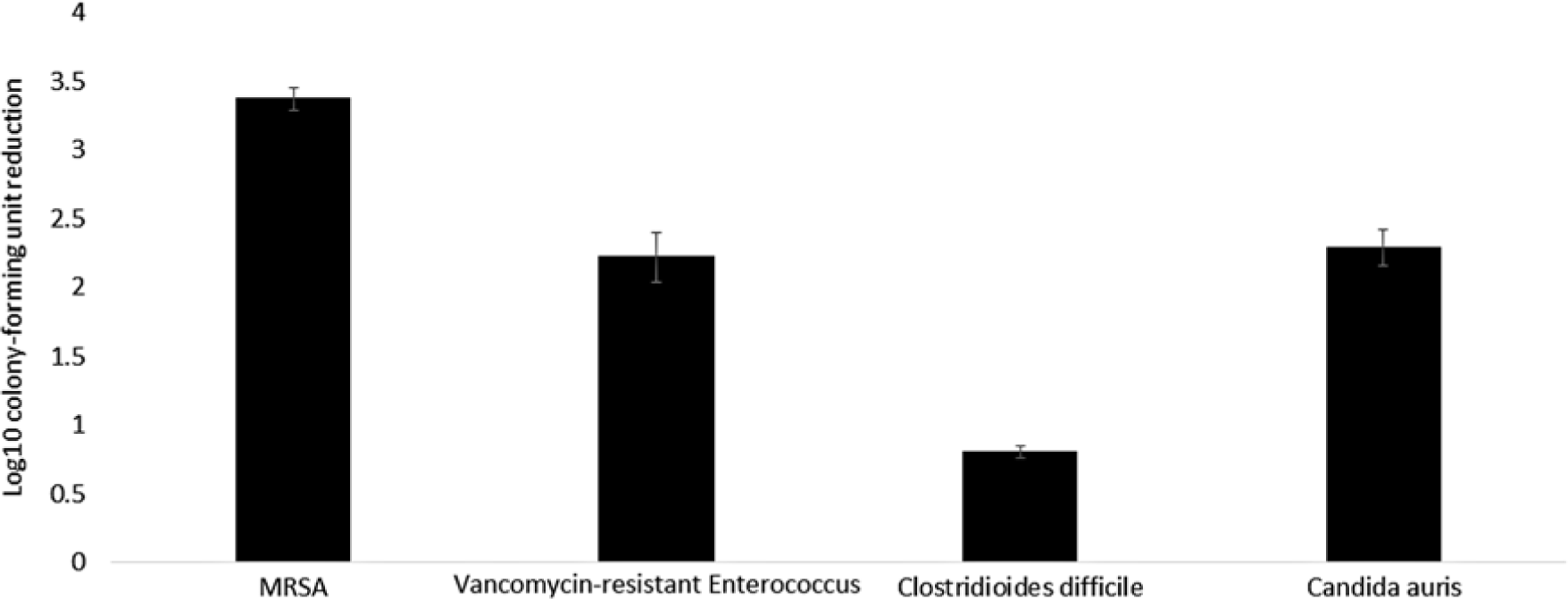
Figure 1 shows the efficacy of the 3-minute UV-C cycle in reducing pathogens on inoculated stethoscope diaphragms. Recovery of VRE, MRSA, and C. auris was reduced by >2 log10 CFU, whereas C. difficile spores were reduced by only 0.8 log10 CFU.
Efficacy of a 3-minute ultraviolet-C cycle delivered by the StetClean device in reducing pathogens inoculated on stethoscope diaphragms. Note. MRSA, methicillin-resistant Staphylococcus aureus. Error bars indicate standard error.

In total, 45 MRSA-colonized patients participated in the assessment of the efficacy of the 3-minute UV-C cycle. In comparison to untreated control stethoscopes, the UV-C cycle reduced the frequency of recovery of MRSA from 17 of 45 (38%) to 4 of 45 (9%) (P < .01). The mean number of MRSA colonies was reduced from 4 to 0.08 (P = .045). Moreover, 20 MRSA-colonized patients participated in the assessment of the efficacy of alcohol pads in removing MRSA. In comparison to untreated control stethoscopes, the alcohol pads reduced the frequency of recovery of MRSA from 7 of 20 (35%) to 0 of 20 (0%) (P < .01).
Our results demonstrate that the wearable semiautomated UV-C device is effective in reducing pathogens inoculated on stethoscope diaphragms and in reducing MRSA transferred to stethoscopes during examination of colonized patients. The device uses UV-C generated by an LED, which is well-suited for decontamination of small items in close proximity to the UV-C source due to its compact size.Reference Messina, Burgassi, Messina, Montagnani and Cevenini7 LEDs have other potential advantages, including lower energy requirement, long lifespan, minimal warm-up time, and absence of mercury.Reference Messina, Burgassi, Messina, Montagnani and Cevenini7
Our study has some limitations. We tested only the efficacy of one 3-minute cycle. In practice stethoscopes would receive numerous cycles per day. We did not test a gram-negative pathogen, but previous studies have demonstrated similar efficacy of UV-C versus gram-positive and gram-negative pathogens.Reference Shaikh, Ely and Cadnum9 The device would not address contamination of the stethoscope tubing, which is also common.Reference Longtin, Schneider and Tschopp2 We did not compare the use of the device with other novel approaches for prevention of pathogen transmission by stethoscopes such as coating stethoscopes with antimicrobial copper.Reference Schmidt, Tuuri and Dharsee10 Finally, our results suggest that the UV-C device may be less effective than alcohol wipes for the removal of pathogens such as MRSA.
In summary, we found that a novel UV-C device was effective in reducing contamination on stethoscope diaphragms. Future studies are needed to evaluate whether routine use of the device will be effective in reducing contamination of stethoscopes used in clinical settings.
Acknowledgments
The authors thank egoHEALTH for providing the device used for testing. egoHEALTH did not provide funding for the study and had no role in study design, analysis or interpretation of the data, or writing of the manuscript.
Financial support
This work was supported by a Merit Review Grant from the Department of Veterans Affairs (grant no. 1 I01 BX002944-01A1 to C.J.D).
Conflicts of interest
C.J.D has received research grants from Clorox, Merck, Pfizer, PDI, GOJO, and Boehringer Laboratories. All other authors report no conflicts of interest relevant to this article.