Introduction
Taiwan, also known as Formosa, is located in the Western Pacific about 160 km off China’s southeast coast, midway between the Japan and the Philippines. In 2006, Taiwan had a total population of 23 million, with a density of 620 persons per square kilometer (Council for Economic Planning and Development; CEPD, 2007).
The social transformation of Taiwan has been exceptional. Little is known about Taiwan before Dutch colonization in the 17th century. The Dutch were defeated by Koxinga’s forces in 1662, which was conquered later by the Qing Dynasty in 1683. The Qing Dynasty ruled Taiwan for 200 years before it ceded Taiwan to Japan in 1895. After 50 years of colonization by the Japanese government, Taiwan was repatriated to the Republic of China at the end of the World War II. As a result of the civil war, the Kuomintung (KMT, then the ruling party) retreated from Communist-occupied mainland China to Taiwan in 1949. Taiwan was then ruled under Martial Law and authoritarian one-party leadership, until the gradual liberation and democratization of the political system in the late 1980s. Yet, with Taiwan’s withdrawal from the United Nations in 1971, its political status to date remains controversial both domestically and internationally.
Taiwan’s fast growing economy and rapid industrialization in the latter half of 20th century is widely regarded as the ‘Taiwan miracle’, rivaling the growth of Singapore, Hong Kong and South Korea – together, the ‘Four Asian Tigers’ (Kuo et al., Reference Kuo, Ranis and Fei1981; Gold, Reference Gold1986; CEPD, 2006). Gross national product per capita in Taiwan increased from US$145 in 1951 to US$16,471 in 2006. More importantly, the income inequality has substantially improved – the ratio of income shared by the richest 20% to that of the poorest 20% was 6.0 in 2005, compared to 20.3 in 1952. Together with economic development, Taiwan has witnessed a demographic transition. The crude birth rate in Taiwan declined sharply from the peak of 50‰ in 1951 to 9‰ in 2006. The crude death rate also declined from 12‰ in 1951 to the bottom of 5‰ in the mid-1970s, but increased slightly to 6‰ in 2006 due to population aging. In 2006, there were 2.3 million people aged 65 and over in Taiwan, representing 10% of the total population.
Besides demonstrating an ‘economic miracle’, Taiwan also achieved a ‘health miracle’ (DOH, 2007). Since the 1950s, mortality has declined substantially among all age groups. Improvement is especially significant in infant mortality, which decreased from 45‰ in 1952 to 5‰ in 2002. Accordingly, life expectancy at birth in Taiwan increased for males and females, respectively, from 57 and 61 years in 1952 to 75 and 81 years in 2006. With the decline in death rates, Taiwan experienced an epidemiological transition. In the early 1950s, most of the leading causes of death in Taiwan were infectious diseases, including gastroenteritis, pneumonia, tuberculosis, nephritis, bronchitis and malaria, which soon gave way to non-infectious diseases as the leading causes of death. By the beginning of the new century, non-infectious diseases such as cancer, stroke, heart disease, hypertension diseases, diabetes mellitus and accidents have already become dominant health problems in Taiwan.
In response to changing health needs and evolving social, economic and political context, the health care system of Taiwan has remarkably progressed (Chiang, Reference Chiang2005). Before the dawn of the 20th century, no government in Taiwan played a significant role in health care delivery and financing. Chinese medicine used to be the mainstream of health care delivery in Taiwan, but no formal school education and licensing systems for it. Western medicine did not exist until James L. Maxwell, a philanthropic medical missionary from the Presbyterian Church of the United Kingdom (UK), started his medical practice in Tainan in 1865. However, the practice of Western medicine was limited only to places where missionaries were based.
The dominance of Chinese medicine, however, began to diminish soon after Japan took over Taiwan and the 50 years of Japanese occupation has imposed significant impacts on Taiwan’s present day health-care system. First, the colonial government systematically and rapidly scaled up the supply of Western-style providers by establishing the first school of Western medicine and erecting a number of public hospitals staffed by doctors trained in Western medicine (Hsiao et al., Reference Hsiao, Yaung and Lu1990). Second, a formal licensure system was instated to regulate medical practice: Chinese and Western medicine could only be practiced with permission from the colonial government. However, in contrast with the rapid acceptance of Western medicine, the practice of Chinese medicine was so heavily suppressed that the number of licensed Chinese medicine practitioners had drastically decreased from 1903 in 1901 to less than two dozens in 1945 (Lin, Reference Lin2004). Third, the Japanese medical providers prescribed and also dispensed medicine, and made substantial profits from the sale of drugs, which made the policy of separating dispensing from prescribing still a daunting task to carry out nowadays in both Japan and Taiwan. Fourth, following Japanese legacy, the hospitals in Taiwan remained operating in closed system with a large outpatient department. Finally, medical doctors who were the few highly educated professionals in the colonization period, were considered social elite and on top of the social class ladder. The social perception of medical professions has remained and made studying in medicine still the top career choice for the young people.
After World War II, the Republic of China became the governing polity of Taiwan. Western medicine has continued to flourish and dominate in Taiwan’s health care system. There was also aggressive advocacy of Chinese medicine by high ranking KMT party members and medical practitioners, and consequently the licensure examination was reinstated in 1947 (Lin, Reference Lin2004). To enhance its scientific basis and gain market competitiveness, the practice of Chinese medicine was modernized by establishing medical training programs within the formal medical school education system, which enroll approximately 270 medical students yearly. Yet, practitioners will also be able to obtain a license through the Professional and Technical Special Examinations for Doctors of Chinese Medicine before 2011 (Lin, Reference Lin2004).
Although the new government made many efforts to improve public health (such as malaria control and mass vaccination), it did not pay much more attention to the health care delivery system than did the colonial government. What the government had undertaken was mainly to assure each of the 21 counties and cities at least one public hospital and to set up military and veteran hospitals. In the early 1970s, Taiwan had fewer than 0.5 physicians and 2.5 hospital beds per 1000 population.
With the establishment of the Department of Health (DOH) under the national cabinet in 1971, Taiwan’s health care system moved into a new era, characterized by the government’s active involvement in health care reforms. Since then, Taiwan’s health care system has undergone two important periods of development: pursuing health care for all (1971–1995) and moving toward a high performing health system (1995-present). This study aims to review health care reforms in Taiwan during the two periods from the perspective of public policy. First, we present a conceptual framework for studying health care reforms. Then, we describe the process of formulating and implementing health care policies to achieve the goals of ‘health care for all’ and ‘towards a high-performing system’ during the two periods. Finally, we discuss factors affecting the evolution of Taiwan’s health care system, which may provide valuable lessons for comparative analysis of health care reforms.
Conceptual framework
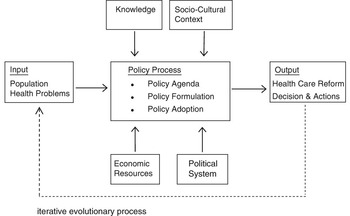
As health care is meant to alleviate pain and suffering of the medically needy and consequently can enhance the wellbeing of individuals, health policy, which concerns the mobilization and distribution of the health care resources contributes to the welfare improvement of the society. Health policy viewed as one aspect of public policy can hence be analyzed through adopting the process framework developed for public policy. In this study, we have borrowed some concepts from the studies of public policy and proposed a conceptual framework for examining the evolution of Taiwan’s health care system through an iterative evolutionary process with population health problems as inputs and health care reform decision and action as outputs (Figure 1). In this framework, we specifically emphasize four external forces, which bear significant influence on the development of health policies, namely, knowledge, socio-cultural context, economic resources and the political system.
Analytical framework for health policy.

Input – ‘Population health problems’: As depicted in Figure 1, the recognition of ‘population health problems’ triggers the health policy process and, in the health sector, an epidemiological transition of disease pattern signifies the birth of different health problems to be resolved through an iterative process.
Process – ‘Policy process’: Recognition of population health problems is followed by the policy process box, where phases of policy agenda setting, policy formulation, and policy adoption are undertaken (Anderson, Reference Anderson1994).
Policy agenda: The magnitude and urgency of the population health problems identified will be assessed and prioritized, upon which the policy agenda will be set.
Policy formulation: Once the policy agenda is set, a feasible work proposal that delineates courses of action to resolve the health problems should be developed.
Policy adoption: The last phase of the policy process focuses on legitimizing and authorizing the proposed work plan and getting the government to accept the proposed solution.
In addition, there are four external forces, which facilitate the policy process: knowledge, socio-cultural context, economic resources and political system.
Knowledge: Knowledge is essential to problem solving in the policy process, which can be generated not only from systematically collecting domestic data to produce scientific evidence, but also from exploiting valuable lessons abroad. The value of the knowledge bestowed upon the process depends on the group of domestic and international scholars involved.
Socio-cultural context: Socio-cultural context is important as it reflects the beliefs and ideology held by the members of a society; consequently it often exerts significant influence on the policy process in terms of reaching a consensus in policy making, which is acceptable to the society.
Economic resources: The strength of the economy is essentially the backbone of any reform policy proposal as it determines the resources available to eventually facilitate the policy implementation. In particular, the size of the resources in the private sector signifies the significance of the role that the private sector can play in initiating changes.
Political system: Political force is a vital determinant of the feasibility and operability of any policy proposal as it is closely associated with the executive arms of the government. In the context of social policy, political and social environment are regarded as crucial to the practicability of the design and execution of the social policy to be launched (Hill and Bramley, Reference Hill and Bramley1986).
Output – ‘Reform decisions and actions’: The outcome of the policy process is phased into ‘reform decisions and actions’ stage. In the governmental policy making process, two overriding questions often asked tend to focus on the efficacy of the policy making in solving problems and on its responsiveness to popular control (Lindblom, Reference Lindblom1980). Consequently, reform decisions and actions will lead to the iterative evolutionary process of the policy making loop in response to constantly changing public demand or unsatisfactory reform outcomes.
In the following section, an account of the health policies implemented in Taiwan from 1970 onward illustrates the conceptual framework proposed in this section.
Pursuing health care for all
In the early 1970s, the development of health policy in Taiwan moved into a new era characterized by the government’s policy focus on the supply of health care professionals and hospital capacities, and then tackling an uneven distribution of health care resources and quality issues.
1970–1985: Period of expansion
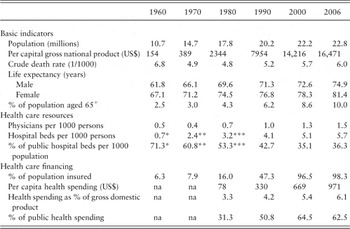
The establishment of the DOH as a Directorate General in charge of health affairs directly under the Executive Yuan in 1971 marked a momentous step in the expansion of the health care industry in Taiwan. Despite government reports, which claimed no physician shortage in the late 1960s (Hsu, Reference Hsu1965; Wu, Reference Wu1980), the number of physicians per 100,000 population declined from 45 in the 1950s to 41 in the 1970s and a quarter of health stations were often staffed without physicians in rural areas (Chiang, Reference Chiang1995a; Table 1). With an aim to enhance access to health care, the government no longer adopted a laissez-faire approach, but rather took up, a much more aggressive policy to expand the supply of health professionals and tackle the issue of mal-distribution of health resources through various policies.
Basic and health care indicators: Taiwan, 1960–2006

*1961; **1971; ***1982; na = not available.
Source: Chiang, T. L. (Reference Chiang2003); Council for Economic Planning and Development (2007); Department of Health (2007).
First, to cope with the imminent demand for physician services and the retirement issue of military doctors (most of them were not trained in medical school), the government granted practicing licenses to 2724 retired military doctors through seven special license examinations from 1972 to 1976 and was able to recruit some to practice in the rural health stations (Lin, Reference Lin1980). Although this measure somewhat ameliorated the shortage problem, critiques on quality of care rendered were not uncommon.
Second, to achieve the target of one physician per 1000 population, the government took multi-faceted action to increase medical student enrollment, which had reached roughly 1200 per year by the mid-1980s (Chiang, Reference Chiang1995a). The enrollment expansion was made possible through opening up two new public medical schools (in 1975 and 1983), scaling up the enrollment class size at existing medical schools, and launching in 1982 several new five-year post-graduate programsFootnote 1 (similar to the most prevailing medical school system in US) parallel to its concurrent seven-year program (Chiang, Reference Chiang2003).
Third, the DOH also aimed to expand hospital capacities to achieve the target of four hospital beds per 1000 population with joint efforts contributed by the private sector (Chiang, Reference Chiang1997). With a growing economy, the private sector was able to mobilize more funds to invest in hospitals and launch large-scale hospital construction projects. One of the most significant examples is the hospital investment project undertaken by the Chang Gung Memorial Hospital group in 1976, which now operates more than 9000 beds in five different geographical locations and has become the largest hospital chain in Taiwan. This continuing endeavor by private investment (mainly in large-scale proprietary hospitals managed by non-for-profit foundations)Footnote 2 was reflected by the steadily declining market share taken up by public hospitals and increasing average hospital scale since 1960 (Table 1).
Fourth, while the expansion in the supply of physicians and hospital beds seems to have achieved the target, the mal-distribution of health care resources remained a real issue to tackle. The most significant policy intervention to address the mal-distribution of physician workforce was the ‘group practice center’ (GPC) program introduced in 1983 as part of a series of policies laid out to enhance the infrastructure of rural communities and to improve farmers’ income levels. The GPCs were normally set up in under-served areas and shared capital facilities with local health stations (Chiang et al., Reference Chiang, Yaung and Lew-Ting1991). The DOH, for its part, subsidized large teaching hospitals to send their physicians to practice in the centers and concurrently allowed the staff physicians to retain 80% of net profits as a bonus, which greatly enticed physicians to practice in rural areas. In addition, starting in 1984, the government assigned public-sponsored medical graduatesFootnote 3 to practice in the GPCs, which assured a steady flow of staff physicians for the GPC’s (Chiang, Reference Chiang2003).
1985–1995: Period of improving distribution and enhancing quality
The inauguration of the ‘Medical Care Network’ in 1985 has promulgated the main policy emphases in rectifying the mal-distribution of health care professionals and facilities, and quality improvement, aside from licensing management and supply of physicians. With the passage of the Medical Care Act at the end of 1986, the Medical Care Network program – which aimed for an all-dimension development of the health care delivery system rather than institution-wise functional reform – was able to generate a profound impact on the progression of the health care sector in Taiwan, in particular on physician workforce policy. Through numerous rounds of heated debate between the CEPD, which was a strong advocate of market competition approach (hence, less concerned about possible oversupply), and the DOH, which projected an oversupply of physicians by 2000, the government revised the pre-set target of one physician per 1000 population to one physician per 750 population in 1987.Footnote 4 Regardless of which physician supply target is more realistic, the main issue lies in the distribution of the physicians, rather than the total supply (DOH, 1986).
To improve the geographic distribution of physicians, the DOH has consequently developed a few strategies. At the beginning, the DOH proceeded with setting up more GPCs in towns, which have less than one physician per 3000 population and by 1995, there were in total 174 GPCs in Taiwan. Although the program has indeed contributed to the physician supply in the rural areas, the GPCs could hardly compete for practicing physicians with the fast expanding large-scale hospitals in metropolitan areas. To address the geographic disparity, the DOH has taken a two-pronged approach. First, the DOH announced a policy target of ‘reducing the gap in physician population ratios among medical care regions to a two-fold difference by year 2000’ in the Medical Care Network Phase II program implemented in 1990. In addition, the government had budgeted NT$10 billion to set up a medical care development fund to encourage private sector entrepreneurs to build small hospitals in under-served areas (DOH, 1990).Footnote 5 Second, the Medical Care Act prohibited the construction of new hospitals of more than 100 beds or hospital expansion projects in saturated areas, which indirectly slowed the growing demand for urban physicians as well as narrowing the disparity gap (Chiang, Reference Chiang2003; Lu and Hsieh, Reference Lu and Hsieh2003). Despite the government’s various interventions to address the mal-distribution of physician workforce, the effects appeared modest and incomparable to market mechanisms reflected by the carrying capacity of community for physicians (Chiang, Reference Chiang1995b).
At the same time, the DOH also sought to promote quality of care and had enacted relevant policy instruments in implementing the resident training program as well as specialty licensure system. First, as stipulated by the Medical Care Act, the practicing physicians needed to complete at least a two-year resident training program before becoming a responsible physician and to obtain a specialist qualification in the case of being responsible for specialty clinics and hospitals. Second, abiding by the Medical Care Act, the DOH entrusted the specialist licensing examination to medical specialty associationsFootnote 6 and required physicians to finish a special training program and participate in continuous medical education before becoming eligible for a valid specialty license.
In accordance with the institution of the resident training program and specialty licensure system, DOH officially launched the hospital accreditation program in 1987, which accredited hospitals every three years.Footnote 7 At its infancy, only 145 hospitals applied for accreditation, of which 122 were successfully accredited. By 2000, there were 506 hospitals passing the accreditation criteria, which accounted for 76% of the hospitals and 92% of the hospital beds (Chiang, Reference Chiang2003).
To assure access to care and control for rapid growing health costs, another policy worth noting in this period was the DOH’s aim in promoting the development of primary care, which was severely threatened by a fast expanding hospital sector. In addition to the GPC program in place, the DOH also pushed for the birth of the specialty in family medicine and delineated a policy goal, which set the target supply of primary care physicians as 40% of total practicing physicians in the amendment to the Medial Care Network phase II program (DOH, 1993).
Moving toward a high performing health-care system
Despite government’s efforts to enhance the functions of the delivery system through various intervention programs since the 1970s, fragmented health care financing mechanisms received much less due attention. In 1984, exploiting the fruits of recent socio-economic development and in response to the call for a widespread social security system, the government charged the CEPD with organizing a planning task force to study Taiwan’s social security programs (Chiang, Reference Chiang1997). Two years later, the task force completed an integrated planning report and concluded with a recommendation for a universal health insurance scheme by the year 2000 and a supply target of 1.5 physicians and five beds per 1000 population (CEPD, 1986a). These recommendations later became a chapter of ‘Long-term Economic Perspectives in Taiwan, 1986–2000’, which eventually formed Executive Yuan’s policy guidelines for Taiwan’s economic development (CEPD, 1986b). In fact, Premier Kuo-hwa Yu had made the policy announcement of ‘health insurance for all by 2000’ in his report to the Legislative Yuan in early 1986.
At the same time, Taiwan’s political environment and climate had gone through major transitional changes. The political participation by the opposition power substantially intensified and the government lifted the Emergency Decree Law (martial law) in 1987. In the process of democratization, Taiwan’s first opposition party, the Democratic Progressive Party (DPP) was officially formed on 28 September 1986. To mobilize public support and raise its political capital, DPP often seized headlines to fiercely criticize the government on issues such as political freedom and social security. Although, the ruling KMT party had strategically implemented a health insurance demonstration project to cover farmers in 1985 (fully implemented in 1989), the mounting political pressure compelled an earlier enactment of National Health Insurance (NHI) to appeal to the public. On 28 February 1989, Premier Yu finally announced to advance the new target year for implementing the NHI program to 1995 (CEPD, 1990).
In 1988, CEPD had assembled a task force composed of Taiwanese public health scholarsFootnote 8 to draft the basic principles of the new health insurance program. Recognizing the importance of international experiences, Minister of CEPD Frederick Chien engaged Professor William Hsiao of Harvard University as chief advisor to the task force in 1989. As a result of a cabinet reshuffle in the middle of 1990, the CEPD task force was dismissed and a task force under the DOH was created after the NHI planning report was submitted to the Executive Yuan (CEPD, 1990). After nearly five years of planning efforts (1988–1993) and a two-year legislative marathon, the NHI program was inaugurated on 1 March 1995. As the task force emphasized the values of learning from the past and abroad, the Taiwan NHI program has been described by the former deputy Health Minister and CEO of Bureau of NHI (BNHI), Dr Hong-Jen Chang, as ‘a car that has been domestically designed and produced, but with many components imported from over ten other countries’ (Cheng, Reference Cheng2003).
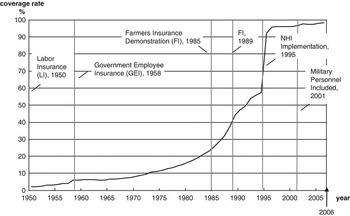
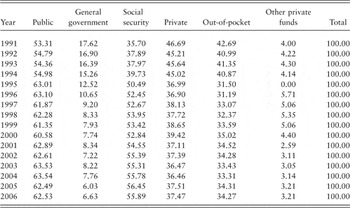
Before the introduction of NHI in 1995, Taiwan’s government had established four major social insurance programs,Footnote 9 which closely modeled the social insurance approach of Germany and Japan, namely Labor Insurance (in 1950), Government Employee Insurance (in 1958), Farmers Insurance (in 1985) and Low-Income Household Insurance (in 1990) (Lu and Hsieh, Reference Lu and Hsieh2000; Cheng, Reference Cheng2003; Lu and Hsiao, Reference Lu and Hsiao2003). Collectively, those existing social insurance programs had covered about 57% of the total population by 1995, compared to 16% by 1980, which left most of the high-risk population uninsured (Table 2, Figure 2). Recognizing the administrative deficiency and concurrent large deficits in the existing multiple payer social insurance system, then President Teng-Hui Lee along with major policy makers took the advice from the task force and decided on a single-payer model. BNHI, a quasi-governmental agency that by law is the only administration that operates the insurance program was then inaugurated in January 1995, nearly six months after the Legislative Yuan passed the NHI Act.
Insurance coverage expansion in Taiwan, insured people as a percentage of population 1950–2006. Sources: For 1950–1994, data from Lu and Hsieh (Reference Lu and Hsieh2000), ‘The National Health Insurance Program in Taiwan’, in Health Economics, Taipei: Pro-Ed Publishing Company; for data after 1995, Department of Health (2008), Health Statistics in Taiwan, 2006, Taipei: Department of Health, Executive Yuan, R.O.C. (Taiwan).

The accelerated implementation timeline of NHI (five years ahead of its original schedule) was mostly a product of political compromise to the increasing public demand for universal health coverage. Given the scale of the program, there was chaos when NHI was first introduced. However, with some precautionary measures taken by the government, there was hardly any major unintended undesirable consequence. First, the design of NHI was a path-dependent social insurance model, which the previously insured 57% of the population was familiar with. Second, Prime Minister Lien has formed an intergovernmental task force in September 1993 to coordinate NHI related affairs among the ministries involved within Executive Yuan. In addition, the NHI Preparatory Office was officially established in December 1993 to prepare for the inauguration of the NHI program in 1995. Third, the premium contribution rate was politically set with consideration of insurance shock effect. Hence, NHI was free from financial distress at the initial implementation stage. Fourth, the BNHI set up many hot lines to accommodate call-in for questions and complaints, and several Ministers without portfolio toured around the country to engage face-to-face communication with the public, followed by improved operations of the NHI. With the considerably concerted efforts, the public responded with a satisfaction rate increase from 30% in April 1995 to 50% in September 1995, and to 55% in January 1996 (Department of Health, 1996).
The government planned its new NHI system to achieve three essential objectives: providing equal access to health care for all citizens, controlling total health spending within a reasonable level, and promoting efficient use of health care resources. The NHI provides a comprehensive benefits package that covers preventive and medical services, prescription drugs, dental services, Chinese medicine and home nurse visits. To constrain growing utilization rates due to moral hazard, the NHI also incorporated a co-payment of US$2 for each outpatient visit to clinics, US$5 for each visit to medical center outpatient clinics, and a 10% co-insurance for inpatient services, but capped the total amount that a patient has to pay for each admission at 6%, and for each year at 10% of the average national income per person (Lu and Hsiao, Reference Lu and Hsiao2003).
On the delivery side, Taiwan maintained a market-driven system, which reflects Taiwan’s free-enterprise economy. Both patients and providers have free choice. Hospitals and physicians are paid mainly on a fee-for-service basis and abide by a uniform fee schedule established by BNHI for its contracted providers, which was adopted from the one originally implemented by the Labor Insurance program. Hospital physicians are often paid on a salaried basis with bonus payments based on productivity. Private practitioners remain mainly reimbursed on a fee-for-service basis. For the same type of treatment rendered, the medical institutions are reimbursed contingent upon their accreditation status, which bestows the medical institutions incentives to ‘upgrade’ through means of expanding capacities. As a result, the average bed size of medical institutions has gone up from 82 beds in 1986 to 171 beds in 2000 (Lu and Hsieh, Reference Lu and Hsieh2003). Evidently, the market share of NHI expenditures has been unevenly absorbed by the small number of large-scale hospitals.
NHI is mainly financed through premiums (in the form of payroll tax), supplemented with direct government funding. The premium, calculated as a percent of total payroll was to be shared between employers, employees and the government, at the rate of 60%, 30% and 10%, respectively. At its infancy, the NHI wage base was rather narrow as contributions are capped at the upper end of income (where the top earning base was only 5.5 times that of the lowest earning base), but later the wage base was gradually expanded to resolve the financial distress. To avoid the possibility that employers may discriminate against workers with large families, the employers would only have to pay for the worker plus 0.7 dependent. The worker has to pay the premium for himself/herself plus up to three dependents. The government also allotted a reserve fund for NHI at its inauguration and would pay for the annual operating cost, which is currently less than 2% (by law, it is capped at 3.5%) of its total expenditures. In other words, the collected premiums are only used to cover the medical expenditures incurred. Of the total premium income in 2006, the insured is the largest contributor, paying for 37.9%, followed by 33.9% from the government (25.4% as subsidiesFootnote 10 and 8.5% paid as an employer) and the remaining 28.1% is borne by the employers (BNHI, 2008).
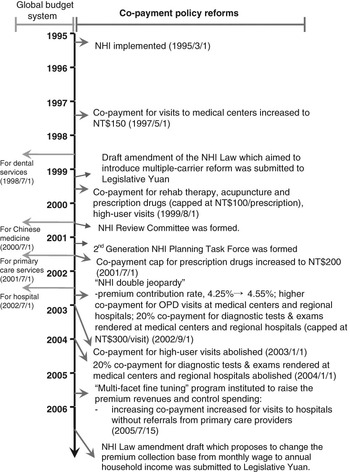
However, the NHI’s revenue has not kept pace with gross domestic product growth, as the annual growth rate for health expenditure was 6%, compared to 4% for premium income. In 1998, three years after the NHI’s implementation, the actual annual cash flow of the NHI program began to run a deficit. To counter financial pressure born by steady growth in expenditure outlay and a relatively lagged increase in premium income, BNHI gradually set up separate global budgets for dental services, Chinese medicines, and primary care services (outpatient services delivered in clinic settings). In 2002, Taiwan created a separate global budget for hospital outpatient and inpatient services, which provoked vociferous opposition by the hospitals.
Given its financial condition and significant impact on the welfare of the Taiwanese people, NHI was never short of reform proposals over the years (Figure 3). In 1997, just two years after the NHI was introduced, the KMT government proposed a new ‘multiple carriers’ structure in providing health insurance, often misperceived as ‘privatization of the NHI scheme’, and the draft amendment essentially died in the Health and Welfare Committee of the Legislative Yuan (Wong, Reference Wong2003; Chiang, Reference Chiang2005). When the government changed hands in the 2000 presidential election, the newly elected DPP government first charged the National Health Research Institutes to critically review the performance of NHI (NHI Review Committee, 2001). After the NHI Review Committee completed the assessment report in 2001, the DOH decided to form the ‘2nd generation NHI Planning (NHI 2G) Task Force’ in July 2001 to develop a reform proposal. Before the reform proposal could be presented in 2002, the government decided to immediately raise the contribution rate from 4.25% to 4.55% and co-payment for services rendered at medical centers and regional hospitals, as the NHI reserve fund had less than one-month expenditure outlay.Footnote 11 This move, termed ‘NHI Double Jeopardy’ by the media, consequently created a perilous political storm.
National Health Insurance (NHI) reform policies, 1995–2006.

Facing a nearly depleted reserve fund in 2005,Footnote 12 NHI quickly promulgated a series of ‘multi-facet micro-tuning’ programs to expand the revenue base and further contain costs, but deliberately circumvented further increases in contribution rates across the board. Specifically, the contribution cap was raised so that the highest earning base became 8.3 times that of the lowest; tobacco tax was doubled from NT$5 to NT$10; and new budgets from relevant government agencies were appropriated to finance preventive interventions, infection disease control, and medical education in teaching hospitals. On cost containment, NHI instituted primary care gate keeping by increasing co-payments for hospital services without a referral, and strengthening physician and patient profiling to reduce duplicate and unnecessary tests and prescriptions. Figure 3 depicts NHI policy reforms from 1995 to 2006.
Nevertheless, ‘multi-facet micro-tuning’ was only a temporary measure to ameliorate the imminent threat of insolvency. In 2006, amidst much controversy, the NHI 2G task force unveiled a reform package and submitted it to the Executive Yuan for consideration. This legislative amendment proposed to change NHI premium contribution from a payroll tax base to a household income base thereby broadening the contribution pool, and to limit (by explicitly capping contributions at a fixed percentage of the total revenue base) the financial exposure of employers and government. In particular, the current system classifies the insured into 6 categories and 14 classes based on occupation by which the level of government subsidy varies rather than by income. By moving away from this complicated occupation-based classification to a household income contribution mechanism, NHI anticipates that government subsidies would be more targeted to the socially indigent for greater equity, although it could prove administratively costly in terms of premium assessment and collection. Due to its controversy, the draft legislative amendment never made it to the first reading.
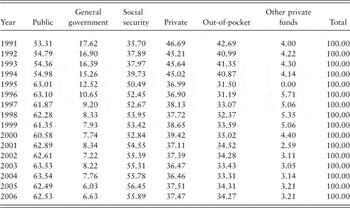
Currently, Taiwan reported spending approximately 6.1% of GDP in health care, averaging to a per capita health expenditure of NT$31,661 (US$934) in 2006, of which NHI, household out of pocket payment, and government, accounts for 55.9%, 34.3% and 6.6%, respectively (Table 2).Footnote 13 An average household in Taiwan devoted 3.74% of total household consumption expenditures to health care and the distribution of out-of-pocket sharesFootnote 14 across income quintiles (indicated by concentration index of −0.1065) showed a modest pro-poor tendency, namely, that the less well-off were burdened with a higher out-of-pocket share than the better-off (Van Doorslaer et al., Reference Van Doorslaer, O’Donnell, Rannan-Eliya, Somanathan, Adhikari, Garg, Harbianto, Herrin, Huq, Ibragimova, Karan, Lee, Leung, Lu, Ng, Pande, Racelis, Tao, Tin, Tisayaticom, Trisnantoro, Visasvid and Zhao2007).
Discussion
As Taiwan encountered considerable disease pattern shift since early 1900s, the public demand for health services varied substantially as well. Consequently, health policies developed different focuses at different phases. In the process, the four external forces depicted in the conceptual framework (knowledge, socio-cultural factors, economics resources and political system) have contributed to and facilitated the progression of the policy process and shaping health care reform decisions and actions.
One of the distinct features of the policy process in Taiwan is the value of knowledge introduced in shaping the policy. For instance, in the case of NHI planning, both CEPD and DOH NHI task forces not only had drawn in domestic leading experts but also consulted more than a dozen of countries to develop the planning report (Cheng, Reference Cheng2003). It is worth mentioning that an international symposium themed ‘What can be learned from the experiences of the health care systems in developed nations?’, which invited scholars and experts from West Germany, UK, Canada, United States and Japan, was held in 1989 to solicit global experiences in health care reform.Footnote 15 One among the many important lessons learned from abroad was the recommendation of the ‘single-payer model with a global budget’ for its efficiency through exercising monopsony power and significantly reducing administrative red tape, and containing health care cost (Reinhardt, Reference Reinhardt1981; Evans, Reference Evans1983; Glaser, Reference Glaser1984; Himmelstein and Woolhandler, Reference Himmelstein and Woolhandler1986; Whitney, Reference Whitney1988; Bodenheimer, Reference Bodenheimer1989; Iglehart, Reference Iglehart1990). The final recommendations in the planning report synthesized global experiences not only abstracted from published papers, books and research reports, but also the first-hand suggestions by the experts they interviewed during organized site visits to various national health authorities, namely Japan, Korea, Canada, UK, Sweden and West Germany. For example, as Evan pointed out (1983) that ‘costs have been contained by a public insurance system, a monopoly maintained by legislative exclusion of private insurers, and not by a public service’. Also, during one of the site visits to UK NHS, the experts had advised against financing through general revenues and suggested for earmarked taxes. Consequently, a path-dependent social insurance model with a single-payer feature and payroll based financing source, was quickly adopted and recommended by the CEPD task force. Next, to rectify the payment mechanism, BNHI has extensively borrowed experiences abroad and experimented with various payment reform schemes over the years. Prospective payment, such as diagnosis related group, also offers one illuminating example. Knowledge sharing has clearly been an important determinant of the policy making process.
Socio-cultural context of the policy process reflects the ideological and cultural values possessed, social norms acceptable, as well as social changes encountered by members of the society. In the early 1970s, when degenerative diseases had replaced communicable diseases as dominant health problems in Taiwan, access to health care was still considered an individual responsibility. At the same time, along the path marching toward industrialization, family function was waning and hence became insufficient to provide the care needed. Consequently, demand for health care has increasingly relied on provision by the formal sector and government’s efforts in building a satisfactory social security system. Largely guided by Neo-Confucian principles, which tout a paternalistic role for the rulers (Hsiao and Lu, Reference Hsiao and Lu1995), the then-ruling KMT elite decided to focus on expanding health resource capacities including physician supply and hospital facilities as aforementioned. However, the paternal role was limited when it came to financing a social safety net. For example, as the government intended to extend the compulsory coverage of Labor Insurance to employees of small and medium business, the eligibility was initially limited to wage earners but not to their spouses and dependents. The policy makers had all their hearts on economic growth but also somewhat recognized the importance and potential benefits that a profound social security system might bring to a democratic society. However, they also worried about the potential financial costs, which might adversely affect the economy’s growth and tried to somehow ‘limit the welfarism’. As it turned out, the passage of universal coverage in 1995 was actually through the forces of political power (democratic movement), which will be discussed later.
Economics and politics are commonly viewed as two of the most crucial forces that facilitate policy formation. Since the 1970s, as a result of the expanding economy, demand for health care was expected to increase (as medical care is normally assumed to be normal goods) and more resources were gradually mobilized into the health sector. The government introduced various policies and launched programs to not only augment the infrastructure building but also increase the enrollment of medical students, accompanied by growing private investment in founding new medical schools and hospital construction projects. The joint venture of public and private sectors in health has significantly enhanced the quality of human capital and consequently created a phenomenally prospering health industry. Moreover, Taiwan’s miraculous economic growth in the 1980s (per capita income growing at 6%–8% per year in real terms) provided an expanding fiscal base for financing NHI program without having to impose significant cutbacks on current wages, profits or other governmental programs, which might easily face strong opposition (Hsiao and Lu, Reference Hsiao and Lu1995).
The evolution of political institutions in Taiwan played an indispensable role in the development of health care sector reform. Winckler (Reference Winckler1984) argued that Taiwan was best understood as a ‘gerontocratic-authoritarian’ regime, where there was generational succession from mainland-based to Taiwan-based leadership, and a beginning of a systemic transition from ‘hard’ to ‘soft’ authoritarianism. Under the ‘hard authoritarian’, mainlander-technocratic rule of one-man dictatorship, Chiang Kai-Shek (1949–1975), elections were largely limited to local areas and seen as control devices for co-opting local elites and reinforced by the extra-constitutional security police. As remarked by Wong (Reference Wong2004), the presidential office and ruling party leadership dominated social policymaking, reform was hardly universal and social policy was never meant to promote wealth redistribution.
The passing of Chiang Kai-Shek commenced the period of ‘soft authoritarianism’ (1975–1987) characterized by joint mainlander-Taiwanese technocratic rule under collective party leadership, which allows for more open electoral competition in tandem with the new social forces created by Taiwan’s rapid socio-economic modernization (Winckler, Reference Winckler1984). When Chiang Ching-Kuo, son of Chiang Kai-Shek, was chosen by the KMT-dominated National Assembly as President of the Republic of China in 1978, he started to bring more native-born Taiwanese into high government positions. During his rule, Chiang Ching-Kuo legitimized his political institution by sharing political power with the opposition, boosting economic development and enacting social welfare programs to respond to growing internal demand for a wider distribution of national wealth and power (Tsai and Chang, Reference Tsai and Chang1985). In a review of social welfare legislation in the 1970s and 1980s, Tsai and Chang (Reference Tsai and Chang1985) pointed out that the enactment of the four major social welfare legislations in that period was more of a result of politically motivated manipulation. More specifically, external factors, including external assistance and crisis in Taiwan’s diplomatic ties with international communities, played a significant role. The era of soft authoritarian state was ended with legalization of the grass-roots opposition DPP in 1986 and the lifting of martial law in 1987.
The political pressures on the KMT party-state to gain public support began in the mid-1980s. It was then that the ruling KMT government decided to launch new social policy initiatives, and the political strategy taken was to reform health care by proposing a universal health coverage program – ‘National Health Insurance’ – which was very much a product of bureaucratic policymaking directed by the KMT party leadership (Wong, Reference Wong2003). One illustrative example is the decision on single-payer model made by the former top political leaders, against the will of the entrenched bureaucrats.Footnote 16 Moreover, the successful enactment of NHI Act by the Legislative Yuan in July 1994 was through the strong political will exerted by the former President Teng-Hui Lee. However, the conditional passing of the law without compulsory coverage requirement was as a result of political infighting among different interest groups within the KMT, but it was soon resolved at the beginning of the new legislative term through passing an amendment to the NHI Act, which reinstated the compulsory coverage requirement. In addition, the timing of implementing the NHI program was carefully chosen to minimize its adverse political impact (the potential for a shock effect) on the legislative election campaign starting in September 1995 and consequently the presidential campaign launched in January 1996.
However, the failed attempt of ‘multiple carriers reform’ in 1999 demonstrated that the KMT’s waning authority and weaker leadership in the late 1990s undermined effective consensus building in the Legislative Yuan, despite the fact that KMT still continued to control a majority of seats in the legislature.Footnote 17 When the government changed hands in 2000, the DDP government still was not able to direct and pass any reform proposals, which required premium increases to solve NHI’s financial insolvency.
As evidenced by the discussion above, the forces of knowledge, social-cultural context, economic resources and political system are closely intertwined in the policy process. Further, Taiwan’s experiences in forming reform decisions and actions seem to suggest that political will tends to play a pivotal role as it may tip the balance in favor of action and expedite the policy process. The introduction and implementation of the NHI program clearly illustrate our observation. With the valuable policy advice from domestic and international experts and a sufficiently strong economy to support a NHI program, which was greatly embraced by the public, the government came to take action because of irresistible political forces. Hence, one may pay close attention to a skillful maneuver of the political machinery to enhance the probability of achieving the policy goal in the policy process.
Conclusions
In this study, we have dissected the forces of knowledge, socio-cultural context, economic resources and the political system in our analyses and identified factors, which have had significant impacts on health care reform policies in Taiwan through illustrative policy examples.
Through an overview of the evolution of Taiwan’s health care system, we have observed that Taiwan has made several impressive achievements in health care reform in the past half century. First, along with economic growth and democratization, the society has valued access to health care as a basic human right rather than individual responsibility. Second, through careful planning efforts, the supply of physicians (by increasing medical school enrollment) and hospital facilities, has rapidly expanded since the 1970s. Third, the government has made a concerted effort to improve the geographic distribution of health care resources through the implementation of the GPCs and the Medical Care Network programs. Last but not least, to enhance financial protection against unexpected medical expenses and assure access to health services, the government has implemented a universal single-payer social health insurance program characterized by a comprehensive benefits package and global budgeting system.
The rising demand for health care resulting from an epidemiological transition together with a rapid economic take-off paved the way for the launch of a series of health care reform proposals in the early 1970s. On the other hand, the limited paternalism of the government in building a health security safety net became a major challenge to face in an era of fast social transformation from an agricultural centered to a newly industrialized society. In response to the pressing demand for health care for all, the CEPD and DOH NHI planning task forces were organized to sketch the blueprint and plan for the groundwork of a NHI program. In the process, we came to recognize the value of knowledge, which contributed significantly to the formulation of health care reform proposals. However, without the key input of political transition from authoritarian to democracy state, the NHI might still be under planning or co-opted as a means of social control.
Health care reform has an unfinished agenda. Despite a high satisfaction rate in the polls, Taiwan’s health care system today is encountering new pressures for reforms as a result of its rapidly aging population, economic stagnation and imbalanced NHI checkbook. Although there may exist some heterogeneous system characteristics and challenges among different health systems around the world, Taiwan’s experiences in reforming the health system over the past few decades may provide valuable lessons for countries going through rapid economic and political transition.
Acknowledgement
J.R.L. is grateful to the grant funding support of Taiwan National Science Council (NSC96-2416-H-182-001-MY3) during which the study was completed.